
MTAR: The Workshop Powering US AI Data Centres
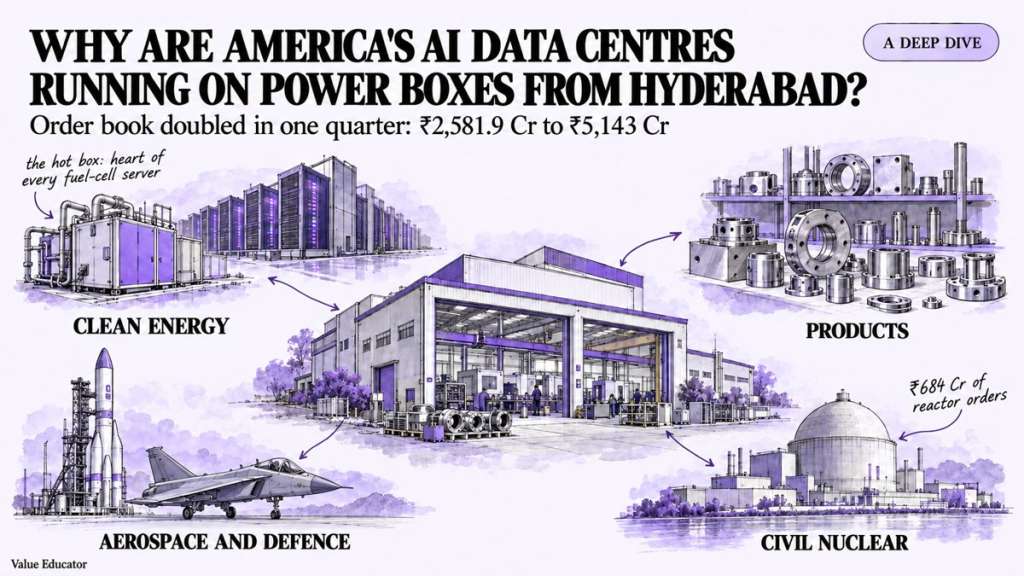
AI data centres in the US need huge amounts of electricity, and they need it quickly. Getting a new project connected to the US grid, however, can take several years. By the end of 2024, power projects waiting for a grid connection added up to 2,300 GW. For a data centre owner, every month without power means expensive chips sitting unused. So the industry now talks about time to power, which simply means how fast a new site can get electricity and start running.
One answer to this power problem comes from Bloom Energy, a US company. It makes fuel-cell power systems, called Energy Servers, that sit on the customer's own site and produce electricity from natural gas without burning it. Bloom earns money in three ways. It sells and installs the Energy Servers, it charges for servicing them over many years, and in some projects it sells the electricity itself. Because the systems come in modules, a data centre can start with a few and keep adding more as it grows, instead of waiting years for the grid.
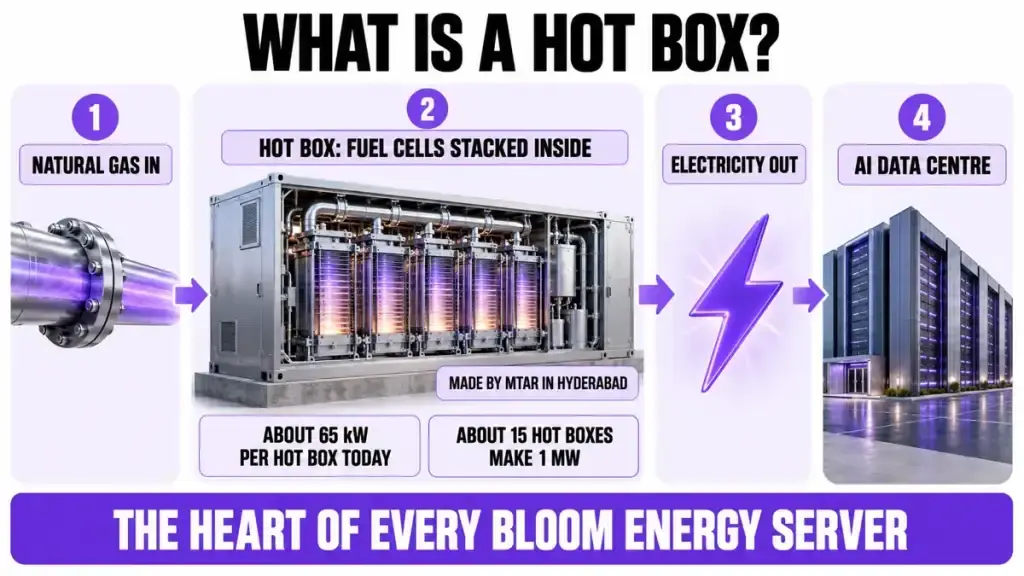
The heart of each Energy Server is the hot box. This is the sealed unit in which the fuel cells are stacked and where the power is actually produced, at very high temperatures. Bloom buys most of these hot boxes from MTAR Technologies (NSE/BSE: MTARTECH), a precision engineering company in Hyderabad. MTAR has made fuel-cell units and hot boxes for Bloom for 10-15 years, and its managing director says MTAR holds a majority share of Bloom's requirement.
MTAR in five numbers
- Q1 FY27 revenue of ₹360.7 Cr, up 130.4% from a year ago, with profit up 364.5%
- Order book of ₹5,143 Cr on 30 June 2026, about 5.9 times FY26 revenue
- One customer order of ₹3,100.09 Cr, about 3.5 times FY26 revenue
- Hot-box capacity rising from 8,000 to 20,000 units a year by the end of FY27
- A 60-70% share of orders for the Indian reactors it supplies
These numbers are new. Just two years ago, in FY24, MTAR's revenue was ₹580.8 Cr for the whole year. So what changed? This article tries to answer one question: is this a one-quarter spike, or the start of a new scale for a company that has spent five decades making parts that cannot fail? Let's first understand the company, and then look at the latest quarter.
MTAR Technologies: Company Overview
MTAR Technologies was established in Hyderabad in 1969 by three founders, P. Ravinder Reddy, K. Satyanarayana Reddy and P. Jayaprakash Reddy, to meet India's growing engineering needs after the technology embargoes of that time. Today it runs more than ten manufacturing units in Hyderabad, including an export-oriented unit, and it is moving its entire Bloom operation to a larger site in the SEZ near the city's airport. The company listed on the NSE and BSE in March 2021. Promoters held 29.35% of the shares in June 2026, and foreign institutions held 24.80%. MTAR earned ₹876.2 Cr of revenue in FY26 from four businesses: clean energy, products, aerospace and defence, and civil nuclear.
"Behind every stock is a company. Find out what it's doing."
— Peter Lynch
With MTAR, what the company does has changed more in the last two years than in the two decades before. A reactor and rocket supplier now earns most of its revenue from power boxes for US data centres, so the numbers need to be read with that shift in mind.
The Quarter That Changed MTAR's Scale
Let's look at Q1 FY27, the quarter that changed MTAR's scale. As you can see below, every main number more than doubled from a year ago.
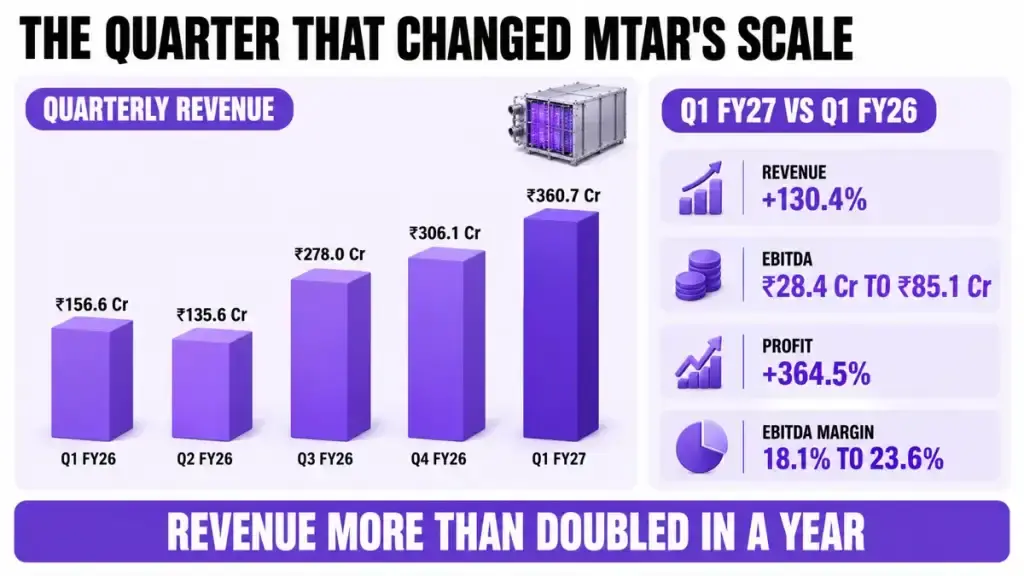
- Revenue: ₹360.7 Cr (+130.4%)
- EBITDA: ₹85.1 Cr (+199.7%)
- PAT: ₹50.2 Cr (+364.5%)
- EBITDA margin: 23.6% (+5.5 points over 18.1% a year ago)
Profit grew fastest among these numbers, and you can see why. That one quarter earned about 53% of FY26's full-year profit of ₹94 Cr. This is what we call operating leverage. A large part of MTAR's costs, such as salaries, factory overheads and depreciation, does not rise in step with sales. In Q1 FY27, revenue grew 130.4%, but employee costs and other expenses together rose only about 40%, from ₹56.5 Cr to ₹79.1 Cr. So most of the extra revenue flowed straight to EBITDA, which more than tripled from ₹28.4 Cr to ₹85.1 Cr. The EBITDA margin rose to 23.6% even though the product mix had a gross margin of 45.5%, compared with 54.2% a year earlier, because hot boxes are a volume business. That is why management guides for 80% revenue growth in FY27, with an EBITDA margin of 24%, plus or minus 100 basis points. Read this Operating Profit Margin vs Net Profit Margin: Which Tells the True Story?
This jump came after a year of steady gains. Quarterly revenue went from ₹156.6 Cr in Q1 FY26 to ₹278 Cr in Q3 FY26 and ₹306.1 Cr in Q4 FY26. Q1 FY27 then reached ₹360.7 Cr.
The order book grew even faster than revenue. MTAR booked ₹2,895.1 Cr of new orders in Q1 FY27, more than in all of FY26, and the book doubled from ₹2,581.9 Cr in March 2026 to ₹5,143 Cr in June 2026. So where did this jump come from? Two international orders in May 2026, the ₹2,278.96 Cr blanket orders and a ₹467.30 Cr order, made up about 95% of the quarter's inflow. That is why clean energy now makes up two-thirds of the order book. Management says most of these fuel-cell orders are short-cycle, executed within months rather than years, so they turn into revenue quickly. Then, on 30 July 2026, an existing customer enlarged an order it had placed on 14 May 2026. Its value went from USD 238.76 million to USD 324.62 million, about ₹3,100.09 Cr.

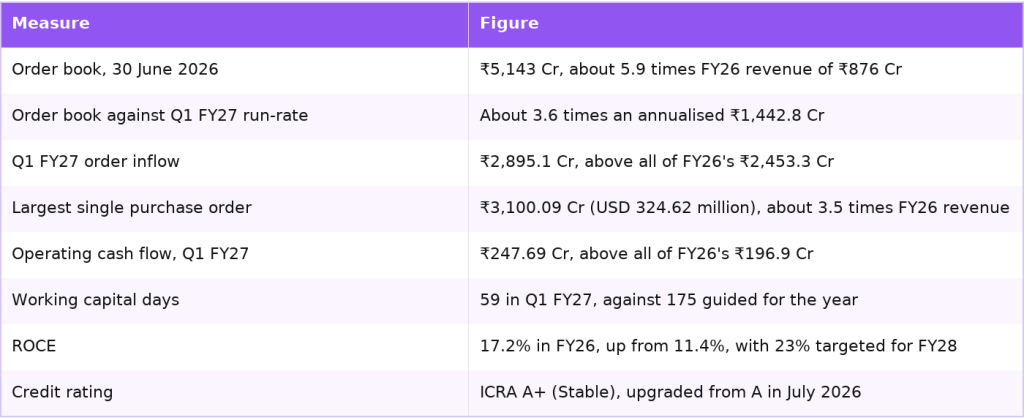
Cash has kept pace with profit. MTAR made ₹247.69 Cr of operating cash flow in Q1 FY27, more than in the whole of FY26, helped by better payment terms with several customers. ICRA raised the company's long-term rating to A+ in July 2026. Management expects return on capital to rise from 17.2% to about 23% by FY28 as the new capacity fills.
The orders behind the order book
You might ask where such a big order book came from. It did not appear in one go. MTAR filed ten order announcements between October 2025 and August 2026, plus two more that enlarged orders it had already received. When we read these filings together, we can see who is placing orders and how big the orders have become.
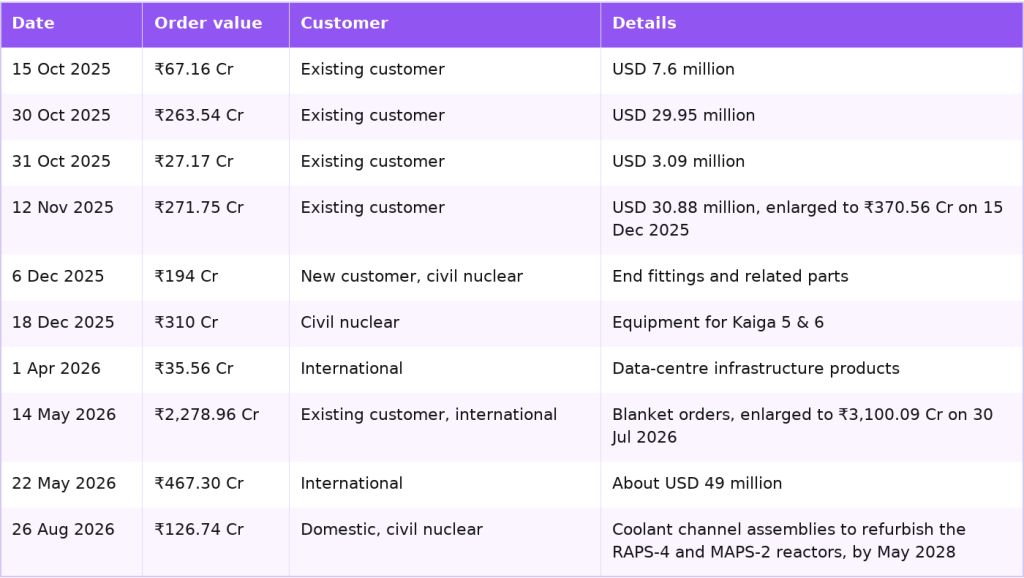
The list shows us how fast order sizes have grown. The four orders of October and November 2025 added up to ₹629.62 Cr. The single order of May 2026, after its July increase, is worth ₹3,100.09 Cr. That is about five times the four earlier orders put together.
Nuclear orders also arrived in the same months. The ₹194 Cr and ₹310 Cr orders of December 2025 together make up the ₹504 Cr Kaiga order. Most of these filings do not name the customer, because of confidentiality terms. They do show that the biggest orders come from existing customers who already know MTAR's work.
Four Businesses Under One Roof
So who is placing all these orders? To answer that, we need to look at the four businesses that MTAR runs under one roof. Each one sells precision parts to a different kind of customer, and the table below shows how they compare.

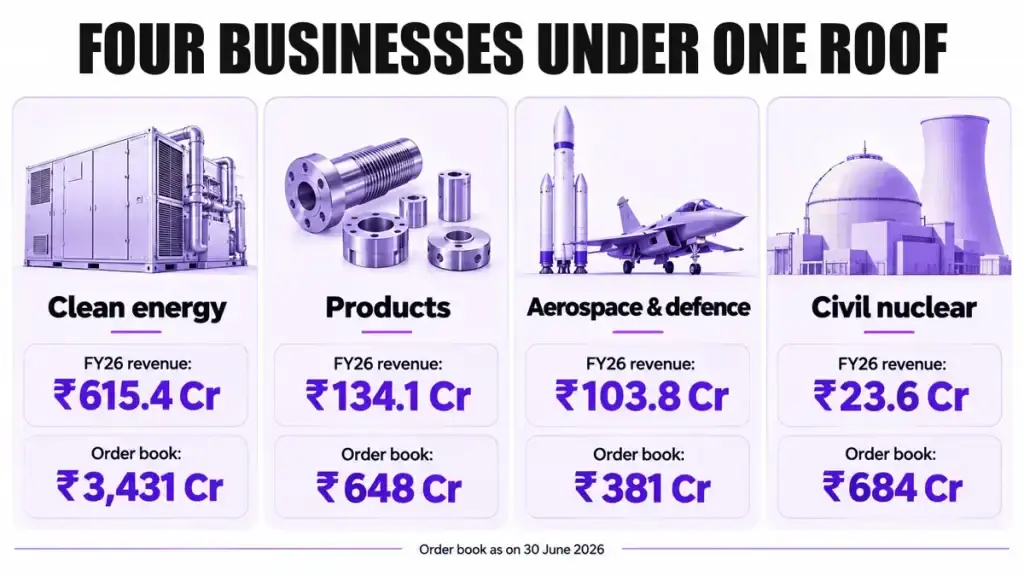
The products segment and the aerospace and defence segment can sound alike, but MTAR runs them in different ways. In aerospace and defence, the customer owns the design. ISRO, HAL or a global aircraft maker gives MTAR the drawings and specifications, and MTAR machines, assembles and tests the part to those exact requirements for one programme, such as a rocket engine or the Tejas fighter. In products, MTAR owns the design. It develops the part itself, usually one that India used to import, gets it qualified, and then sells the same product to many customers in many sectors.
Clean energy from fuel cells to data centres
Let's begin with the biggest of the four, clean energy, where fuel cells for Bloom make up most of the work. To understand why this business is growing so fast, we have to start with data centres, which are one of the biggest new users of power in the US. Worldwide, data centres used about 415 TWh of electricity in 2024, or 1.5% of all electricity. This is projected to reach about 945 TWh by 2030, and the US will add the most. Large power users, especially data centre operators, are now looking at making their own power on site, so that they can control their own timelines. On-site fuel cells suit this need well, because they come in modules and can be placed right next to the building that needs the power.
Bloom's recent deals show how quickly this idea has spread. In November 2024, the US utility American Electric Power (AEP) agreed to buy up to 1 GW of Bloom fuel cells for AI data centres, starting with 100 MW. Bloom called it the largest commercial purchase of fuel cells ever made. Oracle chose Bloom in October 2025 to power its AI data centres on site. Brookfield agreed to provide up to $5 billion over five years to fund Bloom projects. In South Korea, Bloom has installed nearly 682 MW with its partner SK ecoplant.
These deals now show up in Bloom's results. Its revenue grew 37.3% in 2025 to about $2,024 million, and its product revenue grew 41.1%, driven by the time to power needs of its customers. Bloom now plans to double its factory capacity from 1 GW to 2 GW by the end of 2026.
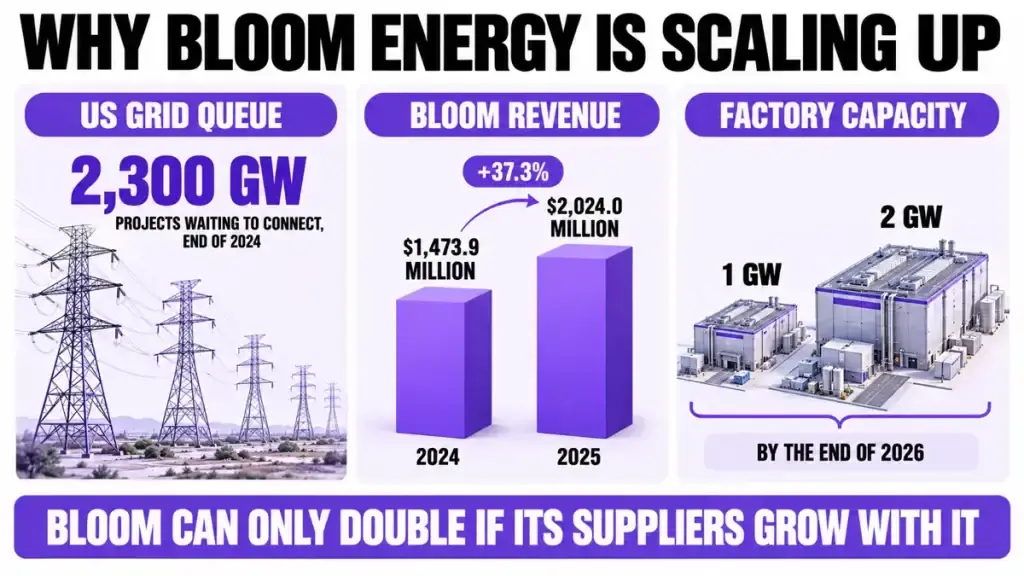
Why this matters for MTAR: Bloom can only double its factory if its suppliers grow with it. Bloom relies on a small number of suppliers, and on single suppliers for some parts. Its supply base covers North America, Asia, Europe and India. MTAR is the Indian supplier in that chain, and it has made these parts for 10-15 years.
MTAR has been part of this chain for a long time. Bloom came to MTAR around 2010-12, when MTAR began making fuel cell units and hot boxes for it, long before anyone talked about AI. This is how MTAR's business works. Winning a customer takes years of testing, but after that the same customer tends to keep buying for decades. The managing director has been direct about MTAR's position: "we hold a majority of the share" of the customer's needs.
"The big money is not in the buying and the selling, but in the waiting."
— Charlie Munger
MTAR waited more than a decade for its Bloom relationship to matter at this scale. The hot boxes it began making around 2010-12 became a large business only when AI data centres needed power quickly.
MTAR's numbers have already moved well past what it expected a year ago. In August 2025, management said it expected about ₹140-150 Cr a quarter from Bloom in FY27, or about ₹560-600 Cr a year. Clean energy earned ₹615.4 Cr in FY26, and in Q1 FY27 the segment, where Bloom is the main customer, earned ₹220.8 Cr in a single quarter. In May 2026, an existing international customer placed blanket orders of ₹2,278.96 Cr. In July it enlarged them to ₹3,100.09 Cr, which is about 3.5 times MTAR's whole FY26 revenue. The clean energy order book stood at ₹3,431 Cr on 30 June 2026.
This growth shows most clearly in hot-box volumes. MTAR used to ship about 3,500 hot boxes a year, and in late 2024 Bloom raised its forecast for calendar 2025 from 3,000 to 4,000 units. Since then, MTAR has been expanding capacity in clear steps: from 8,000 units a year to 12,000 by March 2026, then 16,000 by September 2026 and 20,000 by March 2027, the end of FY27. That is about 5.7 times its past shipments. After that, MTAR plans to reach 30,000 units in FY28, and it is building the infrastructure for that level now.
"It's going to be a massive multifold expansion plan, which is in place because of a very strong demand..."
That is how MTAR's managing director described Phase 3 of the expansion. Phase 2 is due by September-October 2026, and Phase 3 should be commissioned by March 2027.
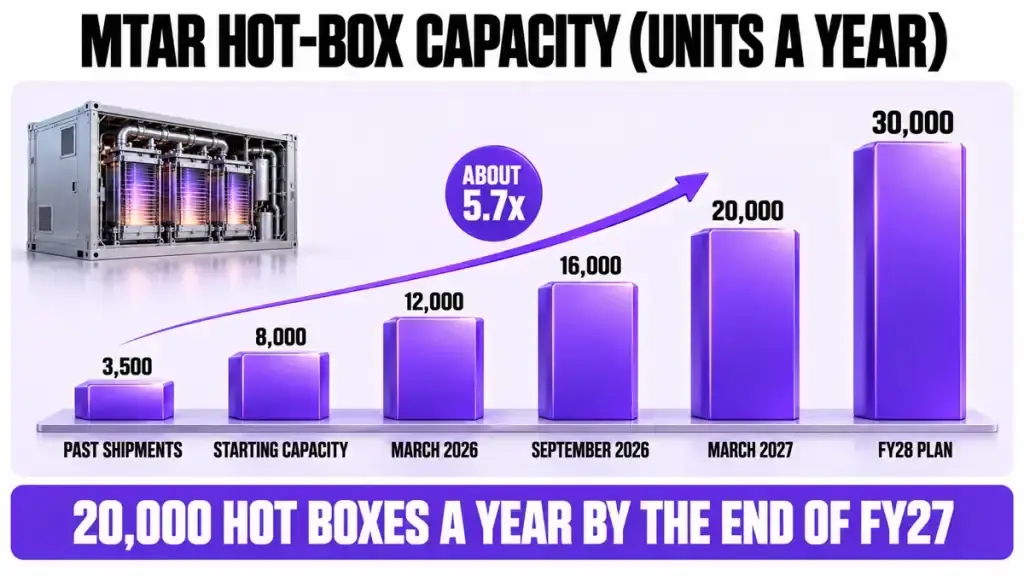
What the capacity path tells us: going from 8,000 to 20,000 hot boxes is a 2.5-fold increase in under two years, and the buildings are sized for nearly four times the old base. Management has also spoken of the hot box moving from a 55 kW to a 75 kW configuration, so each unit could carry more value as the count rises.
Each hot box today produces about 65 kW of electricity, and MTAR's managing director says better technology could take it to 75 kW over time. We can use this to picture the capacity numbers. About 15 hot boxes make 1 MW, so 20,000 hot boxes a year are enough for roughly 1.3 GW of Bloom systems, or about two-thirds of Bloom's planned 2 GW factory. MTAR also makes assemblies for Bloom's solid oxide electrolysers, which use the same technology in reverse to produce hydrogen.
Bloom is not the only clean energy customer, though. MTAR is using the same machining and assembly skills to win two large global customers.
One of them is Weatherford, a global oilfield services company based in Houston that supplies drilling and well equipment to oil and gas producers. MTAR makes whipstock assemblies for it. A whipstock is a steel wedge placed inside an oil well that turns the drill sideways, so that one well can reach oil in a new direction. MTAR delivered the first samples successfully and signed a ten-year contract in June 2025, worth about ₹90 Cr a year from FY27. Management says this one product could grow to $35-40 million of yearly revenue over time, once full volume production starts. To make these parts, MTAR is building a dedicated oil and gas plant that management expects to start operating in September-October 2026. The same building will also house Phase 2 of the fuel-cell expansion. Management says this plant could grow to ₹450-500 Cr of revenue in three to four years, as more oil and gas customers come on board.
Another customer is SLB, formerly known as Schlumberger, the world's largest oilfield services company, which also builds equipment for data centres. MTAR has received ₹45 Cr of orders from SLB for sheet-metal parts and assemblies used in data-centre infrastructure, all for export. Management says SLB needs up to eight such sets a year, and MTAR is setting up a dedicated facility to make them.
These data-centre orders are becoming a business of their own for MTAR. In April 2026, it received its first export order for data-centre infrastructure assemblies, worth ₹35.56 Cr. Management sees a potential of ₹400-500 Cr from this work over the next couple of years, and says about 70% of the value of these assemblies is MTAR's own work.
Civil nuclear, where MTAR already has most of the work
Now let's move to the business where MTAR began, civil nuclear. Here, the sector itself is about to change pace. India's nuclear capacity is about 8.8 GW today. Reaching 22.38 GW by 2031-32 means adding more than one and a half times today's capacity in about six years. A new law, the SHANTI Act of December 2025, also opens nuclear power to companies beyond NPCIL. NPCIL itself plans to build about 54 GW of the 100 GW target.
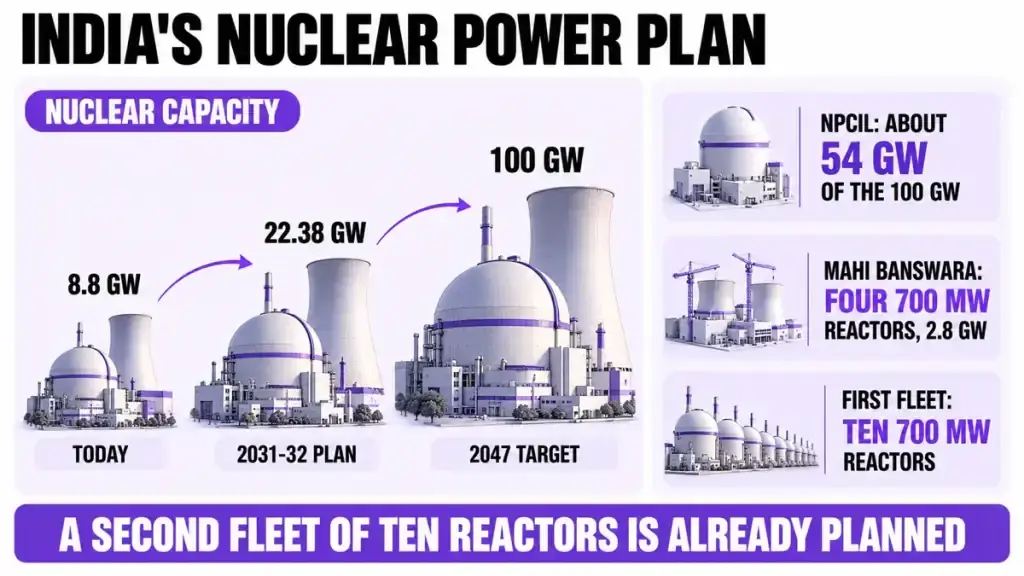
India has 8,780 MW of nuclear power capacity today, just about 1.7% of its total power capacity. The government plans to reach 22.38 GW by 2031-32. The first fleet of ten 700 MW reactors, at Kaiga, Gorakhpur, Chutka and Mahi Banswara, carries large manufacturing orders for Indian industry, and a second fleet of ten reactors has already been planned.
India has set a target of 100 GWe of nuclear capacity by 2047. The next big project after Kaiga is Mahi Banswara, where NTPC is partnering with NPCIL to build four 700 MW reactors. The main nuclear island tender, worth over ₹28,000 Cr, was floated in July 2026. The project is being developed by ASHVINI, a joint venture in which NPCIL holds 51% and NTPC 49%, and it adds 2.8 GW of capacity, twice the 1,400 MW of the two Kaiga units that MTAR is now supplying. MTAR's position going into those tenders is unusually strong.
MTAR's nuclear work started in the 1970s with coolant channel assemblies for India's reactors. Today it makes the reactor's fuelling machine heads, their drive mechanisms, coolant channel assemblies and end fittings. MTAR made complex core assemblies for Kakrapar, India's first 700 MW reactor, which started in July 2020. It also supplied a majority of the critical assemblies for the reactor core for the Prototype Fast Breeder Reactor at Kalpakkam, which recently reached criticality, a key step for the second stage of India's nuclear plan. Its customers include NPCIL, IGCAR and BHAVINI.
MTAR's range of nuclear parts is also getting wider. After building a new fabrication facility, MTAR qualified to make larger reactor parts such as the end shield and the calandria, the vessel that holds a reactor's fuel channels. It has already bid in tenders for several of these new parts.
If we look at the orders, these parts now fill a large order book. Civil nuclear is the smallest segment by revenue, at ₹23.6 Cr in FY26, but it has the second-largest order book, at ₹684 Cr. That book includes its single largest nuclear order, ₹504 Cr for the Kaiga 5 & 6 reactors, which came as two orders of ₹194 Cr and ₹310 Cr in December 2025. MTAR expects to execute it from the second half of FY27. MTAR also expects about ₹150 Cr of orders in FY27 to refurbish older reactors. The current ₹684 Cr nuclear book will run over three to three and a half years. That means about ₹195-228 Cr of nuclear revenue a year, several times the FY26 level, before any Mahi Banswara orders.
Aerospace and defence, from rockets to fighter jets
Next, let's look at aerospace and defence, which takes MTAR from rocket engines to fighter jets. This business is now moving into volume production. Revenue grew from ₹64.5 Cr in FY23 to ₹103.8 Cr in FY26. The segment then earned ₹36.4 Cr in Q1 FY27 alone, about a third of last year's total in one quarter. The order book stood at about ₹381 Cr on 30 June 2026. Management expects revenue to double in FY27 and to reach ₹600-700 Cr in three to four years. Its customers include ISRO, DRDO, HAL, ADA, Thales, GKN, IAI, Rafael and Elbit.
The space work started with the Vikas engine. Vikas is the liquid-fuel rocket engine that powers the second stage of ISRO's PSLV and the boosters and second stage of the GSLV. Two Vikas engines also power the core stage of LVM3, the rocket chosen for India's human spaceflight mission, Gaganyaan. MTAR rolled out the first Vikas engine in 1989. It still supplies Vikas engines, cryogenic upper-stage assemblies and electro-pneumatic modules for ISRO's launch vehicles. Over three decades it has also built engine systems, actuators and structures for Chandrayaan-II, Mangalyaan and Agni.
MTAR's space work now reaches Europe. Thales Alenia Space is one of Europe's leading satellite makers, a joint venture of France's Thales and Italy's Leonardo. It builds communication satellites, Galileo satellites for Europe and modules for space stations. MTAR has completed the design and development of a load-bearing structure, the Z adapter, for Thales Alenia Space. First samples are under way, and volume production will follow under a long-term agreement.
Now let's turn to defence, the other half of the segment. The Indian Air Force has ordered 180 Tejas Mk1A fighters, 83 in 2021 and 97 more in September 2025 for over ₹62,370 Cr. MTAR is qualified to supply the Tejas actuators, a programme that management values at about ₹140-150 Cr. India's defence production reached a record ₹1.78 lakh Cr in FY26, up 15.6% from the year before. Read this Defence Electronics Stocks Leading India's Indigenization Push (2026 Picks)
The next big defence programme is AMCA, India's own fifth-generation stealth fighter. In May 2026, the Ministry of Defence asked three shortlisted teams, led by Tata Advanced Systems, L&T and Bharat Forge, for proposals. The winner will build five flying prototypes and one structural test aircraft with the Aeronautical Development Agency. MTAR has already won its first AMCA structural order, worth ₹4 Cr, for the main landing gear support structure test box. It was also the lowest bidder for the fuselage door assembly. MTAR is one of only 8 qualified vendors for AMCA's structural assemblies.
"With qualified products moving towards higher volumes, increasing demand from existing customers, and multi-year visibility across key programs, we believe aerospace and defense is well-positioned to emerge as a significant growth driver for the company."
Global aircraft makers are the fastest-moving part of the segment. Over the last two years, MTAR has worked through first samples with each of them, a cycle that took one and a half to two years per customer. These orders run under contracts of five to ten years, and customers release them quarter by quarter, so the order book shows only part of each programme's value. Next, first samples for Israel Aerospace Industries (IAI) are due by September 2026, with volume production planned from October.
Products that replace imports
Now let's discuss the fourth business, the products segment, where MTAR sells parts of its own design. A few examples make this easy to picture. Ball screws and roller screws turn a motor's spin into precise straight-line movement, and they go into actuators used in clean energy, space and defence. Electro-mechanical actuators are complete motion units that MTAR has now started supplying. Some products go into Bloom's fuel-cell systems as well. ASP assemblies, for example, are parts used inside the hot boxes, and MTAR is raising its capacity for them from about 80,000 to 1,25,000 units a quarter.
These products are also export products. India's defence exports reached a record ₹38,424 Cr in FY26, up 62.66% in a year, and MTAR has qualified to export ball screws to a global aerospace customer, where management expects a major contract.
"We've got a major demand in this product division, and it's going to continue to grow more than what it has grown in Q1."
These products have grown quickly. Revenue grew from ₹23.7 Cr in FY23 to ₹134.1 Cr in FY26, and in Q1 FY27 the segment earned ₹100.4 Cr in a single quarter. The managing director said this came from strong demand across the range, including ball screws with many export orders and products for fuel cells. Management expects products revenue to cross ₹200 Cr this year, with the second half stronger than the first.
The products order book stood at about ₹648 Cr on 30 June 2026. Management has set clear targets for both businesses: ₹600-700 Cr of aerospace and defence revenue and more than ₹1,000 Cr of products revenue within three to four years.
Against FY26 revenue of ₹103.8 Cr in aerospace and defence and ₹134.1 Cr in products, these targets imply a rise of about 6-7 times in aerospace and roughly 7.5 times in products over three to four years. The Q1 FY27 products revenue of ₹100.4 Cr in a single quarter shows how quickly that segment can move once a qualified product reaches volume.
The Parts Nobody Else Is Allowed to Make
Now that we have seen all four businesses, let's understand MTAR's moat, the thing that ties them together. MTAR makes parts that nobody else is allowed to make without years of testing, so its biggest strength is the approvals it holds. In nuclear power, space, aerospace and fuel cells, a customer buys a critical part only from a supplier it has tested and approved, and getting that approval takes years. A reactor's fuelling machine head, a part for a rocket engine and a hot box for a fuel-cell system all go through this process.
The process usually runs in the same way. A customer gives MTAR a drawing, MTAR builds first articles, the customer tests them against its own standards, and only then does a programme move into batch and volume production. In aerospace, that cycle has taken MTAR one and a half to two years with each global customer, and management says most of those first articles have now moved into volume production. Once a part is approved, changing the supplier means repeating the whole cycle, retesting the part and, in nuclear and aerospace, repeating regulatory approvals. That is why customers rarely switch. The aerospace contracts make the point well: MTAR's MNC aerospace orders run under long-term contracts of five to ten years, with releases flowing every quarter once a part is approved.


These four businesses also feed each other. The same machining, welding, brazing and assembly skills serve nuclear, space, fuel cells and aerospace. So a skill built for one customer can be offered to the next. The ₹45 Cr SLB order and the Weatherford contract both came from customers who first saw MTAR's quality on other programmes. Each approval makes the next one easier to win.
"In business, I look for economic castles protected by unbreachable moats."
— Warren Buffett
MTAR's moat is not a brand or a patent. It is the long list of approvals that took decades to earn, and that a new supplier would have to earn again, part by part.
Financials: Five Years of Growth, Margins and Cash
One strong quarter can flatter any company, so let's look at five full years together.
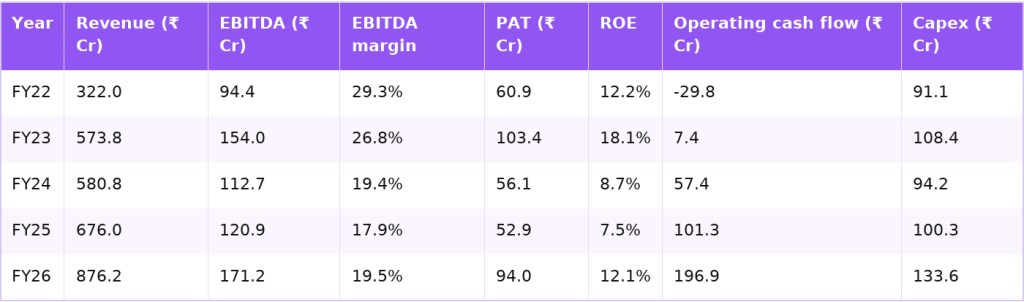
Revenue grew about 2.7 times in four years, from ₹322.0 Cr in FY22 to ₹876.2 Cr in FY26, but the path was not smooth. FY23 was the peak for margins, with an EBITDA margin of 26.8% and PAT of ₹103.4 Cr. In FY24 and FY25, revenue grew slowly while employee costs rose from ₹93.5 Cr to ₹123.8 Cr as MTAR hired ahead of new capacity. The EBITDA margin fell to 17.9% and PAT halved to ₹52.9 Cr. These were the difficult years, and they show how much MTAR's results depend on its main customer's ordering pattern.
Cash flow tells a similar story with a delay. In FY22 and FY23, MTAR reported ₹164.3 Cr of profit, but its operating cash flow over the two years was negative ₹22.4 Cr, because inventory and receivables grew with the business. Since then, cash has caught up. In FY26, operating cash flow of ₹196.9 Cr was about 2.1 times PAT of ₹94.0 Cr. Over all five years, operating cash flow of ₹333.2 Cr came to about 91% of the ₹367.3 Cr of reported profit. Read this Cash Flow Statement Explained: The Most Honest Financial Report
Growth has needed a lot of capital. MTAR spent ₹527.6 Cr on capex over these five years, more than all the cash its operations produced, so borrowings rose from ₹95.9 Cr in FY22 to ₹369.2 Cr in FY26. Against equity of ₹822.6 Cr, that is a debt-to-equity ratio of about 0.45. Free cash flow turned positive only in FY25, at ₹0.9 Cr, and reached ₹63.3 Cr in FY26. ROE recovered to 12.1% in FY26 from 7.5% a year earlier, and it still has room to rise if the new capacity fills. Read this Capital-Intensive Businesses Explained: Risks, Economics, and Investor Insights
"The stock market is filled with individuals who know the price of everything, but the value of nothing."
— Philip Fisher
For MTAR, the value question sits in these five years of numbers: whether margins hold near the guided 24% as volumes rise, and whether cash flow keeps pace with profit while capex continues.
What FY27 Could Look Like on Management's Numbers
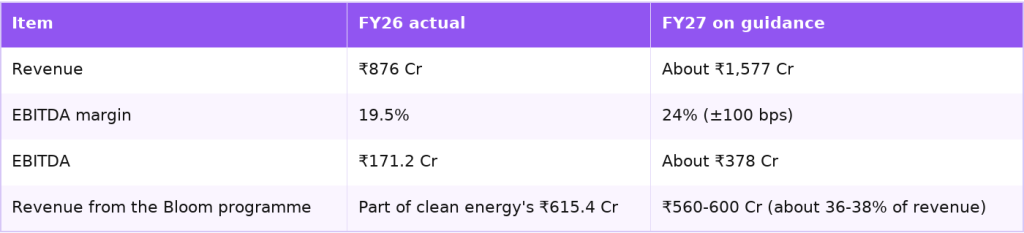
So what could all of this add up to in the current year? Putting management's own guidance together gives a useful sense of scale. If revenue grows about 80% to roughly ₹1,577 Cr and the EBITDA margin lands at the guided 24%, EBITDA would be about ₹378 Cr, around 2.2 times the ₹171.2 Cr of FY26. The Bloom programme alone, at ₹560-600 Cr a year, would make up roughly 36-38% of that revenue, with the rest coming from nuclear execution, aerospace, products and the new oil and gas and data-centre lines.
The Plan for FY27 and FY28
Here is the plan management has laid out for FY27 and FY28, in one place, so that we can check it as the quarters come in.

Key Risks
No business grows in a straight line, so let's look at what could go wrong for MTAR.
- Dependence on one customer: the largest customer was about 72.3% of FY26 revenue, and clean energy makes up 66.7% of the order book. The cost of this showed in FY24. Clean energy revenue fell from ₹441.7 Cr to ₹351.2 Cr, and profit fell about 45.7%, from ₹103.4 Cr to ₹56.1 Cr, before it recovered.
- A second hot-box supplier: MTAR is not Bloom's only hot-box supplier. In 2021, MTAR's managing director said Bloom bought from a supplier in Taiwan while MTAR's plant was shut in the 2020 lockdown. If Bloom moves more volume to that supplier, or adds new ones, MTAR's share could shrink.
- The customer's own execution: Bloom itself warns that doubling capacity to 2 GW could face delays, cost overruns and labour shortages. Any delay there would push MTAR's fuel-cell revenue into later years.
- Delivery record: of seven targets we tracked for FY25 and FY26, MTAR met three and missed four. The misses include the FY26 EBITDA margin of 19.5% against 21% guided, and the FY26 order book of about ₹2,582 Cr against about ₹2,800 Cr guided.
- Capex and debt: MTAR plans about ₹500 Cr of capex across FY27 and FY28, funded by internal cash and borrowings. Debt stood at ₹423.6 Cr in June 2026.
- Staff turnover: the share of permanent employees who left during the year rose to 22.91% in FY26, from 5.60% in FY24. It matters because new capacity needs trained machinists and inspectors. Management says it trains staff ahead of each expansion and is adding automation to need fewer people.
- Promoters selling shares: promoter holding fell from 46.63% in March 2023 to 37.26% in March 2024, 31.77% in March 2025 and 29.35% in June 2026, as promoters sold some of their shares. Foreign institutions raised their holding from 17.31% to 24.80% in the June 2026 quarter.
- Nuclear timing: nuclear revenue was ₹3.2 Cr in Q1 FY27 against a ₹684 Cr book. So the segment's contribution depends on execution from the second half of FY27 and on when the Mahi Banswara orders are placed.
"You can't predict. You can prepare."
— Howard Marks
None of these risks can be timed in advance. What an investor can do is watch the few numbers below that will show early whether the plan is slipping.
Explore our Products
Research Framework

Emerging Titans
Combination of quantitative analysis, industry tailwinds, and management assessment - SPRINT investment philosophy

Tiny Titans
Heavy emphasis on scuttlebutt research, plant visits, and early on-ground signals
What to Track Next
If you follow MTAR, these are the signals that will show whether the plan is on track. Read this A Fundamental Checklist: How to Research a Stock in 1 Hour
- FY27 revenue against the 80% growth guidance, which implies about ₹1,577 Cr
- Hot-box capacity reaching 16,000 by September 2026 and 20,000 by the end of FY27
- Bloom's progress towards 2 GW of factory capacity by the end of 2026
- Mahi Banswara orders after the nuclear island tender, and MTAR's share of the four reactors
- Volume production for IAI from October 2026, and the oil and gas plant starting in September-October 2026
- Aerospace and defence revenue doubling from ₹103.8 Cr, AMCA structural orders, and products crossing ₹200 Cr
- Working capital days staying below 100
Conclusion
Let's step back and put it all together. For five decades, MTAR has learned to make parts that cannot fail. It started with India's reactors and rockets. Then it began supplying a US fuel-cell company whose power servers now feed AI data centres for utilities, Oracle and Brookfield-funded projects. In one quarter, MTAR's order book doubled and its cash flow caught up with profit. Its capacity plan points to two and a half times as many hot boxes within two years.
The next few years matter because the fuel-cell boom is arriving just as MTAR's other businesses grow up. Kaiga is moving into execution. Mahi Banswara comes next, and MTAR already has a 60-70% share of reactor orders. Aerospace and products have targets of ₹600-700 Cr and more than ₹1,000 Cr. The cautious thread is concentration: one customer was 72.3% of FY26 revenue, and MTAR met only three of seven targets we tracked for FY25 and FY26. If MTAR builds its factories on time, approvals that took decades to earn will start to pay off in four markets together. The next few quarters, starting with hot-box capacity of 16,000 units and the first Mahi Banswara orders, will show which thread wins.
FAQs
What does MTAR Technologies do?
+MTAR Technologies is a Hyderabad precision engineering company established in 1969. It makes critical parts in four businesses: clean energy (mainly fuel-cell hot boxes for Bloom Energy), its own import-substitute products, aerospace and defence, and civil nuclear. It earned ₹876.2 Cr of revenue in FY26, with clean energy at 70%.
Why is Bloom Energy so important for MTAR?
+Bloom buys most of its fuel-cell hot boxes from MTAR, and MTAR has supplied it for 10-15 years. Bloom's systems give AI data centres power on site without waiting years for a grid connection, and Bloom plans to double its factory capacity from 1 GW to 2 GW by the end of 2026. MTAR's largest customer was about 72.3% of FY26 revenue.
How big is MTAR's order book?
+The order book was ₹5,143 Cr on 30 June 2026, about 5.9 times FY26 revenue. It doubled from ₹2,581.9 Cr in March 2026 after ₹2,895.1 Cr of new orders in Q1 FY27. Clean energy makes up about two-thirds of the book, and most fuel-cell orders are executed within months.
What has MTAR guided for FY27?
+Management guides for about 80% revenue growth in FY27, which implies roughly ₹1,577 Cr, with an EBITDA margin of 24%, plus or minus 100 basis points. It also plans hot-box capacity of 20,000 units a year by March 2027 and working capital below 100 days.
What role does MTAR play in India's nuclear power plan?
+MTAR has supplied India's reactors since the 1970s and holds a 60-70% share of orders for the reactors it supplies. Its nuclear order book was ₹684 Cr in June 2026, including ₹504 Cr for Kaiga 5 & 6. The next large project is the four-reactor Mahi Banswara plant, whose nuclear island tender of over ₹28,000 Cr was floated in July 2026.
What are the main risks for MTAR investors?
+The biggest risk is dependence on one customer, which was 72.3% of FY26 revenue; profit fell about 45.7% in FY24 when that customer slowed orders. Other risks are a second hot-box supplier, delays in Bloom's own expansion, a mixed record on guidance (three of seven targets met), about ₹500 Cr of capex across FY27-FY28, and falling promoter holding.

High growth stock specialist, Value Educator
Shashank Mahajan is an equity research professional with over 12 years of experience in identifying high-potential SME and micro-cap stocks at an early stage. He follows a rigorous scuttlebutt research–driven approach, combining on-ground insights with deep financial analysis. Shashank specializes in uncovering under-researched and under-owned companies with strong management quality and long-term growth potential. Through disciplined research and early identification, he focuses on spotting tomorrow’s market leaders before they enter the mainstream investor radar.

Zen Technologies: Why Revenue Fell After Its Biggest Win

Data Patterns: India's Radar Designer and Its Waiting Orders
KSH International: The Wire Inside India's Transformers

Krishna Defence: The Steel Behind India's Warship Hulls

PNG Jewellers: A 194-Year-Old Name Goes National
Axiscades: From Services to Missile and Radar Electronics
Explore our Products
Research Framework
Emerging Titans
Combination of quantitative analysis, industry tailwinds, and management assessment - SPRINT investment philosophy
Tiny Titans
Heavy emphasis on scuttlebutt research, plant visits, and early on-ground signals


 Orders
 Subscription
 Share with friends
 Logout


Required Details
₹23999.00
(12 month subscription)
As per SEBI regulations, all users are mandated to complete the KYC that is validated for 1 year. Post payment, you will be redirected to the KYC screen


No comments yet. Be the first to comment!