
Netweb vs Black Box vs Rashi: Data-Centre Hardware Compared
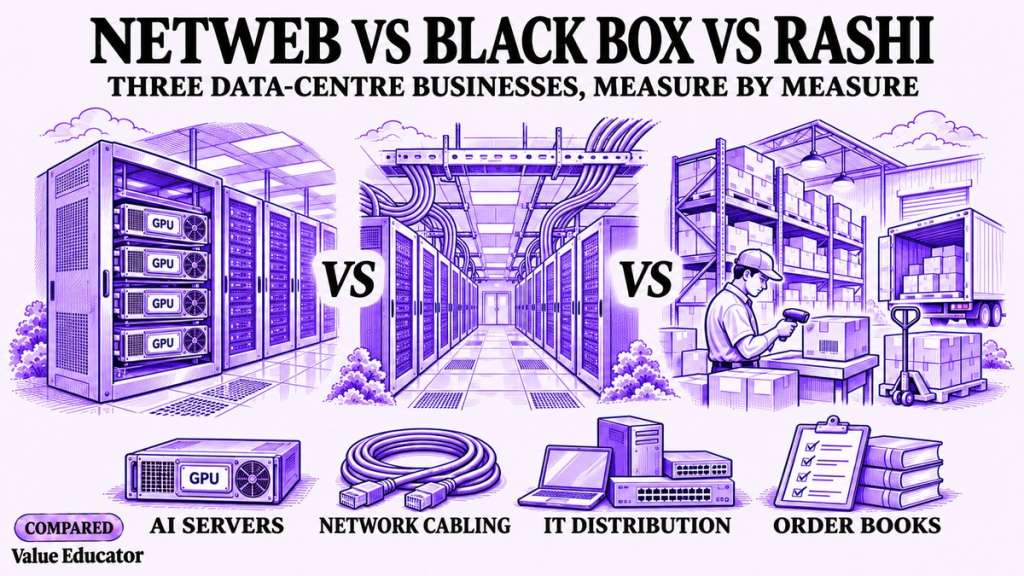
Netweb Technologies, Black Box and Rashi Peripherals often turn up on the same list of small and mid cap data-centre stocks in India. All three earn money when data centres fill up with AI servers, storage and networks, and all three reported a strong quarter to 30 September 2026. Netweb reported on 24 October, Rashi Peripherals on 5 November and Black Box on 13 November 2026.
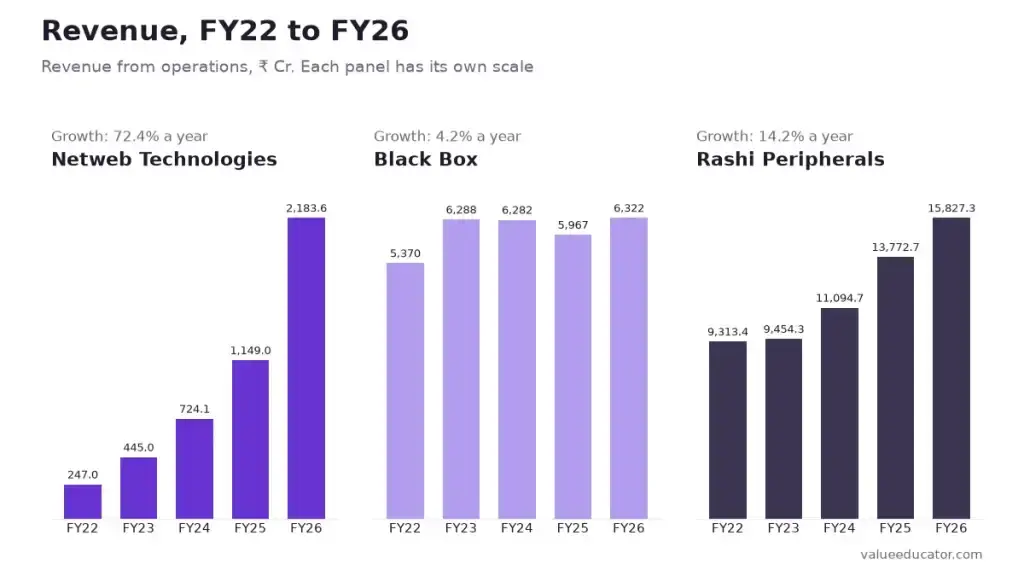
But they do three different jobs in that data centre. Netweb designs and builds the servers and supercomputers that go into the hall. Black Box lays the fibre and builds the network that connects those servers, mostly in US data centres. Rashi Peripherals is a distributor: it buys laptops, servers and parts from global brands and sells them across India. So a 3% margin means something very different at a distributor than at a server maker. This page sets the three side by side on business, latest quarter, five-year numbers, orders, debt, cash flow and risks, with the same period for each company in every row, and explains what each figure means for each business.
Figures as of 21 November 2026. This page is research, not a recommendation to buy or sell any stock.
Netweb vs Black Box vs Rashi Peripherals at a Glance
| Measure | Netweb Technologies | Black Box | Rashi Peripherals |
|---|---|---|---|
| Business | Designs and builds AI servers, supercomputers and private cloud systems under its Tyrone brand | Builds and runs networks: data-centre fibre cabling, enterprise networks and managed services | Distributes IT products from 89 global brands across India |
| Place in the data centre | The computers inside the hall | The cabling and network that connect the hall | Sources, finances and delivers other brands' servers and parts |
| Footprint | 3 facilities and 22 offices, Faridabad | 35 countries, about 4,000 employees; 66% of H1 FY27 revenue from North America | 57 branches and 72 warehouses |
| Revenue, FY26 | ₹2,183.6 Cr | ₹6,322 Cr | ₹15,827.3 Cr |
| EBITDA margin, FY26 | 13.0% (operating) | 9.0% | 2.90% |
| Profit after tax, FY26 | ₹205.8 Cr | ₹218 Cr | ₹282.3 Cr |
| ROCE / ROE, FY26 (as each company reports it) | 37.5% / 32.9% | 21.3% / 23.8% | 16.02% / 14.74% |
| Net debt (+) or net cash, 30 Sep 2026 | Net cash about ₹13.6 Cr | Net debt about ₹601 Cr | Net debt about ₹1,830.9 Cr (0.76x equity) |
| Order book, 30 Sep 2026 | ₹2,629 Cr, plus ₹652.5 Cr of L1 positions | US$1,044 million, about ₹9,975 Cr | No order book reported (sells from stock) |
| Revenue growth, Q2 FY27 | 335.7% | 22% | 48.8% |
| Data-centre link | AI systems were 58.4% of Q2 FY27 revenue | Data centres were 20% of Q2 FY27 revenue | One AI data-centre deal was about 12% of FY25 revenue; no large project since |
| Customers | IndiaAI Mission, C-DAC, ISRO, Yotta, Akamai; 75.6% of FY26 revenue from repeat customers | Four of the top six hyperscalers, 120 Fortune 500 clients; Bank of America is the largest | 10,289 channel partners and business customers |
| Key risk | Lumpy large orders and a heavy inventory build | Turning a large backlog into revenue on time | Thin margin, high working capital and rising debt |
The table shows three different shapes. Rashi Peripherals is by far the largest by revenue, but it keeps the least of each rupee. Netweb is the smallest by revenue, but it has the highest margin, the highest returns, net cash and the fastest growth. Black Box sits in between on margin, has the largest order book and the longest visibility, and is the most exposed to US hyperscalers.
Business Models: Server Maker, Network Integrator and Distributor
A data centre needs land, power, cooling and racks before a single server goes in. Then come the computers, the network that links them and the software that runs them. These three companies all work inside that hall, but at different points, and that decides their margins, their working capital and their risks.
Netweb Technologies: designs and builds the computers
Netweb designs, builds and installs high-end computers from Faridabad, near Delhi, mostly under its own Tyrone brand. It has three main lines. AI systems are servers packed with GPUs, the chips from NVIDIA and AMD that run AI models; they brought in ₹773.1 Cr, or 58.4%, of Q2 FY27 revenue. Supercomputing brought in ₹248.2 Cr and private cloud ₹244.8 Cr.
Netweb is an OEM, an original equipment maker. It buys the chips and designs the boards, cooling and software around them, so it keeps a larger share of each sale than a reseller. It has installed more than 600 supercomputing systems and more than 10,000 GPU-based AI systems. Its buyers include the IndiaAI Mission, research labs such as C-DAC and ISRO, and data-centre operators such as Yotta. Read the full story in our Netweb Technologies article.
Black Box: wires and runs the network
Black Box, formerly AGC Networks, bought the US firm Black Box Corporation in January 2019. Inside a data centre, it works in the white space, the hall where the server racks stand. It lays the fibre and copper cabling, called structured cabling, that links every rack to every other rack, and then runs and supports the network for the customer. Management says the fibre job inside a 100-megawatt building was about US$8 million for a cloud data centre and is now about US$60 million for an AI data centre.
Data centres were 20% of Q2 FY27 revenue, or about ₹387 Cr, against 17% in FY26. The rest comes from enterprise networks, workplace technology and cybersecurity for banks, retailers and hospitals, mostly in North America. Its customers include four of the top six hyperscalers, the very large cloud companies that build their own data centres. See our Black Box article for more detail.
Rashi Peripherals: moves the boxes from brands to buyers
Rashi Peripherals, known as RP Tech, was incorporated in 1989 and listed in February 2024. It does not make what it sells. It buys laptops, components, servers and accessories from 89 global brands, including Dell, NVIDIA, Lenovo and Supermicro, holds them in its warehouses and sells them on credit to 10,289 channel partners and business customers.
Its data-centre link is real but occasional. In FY24 it won its largest single order, ₹1,510 Cr from NMDC Data Center, known as Yotta, for AI servers that it delivered in FY25. That one deal was about 12% of FY25 revenue. Since then it has taken only small data-centre orders and has chosen not to chase large ones, because they need heavy capital for a low margin. More detail is in our Rashi Peripherals article.
Latest Quarter: Q2 FY27 Side by Side
All three reported the quarter to 30 September 2026. The table uses each company's consolidated figures. Netweb reports operating EBITDA, which leaves out other income.
| Q2 FY27 (quarter to 30 Sep 2026) | Netweb Technologies | Black Box | Rashi Peripherals |
|---|---|---|---|
| Revenue | ₹1,323.3 Cr | ₹1,936 Cr | ₹6,185.1 Cr |
| Revenue a year earlier | ₹303.7 Cr | ₹1,585 Cr | ₹4,155.4 Cr |
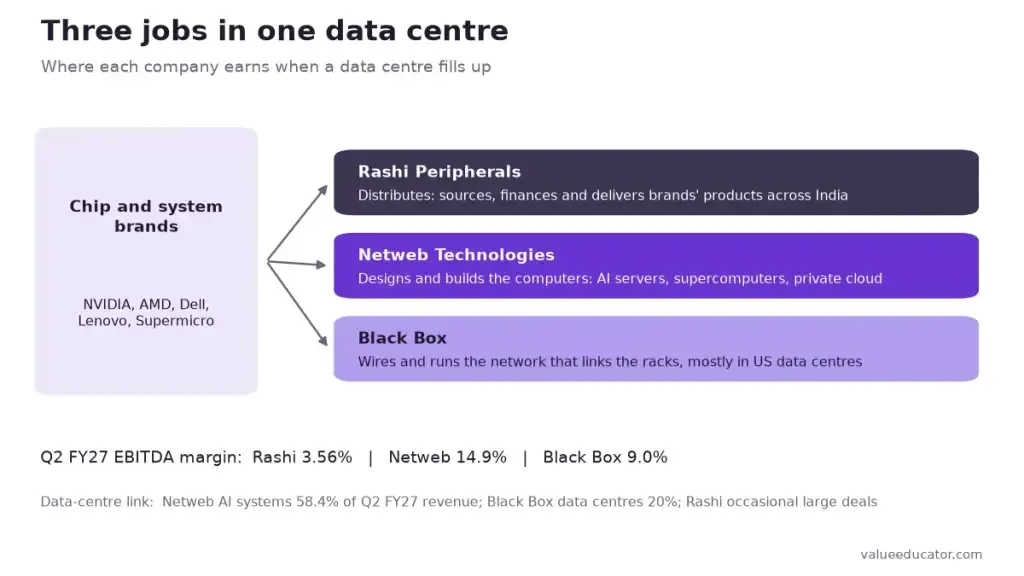
| Revenue growth | 335.7% | 22% | 48.8% |
| EBITDA | ₹197.3 Cr | ₹175 Cr | ₹220.1 Cr |
| EBITDA margin | 14.9% | 9.0% | 3.56% |
| EBITDA margin a year earlier | 15.0% | 9.0% | 2.50% |
| Finance cost | ₹23.8 Cr | ₹50 Cr | ₹48.0 Cr |
| Profit after tax | ₹136.7 Cr | ₹73 Cr | ₹130.7 Cr |
| Profit growth | 334.8% | 31% | 120.8% |
| PAT margin | 10.2% | 3.8% | 2.11% |
| H1 FY27 revenue | ₹2,143.0 Cr | ₹3,655 Cr | ₹11,287.0 Cr |
| H1 FY27 profit after tax | ₹222.0 Cr | ₹129 Cr | ₹235.3 Cr |
Netweb had the biggest jump, because large AI orders are now shipping. Revenue more than quadrupled from a year earlier, and AI systems alone brought in ₹773.1 Cr. The margin held at 14.9%, a little above management's 13% to 14% range for the year. One cost grew much faster than the business: finance cost was ₹23.8 Cr against ₹0.9 Cr a year ago, as the company borrowed to buy chips for orders.
Rashi Peripherals grew 48.8%, but management says about 30% of the growth came from higher prices and 10% to 11% from more units, as memory and GPU prices rose. The EBITDA margin rose to 3.56% from 2.50%, and profit more than doubled. Finance cost almost doubled to ₹48.0 Cr, because the company built up stock ahead of the festive season and enterprise orders.
Black Box posted its highest quarterly revenue so far, up 22% to ₹1,936 Cr, with a steady 9.0% EBITDA margin. Part of the growth came from 2S, a Brazilian company it bought from 1 May 2026, which added ₹177 Cr of revenue in H1 FY27. Without it, H1 revenue grew about 17%.
What do these margins mean? On every ₹100 of sales in the quarter, Netweb kept about ₹10.2 as profit after tax, Black Box about ₹3.8 and Rashi about ₹2.11. That is why Rashi's quarterly revenue was 4.7 times Netweb's, yet its profit was a little lower. A distributor earns a thin margin many times over by turning its stock quickly, so its margin should be judged against its working capital, not against a manufacturer's margin. To see why EBITDA alone can mislead across such different businesses, read EBITDA Explained: Uses and Limits.
Five-Year Financials, FY22 to FY26
All figures are consolidated, in ₹ Cr, for years to 31 March.
| Revenue (₹ Cr) | Netweb Technologies | Black Box | Rashi Peripherals |
|---|---|---|---|
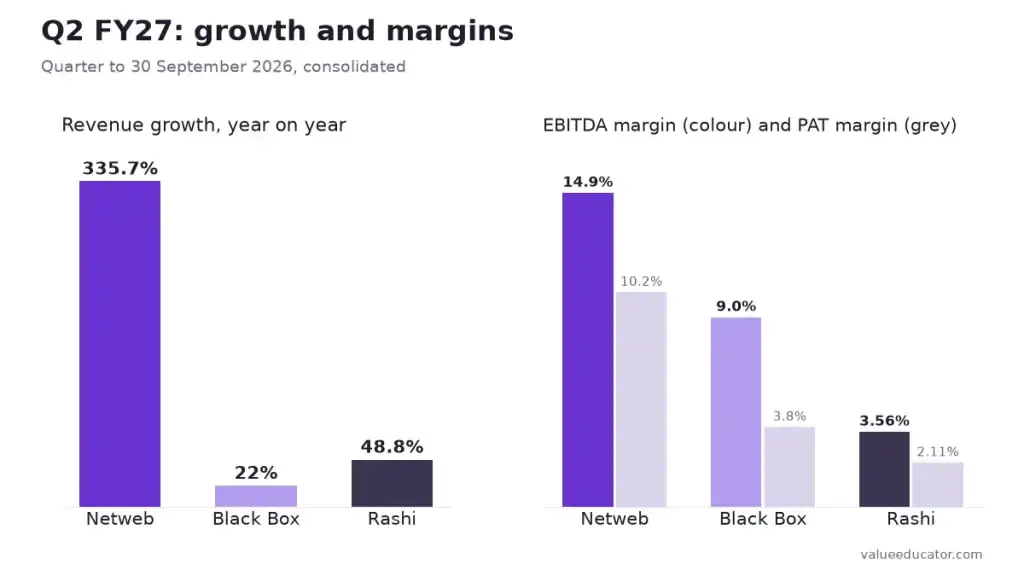
| FY22 | 247.0 | 5,370 | 9,313.4 |
| FY23 | 445.0 | 6,288 | 9,454.3 |
| FY24 | 724.1 | 6,282 | 11,094.7 |
| FY25 | 1,149.0 | 5,967 | 13,772.7 |
| FY26 | 2,183.6 | 6,322 | 15,827.3 |
| Growth a year, FY22-FY26 | 72.4% | 4.2% | 14.2% |
| EBITDA margin | Netweb Technologies | Black Box | Rashi Peripherals |
|---|---|---|---|
| FY22 | Not disclosed on the same basis | 4.8% | Not disclosed on the same basis |
| FY23 | 15.7% | 4.3% | 2.68% |
| FY24 | 14.2% | 6.8% | 2.64% |
| FY25 | 13.8% | 8.9% | 2.18% |
| FY26 | 13.0% | 9.0% | 2.90% |
| Profit after tax (₹ Cr) | Netweb Technologies | Black Box | Rashi Peripherals |
|---|---|---|---|
| FY22 | 22.5 | 73 | 182.5 |
| FY23 | 46.9 | 24 | 123.3 |
| FY24 | 75.9 | 138 | 143.9 |
| FY25 | 113.8 | 205 | 209.7 |
| FY26 | 205.8 | 218 | 282.3 |
The three records are very different. Netweb grew revenue about 8.8 times in four years, from ₹247.0 Cr to ₹2,183.6 Cr, as AI systems went from a small line to the largest one. Its margin came down from 15.7% in FY23 to 13.0% in FY26, because a GPU server carries costly bought-in chips.
Black Box barely grew revenue, from ₹5,370 Cr to ₹6,322 Cr, but its story was margin. After it cut its long tail of small, low-value accounts to fewer than 1,000, the EBITDA margin rose from 4.3% in FY23 to 9.0% in FY26, and profit after tax rose to ₹218 Cr. In FY26 revenue grew only 6%, against a 13% to 17% guide, as a fibre shortage and customer delays pushed projects into later quarters.
Rashi Peripherals grew revenue steadily, with a margin between 2.18% and 2.90%. Its FY22 profit of ₹182.5 Cr was higher than the next two years, and FY25 included the one large Yotta deal.
Order Book and Growth Plans
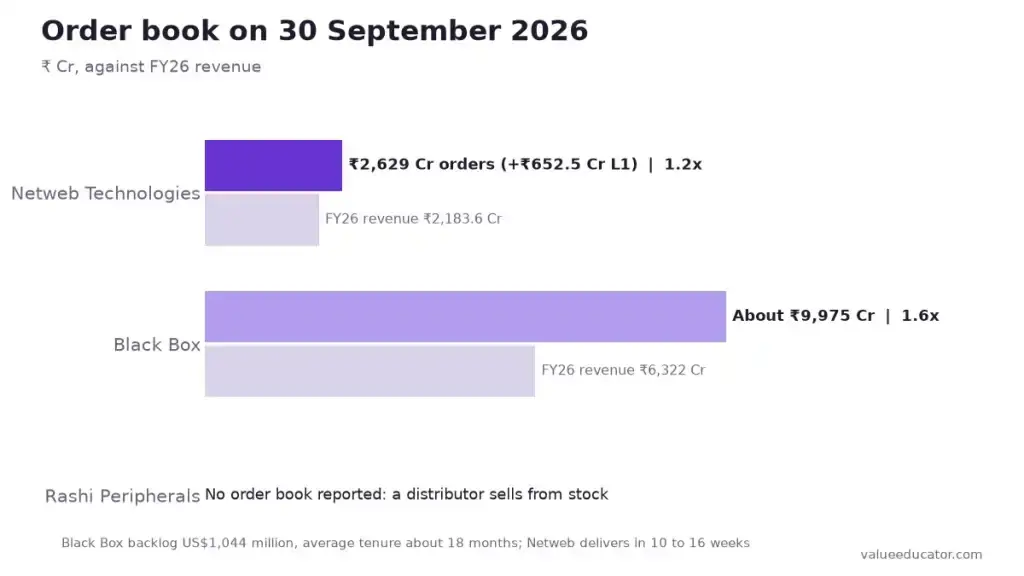
An order book means different things here. Netweb counts confirmed orders not yet delivered. Black Box counts signed contracts that run for months or years. Rashi does not report one, because it sells mostly from stock to thousands of buyers.
Netweb: ₹2,629 Cr, mostly deliverable within the year
Netweb's order book was ₹2,629 Cr on 30 September 2026, about 1.2 times FY26 revenue, with another ₹652.5 Cr of L1 positions, tenders where it was the lowest bidder but the order has not yet come. Management puts its usual delivery time at 10 to 16 weeks, so most of the book can turn into revenue soon. It targets ₹4,000 Cr of revenue in FY27, about 83% more than FY26, which needs ₹1,857 Cr in H2. Its active pipeline was about ₹11,152 Cr, and management says about 60% of the pipeline usually converts over 18 to 24 months.
Black Box: the largest book and the longest visibility
Black Box's order backlog was US$1,044 million, about ₹9,975 Cr, on 30 September 2026, up 88% in a year and about 1.6 times FY26 revenue. The average backlog runs about 18 months, and data-centre projects run 24 to 36 months. In August 2026 it won a US$131 million order from a new US hyperscaler, with work on the ground starting from November. Management guides FY27 revenue of ₹7,800 Cr to ₹8,000 Cr, which needs about 24% to 30% growth in H2, and aims to double organic revenue to about ₹12,000 Cr by FY30.
Rashi Peripherals: growth through prices, capital and new lines
Rashi has no order book to track. For H2 FY27, management expects prices to add 10% to 15% while unit volumes stay flattish, and new businesses to contribute more than 10% of revenue. It sees a long-term EBITDA margin of about 2.75%, below the 3.56% of Q2 FY27. On 5 November 2026 its board approved raising up to ₹900 Cr through a placement. Management says new equity at a 1:1 debt-equity ratio could support about ₹1,800 Cr to ₹2,000 Cr more working capital, or about ₹12,000 Cr to ₹15,000 Cr of yearly revenue. It has seen data-centre funnels of ₹20,000 Cr to ₹25,000 Cr, but says it will take only what fits its capital.
Balance Sheet and Cash Flow
| 30 Sep 2026 / H1 FY27 | Netweb Technologies | Black Box | Rashi Peripherals |
|---|---|---|---|
| Borrowings | ₹321.3 Cr | About ₹1,211 Cr | ₹1,967.9 Cr |
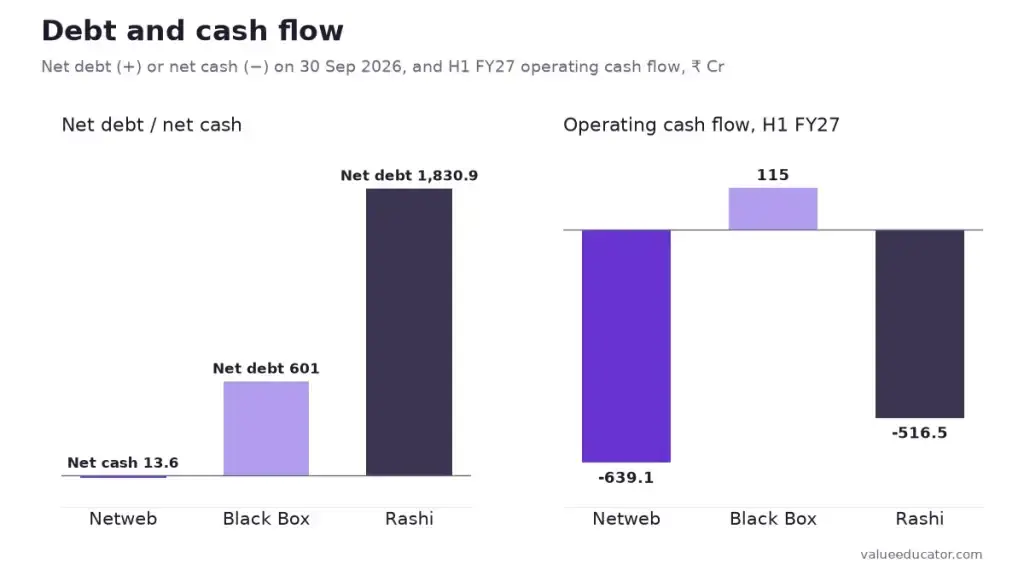
| Net debt (+) or net cash | Net cash about ₹13.6 Cr | Net debt about ₹601 Cr | Net debt about ₹1,830.9 Cr |
| Net worth | ₹2,104.1 Cr | Not disclosed for Sep 2026 | ₹2,412.7 Cr |
| Operating cash flow, H1 FY27 | Minus ₹639.1 Cr | ₹115 Cr | Minus ₹516.5 Cr |
| Operating cash flow as a share of PAT, FY23-FY26 | About 46% | About 24% | Negative (minus ₹402.1 Cr against ₹759.2 Cr of PAT) |
| Credit rating (CRISIL) | A+/Stable | BBB+/Positive | AA-/Stable |
Netweb has the cleanest balance sheet, but only because it raised ₹1,200 Cr of equity in August 2026, its first raise since listing. Operating cash flow was a negative ₹639.1 Cr in H1 FY27, against a positive ₹101.2 Cr a year earlier, because inventories rose by about ₹1,125.8 Cr as it bought GPUs, memory and other parts for orders. Its cash conversion cycle, the days between paying suppliers and collecting from customers, rose to 94 days, and inventory days to 117.
Black Box is the only one of the three with positive operating cash flow in H1 FY27, at ₹115 Cr. But over FY23 to FY26 its operating cash flow added up to only about ₹138 Cr against ₹585 Cr of profit after tax. Borrowings rose to about ₹1,211 Cr after the 2S purchase, and goodwill to ₹963 Cr.
Rashi Peripherals carries the most debt. Inventory rose to ₹4,498.7 Cr in September 2026 from ₹2,553.7 Cr in March, and net debt to equity rose to 0.76 from 0.43. Its working capital days were 55 in H1 FY27, and management says turning that stock into cash in H2 is a priority. Its AA-/Stable rating is still the highest of the three. For how to read these lines, see Cash Flow Statement Explained.
Risks for Each
Netweb Technologies
- Lumpy large orders: a few large AI orders drive much of the revenue, so a delayed tender can change a quarter sharply.
- Inventory and cash: inventory days of 117 and a negative ₹639.1 Cr operating cash flow in H1 FY27 leave costly chips on the balance sheet if deliveries slip.
- Chip supply and prices: it depends on NVIDIA, AMD and others, and management says memory prices have gone up by 200% or more.
- A slower second half: the ₹4,000 Cr target needs about 17.6% growth in H2 FY27, against 254.2% in H1.
Black Box
- Execution: FY26 revenue grew 6% against a 13% to 17% guide; the FY27 guide needs about 24% to 30% growth in H2.
- Hyperscaler concentration: a few hyperscalers place most data-centre orders, so one delayed site slows the backlog.
- Thin net margin and cash conversion: profit after tax was 3.4% of revenue in FY26, and cash flow has lagged profit.
- Acquisitions and the US: the FY30 plan needs about ₹6,000 Cr of acquired revenue, and about 66% of revenue comes from North America.
Rashi Peripherals
- Working capital and debt: operating cash flow was a negative ₹516.5 Cr in H1 FY27, and quarterly finance cost almost doubled.
- Prices turning down: about 30% of Q2 growth came from higher prices; a price fall would cut revenue and could hurt margins on stock bought high.
- Thin margin: management's own long-term guide of about 2.75% is below the latest quarter's 3.56%.
- Brand dependence and dilution: a large brand moving away would take revenue with it, and the proposed ₹900 Cr raise would dilute shareholders.
Which Is Stronger on Each Measure?
| Measure | Stronger | Why |
|---|---|---|
| Size (FY26 revenue) | Rashi Peripherals | ₹15,827.3 Cr, against ₹6,322 Cr for Black Box and ₹2,183.6 Cr for Netweb |
| Latest-quarter growth | Netweb | 335.7%, against 48.8% for Rashi and 22% for Black Box |
| Margin (FY26 EBITDA) | Netweb | 13.0%, against 9.0% for Black Box and 2.90% for Rashi |
| Latest-quarter profit | Netweb | ₹136.7 Cr, against ₹130.7 Cr for Rashi and ₹73 Cr for Black Box |
| Five-year growth record | Netweb | Revenue grew 72.4% a year, from the smallest base |
| Order visibility | Black Box | About ₹9,975 Cr of backlog, 1.6 times FY26 revenue, running about 18 months |
| Returns (FY26 ROCE) | Netweb | 37.5%, against 21.3% for Black Box and 16.02% for Rashi |
| Balance sheet | Netweb | Net cash of about ₹13.6 Cr after its equity raise |
| Cash flow, H1 FY27 | Black Box | ₹115 Cr from operations; the other two were negative |
| Credit rating | Rashi Peripherals | AA-/Stable, against A+/Stable for Netweb and BBB+/Positive for Black Box |
| Direct data-centre exposure | Netweb | AI systems were 58.4% of Q2 FY27 revenue |
No company wins on every measure. Netweb leads on growth, margin, returns and data-centre exposure, but its growth now depends on large orders and its cash went into stock. Black Box has the longest order visibility and positive cash flow, but has to prove it can turn the backlog into revenue on time. Rashi is the largest and has the highest credit rating, but earns the thinnest margin and has the most debt.
Explore our Products
Research Framework

Emerging Titans
Combination of quantitative analysis, industry tailwinds, and management assessment - SPRINT investment philosophy

Tiny Titans
Heavy emphasis on scuttlebutt research, plant visits, and early on-ground signals
Conclusion
These three companies share a theme, the build-out of data centres, but they earn from it in different ways. Netweb is the most direct play on AI computing in India, as a maker of the servers themselves. Black Box earns from the wiring of large AI data centres, mostly in the US. Rashi Peripherals earns mostly from distributing laptops and components across India, with data centres as an occasional large deal rather than a steady stream.
What each suits depends on what matters to the reader. Netweb's case rests on its pipeline turning into new large orders after the current ones ship. Black Box's rests on delivering its backlog and lifting its margin toward its 10% target. Rashi's rests on turning its festive stock into cash and holding its margin as prices move. For a wider view of the sector, see our guide to data centre stocks in India.
FAQs
Netweb vs Black Box vs Rashi Peripherals: which is better?
+None is stronger on every measure. Netweb grew Q2 FY27 revenue 335.7%, had the highest FY26 EBITDA margin at 13.0% and a FY26 ROCE of 37.5%, but its operating cash flow was a negative ₹639.1 Cr in H1 FY27. Black Box has the largest backlog at about ₹9,975 Cr and positive H1 cash flow, but grew only 22%. Rashi is the largest at ₹15,827.3 Cr of FY26 revenue, but keeps about ₹2.11 of profit per ₹100 of sales and has the most debt.
Netweb Technologies vs Black Box: what is the difference?
+Netweb designs and builds the AI servers and supercomputers that go inside a data centre, mostly for Indian buyers. Black Box builds the cabling and network that connect those servers, mostly for US hyperscalers. Netweb's FY26 EBITDA margin was 13.0%, against 9.0% for Black Box.
Netweb vs Rashi Peripherals: why are their margins so different?
+Netweb makes its own systems and earned an operating EBITDA margin of 14.9% in Q2 FY27. Rashi distributes other brands' products and earned 3.56%. A distributor earns a thin margin on very large volumes, so Rashi's Q2 revenue was 4.7 times Netweb's, while its profit after tax was a little lower, at ₹130.7 Cr against ₹136.7 Cr.
Which of the three earns the most from data centres?
+Netweb, where AI systems were 58.4% of Q2 FY27 revenue. Data centres were 20% of Black Box's Q2 FY27 revenue. Rashi's one large AI data-centre deal was about 12% of FY25 revenue, and it has taken no large project since.
Which has the largest order book?
+Black Box, with a backlog of US$1,044 million, about ₹9,975 Cr, on 30 September 2026. Netweb had ₹2,629 Cr of orders plus ₹652.5 Cr of L1 positions. Rashi does not report an order book.
Which has the strongest balance sheet?
+Netweb had net cash of about ₹13.6 Cr on 30 September 2026 after raising ₹1,200 Cr of equity. Black Box had net debt of about ₹601 Cr, and Rashi about ₹1,830.9 Cr, or 0.76 times equity, though Rashi has the highest credit rating, AA-/Stable.

High growth stock specialist, Value Educator
Shashank Mahajan is an equity research professional with over 12 years of experience in identifying high-potential SME and micro-cap stocks at an early stage. He follows a rigorous scuttlebutt research–driven approach, combining on-ground insights with deep financial analysis. Shashank specializes in uncovering under-researched and under-owned companies with strong management quality and long-term growth potential. Through disciplined research and early identification, he focuses on spotting tomorrow’s market leaders before they enter the mainstream investor radar.
More about Shashank Mahajan →
PCBL Chemical: Carbon Black Margins and Battery Materials
KEC International: Record Orders, Weak Margin, High Debt

Sona BLW: EV Revenue Now Tops Half of Its Auto Sales
HPL Electric & Power: Smart Meters, Wires and Two Engines
Kaynes Technology: EMS, Chip Plants and ₹10,563.5 Cr Orders
Sterlite Technologies: Glass Rods to Hyperscaler Deals
Explore our Products
Research Framework
Emerging Titans
Combination of quantitative analysis, industry tailwinds, and management assessment - SPRINT investment philosophy
Tiny Titans
Heavy emphasis on scuttlebutt research, plant visits, and early on-ground signals



India's Aerospace Opportunity
Global Demand. Supply Bottlenecks. Opportunities Ahead.
Don't Miss This Exclusive Webinar!
Join Value Educator to decode the key trends shaping India's aerospace sector and learn how to identify tomorrow's potential leaders in the space.
- How the aircraft value chain works, layer by layer
- Indian companies supplying global aircraft makers
- A framework to judge any aerospace company

 Orders
 Subscription
 Share with friends


Required Details
₹23999.00
(12 month subscription)
As per SEBI regulations, all users are mandated to complete the KYC that is validated for 1 year. Post payment, you will be redirected to the KYC screen


No comments yet. Be the first to comment!