
Genus Power vs HPL Electric: Smart Meter Makers Compared

India is replacing its old electricity meters with smart meters that send readings on their own and let a discom cut or restore supply from a control room. Two listed companies that make these meters in India are Genus Power Infrastructures and HPL Electric & Power. Both have made meters for decades, both sell to the same discoms and service providers, and both reported their September 2026 quarter in November 2026. That is why investors searching for smart meter stocks in India often put the two side by side.
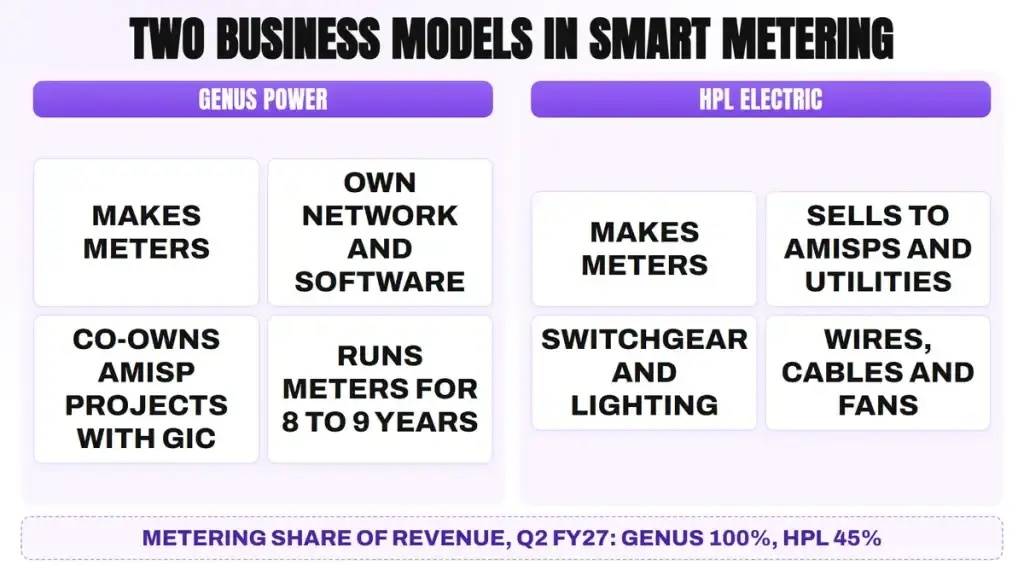
They are not the same kind of company, though. Genus is a pure metering company that also co-owns, with GIC of Singapore, the project companies that install and run smart meters for discoms. HPL makes meters too, but 55% of its latest quarter's revenue came from switchgear, lighting, wires and cables and fans. This page compares the two like for like: Genus as a whole against HPL's metering business where HPL discloses it, and the whole companies where the measure only exists at company level.
Figures as of 20 November 2026. This page is research, not a recommendation to buy or sell any stock.
Genus Power vs HPL Electric at a Glance
| Measure | Genus Power | HPL Electric & Power |
|---|---|---|
| Business | Smart electricity meters plus AMISP projects (install, run and maintain meters for discoms) | Meters and metering systems, plus switchgear, lighting, wires and cables, and fans |
| Metering share of revenue | 100% (one business segment) | 57% in FY26; 45% in Q2 FY27 |
| Meter capacity | 18+ million meters a year (Jaipur, Haridwar, Guwahati) | 11 million meters a year (seven plants in total, Haryana and Himachal Pradesh) |
| FY26 revenue | ₹4,750.9 Cr | ₹1,811.1 Cr, of which metering ₹1,026.4 Cr |
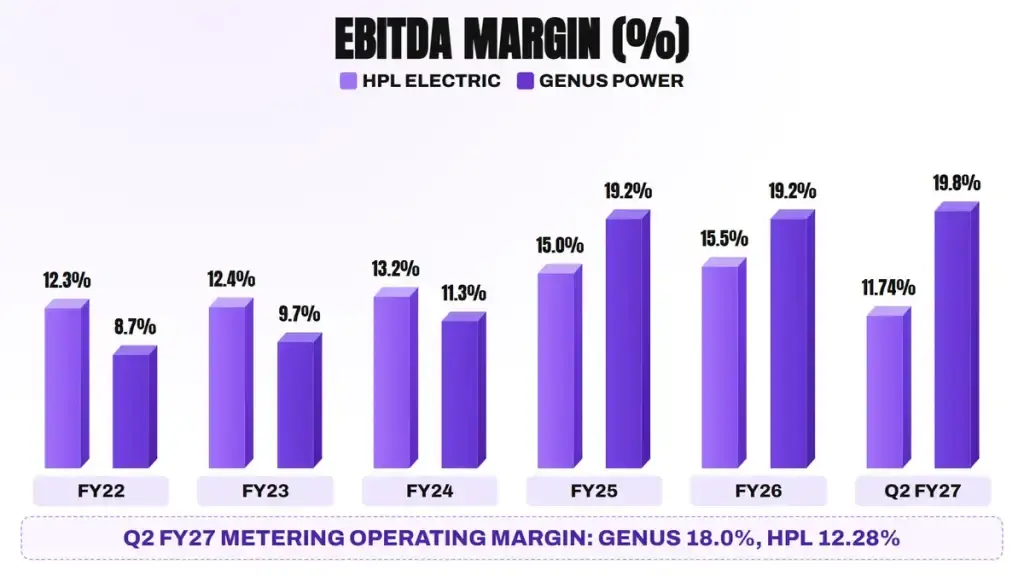
| FY26 EBITDA margin | 19.2% | 15.5% |
| FY26 net profit | ₹592.3 Cr | ₹91.3 Cr |
| FY26 ROCE / ROE (standalone, as reported) | 21% / 30% | 12.70% / 8.86% |
| Net debt (March 2026) | ₹1,573 Cr | ₹668.6 Cr |
| Order book | ₹22,634 Cr (September 2026) | ₹2,700+ Cr (2 November 2026), over 96% metering |
| Q2 FY27 revenue growth | -1.4% | +40.02% (metering +18.17%) |
| Customers | Discoms through project companies with GIC; other AMISPs | AMISPs such as Adani and EESL, utilities; 900+ dealers and 90,000+ retailers for other products |
| Key risk | Slow installation, large receivables and rising debt | Lower metering margins on fixed-price contracts and a smaller order book |

How Genus Power and HPL Electric Make Money
Genus Power: meters plus a long service contract
Genus has made meters for three decades and has installed more than 113 million of them. It calls itself the country's largest manufacturer of smart meters for the power sector. Under the government's Revamped Distribution Sector Scheme (RDSS), discoms hire an Advanced Metering Infrastructure Service Provider (AMISP), which supplies, installs and runs the meters and is paid per meter per month over a concession of 8 to 9 years.
Genus takes part in these tenders through a platform with GIC, in which GIC holds 74% and Genus 26%. The project companies win the contracts and hand the meter, installation and software work back to Genus. So Genus earns twice: first as the maker and installer, then from operation and maintenance for years after. It makes its own meters, communication network, head-end system and data software in house. By its own estimate it has a market share of around 22% to 23% as an AMISP, and more than 30% as meter maker and AMISP together (May 2026).
HPL Electric: a meter maker with a second business
HPL has two segments. Metering, Systems & Services makes conventional, smart, prepaid and net meters and sells them mainly to AMISPs and utilities. Management said in November 2026 that HPL is a preferred approved vendor of Adani and is approved with EESL, and that all independent AMISPs buy from it. HPL says it has about 20% of the domestic meters market and 11 million meters a year of capacity.
The second segment, Consumer & Industrial (C&I), sells switchgear, lighting, wires and cables and fans through 900+ authorised dealers and 90,000+ retailers. This business has a shorter working-capital cycle of about 3 months. In Q2 FY27 it was the faster-growing half, with revenue of ₹337.46 Cr, up 64.42%, led by wires and cables at ₹177.99 Cr, up 159.46%.
On 5 November 2026 HPL's board gave in-principle approval to study splitting one or more businesses into separate companies through a scheme of arrangement. Management called it an enabling step at the evaluation stage, with no structure decided.
For more on Genus's AMISP orders and its FY27 plan, see Genus Power: Smart Meters and ₹22,634 Cr of Orders.
Latest Quarter: Q2 FY27 Side by Side
Both companies reported the quarter to 30 September 2026: HPL on 5 November 2026 and Genus on 14 November 2026. The figures below are consolidated for both.
| Q2 FY27 (consolidated) | Genus Power | HPL Electric (whole company) | HPL metering segment |
|---|---|---|---|
| Revenue | ₹1,132.6 Cr | ₹608.31 Cr | ₹270.85 Cr |
| Growth over Q2 FY26 | -1.4% | +40.02% | +18.17% |
| Gross margin | 38.3% (41.5% a year earlier) | 28.57% (36.56% a year earlier) | not disclosed |
| EBITDA | ₹224.4 Cr | ₹71.42 Cr | not disclosed |
| EBITDA margin | 19.8% (20.4% a year earlier) | 11.74% (15.17% a year earlier) | not disclosed |
| Operating margin (EBIT, before other income) | 18.0% | 8.7% | 12.28% |
| Net profit | ₹158.6 Cr, up 10.9% | ₹23.40 Cr, up 4.68% | not disclosed |
| H1 FY27 revenue growth | 19.4% | 37.44% | 17.40% |
Genus's revenue was flat because installations slowed. The company pointed to local body elections in some areas and a slower pace of installation in Uttar Pradesh, and said its orders remain fully intact. Its gross margin improved from 37.0% in Q1 FY27 to 38.3%, which the company credited to better supplier terms and logistics, and its EBITDA margin stayed near 20%.
HPL grew fast, but mostly through C&I. Its metering revenue rose 18.17%, with a 13.97% pick-up over Q1 FY27, while the metering segment's operating margin fell to 12.28%. HPL said metal, industrial plastic and electronic costs rose from March onwards, and in metering it cannot pass these on because the contracts have fixed prices. Management expects the full-year EBITDA margin to settle around 12% to 12.5%.
On the measure that matters most for a meter maker, the operating margin on metering, Genus earned 18.0% in the quarter against 12.28% at HPL's metering segment.
Five-Year Financials (FY22 to FY26)
All figures are consolidated, in ₹ Cr. HPL's metering revenue is its Metering, Systems & Services segment.
| Year | Genus revenue | HPL revenue | HPL metering revenue | Genus EBITDA margin | HPL EBITDA margin | Genus net profit | HPL net profit |
|---|---|---|---|---|---|---|---|
| FY22 | 685.1 | 1,014.0 | 444.1 | 8.7% | 12.3% | 57.5 | 7.8 |
| FY23 | 808.4 | 1,262.2 | 670.0 | 9.7% | 12.4% | 29.0 | 30.3 |
| FY24 | 1,200.6 | 1,460.9 | 852.6 | 11.3% | 13.2% | 86.7 | 43.6 |
| FY25 | 2,442.0 | 1,700.2 | 1,075.6 | 19.2% | 15.0% | 311.4 | 94.0 |
| FY26 | 4,750.9 | 1,811.1 | 1,026.4 | 19.2% | 15.5% | 592.3 | 91.3 |
The table shows how the smart meter rollout changed both companies. In FY22 HPL was the larger company, and its metering business alone was about two thirds the size of Genus. By FY26 Genus's revenue was about 6.9 times its FY22 level, while HPL's metering revenue was about 2.3 times its FY22 level, and it slipped in FY26 after an execution slowdown across the industry in Q1 FY26.
Margins moved the same way. Genus's EBITDA margin rose from 8.7% to 19.2% as volumes grew. HPL's margin rose from 12.3% to 15.5%, and it had the higher EBITDA margin of the two until FY24. HPL's FY26 net profit of ₹91.3 Cr was below FY25 because of higher depreciation after new capacity.
To read segment numbers like HPL's metering line, see Segment-Wise Revenue Analysis Explained.
Order Book and Growth Plans
| Order book | Genus Power | HPL Electric |
|---|---|---|
| Latest | ₹22,634 Cr (September 2026) | ₹2,700+ Cr (2 November 2026) |
| Peak | ₹30,110 Cr (March 2025) | ₹3,500+ Cr (May 2025) |
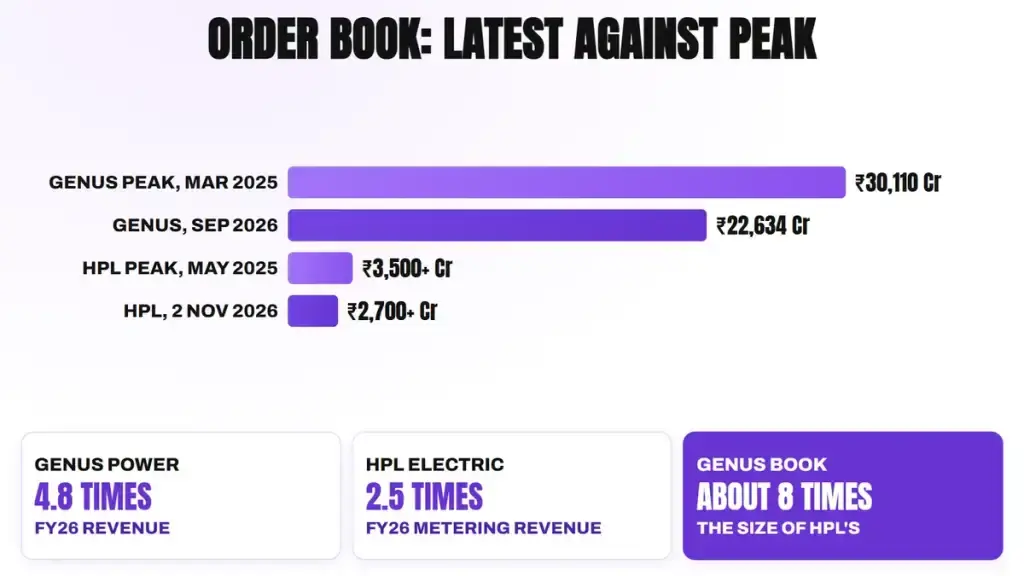
| Against FY26 revenue | About 4.8 times total revenue | About 2.5 times metering revenue |
| What it includes | Meters and installation, plus years of operation and maintenance | Mostly metering supply; C&I orders cover only 15 to 20 days |
Genus's order book is about eight times HPL's. Part of the gap is the business model: about ₹20,970 Cr of Genus's September book comes from the project companies with GIC, and it includes years of operation and maintenance work, about ₹7,000 Cr of the platform book in May 2026. HPL's order book is mostly meters to be supplied over the next two years or so.
Both books have come down from their peaks as the companies deliver faster than new tenders arrive. Genus's fell from ₹30,110 Cr in March 2025 to ₹22,634 Cr in September 2026, and HPL's from ₹3,500+ Cr in May 2025 to ₹2,700+ Cr. HPL's management said the exact figure, whether 2,500 or 3,000, is not material because it gives visibility of over 2 years.
Genus's plan for FY27: revenue of ₹6,000-6,500 Cr, an EBITDA margin of 18%, and about 1 crore smart meters installed. Of the 3.6 crore AMISP meters awarded to Genus, about 1.7 crore were installed by September 2026. It also expects smart gas meter tenders to pick up in FY28.
HPL's plan for FY27: C&I revenue well north of ₹1,000 Cr (H1 was ₹615.05 Cr), a second half better than the first in both segments, and an EBITDA margin around 12% to 12.5%. Management expects metering to grow 15% to 20% a year from here. Its metering plants run at about 70% of capacity, and management sees no capacity issue in metering.
Balance Sheet and Cash Flow
| Measure | Genus Power | HPL Electric |
|---|---|---|
| Operating cash flow, FY22 to FY26 added up | -₹699.9 Cr | +₹669.7 Cr |
| Net profit, FY22 to FY26 added up | ₹1,076.8 Cr | ₹266.9 Cr |
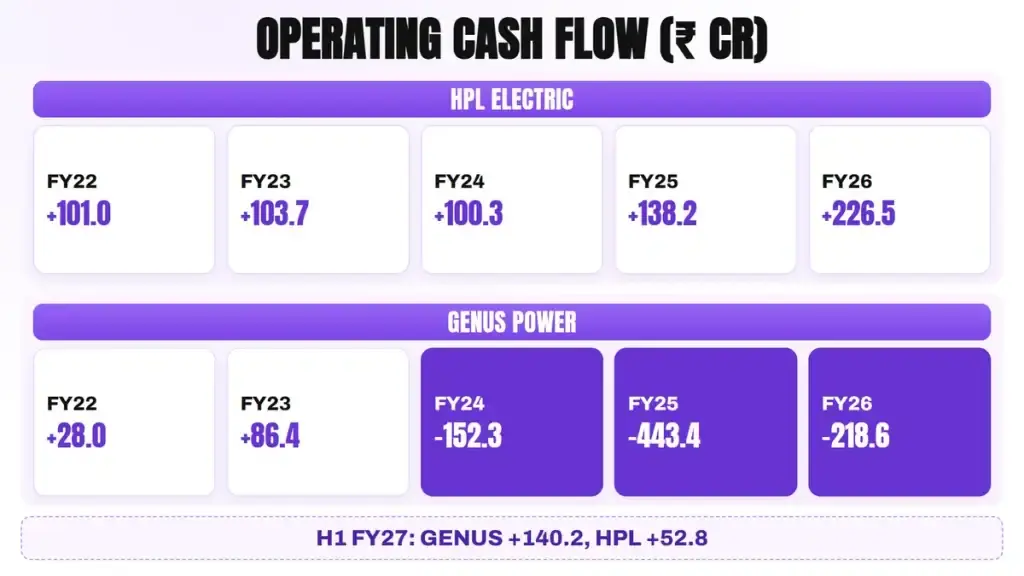
| Operating cash flow, H1 FY27 | +₹140.2 Cr (against -₹157.7 Cr in H1 FY26) | +₹52.8 Cr (against +₹114.9 Cr in H1 FY26) |
| Net debt, March 2026 | ₹1,573 Cr | ₹668.6 Cr |
| Net debt to FY26 EBITDA | About 1.7 times | About 2.4 times |
| Debt to equity, FY26 (standalone) | 1.04 | 0.75 |
| Receivables, March 2026 | About 114 days of FY26 revenue (standalone) | About 154 days of FY26 revenue |
| Inventory, March 2026 | About 104 days of FY26 revenue (standalone) | About 151 days of FY26 revenue |
| Credit rating | CRISIL AA-/Positive (November 2026) | IND A+/Stable (June 2026) |
This is where the two differ most. HPL has turned profit into cash every year: operating cash flow was positive in all five years, from ₹101.0 Cr in FY22 to ₹226.5 Cr in FY26. Genus earned far more profit, but its cash went into meters, receivables and its share of the project companies, so operating cash flow was negative for three years in a row: -₹152.3 Cr in FY24, -₹443.4 Cr in FY25 and -₹218.6 Cr in FY26.
That changed in H1 FY27. Genus's operating cash flow turned positive at ₹140.2 Cr, while HPL's fell to ₹52.8 Cr as its inventory rose from ₹748.51 Cr to ₹843.87 Cr in six months. Genus expects net debt to peak at about ₹2,000 Cr and fall from FY28. HPL says it wants to tighten stock and debtors in the second half.
On debt, Genus carries more in rupees, but against its larger EBITDA its net debt is lower, at about 1.7 times against about 2.4 times for HPL. Genus also ties up less money per rupee of sales in receivables and inventory on these figures. To read these lines yourself, see Cash Flow Statement Explained.
Risks for Each Company
Genus Power
- Installation pace: revenue depends on how fast meters go into homes. Q2 FY27 revenue fell 17.0% from Q1 because of slower installation, and the full-year target needs a much stronger second half.
- Receivables and debt: trade receivables rose by ₹487.2 Cr in H1 FY27 to ₹1,971.7 Cr, and the company expects another ₹600-700 Cr of investment in the GIC platform.
- Fixed prices: Genus's contracts are fixed price with no pass-through of material costs, the same exposure that hurt HPL's metering margin this year.
- Legal matter: the Enforcement Directorate searched the Chairman's residence in December 2024, and the company received a notice from the PMLA court in February 2026. The company still discloses the matter with its results.
HPL Electric
- Metering margin: the metering operating margin fell from 17.59% in H1 FY26 to 13.17% in H1 FY27, and HPL cannot pass cost increases on in metering contracts.
- Smaller order book and price competition: the book is down from ₹3,500+ Cr to ₹2,700+ Cr. An analyst on the November call said the lowest bid in a recent Kerala tender was priced about 50% apart from HPL's. Management said low-price entrants have not lasted in the past.
- Working capital: receivables rose to ₹794.95 Cr and inventory to ₹843.87 Cr in September 2026, both higher than in March, and H1 operating cash flow more than halved.
- Restructuring: the possible split of the businesses is at an early stage, and its form, timing and effect on each business are not yet known.
Which Is Stronger on Each Measure?
| Measure | Stronger on this measure | Why |
|---|---|---|
| Size in metering | Genus Power | FY26 revenue ₹4,750.9 Cr against HPL metering ₹1,026.4 Cr; 18+ million against 11 million meters of capacity |
| Five-year growth | Genus Power | Revenue about 6.9 times FY22, against about 2.3 times for HPL metering |
| Latest quarter growth | HPL Electric | Q2 FY27 revenue +40.02% (metering +18.17%) against -1.4% at Genus |
| Metering margin | Genus Power | Q2 FY27 operating margin 18.0% against 12.28% for HPL metering |
| Returns on capital | Genus Power | FY26 ROCE 21% against 12.70% (standalone) |
| Order book visibility | Genus Power | About 4.8 times revenue against about 2.5 times HPL metering revenue |
| Cash flow record | HPL Electric | Positive operating cash flow in each of FY22 to FY26; Genus negative in FY24 to FY26 |
| Debt against earnings | Genus Power | Net debt about 1.7 times EBITDA against about 2.4 times |
| Spread of business | HPL Electric | Two segments; C&I was 55% of Q2 FY27 revenue |
Explore our Products
Research Framework

Emerging Titans
Combination of quantitative analysis, industry tailwinds, and management assessment - SPRINT investment philosophy

Tiny Titans
Heavy emphasis on scuttlebutt research, plant visits, and early on-ground signals
Conclusion
Genus Power vs HPL Electric is really a choice between two shapes of business, not two versions of the same one. Genus is the bigger, more focused and more profitable smart meter company, with a long order book that includes years of service income. The cost of that model has been cash: its profits went into receivables, inventory and project equity for three years, and only in H1 FY27 did operating cash flow turn positive. Whether that holds depends on how fast installations pick up and whether the 18% margin target survives fixed-price contracts.
HPL is smaller in metering and its metering margin has dropped this year, but it has turned profit into cash every year and is no longer a pure meter story. Its C&I business, led by wires and cables, brought in more revenue than metering in Q2 FY27. What HPL looks like from here depends on whether its metering margin recovers, how its order book is refilled, and what comes of the proposed split. Each suits a different reader: Genus for someone studying the smart meter rollout itself, HPL for someone studying a mixed electrical products company with a metering arm. For how both fit into the wider power chain, see Power Sector Stocks in India 2026: List by Value Chain.
FAQs
Genus Power vs HPL Electric: which is better?
+Neither is better on every measure. Genus is stronger on size, five-year growth, metering margin, return on capital and order book: FY26 revenue of ₹4,750.9 Cr, a Q2 FY27 operating margin of 18.0% and an order book of ₹22,634 Cr. HPL is stronger on latest-quarter growth (+40.02%), on cash flow (positive operating cash flow in each of FY22 to FY26) and on spread of business. This is research, not a recommendation.
Which company has the bigger smart meter order book?
+Genus Power. Its order book was ₹22,634 Cr in September 2026, about 4.8 times its FY26 revenue. HPL's was ₹2,700+ Cr on 2 November 2026, over 96% from metering, or about 2.5 times its FY26 metering revenue.
How much of HPL Electric's revenue comes from metering?
+Metering, Systems & Services brought in ₹1,026.4 Cr, or 57% of HPL's FY26 revenue of ₹1,811.1 Cr. In Q2 FY27 its share fell to 45% (₹270.85 Cr) because the Consumer & Industrial business grew 64.42%.
What is an AMISP and how does Genus Power earn from it?
+An Advanced Metering Infrastructure Service Provider supplies, installs and runs smart meters for a discom and is paid per meter per month over 8 to 9 years. Genus bids through project companies co-owned with GIC (GIC 74%, Genus 26%), which hand the meter and installation work to Genus, so it earns from making the meters and later from operating them.
Why are smart meter stocks in India in focus?
+Under RDSS, smart metering worth ₹1,30,671 crore has been sanctioned, covering 19.79 crore consumer meters, and the rollout is now expected to run to FY28. Meter makers and AMISPs such as Genus Power and HPL Electric supply this programme.
Which has better cash flow, Genus Power or HPL Electric?
+HPL has the better record: its operating cash flow was positive in every year from FY22 to FY26, adding up to ₹669.7 Cr. Genus's added up to -₹699.9 Cr over the same years, though it turned positive at ₹140.2 Cr in H1 FY27 while HPL's fell to ₹52.8 Cr.

High growth stock specialist, Value Educator
Shashank Mahajan is an equity research professional with over 12 years of experience in identifying high-potential SME and micro-cap stocks at an early stage. He follows a rigorous scuttlebutt research–driven approach, combining on-ground insights with deep financial analysis. Shashank specializes in uncovering under-researched and under-owned companies with strong management quality and long-term growth potential. Through disciplined research and early identification, he focuses on spotting tomorrow’s market leaders before they enter the mainstream investor radar.
More about Shashank Mahajan →
Azad Engineering vs MTAR vs Unimech: Aerospace Parts
Subros vs Lumax Auto vs Sona BLW: EV Auto Parts Compared
Jyoti CNC vs Macpower CNC: Machine Tool Makers Compared
Data Patterns vs Astra Microwave vs Apollo Micro

Himadri vs PCBL: Carbon Black and Battery Materials

Inox Wind vs Suzlon: Wind Turbine Makers Compared
Explore our Products
Research Framework
Emerging Titans
Combination of quantitative analysis, industry tailwinds, and management assessment - SPRINT investment philosophy
Tiny Titans
Heavy emphasis on scuttlebutt research, plant visits, and early on-ground signals



India's Aerospace Opportunity
Global Demand. Supply Bottlenecks. Opportunities Ahead.
Don't Miss This Exclusive Webinar!
Join Value Educator to decode the key trends shaping India's aerospace sector and learn how to identify tomorrow's potential leaders in the space.
- How the aircraft value chain works, layer by layer
- Indian companies supplying global aircraft makers
- A framework to judge any aerospace company

 Orders
 Subscription
 Share with friends


Required Details
₹23999.00
(12 month subscription)
As per SEBI regulations, all users are mandated to complete the KYC that is validated for 1 year. Post payment, you will be redirected to the KYC screen


No comments yet. Be the first to comment!