
Jyoti CNC vs Macpower CNC: Machine Tool Makers Compared
A CNC machine is a computer-controlled machine that cuts metal into precise parts: a gear for a car, a turbine blade, a valve body, a missile casing. India still buys about 60% of its CNC machines from abroad, so local makers that can match imported machines on precision have a long runway. Two of the listed ones sit a short drive apart in Rajkot, Gujarat: Jyoti CNC Automation and Macpower CNC Machines. Both make metal-cutting CNC machines, both sell to Indian factories, and both reported their September 2026 quarter in October and November 2026. That is why investors looking at CNC machine stocks in India often compare the two.
They are very different in size and in what they sell. Jyoti's FY26 revenue of ₹2,093.1 Cr was about 6.3 times Macpower's ₹333.18 Cr. Jyoti sells higher-end machines, including 5-axis machines for aerospace and defence, and owns Huron Graffenstaden, a machine maker in Strasbourg, France. Macpower sells mainly turning centres and vertical machining centres to small and mid-sized factories, at a little over half of Jyoti's average price per machine. This page compares the two on the same periods: Q2 FY27 and H1 FY27 (to 30 September 2026) for the latest numbers, and FY22 to FY26 for the long view.
Figures as of 20 November 2026. This page is research, not a recommendation to buy or sell any stock.
Jyoti CNC vs Macpower CNC at a Glance
| Measure | Jyoti CNC Automation | Macpower CNC Machines |
|---|---|---|
| Business | CNC turning, milling, 5-axis and multitasking machines; owns Huron Graffenstaden (France) | CNC turning centres, vertical machining centres and other metal-cutting machines |
| Plants and capacity | 3 plants (2 in Rajkot, 1 in Strasbourg); 6,000 machines a year in India, with 10,000 more being put to use; Huron 240 a year | One plant of about 8 acres at Metoda, Rajkot; 2,500 machines a year; 13-acre site being built |
| FY26 revenue | ₹2,093.1 Cr (consolidated) | ₹333.18 Cr |
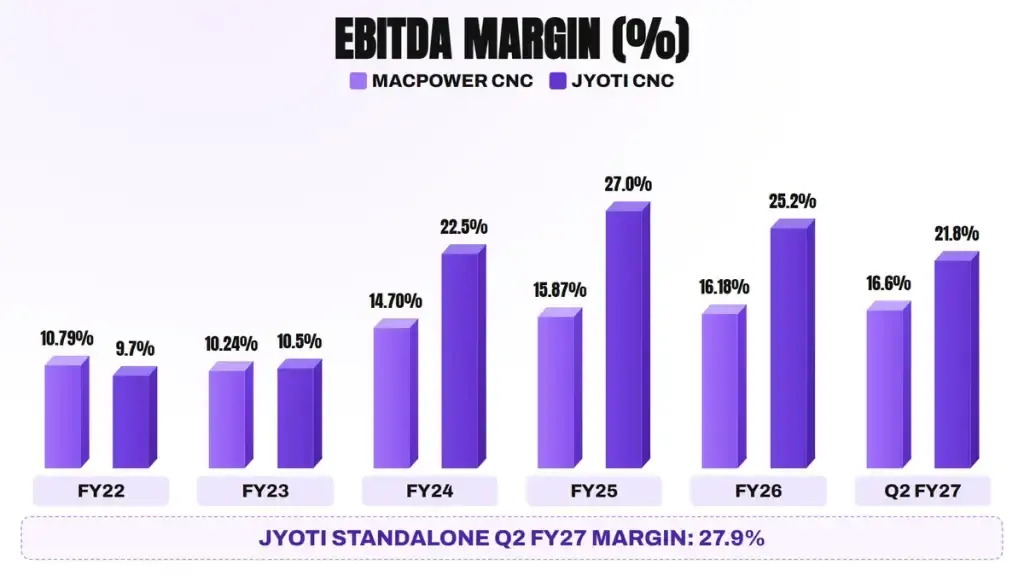
| FY26 EBITDA margin | 25.2% | 16.18% |
| FY26 net profit | ₹336.0 Cr | ₹33.87 Cr |
| FY26 ROCE / ROE (standalone, as reported) | 18.52% / 17.31% | 26.24% / 19.36% |
| Net debt (30 September 2026) | ₹824.8 Cr | Net cash of ₹25.6 Cr |
| Order book (30 September 2026) | ₹5,082 Cr, 36% aerospace and defence | ₹476.7 Cr, 40% premium NEXA range |
| Q2 FY27 revenue growth | +18.5% (standalone +31.1%) | +40.4% |
| Customers | 15,000+ in India; aerospace and defence 39% of FY26 revenue | Mostly MSME buyers; no customer at 10% or more of revenue; 200+ machines in 35 defence factories |
| Key risk | French investigation at Huron, rising debt and slow cash conversion | Small scale, high inventory and capacity limits until the new site is ready |

How Jyoti CNC and Macpower CNC Make Money
Jyoti CNC: high-end machines and a French arm
Jyoti began as a partnership in 1989 and now offers 200+ machine variants, with more than 1,40,000 machines installed across the world. It is among the leading makers of simultaneous 5-axis CNC machines in India, the kind used to cut complex aerospace and defence parts in one setting. It estimates its own share at about 10-12% of the domestic market for high-precision, high-value metal-cutting CNC machines.
Aerospace and defence made up 39% of Jyoti's FY26 revenue. Auto and auto components, general engineering, die and mould makers and electronics manufacturers make up most of the rest. Jyoti sold its machines at an average of ₹35.62 lakh each in FY26. It runs its own foundry, machine shop and sheet metal shop in Rajkot.
The second piece is Huron Graffenstaden, bought in 2007. Huron makes high-end milling machines in Strasbourg with a capacity of 240 machines a year. About 70% of the goods that go into Huron's machines come from India, and Huron does the final assembly. Huron is also Jyoti's largest single risk today (see the risks section).
Macpower CNC: volume machines for small factories
Macpower was set up in 2003 and lists 388 models and variants. Most of its buyers are MSMEs: auto part makers, engineering firms, die and mould makers and agricultural equipment makers. No single customer made up 10% or more of its revenue in FY26. The average machine sold for nearly ₹20 lakh in FY26 and ₹20.36 lakh in Q2 FY27, so Jyoti's average machine sells for about 1.8 times Macpower's.
Macpower is pushing up the price ladder through NEXA, its premium range, which made up 40% of its order book in September 2026. It has supplied 200+ machines to 35 defence factories and 100+ to 6 aviation and aerospace factories, including HAL and ISRO, but defence is still a single-digit share of its revenue. The company has no subsidiary, so its standalone accounts are its only accounts.
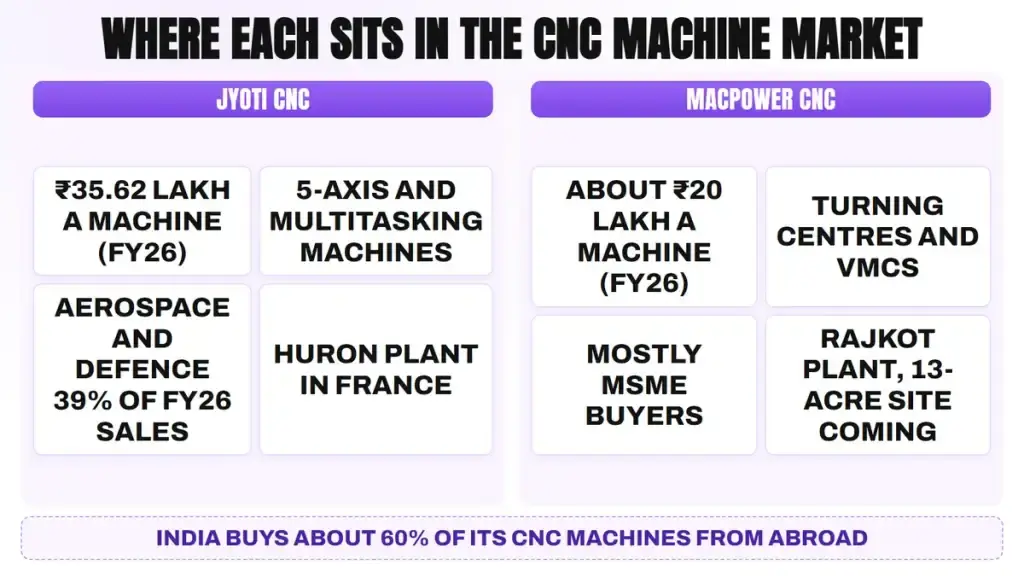
The difference in mix matters for margins and for working capital. Higher-end machines carry higher margins but tie up more stock and capital. Volume machines carry thinner margins and turn over faster. The numbers below show both effects.
Latest Quarter: Q2 FY27 Side by Side
| Q2 FY27 (quarter to 30 Sep 2026) | Jyoti CNC (consolidated) | Macpower CNC |
|---|---|---|
| Revenue | ₹602.0 Cr (Q2 FY26: ₹507.9 Cr) | ₹120.33 Cr (Q2 FY26: ₹85.71 Cr) |
| Revenue growth | +18.5% | +40.4% |
| EBITDA | ₹131.3 Cr (Q2 FY26: ₹124.6 Cr) | ₹19.94 Cr (Q2 FY26: ₹14.16 Cr) |
| EBITDA margin | 21.8% (Q2 FY26: 24.5%) | 16.6% (Q2 FY26: 16.5%) |
| Net profit | ₹72.6 Cr, down 15.1% | ₹13.47 Cr, up 43.7% |
| Net profit margin | 12.1% | 11.2% |
| H1 FY27 revenue | ₹1,110.5 Cr, up 21.0% | ₹215.56 Cr, up 46.9% |
| H1 FY27 net profit | ₹129.7 Cr, down 17.3% | ₹23.06 Cr, up 65.5% |
Jyoti had its biggest quarter for dispatches: it sold 1,911 machines against 1,315 a year earlier, helped by new capacity put to use in the quarter. The parent company in India did well. Standalone revenue rose 31.1% to ₹587.5 Cr and standalone EBITDA margin was 27.9%, with standalone net profit of ₹114.9 Cr against ₹78.9 Cr. The consolidated picture was weaker because of Huron. Huron dispatched ₹42 Cr of machines in the quarter, but only about ₹15 Cr showed up in consolidated revenue. Other expenses rose to ₹107.0 Cr from ₹73.4 Cr, depreciation rose to ₹16.0 Cr from ₹10.5 Cr, and other income fell to ₹2.3 Cr from ₹9.1 Cr. So consolidated profit before tax fell to ₹103.7 Cr from ₹109.1 Cr, even though revenue grew.
The revenue mix also shifted. Aerospace and defence fell to 21% of Q2 FY27 revenue from 36% a year earlier, while auto and auto components rose to 36%. Management said some defence tenders did not open during the quarter.
Macpower grew faster from a smaller base. Revenue rose 40.4% and net profit 43.7%, with EBITDA margin steady at 16.6%. Its EBITDA grew 40.8%, in line with sales. Average realisation rose to ₹20.36 lakh a machine as the NEXA range took a larger share.
Five-Year Financials (FY22 to FY26)
| Year | Jyoti revenue (₹ Cr) | Jyoti EBITDA margin | Jyoti net profit (₹ Cr) | Macpower revenue (₹ Cr) | Macpower EBITDA margin | Macpower net profit (₹ Cr) |
|---|---|---|---|---|---|---|
| FY22 | 746 | 9.7% | -48 (loss) | 190.1 | 10.79% | 12.8 |
| FY23 | 929.3 | 10.5% | 15.1 | 201.9 | 10.24% | 12.9 |
| FY24 | 1,338.5 | 22.5% | 150.9 | 241.2 | 14.70% | 24.1 |
| FY25 | 1,817.7 | 27.0% | 316.0 | 261.8 | 15.87% | 25.4 |
| FY26 | 2,093.1 | 25.2% | 336.0 | 333.2 | 16.18% | 33.9 |
Jyoti consolidated; Macpower standalone (its only accounts).
Jyoti's revenue grew 2.8 times over these four years, a compound rate of about 29% a year, and it went from a loss to ₹336.0 Cr of profit. The big step came in FY24, when the margin moved from 10.5% to 22.5%. Its margin peaked at 27.0% in FY25 and slipped to 25.2% in FY26. FY26 profit also included ₹60.5 Cr of other income, about 13% of profit before tax.
Macpower's revenue grew 1.75 times, a compound rate of 15% a year, and its EBITDA and profit grew at 27% a year as the margin climbed from about 10% to 16.18%. It has been profitable in every one of these years. Its growth has been steadier, while Jyoti's has been faster.
Order Book and Growth Plans
| Order book | Jyoti CNC | Macpower CNC |
|---|---|---|
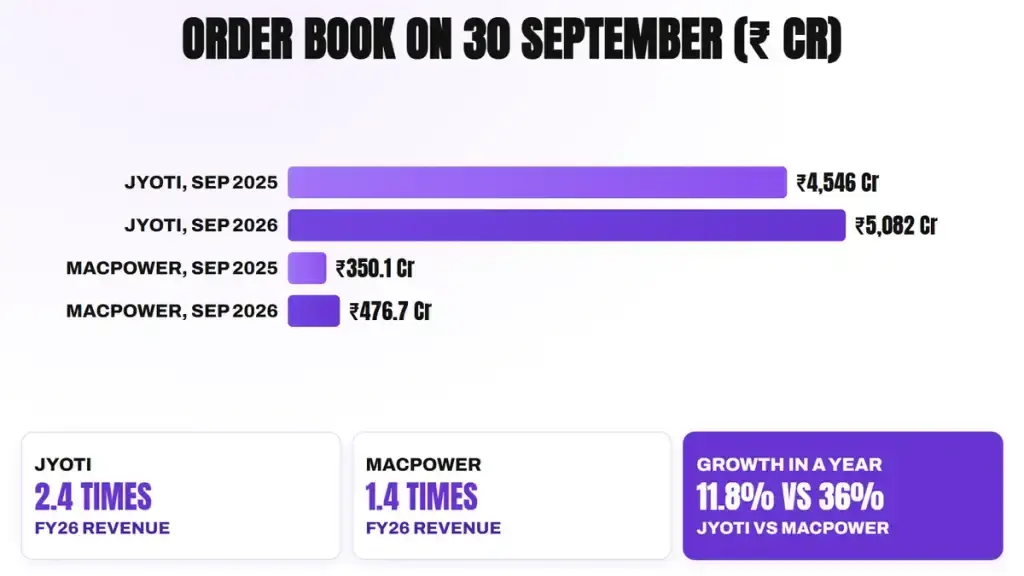
| 30 September 2025 | ₹4,546 Cr | ₹350.1 Cr |
| 30 September 2026 | ₹5,082 Cr | ₹476.7 Cr |
| Growth in a year | 11.8% | 36% |
| Times FY26 revenue | 2.4 | 1.4 |
| Largest slice | Aerospace and defence, 36% | NEXA premium range, 40% |
Jyoti has the bigger and longer order book: ₹5,082 Cr, about 10.7 times Macpower's, and about 2.4 times its own FY26 revenue. In Q2 FY27 it booked ₹809 Cr of new orders and executed ₹575 Cr. Only 13% of the new orders came from aerospace and defence, against 50% from auto and auto components.
Management guides 25% to 30% revenue growth for FY27 with a margin of about 25%, and expects to sell 8,000 machines against 3,317 in H1. At 25% growth, FY27 revenue would be about ₹2,616 Cr, so H2 would need about ₹1,506 Cr against ₹1,110.5 Cr in H1. Its record on guidance is mixed: for FY26 it guided 30% to 35% growth in November 2025 and delivered 15.2%. Jyoti has spent ₹183 Cr on capex so far in FY27 on a ₹450 Cr to ₹500 Cr expansion, and has approval for a ₹1,020.65 Cr investment over five years at Rajkot under the government's electronics component scheme, eligible for a capital subsidy of up to 25%.
Macpower has the faster-growing order book, up 36% in a year, plus bids of ₹939.3 Cr waiting for results. Management guides nearly 35% revenue growth for FY27, or about ₹450 Cr at that rate, and 2,300 to 2,400 machines. Growth depends on new space. A 13-acre site on a 30-year lease, costing about ₹50 Cr, is being built, and it has picked a 60-acre greenfield site where phase 1 would add 2,000 machines for about ₹100 Cr. Management says both sites together could make 10,000 machines a year.
Balance Sheet and Cash Flow
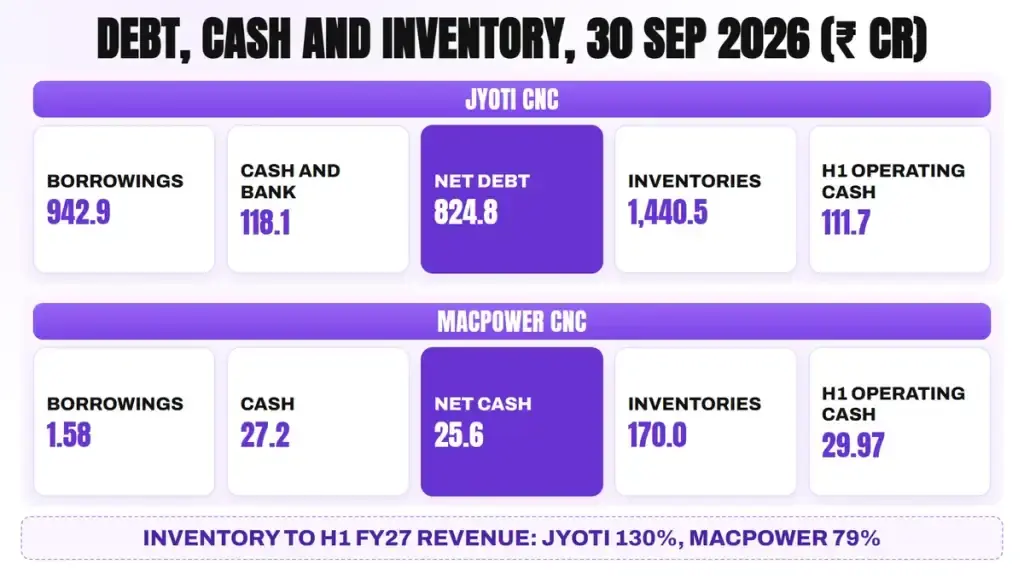
| 30 Sep 2026 unless shown | Jyoti CNC (consolidated) | Macpower CNC |
|---|---|---|
| Borrowings | ₹942.9 Cr (Mar 2026: ₹849.7 Cr) | ₹1.58 Cr |
| Cash and bank | ₹118.1 Cr | ₹27.2 Cr |
| Net debt | ₹824.8 Cr (Mar 2026: ₹712.5 Cr) | Net cash ₹25.6 Cr |
| Equity | ₹2,138.2 Cr | ₹196.9 Cr |
| Debt-equity, FY26 (as reported) | 0.42 consolidated, 0.25 standalone | 0.04 |
| Inventories | ₹1,440.5 Cr (Mar 2026: ₹1,166.0 Cr) | ₹170.0 Cr (Mar 2026: ₹145.6 Cr) |
| Operating cash flow, H1 FY27 | ₹111.7 Cr (H1 FY26: ₹13.2 Cr) | ₹29.97 Cr (H1 FY26: ₹0.82 Cr) |
| Operating cash flow, FY26 | ₹54.4 Cr (FY25: -₹105.4 Cr) | ₹14.0 Cr (FY25: ₹7.0 Cr) |
Both companies tie up a lot of money in stock, because a CNC maker has to hold thousands of parts for hundreds of models. Jyoti's inventory was about 130% of its H1 FY27 revenue; management puts it at about 190 days, down from 203 in March 2026. Macpower's was about 79% of H1 revenue. Read more on this ratio in Inventory Turnover Ratio Explained.
The bigger gap is debt. Jyoti's net debt rose to ₹824.8 Cr as it funded stock, Huron and new capacity, and its operating cash flow has lagged its profit: ₹54.4 Cr in FY26 against ₹336.0 Cr of profit, and negative in FY24 and FY25. H1 FY27 was better, with operating cash flow of ₹111.7 Cr, about 47% of EBITDA. Macpower has almost no debt and turned about 85% of its H1 FY27 EBITDA into operating cash, helped by receivables falling to ₹22.9 Cr from ₹46.3 Cr in March after it stopped dispatching machines against short-term letters from a finance company. For a simple guide to reading these numbers, see Cash Flow Statement Explained.
On return on capital, as each company reports it for FY26, Macpower is ahead: ROCE of 26.24% and ROE of 19.36%, against Jyoti's standalone 18.52% and 17.31%.
Risks for Each Company
Jyoti CNC
- Huron investigation. In April 2026 French authorities opened a judicial investigation into Huron over export controls on dual-use machinery. Huron bank accounts of about EUR 4.0 million and two properties of Jyoti's French holding company were seized, and Huron says it will contest the case. Jyoti reversed ₹67 Cr of Huron revenue in Q4 FY26, and its auditor flagged a material uncertainty about the French subsidiary's ability to continue as a going concern. Management targets close to ₹300 Cr of Huron revenue in FY27.
- Debt and cash. Net debt of ₹824.8 Cr and weak cash conversion leave less room if orders slow.
- Defence timing. Aerospace and defence fell to 21% of Q2 FY27 revenue as some tenders did not open on time, and to 13% of new orders.
- Guidance gap. FY26 growth of 15.2% came in well below the 30% to 35% guided.
- Pledged shares. Promoter group shares equal to 7.72% of capital were encumbered in September 2026.
Macpower CNC
- Scale. With ₹333.18 Cr of FY26 revenue, one slow quarter in MSME demand hits it harder.
- Customer finance. Most buyers are small factories; management says 95% of them use subsidies, which means taking bank loans to buy machines.
- Capacity. Its 2,500-machine plant limits growth until the 13-acre site is running.
- Inventory. Stock rose to ₹170.0 Cr from ₹145.6 Cr in six months.
- Defence is still small. Management says makers win about 10% to 12% of defence tenders they bid for, and defence is a single-digit share of its revenue.
Which Is Stronger on Each Measure?
| Measure | Stronger | Why |
|---|---|---|
| Size (FY26 revenue) | Jyoti | ₹2,093.1 Cr against ₹333.18 Cr |
| Five-year growth (FY22 to FY26) | Jyoti | Revenue 2.8 times against 1.75 times |
| Latest-quarter growth (Q2 FY27) | Macpower | +40.4% against +18.5% |
| EBITDA margin (FY26) | Jyoti | 25.2% against 16.18% |
| Profit trend (H1 FY27) | Macpower | Up 65.5% against down 17.3% |
| Return on capital (FY26) | Macpower | ROCE 26.24% against 18.52% |
| Order book size and cover | Jyoti | ₹5,082 Cr, 2.4 times revenue, against 1.4 times |
| Order book growth | Macpower | 36% against 11.8% |
| Balance sheet | Macpower | Net cash ₹25.6 Cr against net debt ₹824.8 Cr |
| Cash conversion (H1 FY27) | Macpower | About 85% of EBITDA against about 47% |
| Product range and technology | Jyoti | 5-axis machines, Huron, ₹35.62 lakh average price |
| Aerospace and defence exposure | Jyoti | 39% of FY26 revenue, 36% of order book |
Explore our Products
Research Framework

Emerging Titans
Combination of quantitative analysis, industry tailwinds, and management assessment - SPRINT investment philosophy

Tiny Titans
Heavy emphasis on scuttlebutt research, plant visits, and early on-ground signals
Conclusion
Jyoti CNC and Macpower CNC both make metal-cutting machines in Rajkot, but they are at different stages. Jyoti is the larger, higher-end maker: more than six times Macpower's revenue, a ₹5,082 Cr order book, 5-axis technology, a French brand and real aerospace and defence business. It also carries the heavier load: ₹824.8 Cr of net debt, a judicial investigation at Huron, and a consolidated profit that fell in H1 FY27 even as the Indian business grew.
Macpower is the smaller, simpler business: volume machines for small factories, no debt, a higher return on capital and faster recent growth, but with capacity limits until its new site is ready and much less exposure to defence. Which one is stronger depends on the measure. A reader focused on scale, technology and defence will look at Jyoti and the outcome at Huron. A reader focused on balance sheet strength and steady compounding will look at Macpower and how fast it can add capacity. For more listed names across the sector, see Capital Goods Stocks in India 2026, and for each company in depth, read our pages on Jyoti CNC and Macpower CNC.
FAQs
Jyoti CNC vs Macpower CNC: which is better?
+Neither is better on every measure. Jyoti is stronger on size, five-year growth, EBITDA margin, order book and technology: FY26 revenue of ₹2,093.1 Cr, a 25.2% margin and an order book of ₹5,082 Cr. Macpower is stronger on balance sheet, return on capital and recent growth: net cash of ₹25.6 Cr, ROCE of 26.24% and Q2 FY27 revenue growth of 40.4%. This is research, not a recommendation.
Which company has the bigger order book, Jyoti CNC or Macpower?
+Jyoti CNC. Its order book was ₹5,082 Cr on 30 September 2026, about 2.4 times its FY26 revenue, with 36% from aerospace and defence. Macpower's was ₹476.7 Cr, about 1.4 times its FY26 revenue, but it grew 36% in a year against Jyoti's 11.8%.
Why did Jyoti CNC's profit fall in Q2 FY27 when revenue grew?
+Consolidated revenue rose 18.5% to ₹602.0 Cr, but net profit fell 15.1% to ₹72.6 Cr. The Indian business did well, with standalone profit of ₹114.9 Cr against ₹78.9 Cr. The fall came from Huron, where only about ₹15 Cr of ₹42 Cr of dispatches reached consolidated revenue, along with higher other expenses and depreciation and lower other income.
Which has more debt, Jyoti CNC or Macpower CNC?
+Jyoti CNC. Its consolidated borrowings were ₹942.9 Cr and net debt ₹824.8 Cr on 30 September 2026. Macpower had borrowings of ₹1.58 Cr and cash of ₹27.2 Cr, a net cash position of ₹25.6 Cr.
What kind of machines do Jyoti CNC and Macpower make?
+Both make metal-cutting CNC machines. Jyoti offers 200+ variants including simultaneous 5-axis and multitasking machines, sold at an average of ₹35.62 lakh in FY26, and owns Huron in France. Macpower makes turning centres, vertical machining centres and other machines across 388 models, sold at nearly ₹20 lakh on average in FY26, mostly to MSMEs.
Why are CNC machine stocks in India in focus?
+India uses machine tools worth about ₹38,000 Cr to ₹40,000 Cr a year but produces only about ₹16,000 Cr worth, and about 60% of CNC demand is met by imports. Local makers such as Jyoti CNC and Macpower are adding capacity to win that share from auto, general engineering, electronics and defence buyers.

High growth stock specialist, Value Educator
Shashank Mahajan is an equity research professional with over 12 years of experience in identifying high-potential SME and micro-cap stocks at an early stage. He follows a rigorous scuttlebutt research–driven approach, combining on-ground insights with deep financial analysis. Shashank specializes in uncovering under-researched and under-owned companies with strong management quality and long-term growth potential. Through disciplined research and early identification, he focuses on spotting tomorrow’s market leaders before they enter the mainstream investor radar.
More about Shashank Mahajan →
Azad Engineering vs MTAR vs Unimech: Aerospace Parts
Subros vs Lumax Auto vs Sona BLW: EV Auto Parts Compared
Data Patterns vs Astra Microwave vs Apollo Micro

Himadri vs PCBL: Carbon Black and Battery Materials

Inox Wind vs Suzlon: Wind Turbine Makers Compared
Kaynes vs Cyient DLM vs Syrma SGS: EMS Stocks Compared
Explore our Products
Research Framework
Emerging Titans
Combination of quantitative analysis, industry tailwinds, and management assessment - SPRINT investment philosophy
Tiny Titans
Heavy emphasis on scuttlebutt research, plant visits, and early on-ground signals



India's Aerospace Opportunity
Global Demand. Supply Bottlenecks. Opportunities Ahead.
Don't Miss This Exclusive Webinar!
Join Value Educator to decode the key trends shaping India's aerospace sector and learn how to identify tomorrow's potential leaders in the space.
- How the aircraft value chain works, layer by layer
- Indian companies supplying global aircraft makers
- A framework to judge any aerospace company

 Orders
 Subscription
 Share with friends


Required Details
₹23999.00
(12 month subscription)
As per SEBI regulations, all users are mandated to complete the KYC that is validated for 1 year. Post payment, you will be redirected to the KYC screen


No comments yet. Be the first to comment!