
Azad Engineering vs MTAR vs Unimech: Aerospace Parts
Azad Engineering, MTAR Technologies and Unimech Aerospace are three listed Indian makers of precision parts for some of the most demanding customers in the world: jet-engine and gas-turbine makers, aircraft builders, nuclear reactors and rocket programmes. All three machine metal to very tight limits, all three spend years getting each part approved, and all three sell mostly abroad. That is why investors often group them together as "aerospace stocks".
Look closer and they are very different businesses. Azad makes turbine blades, mostly for power-plant turbines. MTAR earns most of its money from fuel-cell parts for one large US customer. Unimech mainly makes the tools that engine makers and repair shops use, and is now starting to make flying parts. Their results for the quarter to 30 September 2026 pulled them further apart. This page sets them side by side on business, growth, margins, order books, debt, cash flow and risks, using the same period for each company in every row.
Figures as of 20 November 2026. This page is research, not a recommendation to buy or sell any stock.
Azad Engineering vs MTAR vs Unimech at a Glance
| Measure | Azad Engineering | MTAR Technologies | Unimech Aerospace |
|---|---|---|---|
| Business | Turbine blades (airfoils) and engine parts for power, aerospace, defence and oil and gas | Precision systems for fuel cells, nuclear reactors, space, defence and aerospace | Aero-engine tooling, precision parts and assemblies, metal bellows |
| Plants | Six customer-dedicated plants (44,800 sq m) plus older units, Hyderabad | Sixteen manufacturing units, Hyderabad | 5 facilities, about 563,000 sq ft |
| Revenue, FY26 | ₹603.0 Cr | ₹876.2 Cr | ₹240.5 Cr |
| EBITDA margin, FY26 | 37.4% | 19.5% | 31.2% |
| Profit after tax, FY26 | ₹133.6 Cr | ₹94.0 Cr | ₹63.3 Cr |
| ROCE, FY26 (as each company reports it) | 15.3% (adjusted, standalone) | 17.2% | 9.6% |
| Net debt (+) or net cash, 30 Sep 2026 | Net debt ₹423.8 Cr (standalone) | Net debt ₹83.1 Cr | Net cash about ₹65 Cr |
| Order book after Q2 FY27 | About ₹6,500 Cr (rolling contracts) | ₹5,976.5 Cr | About ₹855 Cr |
| Revenue growth, Q2 FY27 | 31.1% | 200.0% | 98% (Hobel included) |
| Customers | GE Vernova, Siemens Energy, Mitsubishi, Baker Hughes, Honeywell, Rolls-Royce, Pratt and Whitney Canada, BHEL, GTRE | One customer gave 73.2% of FY26 revenue; also ISRO, nuclear projects, Thales, GKN, IAI, Rafael, Elbit | 41 customers in 8 countries, including Honeywell and FACC; about 95% exports |
| Key risk | New plants built ahead of revenue; cash flow negative | Heavy reliance on one fuel-cell customer | Small confirmed order book; growth helped by an acquisition |
The table shows three different shapes. MTAR is the largest by revenue and grew fastest in the latest quarter. Azad has the highest full-year margin and the largest order book compared with its revenue, but its profit fell in the quarter and it is borrowing to build plants. Unimech is the smallest, has the highest quarterly margin and still has net cash, but its order book is the thinnest of the three.
Business Models: Who Makes What, and for Whom
All three are build-to-print suppliers. The customer owns the design, and the supplier earns its place by making the part exactly, every time, after a long approval process. Azad says qualifying a new supplier takes an estimated 30-48 months. This slow approval is the core of each company's moat, the advantage that keeps rivals out (see Economic Moat Explained).
Azad Engineering: turbine blades, plants built for single customers
Azad makes airfoils, the blades inside gas, steam and nuclear turbines, plus engine and defence parts. Energy and oil and gas made up 81.1% of H1 FY27 standalone revenue. Aerospace and defence was 16.8%, or ₹60.4 Cr, and grew 28.3%. Exports were 88.0% of H1 FY27 revenue, down from 93.9% a year earlier as domestic sales rose.
Its model is unusual. Azad builds a plant for one customer, backed by a long contract. It now has six such plants for four global makers, including two inaugurated for GE Vernova's gas-power business in September 2026 and one for Baker Hughes. In aerospace, it delivered a complete engine to GTRE, the defence research lab, on 22 July 2026. Read the full story in our Azad Engineering article.
MTAR Technologies: fuel cells first, nuclear, space and defence after
MTAR has worked for India's nuclear, space and defence programmes for decades, supplying reactor assemblies, rocket engine parts and actuators. But its revenue today comes mostly from clean energy: fuel-cell parts, hydro and other products made ₹554.7 Cr, or 72%, of H1 FY27 revenue. It makes the hot boxes inside Bloom Energy's fuel cells, which are now used to power US data centres. Products such as ball screws added ₹123.8 Cr (16%), aerospace and defence ₹80.2 Cr (10%), and civil nuclear just ₹8.7 Cr (1%).
MTAR is spreading its base. It has data-centre parts orders from SLB, oil and gas parts qualified with Weatherford, and structural assemblies for the Advanced Medium Combat Aircraft programme. More detail is in our MTAR Technologies article.
Unimech Aerospace: tools first, flying parts next
Unimech, founded in 2016, makes the special tools that aero-engine makers and repair shops use to build and service engines. Aero tooling was about 67% of H1 FY27 revenue, or about ₹155 Cr. The other 33% came from precision components and assemblies, the "flying parts" side. Most of that came from Hobel, a bellows maker it bought for about ₹450 Cr and consolidated from 1 May 2026. Hobel alone gave 30% of H1 revenue.
Unimech is trying to move from tools into parts that fly. It has a 10-year agreement with Honeywell Aerospace, a USD 7.5 million agreement with FACC, and an award of about USD 43 million from an aerostructures maker. It expects 596 parts to go through qualification by the end of FY27. See our Unimech Aerospace article for the full picture.
Latest Quarter: Q2 FY27 Side by Side
All three reported the quarter to 30 September 2026: Unimech on 27 October, MTAR on 29 October and Azad on 6 November 2026.
| Q2 FY27 (quarter to 30 Sep 2026) | Azad Engineering | MTAR Technologies | Unimech Aerospace |
|---|---|---|---|
| Revenue | ₹190.9 Cr | ₹406.8 Cr | ₹123.0 Cr |
| Revenue a year earlier | ₹145.6 Cr | ₹135.6 Cr | ₹62.0 Cr |
| Revenue growth | 31.1% | 200.0% | 98% |
| EBITDA | ₹72.3 Cr | ₹99.2 Cr | ₹49.0 Cr |
| EBITDA margin | 37.9% | 24.4% | 39.8% |
| Profit after tax | ₹30.9 Cr | ₹59.8 Cr | ₹31.8 Cr |
| Profit growth | Down 5.2% | ₹4.2 Cr a year earlier | 103% |
| PAT margin | 16.2% | 14.7% | 24.4% |
| H1 FY27 revenue | ₹363.5 Cr | ₹767.5 Cr | ₹230.6 Cr |
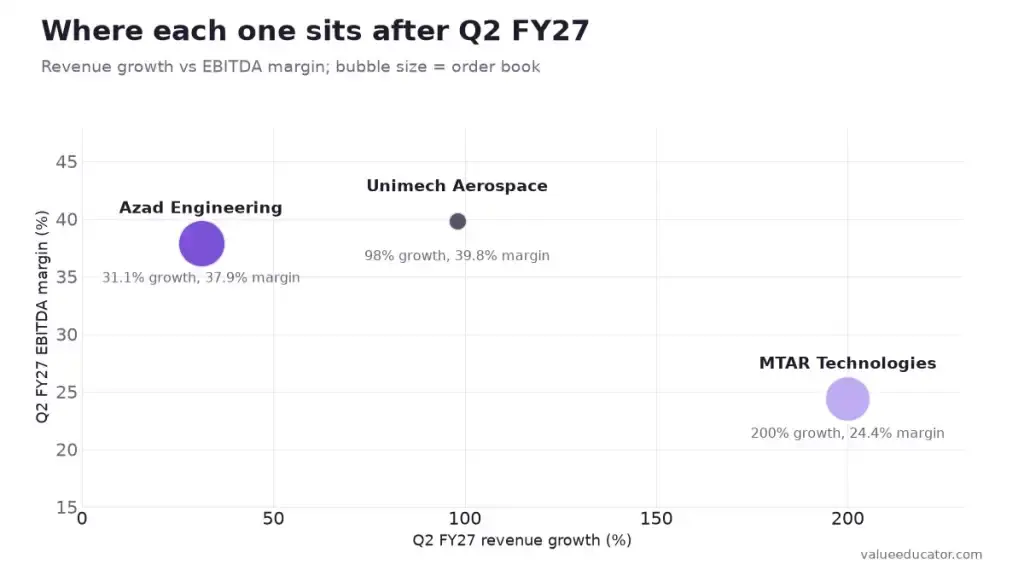
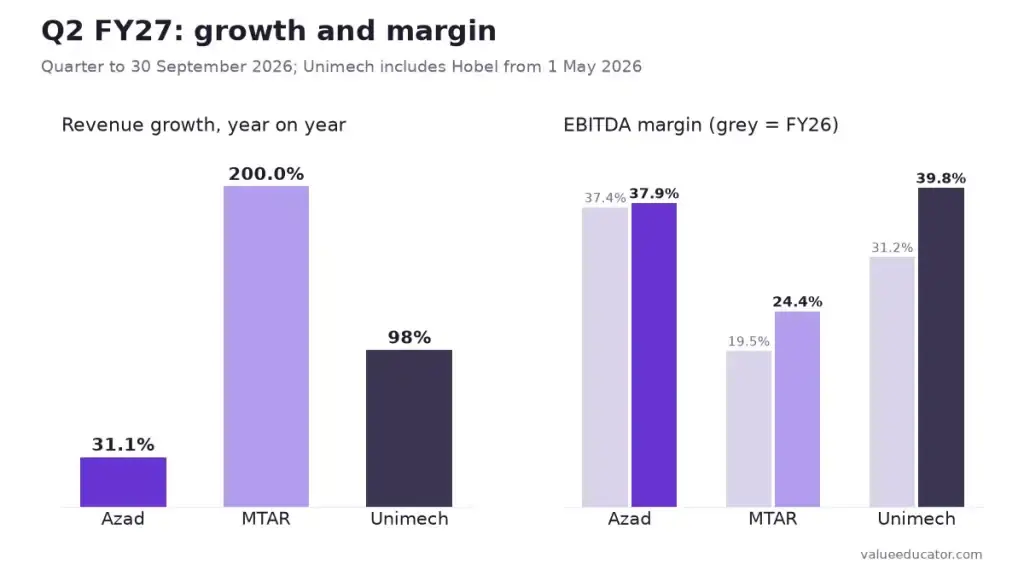
MTAR had the biggest jump. Revenue tripled from a weak base a year earlier, and its EBITDA margin rose from 12.5% to 24.4%. Revenue also grew 12.8% over Q1 FY27's ₹360.7 Cr. MTAR's revenue in the quarter was 2.1 times Azad's and 3.3 times Unimech's.
Unimech almost doubled revenue and lifted its EBITDA margin from 29.9% to 39.8%, the highest of the three. Part of that growth is Hobel, which was not in the numbers a year ago, so the like-for-like growth is lower than 98%.
Azad grew revenue steadily but its profit fell. Interest on its cash fell from ₹12.7 Cr to ₹4.7 Cr as it spent the money on plants. Depreciation doubled to ₹21.8 Cr, finance cost rose to ₹12.2 Cr, and employee cost rose to ₹50.3 Cr from ₹32.5 Cr as it hired ahead of new output. Azad says output from the new plants starts in Q3 FY27.
Five-Year Financials
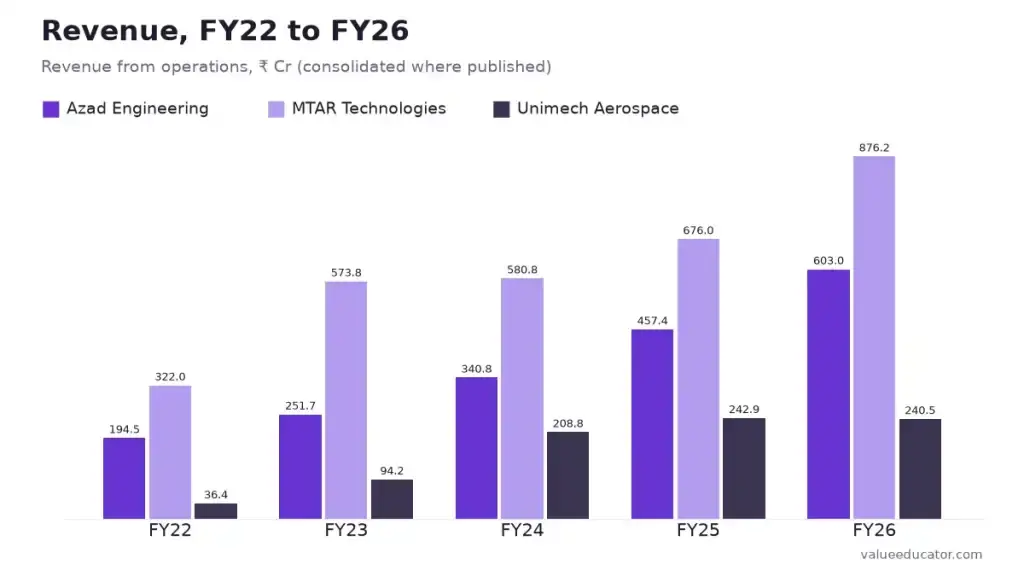
The table below uses the years to 31 March, FY22 to FY26, for all three. Azad and Unimech figures are consolidated. MTAR merged its two subsidiaries into itself in October 2026 and restated past periods; it says the impact was not material.
| ₹ Cr | FY22 | FY23 | FY24 | FY25 | FY26 |
|---|---|---|---|---|---|
| Azad: revenue | 194.5 | 251.7 | 340.8 | 457.4 | 603.0 |
| Azad: EBITDA margin | 32.0% | 28.7% | 34.2% | 36.1% | 37.4% |
| Azad: profit after tax | 29.5 | 8.5 | 58.6 | 86.5 | 133.6 |
| MTAR: revenue | 322.0 | 573.8 | 580.8 | 676.0 | 876.2 |
| MTAR: EBITDA margin | 29.3% | 26.8% | 19.4% | 17.9% | 19.5% |
| MTAR: profit after tax | 60.9 | 103.4 | 56.1 | 53.4 | 94.0 |
| Unimech: revenue | 36.4 | 94.2 | 208.8 | 242.9 | 240.5 |
| Unimech: EBITDA margin | 21% | 37% | 38% | 38% | 31.2% |
| Unimech: profit after tax | 3.4 | 22.8 | 58.1 | 83.5 | 63.3 |
Each company has a different growth record:
- Azad grew every year, at a compound rate of 32.7% from FY22 to FY26, and its margin rose to 37.4%. FY23 profit was low because of one-time finance costs before its listing.
- MTAR grew 28.4% a year over the period, but unevenly. Revenue was nearly flat in FY24 and its margin fell from 29.3% in FY22 to 17.9% in FY25 before recovering in FY26 and then sharply in FY27 so far.
- Unimech grew fastest, at 60.4% a year, but from a very small base. FY26 revenue fell 1.0% after US tariffs, against guidance of growth above 40%. Before tariff concessions, FY26 revenue would have been about ₹257 Cr against about ₹240 Cr reported.
On profit margin for FY26, Unimech led with 26.3%, Azad had 22.2% and MTAR 10.7%.
Order Book and Growth Plans
| Order book | Azad Engineering | MTAR Technologies | Unimech Aerospace |
|---|---|---|---|
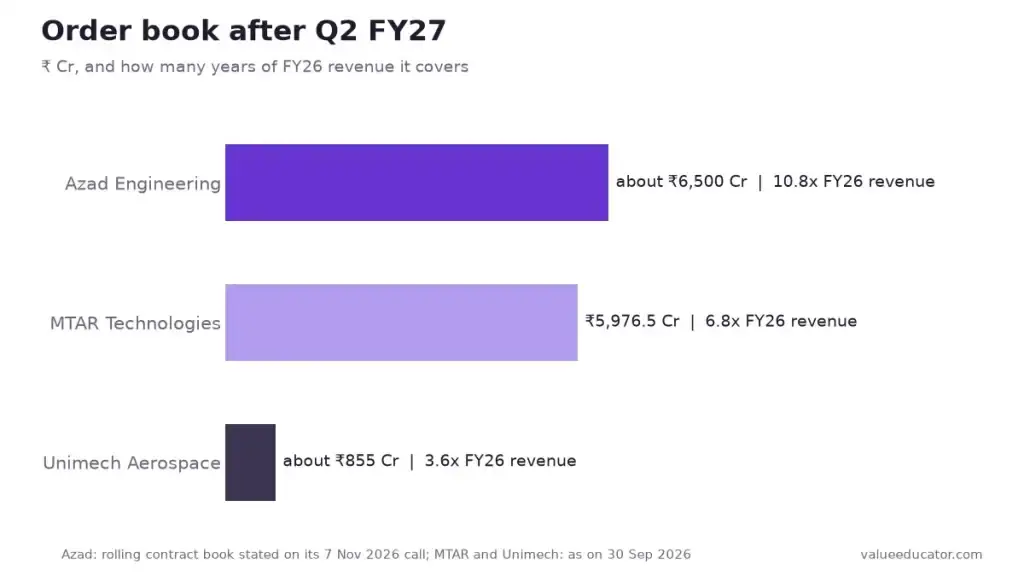
| Size | About ₹6,500 Cr | ₹5,976.5 Cr | About ₹855 Cr |
| Date | Stated on 7 November 2026 call | 30 September 2026 | 30 September 2026 |
| Times FY26 revenue | 10.8x | 6.8x | 3.6x |
| What it includes | Long-term contracts, a rolling book | Firm orders; clean energy ₹4,075.5 Cr | ₹266 Cr confirmed orders plus about ₹589 Cr long-term agreements and award letters |
The three numbers are not quite the same thing, so they need care. MTAR's ₹5,976.5 Cr is a book of orders, up from ₹5,143.3 Cr on 30 June 2026 after ₹1,207.2 Cr of new orders in Q2. It took ₹4,102 Cr of orders in H1 FY27, and its civil nuclear book alone is ₹820 Cr. Azad's figure of about ₹6,500 Cr is a set of long contracts that roll forward, and its management said on the call it should not be read as an order backlog. Unimech's ₹855 Cr is up 715% from a year ago, but only ₹266 Cr is confirmed purchase orders.
Azad Engineering: plants built, revenue to follow
Azad says its plants are now built, staffed and stocked. It expects output from the new plants to start in Q3 FY27, revenue to ramp up from Q4 FY27, and all plants to be fully ramped up by Q2 FY28. It says current capacity can support an annual revenue run-rate of over ₹1,300 Cr by the end of FY28, about double FY26 revenue, and repeats long-term guidance of over 25% annual growth.
MTAR Technologies: more capacity for fuel cells, new lines
MTAR guided for 80% revenue growth in FY27 with an EBITDA margin of 24% ±100 bps, and expects H2 FY27 to be stronger than H1. Its Phase 2 fuel-cell facility was due to start by the end of November, and a larger Phase 3 by June 2028. It plans capex of about ₹500 Cr, ₹400 Cr of it in FY27. It is executing ₹45 Cr of first-article orders from SLB for data-centre parts, a line it says could grow to ₹350-450 Cr over the next 2 years, and aims for about ₹150 Cr plus of revenue from global aerospace customers this year.
Unimech Aerospace: qualification first, a Saudi joint venture next
Unimech's plants are running at about 65% utilisation. It is targeting 596 parts for qualification by the end of FY27 and holds 51% of a Saudi joint venture that needs about ₹200-250 Cr of capex. Management has spoken of an aspiration of ₹1,000 Cr of revenue, but has said this is not guidance.
Balance Sheet and Cash Flow
| 30 Sep 2026 / H1 FY27 | Azad Engineering (standalone) | MTAR Technologies | Unimech Aerospace |
|---|---|---|---|
| Borrowings | ₹536.4 Cr (bank) | ₹466.3 Cr | ₹161.0 Cr |
| Cash, bank deposits and investments | ₹112.6 Cr | ₹383.2 Cr | ₹226.4 Cr |
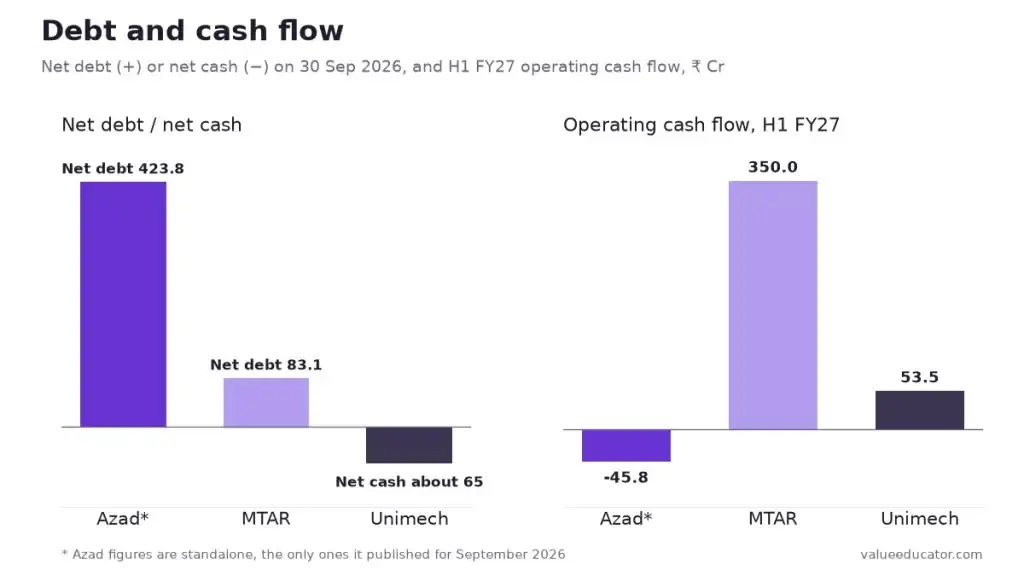
| Net debt (+) / net cash | Net debt ₹423.8 Cr | Net debt ₹83.1 Cr | Net cash about ₹65 Cr |
| Net debt to equity | 0.26x | 0.09x | Net cash |
| Operating cash flow, H1 FY27 | ₹-45.8 Cr | ₹350.0 Cr | ₹53.5 Cr |
MTAR has the strongest cash flow right now. It generated ₹350.0 Cr from operations in H1 FY27, against ₹39.8 Cr a year earlier, and its working capital fell to 50 days, helped by advances that customers pay against orders. That paid for most of its ₹273.1 Cr of H1 capex. Net debt fell to ₹83.1 Cr from ₹132.8 Cr in March 2026.
Azad is in its heaviest spending phase. Net debt rose to ₹423.8 Cr from ₹272 Cr in March 2026. Operating cash flow was negative at ₹45.8 Cr in H1 FY27 and ₹123.3 Cr in FY26, because inventory rose by ₹98 Cr to ₹425 Cr and receivables by ₹92 Cr to ₹402 Cr. Of the inventory increase, ₹72 Cr is work in progress at new lines, including parts still in customer approval. Net debt is still only 0.26x its net worth of ₹1,619.6 Cr.
Unimech still has net cash, but much less than before. Net cash fell from ₹479.7 Cr in March 2026 to about ₹65 Cr, mainly because it paid for Hobel; the deal added ₹322.0 Cr of goodwill. Receivables almost doubled to ₹122.6 Cr from ₹64.8 Cr, and it expects working capital to rise from about 110 days to 150-160 days by the end of FY27 as longer aerospace and nuclear work grows.
If you want to see why operating cash flow can differ so much from profit, read Cash Flow Statement Explained.
Risks for Each Company
Azad Engineering
- Plants ahead of revenue. Costs for six new plants are already in the accounts. If customer approvals or ramp-ups slip, profit and cash flow stay under pressure.
- Rising debt. Net debt rose to ₹423.8 Cr in six months, and finance cost is climbing.
- A few large customers. Each new plant serves one maker, so a change at one customer affects a whole plant.
MTAR Technologies
- One customer. Its largest customer gave 73.2% of FY26 revenue. Any slowdown in that customer's fuel-cell orders would hit MTAR hard.
- Uneven history. Margin fell for two years before FY26, and revenue was nearly flat in FY24.
- Execution. It must deliver 80% growth while building new capacity and adding data-centre and oil and gas lines.
Unimech Aerospace
- Thin confirmed orders. Only ₹266 Cr of the ₹855 Cr book is confirmed purchase orders.
- Tariffs and exports. About 95% of revenue comes from exports, and US tariffs already cut FY26 revenue.
- Acquisition effects. Hobel lifts growth this year and added goodwill; working capital is set to rise.
Which Is Stronger on Each Measure?
| Measure | Stronger | Why |
|---|---|---|
| Size (FY26 revenue) | MTAR | ₹876.2 Cr, against ₹603.0 Cr for Azad and ₹240.5 Cr for Unimech |
| Latest-quarter growth | MTAR | 200.0%, against 98% for Unimech and 31.1% for Azad |
| Full-year margin (FY26 EBITDA) | Azad | 37.4%, against 31.2% for Unimech and 19.5% for MTAR |
| Latest-quarter margin | Unimech | 39.8%, against 37.9% for Azad and 24.4% for MTAR |
| Five-year growth record | Unimech | 60.4% a year, from the smallest base |
| Order book cover | Azad | About 10.8x FY26 revenue, though it is a rolling contract book |
| Firm order book | MTAR | ₹5,976.5 Cr of orders, 6.8x FY26 revenue |
| ROCE, FY26 | MTAR | 17.2%, against 15.3% for Azad (adjusted) and 9.6% for Unimech |
| Balance sheet | Unimech | Net cash of about ₹65 Cr |
| Cash flow, H1 FY27 | MTAR | ₹350.0 Cr from operations |
| Customer spread | Azad | Several global turbine and engine makers, each served through its own plant |
No company wins on every measure. MTAR leads on size, growth, returns and cash flow right now, but it depends heavily on one customer. Azad has the best full-year margin and the longest visibility, but it is in a costly build-out phase. Unimech has the highest quarterly margin and a clean balance sheet, but the smallest and least firm order book.
Explore our Products
Research Framework

Emerging Titans
Combination of quantitative analysis, industry tailwinds, and management assessment - SPRINT investment philosophy

Tiny Titans
Heavy emphasis on scuttlebutt research, plant visits, and early on-ground signals
Conclusion
These three companies share a skill, making precise metal parts that take years to approve, but they sell it into different markets. MTAR's results today depend mostly on fuel cells for data-centre power, with nuclear, space and aerospace as long-term options. Azad's depend on power-plant turbines, with aerospace and defence at 16.8% of revenue. Unimech is the most aerospace-focused of the three, but much of that is tooling rather than flying parts.
What each suits depends on what matters to the reader. Azad's case rests on its six new plants ramping up on time from Q4 FY27. MTAR's rests on its main customer's growth continuing and on new lines reducing that reliance. Unimech's rests on turning qualified parts and award letters into firm orders. For a wider view of the sector, see our guide to aerospace stocks in India.
FAQs
Azad Engineering vs MTAR vs Unimech: which is better?
+None is stronger on every measure. MTAR is the largest, grew revenue 200.0% in Q2 FY27 and generated ₹350.0 Cr of operating cash in H1 FY27, but one customer gave 73.2% of its FY26 revenue. Azad had the highest FY26 EBITDA margin at 37.4% and a rolling contract book of about ₹6,500 Cr, but its Q2 profit fell 5.2% and net debt rose to ₹423.8 Cr. Unimech had the highest Q2 margin at 39.8% and net cash, but the smallest order book at about ₹855 Cr.
Which of the three is the largest?
+MTAR Technologies, with FY26 revenue of ₹876.2 Cr, followed by Azad Engineering at ₹603.0 Cr and Unimech Aerospace at ₹240.5 Cr.
Which has the biggest order book?
+Azad Engineering stated about ₹6,500 Cr on its 7 November 2026 call, but this is a rolling set of long contracts rather than a backlog. MTAR had ₹5,976.5 Cr of orders on 30 September 2026, and Unimech about ₹855 Cr, of which ₹266 Cr was confirmed purchase orders.
Which company has the most aerospace exposure?
+Unimech, where aero tooling was about 67% of H1 FY27 revenue. Azad's aerospace and defence revenue was ₹60.4 Cr, or 16.8%, in H1 FY27, and MTAR's was ₹80.2 Cr, or 10%.
Why did Azad Engineering's profit fall in Q2 FY27?
+Revenue grew 31.1% to ₹190.9 Cr, but interest income fell from ₹12.7 Cr to ₹4.7 Cr as cash went into plants, depreciation doubled to ₹21.8 Cr and finance cost rose to ₹12.2 Cr. Profit after tax fell 5.2% to ₹30.9 Cr.
Which has the strongest balance sheet?
+Unimech had net cash of about ₹65 Cr on 30 September 2026, down from ₹479.7 Cr in March after it paid for Hobel. MTAR had net debt of ₹83.1 Cr, or 0.09x equity. Azad had net debt of ₹423.8 Cr, or 0.26x equity, on a standalone basis.

High growth stock specialist, Value Educator
Shashank Mahajan is an equity research professional with over 12 years of experience in identifying high-potential SME and micro-cap stocks at an early stage. He follows a rigorous scuttlebutt research–driven approach, combining on-ground insights with deep financial analysis. Shashank specializes in uncovering under-researched and under-owned companies with strong management quality and long-term growth potential. Through disciplined research and early identification, he focuses on spotting tomorrow’s market leaders before they enter the mainstream investor radar.
More about Shashank Mahajan →
PCBL Chemical: Carbon Black Margins and Battery Materials

KEC International: Record Orders, Weak Margin, High Debt

Sona BLW: EV Revenue Now Tops Half of Its Auto Sales

HPL Electric & Power: Smart Meters, Wires and Two Engines

Kaynes Technology: EMS, Chip Plants and ₹10,563.5 Cr Orders

Sterlite Technologies: Glass Rods to Hyperscaler Deals
Explore our Products
Research Framework
Emerging Titans
Combination of quantitative analysis, industry tailwinds, and management assessment - SPRINT investment philosophy
Tiny Titans
Heavy emphasis on scuttlebutt research, plant visits, and early on-ground signals



India's Aerospace Opportunity
Global Demand. Supply Bottlenecks. Opportunities Ahead.
Don't Miss This Exclusive Webinar!
Join Value Educator to decode the key trends shaping India's aerospace sector and learn how to identify tomorrow's potential leaders in the space.
- How the aircraft value chain works, layer by layer
- Indian companies supplying global aircraft makers
- A framework to judge any aerospace company

 Orders
 Subscription
 Share with friends


Required Details
₹23999.00
(12 month subscription)
As per SEBI regulations, all users are mandated to complete the KYC that is validated for 1 year. Post payment, you will be redirected to the KYC screen


No comments yet. Be the first to comment!