
Genus Power: Smart Meters and ₹22,634 Cr of Orders
In March 2021, an Indian meter maker had orders worth ₹931 Cr on its books. Two years later, in March 2023, it had ₹4,115 Cr. By March 2025 the book had reached ₹30,110 Cr, and in September 2026 it still stood at ₹22,634 Cr, even after two years of record deliveries. Over the same time, its yearly revenue grew from about ₹685 Cr in FY22 to ₹4,750.9 Cr in FY26.
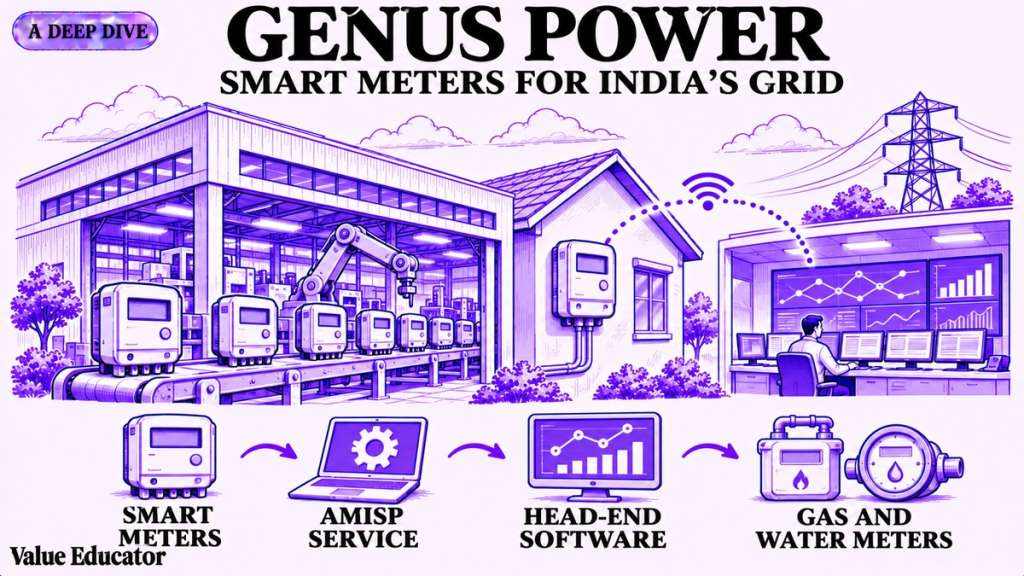
That jump came from one small box. It is the electricity meter on the wall of a home or a shop. The old meter only counted units, and a meter reader came once a month to note the number. A smart meter is a meter that sends the reading to the power company on its own, over a mobile or radio network. The company can then bill without a visit, spot theft, and switch the supply on or off from its office.
Most of these new meters are also prepaid. A prepaid meter is a meter that works like a prepaid mobile phone: the customer recharges first and then uses the power. For India's state power distribution companies, or discoms, that means cash comes in before the power goes out, instead of months later.
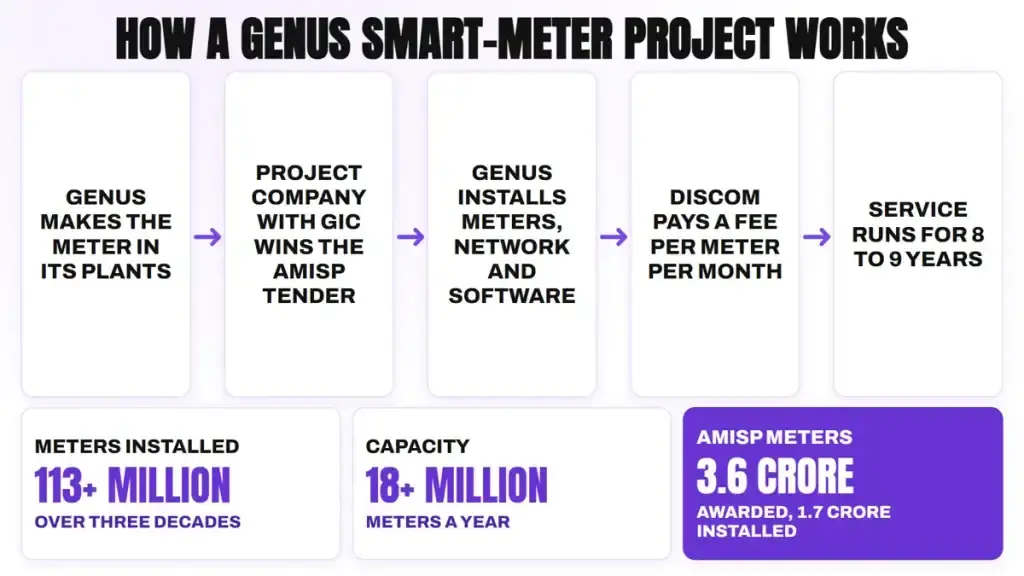
The money for this comes through a government scheme called RDSS, the Revamped Distribution Sector Scheme. Under it, a discom does not buy the meters outright. It hires an AMISP, which means an Advanced Metering Infrastructure Service Provider. The AMISP buys and installs the meters, runs the software and the network behind them, and looks after them for 8 to 9 years. The discom pays it a fixed fee for each meter, each month. This model is called TOTEX, short for total expenditure, because the AMISP's capital spend and running cost are paid back together through that monthly fee.
That meter maker is Genus Power Infrastructures Ltd (NSE: GENUSPOWER). It is based in Jaipur and has been making electricity meters for about three decades. More than 113 million of its meters have been installed so far, and its plants can make more than 18 million meters a year. The company calls itself the country's largest maker of smart meters for the power sector, and it is also a leading AMISP.
So you can think of Genus as the very end of the power chain. It does not make power or carry it over long lines. It makes the meter that measures the power at the customer's door, and it runs the system that turns those readings into a bill.
Genus Power in five numbers
- An order book of ₹22,634 Cr in September 2026, about 4.8 times FY26 revenue
- About 3.6 crore meters awarded in its AMISP projects, about 1.7 crore of them installed
- FY26 revenue of ₹4,750.9 Cr, up from ₹2,442.0 Cr in FY25
- Operating cash flow of ₹127 Cr in H1 FY27, against an outflow of ₹158 Cr a year before
- A target of ₹6,000-6,500 Cr of revenue for FY27
So a company that had ₹931 Cr of orders in March 2021 now holds about 22% to 23% of the AMISP market. How did that show up in the latest numbers? Let's first understand the company, and then look at the latest quarter.
Genus Power: Company Overview
Genus Power Infrastructures Ltd was incorporated in 1992 and is part of the Kailash group; its corporate office is in Jaipur and its registered office in Noida. The business was founded by the late Ishwar Chand Agarwal, Rajendra Kumar Agarwal is Managing Director and CEO, and Jitendra Kumar Agarwal is Joint Managing Director; the promoter group held 39.34% in March 2026. Genus makes smart electricity meters, prepaid meters, transformer and grid meters, and smart gas and water meters, and it writes the head-end and meter data software that runs them. Its plants in Jaipur, Haridwar and Guwahati can make more than 18 million meters a year. It had 1,745 permanent employees in FY26, and a workforce of more than 16,700 including contract staff in June 2026. Revenue was ₹4,750.9 Cr in FY26, and its order book stood at ₹22,634 Cr in September 2026, most of it from AMISP projects run with GIC. Read this Power Sector Stocks in India 2026: List by Value Chain
"Know what you own, and know why you own it."
— Peter Lynch
Genus is no longer only a meter maker. Most of its order book is service work under 8-to-9-year AMISP contracts, so knowing how that model earns and spends cash is the first step to reading its results.
The Quarter Revenue Stood Still
Let's look at Q2 FY27, the July to September quarter that the company reported on 14 November 2026. The numbers below are standalone, which is how the company reports and discusses its results. Revenue was ₹1,132.6 Cr, about the same as the ₹1,149.0 Cr of a year ago. It was also 17.0% lower than the ₹1,364.9 Cr of Q1 FY27.

As we can see in the table, the slowdown came from the field, not from the order book. Management named four reasons: the monsoon, which slows work on the ground, local body elections in some areas, a slower pace of installation in Uttar Pradesh, and the mix of meters shipped. It says the orders remain fully intact and that only the timing of work has moved.
"Our orders remain fully intact; the impact is limited to the timing of execution." - Jitendra Kumar Agarwal, Joint Managing Director, November 2026
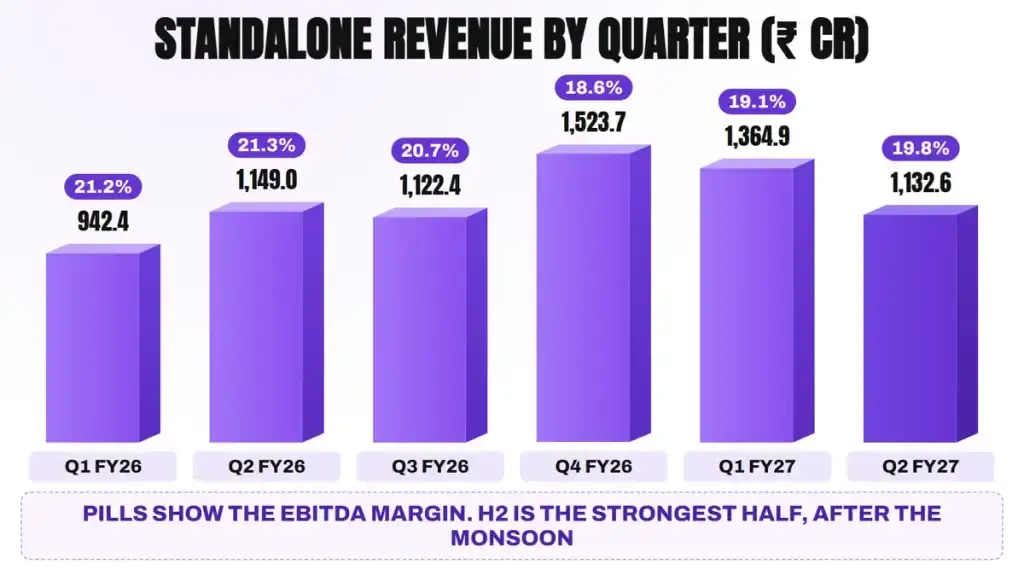
That chart also shows us a seasonal pattern. Revenue was ₹942.4 Cr in Q1 FY26 and ₹1,149.0 Cr in Q2 FY26. It then dipped to ₹1,122.4 Cr in Q3 FY26 before jumping to ₹1,523.7 Cr in Q4 FY26, when installations picked up after the rains and the festive season. Management expects the same pattern this year and calls H2 its strongest half.
Beyond revenue, the margin moved the other way. The gross margin, the share of revenue left after the cost of materials, rose to 38.3% from 37.0% in Q1 FY27. Management says better supplier terms and lower logistics costs helped. The EBITDA margin rose to 19.8% from 19.1% in the previous quarter, though it was below the 21.3% of a year ago.
That year-on-year dip has a clear cause. Genus signs its AMISP contracts at fixed prices, with no clause to pass on a rise in the cost of chips, plastics or other parts. When material costs rose in 2026, the company cut its own margin guidance for FY27 to 18%, from the 20.3% it made in FY26.
Below the EBITDA line, two costs grew faster than the business. Depreciation rose to ₹20.2 Cr from ₹12.2 Cr a year ago, and finance cost rose to ₹49.9 Cr from ₹40.7 Cr. Profit after tax fell 10.0% to ₹133.3 Cr. On a consolidated basis, which adds Genus's share in the profit of the platform it runs with GIC, profit for the quarter was ₹158.61 Cr against ₹142.98 Cr a year ago.
If we add the two quarters, the half looks better. H1 FY27 revenue was ₹2,497.4 Cr, up 19.4% from ₹2,091.4 Cr. EBITDA rose 9.2% to ₹484.7 Cr at a margin of 19.4%, still above the 18% guidance. Profit after tax rose 7.0% to ₹296.1 Cr.
The bigger change in the half was in cash. Operating cash flow was a positive ₹127 Cr in H1 FY27, against an outflow of ₹158 Cr in H1 FY26. Inventory came down by over ₹100 Cr, from ₹1,350.6 Cr in March to ₹1,247.8 Cr in September. Management says all its projects now earn revenue, and it expects receivables to fall from Q3.
That receivables line is the one you should watch, though. Trade receivables rose to ₹1,971.7 Cr in September 2026 from ₹1,484.5 Cr in March. Borrowings also rose, to ₹2,479.4 Cr from ₹2,291.9 Cr. Management has said net debt, which was ₹1,573 Cr in March 2026, should peak at about ₹2,000 Cr and start falling from FY28.
Even so, the balance sheet has room. In November 2026, CRISIL reaffirmed Genus's long-term rating at AA- and changed the outlook to Positive from Stable, on bank facilities of ₹4,927 Cr. The company also completed a buyback of up to 47,50,000 shares, worth up to ₹148.20 Cr, in November 2026.
The Orders Behind the Next Few Years
Now let's look at the orders, because they show how much work is already booked. The order book is the value of signed contracts not yet billed. For Genus, most of it is AMISP work that runs for 8 to 9 years, so it covers both the meters to be installed and the monthly service that follows.
At the end of September 2026 the order book was about ₹22,634 Cr, against ₹24,020 Cr in June and ₹25,173 Cr in March. It is coming down because Genus is billing faster than it is winning new orders. That is a choice management describes as disciplined bidding: it only bids where the returns over the contract life meet its own bar.
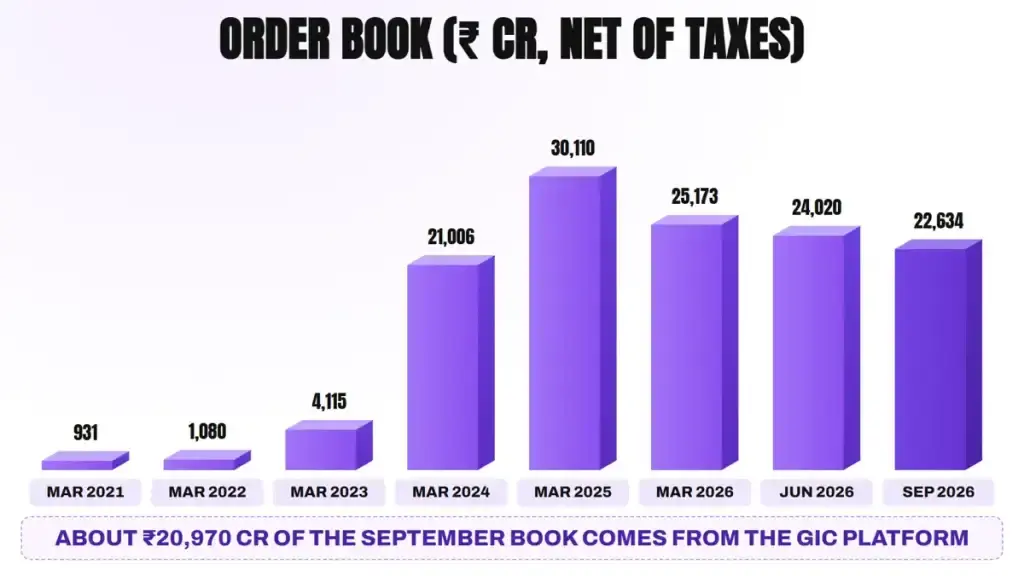
That book was a fraction of this size five years ago. It was ₹931 Cr in March 2021 and ₹1,080 Cr in March 2022. Then the first AMISP orders came under RDSS, and the book rose to ₹4,115 Cr in March 2023 and ₹21,006 Cr in March 2024. It peaked at ₹30,110 Cr in March 2025.
Behind those rupees are meters. The AMISP projects cover about 3.6 crore awarded meters, of which about 1.7 crore had been installed by September 2026. Management expects the total to go above 4 crore meters, as discoms add new connections under the same contracts. All 24 of its AMISP projects have reached operational go-live, which means each project has been declared live and has moved into its service phase.
What the order book says: of the ₹22,634 Cr, about ₹20,970 Cr comes from the projects held with GIC. In May 2026 management said the hardware part of that work, about 45% to 50%, would be done in the next two to two and a half years. The service part then runs for the rest of each 8-to-9-year contract.
How a Jaipur Meter Maker Became an AMISP
To see why the order book moved so fast, let's go back a few years. For most of its history, Genus made meters and sold them to discoms through tenders. It started making electronic energy meters in the 1990s, set up plants in Jaipur, Haridwar and Guwahati, and was the first company in India to get DLMS certification, a common data standard for electronic meters. The business is part of the Kailash group, founded by the late Ishwar Chand Agarwal, and Rajendra Kumar Agarwal is now its Managing Director and CEO.
That meter business was steady but small. In FY22, revenue was about ₹685 Cr and the EBITDA margin was 8.7%. A meter sold through a tender earns a one-time price, and many makers compete for the same order. The profit in FY23 was only about ₹29.0 Cr, lower than in FY22, which shows how thin that old business could be from one year to the next.
Then RDSS changed the way discoms bought meters. In the years after 2022, Genus started bidding as an AMISP, taking on the whole job from the meter to the software and the field work. In the year to March 2024 it set up a platform with GIC of Singapore, through a joint venture with Gem View Investment Pte. Ltd., to bid for and run these projects. Genus holds 26% of that platform, Gemstar Infra, and GIC holds 74%. The platform's project companies win the contracts and hand the work to Genus.
"Show me the incentive and I will show you the outcome."
— Charlie Munger
Under TOTEX, an AMISP is paid each month only while its meters keep working and sending readings. That ties Genus's income to how well the system runs, not just to how many meters it ships.
That platform is what lets a mid-sized meter maker bid for very large projects. The company describes it as a USD 2 billion platform, and Genus is its exclusive partner in India for AMISP contracts. The project companies raise long-term, non-recourse loans, which means the lenders look to the project's own cash flows and not to Genus, and these project companies carry an AA- rating. Genus had put about ₹487 Cr into the platform by March 2026, as a mix of equity and loans, and it can still sell meters to other AMISPs as a supplier.
Other investors have backed the same model. The company also secured USD 49.5 million from DFC, a US development finance agency, for smart meter rollouts. So Genus now has both the orders and the capital partners to deliver them.

That table shows us how the model changed the numbers. Revenue grew about 6.9 times in four years, and the EBITDA margin more than doubled. An AMISP contract pays for the meter, the network, the software and the service in one package, and Genus makes most of those parts itself.

But the model has a cost, and it shows in cash. Read this Cash Flow Statement Explained Under TOTEX, Genus spends on meters, parts and field teams first, and the discom pays back over the years. Operating cash flow was negative for three years in a row: about ₹152 Cr in FY24, ₹443 Cr in FY25 and ₹219 Cr in FY26. From FY22 to FY26, profits added up to about ₹1,076.8 Cr, while operating cash flow added up to an outflow of about ₹699.9 Cr.
That gap is why we should look closely at the first half of FY27. Management had said in May 2026 that it expected operating cash flow to be near zero or slightly negative in FY27 and positive from FY28. The positive ₹127 Cr in H1 came earlier than that.
That cash turn also has a simple logic behind it, which management laid out in May 2026. In FY25, it said, the working capital needed came to about 80% to 85% of the rise in revenue. In FY26 that share came down to about 40%. It expects about 20% in FY27, and in the year after, it expects the business to release cash instead of using it.
We can see the same trend in the days. Debtor days, the average number of days a customer takes to pay, fell from 187 in March 2025 to 89 in March 2026. Inventory days came down from 127 to 104. Including work done but not yet billed, total working-capital days came down from 343 to 274. Those are still long cycles, but they are moving the right way. Read this Days Sales Outstanding (DSO) Explained
Meters, Services and Three Newer Lines
Now that we know how Genus grew, let's look at what it sells today. The company reports one business segment, metering and related services. But the order book gives a clearer split of where the work comes from.
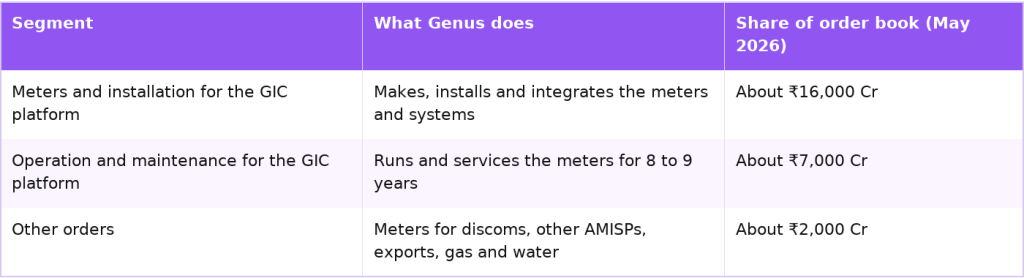

Smart Meters From Three Plants
Let's start with the factory, because every other line depends on it. Genus makes single-phase and three-phase smart meters, prepaid meters, meters for distribution transformers and feeders, and grid meters. Its plants in Jaipur, Haridwar and Guwahati cover nearly 9,96,000 sq ft and can make more than 18 million meters a year.
Those meters are not all for homes. A distribution transformer meter, or DT meter, sits on the transformer that feeds a street or a village, and a feeder meter sits on the line that leaves a substation. When a discom compares what these meters read with what its customers' meters read, it can see where power is being lost. Management says most DT and grid meters are bought under RDSS too, so they come with the same rollout.
As we can see, that capacity is larger than its own projects need. Genus plans to install about 1 crore meters in FY27, and it sells the rest to discoms and other AMISPs. Management says its share is about 22% to 23% as an AMISP, and more than 30% when meter supply to others is added.
AMISP Services and the O&M Annuity
Now let's turn to the service side, where the next step of growth comes from. Once a project reaches go-live, Genus earns a monthly fee for operation and maintenance, or O&M, for the rest of the contract. In FY26 this O&M revenue was about ₹150 Cr.
Management expects O&M revenue to reach about ₹800 Cr a year in the next two to three years, on the current order book alone. In August 2026 it gave a closer path: about ₹600-700 Cr in FY28, rising to ₹1,100-1,200 Cr in the years after. Unlike the meters, management says this revenue is not hit by the cost of chips and other materials.
Gas Meters, Water Meters and Exports
Let's now look beyond electricity, where Genus is building three smaller lines. The largest of them is smart gas meters. Management says India plans to install about 12 crore smart gas meters in the next three to four years, an opportunity it puts at about ₹35,000 Cr. It expects gas meter tenders to pick up in FY28.
The second line is exports. Genus has started to win approvals and orders in Australia and other markets, and it targets about ₹500 Cr of export revenue over the next three to four years. Smart water meters are the last of the three, and management calls them a very early but large market.
None of these three has been reported as a separate revenue number yet. For now, they are options on top of the electricity business, not a part of the current order book.
Where Genus Sits in the Power Value Chain
Now let's place those lines in the power chain, so we can see where Genus earns its money. Power plants make the electricity, transmission lines carry it across states, and the discom takes it down to homes and shops. The meter is the last link, where the power used is measured and turned into money.

That last link has long been the weakest. Discoms lose money to theft, to bills never sent and to bills never paid. A smart prepaid meter tackles all three together, which is why the scheme pays for meters in such large numbers.
That rollout, as we will see, is still far from done. Management puts India's need at about 31 to 32 crore consumer meters. In May 2026 about 15 crore had been tendered and about 7 crore installed. It expected tenders for about 9 crore more meters in FY27, from states such as Haryana, Madhya Pradesh, Punjab, Tamil Nadu, West Bengal and Kerala. In November 2026 it said about 15 crore meters were still to be tendered across the country.
So for Genus, as you can see, the market is two-sided. On one side, it has a large book to execute. On the other, about half of the national meter base is still to be tendered, and its platform with GIC can take on 3 to 5 crore more meters without fresh capital, as management puts it.
That headroom matters because tenders are won on price, and each bid is fixed for close to a decade. Management says it will keep its share of the market but bid only where the returns over the contract life meet its own bar. So the number of new meters it wins in FY27 will tell us how hard competition has become, as much as how large the market is.
Why Genus's Moat Is Hard to Copy
Now that we know where Genus sits, let's understand the moat. A smart meter itself is not hard to make, and many companies make them. So the question is why a discom, or a large investor like GIC, picks Genus to run a 9-year project. Read this Economic Moat Explained
One reason we can see is that Genus makes almost everything itself. It designs its own meters, makes its own circuit boards on surface-mount lines, and moulds its own plastic parts. It also writes its own software: the head-end system that talks to the meters, the meter data management system that stores and checks the readings, and the field apps. It has its own radio network too. The company says it is one of the few AMISPs with all of these in-house.
That software side matters more than it looks. The head-end system can read meters that use mobile networks or radio, and it can connect to meters made by other companies. So Genus can sell its software to discoms and other AMISPs, and not only use it on its own projects.
That in-house work needs people. Genus had more than 250 people in device research and more than 225 in software in June 2026, and it had spent over ₹150 Cr on research over the past few years. Including contract staff, its workforce was more than 16,700.
Beyond the factory and the code, contracts add a second layer.
"In business, I look for economic castles protected by unbreachable moats."
— Warren Buffett
For Genus, the castle is the full system from meter to software, and the moat is the long contract. Whether that moat is wide shows up in how many new tenders it wins on its own terms. Once a discom's meters, network and billing system run on one AMISP's system for 8 to 9 years, switching is slow and costly. And with GIC as a partner, Genus can bid for large projects without carrying all the capital on its own balance sheet.
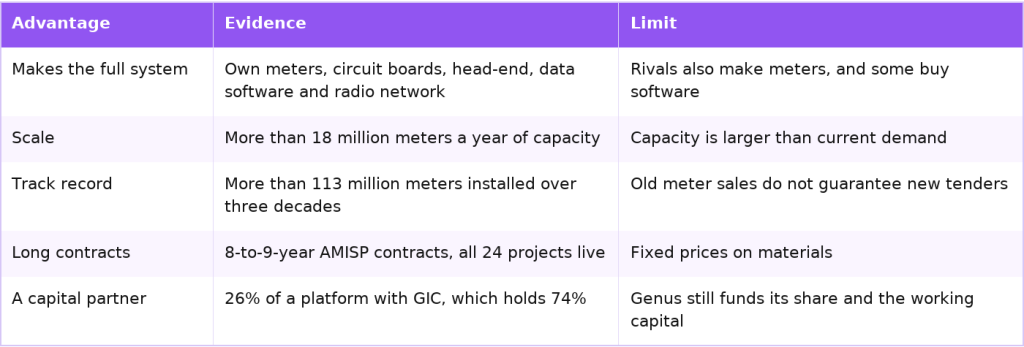

That table also shows the limit of the moat. Management links its margin of about 19% to this in-house work and to scale. But the margin still moves with the cost of chips, because the contracts are fixed-price. The real test is whether the margin holds near 18% to 19% as costs swing.
Financials: Five Years of Revenue, Margins and Cash Flow
One quarter can mislead in a business where installations depend on the monsoon, so let's look at the full years together. The figures below are consolidated; EBITDA excludes other income, and the first half of FY27 is shown for comparison.

Revenue grew about 6.9 times in four years, from about ₹685.1 Cr in FY22 to ₹4,750.9 Cr in FY26, and the EBITDA margin rose from 8.7% to 19.2% as AMISP work took over from one-off meter sales. Net profit grew from ₹57.5 Cr to ₹592.3 Cr over the same years.
Cash flow tells a different story. From FY22 to FY26, net profit added up to about ₹1,076.8 Cr, while operating cash flow added up to an outflow of about ₹699.9 Cr, because Genus pays for meters, parts and field work first and is paid back over the years. In the first half of FY27 it turned positive, at about ₹140.2 Cr on a consolidated basis.
The balance sheet carried that gap with debt. Net debt rose from ₹605 Cr in March 2025 to ₹1,573 Cr in March 2026, and management expects it to peak at about ₹2,000 Cr before falling from FY28. The receivables, which rose to ₹1,971.7 Cr in September 2026, are the next test of how fast profit turns into cash.
"Accounting is the language of business."
— Warren Buffett
Genus's income statement shows a business growing several times over. Its cash flow statement shows what the TOTEX model asks for up front, and both need to be read together.
What FY27 Could Look Like on Management's Numbers
So where does the business go from here? In May 2026 management set a revenue target of ₹6,000-6,500 Cr for FY27, at an EBITDA margin of 18%. It repeated both in November 2026, and said it remains on track to install about 1 crore smart meters in the year.
Now let's put that target against the first half. H1 FY27 revenue was ₹2,497.4 Cr. To reach ₹6,000 Cr, Genus needs about ₹3,502.6 Cr in H2, and to reach ₹6,500 Cr it needs about ₹4,002.6 Cr. That is 32.4% to 51.3% more than the ₹2,646.1 Cr of H2 FY26, against 19.4% growth in the first half.
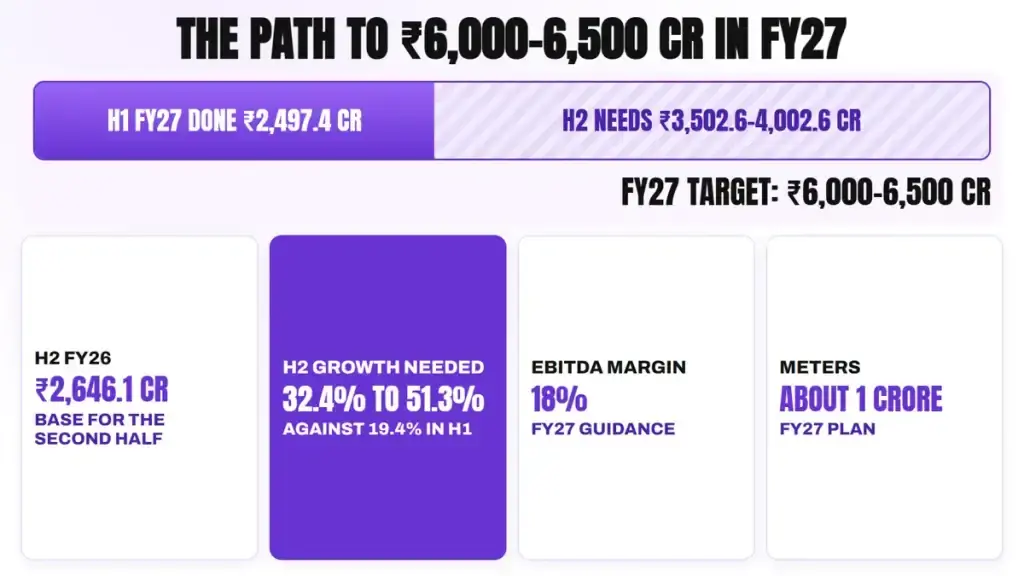
That gap is large, but we have seen H2 carry the year before. In FY26, H2 revenue was ₹2,646.1 Cr against ₹2,091.4 Cr in H1. Still, even the low end of the range needs a strong second half.
Beyond FY27, we have four other commitments from management. It expects working-capital days to fall by 50 to 75 days in FY27, after falling from 343 days to 274 days in FY26. It plans to put another ₹600-700 Cr into the GIC platform by the first quarter of FY29. It does not plan any large new plant, only about ₹10-20 Cr of routine capex. And it expects O&M to become a large, steady part of revenue from FY28.

Those commitments are easier to judge against the past. So let's check what management said before against what it delivered.
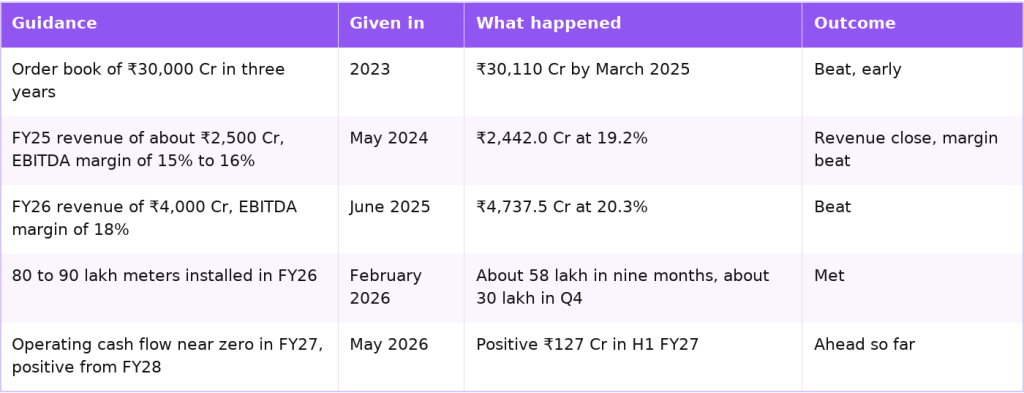
That record shows us a clear pattern. Genus has come close to or beaten its revenue guidance for three years, and it has beaten its margin guidance each time. The softer number has been cash, which stayed negative for three years while profits grew. That makes H2 revenue and the receivables the numbers to watch from here.
Key Risks
Now let's look at what could go wrong for Genus, because the latest quarter has already shown some of these risks.
- A heavy second half: the FY27 target needs 32.4% to 51.3% revenue growth in H2, against 19.4% in H1. Another slow quarter in the field would put the low end of the range at risk.
- Fixed-price contracts: the contracts have no pass-through for the cost of chips, plastics or the rupee. Management cut its FY27 margin guidance to 18% for this reason, and a further rise in costs would hit the margin again.
- Working capital and debt: receivables rose to ₹1,971.7 Cr in September 2026, and borrowings to ₹2,479.4 Cr. Management expects net debt to peak at about ₹2,000 Cr, and Genus still has to put ₹600-700 Cr more into the GIC platform.
- A shrinking order book: the book has come down from ₹30,110 Cr in March 2025 to ₹22,634 Cr. If new tenders are delayed or Genus wins fewer of them, revenue after the current rollout could flatten. Management has not given any order-inflow target for FY27.
- Tender and state risk: the rollout depends on discoms in each state. Q2 FY27 showed how local body elections and a slower pace in Uttar Pradesh can delay work.
- The end of the meter wave: RDSS has been extended to 2028. Once the national rollout is done, the meter side of the business could shrink, and the O&M annuity would have to carry more of the revenue.
- An open legal matter: the Directorate of Enforcement searched the company's corporate office and its Chairman's residence in December 2024 under the money-laundering law. In February 2026 the company received a notice from the PMLA Court in Patna on the matter. The company says it has complied with all requirements, but the case is not closed.
- Reporting gap: much of the order book is held in project companies that Genus does not control, so part of the value shows up only as a share of profit, and reported profit swings with mark-to-market gains on other holdings.
"So there is no pass-through in our contracts. These are all fixed price contracts." - Jitendra Agarwal, Joint Managing Director, May 2026
"So we are confident that we will be able to maintain our market share." - Jitendra Agarwal, Joint Managing Director, May 2026
"The essence of investment management is the management of risks, not the management of returns."
— Benjamin Graham
For Genus, the returns are set by fixed-price contracts that run for close to a decade. What an investor can watch is the risk side: costs, cash, debt and new tenders, which is what the list below sets out.
Explore our Products
Research Framework

Emerging Titans
Combination of quantitative analysis, industry tailwinds, and management assessment - SPRINT investment philosophy

Tiny Titans
Heavy emphasis on scuttlebutt research, plant visits, and early on-ground signals
What to Track Next
If you follow Genus, these are the signals that will show where it goes next.
- H2 FY27 revenue against the ₹6,000-6,500 Cr target, and meters installed against about 1 crore
- The EBITDA margin against the 18% guidance, and the gross margin after 38.3%
- Trade receivables after ₹1,971.7 Cr, and operating cash flow after the ₹127 Cr of H1
- Net debt against the peak of about ₹2,000 Cr
- New AMISP wins as states tender about 15 crore more meters
- O&M revenue as it builds toward ₹600-700 Cr in FY28, and the first gas meter orders
Compare: see how it measures up against its peers in Genus Power vs HPL Electric: Smart Meter Makers Compared, a side-by-side look at order books, margins and balance sheets.
Conclusion
Let's put it all together. Genus Power has turned from a meter maker with a ₹931 Cr order book into a leading AMISP, with ₹22,634 Cr of orders and revenue that grew from about ₹685 Cr in FY22 to ₹4,750.9 Cr in FY26. Its EBITDA margin rose from 8.7% to about 19% as it began to make and run the whole system. Along the way, it kept its plants, its software and its field teams in-house, and it found a large partner in GIC to share the capital. The cautious thread is cash: operating cash flow was negative for three years, and receivables rose again in the first half of FY27. The next two quarters will show whether the turn holds.
Still, the next step depends less on winning and more on collecting. What happens next depends on whether H2 FY27 delivers the revenue the target needs, whether the margin holds on fixed-price contracts, and whether the cash turn of the first half lasts as receivables come due.
FAQs
What does Genus Power do?
+Genus Power makes smart electricity meters, prepaid meters and transformer meters in Jaipur, Haridwar and Guwahati, and writes the software that runs them. It is also an AMISP: it installs, runs and services smart meters for discoms for 8 to 9 years. FY26 revenue was ₹4,750.9 Cr.
What is an AMISP and how does Genus earn from it?
+An AMISP is an Advanced Metering Infrastructure Service Provider. Under the TOTEX model it buys and installs the meters, runs the network and software, and the discom pays a fee per meter per month for 8 to 9 years. Genus runs most of this work through a platform it holds 26% of, with GIC holding 74%.
How did Genus Power do in Q2 FY27?
+Standalone revenue was ₹1,132.6 Cr, about the same as the ₹1,149.0 Cr of a year ago, as the monsoon and local factors slowed installations. The EBITDA margin was 19.8%, and profit after tax was ₹133.3 Cr. In H1 FY27, revenue rose 19.4% to ₹2,497.4 Cr and operating cash flow turned positive at ₹127 Cr.
What is Genus Power's order book?
+The order book was about ₹22,634 Cr in September 2026, of which about ₹20,970 Cr came from the projects held with GIC. Its AMISP projects cover about 3.6 crore awarded meters, of which about 1.7 crore had been installed.
What revenue does Genus Power target for FY27?
+Management targets ₹6,000-6,500 Cr of revenue in FY27 at an EBITDA margin of 18%, and about 1 crore smart meters installed. H1 FY27 revenue was ₹2,497.4 Cr, so the second half needs ₹3,502.6-4,002.6 Cr.
What are the main risks for Genus Power?
+The FY27 target needs 32.4% to 51.3% revenue growth in the second half. Its contracts are fixed-price, so a rise in the cost of chips and other parts hits the margin. Receivables rose to ₹1,971.7 Cr in September 2026, management expects net debt to peak at about ₹2,000 Cr, and an Enforcement Directorate matter from December 2024 is still open.

High growth stock specialist, Value Educator
Shashank Mahajan is an equity research professional with over 12 years of experience in identifying high-potential SME and micro-cap stocks at an early stage. He follows a rigorous scuttlebutt research–driven approach, combining on-ground insights with deep financial analysis. Shashank specializes in uncovering under-researched and under-owned companies with strong management quality and long-term growth potential. Through disciplined research and early identification, he focuses on spotting tomorrow’s market leaders before they enter the mainstream investor radar.
More about Shashank Mahajan →
Azad Engineering vs MTAR vs Unimech: Aerospace Parts

Subros vs Lumax Auto vs Sona BLW: EV Auto Parts Compared
Jyoti CNC vs Macpower CNC: Machine Tool Makers Compared
Data Patterns vs Astra Microwave vs Apollo Micro

Himadri vs PCBL: Carbon Black and Battery Materials

Inox Wind vs Suzlon: Wind Turbine Makers Compared
Explore our Products
Research Framework
Emerging Titans
Combination of quantitative analysis, industry tailwinds, and management assessment - SPRINT investment philosophy
Tiny Titans
Heavy emphasis on scuttlebutt research, plant visits, and early on-ground signals



India's Aerospace Opportunity
Global Demand. Supply Bottlenecks. Opportunities Ahead.
Don't Miss This Exclusive Webinar!
Join Value Educator to decode the key trends shaping India's aerospace sector and learn how to identify tomorrow's potential leaders in the space.
- How the aircraft value chain works, layer by layer
- Indian companies supplying global aircraft makers
- A framework to judge any aerospace company

 Orders
 Subscription
 Share with friends


Required Details
₹23999.00
(12 month subscription)
As per SEBI regulations, all users are mandated to complete the KYC that is validated for 1 year. Post payment, you will be redirected to the KYC screen


No comments yet. Be the first to comment!