
Data Patterns vs Astra Microwave vs Apollo Micro
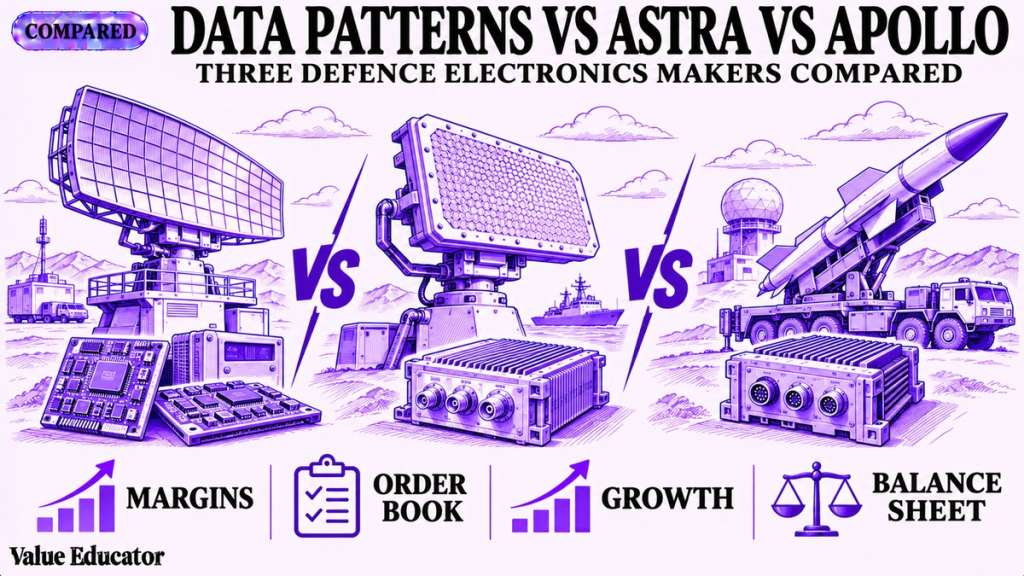
Every radar, jammer and guided missile that India now orders needs electronics inside it, and three listed companies built their businesses on making them: Data Patterns from Chennai, and Astra Microwave and Apollo Micro Systems from Hyderabad. All three sell mainly to DRDO, the Ministry of Defence and defence companies such as BEL, HAL and BDL. All three had FY26 revenue between ₹904.3 Cr and ₹1,163 Cr. That is why investors so often search for "Data Patterns vs Astra Microwave" or "Apollo Micro Systems vs Astra Microwave".
Yet the three are very different businesses, and their July to September 2026 quarter (Q2 FY27), reported between 24 October and 12 November 2026, pulled them in three directions. Data Patterns' revenue fell by more than half, Astra's margin jumped, and Apollo's revenue grew fastest. This page puts the three side by side on the same quarter, the same order-book date of 30 September 2026 and the same five years, FY22 to FY26.
Figures as of 20 November 2026. This page is research, not a recommendation to buy or sell any stock.
Data Patterns vs Astra Microwave vs Apollo Micro at a Glance
| Measure | Data Patterns | Astra Microwave | Apollo Micro Systems |
|---|---|---|---|
| What it does | Designs and builds radars, electronic warfare systems, avionics and test equipment | Makes radio-frequency and microwave parts and subsystems for radars, electronic warfare, satellites and weather radars | Makes the electronics that guide and control missiles, mines and rockets; now adding explosives |
| Founded, base | 1998, Chennai | 1991, Hyderabad | 1985, Hyderabad |
| Plants | A 10.28-acre campus in Chennai with about 200,000 sq ft built up; electronics line of 600 boards a day | Four manufacturing facilities in Hyderabad, R&D centres in Hyderabad and Bengaluru | Units in Hyderabad; first phase of Unit 3 producing, about 12 times today's capacity when complete |
| FY26 revenue | ₹924.8 Cr | ₹1,163 Cr | ₹904.3 Cr |
| FY26 EBITDA margin | 40.1% | 28.7% | 24.1% |
| FY26 profit after tax | ₹271.4 Cr | ₹193 Cr | ₹107.4 Cr |
| FY26 return on equity | 16.7% | 16.0% | 11.2% |
| Net debt, 31 March 2026 | Net cash of ₹422.8 Cr | Net debt of ₹34 Cr | Net debt of ₹387.2 Cr |
| Order book, 30 September 2026 | ₹1,723.6 Cr (₹2,698 Cr with negotiated orders) | ₹4,708 Cr including joint ventures (₹3,937 Cr standalone) | ₹1,765 Cr |
| Q2 FY27 revenue growth | -56.7% | 22.6% | 72.3% (36.0% standalone) |
| Main customers | Ministry of Defence, DRDO, BEL, HAL, BrahMos, export clients | DRDO, BEL and other defence PSUs, the weather department, ISRO, exports | DRDO laboratories, defence PSUs such as BDL, the Navy |
| Key risk | Lumpy deliveries and slow order signing | A large order book that must be delivered on time, and the space-business demerger | Negative cash flow, rising debt and large acquisitions |
Astra and Apollo figures are consolidated. Return on equity is profit after tax divided by average equity for FY26; for Data Patterns it matches the company's own 16.7%.
How Each Company Makes Money
All three earn in the same broad way. A DRDO laboratory or the armed forces first pays for a product to be developed and tested. Once it qualifies, production orders follow for years, often through a large integrator such as BEL, HAL or BDL. But each sits at a different point in the weapon.
Data Patterns: Complete Electronic Systems, Owned Designs
Data Patterns designs the whole box: radars, electronic warfare receivers and jammers, avionics for aircraft, fire-control electronics for BrahMos, and automatic test equipment. It owns the designs of what it builds, which is why its gross margin is high. It had 1,137 engineers in September 2026, after hiring 91 people in Q2 FY27. In the same quarter it bought ST Advanced Composites for ₹10 Cr to make composite structures for its radars in-house. Its largest Q2 FY27 orders were two radar production orders from BEL, worth ₹332.8 Cr and ₹253.0 Cr.
Astra Microwave: Radio-Frequency Parts and Radar Panels
Astra Microwave works one level deeper. It makes the radio-frequency and microwave building blocks of a radar, such as transmit-receive modules and the active antenna panels of modern radars, and it is one of the few private Indian makers of GaN and GaAs chips that work up to 40 GHz. It has worked on 35 radars, 25 satellites and 15 strategic programmes. In FY26, DRDO gave 28.2% of its standalone revenue, BEL and other defence PSUs 22.7%, the weather department 18.0%, exports 11.9% and ISRO 6.4%. Its joint venture with Rafael, Astra Rafael Comsys, makes software-defined military radios in a 48,000 sq ft plant in Hyderabad.
Apollo Micro Systems: Weapon Electronics, Moving to Whole Weapons
Apollo Micro Systems makes the electronics that sit inside a weapon: onboard computers, guidance units and fin-control systems for missiles, and the electronics of underwater mines. It has taken part in more than 150 indigenous programmes and more than 60 programmes as a development-cum-production partner of DRDO. It is now moving towards complete weapons. Its explosives subsidiary, IDL Explosives, commissioned a silo unit on 8.5 acres with 9,000 tonnes of storage in Q2 FY27, and India's competition regulator has approved its purchase of Premier Explosives, a maker of missile propellants.
So the simple way to see the three: Data Patterns sells complete systems built on its own designs, Astra sells the high-value parts inside radars, and Apollo sells weapon electronics and is buying its way into explosives and propulsion.
Latest Quarter: Q2 FY27 Side by Side
All three reported the quarter to 30 September 2026. The table shows each company's own figures against the same quarter a year earlier.
| ₹ Cr, Q2 FY27 | Data Patterns | Astra Microwave | Apollo Micro Systems |
|---|---|---|---|
| Revenue from operations | 133.2 | 263 | 388.2 |
| Revenue, Q2 FY26 | 307.5 | 215 | 225.3 |
| Revenue growth | -56.7% | 22.6% | 72.3% |
| EBITDA | 31.4 | 89 | 111.2 |
| EBITDA margin | 23.6% | 33.8% | 28.6% |
| EBITDA margin, Q2 FY26 | 22.3% | 22.3% | 26.3% |
| Profit after tax | 22.0 | 52 | 46.2 |
| Profit after tax, Q2 FY26 | 49.2 | 24 | 30.0 |
| H1 FY27 revenue (growth) | 249.3 (-38.7%) | 440 (6.1%) | 639.4 (78.2%) |

Data Patterns had a slow quarter by its own calendar. Revenue fell to ₹133.2 Cr from ₹307.5 Cr, because Q2 FY26 had been an unusually strong quarter. Its gross margin was still 69.0%, but salaries stay the same whatever the deliveries, so staff cost rose to 33.1% of sales from 12.3%. The chairman said he expects the second half of FY27 to be stronger than the first, and kept the full-year guidance. Its revenue is booked only when a customer accepts each delivery, so single quarters swing widely.
Astra had its best margin. Consolidated revenue rose 22.6% to ₹263 Cr, and the EBITDA margin rose to 33.8% from 22.3%, helped by a gross margin of 57.4% against 50.8%. Profit after tax more than doubled to ₹52 Cr. The managing director said the first half's EBITDA and profit were the highest the company has ever reported.
Apollo grew fastest, partly through IDL. Consolidated revenue rose 72.3% to ₹388.2 Cr. Part of that growth is IDL Explosives, which was not in the group a year earlier. The core business alone grew 36.0% to ₹306.3 Cr, with a standalone EBITDA margin of 35.1% against 26.3%. Group profit grew more slowly, 53.7%, because tax took about 50.1% of pre-tax profit in the quarter.
Five-Year Financials, FY22 to FY26
One quarter says little about defence suppliers, so here are five full years, FY22 to FY26. Astra and Apollo figures are consolidated.
Revenue from operations (₹ Cr)
| Year | Data Patterns | Astra Microwave | Apollo Micro Systems |
|---|---|---|---|
| FY22 | 310.9 | 750 | 243.2 |
| FY23 | 453.5 | 816 | 297.5 |
| FY24 | 519.8 | 909 | 371.6 |
| FY25 | 708.4 | 1,051 | 562.1 |
| FY26 | 924.8 | 1,163 | 904.3 |
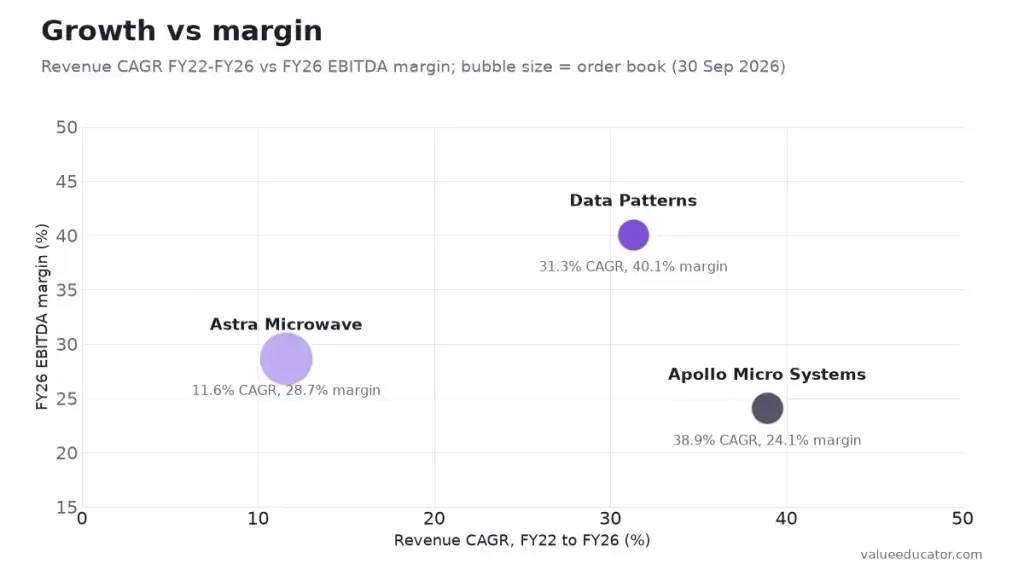
| Growth a year, FY22-FY26 | 31.3% | 11.6% | 38.9% |
EBITDA margin
| Year | Data Patterns | Astra Microwave | Apollo Micro Systems |
|---|---|---|---|
| FY22 | 45.3% | 11.9% | 18.7% |
| FY23 | 37.9% | 18.1% | 21.5% |
| FY24 | 42.6% | 21.1% | 22.6% |
| FY25 | 38.8% | 25.6% | 23.0% |
| FY26 | 40.1% | 28.7% | 24.1% |
Profit after tax (₹ Cr)
| Year | Data Patterns | Astra Microwave | Apollo Micro Systems |
|---|---|---|---|
| FY22 | 94.0 | 38 | 14.6 |
| FY23 | 124.0 | 70 | 18.7 |
| FY24 | 181.7 | 121 | 31.1 |
| FY25 | 221.8 | 154 | 56.4 |
| FY26 | 271.4 | 193 | 107.4 |
| Growth a year, FY22-FY26 | 30.4% | 50.1% | 64.6% |
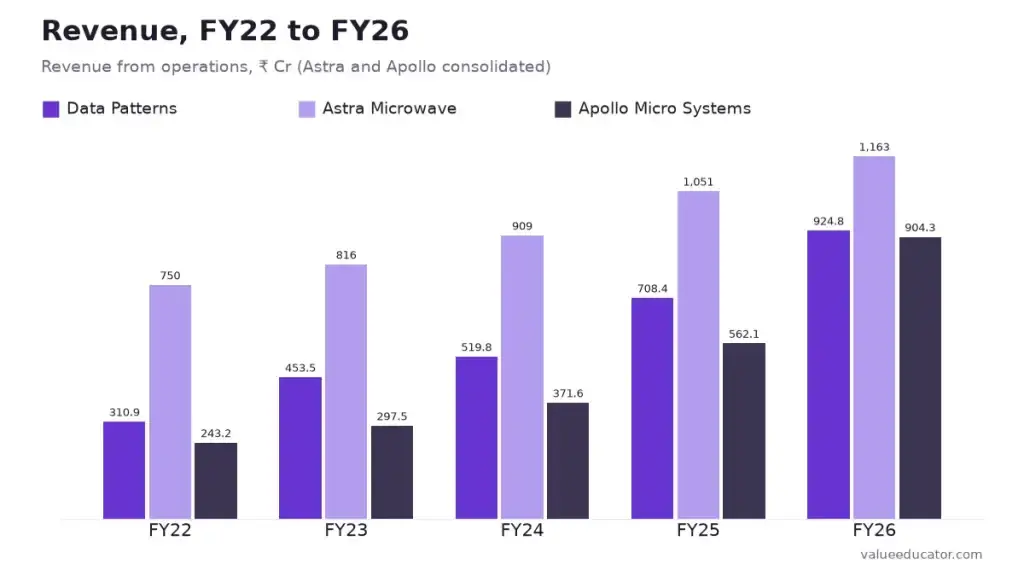
Three different stories come out of these tables. Data Patterns grew revenue about 31.3% a year and kept its EBITDA margin around 40%, the highest of the three in every year. Astra grew revenue more slowly, 11.6% a year, but its margin rose from 11.9% to 28.7%, so its profit grew 50.1% a year. Apollo grew revenue fastest, 38.9% a year, with a margin that rose steadily to 24.1%, and its profit grew 64.6% a year from the smallest base.
Order Book and Growth Plans
An order book is the value of signed orders not yet delivered. Dividing it by a year's revenue shows how many years of work a company already holds.
| Order book and plans | Data Patterns | Astra Microwave | Apollo Micro Systems |
|---|---|---|---|
| Order book, 30 Sep 2026 | ₹1,723.6 Cr | ₹4,708 Cr consolidated; ₹3,937 Cr standalone | ₹1,765 Cr |
| Times FY26 revenue | 1.9x | 4.0x | 2.0x |
| Orders won in Q2 FY27 | ₹929 Cr | ₹2,036 Cr (standalone) | Not disclosed |
| Management's targets | 20-25% revenue growth and a 35-40% EBITDA margin in FY27 | 15% to 20% revenue growth, with more complex systems over three to five years | 35% to 45% growth; order book above ₹2,000 Cr by March 2027 without the MIGM mine order |
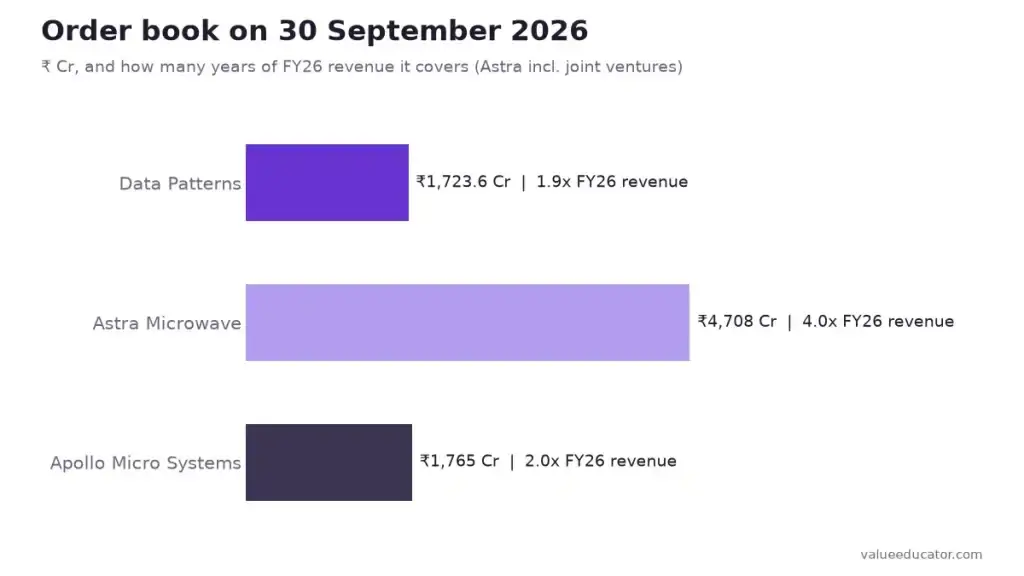
Data Patterns: orders agreed but not all signed. Its signed book of ₹1,723.6 Cr covers about 1.9 years of FY26 revenue. Counting orders that are agreed but not yet signed, it is about ₹2,698 Cr, or 2.9x. It won ₹929 Cr of orders in Q2 FY27 alone and ₹1,046 Cr in the first half. Management expects another ₹2,000 Cr of orders in FY27 beyond those, and sees a pipeline of ₹2,000-4,000 Cr over the next 24 months. It plans about ₹150 Cr of capital spending over the next two years.
Astra: the largest book, built on one order. Its standalone book of ₹3,937 Cr includes a ₹1,878.8 Cr production order from HAL for the antenna units of the Uttam radar, received in Q2 FY27. That single order is about 47.7% of the standalone book. With the joint ventures, the group book was ₹4,707.59 Cr, of which ₹237.18 Cr was service orders. Production orders make up 82.0% of the standalone book. The board approved in June 2026 a plan to move the space, meteorology and hydrology business into a separate company; that business had ₹110.6 Cr of FY26 revenue.
Apollo: waiting for large programmes. Its ₹1,765 Cr book is a record, but a little less than ₹1,300 Cr of it belongs to the core business; the rest is IDL. Management expects the book to cross ₹2,000 Cr by March 2027 without the MIGM naval mine order, and ₹4,500-5,000 Cr with it. It expects the MIGM order by February 2027, and not later than March. New orders usually take about 18 months to deliver, and MIGM about 2.5 years. A third factory unit, about 12 times the size of today's capacity, is due by March 2027.
Balance Sheet and Cash Flow
Defence suppliers often book profits long before the cash arrives, so the balance sheet matters as much as the profit. If these terms are new, our guides to the cash flow statement and to days sales outstanding explain them.
| ₹ Cr | Data Patterns | Astra Microwave | Apollo Micro Systems |
|---|---|---|---|
| Borrowings, 31 Mar 2026 | 0 | 287 | 543.3 |
| Cash, bank and investments, 31 Mar 2026 | 422.8 | 253 | 156.1 |
| Net debt, 31 Mar 2026 | Net cash of 422.8 | 34 | 387.2 |
| Net debt, 30 Sep 2026 | Net cash of 405.3 | 279 | Not disclosed |
| Operating cash flow, FY26 | 80.1 | 387 | -129.8 |
| Operating cash flow, H1 FY27 | 110.2 | -148 | 22.4 |
| Receivable days, FY26 | 287 | 216 | 194 |
| Inventory days, FY26 | 108 | 193 | 321 |
Receivable and inventory days are each year-end balance divided by FY26 revenue, times 365.
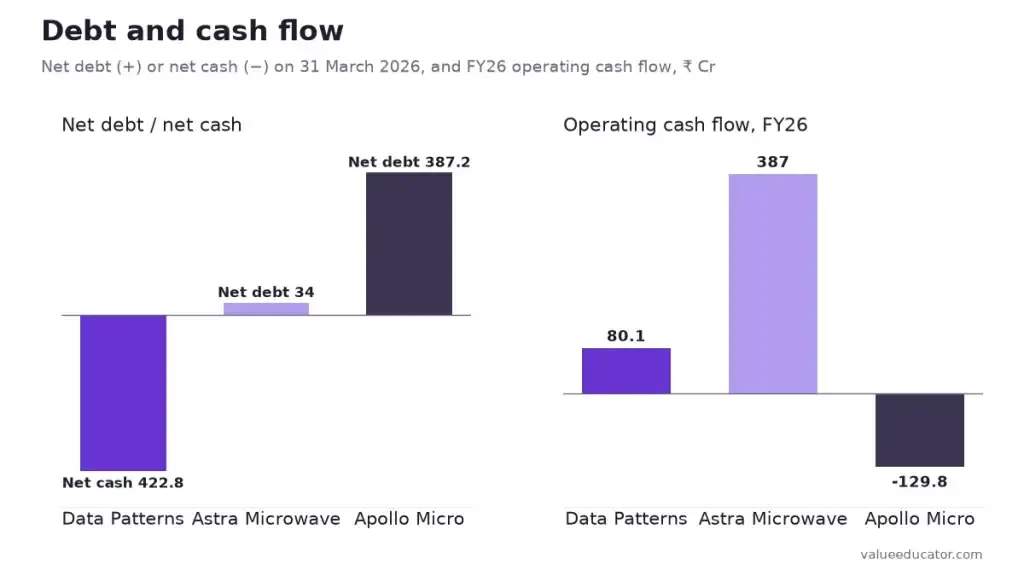
Data Patterns has no debt and held ₹405.3 Cr of cash, bank balances and investments in September 2026. Its weak spot is collection. Receivables were ₹727.8 Cr in March 2026, or about 287 days of revenue, so FY26 operating cash flow was only ₹80.1 Cr against a profit of ₹271.4 Cr, about 30%. Collections improved in the first half: receivables fell to ₹498.8 Cr and operating cash flow was ₹110.2 Cr.
Astra turned a strong FY26 into cash, with operating cash flow of ₹387 Cr, about 2.0x its profit. But in the first half of FY27 it used ₹148 Cr, as inventory rose to ₹807 Cr from ₹616 Cr for the orders ahead. Borrowings rose to ₹486 Cr in September from ₹287 Cr in March, so net debt rose to ₹279 Cr.
Apollo carries the most debt and stock. Borrowings rose 62.0% in FY26 to ₹543.3 Cr, and operating cash flow was -₹129.8 Cr, after -₹78.5 Cr in FY24. Inventory of ₹795.3 Cr was about 321 days of revenue, the highest of the three. The first half of FY27 brought positive operating cash flow of ₹22.4 Cr, and working capital days improved to 353 from 359.
Risks for Each Company
Data Patterns
- Lumpy quarters: revenue is booked only after customer inspection, so a quarter can fall sharply, as Q2 FY27 did by 56.7%.
- Signing delays: about ₹974 Cr of the ₹2,698 Cr book was still being negotiated or awaiting signature.
- Slow collections: receivables of about 287 days of revenue kept FY26 cash flow far below profit.
- Fixed costs: staff costs keep rising as it hires engineers ahead of orders, which squeezes margins in slow quarters.
Astra Microwave
- One large order: the HAL radar order is about 47.7% of the standalone book, so its delivery timing drives the next few years.
- Working capital and debt: the first half used ₹148 Cr of cash and borrowings rose to ₹486 Cr.
- The demerger: moving the space and weather business into a new company needs several approvals, and changes what remains in Astra.
- Concentrated customers: DRDO and defence PSUs gave about half of FY26 standalone revenue.
Apollo Micro Systems
- Cash and debt: two of the last three years had negative operating cash flow, and borrowings have risen fast.
- Big orders can slip: the expected jump in the order book depends mainly on MIGM, which is not yet signed.
- Acquisitions: IDL and Premier Explosives bring new, lower-margin businesses and integration work, and group profit already trails standalone profit.
- High tax charge: about 50.1% of pre-tax profit went to tax in Q2 FY27.
Which Is Stronger on Each Measure?
There is no single winner, because each company leads on different measures. Here is how they compare, one measure at a time.
| Measure | Stronger | Why |
|---|---|---|
| Profit margin | Data Patterns | FY26 EBITDA margin of 40.1%, against 28.7% and 24.1% |
| Return on equity | Data Patterns, Astra close behind | 16.7% and 16.0% in FY26, against 11.2% |
| Five-year revenue growth | Apollo Micro Systems | 38.9% a year from FY22 to FY26 |
| Latest quarter growth | Apollo Micro Systems | Revenue up 72.3% (36.0% in the core business) |
| Latest quarter margin | Astra Microwave | Q2 FY27 EBITDA margin of 33.8% |
| Order book cover | Astra Microwave | 4.0x FY26 revenue, against 1.9x and 2.0x |
| Balance sheet | Data Patterns | No debt and net cash of ₹405.3 Cr in September 2026 |
| Cash flow in FY26 | Astra Microwave | ₹387 Cr, about 2.0x profit |
| Collections | Apollo Micro Systems | 194 receivable days, though inventory is the highest at 321 days |
Explore our Products
Research Framework

Emerging Titans
Combination of quantitative analysis, industry tailwinds, and management assessment - SPRINT investment philosophy

Tiny Titans
Heavy emphasis on scuttlebutt research, plant visits, and early on-ground signals
Conclusion
Data Patterns vs Astra Microwave vs Apollo Micro is really a comparison of three business models. Data Patterns is the most profitable and the only one with no debt, because it sells complete systems built on its own designs, but its quarters swing widely and its signed orders cover under two years of revenue. Astra holds the largest order book, about four years of revenue, and its margin has risen every year since FY22; what matters for it is delivering the HAL radar order and handling the demerger. Apollo has grown fastest and has the largest ambitions, from naval mines to explosives, but it has funded that growth with debt and its cash flow has been weak.
So which one fits depends on what a reader values most. Margin and a clean balance sheet favour Data Patterns, visible orders and cash generation favour Astra, and growth favours Apollo, along with the most risk on cash and acquisitions. For more listed names in this space, see our list of the best defence stocks in India for 2026.
FAQs
Data Patterns vs Astra Microwave vs Apollo Micro Systems: which is better?
+None is better on every measure. Data Patterns had the highest FY26 EBITDA margin (40.1%) and no debt. Astra Microwave had the largest order book, ₹4,708 Cr including joint ventures, or about 4.0x FY26 revenue, and the best Q2 FY27 margin (33.8%). Apollo Micro Systems grew revenue fastest, 38.9% a year from FY22 to FY26, but had net debt of ₹387.2 Cr and negative FY26 operating cash flow.
What is the difference between Data Patterns and Astra Microwave?
+Data Patterns designs and sells complete electronic systems such as radars, electronic warfare systems and avionics, built on designs it owns. Astra Microwave mostly makes the radio-frequency and microwave parts inside radars and satellites, such as antenna panels and transmit-receive modules, and also builds weather radars. Data Patterns had FY26 revenue of ₹924.8 Cr at a 40.1% EBITDA margin; Astra had ₹1,163 Cr at 28.7%.
Apollo Micro Systems vs Astra Microwave: which has the bigger order book?
+Astra Microwave. On 30 September 2026, Astra's order book was ₹4,708 Cr including joint ventures (₹3,937 Cr standalone), against ₹1,765 Cr for Apollo Micro Systems. Apollo expects its book to reach ₹4,500-5,000 Cr by March 2027 if it receives the MIGM naval mine order.
Which of the three defence electronics companies has no debt?
+Data Patterns. It had no borrowings and held ₹405.3 Cr of cash, bank balances and investments on 30 September 2026. Astra had net debt of ₹279 Cr on that date, and Apollo had net debt of ₹387.2 Cr in March 2026.
Why did Data Patterns' revenue fall in Q2 FY27?
+Revenue fell 56.7% to ₹133.2 Cr because Q2 FY26 had been an unusually strong quarter and the company books revenue only when customers accept deliveries. Management kept its FY27 guidance of 20-25% revenue growth and expects the second half to be stronger than the first.
What are defence electronics stocks in India?
+Defence electronics stocks are listed companies that design or make the electronics inside defence equipment, such as radars, electronic warfare systems, missile guidance units and communication systems. Data Patterns, Astra Microwave and Apollo Micro Systems are three of them, alongside larger names such as Bharat Electronics.

High growth stock specialist, Value Educator
Shashank Mahajan is an equity research professional with over 12 years of experience in identifying high-potential SME and micro-cap stocks at an early stage. He follows a rigorous scuttlebutt research–driven approach, combining on-ground insights with deep financial analysis. Shashank specializes in uncovering under-researched and under-owned companies with strong management quality and long-term growth potential. Through disciplined research and early identification, he focuses on spotting tomorrow’s market leaders before they enter the mainstream investor radar.
More about Shashank Mahajan →
Azad Engineering vs MTAR vs Unimech: Aerospace Parts
Subros vs Lumax Auto vs Sona BLW: EV Auto Parts Compared
Jyoti CNC vs Macpower CNC: Machine Tool Makers Compared

Himadri vs PCBL: Carbon Black and Battery Materials

Inox Wind vs Suzlon: Wind Turbine Makers Compared
Kaynes vs Cyient DLM vs Syrma SGS: EMS Stocks Compared
Explore our Products
Research Framework
Emerging Titans
Combination of quantitative analysis, industry tailwinds, and management assessment - SPRINT investment philosophy
Tiny Titans
Heavy emphasis on scuttlebutt research, plant visits, and early on-ground signals



India's Aerospace Opportunity
Global Demand. Supply Bottlenecks. Opportunities Ahead.
Don't Miss This Exclusive Webinar!
Join Value Educator to decode the key trends shaping India's aerospace sector and learn how to identify tomorrow's potential leaders in the space.
- How the aircraft value chain works, layer by layer
- Indian companies supplying global aircraft makers
- A framework to judge any aerospace company

 Orders
 Subscription
 Share with friends


Required Details
₹23999.00
(12 month subscription)
As per SEBI regulations, all users are mandated to complete the KYC that is validated for 1 year. Post payment, you will be redirected to the KYC screen


No comments yet. Be the first to comment!