
Inox Wind vs Suzlon: Wind Turbine Makers Compared

India added 6,057 MW of wind power in FY26, its best year so far, and Suzlon's management expects about 8 GW in FY27. Two listed Indian companies make complete wind turbines: Suzlon Energy, the older and larger maker from Pune, and Inox Wind, part of the INOXGFL group. So when investors look at wind energy in India, the question "Inox Wind vs Suzlon" comes up quickly.
The two sell the same product to many of the same customers, but they look very different in their numbers. Suzlon's FY26 revenue was about 3.8 times that of Inox Wind, and it ended FY26 with net cash. Inox Wind grew faster from a smaller base, earns a similar operating margin, but has had trouble turning its profit into cash. This page puts the two side by side, measure by measure, using each company's own filings.
Figures as of 20 November 2026. This page is research, not a recommendation to buy or sell any stock.
Inox Wind vs Suzlon at a Glance
| Measure | Inox Wind | Suzlon Energy |
|---|---|---|
| Business | Wind turbines in the 2 MW and 3 MW class, a 4X class model on the way; wind farm service through its listed subsidiary Inox Green | Wind turbines (S144 of 3.15-3.30 MW, new S175 of 5.x MW); service of a 16.1 GW turbine fleet in India |
| Plants and capacity | Five plants, about 2,500 MW of turbines a year | About 4,500 MW of turbines a year in India |
| FY26 revenue | ₹4,397.5 Cr (up 23.6%) | ₹16,679.1 Cr (up 53.7%) |
| FY26 operating EBITDA margin | 20.3% | 17.8% |
| FY26 profit after tax | ₹449.1 Cr | ₹3,163.4 Cr, including ₹1,463 Cr of deferred tax asset creation (₹1,701 Cr without it) |
| Return on equity, FY26 | 6.9% (10.1% before tax) | 40.6% (31.1% before tax) |
| Debt, March 2026 | Net debt of ₹939.8 Cr | Net cash of ₹2,384 Cr |
| Order book | About 3.8 GW (October 2026) | 6,009 MW (September 2026) |
| Q2 FY27 revenue (Jul-Sep 2026) | ₹1,354.3 Cr, up 21.0% | ₹4,869.1 Cr, up 26.0% |
| Q2 FY27 operating EBITDA margin | 15.1% (20.3% a year earlier) | 14.6% (18.5% a year earlier) |
| Main customers | NTPC, CESC, NLC India, Aditya Birla, Amplus/Gentari, Hero Future Energies, Inox Clean | 78% of the order book from PSU and C&I (company and industry) buyers (September 2026) |
| Key risk | Money stuck with customers: receivables equal to 353 days of FY26 revenue | Margin: reported Q2 FY27 EBITDA margin of 14.8%, against 18.6% a year earlier; FY27 margin guidance now 15.1% plus up to 1% |
Operating EBITDA on this page is worked out the same way for both companies: revenue from operations minus operating costs, leaving out other income. Return on equity is profit after tax divided by average equity for the year.

How Inox Wind and Suzlon Make Money
Inox Wind: a turbine maker inside a power group
Inox Wind was set up in 2009. Its registered office is in Una, Himachal Pradesh, and its corporate office is in Noida. It makes nacelles, hubs, blades and towers in five plants with about 2,500 MW of yearly capacity, and it is building a new blade and tower plant in South India to cut transport costs. Its current turbines are in the 2 MW and 3 MW class. A 4.45 MW prototype is running in Gujarat, and the bigger 4X turbine is the next launch.
Two group links matter. Inox Green, a listed subsidiary, services wind farms, with a portfolio of about 12.5 GWp in September 2026, including about 10.4 GW of wind. And Inox Clean, a group power producer, is one of Inox Wind's biggest buyers: management said in May 2026 that two-thirds of yearly execution for the next four to five years will come from Inox Clean and CESC.
The biggest change at Inox Wind is in what it sells. Two years ago, all of its order book was turnkey, meaning it built the whole wind farm and got paid only as the project moved ahead. By October 2026, 61% of the order book was plain equipment supply and only 39% was turnkey, and the target is 75% equipment. Management has called turnkey work "the biggest working capital blockage", which is why it is moving away from it.
Suzlon: the larger maker, moving the other way
Suzlon was set up in 1995 and is based in Pune. It has more than 22 GW of turbines installed and a cumulative market share of about 28% in India. Its main model today is the S144, a 3.15-3.30 MW turbine. It launched the S175, a 5.x MW turbine, and won its first order for it in the April-June 2026 quarter; S144 machines still make up 89% of the order book. Its service arm looks after a 16.1 GW fleet in India, which gives it a steady second income.
Suzlon is moving in the opposite direction to Inox Wind. Its EPC (build-the-whole-project) share of the order book rose from 22% in Q1 FY26 to 38% in September 2026, and the target is 50% by FY28. It has also started a DevCo model, where it develops wind sites and then sells turbines on them: DevCo-led orders were more than 70% of order intake in April-September 2026, at 1.1+ GW. Its plan, called Suzlon 2.0, aims for 25% yearly growth for the next five years.
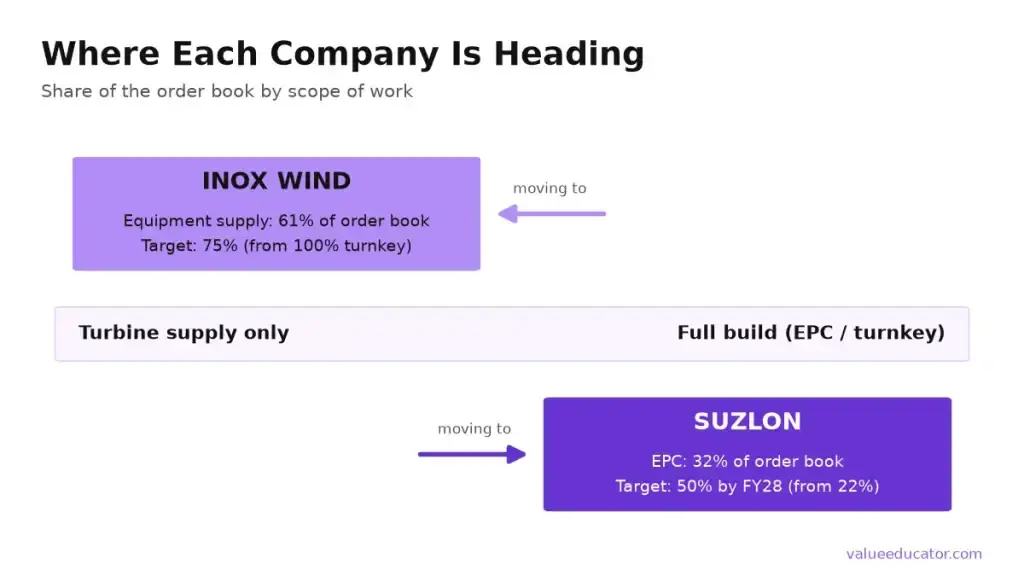
Doing more of the project brings in more revenue per megawatt, but ties up more money and usually earns a lower margin on the extra work. Inox Wind is taking the opposite bet: less revenue per megawatt, but faster payment.
Latest Quarter Side by Side: Q2 FY27 (July-September 2026)
Both companies have reported the July-September 2026 quarter. Suzlon reported on 29 October 2026 and Inox Wind on 13 November 2026.
| Q2 FY27 (Jul-Sep 2026) | Inox Wind | Suzlon Energy |
|---|---|---|
| Revenue from operations | ₹1,354.3 Cr | ₹4,869.1 Cr |
| Growth over Q2 FY26 | Up 21.0% (from ₹1,119.2 Cr) | Up 26.0% (from ₹3,865.5 Cr) |
| Operating EBITDA | ₹205.1 Cr | ₹713.2 Cr |
| Operating EBITDA margin | 15.1% (20.3% a year earlier) | 14.6% (18.5% a year earlier) |
| EBITDA margin as each company reports it | About 17% (adjusted, including other income) | 14.8% (18.6% a year earlier) |
| Profit after tax | ₹68.6 Cr (₹120.6 Cr a year earlier) | ₹394.2 Cr (₹1,279.4 Cr a year earlier, which included ₹891 Cr of deferred tax asset creation; ₹389 Cr without it) |
| Turbines delivered | Not disclosed in megawatts | 710 MW, up 26%; 454 MW commissioned |
| New orders | 350 MW in the quarter | About 1.5 GW in April-September 2026 |
Suzlon's quarter was about 3.6 times Inox Wind's in revenue and about 5.7 times in profit. Both margins fell four to five points, to almost the same level.
The reasons overlap. Inox Wind blamed higher raw material prices linked to the West Asia war and said new bids are now priced to current costs. Suzlon's CFO Rahul Jain said the contribution margin of its turbine business fell from 26.9% to 21.2%, mainly from customer and scope mix, plus currency and commodity swings, and that one-off Suzlon 2.0 costs cut the EBITDA margin by around 1%.
What each company now expects
Suzlon cut its margin view on the 29 October 2026 call. Group CEO Ajay Kapur said the company did a 15.1% margin in the first half and guided to "15.1% plus 1%" for FY27, against about 17% talked of earlier in the year. He expects the second half to be 1.5 to 1.65 times the first, and turbine contribution margins of 22% to 23% for FY27. Management put the normalised margin, without one-off and commodity effects, at around 16.5% to 17%.
Inox Wind's stated goal is unchanged: revenue of about ₹7,500 Cr and a margin of about 20% in FY28, both including other income. With its results on 13 November 2026, the board noted that CEO Sanjeev Agarwal had resigned for personal reasons; Saibaba Vutukuri became Managing Director of the group's wind business.
Five-Year Financials: FY22 to FY26
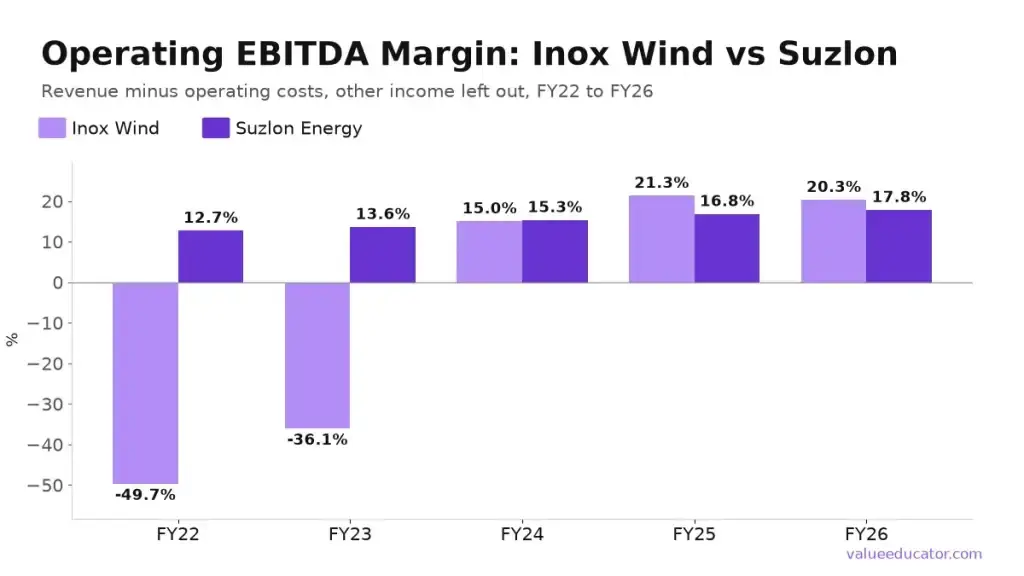
Figures in ₹ Cr, consolidated, for the years ending March. Operating EBITDA margin leaves out other income for both.
| Year | Inox revenue | Inox EBITDA margin | Inox profit after tax | Suzlon revenue | Suzlon EBITDA margin | Suzlon profit after tax |
|---|---|---|---|---|---|---|
| FY22 | 624.6 | -49.7% | -482.6 | 6,520.0 | 12.7% | -176.6 |
| FY23 | 733.0 | -36.1% | -712.4 | 5,946.8 | 13.6% | 2,887.3 |
| FY24 | 1,746.3 | 15.0% | -48.2 | 6,496.8 | 15.3% | 660.4 |
| FY25 | 3,557.2 | 21.3% | 437.6 | 10,851.3 | 16.8% | 2,071.6 |
| FY26 | 4,397.5 | 20.3% | 449.1 | 16,679.1 | 17.8% | 3,163.4 |
Three points stand out.
Inox Wind grew faster, from a much smaller base. Its revenue rose about 7 times from FY22 to FY26, while Suzlon's rose 2.6 times. Inox Wind went from deep operating losses in FY22 and FY23 to a 20.3% margin in FY26.
Suzlon's margin climbed steadily, every year. Its operating margin rose from 12.7% in FY22 to 17.8% in FY26, with no loss year. Inox Wind's margin has been higher than Suzlon's in FY25 and FY26, but it came from a much weaker starting point.
Suzlon's reported profit flatters it in some years. FY23 profit of ₹2,887.3 Cr included a one-time gain of ₹2,720.6 Cr from its debt restructuring. FY26 profit of ₹3,163.4 Cr included ₹1,463 Cr of deferred tax asset creation; the company puts profit without it at ₹1,701 Cr.
Order Book and Growth Plans
| Measure | Inox Wind | Suzlon Energy |
|---|---|---|
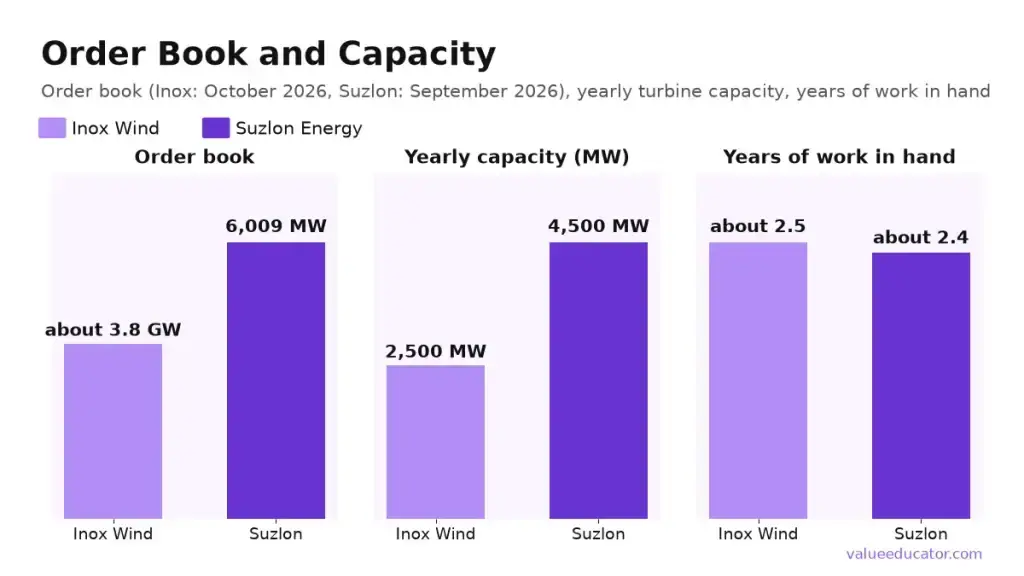
| Order book | About 3.8 GW (October 2026) | 6,009 MW (September 2026), up from 5,697 MW in March 2026 |
| Yearly turbine capacity | About 2,500 MW | About 4,500 MW |
| Years of work in hand | About 2.5 years, at a rough 1.5 GW a year | About 2.4 years, at FY26 deliveries of 2,456 MW |
| Scope of work | 61% equipment, 39% turnkey; target 75% equipment | 38% EPC; target 50% EPC by FY28 |
| Recent orders | 350 MW in Q2 FY27 | About 1.5 GW in April-September 2026 |
| Stated goal | Revenue of about ₹7,500 Cr and a margin of about 20% in FY28 (both including other income) | 25% yearly growth for five years under Suzlon 2.0; FY27 EBITDA margin of 15.1% plus up to 1% |
| Spending plans | New blade and tower plant in South India; 4X turbine launch | About ₹700 Cr of yearly capex; three new blade factories |
Both companies hold roughly two and a half years of work. Suzlon's book is bigger in gigawatts, but so is its factory. Inox Wind's FY28 goal implies total income about 64% above FY26.
The order books differ in who the customers are. Suzlon's book is spread across PSU and company buyers, with 78% from PSU and C&I customers, and its new DevCo orders come from sites it develops itself. Inox Wind's book includes NTPC, NLC India and private power producers, but a large share depends on two buyers, its group company Inox Clean and CESC.
On product, rivals are bringing 5 MW turbines, Suzlon's S175 among them; Inox Wind's answer is its 4X model, with a 4.45 MW prototype already running.
Balance Sheet and Cash Flow
| Measure | Inox Wind | Suzlon Energy |
|---|---|---|
| Equity, March 2026 | ₹7,692.9 Cr | ₹9,463.5 Cr |
| Borrowings, March 2026 | ₹1,551.5 Cr | ₹264.0 Cr |
| Cash and bank balances, March 2026 | ₹611.7 Cr | ₹2,648 Cr (including funds) |
| Net debt or net cash, March 2026 | Net debt of ₹939.8 Cr | Net cash of ₹2,384 Cr |
| Trade receivables, March 2026 | ₹4,249.8 Cr | ₹6,486.5 Cr |
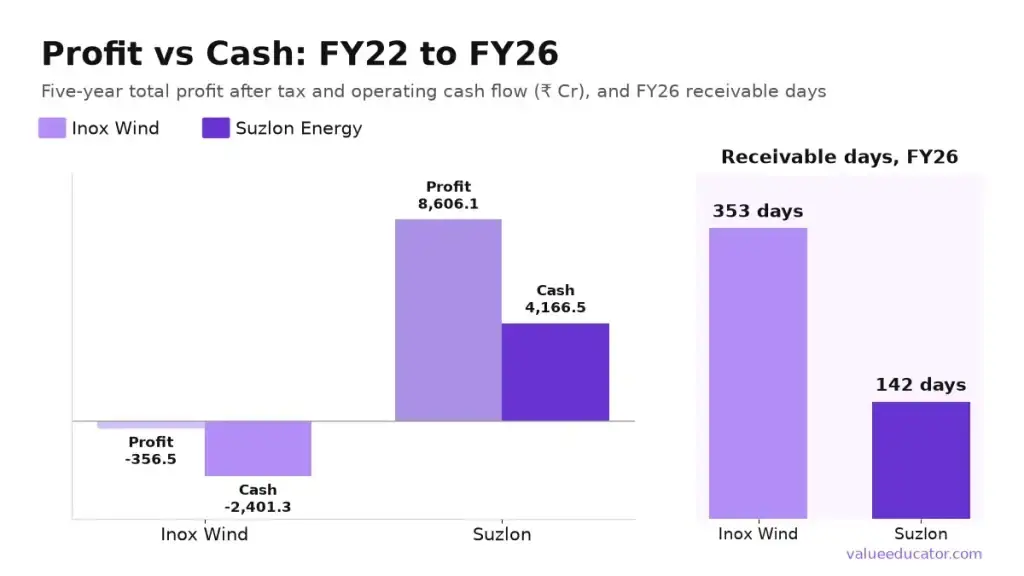
| Receivable days, FY26 | 353 | 142 |
| Inventories and receivables as a share of FY26 revenue | 137% | 66% |
| Operating cash flow, FY26 | Minus ₹598.1 Cr | ₹1,202.1 Cr |
| Operating cash flow, FY22-FY26 total | Minus ₹2,401.3 Cr | ₹4,166.5 Cr |
| Profit after tax, FY22-FY26 total | Minus ₹356.5 Cr | ₹8,606.1 Cr |
Suzlon generates cash; Inox Wind uses it. Over five years Suzlon produced ₹4,166.5 Cr of operating cash. Inox Wind used ₹2,401.3 Cr. In FY26 Inox Wind reported a profit of ₹449.1 Cr but an operating cash outflow of ₹598.1 Cr.
The reason is receivables, the money customers still owe. Inox Wind's receivables equalled 353 days of FY26 revenue, against 142 days at Suzlon. Inox Wind books revenue when risk passes to the customer, but part of the payment waits until the turbine is commissioned, and management has spoken of payment delays in PSU contracts. Days sales outstanding is the number to track. By September 2026, Inox Wind's receivables were ₹4,225.4 Cr, about 334 days of the last twelve months' revenue, a small improvement. Its borrowings, however, rose to ₹2,473.7 Cr, and it used ₹462.3 Cr of operating cash in the April-September 2026 half-year. Inox Wind raised ₹1,619.1 Cr of fresh equity in FY26, which helped fund the gap.
Suzlon is not free of this either: its FY26 operating cash flow was only about 0.4 times its reported profit. It also held ₹2,014.2 Cr of customer advances in September 2026. But its receivables kept rising, to ₹7,004 Cr in September 2026 (about 139 days of the last twelve months' revenue), inventories rose to ₹5,461 Cr, and it used ₹199.5 Cr of operating cash in the April-September 2026 half-year. Net cash fell to ₹2,048 Cr from ₹2,384 Cr in March, though borrowings were still only ₹327 Cr. The cash flow statement tells the two stories more clearly than the profit line.
Risks for Each Company
Inox Wind
- Cash tied up with customers. Receivables of 353 days and five years of negative operating cash flow are the main risk. Management expects the numbers to fall, but by September 2026 the fall was small and borrowings were higher.
- Dependence on group and a few buyers. Two-thirds of execution for the next four to five years is expected from Inox Clean and CESC. A slowdown at Inox Clean would hit Inox Wind directly.
- Margin and leadership. The operating margin fell to 15.1% in Q2 FY27 on costlier materials, and the CEO stepped down in November 2026.
- Product gap. Rivals are launching 5 MW turbines while Inox Wind's 4X model is still being launched.
Suzlon Energy
- Margin under pressure. The reported Q2 FY27 margin was 14.8%, against 18.6% a year earlier, and FY27 guidance came down to 15.1% plus up to 1%, from about 17%. Turbine contribution margin fell from 26.9% to 21.2% on mix, currency and commodity costs.
- More EPC means more money tied up. The move to 50% EPC by FY28 brings more project risk, from land and grid delays to working capital, which is exactly what Inox Wind is moving away from. Over 1.25 GW of erected turbines were waiting for commissioning in September 2026, and receivables and inventories both rose in April-September 2026.
- Profit quality. Deferred tax asset creation lifted reported profit in FY26 (₹1,463 Cr) and in Q2 FY26 (₹891 Cr); without it, reported profit depends fully on operations, as Q2 FY27 shows.
- New bets. DevCo projects, exports, the S175 and new blade factories all need money and time before they pay back.
Which Is Stronger on Each Measure?
| Measure | Stronger | Why |
|---|---|---|
| Size | Suzlon | FY26 revenue about 3.8 times Inox Wind's; 4,500 MW of capacity against 2,500 MW |
| Revenue growth, FY22-FY26 | Inox Wind | Revenue up about 7 times against 2.6 times, from a much smaller base |
| Revenue growth, FY26 | Suzlon | 53.7% against 23.6% |
| Operating margin, FY26 | Inox Wind | 20.3% against 17.8% |
| Margin record, FY22-FY26 | Suzlon | Rose every year with no loss year; Inox Wind had two years of operating losses |
| Latest quarter growth (Q2 FY27) | Suzlon | Revenue up 26.0% against 21.0% |
| Latest quarter margin (Q2 FY27) | Roughly even | Operating margin 15.1% against 14.6%; both down four to five points |
| Return on equity, FY26 | Suzlon | 40.6% against 6.9% (31.1% against 10.1% before tax) |
| Order book | Suzlon in size; close in years of work | 6,009 MW against about 3.8 GW; about 2.4 against 2.5 years |
| Cash flow | Suzlon | ₹4,166.5 Cr of operating cash over five years against minus ₹2,401.3 Cr |
| Receivables | Suzlon | 142 days against 353 days |
| Balance sheet | Suzlon | Net cash of ₹2,384 Cr against net debt of ₹939.8 Cr (March 2026); ₹2,048 Cr of net cash against ₹2,473.7 Cr of borrowings at Inox Wind in September 2026 |
| Customer spread | Suzlon | Inox Wind leans on Inox Clean and CESC for two-thirds of execution |
| Lower working capital model ahead | Inox Wind | Moving to 75% equipment supply, while Suzlon moves to 50% EPC |
Explore our Products
Research Framework

Emerging Titans
Combination of quantitative analysis, industry tailwinds, and management assessment - SPRINT investment philosophy

Tiny Titans
Heavy emphasis on scuttlebutt research, plant visits, and early on-ground signals
Conclusion
On most measures in the filings, Suzlon is the stronger company today: it is bigger, its margin has risen every year for five years, it turns more of its profit into cash, and it has net cash rather than net debt. Its open questions are the margin dip in 2026, now built into a lower FY27 guidance, the extra money that a 50% EPC share will need, and how much of its recent profit came from tax credits.
Inox Wind is the faster-growing, smaller maker with a slightly higher FY26 operating margin and a clear plan to free up cash by selling more equipment and less turnkey work. Its open questions are its receivables, its rising borrowings, its reliance on group buyers and a change at the top. So "Inox Wind vs Suzlon" comes down to what a reader weighs most: Suzlon's scale and cash strength, or Inox Wind's growth and the chance that its cash problem eases. Both depend on India keeping up its wind additions after a record FY26.
For each company in depth, see our research on Inox Wind and Suzlon Energy, and our guide to renewable energy stocks in India for where both sit among solar and wind companies.
FAQs
Inox Wind vs Suzlon: which is better?
+Neither is better on every measure. Suzlon is stronger on size, five-year margin record, return on equity, cash flow and balance sheet: FY26 revenue of ₹16,679.1 Cr, net cash of ₹2,384 Cr in March 2026 and receivables of 142 days. Inox Wind grew faster over five years and had a higher FY26 operating margin of 20.3% against 17.8%, but its receivables were 353 days and it had net debt of ₹939.8 Cr. This is a factual comparison, not a recommendation.
Which company has the bigger order book, Suzlon or Inox Wind?
+Suzlon, with 6,009 MW in September 2026 against Inox Wind's about 3.8 GW in October 2026. Measured against what each can deliver in a year, both hold about two and a half years of work.
Why does Inox Wind have weak cash flow despite making a profit?
+Customers pay slowly. Inox Wind books revenue when risk passes to the customer, but part of the money comes only after commissioning, and PSU customers have paid late. Its receivables equalled 353 days of FY26 revenue, so it reported a profit of ₹449.1 Cr in FY26 but an operating cash outflow of ₹598.1 Cr.
Is Suzlon debt-free?
+Suzlon had borrowings of ₹264.0 Cr in March 2026 against cash and bank balances of ₹2,648 Cr, so it had net cash of ₹2,384 Cr. In September 2026 its net cash was ₹2,048 Cr, with borrowings of ₹327 Cr.
How much turbine capacity do Suzlon and Inox Wind have?
+Suzlon can make about 4,500 MW of turbines a year in India and is building three new blade factories. Inox Wind has five plants with about 2,500 MW of yearly capacity and is building a new blade and tower plant in South India.
What is the difference between Suzlon's and Inox Wind's business models?
+Both make wind turbines and service wind farms. Suzlon is taking on more of the full project, with EPC at 38% of its order book in September 2026 and a target of 50% by FY28. Inox Wind is doing the opposite: equipment supply is 61% of its order book, with a target of 75%, to cut the working capital that turnkey projects lock up.

High growth stock specialist, Value Educator
Shashank Mahajan is an equity research professional with over 12 years of experience in identifying high-potential SME and micro-cap stocks at an early stage. He follows a rigorous scuttlebutt research–driven approach, combining on-ground insights with deep financial analysis. Shashank specializes in uncovering under-researched and under-owned companies with strong management quality and long-term growth potential. Through disciplined research and early identification, he focuses on spotting tomorrow’s market leaders before they enter the mainstream investor radar.
More about Shashank Mahajan →
Azad Engineering vs MTAR vs Unimech: Aerospace Parts

Subros vs Lumax Auto vs Sona BLW: EV Auto Parts Compared
Jyoti CNC vs Macpower CNC: Machine Tool Makers Compared
Data Patterns vs Astra Microwave vs Apollo Micro

Himadri vs PCBL: Carbon Black and Battery Materials
Kaynes vs Cyient DLM vs Syrma SGS: EMS Stocks Compared
Explore our Products
Research Framework
Emerging Titans
Combination of quantitative analysis, industry tailwinds, and management assessment - SPRINT investment philosophy
Tiny Titans
Heavy emphasis on scuttlebutt research, plant visits, and early on-ground signals



India's Aerospace Opportunity
Global Demand. Supply Bottlenecks. Opportunities Ahead.
Don't Miss This Exclusive Webinar!
Join Value Educator to decode the key trends shaping India's aerospace sector and learn how to identify tomorrow's potential leaders in the space.
- How the aircraft value chain works, layer by layer
- Indian companies supplying global aircraft makers
- A framework to judge any aerospace company

 Orders
 Subscription
 Share with friends


Required Details
₹23999.00
(12 month subscription)
As per SEBI regulations, all users are mandated to complete the KYC that is validated for 1 year. Post payment, you will be redirected to the KYC screen


No comments yet. Be the first to comment!