
Waaree Energies: Riding India's Solar Push

The Energy Shift That's Rewriting the Rules
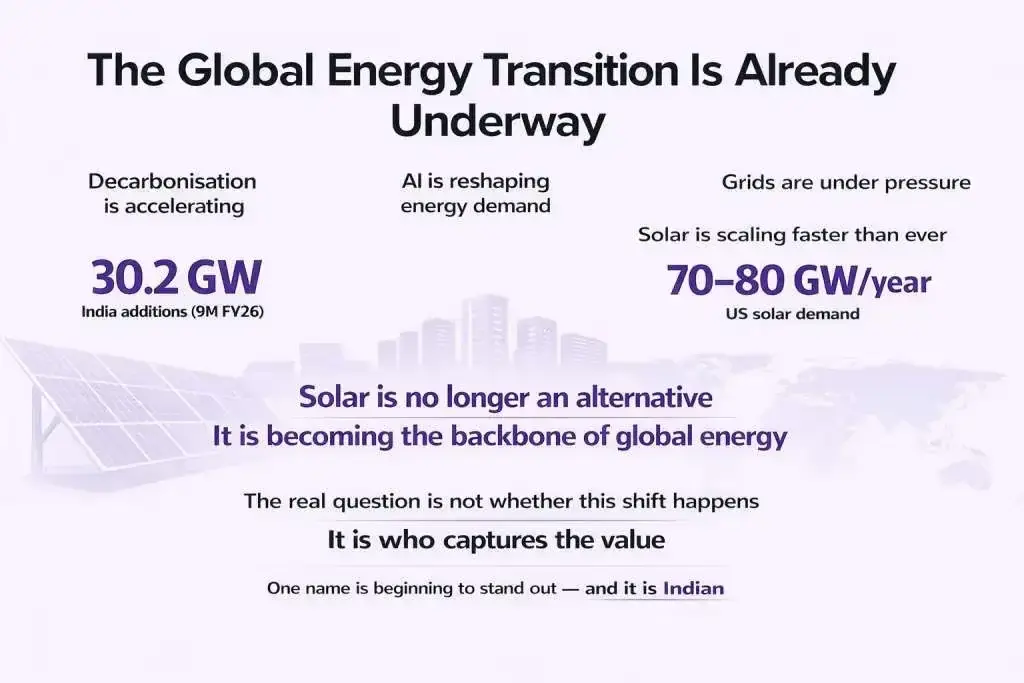
The world is in the middle of the most significant energy transition since the discovery of oil. Governments are racing to decarbonise. Corporations are signing billion-dollar renewable power purchase agreements. Data centers — the backbone of artificial intelligence — are consuming electricity at a pace that no grid was designed to handle. Solar energy sits at the epicenter of this disruption.
India alone added 30.2 GW of solar capacity in just nine months of FY26, already surpassing the entirety of FY25's 23.8 GW. The United States, driven by an AI-fueled data-center supercycle, is projected to need upwards of 70–80 GW of solar modules annually. The EU is systematically de-risking from Chinese supply chains. Everywhere you look, demand for reliable, traceable, non-Chinese solar modules is exploding.
For a broader perspective on how power sector trends are evolving alongside this shift, see our breakdown of Top Power Sector Stocks in India for 2026.
The question investors are asking is simple: who profits from this shift? One name keeps rising to the top — and it is Indian.
From Modules to a Multi-Energy Empire — Meet Waaree
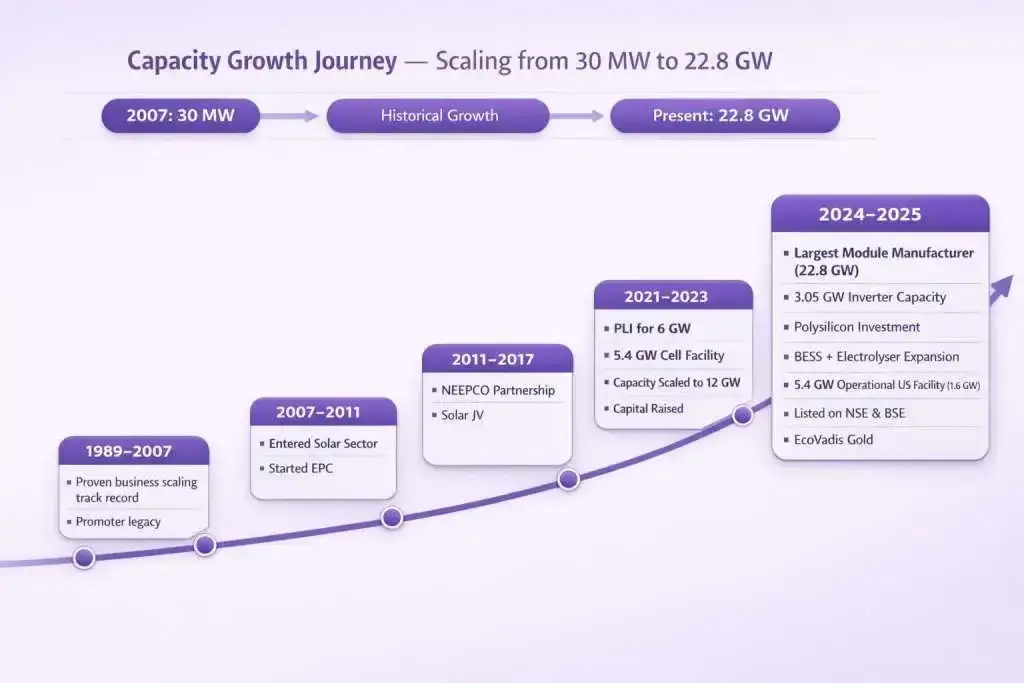
Founded in 1990 by Dr. Hitesh Chimanlal Doshi, Waaree Energies Limited entered solar in 2007 with a modest 30 MW module capacity. What followed is one of Indian industry's most dramatic compounding stories — a 20x capacity expansion to 22.8 GW in under seven years, a stock exchange listing on BSE and NSE, and a transformation from a single-product manufacturer into what management calls Waaree 2.0 — India's first fully integrated multi-energy platform.
Waaree 1.0 was modules and, subsequently, solar cells. Waaree 2.0 is a vertically integrated behemoth that spans polysilicon (via a strategic stake in United Solar Holdings, Oman), ingots and wafers, cells, modules, inverters, transformers, battery energy storage systems (BESS), green hydrogen electrolysers, EPC project execution, and renewable power infrastructure.
This shift toward integrated energy platforms is a broader trend across the sector — including in traditional power companies, as discussed in Power Sector Stocks in India 2026: List by Value Chain
Why does integration matter? Because every rung of the value chain Waaree owns is a rung competitors cannot use against it. It controls cost, it controls quality, it controls traceability — the single most important criterion for accessing the US market.
What Waaree Does — and How It Makes Money
Waaree's revenue engine rests on four distinct but synergistic pillars:
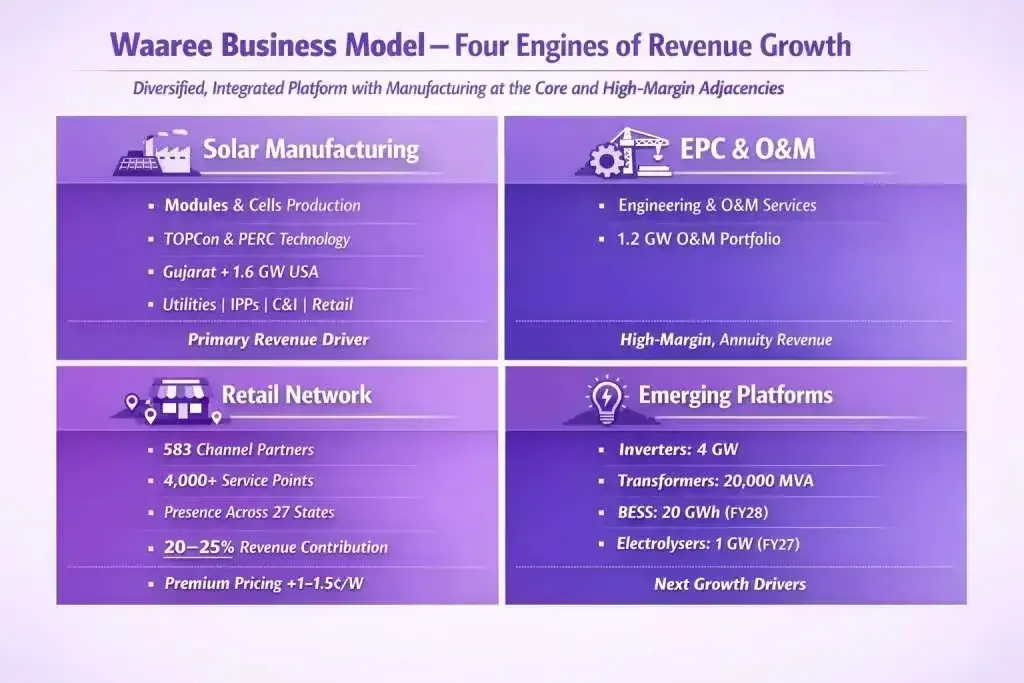
Solar Manufacturing (Modules + Cells):
The core. Waaree produces TOPCon and PERC modules at its facilities in Chikhli, Samakhiali, and Unn (Gujarat), plus 1.6 GW in the United States (Texas). Modules are sold to utilities, Independent Power Producers (IPPs), commercial & industrial (C&I) buyers, and retail customers.EPC and O&M Services:
Waaree Renewable Technologies Limited (WRTL, 74.5% subsidiary) provides engineering, procurement, and construction services and manages 1.2 GW of O&M contracts. This is a high-margin, annuity-like business that deepens customer stickiness.Retail (B2C):
An often underappreciated revenue line. With 583 channel partners, 4,000+ authorised service points across 27 states, and a product range spanning solar kits, panels, batteries, and inverters, retail contributes 20–25% of revenue and commands a premium of 1–1.5 cents per watt over institutional pricing.Emerging Platforms:
Inverters (4 GW facility at Sarodhi, Gujarat — Phase I operational), Transformers (20,000 MVA expansion underway at Alwar, Rajasthan), BESS (20 GWh facility at Rola, Gujarat, targeting FY28), and Green Hydrogen Electrolysers (1 GW facility at Dongri, Gujarat, targeting FY27).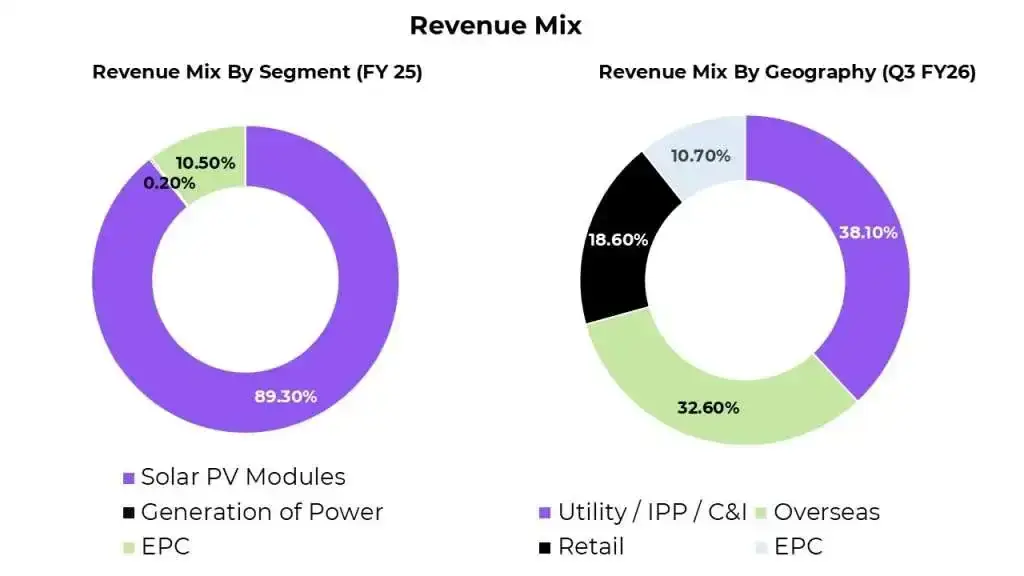
The geographical split in Q3 FY26 was 67.4% domestic and 32.6% overseas, of which the United States is the largest single export market. This balance insulates Waaree from dependence on any single geography while capturing premium realisation in the US.
The Industry Context: Why Timing Has Never Been Better
A Domestic Market in Hyperdrive
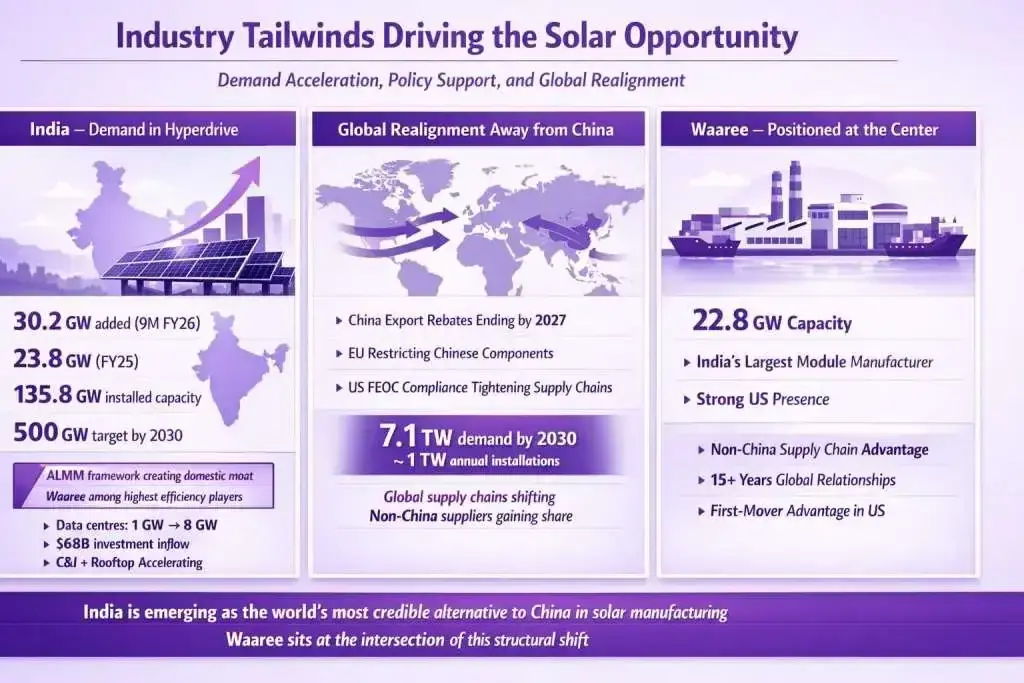
India's solar installation pace has broken every prior forecast. In just the first nine months of FY26, the country added 30.2 gigawatts of solar capacity, already exceeding the entire FY25 full-year addition of 23.8 gigawatts. Cumulative solar capacity now stands at 135.8 gigawatts. The government's 500 gigawatt renewable energy target by 2030 ensures that the trajectory only steepens from here.The domestic demand growth story runs deeper than grid-scale projects. India's data centre capacity is projected to scale from roughly one gigawatt today to eight gigawatts by 2030, driven by data localisation requirements and approximately 68 billion dollars of global investment flowing into clean energy infrastructure. The commercial and industrial segment is electrifying rapidly. And the PM Surya Ghar Muft Bijli Yojana is catalysing rooftop solar penetration in a market where Waaree commands a disproportionately strong retail position.
Critically, India's policy architecture has become among the most manufacturing-supportive in the world. The ALMM framework (Approved List of Models and Manufacturers), with its three-tier structure, is systematically creating moats for domestic producers while restricting cheap Chinese imports. Waaree already holds the highest-enlisted efficiency for both TopCon and PERC cells in the ALMM-II list. This is not regulatory arbitrage. It is competitive positioning entrenched in law.
The Global Realignment Advantages India
Internationally, the forces are equally powerful. China is phasing out export rebates for solar products, with a complete withdrawal expected by January 2027. The European Union is moving to exclude Chinese-made components from new renewable incentive programmes. The United States, through its FEOC (Foreign Entity of Concern) compliance framework, is systematically purging Chinese-linked supply chains from its solar market. Global solar demand is projected to reach 7.1 terawatts by 2030, with annual additions approaching one terawatt per year.The structural implication is straightforward. India, with its rapidly scaling manufacturing base, its non-Chinese supply chain credentials, its cost competitiveness, and its English-speaking professional workforce, is the only large-scale alternative the world has to Chinese solar dominance. Waaree, as India's largest module manufacturer with 22.8 gigawatts of capacity, sits at the precise intersection of this structural shift. Its first-mover advantages in the United States, built over fifteen years of patient relationship-building, are now yielding extraordinary commercial returns.
Order Book and Revenue Visibility: The Real Backbone
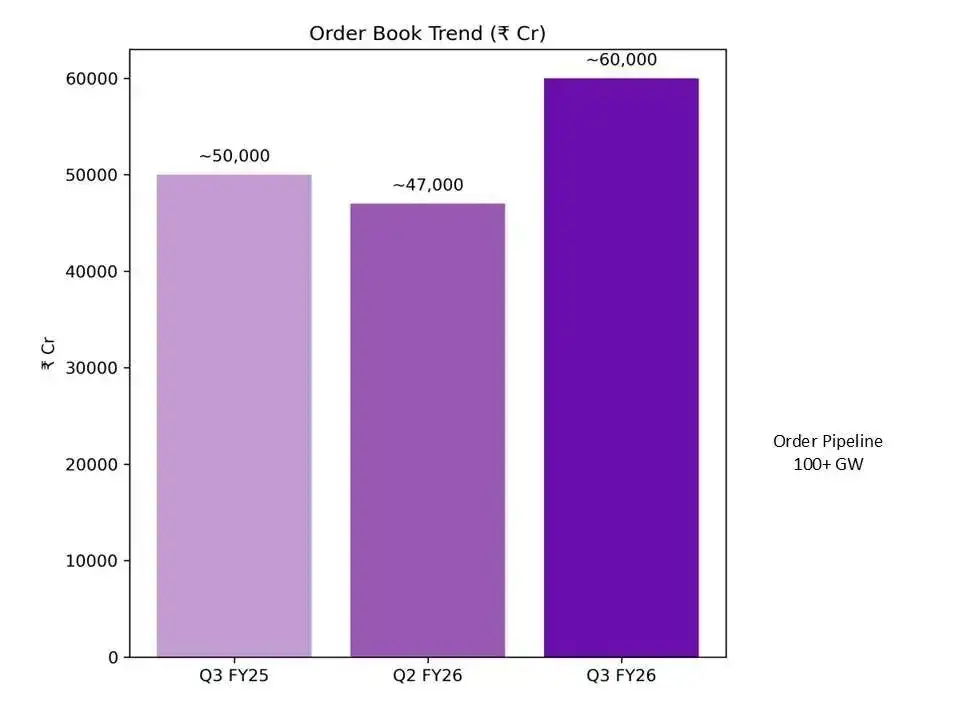
Waaree’s order book of approximately Rs. 60,000 crores as of Q3 FY26 is a strong indicator of its growth visibility, nearly four times its FY25 revenue of Rs. 14,445 crores. It has expanded sharply from around Rs. 47,000 crores at the start of Q2, implying fresh inflows of about Rs. 20,500 crores in a single quarter.
The mix of this order book adds further strength. Around 65 percent comes from overseas markets, largely the United States, while 35 percent is domestic. Domestic orders are currently dominated by non DCR projects, though this is expected to evolve with upcoming cell capacity. Recent wins include 5.3 gigawatts of module orders along with entry into transformers and an initial BESS project.
Importantly, this backlog is backed by firm commercial discipline. Orders are secured with advance payments and retail sales are executed against full payment, ensuring the order book reflects contracted and financially backed demand rather than soft visibility.
“Predictability is the foundation of value in business.”
— Charlie Munger
Beyond this, the company has a pipeline exceeding 100 gigawatts, offering significant conversion potential over the next few years. Additionally, US contracts signed at higher module prices continue to provide a margin advantage, supporting profitability as execution progresses.
Order book strength remains one of the most reliable indicators of future earnings, a theme we explore further in Highest Order Book Stocks in India 2026: Ranked List
Financials: Growth, Margins, and Operating Leverage
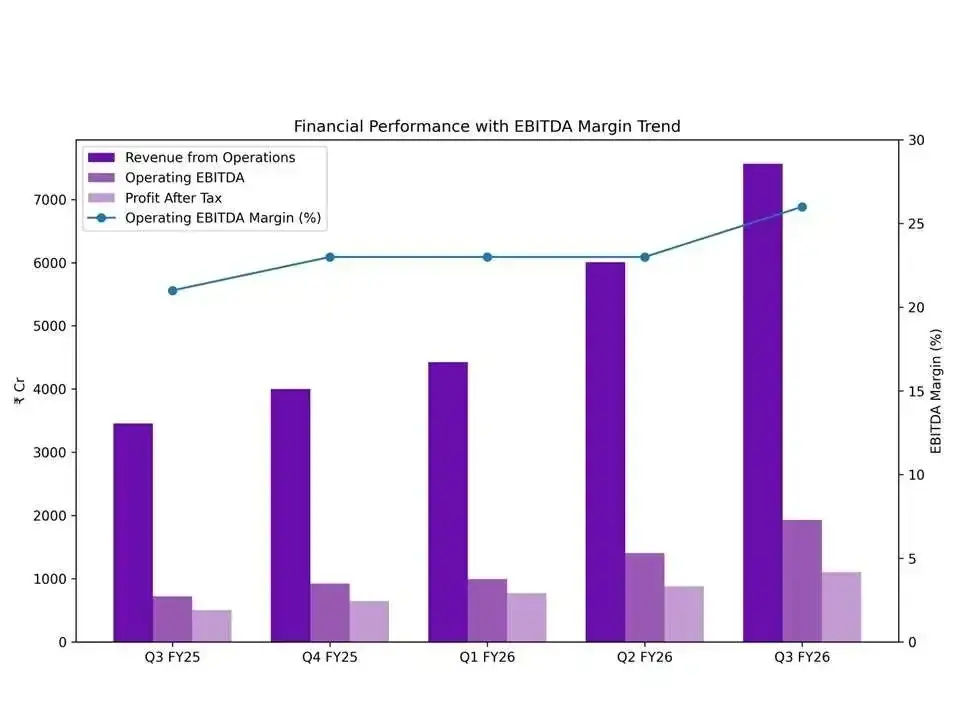
Three things stand out in Waaree's financials. First, revenue growth has been explosive but is driven by real volume — 3.5 GW of modules in a single quarter — not pricing gimmicks. Second, margin expansion is structural: the EBITDA margin expanded from 17.2% in 9M FY25 to 24% in 9M FY26, with Q3 alone touching 25.5%. Third, operating leverage is real — as cell utilisation climbs toward 90%, the incremental cost of producing each additional watt falls, because fixed overheads are already deployed.
Management has guided for an EBITDA of ₹5,500–6,000 crore for FY26, and the Q3 earnings call included a clear statement: they see visibility to surpass this guidance. The record EBITDA of ₹2,124 crore in Q3 FY26 (including other income) underlines this trajectory.
Note on exceptional item: Waaree provisioned ₹294.78 crore in Q3 as an exceptional charge, reflecting prudent accounting for the ongoing US countervailing duty investigation — a charge made proactively based on legal counsel advice before any formal demand was raised. This one-time item does not affect operating EBITDA.
The Strategic Shift: Waaree 2.0 and the Capex of 25000 cr to back it.
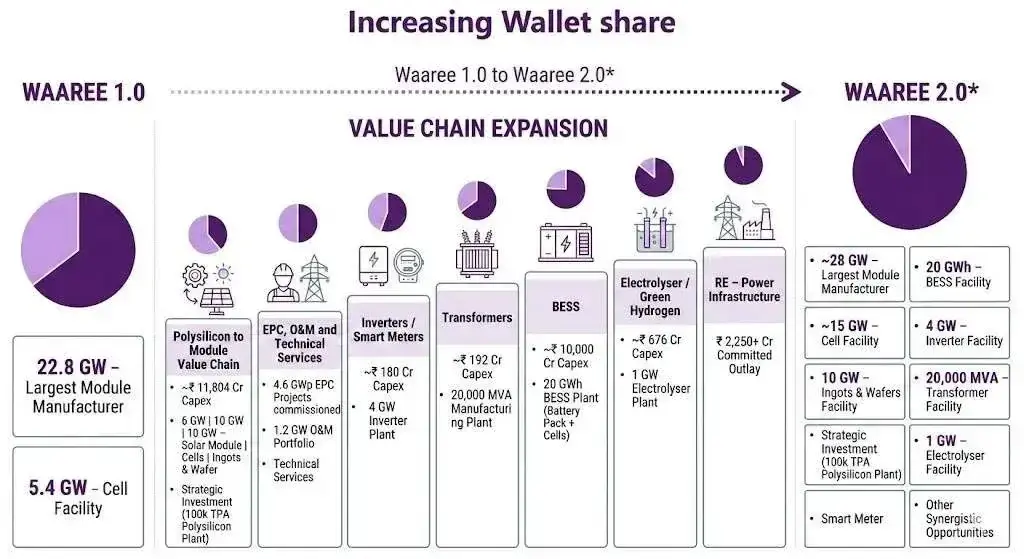
The scale of Waaree's capital commitment is extraordinary and deserves granular examination. Total planned capex under the Waaree 2.0 vision exceeds Rs. 25,000 crores, dwarfing the company's own historical asset base and representing a multi-year re-rating catalyst as each investment comes online.
“You cannot build long-term value without long-term investment.”
— Satya Nadella
Solar Value Chain: Rs. 11,804 Crore Commitment
The integrated solar manufacturing capex covers the entire value chain from ingots and wafers through cells to modules. This includes 6 gigawatts of incremental module capacity in India, 10 gigawatts of new cell capacity (taking total cells to 15.4 GW), and 10 gigawatts of ingots and wafers, all targeted for FY27. In the United States, the company is simultaneously building 1.6 gigawatts of additional module capacity at its Texas facility and has acquired the 1 gigawatt Meyer Burger facility in Arizona for approximately 20 million dollars, a highly capital-efficient acquisition that can be converted from HJT to TOPCon manufacturing with marginal incremental capex.
Battery Energy Storage: Rs. 10,000 Crore Commitment
The single, most capital-intensive investment in the portfolio of Waaree 2.0 is the 20 gigawatt-hour BESS facility in Rola, in Gujarat. Phase I 3.5 gigawatt-hours is projected to be in FY27 and the entire 20 gigawatt-hours by FY28. The company has already increased about Rs. This project will have 1,000 crores of equity contribution to a budgeted equity contribution of a higher value, and the total capex of the project will be about Rs. 10,000 crores. The market size is attractive: India needs 236 gigawatt-hours of BESS by 2032 compared to its existing 0.57 gigawatt-hours of base capacity, and compulsory minimum two-hour energy storage on solar PV tenders are generating structural demand that is not subject to policy discretion. With a BESS pricing of 140-150 dollars/megawatt-hour compared to 70-80 dollars/megawatt-hour in India, this has resulted in an opportunity to blend revenue that management projects will bring 1.5-2 billion dollars of revenue upon full operation in the US market.
Electrolyser: Rs. 676 Crore Commitment
Waaree is placed in the nascent market in green hydrogen with the 1 gigawatt electrolyser plant in Dongri, Gujarat, planned to be in operation in FY27. National Green Hydrogen Mission aims at achieving 5 million tonnes per annum of green hydrogen generation, equal to 40 to 60 gigawatts of electrolyser capacity. Waaree has already secured a PLI of Rs. 444 crores for 300 megawatts of electrolyser capacity and an order book of approximately Rs. 152 crores. The commercial scale of this business remains early-stage, but the PLI backstop and long-term option value on green hydrogen are meaningful.
Inverters and Transformers: Completing the Ecosystem
The 4 gigawatt inverter facility at Sarodhi, Gujarat, with phase I of 3 gigawatts already commissioned, addresses a market projected to grow fourfold in India by 2035. At a capex of Rs. 180 crores, the inverter facility leverages Waaree's retail distribution network and data localisation advantage. Similarly, the transformer business, with current capacity of 4,000 MVA expanding to 20,000 MVA at a capex of Rs. 192 crores, addresses a documented supply gap under India's Revamped Distribution Sector Scheme. An existing order book of Rs. 245 crores, including a large order from a global multinational, validates the commercial potential.Investors looking to capitalise on this capex cycle should also track Power Stocks with High Capex Plans & Capacity Expansion (2026).
Why Waaree Wins — Five Structural Advantages
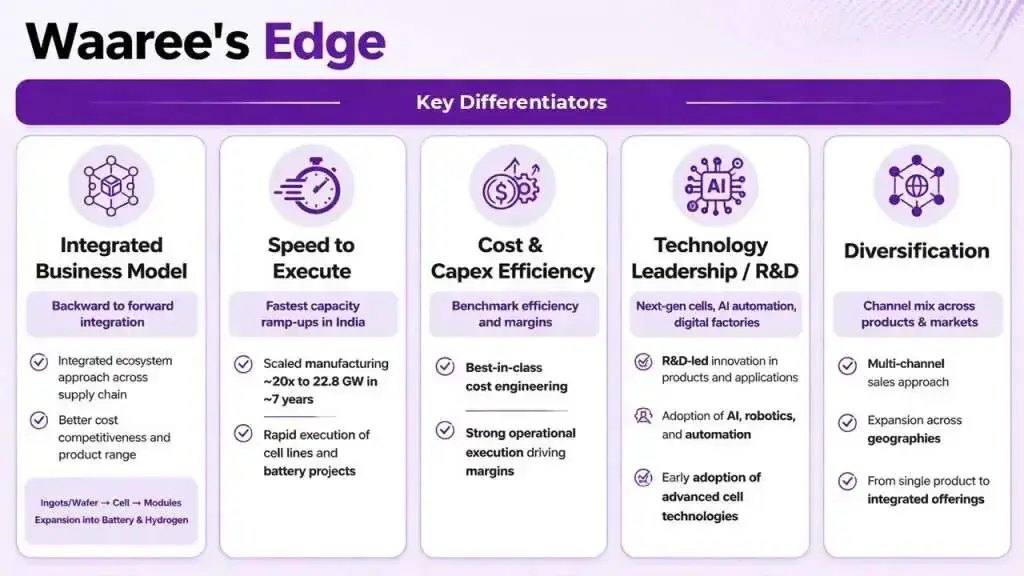
1. Scale as a Moat
At 22.8 GW of module capacity, Waaree is the largest solar module manufacturer in India and one of the largest globally outside China. Scale in solar is not just about cost per watt — it is about the ability to service GW-scale contracts that smaller manufacturers simply cannot bid on. Waaree's EPC business, for instance, only qualifies for 2 GW contracts because it has already executed 1 GW contracts. This circular logic of scale breeds more scale.
2. Supply Chain Resilience
Waaree has spent fifteen years building a non-Chinese cell supply chain for the US market. When the US imposed duties on Cambodia, Malaysia, Thailand, and Vietnam, Waaree pivoted in a single quarter. When Indonesia faced scrutiny, Waaree had already diversified. The Oman polysilicon investment is the next adaptation — securing a FEOC-compliant, fully traceable supply chain from the rock face upward.
3. Retail Distribution — A Decade in the Making
583 channel partners, 4,000+ authorised service points, presence in 80% of Indian pin codes. This retail network took over a decade to build and is essentially impossible to replicate quickly. It generates 20–25% of revenue at a 1–1.5 cent premium, is largely insulated from institutional pricing cycles, and provides an always-on channel for new products like inverters and batteries.
4. Technology and Quality Recognition
Waaree has been a Bloomberg NEF Tier-1 PV module maker for 39 consecutive quarters. It is the only Indian manufacturer to be a RETC Overall Highest Achiever across performance, reliability, and quality categories. It holds ISO 50001:2018 certification, a bankability rating of 'A' from PVTech, and a credit upgrade to 'A+' from CareEdge. In a world where US banks, project developers, and utilities require proven, bankable module suppliers, these certifications are table stakes that Waaree alone among Indian manufacturers fully satisfies.
5. Execution Track Record
Module capacity expanded 20x in seven years, ahead of schedule. Cell plant commissioned on time. Inverter Phase I operational. Oman polysilicon at pilot stage. Every major project Waaree has announced has been delivered. In an industry where capex over-promises and operational under-delivers, Waaree's execution track record is its most underappreciated advantage.
The US Duty Question — Why Waaree Is Not the Target
On 24 February 2026, the US Department of Commerce announced a preliminary countervailing duty (CVD) of 126% on solar panels assembled using cells manufactured in India. The announcement sent shockwaves through the Indian solar sector. Waaree's stock fell sharply on fears that its dominant US export market had been effectively shut.Management convened an emergency investor call on 25 February 2026 to walk the market through a crucial distinction that the headlines missed entirely.
How the US Tariff System Actually Works
The US does not tax modules based on where they are assembled. It taxes them based on where the solar cells inside the module are manufactured. This is the governing principle that has been in place for years, and it is the cornerstone of Waaree's US strategy.- A module assembled in India using cells made in India → 126% CVD (new announcement)
- A module assembled in India using cells made in, say, the Middle East or non-sanctioned jurisdictions → tariff of that cell's country of origin, currently ~10%
- A module manufactured entirely in the US → IRA-eligible, zero import duty, plus ¢7/Wp incentive under Section 45X
Waaree has never sourced cells from India for its US-bound modules. Since 2019, it has maintained a fully non-Chinese, geographically diversified cell supply chain. At the time of the February call, its US-bound modules were sourced from jurisdictions carrying approximately 10% tariff — unaffected by the India CVD announcement.
The Management's Direct Statement
CEO Amit Paithankar stated: the current CVD announcement does not impact Waaree Energies Limited, as the company sources cells from non-Indian, non-Chinese jurisdictions with low tariff rates. CFO Sonal Shrivastava added that the company's supply chains were already FEOC-compliant (Foreign Entity of Concern) — the next major regulatory tightening due from April 2026.
The Oman Investment — Thinking Three Steps Ahead
Waaree's $30 million strategic investment in United Solar Holdings in Oman — a fully traceable, non-Chinese polysilicon producer — is not a response to the 2026 tariff. It is a supply-chain asset built for FEOC compliance and for the era when US banks, project developers, and federal agencies will require complete traceability from polysilicon to panel. The Oman facility was already at pilot stage as of February 2026, with commercial production expected within months.Risks — What Could Go Wrong
No investment thesis is complete without a rigorous assessment of risks. Waaree's are real and worth monitoring closely.
Policy and Regulatory Risk
The US tariff landscape is the most acute near-term risk. Tariffs are applied, modified, and reversed faster than supply chains can adapt. The February 2026 CVD announcement — though not currently impacting Waaree — serves as a reminder that the regulatory goalpost moves constantly. Any unexpected duty on cells from Waaree's current supply jurisdictions, or a broadening of FEOC rules to cover assembly, would require fresh supply-chain pivots. The company has demonstrated it can pivot, but speed and margin cost are unknowns.Foreign investor behaviour often signals these shifts early — discussed in FII Selling in Power Sector – Opportunity or Red Flag?
Domestically, the ALMM (Approved List of Models and Manufacturers) framework for cells and modules governs DCR qualification. Changes in ALMM criteria or DCR requirements could alter the domestic product mix and pricing.
“Regulation is the biggest risk in industries tied to government priorities.”
— Ray Dalio
Supply Chain Concentration
Despite diversification, Waaree's US business ultimately depends on a handful of third-party cell suppliers. Any disruption — geopolitical, quality-related, or tariff-triggered — in those jurisdictions would require rapid sourcing replacement. The Oman investment mitigates this but is not yet at commercial scale.
Execution Risk on New Businesses
BESS, electrolysers, and green hydrogen are genuinely new markets for Waaree. The economics are compelling on paper; execution at 20 GWh and 1 GW scale is untested. Battery chemistry is evolving rapidly, and LFP cell pricing from Chinese manufacturers could undercut economics. Management is investing ₹10,000 crore in BESS — a wrong technology or timing bet would be painful.
Margin Pressure from Commodities
Silver, wafers, and glass are the three primary variable cost inputs. Silver has been volatile. If Waaree's back-to-back procurement contracts are mis-timed or if spot orders are unavoidable, margin could compress faster than the operating leverage can compensate. The CFO's statement that the company manages 'gross margin, not commodity risk' is the right philosophy — but philosophy does not eliminate execution risk.
Explore our Products
Research Framework

Emerging Titans
Combination of quantitative analysis, industry tailwinds, and management assessment - SPRINT investment philosophy

Tiny Titans
Heavy emphasis on scuttlebutt research, plant visits, and early on-ground signals
Conclusion — What to Watch and the Bigger Picture
Waaree Energies stands at the intersection of three of the most powerful secular growth stories of our era: the global energy transition, the AI-driven data-centre power demand supercycle, and India's emergence as a credible alternative to Chinese supply chains. It is not merely a beneficiary of these trends — it is an infrastructure builder for them.The Q3 FY26 results — revenue of ₹7,565 crore (+119% YoY), EBITDA of ₹1,928 crore (+167% YoY), and a record order book of ₹60,000 crore — are not the story. They are evidence of a strategy that has been compounding for fifteen years and is now entering its most expansive phase.
The US duty episode of February 2026 was instructive not because it threatened Waaree, but because of how clearly and quickly management separated signal from noise. The company's diversified supply chain, US manufacturing presence, and FEOC-compliant sourcing philosophy are not reactive measures — they are the product of decisions made years in advance.
If you found this useful, comment “SOLAR” I will share more deep dives like this on energy, power, and high conviction sectors.
FAQs
What company is Waaree Energies?
+Waaree Energies is one of India’s largest solar energy companies and a leading manufacturer of photovoltaic solar modules. Founded in 1990, the company has evolved from a module manufacturer into an integrated renewable energy player with a growing presence across global markets, particularly in the United States and Europe.
Who is the CEO of Waaree Energies?
+As of 2026, the Chief Executive Officer of Waaree Energies is Jignesh Devchandbhai Rathod. He has been closely associated with the company’s manufacturing and operational growth and took over the leadership role following the exit of Amit Paithankar.
What is the main business of Waaree Energies?
+The core business of Waaree Energies is the manufacturing of solar photovoltaic modules. Over time, the company has expanded across the renewable energy value chain, including solar cells, engineering procurement and construction services, operations and maintenance, and newer areas such as energy storage and related energy infrastructure solutions.
What is the future outlook for Waaree Energies?
+The future outlook for Waaree Energies remains strong, supported by the global shift toward clean energy, rising electricity demand, and increasing policy support for domestic manufacturing in India and other regions. The company’s ongoing capacity expansion, entry into new segments like battery storage and hydrogen, and strong order book visibility position it well for sustained growth over the coming years.
What are the risks to Waaree Energies’ growth?
+The key risks to Waaree Energies’ growth include regulatory and policy changes, particularly in export markets such as the United States, where tariffs and compliance requirements can shift quickly. The company also faces supply chain dependencies for critical inputs, execution risks in scaling newer businesses like energy storage and hydrogen, and margin pressures from commodity price fluctuations. Additionally, high market expectations mean that any slowdown in growth or profitability could impact investor sentiment.

High growth stock specialist, Value Educator
Shashank Mahajan is an equity research professional with over 12 years of experience in identifying high-potential SME and micro-cap stocks at an early stage. He follows a rigorous scuttlebutt research–driven approach, combining on-ground insights with deep financial analysis. Shashank specializes in uncovering under-researched and under-owned companies with strong management quality and long-term growth potential. Through disciplined research and early identification, he focuses on spotting tomorrow’s market leaders before they enter the mainstream investor radar.

Glenmark: The USD 700 Mn Cancer Deal and Its Brands

Pharma Stocks in India 2026: Generics, APIs and CDMOs

Granules India: From Paracetamol to a 65% Gross Margin

Natco Pharma: After Revlimid, 29 Patent Challenges

Shilpa Medicare: Cancer APIs, Films and Biosimilars

Alembic Pharma: US Plants Pay Back, Margin Hits 22.2%
Explore our Products
Research Framework
Emerging Titans
Combination of quantitative analysis, industry tailwinds, and management assessment - SPRINT investment philosophy
Tiny Titans
Heavy emphasis on scuttlebutt research, plant visits, and early on-ground signals



Modern Warfare to Multibaggers
Key Trends. Strategic Shifts. Opportunities Ahead.
Today at 7:00 PM IST. Room opens 30 minutes before.
Don't Miss This Exclusive Webinar!
Join Value Educator to decode the key trends shaping India's defence sector and learn how to identify tomorrow's potential leaders in the space.
- In-depth research on India's defence sector
- Live Q&A session
- Actionable takeaways for long-term investors

 Orders
 Subscription
 Share with friends


Required Details
₹23999.00
(12 month subscription)
As per SEBI regulations, all users are mandated to complete the KYC that is validated for 1 year. Post payment, you will be redirected to the KYC screen


No comments yet. Be the first to comment!