
APAR Industries: Wiring Clean Energy

The Problem Nobody Sees
Imagine a ₹5,000 crore solar park in the middle of a desert. After years of planning and construction, thousands of solar panels finally begin generating electricity making investors celebrate, but policymakers highlight renewable energy milestones, and everything appears to be working as planned.
But generating electricity is only half the job as power has little value if it cannot be transported efficiently to where it is needed and unlike most products, electricity needs to move through the grid from the moment it is generated.
For decades, the power sector focused primarily on increasing generation capacity by building more power plants. India followed the same approach, adding large-scale solar parks, expanding wind capacity, & setting increasingly ambitious renewable energy targets.
For a long time, this strategy worked but as renewable energy capacity expanded rapidly, the bottleneck began to shift and challenges started to emerge in transporting electricity from where it was produced to where it was actually needed.
Consider that solar park again, electricity may be generated in Rajasthan, while the factories, cities, and data centres consuming it are located hundreds of kilometres away. As a result, electricity must travel longer distances than ever before. This reality has transformed transmission infrastructure into one of the most critical components of the power sector; without an efficient transmission network.
At first glance, the solution appeared simple, but practically, new transmission corridors take years to develop due to land acquisition challenges, regulatory approvals, environmental clearances, and construction delays. Meanwhile, electricity demand continues to rise as cities expand, industries grow, electric mobility and data centres consume more power.
This growing mismatch forced utilities and grid operators to ask a different question: can existing transmission networks carry more electricity without a new infrastructure?
In many cases, the answer was yes as the limitation was often not the transmission corridor itself but the overhead transmission wire while the towers were already in place with an established route and by replacing older conductors with better, higher-capacity technologies, utilities could increase power flow without constructing entirely new transmission lines.
As India invests heavily in renewable energy and electrification, transmission networks must carry larger volumes of electricity than ever before and to meet this demand requires not only new transmission lines but also advanced conductors, cables, transformers, and grid components capable of improving the performance of existing infrastructure.
And, this is where Apar Industries comes into the picture while participating in multiple layers of the electrification story.
Following The Journey Of A Single Unit Of Electricity
"The big money is not in the buying and selling, but in the waiting." - Charlie Munger
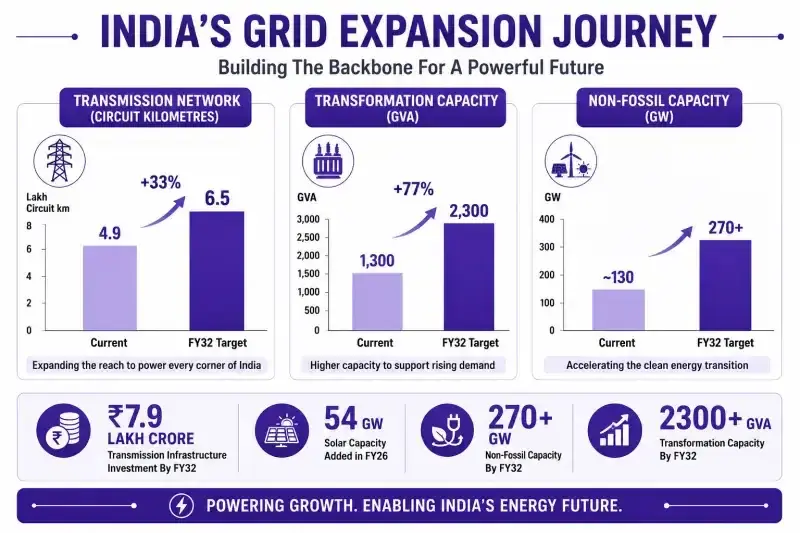
To accommodate this shift, India's transmission network is expected to expand over the decade with the National Electricity Plan envisions transmission infrastructure reaching roughly 6.5 lakh circuit kilometres by 2032, alongside substantial additions in substation and transformation capacity.
And India is not alone, the United States faces a similar challenge, although for different reasons as much of its grid infrastructure built decades ago requires modernization. Along with Europe investing heavily in energy security and grid stability following recent disruptions.
Across regions, the objective remains to move larger volumes of electricity over longer distances while maintaining reliability and minimizing losses creating a powerful backdrop for companies supplying the equipment that makes such movement possible.
Where APAR Sits In The Value Chain
Most investors first encounter APAR Industries through a simple description: the company manufactures conductors, cables, and transformer oils while technically accurate, that description does not fully capture what makes the business interesting or why it has become an important player in the power infrastructure ecosystem.
"You don't make money when you buy things. You make money when you understand things." — Howard Marks
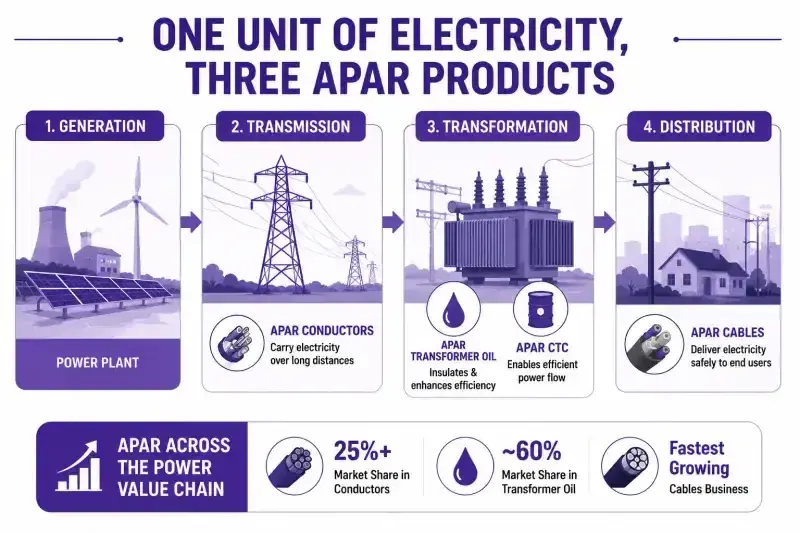
At nearly every stage of the power journey, APAR supplies a critical component, its conductors act as the highways that transport electricity across long distances, its transformer oils help transformers operate safely, and its cables carry power into smart cities, infrastructure projects, renewable energy installations, & rail networks.
What makes this positioning particularly valuable is diversification as many companies benefit from only one part of the power investment cycle, whereas APAR participates in several. If transmission investments accelerate, the conductor business benefits. If transformer deployment increases, transformer oils see higher demand. If industrial electrification expands, cable demand grows. This broad exposure reduces dependence on any single end market and allows the company to participate in multiple growth themes.
Today, APAR commands roughly a quarter of India’s conductor market and nearly 60 percent of the transformer oil market. Its position in cables is comparatively smaller, but management anticipates highest cable growth opportunities in the years ahead.
At first glance, these may appear to be three separate businesses but in reality, they are different ways of monetizing the same underlying clientele. Among these segments, the conductor business is the most mature and it is here that the investment story truly begins.
The Conductor Story Is Bigger Than New Transmission Lines
Developing new transmission corridors can take years, land acquisition has become more challenging, and environmental approvals often introduce significant delays. At the same time, electricity demand continues to rise, creating pressure on utilities to expand capacity more quickly than traditional infrastructure development allows.
This has created a growing interest in reconductoring, instead of constructing new transmission lines, utilities can replace old conductors with newer technologies carrying higher loads. The transmission corridor remains the same, but the electricity that can flow through it increases.
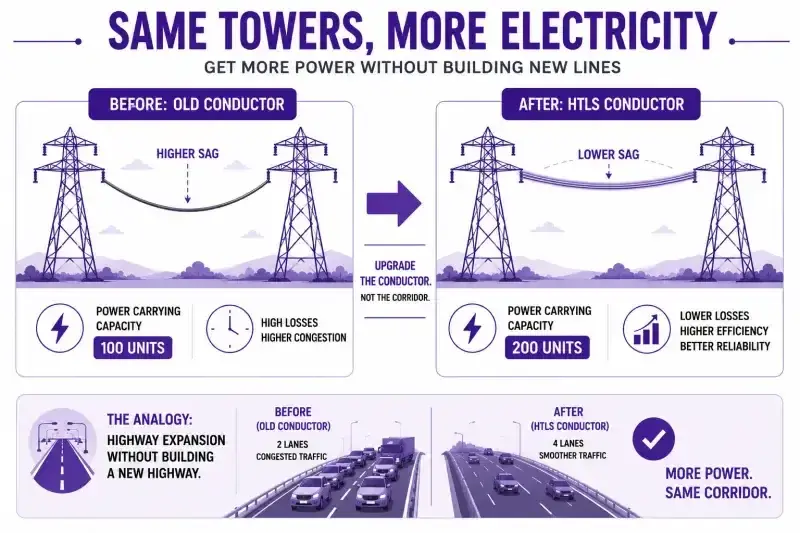
The economics of this approach are attractive and utilities unlock additional capacity without the time, cost, and complexity associated with building new transmission infrastructure. For conductor manufacturers, this creates an important opportunity because demand is no longer driven solely by new transmission projects but through the existing networks.
As countries seek to maximize the utilization of their current infrastructure, advanced conductors are gaining importance and this is where APAR positions itself for the next leg of growth, where they are linked not just to the volume of conductors, but value of the conductors. That distinction is critical because it ultimately drives profitability within the conductor business and helps explain why this segment remains central to the broader investment thesis.
Premiumization - The Real Driver Of Profitability
Over the past few years, the conductor business has been about the premium product mix with utilities looking for conductors operating at higher temperatures, carrying greater loads, and maintaining lower sag levels, these are High Temperature Low Sag conductors."The single most important decision in evaluating a business is pricing power." - Warren Buffett
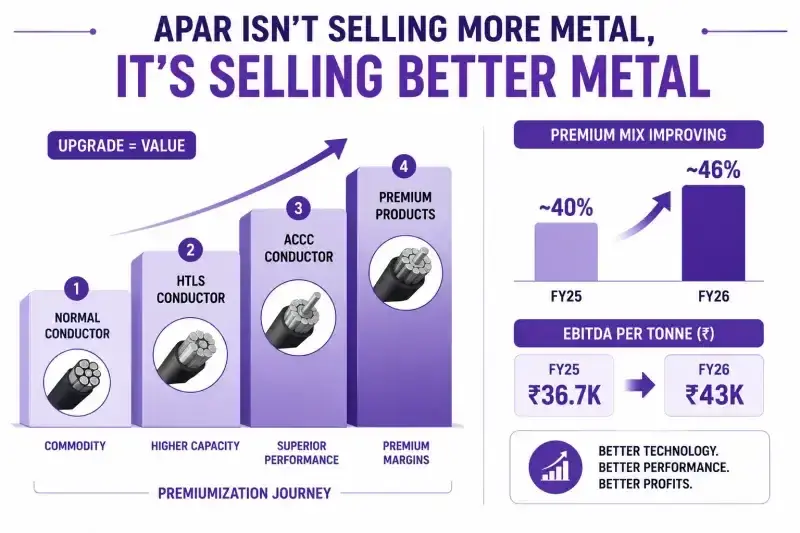
A few years ago, premium products accounted for roughly one-third of conductor revenue and by FY26, that figure had increased to nearly 46%, and management anticipates premium products to cross the 50% mark. More importantly, the order book itself is increasingly skewed toward these higher-value products while the trend is structural.
EBITDA per tonne improved from ₹36,683 in FY25 to ₹43,012 in FY26, also considering ₹44,919 during Q4 FY26, while this improvement was not driven by fluctuations in aluminium prices but the company's ability to sell a richer mix of products with superior economics.
Utilities typically qualify suppliers over many years through testing, certifications, and field performance and winning approval for critical transmission infrastructure requires far more than manufacturing capacity; it requires trust, reliability, and a proven operating history.
This creates a competitive advantage that is difficult to replicate quickly when compared to new entrants who may be able to build a factory, but building utility relationships and obtaining technical approvals can take considerably longer. APAR's partnership with CTC Global further strengthens this position by providing access to ACCC technology, one of the most advanced conductor solutions used globally for grid modernization.
The interesting question now is what happens once electricity reaches the end of those transmission lines because moving electricity is only part of the journey. It must still be transformed before it can be safely distributed and consumed.
The Transformer Ecosystem Opportunity
Every time electricity travels across a transmission network, it eventually encounters a transformer where these transformers perform the most critical function within the entire power system. They step voltage levels up or down, allowing electricity to move efficiently across long distances before being delivered safely to industries, commercial buildings, and households.
This creates a massive ecosystem that extends far beyond the transformers themselves as every transformer requires specialized components, insulating materials, cooling systems, and winding conductors. As transmission networks expand and voltage levels increase, demand for these supporting products grows alongside them.
APAR occupies an unusually strong position within this ecosystem. The company's transformer oil business commands close to 60% market share in India. While transformer oils rarely attract investor attention, they ensure transformer reliability by insulating and cooling with each transformer requiring oil throughout its operating life, creating a recurring demand.
What makes this business particularly attractive is the nature of customer relationships. Transformer manufacturers are generally reluctant to change suppliers because reliability is critical. This dynamic has built relationships with transformer manufacturers such as BHEL, Hitachi Energy, Siemens Energy, ABB, and CG Power.
Alongside transformer oils, another opportunity is emerging through Continuous Transposed Conductors. These conductors are used within transformer windings and are increasingly being adopted because of their higher efficiency characteristics supported by regulation accelerating, as the Central Electricity Authority mandated their use in certain transformer applications.
APAR's CTC business grew nearly 50% during FY26 and is currently undergoing a substantial capacity expansion. Importantly, many customers purchasing transformer oils are also buyers of CTC conductors, creating opportunities for cross-selling and deeper customer relationships.
Viewed together, transformer oils and CTC represent more than individual product lines as they form part of a broader ecosystem and while these businesses provide stability while maintaining market leadership, the company's biggest growth ambition lies in the segment where APAR is not yet a leader.
The Cable Bet That Could Change Everything
If conductors represent APAR's legacy and transformer oils represent its strongest competitive position, cables represent its future and when examining capital allocation of the company's planned ₹1,450 crore capex program, ₹850 crore is being directed toward cables, anticipating it the largest long-term opportunity.
A company should be viewed as an unfolding movie, not as a still photograph." - Jeff Bezos
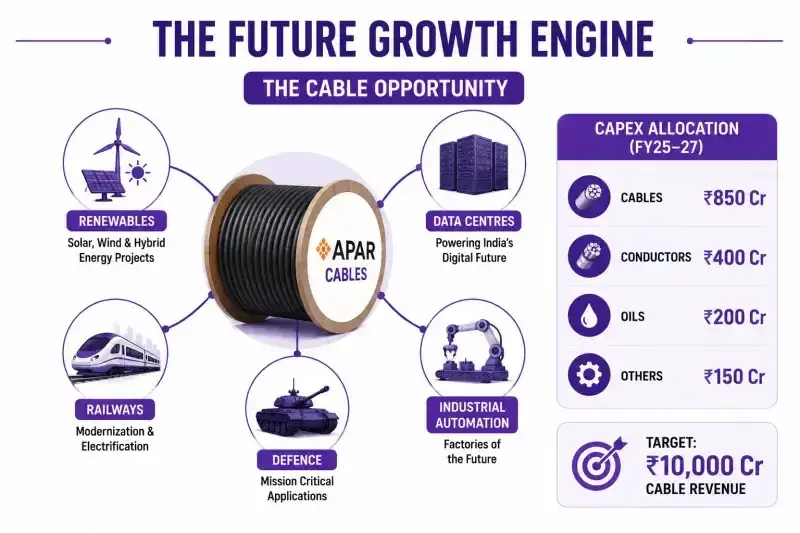
The reasoning is relatively straightforward, in the conductors and transformer oils segment, they are the dominant players but within cables, they target highest growth by catering towards renewable energy, railways, defence, industrial infrastructure, data centres, commercial buildings, and residential construction. Along with smart electrification accelerating, demand for specialized cable solutions will also keep on increasing.
Management is targeting a revenue of ₹10,000 crore cable business over time and to achieve the APAR's revenue mix reducing the company's dependency on mature segments.
Of course, this opportunity is accompanied by greater competition but unlike conductors and transformer oil’s dominant position, the cable industry includes some of India's strongest electrical brands like Polycab, KEI, RR Kabel, & Finolex, they have extensive distribution and strong market presence.
Recognizing this reality, APAR is not competing with them in their niche segments, they are focusing on categories where technical capabilities, customer approvals, and engineering expertise play a larger role than brand recognition.
The success or failure of this strategy will likely determine what APAR looks like five years from now, if they gain market share in higher-value cable categories while maintaining their leadership position, the business could emerge from the current investment cycle as a much larger and more diversified infrastructure player.
The question, however, is whether management's ambitions are supported by evidence, and to answer that, we need to look beyond future plans, examine what APAR has actually achieved.
Proof Of Execution - The Signals Hidden Beneath The Numbers
Every management team talks about future opportunities but few can point to evidence that they are already participating in them and this distinction is important because investors often overestimate the value of announcements while underestimating the value of execution. Ambitious targets can always be presented on a slide. Building the capabilities required to achieve them is considerably harder.
For APAR, some of the most interesting indicators of future growth are not found in headline revenue numbers but they appear in the projects, approvals, and customer relationships the company has quietly accumulated over years.
Consider India's railway network.
Railway electrification is one of the largest infrastructure modernization programs underway in the country where they electrified the rail networks with deployment of conductors, cables, and signalling systems. Out of India's roughly 45,000 kilometres of railway electrification, APAR has already participated in 31,000 kilometres and this level of involvement is not easily achieved as railway projects demand stringent qualification standards, and consistent execution capabilities.
More recently, the company secured a railway Kavach-related order worth ₹150 crore. Kavach, India's indigenous train protection system, is expected to see increasing deployment as railway safety infrastructure expands across the country.
A similar pattern can be observed in defence where the procurement is rarely driven by price alone because long qualification cycles can take years, testing standards are rigorous, and supplier relationships often persist for extended periods once approvals are obtained. APAR has secured approvals from DRDO, and Indian Navy for specialized subsea and underwater cables. These categories remain small today, but they occupy niches where competition is limited.
The same trend appears internationally where APAR's products have been supplied to projects including the Sydney Metro system where such projects may not represent major revenue contributors but they demonstrate the ability to meet international standards and technical qualifications which matter more than manufacturing scale.
The company has also established a presence in emerging e-mobility applications through wiring harnesses for JBM and Olectra, where APAR participates in another electrification theme that extends beyond its traditional customer base.
Meanwhile, within transformer oils, Apar is developing specialized cooling fluids designed for next-generation liquid-cooled transformer systems. This might sound like a small niche today, but it reflects a broader trend in the data centres, becoming larger and more power-intensive, where cooling requirements are evolving and only qualified solutions for these applications may benefit disproportionately as the market develops.
Collectively, however, they reveal something important.
The company is not merely defending its existing businesses as it is steadily positioning itself in multiple areas where future electrical infrastructure spending is likely to emerge while most of these opportunities remain too small to materially impact earnings today, yet they are precisely the kind of relationships and qualifications that can become valuable years before investors fully appreciate their significance.
Competitive Landscape - Where APAR Leads & Where It Needs Proof
One of the challenges in analysing APAR is that there is no single competitor against which the company can be compared as they operate across three distinct industries, each with its own competitive dynamics, customer base, and barriers to entry.
In conductors, APAR is already one of the largest players in India holding a quarter of the domestic market and competes against players such as KEC International, Diamond Power Infrastructure, Sterlite and various regional manufacturers. While conductors are often perceived as commodity products, the premium conductor market operates differently with the utility approvals, qualification histories, technical certifications, and field performance records creating meaningful barriers to entry making it particularly true for HTLS and ACCC conductors, making reliability critical. APAR's long operating history and partnership with CTC Global provide advantages that newer entrants may find difficult to replicate quickly.
The transformer oil business presents an entirely different picture. Here, APAR enjoys one of the strongest competitive positions within its portfolio with close to 60% market share, the company operates from a position of leadership with competitors, Savita Oil, and Gandhar Oil but the market's qualification-heavy nature tends to favour established suppliers.
Transformer manufacturers are reluctant to change vendors because reliability concerns often outweigh modest pricing differences.
The cable segment is where the challenge becomes more complex, unlike conductors and transformer oils, APAR is the dominant player in the Renewable Energy and Railway segment, and not in the housing and distributor led segment. Instead, it competes against some of the strongest brands in the Indian electrical industry, including Polycab, KEI Industries, RR Kabel, Finolex, & Havells. These companies possess extensive distribution networks, strong brand recognition, and significant manufacturing scale.
Recognizing this reality, APAR appears to be pursuing a different strategy rather than competing directly in every category, the company is increasingly focusing on segments where technical qualifications, specialized applications, and engineering capabilities matter more than retail distribution strength. Renewable energy projects, railway infrastructure, defence applications, industrial cables, and data centre projects all fall into this category.
This distinction is important because it helps explain why management continues investing aggressively in cables despite operating from a smaller market position as the opportunity is not to become another Polycab but to build leadership in specialized categories where competition is less intense and customer relationships are more difficult to displace.
Whether APAR succeeds and to determine the company's next phase of growth while its existing businesses provide stability, future value creation increasingly depends on what management can accomplish in areas where market leadership has not yet been achieved.
Explore our Products
Research Framework

Emerging Titans
Combination of quantitative analysis, industry tailwinds, and management assessment - SPRINT investment philosophy

Tiny Titans
Heavy emphasis on scuttlebutt research, plant visits, and early on-ground signals
Conclusion
By now, a clear picture begins to emerge, and that is, APAR does not generate electricity, own transmission assets, or build power plants. Instead, it occupies a position that is often overlooked and is becoming increasingly important.
The stock market is a device for transferring money from the impatient to the patient." - Warren Buffett
The company supplies products that allow electricity to move safely, efficiently, and reliably across an expanding network.
That positioning matters because the power sector is undergoing a structural transformation. Renewable energy capacity continues to expand, transmission networks are growing, data centres are becoming more power-intensive, railway electrification is advancing, and industrial electrification is accelerating. Each of these trends increases the demand for the infrastructure that supports electricity movement rather than electricity generation itself.
APAR participates in this opportunity through three businesses that are at very different stages of maturity: -
- Transformer oil business provides stability and market leadership.
- Conductor business benefits from premiumization and grid modernization.
- Cable business offers largest opportunity for market share expansion.
- Together, creating portfolio in multiple layers of the electrification cycle.
At the same time, investors should remain aware of the risks: -
- Premium conductor adoption may progress more slowly than expected.
- Cable market share gains could take longer to materialize.
- Infrastructure spending cycles may experience delays.
- Commodity prices can affect working capital and customer behaviour.
- The company's capex program must ultimately generate returns.
For that reason, the most important metrics to monitor are often operational rather than financial.
The premium share of conductor revenue provides insight into mix improvement, with EBITDA per tonne reflecting premiumization trend, cable revenue growth indicating management's expansion strategy gaining traction, capacity utilization being absorbed efficiently, while APAR USA's progress offers a window into the company's international ambitions.
Ultimately, the investment case comes down to a relatively simple question, and that is, can APAR replicate in cables what it has achieved in transformer oils and premium conductors?
If the answer is yes, the company could emerge from the current investment cycle as a larger, more diversified electrical infrastructure player with multiple growth engines.
If the answer is no, APAR will likely remain a strong business, but one whose future growth falls short of current expectations.
The broader direction of the industry appears increasingly clear with electricity demand rising, renewable energy expanding, and power networks becoming more complex. As this transition unfolds, the companies enabling electricity to move across the grid may prove just as important as those generating it.
APAR's bet is that the future of power needs better conductors, better transformer solutions, and better cables in the coming years which is what will ultimately determine the value it creates.
FAQs
Why Is Grid Modernization Becoming So Important?
+Grid modernization is becoming critical because electricity demand is growing faster than traditional transmission infrastructure can be expanded. Renewable energy projects are often located far from consumption centres, requiring electricity to travel longer distances. Upgrading existing transmission networks can often be faster and more economical than building entirely new transmission corridors.
What Is Reconductoring And Why Are Utilities Adopting It?
+Reconductoring is the process of replacing older transmission conductors with advanced, higher-capacity conductors while using the same transmission towers and corridor. This allows utilities to increase electricity carrying capacity without facing the delays, costs, and regulatory challenges associated with building new transmission lines.
What Are HTLS Conductors?
+HTLS (High Temperature Low Sag) conductors are advanced transmission conductors designed to carry more electricity while maintaining lower sag levels. They help utilities increase power transfer capacity on existing transmission networks, making them an important technology for grid modernization and renewable energy integration.
Why Are Transformer Oils Important In The Power Sector?
+Transformer oils play a critical role in insulating and cooling transformers, helping them operate safely and efficiently. Since transformers are essential for stepping voltage levels up and down across the power network, reliable transformer oils remain an important part of the broader electrical infrastructure ecosystem.
What Are The Biggest Trends Driving Electrical Infrastructure Demand?
+Several long-term trends are increasing demand for electrical infrastructure:
- Renewable energy expansion
- Transmission network upgrades
- Data centre growth
- Railway electrification
- Industrial electrification
- Electric vehicle adoption
- Smart city development
Together, these trends are increasing the need for conductors, transformers, cables, and other grid-related equipment.

High growth stock specialist, Value Educator
Shashank Mahajan is an equity research professional with over 12 years of experience in identifying high-potential SME and micro-cap stocks at an early stage. He follows a rigorous scuttlebutt research–driven approach, combining on-ground insights with deep financial analysis. Shashank specializes in uncovering under-researched and under-owned companies with strong management quality and long-term growth potential. Through disciplined research and early identification, he focuses on spotting tomorrow’s market leaders before they enter the mainstream investor radar.

Zen Technologies: Revenue Fell After a Big Win




PNG Jewellers: A 194-Year-Old Name Goes National

Explore our Products
Research Framework
Emerging Titans
Combination of quantitative analysis, industry tailwinds, and management assessment - SPRINT investment philosophy
Tiny Titans
Heavy emphasis on scuttlebutt research, plant visits, and early on-ground signals


 Orders
 Subscription
 Share with friends


Required Details
₹23999.00
(12 month subscription)
As per SEBI regulations, all users are mandated to complete the KYC that is validated for 1 year. Post payment, you will be redirected to the KYC screen


No comments yet. Be the first to comment!