
PSU vs Private Defence Stocks for 2026

India’s Defence investment has overtaken unobtrusively to become one of the strongest long-term structural themes in the market. This is a change in the previously dominated business of imports and outside suppliers with national production as supported by policy, finance, and a sense of urgency. This is not only a business development transition, but a national development transition and strategic self-sufficiency.
Defence stocks have just, over the past few years, provided investors with enormous returns, but the actual performance is not in history. The actual narrative is to come as the next stage of development will probably draw the line between the companies that just gain off the cycle and the ones that really rule it.
This is where the debate between PSU defence companies and private defence players becomes critical. Both are participating in the same opportunity, but they are playing very different games when it comes to execution, growth, and value creation.
As Howard Marks once said, “You can’t predict, but you can prepare.”
The goal here is not to pick a side blindly, but to understand how each segment behaves so you can position yourself intelligently for 2026 and beyond. Let’s get into it and understand who is actually leading?

1. India’s Defence Spending: The Core Growth Engine
The budget of the defence has consistently risen to about 6.21 lakh crore in FY25 as opposed to about 4.7 lakh crore in FY21. This steady growth represents a CAGR of close to 78, and this might not seem aggressive at the onset, but when compounded over such a period of time, it will be very powerful.
A significant percentage of this budget is capital expenditure, which amounts to almost 1.72 lakh crores. This segment is directly advantageous to defence companies since funds are spent to fund equipment, systems, and modernisation projects, not on administration or salary expenses.
If you are interested in knowing about penny stocks and understanding how they work, then read our article: What are penny stocks? The complete beginner's guide: pros & cons
The government has also been very tough in its approach towards indigenisation, and close to 75 percent of the procurement is now allocated to the domestic companies. This one policy change has changed the opportunity landscape of the Indian defence manufacturers all around.
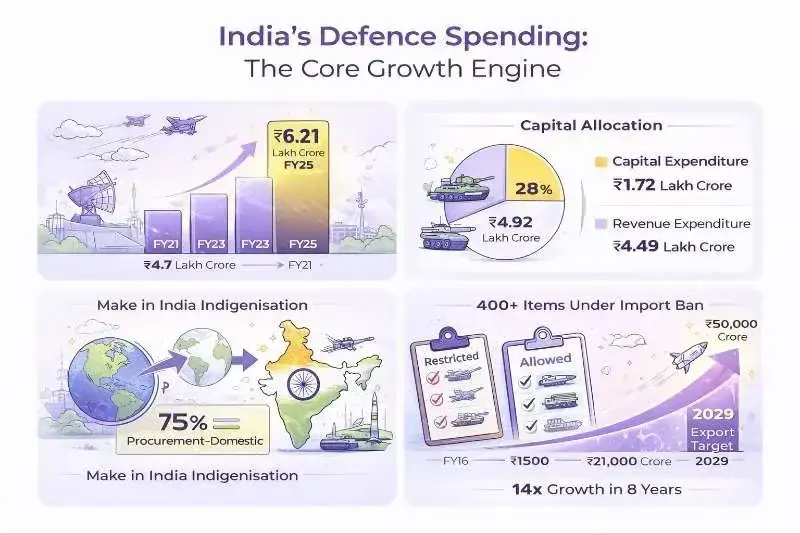
Over 400+ defence products have been put on indigenisation lists, which actually limit the imports and compel the local sourcing. This guarantees long-term demand visibility of Indian companies, particularly in strategic and high-value segments.
Defence export has increased by 14 times in less than a decade, as ₹1,500 crore of FY16 has changed to more than 21,000 crore in FY24. This indicates that the Indian firms are not only expanding on the local front but also are becoming competitive internationally.
Indicators that export-led growth will be a point of foundation in the future is the government has set an ambitious goal of 50,000 Crore in exports by 2029. To accomplish this goal, regular implementation will be needed and effective international alliances.
India is currently spearheading the export of defence equipment to more than 85 countries, and this has greatly lessened the reliance on domestic demand. This diversification enhances the stability of revenue and creates new growth opportunities for businesses.
A combination of all these points suggests that defence is no longer a cyclical industry that is fuelled by intermittent expenditure. It has become a long-term structural development motor, which is likely to define the industrial future of India in the coming decade.
2. PSU Defence Companies: Scale, Stability, and Government Backing
Public sector undertaking (PSU) defence firms benefit from having a larger scale in terms of size than their private sector competitors when carrying out larger, more complicated projects, and are thus able to take advantage of these larger scales. Hindustan Aeronautics has an order backlog that is greater than ₹90,000 crores, which represents approximately 4-5 times its annual revenue.
Bharat Electronics similarly has an order backlog that is greater than ₹60,000 crores and receives a steady stream of revenue each year from the government's defence contracts and projects that are undertaken by the military and other agencies, giving it good visibility for its revenues.
Typical PSU contracts have a 5-10 year term and include long-term contracts for large projects, such as the manufacture of fighter planes, missile systems, and advanced radar systems.
The EBITDA margins for most PSU companies remain relatively consistent and in the 20-25% range due to a combination of long-term pricing contracts that are generally based on the volume of the order and are favourable for the defence industry, as well as the larger scale of procurement and execution of projects.
Because of the nature of the government as the owner of all PSU firms, the government gives priority to PSU companies when awarding new strategic and sensitive government contracts. As a result, there will always be a large number of contracts available for PSU defence contractors, regardless of changes in the larger global economy or on the world stage.
However, the benefits of having larger orders of work to perform or larger contracts do come with some disadvantages for the PSU companies when it comes to the speed of completing and executing projects. The bureaucracy and layers of bureaucracy within the government result in delays associated with the processing of paperwork for the approval of projects and the processing of the expenditure of funds for the completion of these projects.
Flexibility is another challenge, as PSU companies often operate within rigid frameworks. This can limit their ability to adapt quickly to new technologies or changing market dynamics.
Despite these challenges, PSU defence companies remain relatively low-risk investments with predictable cash flows. They are well-suited for investors who prefer stability and long-term compounding over aggressive growth.
3. Private Defence Companies: Growth, Agility, and Innovation
Dynamic defence industries have established themselves by being agile, using innovation, and executing faster than PSUs do despite being subject to more red tape, as those systems must navigate multiple levels of management before moving forward, while the defence companies operate independently from any government organization; therefore, they are not micromanaged by the government. Also, Data Patterns has experienced a revenue increase of 25% or greater compounded annually, mainly because they sell advanced technological products/services in their field of defence electronics, and because Paras Defence sells optical and advanced component systems at higher prices per unit than would be applicable in traditional supply chain activities.
The defence business typically focuses on high-dollar value electronic systems, software-based integration, and precision engineering, all of which tend to provide better returns on investment (ROI) and present more opportunity to grow than other (traditional) manufacturing businesses.

A lower capital intensity yields better return ratios, such as ROCE and ROE, and makes capital deployments more effective. This is an important advantage when ramping up an operation.
Private companies will also tend to be more aggressive about entering overseas markets, which is helpful for diversifying revenue sources and reducing dependence on the domestic market. This creates additional avenues for growth.
Curious about what market cap actually means when it comes to stocks? Read our article on: What is Market Capitalization? Large, Mid, Small Cap Explained with Examples
However, order book visibility tends to be lower, typically only allowing for 1–2 years of forecasts. This creates a strong reliance on receiving ongoing orders for revenue and increases the risk of being unable to execute.
Thus, private defence companies are classified as having high growth potential but also being highly volatile investments, where success relies heavily on the company's demonstrated ability to obtain and execute contracts.
4. Profitability and Margins: Stability vs Expansion
State-owned defence firms typically have steady profitability through a cycle, largely because of their contract structure and cost structure. For instance, Bharat Electronics Limited has reported consistent EBITDA (earnings before interest, taxes, depreciation, and amortization) margins in the 22%-25% range each year, which indicates control of costs within a predictable time frame.
This kind of predictability is very valuable in a sector where project timeframes are long and capital intensity is very high. As such, investors have the ability to estimate earnings for these businesses with a higher degree of confidence than they could for a privately owned business, which lowers the level of uncertainty in the market and ultimately results in a more stable overall valuation.
On the other hand, private sector defence firms typically operate in niche markets and are able to achieve higher than normal margins of more than 28%-30%. Their high margins are mostly due to their specialisation in components, electronics, and precision-engineering goods that tend to have pricing power relative to other types of products.
At the same time, private companies’ margins tend to fluctuate more than state-owned firms because they rely on project mix and execution efficiency to determine their profitability. A delay or cost overrun on a single contract can have a material effect on private-sector margins.
Operating leverage is important in the private sector as fixed costs tend to be lower than potential revenues. Therefore, as private companies grow, they will experience disproportionately greater profit growth as a result of even small revenue increases.
Public Sector Undertakings (PSUs) are larger entities that typically experience longer periods of gradual increases in their profit margins. They will have lower volatility in their profits, but also an extremely low chance of experiencing large upside swings in profit.
Another consideration is input costs, in which private companies may be subject to large volatility in their input costs depending on raw material pricing and supply chain conditions. Conversely, due to their scale and long-term contracts, PSUs are much more insulated from input cost shocks.
Warren Buffett said, “The best business is that which can provide high returns on capital while carrying with minimal risk.” Each segment's margin characteristics provide insight into how risk vs returns are balanced differently.
Ultimately, defence profitability depends not just on having higher margins, but also on being able to sustain those margins for a long period. This is the key difference between the PSU and private business models.
5. Order Book Strength: Visibility vs Dependence
One of the Barricaders' greatest allies when investing in the Defence industry is having access to good order book positions, as they give investors the ability to estimate what revenues will be generated from the long-term contracts, thus providing them with good long-term revenue visibility.
In general, Public Sector Units (PSUs) dominate the order book from their long-term government contracts, and have strategic importance to the Defence department.
Hindustan Aeronautics Limited (HAL) is an excellent example of this with an order book of over ₹90,000 crores, which gives over a good 4–5 years of revenue visibility (therefore, revenues will remain stable regardless of any fluctuations in order inflows that may occur in the short term).
Similarly, BEL has and continues to have a good growth in its order pipeline due largely to consistent Defence procurements backed by the government, and thus, they have a high degree of revenue visibility, which allows for a significant reduction in uncertainty of earnings for its shareholders.
Whereas, Private sector defence manufacturers generally operate with much smaller order books (i.e., between the ₹1,000 to ₹5,000 range depending on their size), thus more dependent on the ongoing acquisition of future contracts as a means of continuing to drive growth.

The gap in order visibility is a reflection of how businesses operate differently; PSUs build large integrated systems, whereas private companies build specialized components and sub-systems.
As private sector firms continue to expand and earn trust, their order books are anticipated to be stronger than what they currently show. In the meantime, between the two segments, there is still some distance apart.
This distinction makes it clear how PSU companies provide predictability & stability, whereas the private sector will deliver growth through opportunity with successful execution.
For the investor, this creates a contrasting decision between guaranteed earnings visibility versus potential upside from future orders.
6. Valuations: Stability Discount vs Growth Premium
There is a huge divide in how the market recognizes value in public sector units (PSUs) and private companies within the defence industry. The average price/earnings ratio for PSU several successful organisations is usually between 20 - 35 times annual earnings, which indicates the conservative nature of valuations according to the market. The primary reason for this is that their growth is stable and thus limits their ability to be more agile and innovative - while their earnings appear stable, the market perceives that their ability to grow will be more modest than that of their counterparts.
When comparing valuations of private company defence stock, it can be observed that the average price/earnings ratio is between 40-70 times annual earnings, and in many cases, the multiples are much higher. This reflects better expectations in the market for future growth and scalability of private company defence stocks.
The reason why some private companies have a premium valuation is that they tend to grow at a faster rate than PSUs, penetrate the export market more quickly, and have the ability to capture niche markets that generate high margins, which are associated with higher multiples.
On the other hand, the high multiples that can be placed on private company defence companies also carry the risk of a downturn in growth or execution issues; therefore, timing of the entry for these equities becomes a critical part of overall investors' plans.
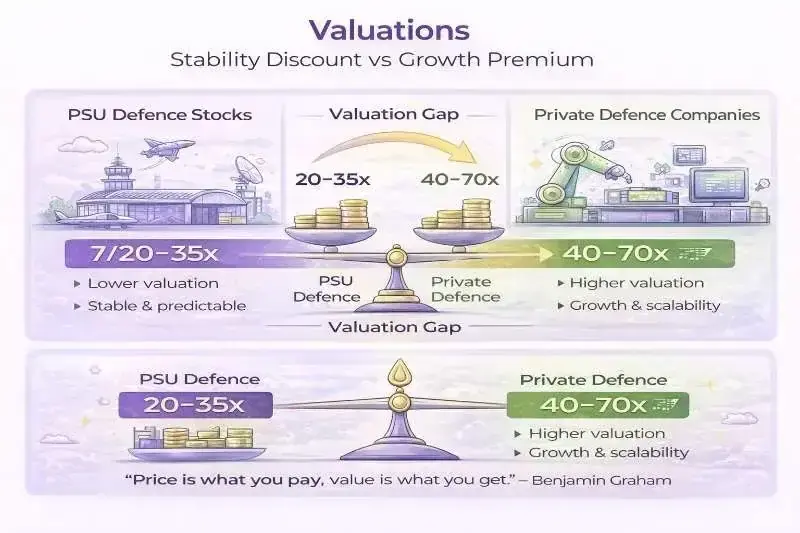
The lower valuations associated with PSUs provide a cushion for the investor in the event of a downturn in the market, making investing in the PSU defence stock less risky than investing in the private sector defence stocks.
Valuations are not just numbers, but a reflection of market expectations and sentiment. Paying too much for growth can reduce future returns even if the business performs well.
This makes it essential for investors to balance growth expectations with valuation discipline when allocating capital in this sector.
7. Export Opportunity: The Biggest Trigger Ahead
Exports are rapidly emerging as one of the most powerful growth drivers for the Indian defence sector. With exports crossing ₹21,000 crore, the trajectory clearly indicates a shift toward global competitiveness.
The government’s target of ₹50,000 crore in defence exports by 2029 suggests that this growth is not just a short-term trend but a long-term strategic priority. Achieving this will require strong execution and global partnerships.
Private companies are currently leading this export push due to their flexibility, customization capabilities, and faster decision-making processes. This gives them an edge in capturing international markets.
PSU companies are also entering export markets, but their progress has been relatively slower due to structural constraints and operational complexities. This creates a gap in growth opportunities.
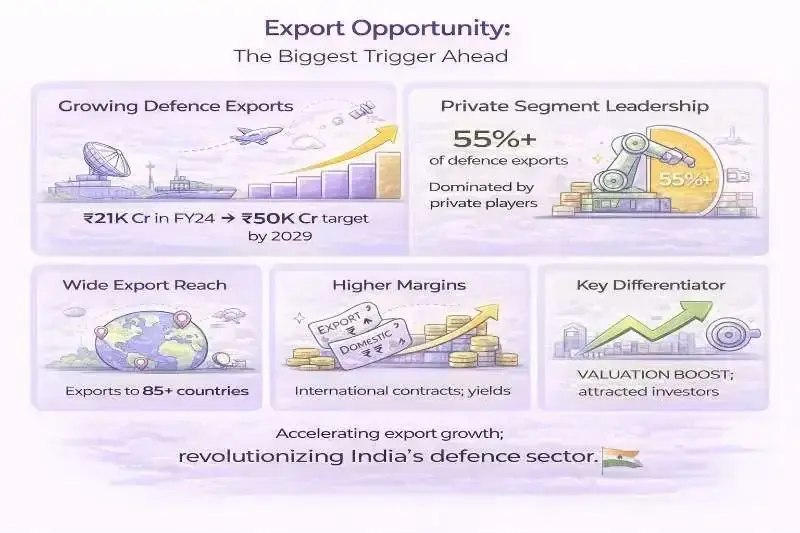
Another advantage of exports is diversification, where companies are not entirely dependent on domestic defence spending cycles. This improves revenue stability over the long term.
Indian defence products are now being exported to over 85+ countries, which significantly reduces geographical concentration risk. This broadens the market opportunity for domestic companies.
Companies that successfully build a strong export presence can experience significant valuation re-rating. This is because global exposure enhances both growth potential and investor perception.
Export capability is likely to become one of the most important differentiators between defence companies over the next decade. Investors who track this early may benefit the most.
8. Risks, Competition, and What Can Go Wrong
Despite the strong growth outlook, the defence sector is not without risks, and understanding these risks is critical for making informed investment decisions. PSU companies, while stable, face challenges related to slow execution and bureaucratic inefficiencies.
Delays in project approvals and implementation can impact revenue recognition and overall growth timelines. This becomes particularly important in large-scale, long-duration projects.
Private companies face a different set of risks, primarily related to high valuations and limited order visibility. Any disruption in order inflows can significantly impact earnings and stock performance.
Policy risk remains one of the biggest uncertainties, as defence spending is heavily influenced by government priorities and geopolitical conditions. A shift in policy can affect the entire sector.
Technological disruption is another growing risk, as defence systems are becoming increasingly complex and innovation-driven. Companies that fail to keep up may lose competitiveness.
Global competition is intensifying, with international defence companies entering India through joint ventures and partnerships. This increases pressure on domestic players to maintain quality and pricing.
Supply chain risks, especially for critical components, can also impact execution timelines and costs. This is particularly relevant for private companies with less bargaining power.
As Charlie Munger once said, “All investment is about weighing probabilities.” Understanding risks is just as important as identifying opportunities.
In a sector like defence, where growth is strong but execution is complex, ignoring risks can lead to costly mistakes for investors.
Explore our Products
Research Framework

Emerging Titans
Combination of quantitative analysis, industry tailwinds, and management assessment - SPRINT investment philosophy

Tiny Titans
Heavy emphasis on scuttlebutt research, plant visits, and early on-ground signals
Conclusion: Where Should You Invest for 2026?
The comparison between PSU and private defence stocks is not about choosing a winner, but about understanding how each segment fits into your portfolio strategy. Both are benefiting from the same structural tailwinds, but their risk-reward profiles are very different.
PSU defence companies offer stability, strong order visibility, and relatively lower downside risk. They are better suited for investors who prefer steady compounding and predictable earnings over long periods.

Private defence companies offer higher growth potential driven by innovation, exports, and niche specialization. However, this comes with higher volatility and execution risk, making them more suitable for aggressive investors.
To balance sector-specific risks, read: Portfolio Diversification – How Many Stocks Should You Hold?
A balanced approach, where capital is allocated across both PSU and private players, can help capture the full opportunity while managing risk. This allows investors to benefit from both stability and growth.
At the same time, risks such as high valuations, execution challenges, and growing competition must be monitored closely. Ignoring these factors can impact returns significantly.
As Peter Lynch said, “Know what you own, and know why you own it.” In defence investing, this clarity becomes even more important because you are investing in a sector driven by long-term national priorities and global dynamics. Comment “DEFENCE” if you loved our article, and share it with your friends who might find this useful.
FAQs
Are PSU defence stocks safer than private defence stocks?
+PSU defence companies are generally considered safer because of strong government backing and long-term contracts that provide revenue visibility of 3–5 years or more, with companies like Hindustan Aeronautics Limited holding order books above ₹90,000 crore, which reduces uncertainty significantly, whereas private companies depend more on continuous order inflows, making them relatively volatile, so the trade-off essentially comes down to stability versus higher growth potential.
Why do private defence stocks trade at higher valuations?
+Private defence companies often trade at 40–70x earnings because the market is pricing in strong future growth, especially in exports and niche high-margin segments, with companies like Data Patterns delivering around 20–25% revenue growth, while PSU companies typically trade at 20–35x due to their stable but slower growth profile, meaning the valuation gap reflects expectations of scalability rather than just business quality.
Which segment benefits more from the Make in India push?
+Both PSU and private companies benefit from indigenisation policies, with PSUs receiving large strategic contracts directly, while private players participate through components and specialized systems, and with 75% procurement reserved for domestic players, along with 400+ items under import restriction, the entire ecosystem is expanding, although private companies may see faster growth due to flexibility and innovation.
How big is the defence export opportunity for India?
+India’s defence exports have grown sharply from ₹1,500 crore in FY16 to over ₹21,000 crore in FY24, and with a government target of ₹50,000 crore by 2029, the opportunity is massive, as exports not only drive revenue growth but also improve margins and global competitiveness, with private companies currently leading due to agility while PSUs are gradually catching up.
Should investors choose PSU or private defence stocks for 2026?
+The choice depends on risk appetite, as PSU stocks offer steady compounding with strong order visibility and lower downside risk, while private stocks provide higher growth potential driven by exports and niche capabilities but come with higher volatility, so a balanced allocation across both segments can help capture stability as well as upside, aligning with the idea shared by Peter Lynch that investors should always understand what they own and why they own it.
The choice depends on risk appetite, as PSU stocks offer steady compounding with strong order visibility and lower downside risk, while private stocks provide higher growth potential driven by exports and niche capabilities but come with higher volatility, so a balanced allocation across both segments can help capture stability as well as upside, aligning with the idea shared by Peter Lynch that investors should always understand what they own and why they own it.

High growth stock specialist, Value Educator
Shashank Mahajan is an equity research professional with over 12 years of experience in identifying high-potential SME and micro-cap stocks at an early stage. He follows a rigorous scuttlebutt research–driven approach, combining on-ground insights with deep financial analysis. Shashank specializes in uncovering under-researched and under-owned companies with strong management quality and long-term growth potential. Through disciplined research and early identification, he focuses on spotting tomorrow’s market leaders before they enter the mainstream investor radar.

Zen Technologies: Why Revenue Fell After Its Biggest Win

Data Patterns: India's Radar Designer and Its Waiting Orders

KSH International: The Wire Inside India's Transformers

Krishna Defence: The Steel Behind India's Warship Hulls

PNG Jewellers: A 194-Year-Old Name Goes National

Axiscades: From Services to Missile and Radar Electronics
Explore our Products
Research Framework
Emerging Titans
Combination of quantitative analysis, industry tailwinds, and management assessment - SPRINT investment philosophy
Tiny Titans
Heavy emphasis on scuttlebutt research, plant visits, and early on-ground signals

Download your free E-book - Beyond the radar
Master your micro-cap investing with our tailor-made E-book. Beyond the radar. Download now!


 Orders
 Subscription
 Share with friends
 Logout


Required Details
₹23999.00
(12 month subscription)
As per SEBI regulations, all users are mandated to complete the KYC that is validated for 1 year. Post payment, you will be redirected to the KYC screen


No comments yet. Be the first to comment!