
How Many Stocks Should You Hold?
When COVID shut the world down, the stock market didn’t fall uniformly—it split in two.
As fear spread, shares of pharma, healthcare, FMCG, and essential services quietly moved up, while hospitality, aviation, real estate, and discretionary consumption collapsed almost overnight. On paper, diversification was supposed to protect investors in moments like these. In reality, it revealed something far more uncomfortable.
Investors with thoughtfully balanced portfolios could see the picture clearly. They reviewed exposure, trimmed vulnerable sectors, and stayed invested in businesses that were actually benefiting from the crisis. Others faced a different problem. Their portfolios were built around stocks they liked—names added over time because they felt familiar, popular, or “long-term,” without a clear role or limit.
When markets crashed live on screen, conviction blurred. Many sold the stocks that still held value, while holding on to beaten-down names simply because they believed in them. By the time they reached the stocks that truly needed to be cut, prices had already collapsed.
The pandemic didn’t just test which sectors would survive. It exposed a harder truth: diversification only works when it is intentional. Too little magnifies losses. Too much—especially when driven by comfort and preference—paralyses decisions.
“Risk is what’s left over when you think you've thought of everything.”- Carl Richards
Portfolio Diversification: More Than Just Owning Many Stocks
The concept here is "diversification"—the idea that you can cut your risk and volatility by allocating investments not to one, but to several, assets.
Creating a diversified portfolio primarily is not about trying to find the next hot investments and earning the highest returns. What diversification aims to do is make the portfolio more resilient. Even when some investments perform poorly, some investments may absorb the shock and allow the portfolio to remain more steady, hence allowing people to remain invested when the market turns volatile.
Through the course of this article, we will discuss what really defines diversification of a portfolio, the importance of the process in all market cycles, and how a proper strategy can guide investors to stay in the markets while also managing risks.
What is Portfolio Diversification?
At its most basic, portfolio diversification involves a very simple principle:
“Don't put all your eggs in one basket.”
In investing, it means avoiding placing all your eggs in one basket, rather diversifying your investments in such a way that the performance of a portfolio is not relying on the performance of one investment, sector or industry.
Diversification is not the process of maximizing gains but reducing the risk of loss. When some investments are not doing so well, others help compensate for that effect and bring stability to the portfolio.
“Diversification is the only free lunch in finance,” as economist Harry Markowitz, a portfolio theory pioneer, once famously put it:
The secret of diversification is not predicting what stocks are likely to perform well, but rather how you can hedge against the unpredictable.
A Simple Illustration:
For example, a street food seller will be earning a living from the sale of food. If the food seller only sells a particular dish like vada pav, the earning will depend on a few things such as availability of bread and potatoes. A startup can be vulnerable if it collects revenue from only one source.
Then picture the same supplier providing vada pav, bhel, and lemon juice. Even if the demand for one is reduced, the earnings will be coming from the remaining sources.
Likewise, many farmers cultivate various crops depending on the season, thereby ensuring that they earn money every time. If a particular crop fails due to weather conditions and/or pricing issues, others compensate for the loss.
Portfolio diversification works in the same way. By spreading investments across multiple companies, the portfolio is not reliant on a single outcome, sector or event. A setback in one holding does not automatically translate into a severe loss for the entire portfolio.
While the principle is universal, India’s unique market dynamics make diversification especially important here.
Why Portfolio Diversification Matters in India?
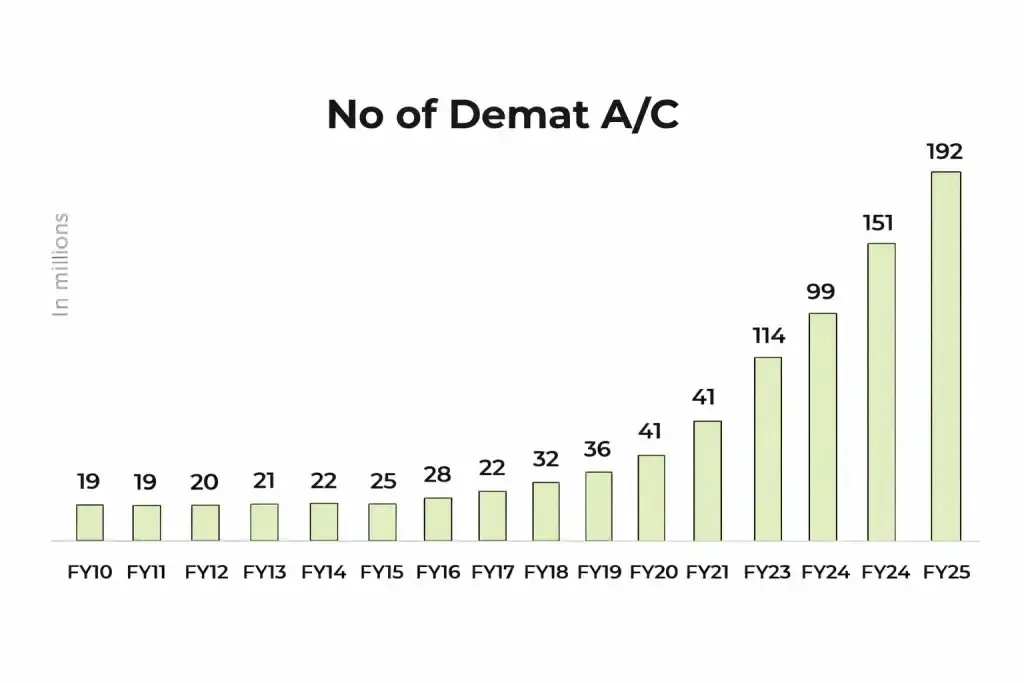
While this is a positive shift, many first-time investors enter the market without fully understanding how risk works at the portfolio level.
New investors often follow trends. When a sector performs well, capital rushes in. When markets fall, fear spreads just as quickly.
This behaviour frequently leads to portfolios becoming heavily concentrated in a few themes or scattered randomly without structure. In both cases, investors believe they are diversified—but are often not.
“In investing, emotions are expensive.” ~ Market Wisdom
Indian markets are influenced by external factors, including global interest rates, geopolitical events, liquidity cycles, and policy decisions made outside the country. An individual investor cannot predict these factors.
Risks can also impact the whole market simultaneously in a global downturn, policy shock, or crisis, where even a strong business can fall, and diversification will not work in preventing losses in a situation that is temporary in nature.
There are also company-specific or industry-specific risks, and the process of diversification protects against a bad decision, a failing business, or a downturn in a specific industry affecting the whole portfolio irreparably.
Indian investors have had a chance to witness for themselves the effects of the absence or presence of diversification.
2016 – Demonetization
The demonetization shock has had its strongest impact in the parts of the economy that were most heavily dependent on cash flow. The kiranas, small-scale wholesalers, transporters, real estate contractors, and small-scale manufacturing units were severely hit due to a lack of cash flow of cash.
At the same time, large-sized organizations, especially in FMCG, private sector banks, organized retail, and payment services, were more resilient to the shock, helping portfolios holding shares of such organizations stabilize sooner.
2018 – Small-Cap Crash
2020 – COVID-19 Crash
2022 – IT & Growth Stock Selloff
The core lesson is simple:
Diversification does not eliminate market falls.
It prevents one mistake, one sector, or one cycle from permanently damaging your capital.
New to investing? Read our beginner’s guide to Indian Stock Market Here: Link
In a market like India—where volatility, sentiment, and external shocks are unavoidable—diversification acts as a stabilising force. It does not remove uncertainty, but it helps ensure uncertainty does not turn into irreversible loss.
Key Factors That Influence Portfolio Diversification
Portfolio diversification does not work just because multiple stocks are added. It works when those stocks behave differently, are manageable, and are held with clarity. A few factors determine whether diversification actually protects a portfolio or only creates an illusion of safety.
Diminishing Risk Reduction:
The biggest benefit of diversification comes early.
Imagine carrying groceries home. Holding one heavy bag in one hand puts a lot of strain on that arm. Splitting the weight into two or three bags immediately makes it easier. But after a point, adding more bags does not reduce the load—it only makes walking more difficult or awkward.To see this in numbers: if you hold 1 stock, a single failure hits 100% of your portfolio. With 5 stocks, the impact of one failing drops to roughly 20%. Move to 10 stocks, and it falls to about 10%. Beyond 10–15 stocks, adding more reduces risk only slightly while increasing effort and complexity.
“Risk comes from not knowing what you’re doing.” – Warren Buffett
Diversification works in a similar way. Moving from one stock to a basket of say around ten to fifteen stocks significantly reduces the impact of a single company going wrong. Beyond that, adding more stocks increases complexity without offering the same level of risk reduction. The portfolio only becomes harder to manage, while the benefit becomes smaller.
Sector and Business Correlation
A good instance to think about is the use of umbrellas in stormy weather conditions. Having five umbrellas will not provide any security against the rain when all the umbrellas are kept in the same place, thus all blown by the wind.
Likewise, it applies to stocks too. Firms in similar sectors, or having similar business models, tend to have similar reactions to similar external shocks. In other words, an increase in interest rates may affect real estate developers, infrastructure firms, and over-leveraged NBFCs at the same time. Regulatory challenges may impact sectors as a whole, posing threats to entire sectors, such as telecom and pharma, while demand shocks may affect sectors such as discretionary, hospitality, and aviation at one time, irrespective of their underlying fundamentals.
In such situations, portfolios concentrated within one sector suffer across the board. But this could be cushioned by exposure to companies in unrelated businesses: FMCG, healthcare, utilities, and IT services. When one is suffering, another often remains stable or even benefits; this prevents the entire portfolio from moving in one direction.
True diversification, therefore, is all about holding stocks across businesses that would react differently to the same economic event, so that when one umbrella fails to protect you from the rains, the others do not get blown away with it.
“The stock market is filled with individuals who know the price of everything, but the value of nothing.” – Philip Fisher
Ability to Track and Review
“An investment in knowledge pays the best interest.” – Benjamin Franklin
Imagine trying to manage ten small shops versus managing fifty. As the number increases, attention gets divided, and small problems are easier to miss. Over time, a lack of monitoring can turn into a bigger risk than concentration itself.
The same applies to portfolios. When investors own more individual stocks than their practical ability to follow, diversification occurs randomly instead of purposefully.
Quarterly or semi-annual reviews can ensure that drift can be spotted and changes to a portfolio can be made before small issues become large ones.
If a portfolio cannot be examined in a calm and consistent manner, a number of decisions may end up being made in an emotional or delayed state.
Weight Allocation Matters
It would happen in a group assignment for the class, where most of the work would be done by one student, while others would not do much.
Similarly, if most of the money in the portfolio is sitting in a few stocks, the portfolio will be at the whim of those holdings. It balances out so that no single outcome overshadows the entire portfolio.
Time Horizon and Investor Behaviour
In the short-term, market trends can be very alluring to investors who feel that they should simply ride the trend by putting more money into what is going well and taking it away from that which is going poorly.
“Time is your friend; impulse is your enemy.” - John C. Bogle
A diversified portfolio can be managed throughout various periods without constant changes.
Once investors understand what affects diversification, a natural question follows:
How do you actually apply all of this in practice?
Knowing what affects diversification is useful, but applying it consistently requires a philosophy.
Why Diversification Needs a Philosophy, Not Just a Number?
Knowing that correlation matters, that too many stocks reduce focus, and that emotions distort decisions is useful. However, without a proper structure to follow, this information may stay abstract. For instance, investors are confronted with different decisions daily. For example, what to add to a portfolio, what to avoid when dealing with certain investments, or how to balance investments.
It is at this stage that the process of diversification ceases to relate to simply calculating stock quantities, and it truly begins to encompass elements of structured thinking.
Rather than relying on a fixed number or reacting to market noise, a philosophy helps bring consistency to how portfolios are built and reviewed across different market phases.
The SPRINT Investment Philosophy
SPRINT is not a portfolio-construction rulebook. It does not prescribe the number of stocks to hold, sector weights, or allocation limits. Instead, it serves as a stock-selection framework, designed to evaluate individual businesses across multiple dimensions of strength and risk. By doing so, it reduces the likelihood of choosing stocks that appear different on the surface but are exposed to similar underlying vulnerabilities.
In other words, SPRINT helps ensure that every stock entering the portfolio earns its place on merit. Diversification then becomes intentional, not accidental—because portfolio construction starts with businesses that differ meaningfully in their sources of return and risk.
With a philosophy like SPRINT guiding decisions, the next step is structuring the portfolio, that is, deciding how many stocks, which sectors, and which risks to balance.
Conceptual Framework — Thinking About How Many Stocks / Process
Core Holdings
It’s like the staple products of the street food vendor. A vada pav, samosa, or lassi vendor operates in a manner that focuses on a couple of staple products that can attract customers. These staple products are the core of the income generation process, just like core assets for the portfolio.
The number within this subset needs to remain small so that the clarity, focus, and conviction that investors possess can remain intact. This is where the principles in SPRINT, such as sustainable advantages and resilient growth, apply.
Supporting Holdings
Using our vendor's metaphor, this means adding seasonal or trendy offerings like jalebi in winter or juice in summer. They may not be drivers in terms of revenue generation, but they diversify without overburdening.
Supporting holdings assist in maintaining the portfolio in such a manner that it is not entirely dependent on a few investment projects, while still being capable of being managed conveniently through the portfolio.
Avoiding Extremes
- Too few stocks in one’s portfolio can result in concentration risk. One negative factor, in the form of regulatory changes, poor earnings, or management decisions, can negatively affect the portfolio.
- Having too many stocks could result in a loss of conviction and control over the portfolio. This is the case, since as the number of stocks increases beyond the capability for observation, the intention for portfolio diversification might be lost.
It’s like performing a juggling act. It’s simple to handle a couple of balls. But try to juggle too many, and it’s as if all balls start to fall. There’s a limit to how many projects or ideas one should have.
“Too many balls in the air” can refer to a situation that is just beyond an individual’s or a team’s control. It also defines Also, with the passage of time, the core, support, and extreme weights may shift based on market performance. It is essential to periodically review the portfolio to ensure that it is on course in terms of risk exposure.
Key Takeaway
Portfolio management is not merely stock counting. It is all about achieving the right mix of stability, managing your assets, and adopting an investment philosophy for all of your decisions.
Even for a disciplined method such as SPRINT, investors can look beyond numbers to processes that ensure diversification functions as designed: to provide downside risk protection while preserving long-term value.
But, in fact, knowing the structure is one thing, and knowing who really benefits from this structure is quite another.
Who This Approach Is Relevant For
Nevertheless, it may not be the best for a short-term trader or investor who tries to remain mostly passive in all aspects. Diversification works best when it is followed and understood-just holding a bunch of stocks without any idea doesn't even reduce the risk.
Real-world market upsets keep on proving the fact that there is meaningful difference created in a disciplined framework under such high emotional points.
When Markets Tested Diversification
- COVID-19 — Pharma & FMCG as Shock Absorbers
Since the outbreak of the global pandemic – COVID-19, market volatilities have been extreme. While some segments have been less volatile – Pharma & FMCG, they have been generating demand irrespective of the environment. Segments including Travel, Hotel, Real Estate, witnessed a drastic downfall in stock prices.For investors whose portfolios included diversification across these industries—converting a stable and resilient portfolio sector and a differential or cyclical sector together—losses and levels of distress were reduced. The resilient sectors in their portfolios served as a buffer, and their other sectors enabled them to gain if markets turned around.
As a takeaway from this, it can be said that by diversifying investments, risks can be minimized but not negated.
- Sector Concentration — The Risk of Being Overexposed
Diversification is important not only during market crashes but even when markets appear stable. The Indian IT sector is a good example. For many years, IT stocks performed well and became a key driver of market returns. This led many investors to put a large part of their money into IT, believing it to be a “safe” sector.However, even strong sectors go through weak phases. The IT sector has faced periods of poor performance due to slower global demand, changes in currency movements, rising competition, and regulatory challenges. During such times, investors with heavy exposure to IT saw their portfolios underperform, even though the broader market did not fall sharply.
At the same time, sectors like pharmaceuticals, FMCG, and other essential services often remained relatively stable because their demand comes largely from everyday consumption. Investors who were spread across multiple sectors were better protected from losses in any one sector.
This shows the risk of putting too much money into a single sector. Diversification across sectors helps ensure that poor performance in one area does not drag down the entire portfolio.
Using a core–support–extremes approach makes this easier. Stable sectors form the core, growing sectors act as support, and high-risk ideas are kept limited. This allows investors to benefit from growth without becoming overly dependent on any one sector.
- Behavioural- Emotional Bias in Action
Now let’s look at how behaviour impacts outcomes, even when a portfolio seems diversified on paper.
Consider two investors during a market upswing:
Investor A: holds many stocks but picks them impulsively—following tips, media hype, or peer recommendations. During market dips, they panic-sell the few stocks that decline, or chase rising ones. Despite owning a “diversified” portfolio, poor behaviour erodes the intended protection.
Investor B: holds fewer, well-understood stocks and applies a framework to select core and supporting holdings. They have confidence in their choices and do not react emotionally to temporary declines.
Even if both portfolios initially look similar in numbers, Investor B experiences less stress, maintains discipline, and avoids costly mistakes.
This shows that diversification is both structural and behavioural. Having an investment philosophy and a clear framework of core/support/avoiding extremes reduces emotional mistakes and ensures portfolios remain robust.
What Diversification Did NOT Protect You From
For instance, during the Global Financial Crisis in 2008, almost all markets fell sharply – banks, property, and industrial firms included in a well-diversified portfolio. This highlights that a diversification strategy cannot protect a portfolio from losses when a particular event shakes a whole market.
This shows that diversification cannot stop losses caused by events that affect the entire market.
Its real benefit lies in protecting you from one big mistake or one struggling company, not from crashes that hit all assets at once.
To understand how to rebalance a portfolio during such periods, read this article:
Link: What is Rebalancing? Why and When You Should Adjust Your Portfolio
A Simple Checklist for a Well-Diversified Portfolio
A diversified portfolio doesn’t need to be complex—it needs to be clear.
A diversified portfolio should:
- Not depend on a single stock for survival
No one company’s failure should be capable of permanently damaging your capital. - Not be concentrated in one sector or theme
If one sector struggles, the entire portfolio should not fall apart. - Contain businesses that behave differently in the same environment
Some holdings should perform better in slowdowns, others in growth phases. - Have enough stocks to track calmly and regularly
If you can’t explain why you own a stock—or review it periodically—it adds risk, not safety. - Have sensible weight allocation
Your largest holdings should reflect your highest conviction, not accidental price movement. - Allow you to stay invested during volatility
If market swings force panic decisions, the portfolio structure needs rethinking. - Be built with a process, not emotions
Diversification should be planned when markets are calm—not rushed during fear or euphoria.
If your portfolio checks most of these boxes, diversification is working as intended.
If it doesn’t, adding more stocks won’t fix the problem—better structure will.
Even with careful structuring, investors often slip into predictable mistakes. Avoiding these mistakes and sticking to a clear, disciplined process is what turns diversification into a real risk-management edge.
Common Diversification Mistakes
Even the most well-intentioned investors can make mistakes that reduce the protective power of diversification. Some of the most frequent pitfalls include:
1. Confusing Quantity with Safety
Owning many stocks doesn’t automatically make a portfolio safe. For instance, holding 20 stocks all in IT or banking is not true diversification—if that sector dips, the portfolio still suffers. True diversification comes from spreading risk across different businesses, sectors, and dynamics.2. Over- or Under-Diversification
Some investors go to extremes: too few stocks create concentration risk, while too many make the portfolio hard to manage and reduce conviction. Both can hurt outcomes, even if the intention was to “spread risk.”3. Ignoring Sector and Business Correlation
Diversification only works when investments behave differently. Holding multiple stocks that react similarly to interest rates, demand shifts, or regulations gives a false sense of security. Without considering correlation, you might think you’re diversified—but you’re really just exposing yourself to the same risks under different names.4. Emotions Driving Decisions
Fear and greed often distort diversification. Panic-buying to “diversify” when markets fall or chasing trending stocks inflates correlation and weakens risk protection. Emotional decisions turn a carefully planned portfolio into an accidental one.5. Neglecting Portfolio Weights
It’s not just about the number of stocks—how much capital is allocated matters as well. A portfolio of 15 stocks where 70% of money sits in a single holding is far riskier than a smaller, well-weighted portfolio.6. Overlapping Exposure
Investors sometimes hold multiple mutual funds or ETFs along with individual stocks that target the same sectors. This creates overlapping exposure, reducing the benefits of diversification while making monitoring more complex.“Diversification is protection against ignorance. It makes little sense if you know what you are doing.” – Warren Buffett
Read more about common investor mistakes here: Link
Conclusion – Diversification as Your Risk Management Edge
Read our “how to build a diversified portfolio with 5000Rs” Here: LINK
If this breakdown helped you recognise patterns you’ve seen or experienced in real markets, comment “DIVERSIFY” below. Like the article to support research-driven investing, share it with friends who are building their portfolios, and comment with one lesson you’ve learned about managing risk.
The strongest investing advantage often comes not from doing more—but from avoiding the same mistakes consistently, and structuring your portfolio in a way that protects against downside while allowing growth.
Diversification isn’t about magic numbers—it’s about process, balance, and discipline.
Explore our Products
Research Framework

Emerging Titans
Combination of quantitative analysis, industry tailwinds, and management assessment - SPRINT investment philosophy

Tiny Titans
Heavy emphasis on scuttlebutt research, plant visits, and early on-ground signals
FAQs ( Frequently Asked Questions )
1. How many stocks should an investor ideally hold in a diversified portfolio?
+There is no universal “perfect number.” The right number depends on how well an investor can understand, track, and review their holdings. For most long-term investors, holding a manageable mix of core and supporting stocks—rather than chasing a fixed count—leads to better risk control.
Is holding more stocks always safer?
+No. Holding more stocks does not automatically reduce risk. If most of those stocks belong to the same sector or react similarly to market events, the portfolio remains exposed to the same risks. In fact, owning too many stocks can make them difficult to track, increasing the chances of missed warning signs and delayed decisions. Diversification works when holdings behave differently—not simply when their number increases.
What is the difference between over-diversification and under-diversification?
Under-diversification occurs when too much money is concentrated in a few stocks or sectors, increasing vulnerability to specific risks.
Over-diversification happens when an investor owns more stocks than they can realistically monitor, leading to loss of conviction, weak oversight, and accidental exposure.
Why does sector diversification matter so much?
Different sectors respond differently to economic conditions, interest rates, and demand cycles. When a portfolio is heavily concentrated in one sector—such as IT, banking, or real estate—a prolonged downturn in that sector can dominate overall returns. Sector diversification helps prevent one weak area from pulling down the entire portfolio.
Can diversification protect against market crashes?
+Diversification cannot eliminate market-wide risks such as global crises or recessions. However, it can reduce company-specific and sector-specific risks, limiting the extent of damage and helping investors stay invested during volatile periods.
How often should a diversified portfolio be reviewed?
+A periodic review—typically quarterly or semi-annually—is sufficient for most long-term investors. The goal is not frequent trading, but ensuring allocations haven’t drifted, risks haven’t become concentrated, and the portfolio still aligns with the original strategy.

High growth stock specialist, Value Educator
Shashank Mahajan is an equity research professional with over 12 years of experience in identifying high-potential SME and micro-cap stocks at an early stage. He follows a rigorous scuttlebutt research–driven approach, combining on-ground insights with deep financial analysis. Shashank specializes in uncovering under-researched and under-owned companies with strong management quality and long-term growth potential. Through disciplined research and early identification, he focuses on spotting tomorrow’s market leaders before they enter the mainstream investor radar.

Zen Technologies: Why Revenue Fell After Its Biggest Win

Data Patterns: India's Radar Designer and Its Waiting Orders

KSH International: The Wire Inside India's Transformers

Krishna Defence: The Steel Behind India's Warship Hulls

PNG Jewellers: A 194-Year-Old Name Goes National

Axiscades: From Services to Missile and Radar Electronics
Explore our Products
Research Framework
Emerging Titans
Combination of quantitative analysis, industry tailwinds, and management assessment - SPRINT investment philosophy
Tiny Titans
Heavy emphasis on scuttlebutt research, plant visits, and early on-ground signals


 Orders
 Subscription
 Share with friends
 Logout


Required Details
₹23999.00
(12 month subscription)
As per SEBI regulations, all users are mandated to complete the KYC that is validated for 1 year. Post payment, you will be redirected to the KYC screen


No comments yet. Be the first to comment!