
Ador Welding: India's First Welding Maker and Its FY29 Goal

Every ship hull, bridge girder, pipeline and boiler is held together by thousands of welds. A weld is made by melting metal at a joint and adding filler metal, so that two pieces of steel become one. A welding consumable is the product that supplies this filler metal, and it is used up as the welder works. The heat comes from a welding machine, which is known in the trade as a power source.
The most common consumable is the electrode, a coated metal rod that melts into the joint as the arc burns. Factories that weld all day often use a flux cored wire instead, which is a thin tube of metal filled with powder that feeds from a reel. Heavy jobs, such as thick steel plates for ships and pressure vessels, use submerged arc welding, which is a method where the arc burns under a layer of granular flux. All three are sold by the tonne, and all three move with how much steel the country cuts and joins.
One Indian company has made these products since 1951, when it started as a joint venture with Oerlikon Buhrle of Switzerland. It calls itself India's first welding manufacturer. Today it has a yearly capacity of 90,000 MT of welding consumables and 30,000 welding power sources, and it serves 31,235 pin codes in India and more than 15 countries.
That company is Ador Welding Ltd (NSE: ADOR). It makes consumables in Raipur, Silvassa and Bengaluru, and welding machines and automation systems in Pune. Since the merger of Ador Fontech's business in 2024, it also runs a repair business from Nagpur. Maintenance and repair here means special alloys, wear parts and services that rebuild worn parts in plants such as cement and steel. In FY26, welding consumables made up about 75% of its turnover and welding equipment about 20%.

So Ador sits at a simple point in the industrial chain. It buys steel, alloys and chemicals, turns them into the consumables and machines that fabricators use, and sells them through dealers and directly to large buyers in infrastructure, power, oil and gas, railways, shipbuilding and defence.
Ador Welding in five numbers
- Q2 FY27 revenue of ₹344.7 Cr, up 22.6%
- H1 FY27 revenue of ₹654.2 Cr, up 22.8%
- A gross margin of 34.2% in Q2 FY27, against 38.6% a year ago
- An EBITDA margin of 10.9%, against management's aim of 12% to 13%
- A target of more than ₹2,000 Cr of revenue by FY29, against ₹1,140.0 Cr in FY26
So a 75-year-old company that grew only 1.5% in FY26 is now growing at more than 20% a year. But in the same half year, the cost of steel rose faster than its prices. How did that show up in the numbers? Let's first understand the company, and then look at the latest quarter.
Ador Welding: Company Overview
Ador Welding Ltd was incorporated in 1951 as a joint venture with Oerlikon Buhrle of Switzerland, and was known as Advani-Oerlikon until 2003. It is based at Ador House in Fort, Mumbai. Ninotchka Malkani Nagpal is the Executive Chairman and Aditya Malkani the Managing Director and CEO, and the promoters held 53.76% in March 2026. The company makes welding consumables, welding and cutting equipment, maintenance and repair products and welding automation systems in five plants at Raipur, Silvassa, Bengaluru, Pune and Nagpur, and sells abroad through a Dubai office. It had 839 permanent employees in March 2026. Revenue from operations was ₹1,140.0 Cr in FY26, the company was net debt-free in March 2026, and in September 2026 it held cash, bank balances and current investments of about ₹119.6 Cr against borrowings of ₹27.7 Cr. Read this 5 Steel Stocks Riding India's Infra Push
"The stock market is filled with individuals who know the price of everything, but the value of nothing."
— Philip Fisher
An electrode looks like a simple steel rod, but the value of Ador's lies in the approvals, the reach and the support behind it. Knowing which product line brings in the revenue is the first step to reading its results.
The Quarter Revenue Grew 22.6% and the Margin Fell
Let's look at Q2 FY27, the July to September quarter that the company reported on 21 October 2026. Consolidated revenue from operations was ₹344.7 Cr, up 22.6% from ₹281.1 Cr a year ago. It was also about 11.4% higher than the ₹309.5 Cr of Q1 FY27.
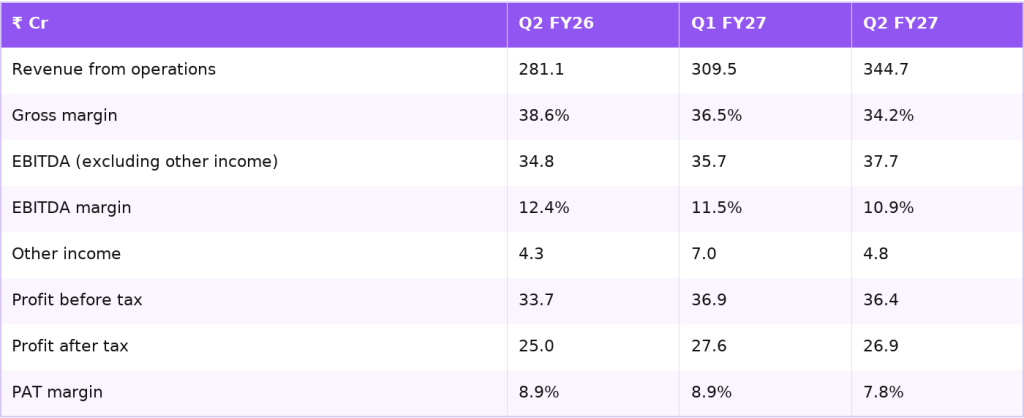
As we can see, the revenue line and the margin line moved in opposite directions. Management says the demand came from infrastructure, power, oil and gas, railways, shipbuilding, defence and heavy fabrication. It put volume growth in the quarter at about the mid-teens, so most of the 22.6% came from selling more, and the rest from higher prices.
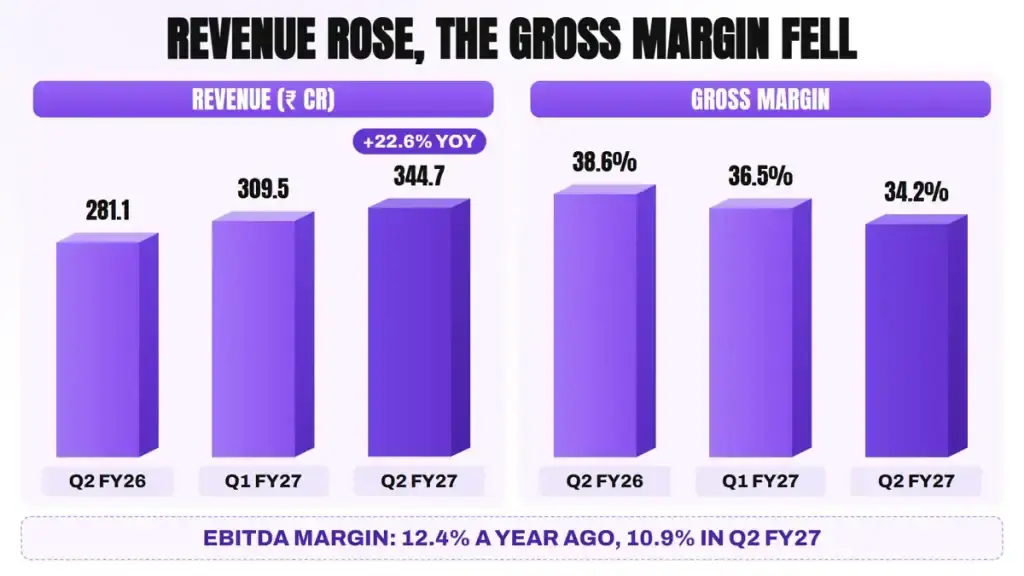
That higher price did not keep up with costs. The gross margin, the share of revenue left after raw materials, fell to 34.2% from 38.6% a year ago. Management says about 80% of that fall came from cost inflation, mostly steel, and the rest from its push for growth, including exports, where the product mix carries a lower margin. It put the rise in steel prices from Q1 to Q2 at about 7% to 8%, and says copper, electronic parts and freight also cost more.
That pressure shows lower down too. EBITDA is the profit before interest, tax, depreciation and amortisation, and the company reports it excluding other income, so it shows what the plants and the sales teams earn. It was about ₹38 Cr, up 8.6%, much slower than revenue. Read this EBITDA Explained: Uses and Limits The margin was 10.9%, against about 12.4% a year ago. Profit after tax rose 7.7% to ₹26.9 Cr. Management says it has raised prices in line with steel, but with a lag, and that the price increases were passed on later than it wanted in Q2.
"The single most important decision in evaluating a business is pricing power."
— Warren Buffett
For Ador, pricing power shows up in how fast it can pass on a rise in steel. Q2 FY27 showed a lag; the next two quarters will show whether its prices catch up.
That pressure looks smaller in the first half, because of a one-time charge a year ago. H1 FY27 revenue was ₹654.2 Cr, up 22.8%, with an EBITDA margin of 11.2%. Profit after tax was ₹54.5 Cr, up 159.0% from ₹21.1 Cr. H1 FY26 carried a ₹27.9 Cr charge for cost overruns and possible penalties on a delayed project, which we will come back to.
That first half also moved working capital the wrong way. Inventory rose to ₹177.1 Cr in September 2026 from ₹151.9 Cr in March, and trade payables fell to ₹145.5 Cr from ₹193.7 Cr. Management says 75% to 80% of the higher inventory is for orders it has to deliver, and the rest is steel bought early because supply was tight. So operating cash flow for the half was negative, at about ₹8.5 Cr, against ₹115.9 Cr of inflow in all of FY26. Read this Cash Flow Statement Explained
That cash gap was small for this balance sheet. Short-term borrowings rose to ₹27.7 Cr from ₹0.3 Cr, which management says is mostly linked to letters of credit and bank guarantees. Against that, the company held cash of ₹20.4 Cr, bank balances of ₹54.3 Cr and current investments of ₹44.9 Cr. To mark its 75th year, the board declared an interim dividend of ₹7.50 a share.
What the quarter says: demand is strong enough to lift revenue by 22.6%, but the gross margin of 34.2% is the lowest of the last three quarters. The next two quarters will show whether the price increases catch up with steel.
One old matter also closed in the quarter. In June 2023, the Bureau of Indian Standards had allowed Ador to settle an alleged breach of the BIS Act, about flux cored welding wire held without a valid licence, for ₹36.43 Cr, an amount the company called unfair and took to court. On 13 October 2026 a Bhiwandi court disposed of the case with a fine of ₹34 lakh, which Ador paid the same day. So a contingent claim of ₹36.43 Cr in the March 2026 accounts has ended for a small fraction of it.
That question of prices and costs matters more for Ador than for many capital goods makers, because it does not work from a large order book. Management says its orders turn over quickly, and it does not share an order book number. So each quarter's revenue depends on demand in that quarter, and each quarter's margin depends on how fast prices follow costs.
How a 1951 Joint Venture Became Ador Welding
Now that we have seen the quarter, let's go back to see how the business was built. It began in 1951 as a joint venture with Oerlikon Buhrle, and was known as Advani-Oerlikon until 2003. It set up its first electrode plant at Bhandup in Mumbai in 1952. The Raipur electrode plant and the Pune equipment plant began production in 1962-63, and exports to the Middle East, Africa and Southeast Asia started in 1967.
That core then grew into a group. Ador Fontech was set up in 1974 for repair and wear products. The welding company listed on the Bombay Stock Exchange in 1986 and on the NSE in 1995, the same year Ador Powertron was demerged. The Bengaluru plant came in 1992 and the Silvassa plant in 2004, and the international business moved to Dubai in 2022.
Then came the latest step for that group, a merger. The Ador Fontech maintenance and repair business was merged into Ador Welding in September 2024, which is why the reported figures jump between FY23 and FY24. Ninotchka Malkani Nagpal is the Executive Chairman and Aditya Malkani the Managing Director and CEO, and the promoters held 53.76% in March 2026.
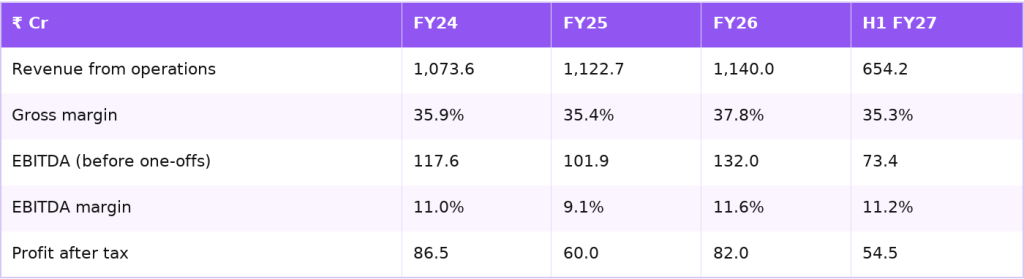
Before the merger, the welding business alone was smaller. Revenue was about ₹661.5 Cr in FY22 and ₹776.8 Cr in FY23, and its EBITDA margin rose from about 8.8% to about 11.2% in those two years. The merger then added the repair business and the flares projects, so FY24 revenue on the merged basis was ₹1,073.6 Cr.
If we look at those numbers together, we can see why the merger made the company look bigger without making it grow faster. That table shows the problem this management set out to fix. On a merged basis, revenue grew only about 6.2% in two years, from ₹1,073.6 Cr in FY24 to ₹1,140.0 Cr in FY26. Exports were flat at ₹150.95 Cr in FY26, against ₹153.35 Cr a year earlier. Management says capital spending in the economy picked up more slowly than it had hoped in FY26.

Those two years also carried one costly project. In FY23, the flares and process equipment team took on a large turnkey job for ONGC at Uran, due for completion by June 2025. Management says it took the order on purpose, to see if the team could handle larger jobs. The project ran late, and in FY26 the company set aside ₹9.8 Cr for cost overruns and ₹15.0 Cr for possible liquidated damages, the penalties a customer can charge for late delivery. A variation order of ₹3.1 Cr in the March 2026 quarter reversed part of the overrun provision.
Still, the margin did improve in FY26, to 11.6% before one-offs, from 9.1% in FY25. That came from a better gross margin, 37.8% against 35.4%. But FY26 also carried two one-time items that cancel out in part: a ₹24.8 Cr provision on the delayed project, and a ₹14.1 Cr gain from recovering an old receivable on a Kuwait project from FY21. So FY26 profit after tax of ₹82.0 Cr is close to what the business earned on its own.
"It has to be between 12%-13% level. I keep saying that, I've no problem in saying that." - Aditya Malkani, Managing Director and CEO, October 2026
Consumables, Equipment, Repair and Automation
Now let's split the business into its parts: consumables, equipment, repair and automation. Ador reports one segment, welding and related products and services. But it sells four kinds of products, and each one wins business in a different way.

As you can see, these lines share one customer base, the people who cut and join metal. As you will see, consumables bring the volume, equipment brings the technology, and repair brings the higher margin.
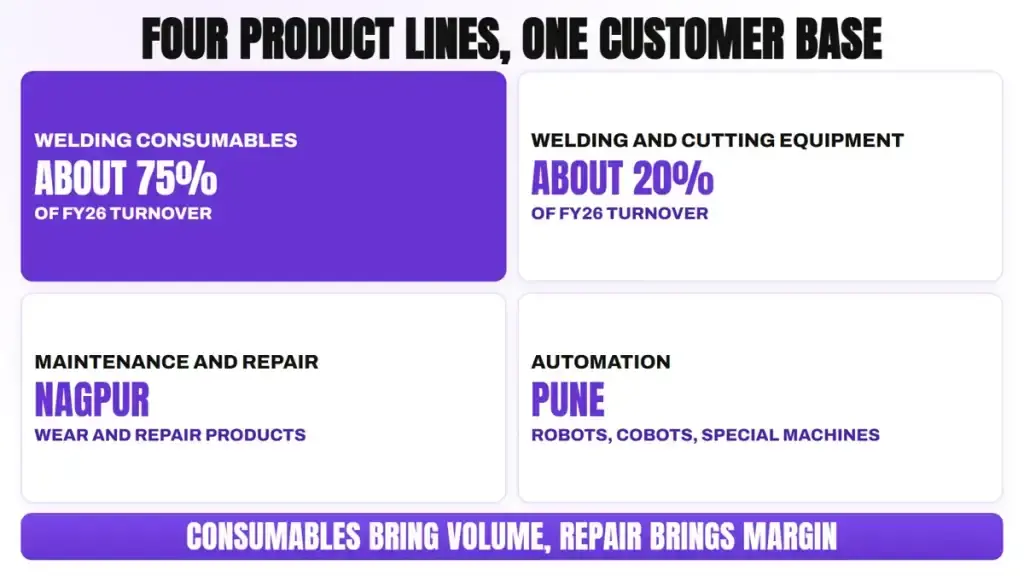
Welding Consumables, About 75% of Turnover
Let's start with consumables, the largest line. Ador makes stick electrodes, filler metals and submerged arc fluxes in three plants with a total capacity of 90,000 MT a year. Management says it has a couple of thousand products in this range, and that it holds about 17% to 18% of the market on its own way of measuring it.
That range is where most of the growth plan sits. In consumables, management wants to move to more specialised steels and to win stronger approvals in shipbuilding and oil and gas. It has added NPCIL-approved products for nuclear use, and is widening its range of high-alloy and nickel-based products for critical welds. A new consumables line is being built under the capex plan.
Those products do not all compete in the same way. Management says each product faces Tier 1, Tier 2 and Tier 3 makers, and each buyer has Tier 1, Tier 2 or Tier 3 approval needs for its own process. Ador wants a larger share of the Tier 1 work, where an approval is needed and a cheap local electrode is not an option.
That line also feels steel prices first. Management says demand for consumables simply follows steel consumption, so if India keeps using more steel in its industries, welding consumables should grow with it. The same steel is also its largest raw material.
Welding and Cutting Equipment, About 20% of Turnover
Next, let's look at equipment. Ador makes arc welding machines from 200 to 1,200 amps in Pune, along with diesel engine welding generators, motor generator welders and a battery-operated welder. Its RHINO-E was recognised as India's first 200A battery-operated welding machine.
That line leans on partners for the high end. Ador is the master distributor in India for Hypertherm's air plasma cutting systems. It works with ITW Welding India to bring Miller's submerged arc and high-amp MIG products to India, and with Liburdi Dimetrics for orbital welding systems used in power, nuclear, oil and gas and shipbuilding. Management says equipment sales tend to rise when the capex cycle picks up.
Maintenance and Repair, the Old Ador Fontech
Now let's move to the repair business that came in with the merger. It sells wear-resistant products, cobalt and nickel alloys, reclamation services and wear parts to plants that grind, crush and heat things, such as cement, steel, mining, power and sugar.
That business grows more slowly, but it matters for profit. Management says this line is smaller, with slightly higher margins, and that it can grow at about 8% to 12% a year by adding products and services, not 20%. Some fabrication products that sat in Ador Fontech have been moved into the main welding business.
Automation and the Old Flares Business
Finally, let's look at two smaller lines. Automation covers robotic welding systems, the Axbot 101 cobot, the Ador Xlogic welding cell and special-purpose machines. Management calls it a priority because labour costs are rising and skilled welders are short, and it is looking at acquisitions in this area, though it says the pool of targets is small.
Unlike automation, the flares and process equipment business went the other way. It brought in ₹56.7 Cr in FY26, and from April 2026 it is no longer a separate division. Management now treats it as a product line of about ₹20 Cr to ₹30 Cr, and says it no longer takes on large projects.
Where Ador Sits in India's Capex Chain
Now let's place Ador in the wider chain, because that is where we can see what drives its demand. Steel makers sell plates, pipes and sections. Fabricators then cut and weld them into ships, bridges, boilers, pipelines, rail coaches and factory structures. Ador sells to the fabricators, so its demand follows the projects that use steel, not one single sector.
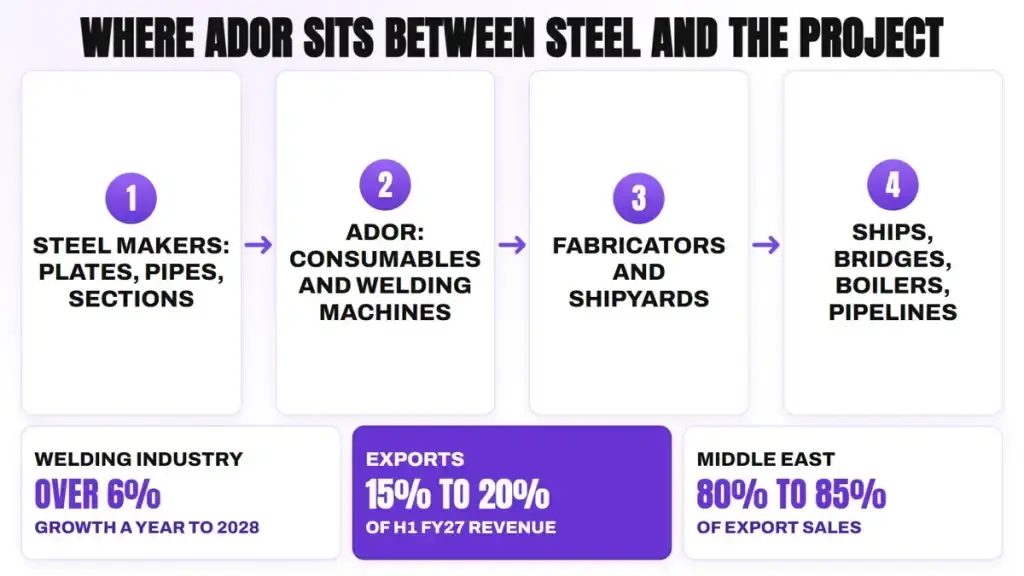
That chain is growing at a steady pace. The welding industry in India is projected to grow at more than 6% a year up to 2028, driven by infrastructure, urbanisation and manufacturing. Management names renewable energy, defence, infrastructure and shipbuilding as the segments where it sees double-digit growth for the coming decade and where its share is still low.
Those segments all need approved welds. Nuclear plants, refineries, power stations and warships each set their own tests for welding products, and management has said it is adding approvals in nuclear, thermal power and defence, where it expects spending over the coming years. Its NPCIL-approved products for nuclear use are one example.
Shipbuilding is the clearest example. Management says there is a lot of work going on in Indian shipyards, that Ador is seeing some benefit, and that it has had inquiries. It did not give any order or revenue number, and calls shipbuilding still small compared to the opportunity.
Beyond India, exports add a second market. Ador International in Dubai serves more than 15 countries, and the Middle East makes up about 80% to 85% of export sales. It has approvals from ADNOC in Abu Dhabi, PDO in Oman, Aramco in Saudi Arabia and QE in Qatar. In H1 FY27, exports were 15% to 20% of revenue, at the upper part of that range. The company is now in two European markets and is entering a third, and it has started selling in the US and Australia.
That export business runs from one office in Dubai's Jebel Ali Free Zone with a team of 15. It sells to farm equipment makers, oil and gas fabricators, cross-country pipeline builders, shipyards and overlay cladding shops. Exports were ₹150.95 Cr in FY26, about 13.2% of revenue, so the move to the upper part of 15% to 20% in H1 FY27 means exports grew faster than the business in India. Management says it is willing to take a slightly lower margin on some export products to build the brand abroad.
Why Ador's Moat Is Hard to Copy
Now that we have seen the parts, let's understand the moat, because it tells us whether Ador can hold its prices when steel moves. An electrode looks like a simple steel rod. Small local makers sell cheap ones in every industrial town. So the question is why a shipyard or a refinery should pay more for Ador's. Read this Economic Moat Explained
That answer starts with approvals. A weld on a pressure vessel, a ship hull or a nuclear part has to pass tests, so the buyer only uses consumables that are approved for that job. Ador has NPCIL approvals for nuclear work and approvals from Gulf oil companies, and its products are certified by international inspection agencies. Each approval takes time to win, and a buyer rarely switches once a product is approved.
Another layer is reach. Ador serves 31,235 pin codes in India through a large dealer network, and 15 more countries through Dubai. A new maker would need years to build that kind of shelf space, and the technical support that goes with it.
"Know what you own, and know why you own it."
— Peter Lynch
With Ador, knowing what you own means knowing that most of its revenue is consumables tied to steel use, and that its edge comes from approvals and reach rather than from a unique product.
Beyond approvals and reach, there is research. Ador's R&D centre is recognised by the Government of India, its laboratory is accredited under ISO 17025, and it has a team of 38 researchers. Management says Ador makes most of its equipment in India, rather than sourcing it from other countries.
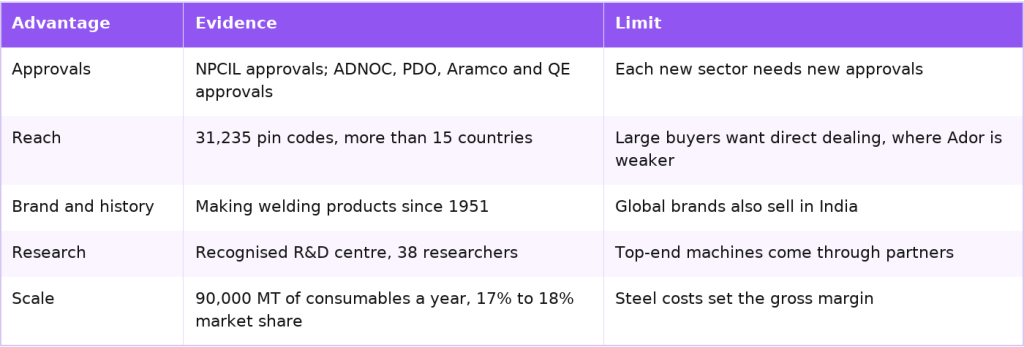
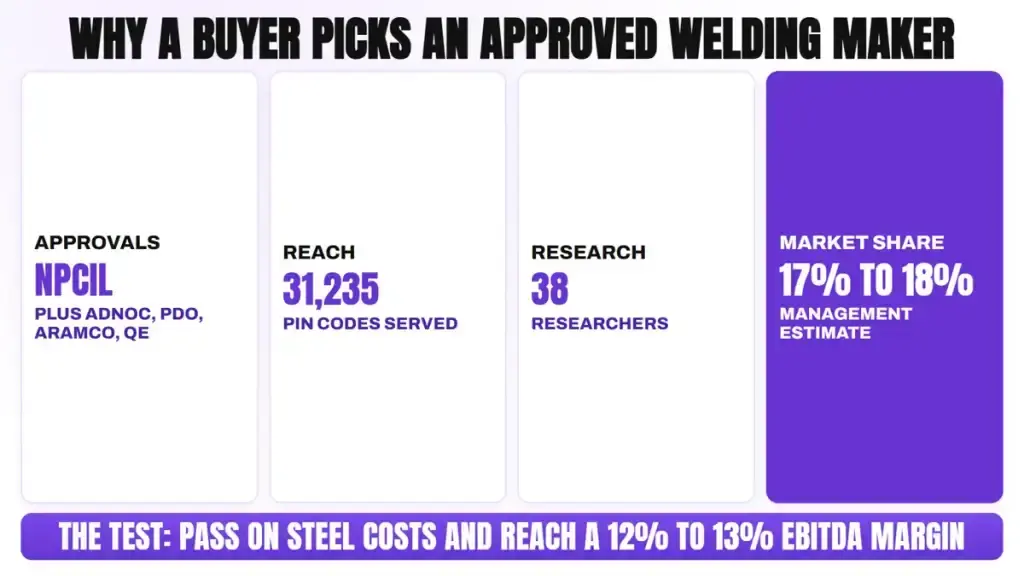
That moat shows up in the returns. Management put return on capital employed at about 23% in FY26, on a business that was net debt-free in March 2026. For a maker of products that look simple, that return suggests buyers pay for the brand, the approvals and the support.
That table shows where the moat is thin. Management says welding is a more competitive field than many industries, so prices cannot go up overnight when steel does. And it admits that Ador has not been strong enough with the top 50 to 100 steel users who want to deal directly. That is why it has hired senior people from other industries and multinationals over the past two years.
Those hires also come with a pay plan tied to results. About 50 people, mostly senior managers, are part of an employee stock option plan that started a little over a year ago, and management says its incentives are linked to profitability across the company. The company had 839 permanent employees in March 2026.
"Ours is very engineering-centric. We work in oil & gas. We work on shipbuilding." - Aditya Malkani, Managing Director and CEO, October 2026
Financials: Five Years of Revenue, Margins and Cash Flow
One quarter can mislead when steel prices move fast, so let's look at the full years together. FY22 and FY23 are the welding business alone, before the Ador Fontech merger; FY24 onwards are on the merged basis. EBITDA excludes other income and the one-time items of FY26, and the first half of FY27 is shown for comparison.

The jump between FY23 and FY24 comes mostly from the merger. On the merged basis, revenue grew about 6.2% in two years, from ₹1,073.6 Cr in FY24 to ₹1,140.0 Cr in FY26, while the EBITDA margin moved between 9.1% and 11.6%. The first half of FY27 is the first period of fast growth on the larger base.
Cash flow has kept up with profit over the five years. From FY22 to FY26, operating cash flow added up to about ₹351.4 Cr, against about ₹332.8 Cr of profit after tax, or about 106%. It was weak in FY23 and FY24, when inventory and receivables grew, and strong in FY25 and FY26. The working capital cycle was 93 days in FY26, against 89 days in FY25.
The balance sheet carries little debt. The company was net debt-free in March 2026, and in September 2026 its borrowings of ₹27.7 Cr were small against equity of ₹569.6 Cr. The negative operating cash flow of the first half, after inventory rose to ₹177.1 Cr, is the number to check in the second half.
"Accounting is the language of business."
— Warren Buffett
Ador's income statement shows a business growing again after two slow years. Its cash flow statement shows how much of that growth is still sitting in inventory, and both need to be read together.
What FY29 Could Look Like on Management's Numbers
So where does the business go from here? In May 2025, after the merger, the company set a target of revenue above ₹2,000 Cr by FY29. In May 2026 management said the main principle behind it is to triple earnings over that period. In October 2026 it said it is fairly on track.
Now let's put that target against the numbers. FY26 revenue was ₹1,140.0 Cr. That leaves a gap of about ₹860 Cr, and reaching ₹2,000 Cr by FY29 needs growth of about 20.6% a year for three years. That is close to the 22.8% of H1 FY27, but far above the 1.5% of FY26. Management says 60% to 70% of the extra growth has to come from product mix, meaning the right products sold to the right customers, and about 20% to 25% from new equipment, partnerships and automation.
That mix has three parts in practice. One is selling more specialised consumables, such as stainless steel, nickel-based and flux cored products, which earn more per tonne. Another is selling more advanced welding machines, including digital and automation-ready models. The last is selling directly to the largest steel users, where Ador says it has filled most of its product gaps over the last two to three years and now has to win the orders.
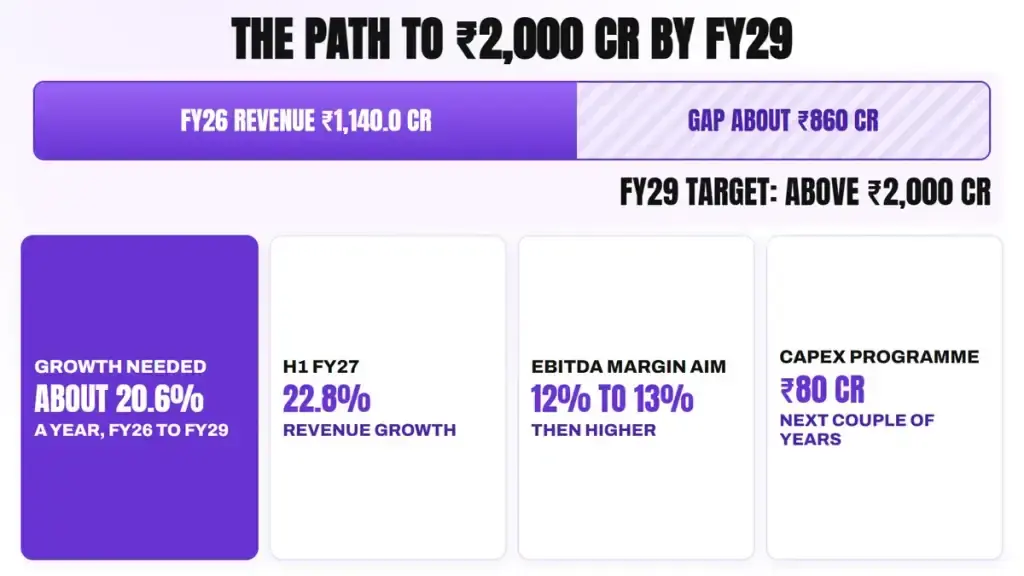
That growth would also need more plant. Asked what it would take to double volumes over five to seven years, management put the capex for plant and machinery at about ₹100 Cr to ₹150 Cr, not counting land. That is small against the ₹569.6 Cr of equity the company had in September 2026.
Beyond revenue, margins have their own aim. Management wants an EBITDA margin of 12% to 13%, and then to push it higher, with a gross margin of at least 36% to 38%. Its plants run at about 70% on average, but some lines run at 90% to 95%, so it needs new lines. In July 2026 it set out an ₹80 Cr modernisation and expansion capex programme over the next couple of years, to be funded without extra debt. It puts normal capex at about ₹35 Cr to ₹40 Cr a year, rising to about ₹60 Cr to ₹70 Cr for one or two years.
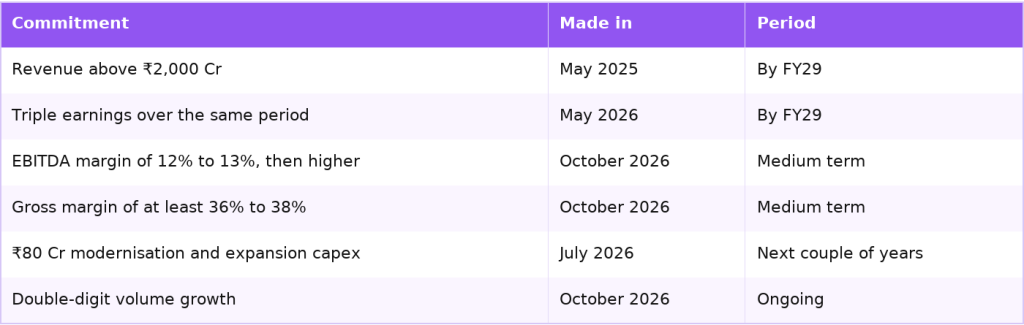
We think those commitments are easier to judge against the past, so you can see how close management has come to its own words. So let's check what management said before against what it delivered.

That record shows us a clear pattern. Revenue has come back faster than many expected in the first half of FY27. The margin promise is the one still waiting, and steel prices have made it harder. That makes the gross margin in the next two quarters the number to watch.
Key Risks
Now let's look at what could go wrong for Ador, because the latest quarter has already shown some of these risks.
- Steel prices and pass-through: steel is the largest raw material, and management does not see steel prices softening soon. Price increases reach customers with a lag, which is why the gross margin fell to 34.2% in Q2 FY27.
- Margin target slipping: the EBITDA margin was 10.9% in Q2 FY27, against the 12% to 13% management aims for. If price increases keep lagging costs, the ₹2,000 Cr revenue target could come with a thinner profit.
- Working capital: operating cash flow was negative at about ₹8.5 Cr in H1 FY27, as inventory rose to ₹177.1 Cr and payables fell. Short-term borrowings rose to ₹27.7 Cr.
- The Uran project: the company has provided ₹15.0 Cr for possible liquidated damages on the delayed project, and its results notes say it is still working to limit the cost overruns and the delay.
- Tax and duty disputes: in March 2026 the company had disputed income tax of about ₹15.8 Cr, excise duty of about ₹9.4 Cr and sales tax of about ₹6.6 Cr under appeal, not provided for. Management says it has appealed an income tax demand of about ₹14 Cr and does not see merit in it.
- Middle East dependence: the Middle East makes up about 80% to 85% of export sales, and management says it is watching developments in the region closely.
- Competition: welding is a competitive field, with local makers in basic products and global brands in high-end machines. Management says Ador is still under-represented with the largest steel users.
- Acquisitions and capex: management is looking at acquisitions in automation and plans an ₹80 Cr capex programme. In FY26 it wrote down ₹5.56 Cr lent to its small subsidiary, 3D Future Technologies.
"We have to keep in mind the last 3-4 months have been very unprecedentedly sporadic in terms of the rise." - Aditya Malkani, Managing Director and CEO, October 2026
"The essence of investment management is the management of risks, not the management of returns."
— Benjamin Graham
No one can say where steel prices will go next. What an investor can do is watch the gross margin, the EBITDA margin and the inventory each quarter, which is what the list below sets out.
Explore our Products
Research Framework

Emerging Titans
Combination of quantitative analysis, industry tailwinds, and management assessment - SPRINT investment philosophy

Tiny Titans
Heavy emphasis on scuttlebutt research, plant visits, and early on-ground signals
What to Track Next
If you follow Ador Welding, these are the signals that will show where it goes next. We would watch the margin lines first, because they decide how much of the revenue growth reaches profit.
- The gross margin after 34.2%, against the 36% to 38% management aims for
- The EBITDA margin after 10.9%, against 12% to 13%
- Revenue growth after 22.8% in H1 FY27, and volume growth in the mid-teens
- Inventory after ₹177.1 Cr and operating cash flow in H2 FY27
- Export share of revenue, and orders from shipbuilding, nuclear and defence
- Progress on the ₹80 Cr capex programme and any automation acquisition
For the other listed makers of cranes, gears, pumps, machine tools and process equipment, see Capital Goods Stocks in India 2026: The Capex Cycle.
Conclusion
Let's put it all together, and look at what we have learned about this 75-year-old welding maker. Ador Welding has made welding consumables since 1951, holds about 17% to 18% of its market on management's estimate, and after the Ador Fontech merger it earned ₹1,140.0 Cr of revenue in FY26. In the first half of FY27, revenue grew 22.8%, much faster than the 1.5% of FY26, while the EBITDA margin held at 11.2%. The cautious thread is the gross margin, which fell to 34.2% in Q2 FY27, and the cash flow, which turned negative in the half as inventory rose. The next two quarters will show which thread is stronger.
Still, the target needs more than revenue. What happens next depends on whether price increases catch up with steel, whether the margin climbs to 12% to 13%, and whether the inventory built in the first half turns back into cash.
FAQs
What does Ador Welding do?
+Ador Welding makes welding consumables such as electrodes, filler wires and submerged arc fluxes, along with welding and cutting machines, maintenance and repair products and welding automation systems. In FY26, consumables made up about 75% of its turnover and welding equipment about 20%. FY26 revenue was ₹1,140.0 Cr.
How did Ador Welding do in Q2 FY27?
+Revenue rose 22.6% to ₹344.7 Cr and profit after tax rose 7.7% to ₹26.9 Cr. The gross margin fell to 34.2% from 38.6% a year ago because steel and other costs rose faster than prices, and the EBITDA margin was 10.9%.
Why did Ador Welding's margin fall?
+Management says about 80% of the fall in the gross margin came from cost inflation, mostly steel, which rose about 7% to 8% from Q1 to Q2. It says price increases were in line with steel but came with a lag, and the rest of the fall came from its push for growth, including exports.
What is Ador Welding's revenue target?
+Ador Welding targets revenue above ₹2,000 Cr by FY29, against ₹1,140.0 Cr in FY26. That needs growth of about 20.6% a year. H1 FY27 revenue grew 22.8% to ₹654.2 Cr, and management wants an EBITDA margin of 12% to 13%.
What happened with the Ador Fontech merger?
+The maintenance and repair business of Ador Fontech was merged into Ador Welding in September 2024. It now runs from the Nagpur plant and sells wear-resistant alloys, reclamation services and wear parts. Management says this line has slightly higher margins and can grow at about 8% to 12% a year.
What are the main risks for Ador Welding?
+Steel prices and the lag in passing them on are the main risk to margins. Operating cash flow was negative at about ₹8.5 Cr in H1 FY27 as inventory rose to ₹177.1 Cr. The company also has disputed income tax of about ₹15.8 Cr under appeal, a ₹15.0 Cr provision for possible penalties on the delayed Uran project, and about 80% to 85% of exports go to the Middle East.

High growth stock specialist, Value Educator
Shashank Mahajan is an equity research professional with over 12 years of experience in identifying high-potential SME and micro-cap stocks at an early stage. He follows a rigorous scuttlebutt research–driven approach, combining on-ground insights with deep financial analysis. Shashank specializes in uncovering under-researched and under-owned companies with strong management quality and long-term growth potential. Through disciplined research and early identification, he focuses on spotting tomorrow’s market leaders before they enter the mainstream investor radar.
More about Shashank Mahajan →
PCBL Chemical: Carbon Black Margins and Battery Materials

KEC International: Record Orders, Weak Margin, High Debt

Sona BLW: EV Revenue Now Tops Half of Its Auto Sales

HPL Electric & Power: Smart Meters, Wires and Two Engines

Kaynes Technology: EMS, Chip Plants and ₹10,563.5 Cr Orders

Sterlite Technologies: Glass Rods to Hyperscaler Deals
Explore our Products
Research Framework
Emerging Titans
Combination of quantitative analysis, industry tailwinds, and management assessment - SPRINT investment philosophy
Tiny Titans
Heavy emphasis on scuttlebutt research, plant visits, and early on-ground signals



India's Aerospace Opportunity
Global Demand. Supply Bottlenecks. Opportunities Ahead.
Don't Miss This Exclusive Webinar!
Join Value Educator to decode the key trends shaping India's aerospace sector and learn how to identify tomorrow's potential leaders in the space.
- How the aircraft value chain works, layer by layer
- Indian companies supplying global aircraft makers
- A framework to judge any aerospace company

 Orders
 Subscription
 Share with friends


Required Details
₹23999.00
(12 month subscription)
As per SEBI regulations, all users are mandated to complete the KYC that is validated for 1 year. Post payment, you will be redirected to the KYC screen


No comments yet. Be the first to comment!