
5 Steel Stocks Riding India's Infra Push

India’s steel sector is entering a phase that feels structurally different from anything seen in the past two decades. Historically, steel has been treated as a deeply cyclical industry, where profitability depended heavily on global commodity prices, Chinese demand cycles, and short-term economic fluctuations. Investors often approached the sector with caution, timing entry and exit based on macro signals rather than long-term conviction.
However, the current cycle is beginning to challenge that perception. The nature of demand itself is evolving. Instead of being driven by sporadic industrial activity, steel consumption in India is now increasingly tied to long-duration, government-backed capital expenditure programs. This shift brings with it a level of visibility and predictability that the sector has rarely enjoyed before, fundamentally altering how investors should think about steel businesses.
At the core of this transformation lies India’s aggressive infrastructure push. From highways and railways to renewable energy and urban housing, steel is a critical input across virtually every major growth initiative. As India aims to position itself as a global manufacturing hub and a $5 trillion economy, the demand for steel is not just increasing in volume but also becoming more sophisticated, with a rising share of value-added products.
This is where the real opportunity begins to emerge. Steel companies are no longer just producers of a commodity; they are becoming enablers of economic expansion. As Rakesh Jhunjhunwala once pointed out, “The biggest wealth is created by identifying long-term structural trends early and staying invested.” The steel sector, often overlooked in favor of more glamorous industries, may quietly be setting up for exactly that kind of opportunity.
Why the Steel Sector Is Entering a Boom Phase
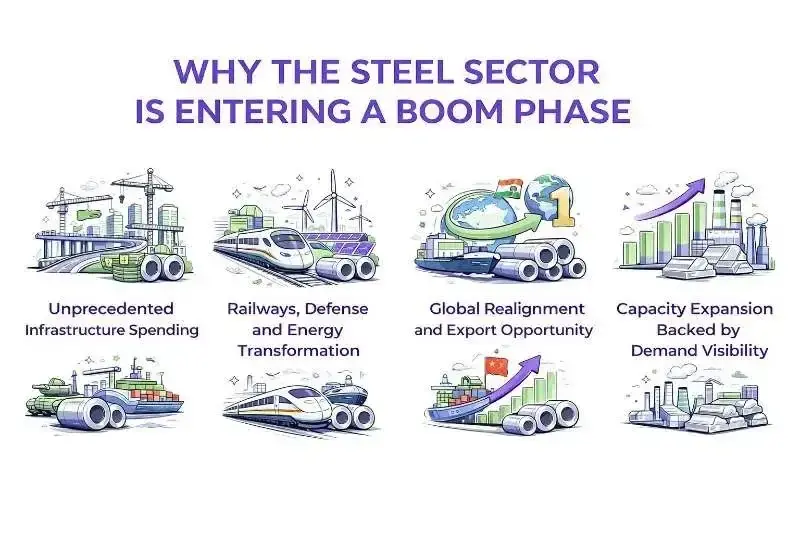
1. Unprecedented Infrastructure Spending
India’s infrastructure push is no longer incremental, it is exponential. With government capital expenditure exceeding ₹11 lakh crore and a strong pipeline of projects under execution, steel demand visibility has improved significantly. Roads, bridges, ports, and smart cities are being developed at a pace not seen before.
Every large infrastructure project is steel-intensive, and this creates a direct and sustained demand pipeline. Unlike previous cycles, where demand was sporadic, the current wave is broad-based and long-term in nature. This ensures that steel producers are not just selling more, but planning capacity with greater confidence.
2. Railways, Defense and Energy Transformation
Indian Railways is undergoing one of its biggest transformations, with dedicated freight corridors, Vande Bharat trains, and electrification projects driving steel consumption. Defense manufacturing is another emerging demand driver, with increasing localization and indigenization.
Renewable energy adds another layer to this demand story. Wind turbines, solar structures, and transmission infrastructure require specialized steel products. This shift is pushing companies toward value-added steel, which commands better margins and creates a competitive moat.
3. Global Realignment and Export Opportunity
The China+1 strategy has opened a new window for Indian steel companies. As global buyers look to diversify supply chains, India is emerging as a reliable alternative. This is not just about exporting excess capacity, but about capturing premium markets with higher-quality products.
Interested in railway sector and looking for a company to invest? Read our article: The Railway Components Manufacturer Riding India’s Rail Infrastructure Expansion – Frontier Springs
Indian companies are increasingly focusing on specialized and high-grade steel, allowing them to move up the value chain. This transition can significantly improve profitability and reduce dependence on volatile commodity pricing.
4. Capacity Expansion Backed by Demand Visibility
One of the biggest risks in the steel sector historically was overcapacity. Companies would expand aggressively during boom phases, only to face demand slowdowns later. This time, the expansion cycle appears more disciplined and demand-backed.
Leading players are investing in capacity expansion while maintaining a close eye on utilization levels and cost efficiency. This balance between growth and discipline is critical and could lead to a more stable earnings trajectory across cycles.
Lets now understand and deep dive into the stocks which are best positioned to benefit from this massive boom.
1. JSW Steel
JSW Steel stands out as one of the most aggressive and forward-looking players in the Indian steel industry, consistently positioning itself ahead of the demand curve rather than reacting to it. The company’s strategy is built on scale, speed, and execution, allowing it to capture opportunities faster than many of its peers. Over the years, this approach has enabled JSW Steel to gain significant market share and establish itself as a dominant force in the sector.
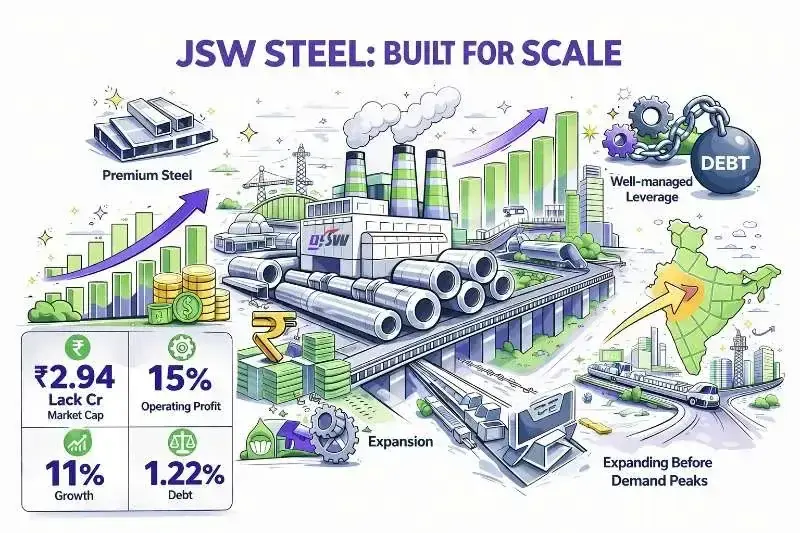
With a market capitalization of ₹2.94 lakh crore, the company has the financial strength to undertake large-scale investments in capacity expansion and technological upgrades. This scale advantage is critical in a capital-intensive industry like steel, where cost efficiencies often determine long-term competitiveness. Larger players are better positioned to negotiate raw material contracts, optimize logistics, and maintain stable margins even during volatile market conditions.
The company’s growth trajectory is reflected in its numbers. A quarterly sales growth of 11.15% indicates strong demand momentum, while an overall sales growth of 5.19% suggests consistent expansion. These figures are particularly noteworthy given the challenging global environment, highlighting the strength of domestic demand and the company’s ability to capture it effectively.
Margins remain a key strength for JSW Steel. With an operating margin of 15.08%, the company demonstrates its ability to maintain profitability despite fluctuations in input costs and global steel prices. This level of margin stability suggests that the company’s focus on operational efficiency and cost control is yielding tangible results.
However, growth at this scale often comes with increased financial leverage. JSW Steel’s debt-to-equity ratio of 1.22 reflects its aggressive expansion strategy, where debt is being used as a tool to accelerate growth. While this enhances potential returns during favorable cycles, it also introduces risk during downturns, making debt management a critical factor to monitor.
The company’s earnings profile provides some comfort in this regard. With an EPS of ₹30.46, JSW Steel has demonstrated its ability to generate strong profits, even in a cyclical industry. Promoter holding at 45.32% further reinforces confidence, indicating that the management has significant skin in the game and is aligned with long-term value creation.
Looking forward, JSW Steel is increasingly focusing on value-added products, which offer higher margins and better demand stability compared to commoditized steel. This strategic shift is crucial, as the future of the industry is likely to be defined by specialization rather than volume alone.
Want to understand the implication of PEG Ratio on your stocks? Read our article: PEG Ratio: The Improved Version of P/E for Growth Stocks
At the same time, the company’s expansion plans are aligned with India’s infrastructure growth story. By building capacity ahead of demand, JSW Steel is positioning itself to capture a disproportionate share of future growth. This proactive approach could translate into significant earnings upside over the long term.
That said, investors must remain mindful of the risks associated with high leverage and global price volatility. Steel remains a cyclical industry at its core, and any sharp downturn in prices or demand could impact profitability. Balancing these risks with the company’s strong growth potential is key to evaluating its investment case.
2. Tata Steel
Tata Steel represents a more balanced and diversified approach to the steel business, combining domestic strength with a significant global presence. This diversification provides resilience across cycles, as the company is not entirely dependent on a single geography or market segment. However, it also introduces complexity, as performance is influenced by multiple macroeconomic factors.
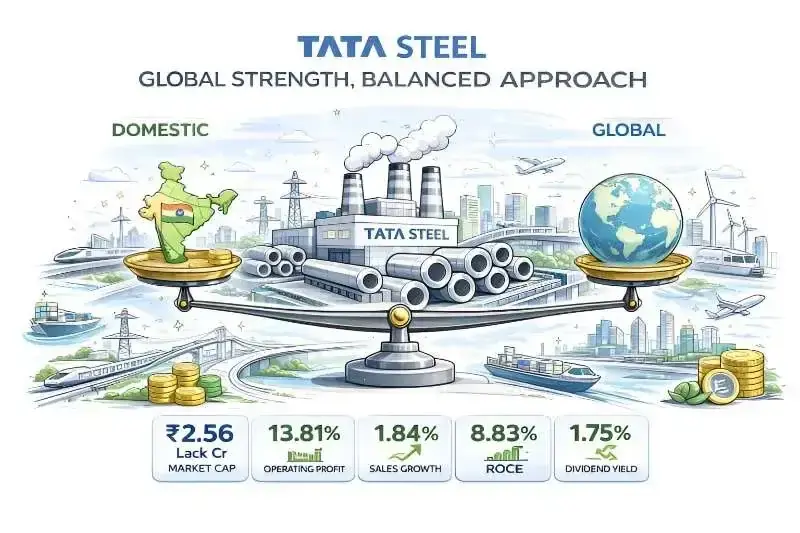
With a market capitalization of ₹2.56 lakh crore, Tata Steel remains one of the largest and most established players in the industry. Its legacy, brand strength, and operational expertise give it a strong competitive advantage, particularly in terms of customer relationships and distribution networks.
One of the defining characteristics of Tata Steel is its focus on stability and sustainability. Unlike more aggressive players, the company tends to adopt a measured approach to growth, prioritizing long-term value creation over short-term gains. This is reflected in its operating margin of 13.81%, which, while slightly lower than some peers, remains relatively stable across cycles.
The company’s sales growth of 1.84% suggests that it is currently in a phase of consolidation rather than expansion. This could indicate a strategic focus on optimizing operations, reducing costs, and strengthening the balance sheet before entering the next growth phase. Such periods of consolidation are often necessary for long-term sustainability.
Return ratios provide further insight into the company’s efficiency. With a ROCE of 8.83%, there is room for improvement in capital utilization. However, this also presents an opportunity. As demand picks up and capacity utilization improves, there is potential for significant enhancement in return ratios.
A notable strength of Tata Steel is its dividend yield of 1.75%, which makes it attractive for investors seeking a combination of income and growth. This positions the company as a relatively defensive option within a typically cyclical sector.
The company is also actively working on deleveraging its balance sheet, particularly in its international operations. Reducing debt and improving financial flexibility could significantly enhance investor confidence and valuation multiples over time.
Confused which broker suits best for your investmments or trading? Read our article: Zerodha vs Groww vs Upstox – Which App is Best for Beginners in 2026?
Looking ahead, Tata Steel’s performance will be influenced by both domestic and global factors. While the Indian market offers strong growth potential, global operations expose the company to economic conditions in regions such as Europe, which can be more volatile.
Overall, Tata Steel offers a well-rounded investment proposition. It may not deliver the highest growth rates, but it provides stability, diversification, and steady returns, making it suitable for investors with a more balanced risk appetite.
3. Jindal Steel & Power
Jindal Steel & Power is gradually emerging as one of the most efficient and disciplined players in the steel sector. While it may not command the same scale as industry leaders, its focus on improving operational metrics and capital efficiency sets it apart. This shift toward quality over quantity is becoming increasingly important in a competitive industry.
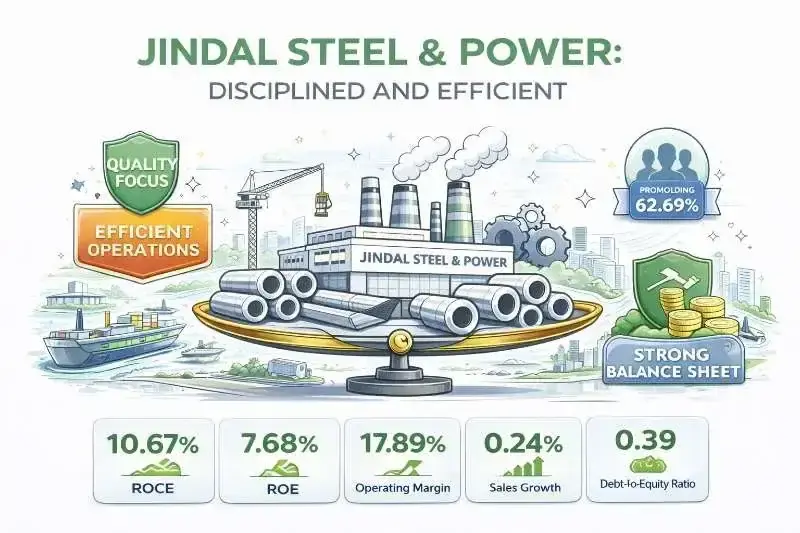
The company’s return ratios highlight this transformation. With a ROCE of 10.67% and ROE of 7.68%, Jindal Steel is demonstrating its ability to generate better returns on capital compared to many peers. These metrics indicate improved utilization of assets and more disciplined investment decisions.
Operating margins of 17.89% further reinforce this narrative. In a sector where margins are often under pressure, maintaining such levels suggests strong cost control and efficient operations. It also indicates a focus on profitability rather than simply increasing volumes.
One of the key strengths of the company is its balance sheet. With a debt-to-equity ratio of 0.39, it is significantly less leveraged than many competitors. This provides financial flexibility and reduces vulnerability to economic downturns, making it a relatively safer play within the sector.
Interestingly, the company’s sales growth of 0.24% appears modest at first glance. However, this should be viewed in the context of its strategic priorities. Instead of pursuing aggressive expansion, Jindal Steel is focusing on improving margins and efficiency, which could lead to stronger earnings growth over time.
Promoter holding at 62.69% indicates strong confidence from management and alignment with shareholder interests. High promoter stake often reflects a long-term commitment to the business and its growth trajectory.
Looking ahead, Jindal Steel is well-positioned to benefit from the infrastructure boom. Its strong balance sheet allows it to invest in growth opportunities without taking on excessive risk, providing a solid foundation for future expansion.
The key challenge will be maintaining high levels of efficiency as the company scales. Growth often brings complexity, and sustaining strong margins and return ratios requires continuous focus on operational excellence.
Overall, Jindal Steel & Power offers a compelling mix of efficiency, financial discipline, and growth potential. It may not be the fastest-growing player, but its emphasis on quality makes it a strong contender in the long term.
Want to understand which defense stock is best for your portfolio, read our article: PSU vs Private Defence Stocks: Which Are Better for 2026?
4. Steel Authority of India Limited
SAIL represents one of the most direct ways to participate in India’s infrastructure growth story. As a government-owned enterprise, its operations are closely aligned with national development priorities, making it a key supplier for large-scale public projects.
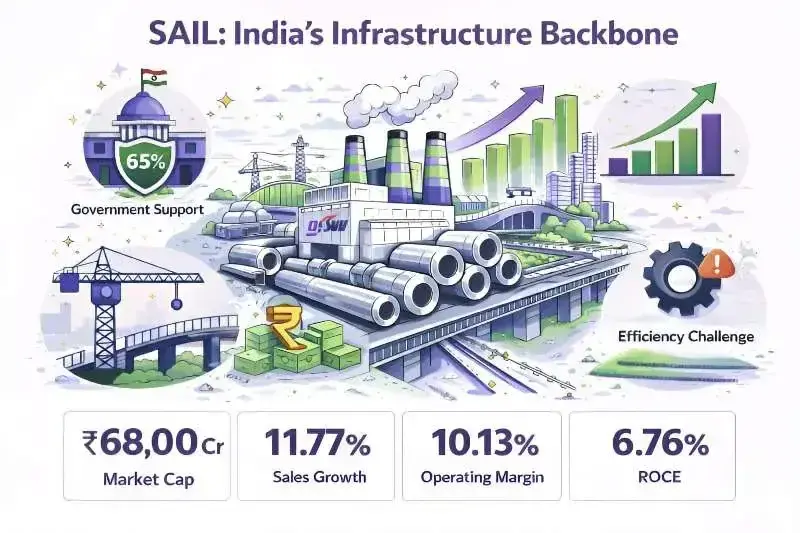
With promoter holding at 65%, the government’s backing provides stability and long-term visibility. This support reduces the risk of extreme volatility and ensures that the company remains a central player in the domestic steel ecosystem.
The company’s quarterly sales growth of 11.77% indicates a recovery in demand, driven primarily by infrastructure and construction activity. This highlights SAIL’s strong linkage to domestic economic growth.
However, efficiency remains a challenge. With an operating margin of 10.13% and ROCE of 6.76%, the company lags behind peers in terms of profitability and capital utilization. This suggests that there is significant room for improvement in operations.
Despite these challenges, SAIL’s scale and integration into the infrastructure ecosystem provide a strong foundation for growth. As government spending increases, the company is likely to see a direct impact on volumes.
Looking ahead, the key question is whether SAIL can improve efficiency while maintaining its scale. Enhancing margins and optimizing costs will be critical for unlocking its full potential.
As a public sector enterprise, decision-making processes can sometimes be slower compared to private players. This could impact the company’s ability to respond quickly to changing market conditions.
Nevertheless, SAIL remains a pure-play infrastructure bet. For investors looking to directly benefit from India’s development cycle, it offers a unique opportunity.
5. Jindal Stainless
Jindal Stainless occupies a unique position within the steel sector by focusing on stainless steel, a segment characterized by higher margins and more stable demand. Unlike traditional steel, stainless steel is used in specialized applications, making it less susceptible to price volatility.
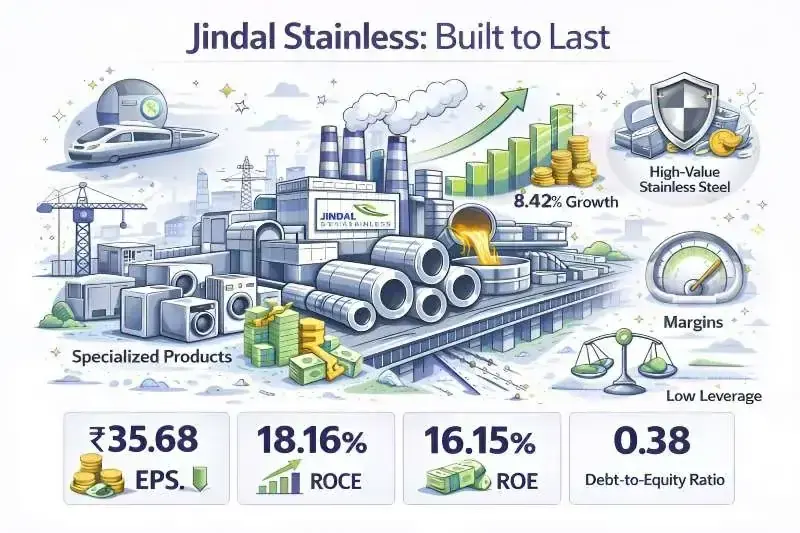
The company’s financial performance reflects this advantage. With a ROCE of 18.16% and ROE of 16.15%, it significantly outperforms most peers in terms of capital efficiency. These metrics indicate strong operational performance and effective utilization of resources.
Its EPS of ₹35.68 highlights robust earnings capability, while a debt-to-equity ratio of 0.38 ensures financial stability. This combination of profitability and low leverage makes it an attractive investment option.
Sales growth of 8.42% demonstrates steady expansion, supported by demand from sectors such as railways, construction, and consumer goods. These industries are increasingly adopting stainless steel for its durability and corrosion resistance.
Operating margins of 12.22% are healthy, particularly given the company’s focus on specialized products. This suggests strong pricing power and a competitive advantage in its niche segment.
One of the key drivers of growth for Jindal Stainless is its focus on value-added products. This strategy not only enhances margins but also creates entry barriers, making it difficult for competitors to replicate its success.
Looking forward, the company is well-positioned to benefit from increasing demand for stainless steel in infrastructure and industrial applications. This segment is expected to grow faster than traditional steel, providing a strong tailwind.
However, the company must navigate challenges such as raw material price volatility, particularly in nickel, which can impact margins. Effective cost management will be crucial for sustaining profitability.
Bullish on power sector? Read our article: Power Stocks with High Capex Plans & Capacity Expansion (2026)
Overall, Jindal Stainless offers a differentiated and high-quality investment opportunity. Its niche positioning, strong financials, and growth potential make it one of the most compelling plays in the sector.
Explore our Products
Research Framework

Emerging Titans
Combination of quantitative analysis, industry tailwinds, and management assessment - SPRINT investment philosophy

Tiny Titans
Heavy emphasis on scuttlebutt research, plant visits, and early on-ground signals
Conclusion
The steel sector is undergoing a transformation that is both subtle and powerful. What was once a cyclical industry is gradually evolving into a structural growth story supported by infrastructure spending, policy initiatives, and global shifts.
Each of the companies analyzed here represents a different way to participate in this theme. From aggressive expansion to niche specialization, they offer a range of investment opportunities suited to different risk profiles.
However, investing in steel requires careful consideration of risks. Global price volatility, raw material costs, and economic cycles can all impact performance. This makes stock selection critical.
For investors, the key lies in identifying companies that can balance growth with efficiency and financial discipline. Those that can adapt to changing demand and maintain strong margins are likely to emerge as long-term winners.
In the end, steel may not capture headlines like technology or startups, but it forms the backbone of economic development. And often, the most powerful investment opportunities are built on the strongest foundations.
FAQs
How is steel demand linked to GDP growth in India?
+Steel consumption is often considered a proxy for economic activity, especially in developing economies like India. As GDP grows, sectors like construction, manufacturing, and infrastructure expand, all of which require significant steel usage. Typically, steel demand tends to grow faster than GDP during high-growth phases because infrastructure and industrial expansion accelerate disproportionately. This makes steel companies indirect beneficiaries of broad economic growth.
What is the difference between primary steel and secondary steel producers?
+Primary steel producers manufacture steel from raw materials like iron ore, using blast furnaces or electric arc furnaces. Secondary producers, on the other hand, recycle scrap steel to produce finished products. Primary producers usually have better control over quality and scale, while secondary players often benefit from lower capital requirements and flexibility. Both segments play a crucial role in meeting India’s growing steel demand.
Why are ferro alloys important in the steel industry?
+Ferro alloys are essential additives used in steelmaking to improve properties like strength, durability, and resistance to corrosion. For example, manganese and chromium-based alloys are widely used in producing high-quality steel. As steel demand increases, the demand for ferro alloys also rises, making companies involved in this segment key beneficiaries of the overall steel ecosystem growth.
How do global steel prices impact Indian steel companies?
+Even though domestic demand in India is strong, global steel prices still influence profitability. If international prices fall significantly, cheaper imports can enter the market, putting pressure on domestic pricing. Conversely, when global prices rise, Indian companies can benefit from higher realizations and export opportunities. Therefore, global trends remain an important factor despite strong domestic demand.
What role does the government play in supporting the steel sector?
+The Indian government plays a significant role through policies, infrastructure spending, and initiatives like the National Steel Policy. Measures such as import duties, anti-dumping tariffs, and incentives for domestic manufacturing help protect and promote the sector. Additionally, large-scale infrastructure projects directly drive demand, making government spending a key growth driver for steel companies.

High growth stock specialist, Value Educator
Shashank Mahajan is an equity research professional with over 12 years of experience in identifying high-potential SME and micro-cap stocks at an early stage. He follows a rigorous scuttlebutt research–driven approach, combining on-ground insights with deep financial analysis. Shashank specializes in uncovering under-researched and under-owned companies with strong management quality and long-term growth potential. Through disciplined research and early identification, he focuses on spotting tomorrow’s market leaders before they enter the mainstream investor radar.

Zen Technologies: Why Revenue Fell After Its Biggest Win

Data Patterns: India's Radar Designer and Its Waiting Orders

KSH International: The Wire Inside India's Transformers

Krishna Defence: The Steel Behind India's Warship Hulls

PNG Jewellers: A 194-Year-Old Name Goes National

Axiscades: From Services to Missile and Radar Electronics
Explore our Products
Research Framework
Emerging Titans
Combination of quantitative analysis, industry tailwinds, and management assessment - SPRINT investment philosophy
Tiny Titans
Heavy emphasis on scuttlebutt research, plant visits, and early on-ground signals


 Orders
 Subscription
 Share with friends
 Logout


Required Details
₹23999.00
(12 month subscription)
As per SEBI regulations, all users are mandated to complete the KYC that is validated for 1 year. Post payment, you will be redirected to the KYC screen


No comments yet. Be the first to comment!