
Aye Finance: Credit for India's Small Businesses

What if the next big lending opportunity in India isn’t sitting inside a large corporate office?
What if it’s operating out of a small workshop, a neighbourhood trading business, a dairy, or a tiny manufacturing unit in a Tier-2 or Tier-3 city ?
These businesses may not have impressive balance sheets. Many may not have years of formal financial records. But they still need money to buy inventory, pay workers, purchase machinery or simply keep their businesses running.
And that creates a very large problem — and an even larger opportunity. Aye Finance is built around it.
Imagine a financial institution that has already reached 6.7 lakh customers, manages ₹7,324 crore in AUM, and operates through 571 active branches. But the scale doesn’t stop there. Behind those numbers is a team of 10,891 people, spread across 21 states, working to bring financial solutions closer to India’s MSMEs. What makes the story even more interesting is the relationship it has built with these customers — reflected in a 72.20 NPS score and a 47.26% retention rate. That means this is not simply a story about how much money is being lent.
It is a story about scale, reach and the ability to build lasting relationships with India's small businesses.
And behind this rapidly expanding MSME financial ecosystem is a company most investors may still be overlooking.
Aye Finance's Unique Approach to Small Businesses
Imagine a small furniture manufacturer.
On paper, the business might look weak. The owner may not have a sophisticated accounting system. There may be limited formal financial information available. But walk into the business and you may see something very different.
There is inventory. There are workers. Orders are coming in. Customers are paying. Raw material is being purchased regularly. Money is moving through the business every day.
This is where Aye Finance enters the story.
Aye Finance has built its underwriting approach around understanding these kinds of businesses.
Its model combines cluster-level knowledge, cash-flow-based lending, physical branches, technology and data science to assess micro-enterprises beyond conventional financial parameters. This is why the company's branch network still matters even in an increasingly digital lending environment. Technology can process information. But when you are lending to a small entrepreneur whose business may not fit neatly into a spreadsheet, understanding the business on the ground matters too.
That is the logic behind Aye Finance's Phygital Model (Physical + Digital) — technology on one side and human presence on the other. And over the years, the company has tried to make both sides stronger.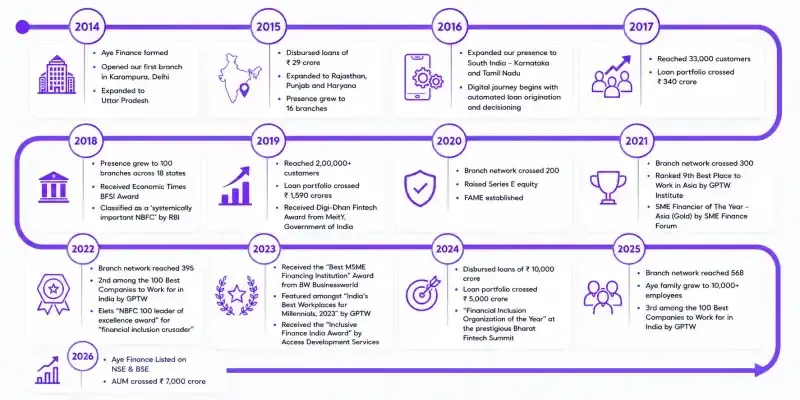
The businesses that traditional lending struggled to understand
India has millions of micro-businesses.They may be small individually, but together they form a critical part of the economy. The problem is that traditional lending systems are generally designed around formal documentation, collateral and established credit histories.A small entrepreneur may have a perfectly viable business but still struggle to tick all those boxes.
Aye Finance was built around this exact gap. The company, founded in 2014, is an RBI-registered NBFC focused specifically on India's micro-enterprise ecosystem. Instead of trying to become another broad-based lender, Aye Finance has stayed focused on businesses that are often underserved by mainstream financial institutions.
And that focus is important. Because Aye Finance is not simply asking: “Does this customer have enough paperwork?” It is trying to answer a different question: “Does this business actually have the ability to repay?”
That difference sits at the heart of the entire business model.
From a ₹29-crore beginning to a ₹7,000-crore-plus lending platform
In 1993, the legal entity that would eventually become Aye Finance was incorporated as Doda Finance Private Limited. But the more important chapter began two decades later. In 2014, the business changed hands, was renamed Aye Finance, and began building a completely different lending model around India's micro-scale businesses.
The opportunity was unusually large but difficult to serve. These were businesses that often lacked formal financial statements, traditional credit histories or adequate collateral. Aye's response was to build a cluster-based underwriting model, combining physical presence with technology and alternative data. In March 2014, it gave its first loan to a small women's-footwear manufacturer. Within the next six months, it had disbursed around 200 loans through just two Delhi branches.
The first stage: proving the model
By 2015, the experiment was beginning to look like a business. Aye obtained its NBFC registration, expanded into Rajasthan, Punjab and Haryana, opened 16 branches and disbursed approximately ₹29 crore of loans.
In 2016, the company moved into Karnataka and Tamil Nadu and began its digital journey with automated loan origination and decision-making. By 2017, it had reached 33,000 customers and crossed ₹340 crore of AUM.
By early 2018, Aye had already disbursed more than ₹500 crore cumulatively to around 40,000 customers, while its AUM was around ₹350 crore.
By 2019, the AUM milestone had moved to approximately ₹1,590 crore, while the company had crossed 2 lakh customers.
Then came the ₹1,000-crore-to-₹7,000-crore journey
The next few years were less about proving whether the model worked and more about scaling it.
AUM was around ₹1,781 crore at March 2020, before the pandemic disrupted the lending environment. It stood at about ₹1,570 crore at March 2021 and ₹1,688 crore at March 2022.
This period is important because the growth story wasn't a straight line. The company’s performance has improved significantly over the years. It reported ₹16.9 crore in FY21, followed by a loss of ₹45.7 crore in FY22. It then recovered strongly to ₹53.8 crore in FY23, rising further to ₹161.1 crore in FY24, ₹171.3 crore in FY25, and ₹193.6 crore in FY26.
The FY22 loss came during a difficult pandemic-affected period, when total revenue fell to ₹443.5 crore and impairment on financial assets increased substantially.
“Credit vanishes and debt becomes financially fatal.”
— Warren Buffett
But the recovery that followed was significant.
FY23 was the turning point
AUM reached ₹2,721.55 crore by March 2023, and PAT recovered to ₹53.79 crore. Then FY24 delivered a major jump. AUM almost doubled from ₹2,721 crore to ₹4,463 crore, a 64% increase. PAT jumped from ₹53.8 crore to ₹161.1 crore. Disbursements also rose sharply to around ₹3,939 crore.
This was the point where Aye Finance started looking less like a niche micro-lender and more like a scaled financial platform.
FY25: ₹5,000 crore AUM
The momentum continued. By March 2025: AUM: ₹5,533.90 crore , Revenue from operations: ₹1,459.73 crore , PAT: ₹171.27 crore , Disbursements: ₹4,291 crore , AUM grew another 24% during FY25.
But this period also highlighted an important part of the story: growth came with pressure on profitability and asset quality.Financing margin declined from 20% in FY24 to 14% in FY25, while GNPA increased from 3.19% to 4.21%.
So the question was no longer simply “Can Aye grow?”
It had become: “Can Aye keep growing while maintaining the quality and profitability of that growth?”
FY26: ₹7,000 crore milestone
And then came another major jump.By March 2026, AUM had reached ₹7,043.80 crore, up 27.28% year-on-year from ₹5,533.90 crore.
The company also disbursed 2,06,254 new loans during FY26, while annual disbursements were around ₹5,169 crore.
Aye Finance Financials
Revenue from operations: ₹1,814.73 crore , PBT: ₹247.30 crore , PAT: ₹193.63 crore , AUM: ₹7,043.80 crore . The balance sheet had expanded to ₹7,772.94 crore, with total loan assets of ₹6,266.44 crore.And the company had reached 571 branches across 18 states and 3 Union Territories.
“Risk comes from not knowing what you’re doing.”
— Warren Buffett
The smartest growth may come from the branches you already have
When a financial company wants to grow, the obvious answer is often: Open more branches. Hire more people. Find more customers.
Aye Finance has been taking a somewhat different approach. During FY26, the company opened no new branches. Instead, it focused on increasing the productivity of its existing network.
Around 71% of incremental AUM growth came from existing branches, while another 29% came from repeat lending. Older branches have also become significantly more productive, with branches more than four years old averaging around ₹15 crore of AUM — roughly three times the level of newer branches.
Think of it like planting a tree.
In the beginning, the focus is on getting the tree to grow. But after several years, you don't necessarily need to plant another tree every time you want more fruit. You can simply get more productivity from the tree you already have. That is increasingly what Aye Finance is trying to do with its branch network.
And there is another layer to this strategy.
Repeat customers.
“The only good loan is one that gets paid back.”
— Robert Wilmers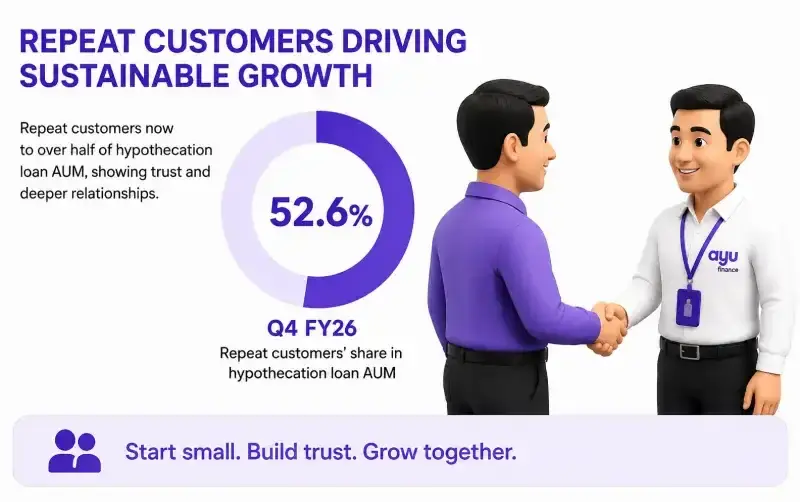
The customer who already knows you is often the best customer
Finding a completely new borrower costs money. You have to source the customer, understand the business, assess the risk and build the relationship from scratch. But imagine a borrower who has already taken a loan from Aye Finance and successfully repaid it. The company already has information about that customer. It knows the repayment behavior. It has more data. And it can potentially lend again at a lower origination cost. Aye Finance has therefore built a repeat-loan programme using machine-learning models to identify lower-risk existing customers.By Q4FY26, repeat customers accounted for 52.6% of hypothecation-loan AUM, up from 47.1% a year earlier. This changes the economics of the business.
The story is no longer simply about acquiring customers, lending to them, collecting repayments, and moving on. It is increasingly becoming a cycle where the company acquires a customer, understands their evolving needs, lends to them again, and deepens the overall relationship. And that brings us to another important change happening inside the loan book.
“Credit means that a certain confidence is given, and a certain trust reposed.”
— Walter Bagehot, Lombard Street
Aye Finance is slowly changing what it lends
Historically, hypothecation loans have been the backbone of Aye Finance's business.
These loans are designed around practical business requirements — inventory purchases, wages, working capital, minor renovations and other short-term needs. But the company is increasingly pushing mortgage loans. And there is a reason. Mortgage loans can have longer repayment tenures and can be used for larger requirements such as machinery, livestock, refinancing or business expansion. They can therefore create a more stable AUM base compared with shorter-tenure lending.
There is also a natural cross-selling opportunity. A customer who has already demonstrated good
repayment behavior on a smaller business loan can potentially graduate to a mortgage loan.
So Aye Finance is trying to build a customer ladder.
Start with a small business loan. Build trust. Understand the borrower. Then gradually increase the relationship. This is one of the most important pieces of the company's long-term story.
Technology is quietly changing the economics
At first glance, lending to micro-enterprises looks like a people-heavy business.
And it is. But Aye Finance has spent years trying to automate everything that can be automated. Its loan origination is paperless. Disbursements are cashless. Collections are increasingly digital. AI/ML scorecards are being used in underwriting. Data models are used to predict repayment behaviour and help optimise collections.
By FY26, around 84% of collections were digital and AI/ML-based scoring supported 32% of underwriting decisions.
This creates an interesting combination.That combination is difficult to replicate overnight because it has been built through years of lending data, branch experience and process development.And this accumulated knowledge may become increasingly valuable as the company grows.
But lending is not about growth alone
Here is where the story becomes more serious. Anyone can grow a loan book by lending more money. The real test is whether the money comes back. For a micro-enterprise lender, asset quality is therefore just as important as AUM growth.
At March 2026, Aye Finance reported GNPA of 4.77% and NNPA of 1.79%. At the same time, credit cost had declined for four consecutive quarters, falling from 6.19% in Q4FY25 to 4.30% in Q4FY26.
The company has also deliberately managed the vintage of its portfolio, with a large portion of the book originated after the period of elevated lending that affected the broader micro-credit ecosystem. And the improvement continued into FY27.
In Q1 FY27, credit cost declined further to 4.01%, with management maintaining a 3.5%-4% guidance range.
Why does this matter? Because for a lender, even a small improvement in credit costs can flow directly into profitability. And that is exactly what started showing up in Q1.
“A lender's greatest asset is not the size of its loan book, but the quality of its underwriting.”
FY27 has started with something investors want to see: operating leverage
Q1 is normally a softer quarter for the business. Yet Aye Finance reported its strongest-ever first-quarter disbursement performance. The company disbursed ₹1,219 crore, up 22% year-on-year. AUM reached ₹7,324 crore, up 28% year-on-year and 4% sequentially from March 2026. More than 44,000 new borrowers were added, taking the active borrower base beyond 6.7 lakh. But the more important part was what happened to profitability. Gross total income increased 22% year-on-year to ₹490 crore. Net total income increased 38% to ₹322 crore. NIM improved to 15.9%. Pre-provision operating profit reached ₹179 crore. And PAT jumped 144% year-on-year to ₹75 crore.
This is the point where the story starts moving beyond simple balance-sheet growth. The company has already built the branches. It has already built the technology. It has already built the customer base. It has already raised capital. Now, investors want to see whether scale can make the business more profitable.
The IPO gave the story another layer
In February 2026, Aye Finance listed on the Indian stock exchanges.
The IPO included a ₹710 crore fresh issue and a ₹300 crore offer for sale. After expenses, the company raised ₹672 crore of primary capital, strengthening its balance sheet. For a lender, fresh equity is not just money sitting in the bank. It is growth capacity. As the loan book expands, a stronger capital base allows the company to grow while maintaining healthy capital adequacy.
At March 2026, Aye Finance's capital adequacy ratio was 42.24%. It also had ₹767.58 crore of cash balance and an LCR of 205.16%.
And Q1 FY27 continued to show a strong capital position, with capital adequacy reported at around 42.4% after the stated errata. So the company is entering its next phase with something that many lenders would like to have: capital to grow, a large customer base and improving credit costs.
The company also has a strong credit profile. India Ratings has assigned an IND A+/Stable rating to Aye Finance’s bank loan facilities of ₹1,300 crore and non-convertible debentures of ₹1,296.3 crore, while its commercial paper carries an IND A1+ rating for ₹50 crore. ICRA has also assigned an ICRAA (Stable) rating to ₹650 crore of long-term bank facilities and ₹400 crore of non-convertible debentures. These ratings indicate the company’s established access to institutional funding and provide another layer of support as Aye Finance scales its lending business.
The opportunity is large — but the execution will decide the outcome
There is a temptation to look at India's huge MSME financing gap and immediately conclude that Aye Finance has an unlimited runway.
The opportunity is certainly significant. But opportunity alone doesn't create shareholder value. Aye Finance still has to prove that it can maintain asset quality while growing. It has to manage the transition toward mortgage lending. It has to keep funding costs under control. And it has to improve productivity enough for operating expenses to grow more slowly than the loan book.
Management has indicated that relatively modest team growth can support substantially higher AUM growth. In the July 2026 earnings call, management said a roughly 10% increase in the team could support around 25%-30% AUM growth.
If that relationship holds over time, the mathematics of the business can become increasingly attractive.
More AUM. More customers. More repeat lending. Higher branch productivity. Lower credit costs. And eventually, better operating leverage.
The Aye Finance story is really a story about trust
There is one way to look at Aye Finance as just another NBFC. A company that lends money, earns interest and manages credit risk. But there is another perspective. It has spent more than a decade trying to solve a very specific problem:
How do you lend responsibly to a business that traditional financial systems struggle to understand?
The answer it developed was not one single technology or one clever product. It was a combination of people, branches, data, technology, cluster knowledge and years of repayment information. That combination has taken the company from an AUM of ₹2,721 crore in FY23 to ₹7,044 crore in FY26, while its active customer base has grown to more than 6.4 lakh and its network has reached 571 branches across 18 states and three Union Territories.
Now comes the harder part. The company has to turn that scale into durable profitability. And that is why Aye Finance is at an interesting point in its journey. The first chapter was about finding India's underserved micro-businesses. The next chapter is about becoming the financial partner those businesses keep coming back to.
If Aye Finance can continue growing its customer relationships while bringing down credit costs and improving operating leverage, the company could move from being simply a fast-growing micro-enterprise lender to becoming a much more efficient financial platform built around India's smallest businesses.
Sometimes, the biggest opportunity is not found by going after the biggest customer. It is found by understanding the customer everyone else overlooked.
The fundamental picture behind the growth
The growth story becomes clearer when the income statement and balance sheet are placed side by side. The financial data provided for FY24–FY26 shows a business that has continued to scale, but with profitability and asset quality requiring closer attention.
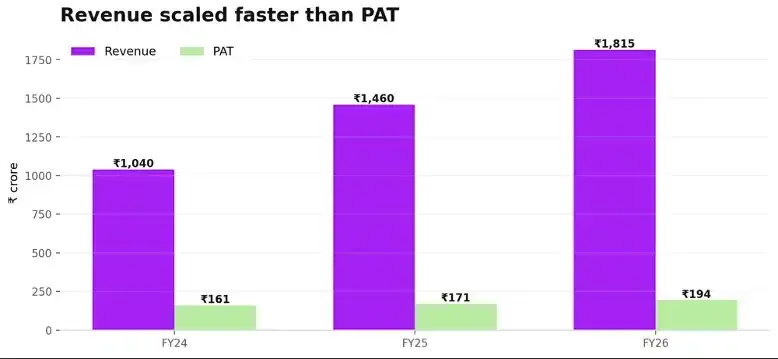
Revenue increased from ₹1,040 crore in FY24 to ₹1,460 crore in FY25 and ₹1,815 crore in FY26. Over the same period, PAT moved from ₹161 crore to ₹171 crore and then ₹194 crore. In other words, the top line has expanded much faster than net profit, which tells us that simply growing the loan book is not enough — the next phase depends on converting scale into better earnings. https://valueeducator.com/fundamental-analysis-basics/how-to-read-profit-and-loss-statemen
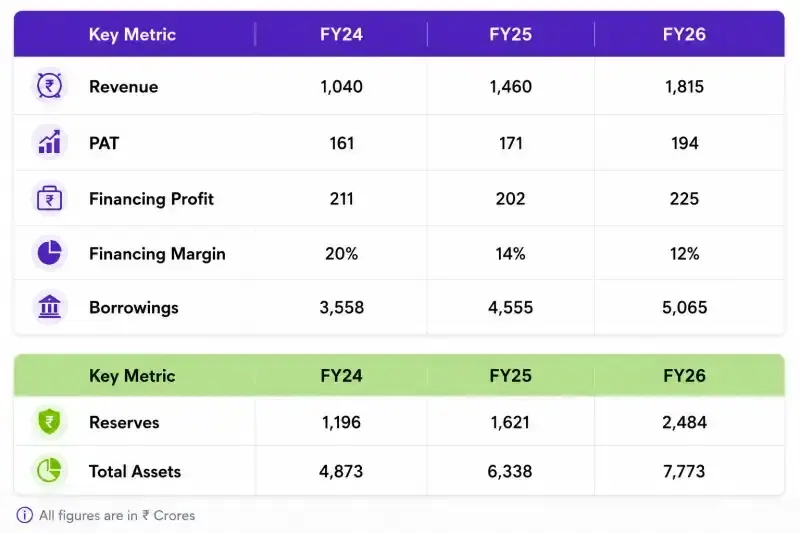
The balance sheet shows the same scaling trend. Borrowings increased from ₹3,558 crore in FY24 to ₹5,065 crore in FY26, while reserves more than doubled from ₹1,196 crore to ₹2,484 crore. Total assets expanded from ₹4,873 crore to ₹7,773 crore. For a lender, this combination matters because growth has to be supported by both funding and capital.
https://valueeducator.com/fundamental-analysis-basics/balance-sheet-analysis-for-investors
At the same time, the financing margin declined from 20% in FY24 to 14% in FY25 and 12% in FY26. That is an important number to watch because a lower financing margin can limit how much of the balance-sheet growth eventually reaches shareholders as profit. The fact that PAT still increased to ₹194 crore in FY26 suggests that the business is managing several moving parts, but margin recovery would make the growth story stronger.
Asset quality remains the other side of the equation. The article's FY26 discussion records GNPA at 4.77% and NNPA at 1.79%, while credit cost had improved for four consecutive quarters into Q4FY26. This is important because the quality of future AUM growth will ultimately depend on how much of the loan book converts into sustainable interest income without a disproportionate increase in credit losses.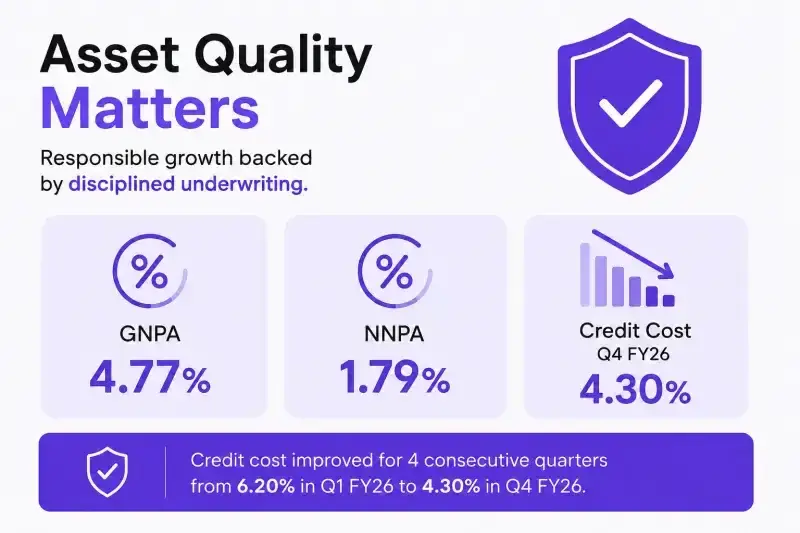
The latest quarterly screen provided for Q1 FY27 also points to a meaningful improvement in operating performance: revenue was ₹477 crore, financing profit ₹91 crore, financing margin 19%, profit before tax ₹97 crore and net profit ₹74 crore. The comparison with Jun-2025 revenue ₹405 crore, financing profit ₹37 crore, financing margin 9% and PAT ₹31 crore , shows why the recent margin and earnings improvement deserves attention.
“In lending, growth is visible. Credit quality is what determines whether that growth creates value.”
The valuation snapshot supplied alongside the financial data showed a market price of ₹173, market capitalization of ₹4,277 crore, P/E of 18.1x and price-to-book of 1.67x. ROE was 9.24% and ROCE 11.4%. These numbers suggest that the valuation should be judged alongside the company's ability to improve returns on the larger capital base, rather than by looking at the P/E in isolation. Q1 financing margin improved from 9% to 19%. https://valueeducator.com/fundamental-analysis-basics/the-pe-ratio-decoded-trailing-vs-forward-and-what-is-a-good-pe
Q1 comparison: revenue, financing profit and PAT improved sharply in Jun-26 versus Jun-25. Financing margin: the decline from 20% to 12% is an important monitorable. Balance sheet: borrowings, reserves and total assets all expanded between FY24 and FY26.
Revenue and PAT: the top line has expanded faster than bottom-line profit.
The balance sheet also remains well capitalized. FY26 capital adequacy was reported at 42.24%, while the supplied market data showed net worth of ₹2,533 crore, debt of ₹5,065 crore and cash equivalents of ₹1,011 crore. For an NBFC, the ability to keep funding growth without stretching capital is an important part of the story. https://valueeducator.com/fundamental-analysis-basics/debt-to-equity-small-cap-investing
What investors should watch

Explore our Products
Research Framework

Emerging Titans
Combination of quantitative analysis, industry tailwinds, and management assessment - SPRINT investment philosophy

Tiny Titans
Heavy emphasis on scuttlebutt research, plant visits, and early on-ground signals
Conclusion
Aye Finance is no longer a small experiment in micro-enterprise lending. It has built a ₹7,000-crore-plus loan book, a large customer base and a nationwide branch network focused on businesses that traditional lenders have often found difficult to evaluate.
The next part of the story is more demanding. Growth by itself is no longer enough. Investors need to see whether Aye can protect asset quality, keep credit costs under control, rebuild financing margins and extract more productivity from the infrastructure it has already built.
The early signs from Q1 FY27 are encouraging: AUM and disbursements continued to grow, financing margin recovered sharply, credit cost declined and PAT increased substantially. But the FY24–FY26 numbers also show why caution is necessary — revenue has expanded much faster than profit, while GNPA and NNPA have risen.
That leaves Aye Finance at an important stage. The first phase was about proving that India's smallest businesses could be served at scale. The next phase is about proving that they can be served profitably and sustainably.
For investors, the key question is therefore not simply how large Aye's loan book can become. It is whether the economics of that loan book can improve as it gets larger.
The bullish case rests on sustained AUM growth, lower credit costs, improving financing margins, operating leverage and, ultimately, a meaningful recovery in ROE.
For anyone studying Aye Finance, the next few years are less about chasing one exciting number and more about watching a handful of things move together: https://valueeducator.com/stock-market-basics/stock-fundamental-checklist-how-to-research
Because ultimately, the Aye Finance story is not just about how much it lends.
It is about how profitably and sustainably it can lend.
“The economics of lending are simple: lend wisely, price risk correctly, and collect what you lend.”
FAQs
What specific gap in India's lending ecosystem is Aye Finance trying to solve?
+Aye Finance focuses on micro-enterprises and very small businesses that may have viable businesses but lack sophisticated financial statements, formal credit histories or sufficient traditional collateral. Instead of relying only on conventional financial parameters, Aye combines cluster-level knowledge, cash-flow assessment, physical branches, technology and data science to understand whether the business can actually repay the loan.
What is Aye Finance's “Phygital” model?
+“Phygital” means Physical + Digital. Aye combines its physical branch network and on-ground understanding of customers with digital technology, automated underwriting, data science and digital collections. The idea is that technology can process information efficiently, while people on the ground can understand businesses that may not fit neatly into traditional financial models.
Why should investors look at GNPA, NNPA and credit cost alongside AUM?
+Because lending growth is valuable only when the loans are eventually repaid. A company can grow AUM rapidly by lending more, but rising defaults can consume the earnings generated from that growth. At March 2026, Aye's GNPA was 4.77% and NNPA was 1.79%. However, credit cost had improved for four consecutive quarters, falling from 6.19% in Q4 FY25 to 4.30% in Q4 FY26. So asset quality remains a risk to monitor, while the declining credit-cost trend is encouraging
Why is the FY22 loss important?
+FY22 shows that Aye's growth has not been a straight line. PAT fell from ₹16.9 crore in FY21 to a ₹45.7 crore loss in FY22, during a difficult pandemic-affected period when impairment on financial assets increased. The subsequent recovery to ₹53.8 crore PAT in FY23 and ₹161.1 crore in FY24 demonstrates the company's ability to recover, but it also highlights the inherent cyclicality and credit risk of lending.
What does 71% of AUM growth coming from existing branches tell us?
+It suggests Aye is increasingly trying to get more productivity from the network it already has rather than relying only on opening new branches. Branches older than four years averaged around ₹15 crore of AUM, about three times the level of newer branches. If existing branches can continue generating more AUM, the company may be able to achieve greater operating leverage as it scales.

High growth stock specialist, Value Educator
Shashank Mahajan is an equity research professional with over 12 years of experience in identifying high-potential SME and micro-cap stocks at an early stage. He follows a rigorous scuttlebutt research–driven approach, combining on-ground insights with deep financial analysis. Shashank specializes in uncovering under-researched and under-owned companies with strong management quality and long-term growth potential. Through disciplined research and early identification, he focuses on spotting tomorrow’s market leaders before they enter the mainstream investor radar.

Zen Technologies: Why Revenue Fell After Its Biggest Win

Data Patterns: India's Radar Designer and Its Waiting Orders

KSH International: The Wire Inside India's Transformers

Krishna Defence: The Steel Behind India's Warship Hulls

PNG Jewellers: A 194-Year-Old Name Goes National

Axiscades: From Services to Missile and Radar Electronics
Explore our Products
Research Framework
Emerging Titans
Combination of quantitative analysis, industry tailwinds, and management assessment - SPRINT investment philosophy
Tiny Titans
Heavy emphasis on scuttlebutt research, plant visits, and early on-ground signals


 Orders
 Subscription
 Share with friends
 Logout


Required Details
₹23999.00
(12 month subscription)
As per SEBI regulations, all users are mandated to complete the KYC that is validated for 1 year. Post payment, you will be redirected to the KYC screen


No comments yet. Be the first to comment!