
Concord Biotech: Fermentation APIs Grow, Formulations Wait
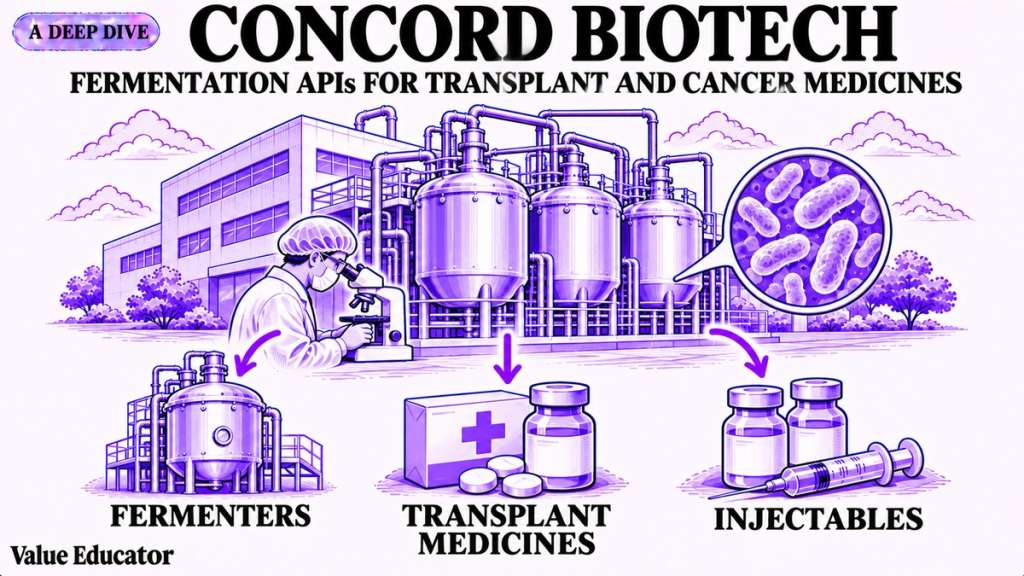
After a kidney transplant, the body sees the new organ as a stranger and tries to attack it. So most transplant patients take medicines called immunosuppressants every day, often for the rest of their lives. Two of the best known are tacrolimus and mycophenolate. They calm the immune system just enough for the new kidney to survive.
Most medicines are built step by step from chemicals in a reactor. These ones start with something alive. A selected strain of microbe is grown in a large steel tank called a fermenter, fed with sugars and nutrients for days, and the molecule it makes is then pulled out and purified. This process is called fermentation. The purified molecule is the active pharmaceutical ingredient, or API, which is the part of a tablet or injection that does the work.
Fermentation is hard to scale. A strain that does well in a flask can behave very differently in a tank holding hundreds of cubic metres, and a small change in temperature or feed can cut the yield. The plants are large and expensive, and every one of them has to pass inspections by drug regulators in each country it supplies. That is why only a few companies in the world make these molecules in large volumes.
One of them is an Indian company with about 1,250 cubic metres of fermentation capacity across two API plants in Gujarat. It makes more than 30 fermentation-based APIs, sells to more than 300 customers in more than 70 countries, and has filed more than 150 drug master files with regulators. A drug master file is the technical dossier a regulator reviews before a medicine maker can use an API.
That company is Concord Biotech Ltd (NSE: CONCORDBIO). Its revenue grew from ₹712.9 Cr in FY22 to ₹1,200.1 Cr in FY25. Then in FY26 it fell 12.1%, to ₹1,054.9 Cr. In the first half of FY27 it grew 26% again.

That fall and recovery tell us a lot about this business. But that recovery also hides a second question. Concord has spent the last few years building a formulation business. A formulation is the finished medicine, the tablet, capsule or injection, made here from Concord's own APIs. That business has not grown yet.
Concord Biotech in five numbers
- Q2 FY27 revenue of ₹309.1 Cr, up 25%
- Q2 FY27 API revenue of ₹250.2 Cr, up 30%
- FY26 revenue of ₹1,054.9 Cr, down 12.1% from ₹1,200.1 Cr
- A new injectable plant running at about 5% of its capacity
- Cash and equivalents of about ₹445 Cr in September 2026, and no debt
So what made revenue fall in FY26, and what is bringing it back? Let's first understand the company, and then look at the latest quarter.
Concord Biotech: Company Overview
Concord Biotech Ltd was incorporated in 1984 and has its registered office and first plant at Dholka, near Ahmedabad in Gujarat. It makes fermentation-based active pharmaceutical ingredients for immunosuppressants, cancer medicines, antibacterials and antifungals, and it sells finished medicines made from those APIs as tablets, capsules, softgels and injections. It runs four plants in Gujarat: API plants at Dholka and Limbasi, and a formulations plant and an injectables plant at Valthera. It has more than 1,600 employees, sells to more than 300 customers in more than 70 countries, and listed on the NSE and BSE in August 2023. Sudhir Vaid is the Chairman and Managing Director, Ankur Vaid the Joint Managing Director and CEO, and Raviraj Karia the Chief Financial Officer. Revenue from operations was ₹1,054.9 Cr in FY26, and the company held cash and equivalents of about ₹445 Cr in September 2026, with no debt. Read this Capital-Intensive Businesses Explained
"The stock market is a device for transferring money from the impatient to the patient."
— Warren Buffett
Concord built its injectable and US businesses ahead of demand. In a business where every customer approval takes months, patience is part of the model.
The Quarter API Sales Grew 30%
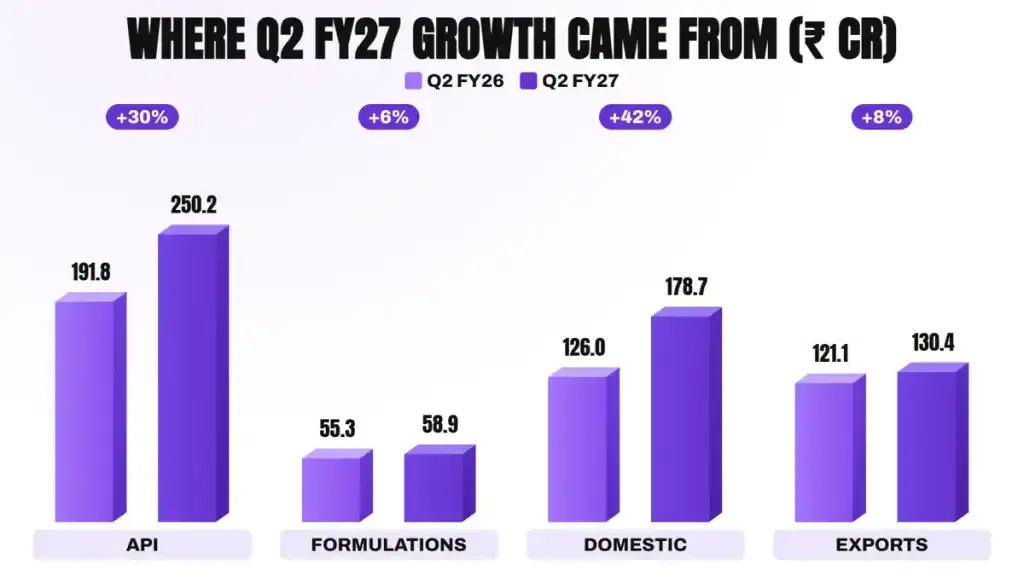
Let's look at Q2 FY27, the July to September quarter in which API sales grew 30%. Concord reported it on 27 October 2026. Revenue from operations was ₹309.1 Cr, up 25% from ₹247.1 Cr a year earlier. It was also about 20% higher than the ₹257.5 Cr of Q1 FY27.
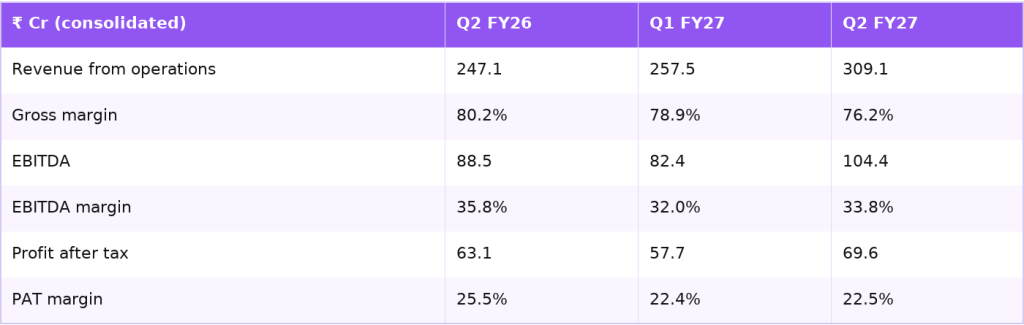
As we can see, the growth came almost entirely from APIs. API revenue rose 30% to ₹250.2 Cr, while formulation revenue rose only 6%, to ₹58.9 Cr. Every product group grew. Immunosuppressants grew at a high double-digit rate, anti-infectives and antifungals grew in line with the company, and oncology nearly doubled.

That growth looks unusual when we split it by market. Domestic revenue rose 42% to ₹178.7 Cr, while exports rose only 8% to ₹130.4 Cr. Management explains that several global customers now buy through their Indian subsidiaries, which then export the medicine to regulated markets. So a sale that is really an export can show up as a domestic sale. Domestic formulations, the medicines Concord sells under its own brands in India, grew 29%.
That growth did not reach the margins. The gross margin fell to 76.2% from 80.2%, a drop of about 400 basis points. Most of it came from raw materials, mainly solvents, whose prices rose amid geopolitical tensions and disrupted supply chains. A smaller part came from selling more of some lower-margin APIs. Power and fuel cost Concord ₹36.6 Cr in the quarter on a standalone basis, against ₹28.5 Cr a year earlier, a rise of about 28.4%.
Concord chose not to pass these costs on. Management sees them as a short-term problem and plans to absorb them through process improvements and better yields. It also says it has faced no pricing pressure from customers. Its lower costs let it offer prices well below those of rival suppliers, which is how it has been winning new customers.
Below gross profit, the quarter looks steadier. Read this EBITDA Explained: Uses and Limits EBITDA rose 18% to ₹104.4 Cr, at a margin of 33.8%. That margin carries the costs of two businesses that barely sell yet: the new injectable plant and Stellon Biotech, the company's new US sales arm. Without those two, the EBITDA margin would have been 37.1%. Profit after tax grew a slower 10.3%, to ₹69.6 Cr, partly because other income fell to ₹10.2 Cr from ₹13.4 Cr.
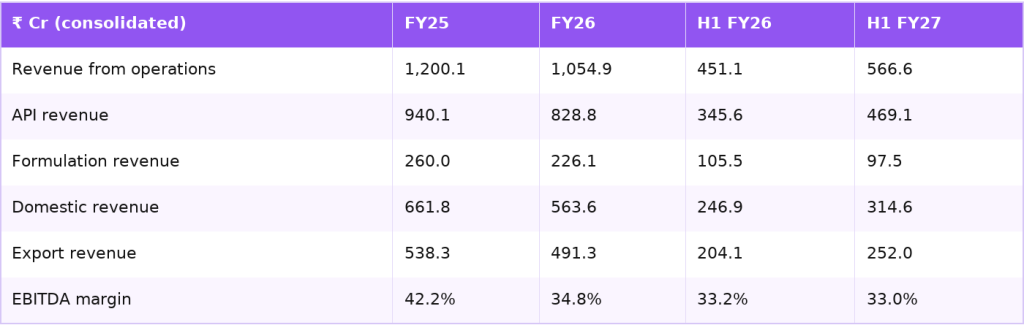
That same pattern shows in the first half, at a larger scale. H1 FY27 revenue was ₹566.6 Cr, up 26%, and EBITDA was ₹186.8 Cr, at a margin of 33.0% against 33.2% a year earlier. Profit after tax rose 19% to ₹127.3 Cr. Leaving out the share of profit from its joint venture, it rose 23%, to ₹126.7 Cr from ₹103.2 Cr.
Inside that half, the gap between the two businesses is wide. API revenue grew 36% to ₹469.1 Cr. Formulation revenue fell 8% to ₹97.5 Cr. So APIs were 83% of H1 revenue, against 77% a year earlier.
That growth was also paid for in cash. Operating cash flow for the half was ₹168.2 Cr, against ₹151.1 Cr a year earlier. Read this Cash Flow Statement Explained Trade receivables fell to ₹412.5 Cr from ₹460.2 Cr in March, while inventory rose to ₹397.8 Cr from ₹326.4 Cr. The company has no borrowings, and it held cash and equivalents of about ₹445 Cr in September 2026. Shareholders also received one bonus share for every share they held, with a record date of 4 November 2026.
What the quarter says: Concord's API engine is growing again, and growing faster than its usual pace. But the gross margin fell by about 400 basis points, and the formulations business, which was meant to add the next leg of growth, shrank in the first half.
Why Revenue Fell 12.1% in FY26
Now that we have seen the recovery, let's go back and see why revenue fell 12.1% in FY26. Concord began operations at its first API plant in Dholka, near Ahmedabad, in FY2000. It added a formulations plant at Valthera in FY2016, a second and larger API plant at Limbasi in FY2021, and an injectables plant at Valthera in FY2025. It listed on the stock exchanges in August 2023, through an offer in which only existing shareholders sold shares, and the investor Helix Investment Holding exited.
Over those years, the business grew steadily. Revenue rose from ₹712.9 Cr in FY22 to ₹1,200.1 Cr in FY25, and the EBITDA margin stayed above 40% in each of FY23, FY24 and FY25. FY25 ended with a very strong quarter: Q4 FY25 revenue was ₹429.9 Cr, up 35%, and API revenue alone was ₹362.4 Cr.
Then several problems arrived in the same year. Management named five of them:
- US buyers waited. Customers, particularly in the US, slowed their buying in the first half of FY26, and new customers did not want to change suppliers while US tariffs were uncertain.
- European supplies stopped for about three months. Exports of APIs to the European Union need a written confirmation from India's drug regulator, CDSCO, and its delay held up those supplies for nearly a quarter of the year.
- The Middle East froze. A major tender in the region was put on hold because of the war, and other API supplies there slowed too.
- Customers bought in smaller lots. In the second half, customers shifted from bulk buying to buying every quarter, which spread revenue out.
- A US government tender was not finalised. Sales to the US Veterans Affairs system fell in Q4, as the tender stayed on hold.
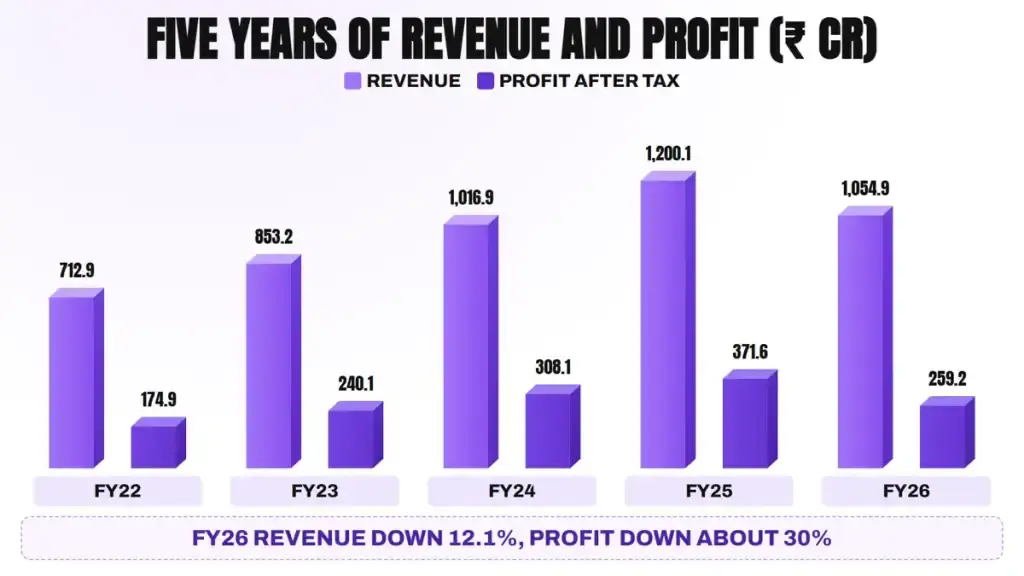
These problems hit the top line hard. Q4 FY26 revenue was ₹326.1 Cr, down 24% from that strong Q4 FY25. For the full year, API revenue fell 12% and formulation revenue fell 13%. Sales fell in both markets, by about 9% abroad and about 15% in India. Profit after tax fell about 30% to ₹259.2 Cr, as fixed costs stayed while sales fell.
"The factors mentioned above were largely beyond our control and were not related to lower demand, loss of market share or pricing pressure." - Ankur Vaid, Joint Managing Director and CEO, June 2026
Still, the business underneath held up in two ways. Without the costs of the new formulation plant and Stellon, the EBITDA margin for FY26 was 38.8%, against a reported 34.8%. And operating cash flow rose to ₹266.9 Cr from ₹244.5 Cr in FY25. Concord also depends less on its largest buyers than before: its top ten customers made up 37.6% of FY26 revenue, against 47.7% in FY22.
So far, the first half of FY27 supports management's reading that most of the fall was about timing. Revenue grew 26%, and API revenue grew 36%. The test is whether that pace holds now that the easy comparison with FY26 is ending.
Two Businesses on One Fermentation Base
Now let's split the company into its businesses, because they are at very different stages. Concord reports one segment, pharmaceuticals, but it shows API and formulation revenue every quarter. It also runs a small contract development business. Read this Segment-Wise Revenue Analysis Explained
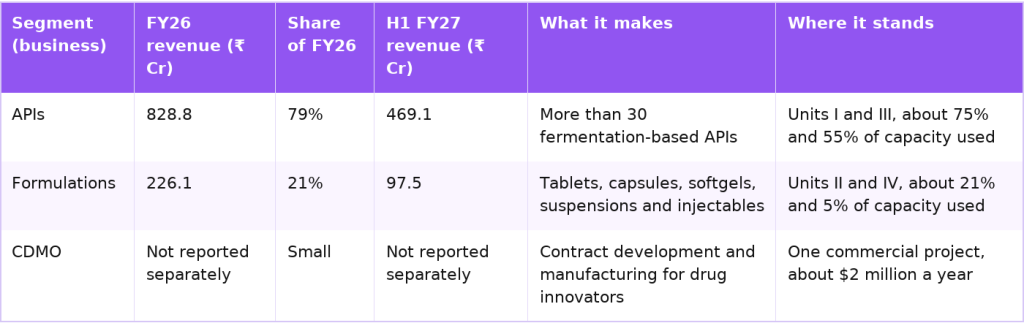
These businesses share one base. Every formulation Concord sells is made from an API it ferments itself. That gives it control over quality and cost. But it also means the formulation plants were built ahead of demand, and as we will see, they are mostly empty today.
Immunosuppressants, the Core API Business
Let's start with immunosuppressants, the products that built Concord. It makes eight of them, including tacrolimus, mycophenolate mofetil, mycophenolate sodium, cyclosporine, sirolimus, pimecrolimus and voclosporin. For tacrolimus, mycophenolate mofetil and cyclosporine, it has filed drug master files in the US, Europe, Canada, Japan and China.
That market grows in two ways. Management puts the market's own growth at around 10% a year. The larger source is becoming a second source for generic medicine makers. A generic company that buys an API from one supplier often qualifies a second supplier to protect its supply. Each such approval takes months, because the customer must test the API and file the change with its regulators.
That approval work is now showing up in numbers. Immunosuppressants grew at a high double-digit rate in the latest quarter, with new customers in the US and Latin America. An inspection by ANVISA, Brazil's drug regulator, at the Limbasi plant has opened Latin America further. Management says an inspection can take four or five months to turn into business.
Even so, Concord wants this group to matter a little less. In May 2025, management said it aimed to bring the share of immunosuppressants in revenue down by 5% to 10% from its level of a year or so earlier, by growing newer products faster.
Oncology, Anti-Infectives and Antifungals
Next, let's look at the newer API groups, which grew fastest in the first half. Concord makes eight oncology APIs, such as everolimus and romidepsin, six antibacterials, such as mupirocin and fidaxomicin, and five antifungals, such as nystatin and micafungin. All of them are part of its fermentation-based range.
Here growth comes from new launches. Nystatin, an antifungal launched about a year and a half ago, keeps gaining customers. Several US buyers have qualified Concord and taken validation quantities, but their commercial orders have not started yet. Fusidic acid, an antibiotic used on the skin, was commercialised in FY26 and faces limited competition, mainly from European makers. Concord has also filed a US drug master file for fidaxomicin, an antibiotic for a serious gut infection. In oncology, romidepsin picked up as some customers launched it in the US.
That launch pipeline is deep. Concord has 10 to 15 more products in development, mostly in anti-infectives and antifungals, and it aims to launch two or three products a year.
Formulations and the US Market
Now let's move to formulations, the business that has not grown. Concord started selling finished medicines in 2016, mainly to use its own APIs further down the chain. Its Valthera plant can make about 869 Mn units a year of tablets, capsules, softgels and oral suspensions. The company has more than 180 approved formulation products across markets, and seven products approved for the US through ANDAs. An ANDA, or abbreviated new drug application, is the approval a generic medicine needs before it can be sold in the US.
Two things held this formulation business back. In emerging markets, some customers have started buying the API and making the tablet themselves, rather than buying the finished medicine from Concord. In the US, Concord is moving its business from Advergent to Stellon Biotech, its own US subsidiary since July 2025. Stellon cost about ₹10 Cr in FY26 before it sold anything.
That move is now under way. The US regulator approved two more of Concord's generics in the first half of FY27, tofacitinib tablets and mycophenolate mofetil oral suspension. Concord has supplied tofacitinib to Stellon and expects to supply the suspension in the next quarter. Management expects meaningful revenue from Stellon in the second half of FY27. The US regulator also inspected the Valthera formulation plant, with one minor procedural observation that was not about manufacturing practice.
"At Concord, we believe it is more appropriate to evaluate the overall business growth rather than view API and formulation revenues in isolation." - Ankur Vaid, Joint Managing Director and CEO, October 2026
Injectables, the Plant Waiting for Contracts
Next, let's look at injectables, the biggest of the new bets. The Unit IV plant at Valthera can make 13 Mn liquid vials, 12 Mn dry powder vials and 2,200 kg of freeze-dried sterile powder a year. It started in FY2025 and received WHO GMP certification in FY26, which lets it supply many emerging markets and Indian government buyers.
That plant is costly while it waits. It cost about ₹38 Cr in FY26, about ₹10 Cr a quarter, and in Q2 FY27 it ran at about 5% of its capacity. Several large Indian and global customers have audited the plant in recent months. Management expects some contracts to be signed in the second half of FY27.
On management's numbers, the prize is large. It puts the market for the injectables Concord can make at about ₹5,000 Cr. It plans for about ₹300 Cr of injectable revenue over the next three to four years, if these customers come on board.

Inspira, a New Skin Care Division
Next, let's look at the newest line, which Concord added in the same quarter. It launched Inspira, a dermatology division, to sell skin medicines in India under its own brands. Several of its APIs already treat skin conditions: tacrolimus and pimecrolimus for eczema, and fusidic acid, nystatin and mupirocin for skin infections.
Management puts the Indian market for this range at close to ₹5,000 Cr, and says Concord is the only Indian company that makes these products all the way from API to finished medicine. It does not expect this to be quick. Reaching ₹400-500 Cr of revenue would take at least four to five years.
CDMO and Newer Platforms
Finally, let's look at contract work, the smallest piece. In CDMO, or contract development and manufacturing, Concord develops and makes a molecule owned by another company, usually the innovator that discovered it. Concord is the exclusive manufacturer of one such new medicine, which its owner launched in the US about a year and a half ago. That project brings in about $2 million a year today, and a few more are at the development stage.
In August 2025, management described its internal ambition as four or five such projects worth $40-50 million in total. Concord has also bought Celliimune Biotech, a cell and gene therapy company, which became a wholly owned subsidiary in April 2026.
Why Fermentation APIs Are Hard to Copy
Now that we have seen the businesses, let's understand why fermentation APIs are hard to copy, because that is Concord's moat. A generic medicine maker that buys tacrolimus needs it to be identical, batch after batch, for years. Its own approvals are tied to its API supplier. So the supplier that gets in first, and keeps passing inspections, tends to stay. Read this Economic Moat Explained
Fermentation adds its own barriers on top of that supplier tie. It starts with the microbe. Concord's scientists isolate strains, mutate them and select the ones that make the most of the molecule, and this work decides the cost of every batch. Then comes scale. Its API plants hold about 1,250 cubic metres of fermentation capacity, 450 at Dholka and 800 at Limbasi. After that comes the starting material. Concord makes its own key starting materials, the raw inputs for each API, so it relies less on outside suppliers.
Then come the approvals, which take the longest to build. Concord's API plants have been inspected by regulators in the US, Europe, Japan, Brazil, Korea and Russia. It has more than 150 drug master files filed around the world and 194 people in research and development. In FY26 it spent about ₹29 Cr on R&D, about 2.8% of sales.
These steps also give Concord a cost edge, and management says it uses that edge on price. It can offer a large discount compared with a customer's current supplier and still keep its usual API margins. Its main rivals are in Europe and Southeast Asia.
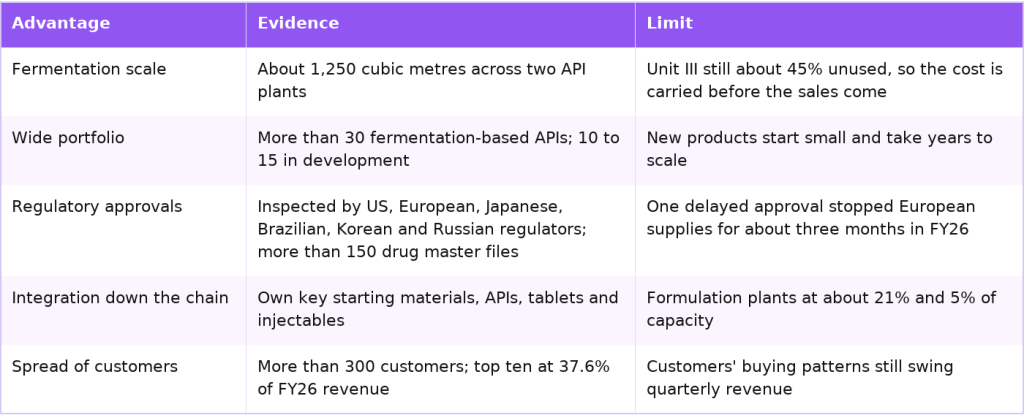
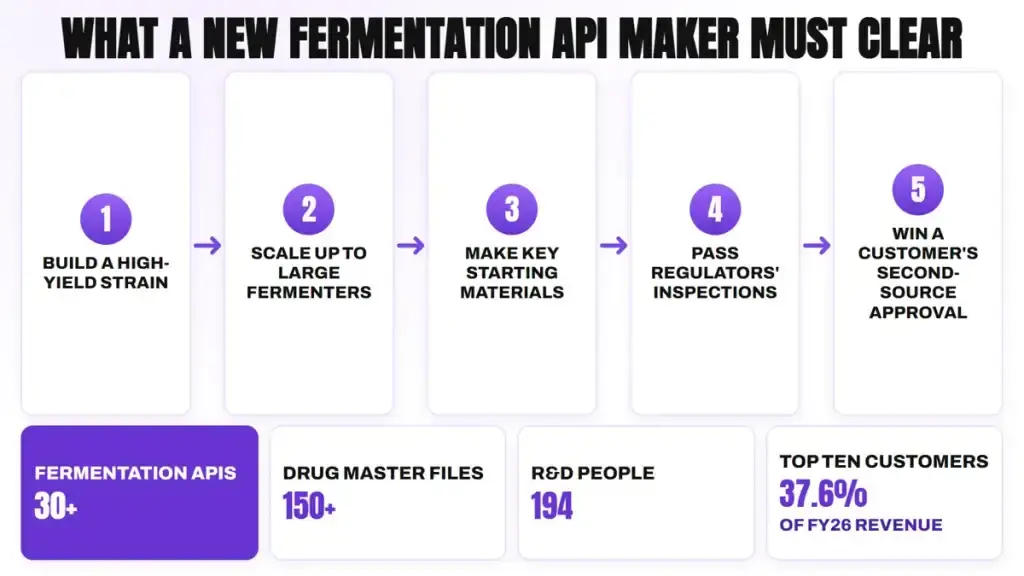
That table also shows us the limit of the moat. It protects the API business well. It does not, by itself, fill a tablet plant or an injectable plant. That part depends on contracts and on how Stellon sells in the US.
"In business, I look for economic castles protected by unbreachable moats."
— Warren Buffett
For a fermentation API maker, the castle is built from strains, scale and regulatory approvals. The moat protects the API business; the new plants still have to earn their own place.
Financials: Five Years of Revenue, Margins and Cash Flow
One year can mislead in a business where customers move orders between quarters and years, so let's look at five full years together. These are consolidated figures as the company presents them in its five-year summary, where EBITDA can differ slightly from the quarterly presentations.
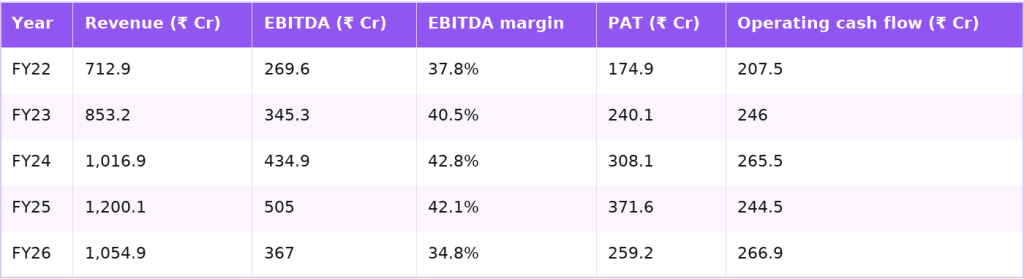
Revenue grew about 68% in three years, from about ₹712.9 Cr in FY22 to about ₹1,200.1 Cr in FY25, or about 19% a year, close to the 18-19% growth management describes as Concord's history. FY26 broke that run, with revenue down 12.1% and profit after tax down about 30%.
Cash flow was steadier than profit. Operating cash flow rose to about ₹266.9 Cr in FY26, even as profit fell. Over the five years, operating cash flow added up to about ₹1,230.3 Cr, about 91% of the ₹1,354 Cr of profit after tax.
The balance sheet carried that growth without debt. Net worth rose from about ₹1,103.2 Cr in FY22 to about ₹2,015.1 Cr in FY26, and net debt to equity was zero in each of the last three years. That gives Concord room to keep funding the new plants while they ramp up.
"In the short run, the market is a voting machine but in the long run, it is a weighing machine."
— Benjamin Graham
Concord's five-year table shows a single bad year inside a long run of growth. Over time, it is the margin and the cash flow that get weighed, not one year's revenue.
What FY27 and FY28 Could Look Like on Management's Numbers
So where does Concord go from here? Management says FY27 revenue growth should be slightly better than its historical rate of about 18%. In the first half, it was 26%.
Now let's put that against the numbers. Growth of 18% on FY26 revenue of ₹1,054.9 Cr would mean about ₹1,244.8 Cr for FY27. After ₹566.6 Cr in the first half, that needs about ₹678.2 Cr in the second half. That is about 12.3% more than the ₹603.8 Cr of H2 FY26. Management says it has a fair amount of visibility on Q3 FY27.
Beyond revenue, the target for margins is to go back to old levels. Management expects the EBITDA margin to reach 38% to 40% over the next few years, the range Concord earned before the new plants, once injectables and Stellon start to contribute. It also expects savings from its renewable power supply, worth about 1% to 1.5% of EBITDA, once power and fuel prices settle.
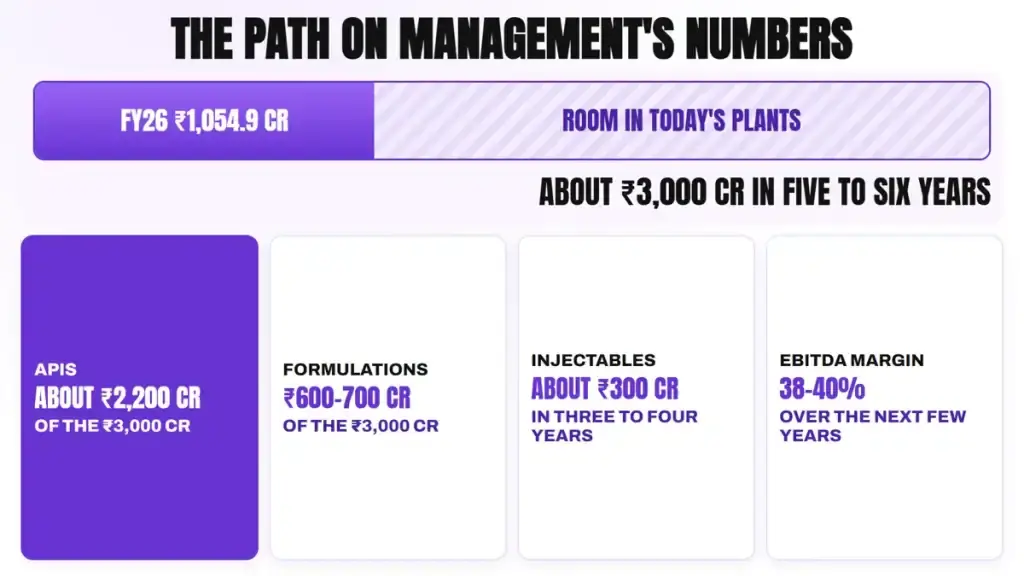
Beyond FY27, the plan is to fill existing plants rather than build new ones. Management says its four plants can support revenue of about ₹3,000 Cr. Of that, it sees about ₹2,200 Cr coming from APIs and ₹600-700 Cr from formulations, and it expects to get close to that number in five to six years. It plans capex of about ₹50-60 Cr in each of FY27 and FY28. It will add capacity at Limbasi only when the plant reaches about 80-85% use, and Limbasi has used only about 20-25% of its 160 acres of land.
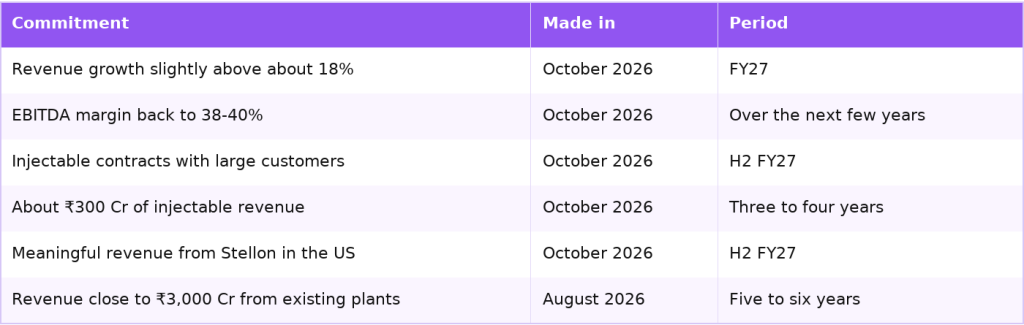
Those commitments are easier to judge against the past. So let's check what management said before against what happened.

That record shows us a clear pattern. The API business has done roughly what management expected, once FY26's problems passed. The new businesses have moved slower than planned every time. That makes injectables and Stellon the numbers to watch.
"Know what you own, and know why you own it."
— Peter Lynch
Concord's revenue is mostly APIs, but its spending in the last two years went into formulations. Knowing which business brings in the money, and which one is still being built, is the first step to understanding this company.
Key Risks
Now let's look at what could go wrong for Concord Biotech, because FY26 showed how quickly some of these risks can hit.
- Input costs: the gross margin fell about 400 basis points in Q2 FY27 because of solvent prices, and power and fuel costs rose about 28.4% on a standalone basis. Concord has chosen not to pass these costs on, so its margin depends on prices settling.
- Slow new businesses: the injectable plant ran at about 5% of capacity and the formulation plant at about 21%. In FY26 the injectable plant cost about ₹38 Cr and Stellon about ₹10 Cr. If contracts slip again, these costs keep weighing on profit.
- Formulations shrinking: formulation revenue fell 8% in H1 FY27 as some emerging-market customers moved to buying APIs. If more customers do this, Concord's own formulation plants stay underused.
- Regulatory delays: a delayed written confirmation stopped European supplies for about three months in FY26. Any delay or adverse finding at an inspection could hold up supplies to a whole region.
- Geopolitics and tenders: a Middle East tender and a US Veterans Affairs tender were both on hold during FY26. Tariff changes in the US could again make customers wait before switching suppliers.
- Lumpy customer buying: customers' buying patterns decide which quarter a sale falls in. In FY26, several such shifts in the same year pushed revenue down.
- Inventory: inventory rose to ₹397.8 Cr in September 2026 from ₹326.4 Cr in March. If sales slow, that stock ties up cash.
"So we would see significant customer additions also happening going forward." - Ankur Vaid, Joint Managing Director and CEO, October 2026
"All I want to know is where I'm going to die, so I'll never go there."
— Charlie Munger
For Concord, the places to avoid are clear from the list above: input costs it does not pass on, new plants that stay empty and regulatory delays that stop a region's supplies. The tracking list below shows how to see which way each one goes.
Explore our Products
Research Framework

Emerging Titans
Combination of quantitative analysis, industry tailwinds, and management assessment - SPRINT investment philosophy

Tiny Titans
Heavy emphasis on scuttlebutt research, plant visits, and early on-ground signals
What to Track Next
If you follow Concord Biotech, these are the signals that will show where it goes next.
- H2 FY27 revenue, against about ₹678.2 Cr needed for 18% growth in FY27
- The gross margin after 76.2%, and the EBITDA margin against 37.1% without the new businesses
- Signed injectable contracts, and Unit IV capacity used after about 5%
- Stellon's first meaningful US revenue, from tofacitinib and mycophenolate mofetil oral suspension
- Commercial US orders for nystatin, and launches of fusidic acid and fidaxomicin
- Formulation revenue after the 8% fall in H1 FY27
- Restart of the Middle East and US Veterans Affairs tenders
Members can read our full Research Desk report on Concord Biotech, with its detailed scorecard and section-by-section analysis.
Conclusion
Let's put it all together. Concord Biotech has built one of the world's broadest portfolios of fermentation-based APIs, with about 1,250 cubic metres of capacity and more than 150 drug master files. After revenue fell 12.1% in FY26, its API business grew 36% in the first half of FY27, and the business still has no debt. The cautious thread is the new businesses, which have moved slower than planned, and the gross margin, which is under pressure from input costs. The next two quarters will show which thread is stronger.
Still, the next step is not about APIs alone. What happens next depends on whether the injectable plant signs its contracts, whether Stellon starts selling in the US, and whether input costs ease enough for the margin to move back towards 38-40%.
FAQs
What does Concord Biotech do?
+Concord Biotech makes active pharmaceutical ingredients by fermentation, mainly for immunosuppressants, cancer medicines, antibacterials and antifungals. It also sells finished tablets, capsules and injections made from its own APIs. FY26 revenue from operations was ₹1,054.9 Cr, of which APIs were 79%.
How did Concord Biotech do in Q2 FY27?
+Revenue from operations rose 25% to ₹309.1 Cr, with API revenue up 30% to ₹250.2 Cr and formulation revenue up 6% to ₹58.9 Cr. EBITDA was ₹104.4 Cr at a 33.8% margin, and profit after tax rose 10.3% to ₹69.6 Cr.
Why did Concord Biotech's revenue fall in FY26?
+Revenue fell 12.1% to ₹1,054.9 Cr because several problems came together: US customers delayed buying amid tariff uncertainty, a delayed regulatory confirmation held up European supplies for about three months, a Middle East tender and a US Veterans Affairs tender were on hold, and customers moved to smaller quarterly orders.
Why is Concord's EBITDA margin lower than before?
+The reported EBITDA margin was 33.8% in Q2 FY27 because it carries the costs of the new injectable plant and of Stellon Biotech, its US subsidiary, which barely sell yet. Without them the margin would have been 37.1%. Raw material prices, mainly solvents, also cut the gross margin by about 400 basis points.
What are Concord Biotech's growth plans?
+Management expects FY27 revenue growth slightly above its historical rate of about 18%, and an EBITDA margin of 38% to 40% over the next few years. It says its four plants can support about ₹3,000 Cr of revenue, which it expects to approach in five to six years, and it plans about ₹300 Cr of injectable revenue in three to four years.
What are the main risks for Concord Biotech?
+The main risks are input costs it does not pass on, a slow ramp-up of the injectable plant and Stellon, formulation revenue that fell 8% in H1 FY27, regulatory delays that can stop supplies to a region, and customers' buying patterns, which can move revenue between quarters.

High growth stock specialist, Value Educator
Shashank Mahajan is an equity research professional with over 12 years of experience in identifying high-potential SME and micro-cap stocks at an early stage. He follows a rigorous scuttlebutt research–driven approach, combining on-ground insights with deep financial analysis. Shashank specializes in uncovering under-researched and under-owned companies with strong management quality and long-term growth potential. Through disciplined research and early identification, he focuses on spotting tomorrow’s market leaders before they enter the mainstream investor radar.
Glenmark: The USD 700 Mn Cancer Deal and Its Brands
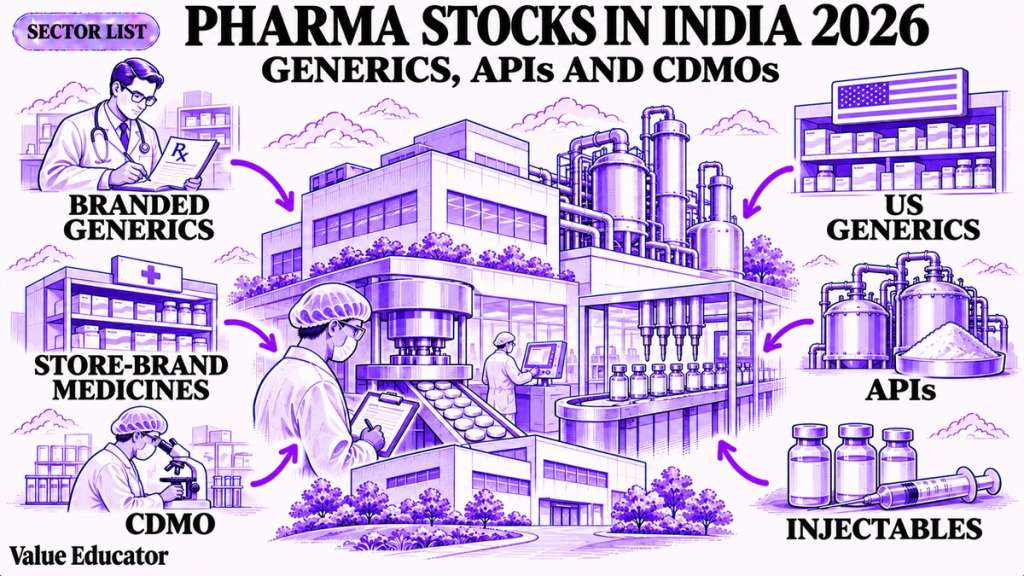
Pharma Stocks in India 2026: Generics, APIs and CDMOs
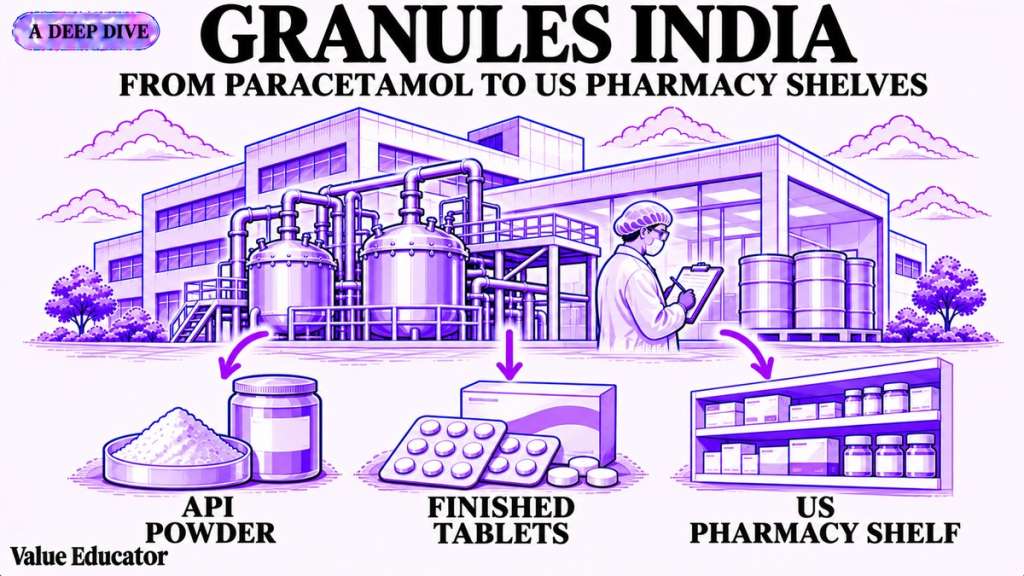
Granules India: From Paracetamol to a 65% Gross Margin
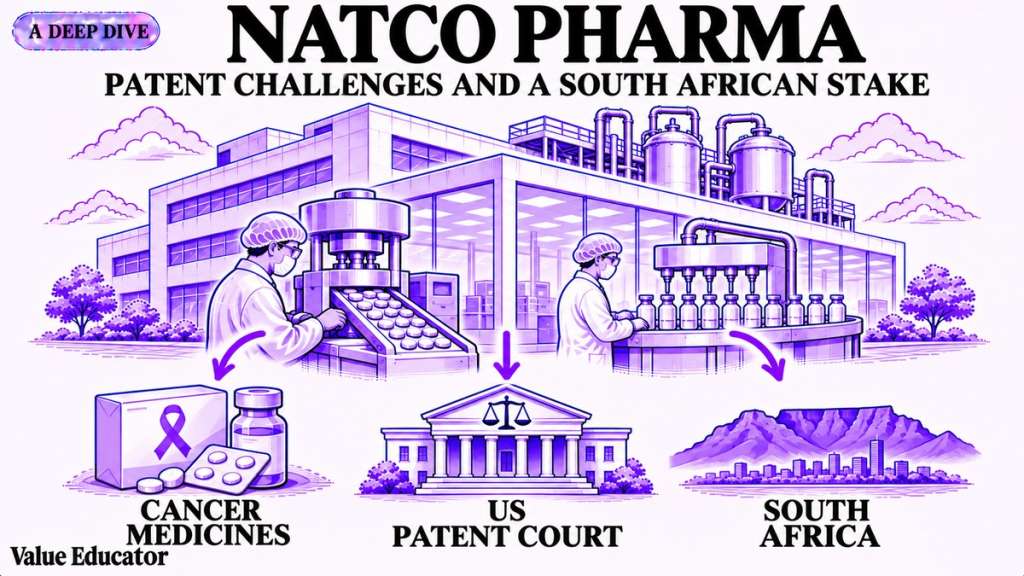
Natco Pharma: After Revlimid, 29 Patent Challenges
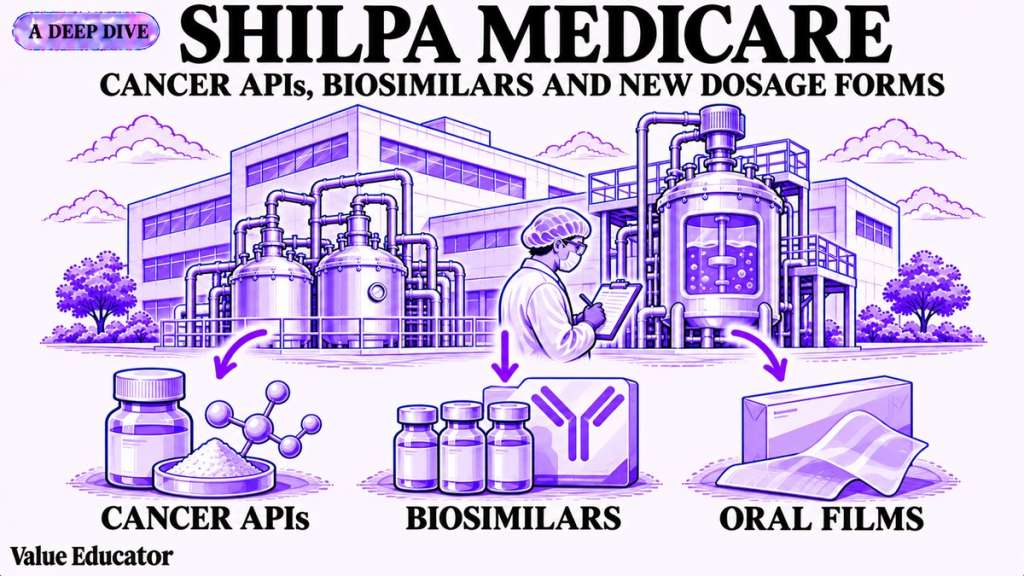
Shilpa Medicare: Cancer APIs, Films and Biosimilars
Alembic Pharma: US Plants Pay Back, Margin Hits 22.2%
Explore our Products
Research Framework
Emerging Titans
Combination of quantitative analysis, industry tailwinds, and management assessment - SPRINT investment philosophy
Tiny Titans
Heavy emphasis on scuttlebutt research, plant visits, and early on-ground signals



Modern Warfare to Multibaggers
Key Trends. Strategic Shifts. Opportunities Ahead.
Don't Miss This Exclusive Webinar!
Join Value Educator to decode the key trends shaping India's defence sector and learn how to identify tomorrow's potential leaders in the space.
- In-depth research on India's defence sector
- Live Q&A session
- Actionable takeaways for long-term investors

 Orders
 Subscription
 Share with friends


Required Details
₹23999.00
(12 month subscription)
As per SEBI regulations, all users are mandated to complete the KYC that is validated for 1 year. Post payment, you will be redirected to the KYC screen


No comments yet. Be the first to comment!