
Kilburn Engineering: The Dryer Maker With ₹470 Cr of Orders

In June 2026, Casale SA of Switzerland placed its first orders with a dryer maker from Maharashtra, worth ₹70.2 Cr. Casale designs the processes used in fertiliser plants around the world. With that win, the dryer maker's fertiliser orders over twelve months crossed ₹170 Cr. Its other fertiliser buyers included Coromandel International, RCF, FACT and the Italian contractor Tecnimont.
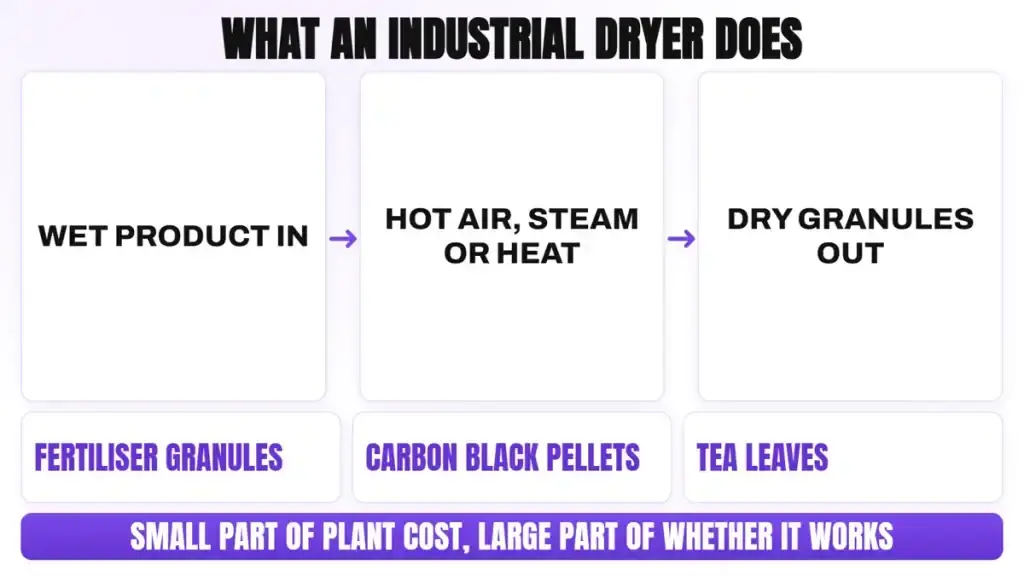
So why would a fertiliser plant care who makes its dryer? An industrial dryer is a machine that takes water or solvent out of a wet product using hot air, steam or heat. That wet product can be fertiliser granules, carbon black pellets or tea leaves. If the dryer runs badly, the product cakes, breaks or fails its quality test. So the dryer is a small part of the plant's cost, but a large part of whether the plant works.
That is where a technology licensor comes in. A technology licensor is a company that owns the design of a chemical process and lets plant owners use it for a fee. Casale works this way in fertiliser, chemical and energy plants. It sells the process design, and it names the equipment and suppliers that go into each plant. Its supplier network serves some of the largest industrial projects in the world. So getting onto that list means a supplier has passed the licensor's checks on design, quality and delivery.
That dryer maker is Kilburn Engineering Ltd (BSE: 522101). For more than 40 years it has designed and built custom dryers, calciners, coolers and heat exchangers at its plant at Saravali, near Bhiwandi. Its customers make fertiliser, carbon black, chemicals, petrochemicals, tea and nuclear power. In the last three years it also bought two companies and became a group of three engineering businesses. The first, ME Energy, works in waste heat recovery, which means turning the hot gas a furnace throws away into steam or power. The second, Monga Strayfield, makes radio frequency dryers and metal enclosures.
That change shows clearly in the numbers. Group revenue was ₹628.8 Cr in FY26, up 48.1%, and about 43% of it came from customers outside India.
Kilburn Engineering in five numbers
- FY26 revenue of ₹628.8 Cr, up 48.1%, at an EBITDA margin of 25.1%
- Q2 FY27 revenue of ₹153.14 Cr, with the two acquired companies more than doubling
- An order backlog of ₹470 Cr in September 2026
- Nuclear orders of ₹57.11 Cr in the June 2026 order book, 11.8% of it
- A target of about ₹500 Cr of FY28 revenue from the two subsidiaries alone
So a 40-year-old dryer maker now has a Swiss licensor's approval, nuclear jobs and a data-centre business. Why, then, did its latest quarter look flat? Let's first understand the company, and then look at the latest quarter.
Kilburn Engineering: Company Overview
Kilburn Engineering Ltd was incorporated in 1987 and has its registered office in Kolkata, while its main plant is at Saravali, near Bhiwandi in Maharashtra. It designs and builds industrial dryers, calciners, coolers, heat exchangers and heavy water vapour recovery systems. Through its two subsidiaries, ME Energy and Monga Strayfield, it also makes waste heat recovery systems, radio frequency dryers and metal enclosures. The group runs six manufacturing facilities with over 36,000 sq. metres of space, at Saravali, Ambernath and Pune in India and at Theale in the UK. Amritanshu Khaitan is the chairman and Ranjit Lala the managing director, and the promoter company Firstview Trading held 29.62% of the shares in March 2026. The parent had 327 permanent employees at that date. Group revenue was ₹628.8 Cr in FY26, and after its warrants were converted the company calls itself net debt free, with cash and bank balances of about ₹122.2 Cr in September 2026. Read this MTAR: The Workshop Powering US AI Data Centres
"An investment in knowledge pays the best interest."
— Benjamin Franklin
Kilburn's edge is process know-how built over more than 40 years, from pilot plant dryers at Saravali to nuclear qualification. That knowledge is what licensors like Casale pay for when they put a supplier on their list.
The Quarter the Two Acquisitions Carried the Group
Let's look at Q2 FY27, the July to September quarter, which the company reported on 12 November 2026. Group revenue was ₹153.14 Cr, level with ₹153.60 Cr a year ago. But that flat total hides two parts of the group moving in opposite directions.
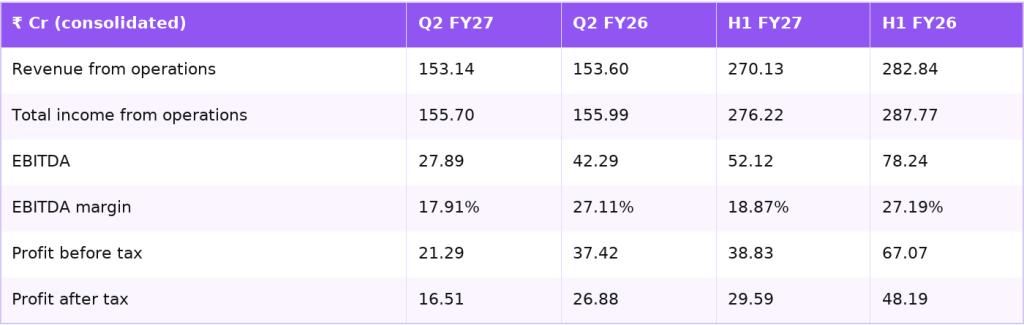
One part is the parent company, which makes the dryers. Its revenue was about ₹69.5 Cr in the quarter, against about ₹114.8 Cr a year ago, because several of its large orders took longer than expected to be finalised. The second part is the rest of the group, mainly ME Energy and Monga Strayfield. That part brought in about ₹83.6 Cr after inter-company adjustments, against about ₹38.8 Cr a year ago. So the subsidiaries grew about 2.2 times in a year. That is a big shift.
That split matters because it shows where the group's growth is coming from today.
"Know what you own, and know why you own it."
— Peter Lynch
Kilburn's consolidated revenue looked flat in Q2 FY27, but the parent and the two subsidiaries moved in opposite directions. Knowing which part is growing is the first step to understanding this group. For the half year, the subsidiaries brought in about ₹141.7 Cr against about ₹73.4 Cr in H1 FY26. Management says both subsidiaries recorded strong growth, and it expects healthy order momentum at ME Energy to continue into FY28.
But profit did not keep pace with revenue. The EBITDA margin came in at 17.91%, against 27.11% a year ago, and the company gives two reasons for the gap. Read this EBITDA Explained: Uses and Limits Q2 FY26 included a high-margin export order, the dryers for the OCP fertiliser project in Morocco through JESA. Lower volumes at the parent also spread its fixed costs over less revenue. Both reasons are about mix and timing, and both can reverse if the parent's large dryer orders move into execution in the second half.
You can see that mix in the cost lines. Cost of materials consumed was about 50% of revenue this quarter, against about 41.3% a year ago. That is partly because ME Energy's projects are EPC jobs, which include site work and more bought-in items. So a quarter led by the subsidiaries has a different cost mix from a quarter led by Kilburn's own dryers.
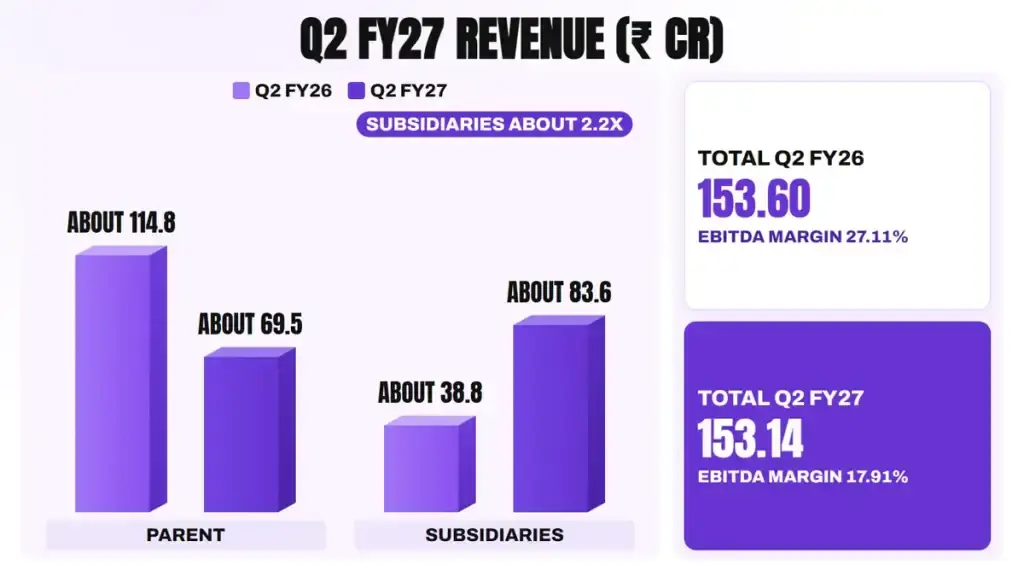
That quarter was also better than the one before it. Revenue rose about 31% from about ₹117 Cr in Q1 FY27, when customers had pushed back their deliveries. For the half year, profit after tax was ₹29.59 Cr, against ₹48.19 Cr in H1 FY26.
The Orders Behind the ₹470 Cr Book
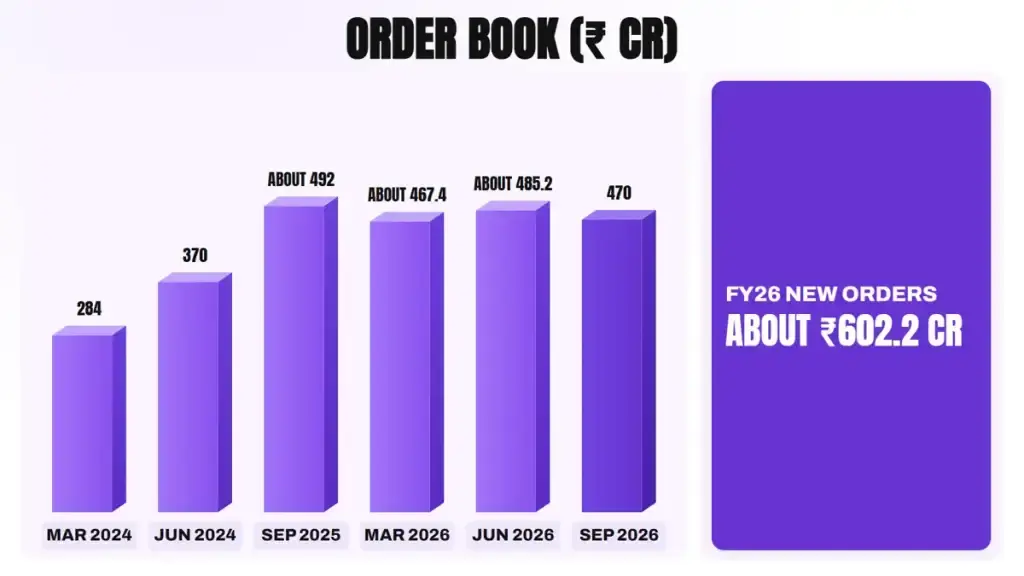
Now let's look at the orders, because they decide the next few quarters. The group ended September 2026 with an order backlog of ₹470 Cr. It had opened the quarter at about ₹485.2 Cr, so new orders of roughly ₹138 Cr came in during Q2, close to what it executed. Management says its projects take six to twelve months to execute, so a book of this size covers most of the coming year if customers release their sites and drawings on time.
That order book has grown in steps as the acquisitions joined the group. It was ₹284 Cr in March 2024, just after ME Energy joined, and ₹370 Cr in June 2024. The book then reached about ₹492 Cr in September 2025 and about ₹467.4 Cr in March 2026. In FY26 the group booked about ₹602.2 Cr of new orders.
Those orders also show up in the parent's filings with the exchange. Each filing lists a batch of orders, and the batches show what kind of equipment customers are buying.
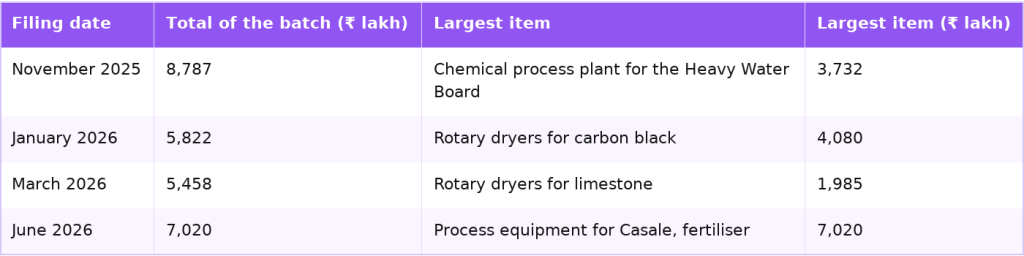
That table also shows us how varied the orders are. Next to the large items sit paddle dryers, tea dryers, dryers for glass fibre and palm oil, and a steady stream of service and spares work. The June 2026 order book shows the same spread across sectors.
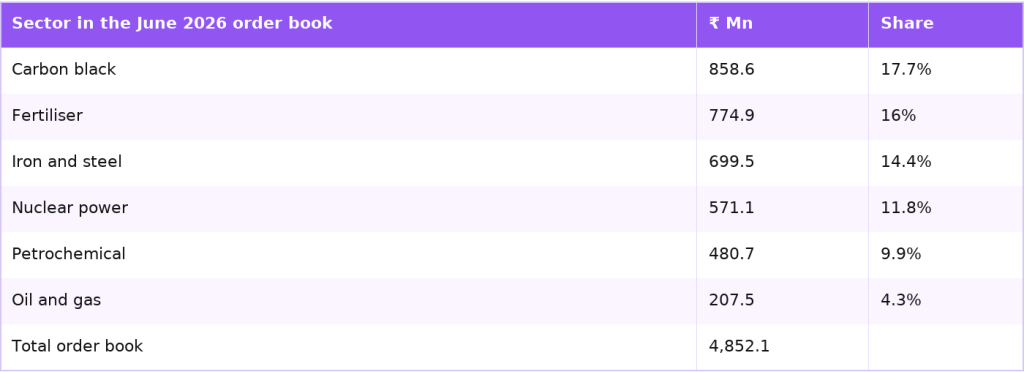
What the order book says: ₹470 Cr is about nine months of FY26 revenue. In Q1 FY27, fertiliser made up 52% of new orders and data-centre equipment 11%. That second number comes from Monga Strayfield's enclosures for data-centre and power equipment makers.
That order book is backed by a stronger balance sheet than Kilburn has had before. In Q1 FY27, holders converted 30,37,500 warrants at ₹425 a share, which brought in the balance of ₹9,682.03 lakh. Cash and bank balances stood at about ₹122.2 Cr in September 2026. The company calls itself net debt free, and Acuité upgraded its rating to A- in November 2025.
How Kilburn Became a Group of Three
Now that we have seen the quarter, let's go back and see how the group got here. In FY22 Kilburn was still a single business. In FY22 its total income from operations was ₹1,227.5 Mn, and its EBITDA was ₹129.6 Mn.
"Kilburn 4 years ago was a INR100 crores revenue company, making INR10 crores of EBITDA. From there, we have scaled up to INR650-odd crores this year with an EBITDA of INR160 crores." - Amritanshu Khaitan, Chairman, May 2026
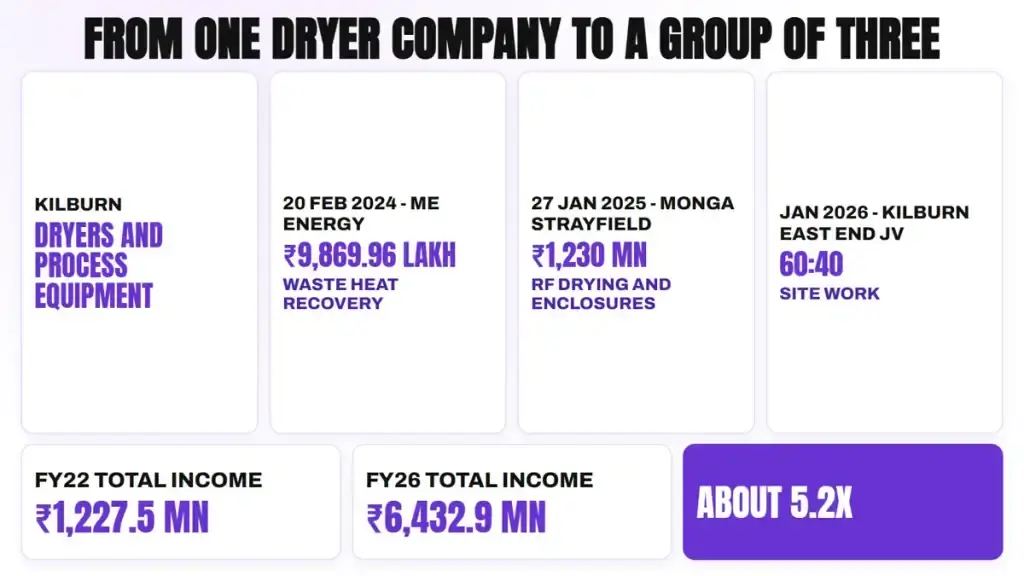
That growth came in two parts. The first part was organic, as the dryer business took on larger and more complex jobs. The second part came from two acquisitions, which added waste heat systems and radio frequency drying to the group.
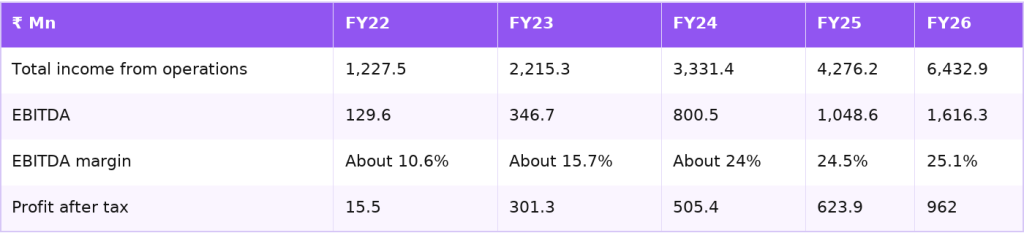
So total income grew about 5.2 times in four years, and EBITDA grew about 12.5 times. FY22 and FY23 are the parent alone, and FY24 onwards are consolidated. That is why the jump in FY24 and FY25 partly reflects the acquisitions.
The first acquisition was ME Energy. Kilburn bought all of it with effect from 20 February 2024, for a total of ₹9,869.96 lakh. It paid ₹7,545.96 lakh in cash and the rest in 14,00,000 new Kilburn shares. Those shares went to ME Energy's founder, Vijaysanker Kartha, who still runs the company as its managing director.
Then came Monga Strayfield, on 27 January 2025. Kilburn paid ₹1,230 Mn for it, of which ₹1,030 Mn was cash and the rest was 4,70,000 Kilburn shares at ₹425 each. In FY26, its first full year in the group, Monga Strayfield earned a profit of ₹1,629.31 lakh. That makes the price about 7.5 times one year's profit. Monga Strayfield also brought a UK arm, Strayfield Limited, with a plant at Theale in Berkshire.
Its exports grew along with the group. Revenue from customers outside India was ₹27,042.02 lakh in FY26, about 2.7 times the FY25 figure. That jump came largely from the Morocco fertiliser order.
Since then the group has kept adding pieces. In January 2026 it set up Kilburn East End, a joint venture in which it will hold 60% and East End Technologies 40%. That company will do piping, structural erection and pre-commissioning work at customer sites, mainly in eastern India. Its shares also began trading on the NSE in April 2026, alongside BSE.
Four Business Lines Sharing One Customer List
Now let's split the group into its four business lines, which share one customer list. The company reports a single segment, engineering products, so we have built the split from the revenue of each company. Read this Segment-Wise Revenue Analysis Explained These companies also sell to each other, so their figures add up to more than group revenue.
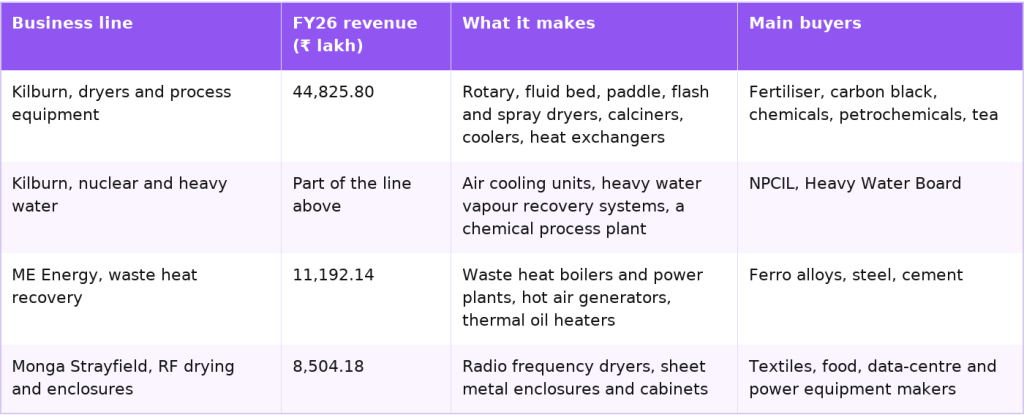
These lines sound alike, but as you will see, each one solves a different problem. Kilburn's dryers remove moisture from a product inside a process plant. ME Energy captures heat that a plant would otherwise throw away. Monga Strayfield dries products with radio waves, and it also builds metal enclosures for electrical equipment.
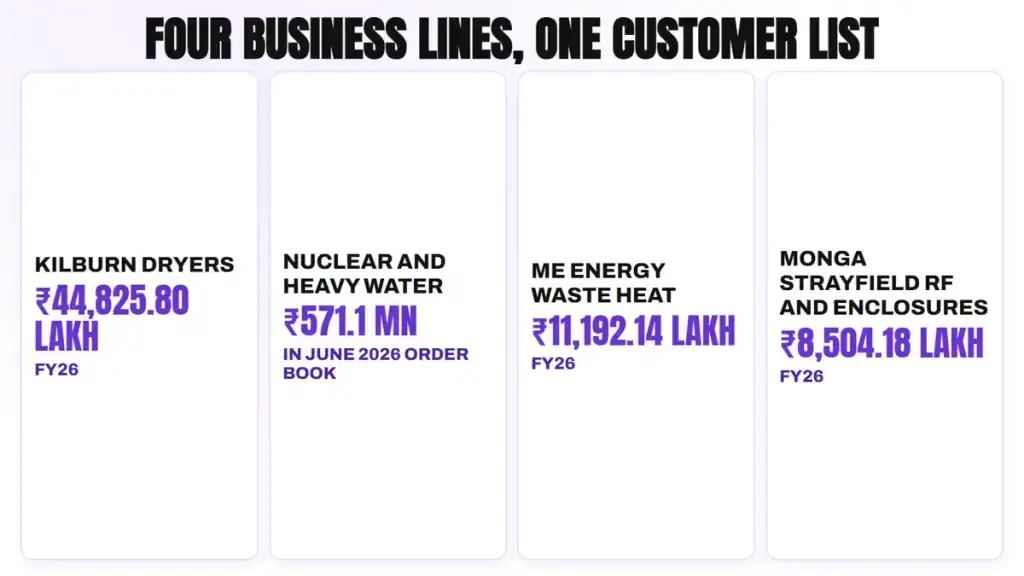
Dryers and Process Equipment
Let's start with Kilburn's own dryer business, the largest of the four lines. India's fertiliser market was about ₹1,021 billion in 2025 and is projected to reach about ₹1,433.6 billion by 2034. India also targets steel capacity of about 300 million tonnes by 2030-31. Both of these markets need more dryers, coolers and calciners as their plants grow, and every new fertiliser or steel plant that a licensor or EPC contractor designs starts with a list of approved suppliers for that equipment.
Kilburn builds that equipment to order for each plant. A rotary dryer, for example, is a long rotating drum through which hot air passes as the wet product tumbles. A calciner heats a material until its chemistry changes. Each of these machines is sized for the customer's product, so no two orders are the same. Kilburn holds the ASME 'U' stamp for pressure vessels, and it works in nickel alloys, duplex stainless steel and titanium. You need that range when the product is corrosive, as many chemicals are.
That custom work earns well. The parent's revenue was ₹44,825.80 lakh in FY26, up 33.6%, at an EBITDA margin of 25.90%. Its order sizes range widely. Tea dryers sell for about ₹40-50 lakh each and smaller machines for about ₹2-5 Cr. The larger enquiries run from about ₹40 Cr to over ₹100 Cr.
Today the fertiliser orders are the ones to watch. Over the past year Kilburn won orders for dryers, granulators, coaters and coolers from Coromandel International, RCF, FACT and Hindustan Zinc. Those domestic orders came to about ₹100 Cr. It also won an export order from Tecnimont and supplied the OCP project in Morocco through the engineering firm JESA.
Next come the carbon black makers, the other large customer group. Carbon black is the fine black powder that goes into tyres, and its makers need rotary dryers to finish their pellets. In January 2026 Kilburn filed rotary dryer orders for carbon black worth ₹4,080 lakh. Carbon black was 17.7% of the June 2026 order book, the largest single sector.
Kilburn also tests a customer's material before it builds the dryer. Its research centre at Saravali has seven pilot plant dryers, where customers can run their own product under plant-like conditions. That testing feeds an enquiry pipeline of more than ₹2,500 Cr for the parent, out of more than ₹4,000 Cr for the group.
Nuclear and Heavy Water
Next, let's look at the nuclear work, which is small in revenue but large in what it signals. India had 8,780 MW of nuclear capacity in June 2026, just 1.60% of its total power capacity. The government's nuclear goal is 22.38 GW by 2031-32. A big part of that goal comes from ten 700 MW pressurised heavy water reactors, built in fleet mode and sanctioned in June 2017 at ₹1,05,000 Cr.
Those reactors use heavy water, a costly form of water that slows the neutrons in the reactor. Any heavy water vapour that escapes into the reactor building has to be captured and returned. Kilburn makes the heavy water vapour recovery systems that do this. Every new reactor of this kind needs them. It also makes the air cooling units that keep the reactor's pump rooms and vaults cool.
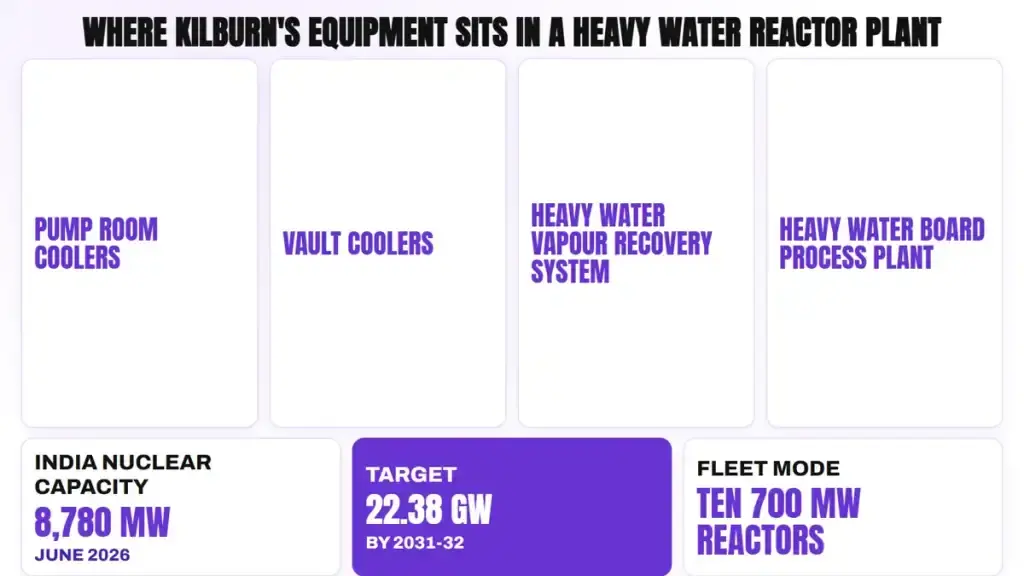
That know-how shows in two current nuclear orders. From NPCIL, Kilburn won an order to design, engineer, make and supply pump room coolers, vault coolers and a heavy water vapour recovery system. From the Heavy Water Board, it is supplying reactors, exchangers, hydrogen pumps, piping and structures. In November 2025 it also filed a ₹3,732 lakh order to set up a chemical process plant for the Board's facility.
As we saw earlier, these nuclear orders are now a real part of the book. Nuclear power stood at ₹490 Mn in the parent's order book in September 2025, ₹602.5 Mn in March 2026 and ₹571.1 Mn in June 2026. Management has said single orders in this line can be worth ₹30-50 Cr each.
That qualification helps when the next nuclear projects come up. Management says it can see two or three more projects, one of them at Kaiga, and it will bid for them through an EPC company. Kaiga 5 and 6 is a pair of 700 MW units, and NPCIL gave its main construction contract to Megha Engineering in April 2025 for ₹12,800 Cr. So a supplier like Kilburn wins its share through the EPC contractor, not directly from NPCIL, and that is why management talks about tying up with EPC companies in both nuclear and fertiliser, where a single main contractor buys equipment for the whole plant.
Waste Heat Recovery at ME Energy
Now let's move to ME Energy, the first acquisition. Its waste heat recovery systems capture the heat from a furnace or kiln and use it to make steam or power. A ferro alloy plant, for example, can run a small power plant on the heat from its furnaces. The global market for these systems is projected to grow from about $65.4 bn in 2025 to about $153.3 bn by 2034.
Its own history goes back more than 25 years, with more than 1,500 installations in over 20 countries. It designs and builds waste heat boilers, waste heat power plants, hot air generators and thermal oil heaters. In FY26 its revenue was ₹11,192.14 lakh and its profit was ₹1,105.44 lakh.
As we saw in the quarter, its orders are getting larger under Kilburn. Before the acquisition, ME Energy lacked the balance sheet to take large orders. In FY26 it won two EPC contracts in the ferro alloy sector, each for a 12 MW waste heat power plant. It also has repeat orders from Shree Cement for hot air generators that burn paddy straw. A cement grinding unit uses that hot air to dry its raw material, and burning crop waste saves coal. So ME Energy sells the same idea as Kilburn, heat and drying, to different plants.
Those wins are moving its pipeline to bigger jobs. Much bigger. Its Bhutan project opened the ferro alloy market, and management sees many steel enquiries of ₹10-15 Cr each. ME Energy is also quoting for jobs of over ₹300 Cr. In February 2026 management said the biggest growth in FY27 would come from ME Energy, and the Q2 numbers bear that out.
RF Drying and Enclosures at Monga Strayfield
Finally, let's look at Monga Strayfield, the second acquisition and the newest growth engine. India's installed data-centre capacity grew from about 375 MW in 2020 to about 1.57 GW in August 2026. That capacity is projected to reach nearly 8 GW by 2030. Every one of those data centres needs power equipment, and that equipment needs metal enclosures.
That equipment is where Monga Strayfield comes in. The company was founded in 1968 and has more than 4,000 installations. Its first business is radio frequency drying. RF drying is a method that heats the water inside a product with radio waves, a bit like a microwave oven. So a textile package or a food product dries evenly from the inside. Its second business is precision sheet metal: enclosures, cabinets and assemblies for power and data-centre equipment.
These two businesses are roughly equal in size, management says. In FY26 Monga Strayfield earned revenue of ₹8,504.18 lakh and a profit of ₹1,629.31 lakh, a net margin of about 19.2%. It also has a long relationship with Vertiv, a global maker of power and cooling equipment for data centres. Its certifications include UL 508A and NEMA 250. These are the North American standards for industrial control panels and enclosures. You need those marks to sell an enclosure into the US market.
That relationship is why the group is now spending on this line, and why the next two years of Monga Strayfield could look very different from its long history in textile and food drying. On 30 October 2026 the board approved up to ₹25 Cr to expand Monga Strayfield's Pune plant over six to nine months. Management expects the enclosure business to earn about ₹50-60 Cr in FY27 and says the expanded plant could support about ₹150 Cr a year at scale. In Q1 FY27, data-centre orders were already ₹148 Mn, or 11% of the group's new orders.
Why a Qualified Dryer Maker Is Hard to Copy
Now that we have seen all four lines, let's understand the moat. A dryer that fails can stop a whole plant, so customers buy from makers they have already tested and qualified. That testing happens at three levels: the buyer's engineers, the licensor's approved supplier list and, in nuclear, the government's own qualification.
Each level takes years to clear. None of it is quick. A new supplier first has to show drawings, then a first unit, then performance on the customer's own product. For licensors like Casale, the supplier must also meet the licensor's standards across many projects. Kilburn entered Casale's qualified supplier base only in June 2026, after more than 40 years in the business. Once a supplier is on that list, though, it can be considered for other Casale-designed plants around the world, which is why the first order matters more than its size suggests.
Nuclear qualification is harder still. It is also rarer.
"In business, I look for economic castles protected by unbreachable moats."
— Warren Buffett
For a dryer maker, the moat is the approval list: a licensor's supplier base, a customer's tested unit and, in nuclear, a qualification that took years to earn. Kilburn has supplied nuclear components and systems in the past, so it did not need to qualify again for its NPCIL order. Management names Lloyds Engineering as its main competitor, which shows how few makers there are in this line.
That group structure adds one more layer. Kilburn treats its two subsidiaries like extra factories, so an order won by ME Energy can be built at Kilburn's Ambernath plant. That lets the group offer a buyer a dryer, a heat recovery unit and an enclosure from one place. A customer that already uses one product is an easy first choice for the next. Read this Economic Moat Explained

That table also shows why the margin is a test of the moat. A business that customers cannot easily replace should keep earning more than a plain fabricator. Over FY24 to FY26, Kilburn's group EBITDA margin stayed between about 24% and 25.1%. So the Q2 FY27 margin of 17.91% will tell us whether that edge holds when the parent is quieter.

Financials: Five Years of Growth, Margins and Cash
One quarter can mislead in a project business, so let's look at five full years together. FY22 and FY23 are the parent alone; FY24 onwards are consolidated and include the acquisitions. EBITDA here is the company's own measure of operating profit.
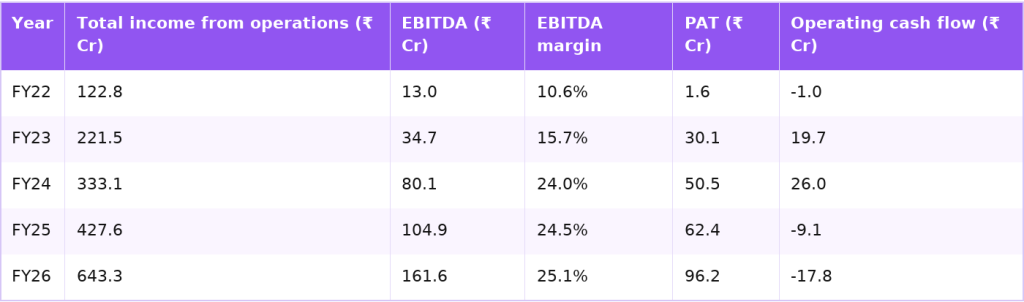
Total income from operations grew about 5.2 times in four years, from about ₹122.8 Cr in FY22 to about ₹643.3 Cr in FY26. EBITDA grew faster, about 12.5 times, as the margin rose from about 10.6% to 25.1%. Part of that jump came from the two acquisitions, which joined in FY24 and FY25.
Cash flow is the weak spot in the table. Over the five years, operating cash flow added up to about ₹17.8 Cr, against about ₹240.8 Cr of profit after tax. Trade receivables rose from about ₹105.5 Cr in March 2025 to about ₹202.2 Cr in March 2026, after large dispatches late in the year, including the Morocco order.
The balance sheet has carried that gap with new equity rather than debt. Shareholders' funds rose from about ₹254.4 Cr in FY24 to about ₹654.1 Cr in FY26, and the warrant money received in 2026 left the company net debt free. Operating cash flow was still negative in H1 FY27, so collections are the number to watch.
"You can't predict. You can prepare."
— Howard Marks
Kilburn cannot control when customers release orders or pay for dispatches. Raising equity before the next phase of growth is its way of preparing for that.
What FY28 Could Look Like on Management's Numbers
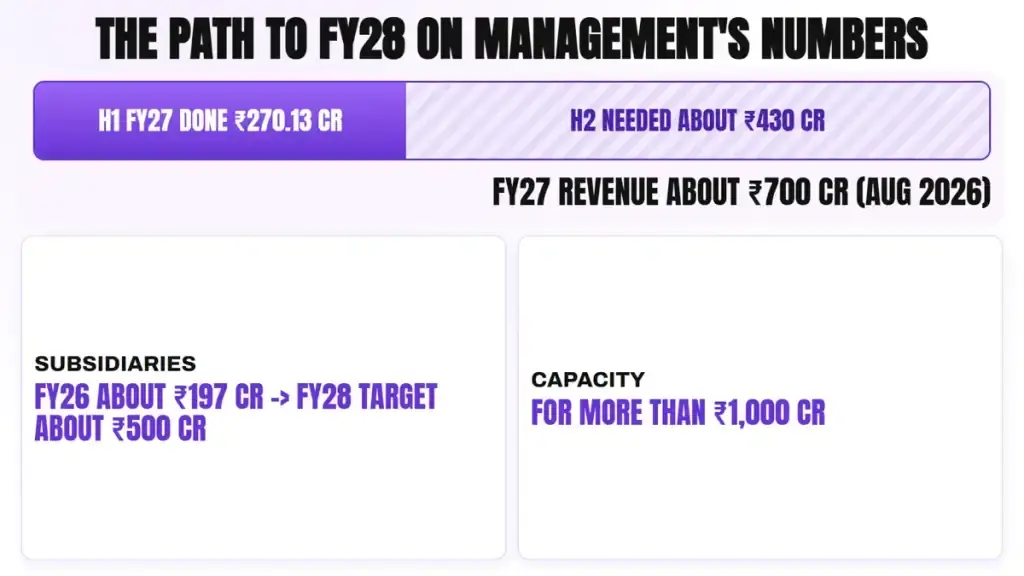
So where does the group go from here? Management's targets have moved over the last six months, so let's lay them out in order. In May 2026 it guided for 20-25% revenue growth in FY27, or about ₹750-800 Cr, and ₹1,000 Cr of revenue by FY28. In August 2026 it lowered the FY27 figure to about ₹700 Cr, at an EBITDA margin of about 20%.
"Our challenge in standalone Kilburn this half has been when large orders are finalised, not whether the opportunity exists." - Ranjit Lala, Managing Director, November 2026
That November 2026 results update did not repeat the FY27 figure. Instead, it looked ahead to FY28. ME Energy has strong order intake from steel and ferro alloys, and Monga Strayfield is scaling up its enclosures business. Together the two subsidiaries now target about ₹500 Cr of revenue in FY28.
Let's put that target against today's numbers. It is a steep climb. The two subsidiaries earned about ₹197 Cr of revenue together in FY26. So the FY28 target is about 2.5 times that level in two years. On top of that, management expects the parent's revenue to recover as its delayed orders move into execution.
That growth needs capacity, and most of it is being built now. The board approved about ₹30 Cr to expand the Saravali plant, and ME Energy's Pune plant is in a second phase of expansion. Both were due to finish by the end of October 2026. With Monga Strayfield's ₹25 Cr plan, the group says its plants will support more than ₹1,000 Cr of annual revenue. Management also says it needs no more equity to fund this. Capex for FY27 was guided at about ₹40 Cr across the group.
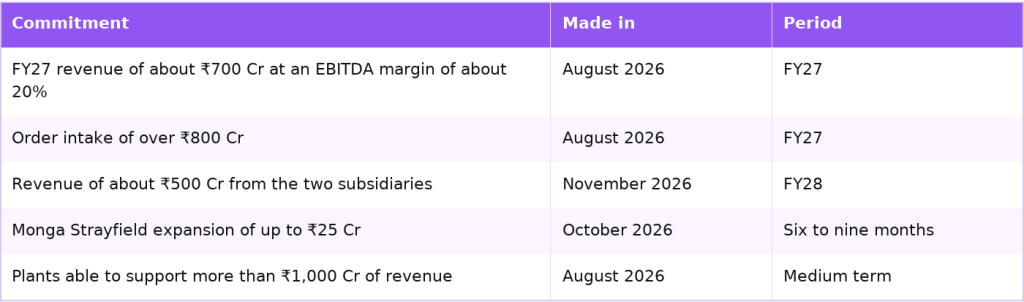
Those commitments are easier to judge against the past. So let's check what management has said before against what it delivered.

That record is mixed, as you can see. The growth target after the acquisitions was met, and the FY26 margin beat guidance. But revenue targets that depend on when customers release orders have slipped more than once.
Key Risks
Now let's look at what could go wrong for Kilburn Engineering, because the latest half year has already shown some of these risks.
- The parent's revenue: standalone revenue fell about 39% in Q2 FY27, to about ₹69.5 Cr. A large carbon black order has been received, but the customer has put it on hold, and its execution is now expected only in FY28. Several other large orders took longer to finalise than expected.
- FY27 guidance: H1 FY27 revenue was ₹270.13 Cr. Reaching about ₹700 Cr would need about ₹430 Cr in H2, about 1.6 times the first half. The November update did not repeat the FY27 figure.
- Order intake: new orders were about ₹272 Cr in H1 FY27, against a full-year target of over ₹800 Cr. In May 2026 management had expected ₹450-500 Cr of orders to close by the end of Q2.
- Cash flow: operating cash flow was negative ₹911.67 lakh in FY25, negative ₹1,775.62 lakh in FY26 and negative ₹2,690.36 lakh in H1 FY27. Trade receivables rose from ₹1,054.8 Mn in March 2025 to ₹2,022.3 Mn in March 2026, and to ₹23,343.92 lakh in September 2026. Growth has so far needed outside money, not cash from operations. Read this Cash Flow Statement Explained
- Margins: the EBITDA margin fell to 17.91% in Q2 FY27 from 27.11%. Costs are not passed through to customers, so steel prices and project delays hit the fixed-price contracts directly.
- Slow approvals: nuclear and Heavy Water Board jobs need many permissions and take longer than private jobs. Some customers are also slow to approve drawings and inspections, which moves revenue into later quarters.
- Geopolitics: the Middle East conflict has delayed customer decisions and shipping, and a couple of large enquiries from that region are still waiting.
- Acquisitions and dilution: goodwill on the balance sheet was ₹12,051.37 lakh in September 2026. Share capital rose about 8.9% in a year as warrants were converted, and further acquisitions remain possible.
- Pipeline language: the ₹4,000 Cr figure is enquiries, not orders. The company itself says these are potential opportunities, not confirmed orders.
"Our costs are not passed through, okay? We mitigate all the risk by placing orders on time." - Ranjit Lala, Managing Director, May 2026
"All I want to know is where I'm going to die, so I'll never go there."
— Charlie Munger
For Kilburn, the places to avoid are clear from the list above: orders that stall in approvals, receivables that keep rising and growth that needs outside money. The tracking list below is how to see whether it steers clear of them.
Explore our Products
Research Framework

Emerging Titans
Combination of quantitative analysis, industry tailwinds, and management assessment - SPRINT investment philosophy

Tiny Titans
Heavy emphasis on scuttlebutt research, plant visits, and early on-ground signals
What to Track Next
If you follow Kilburn Engineering, these are the signals that will show where it goes next.
- Management's Q2 FY27 commentary on 13 November 2026, and whether it restates the FY27 revenue figure
- New orders in H2 FY27 against the target of over ₹800 Cr, and the order book after ₹470 Cr
- A restart date for the carbon black order on hold, and recovery in standalone revenue
- Progress on Monga Strayfield's Pune expansion and its data-centre orders
- New nuclear orders, including any for Kaiga
- Operating cash flow turning positive, and receivables after ₹23,343.92 lakh
Conclusion
Let's put it all together. Kilburn Engineering has turned from a single dryer maker into a group of three engineering companies in four years. FY26 revenue was ₹628.8 Cr at a 25.1% EBITDA margin, and in the latest quarter the acquisitions carried more than half the group's revenue. The cautious thread is cash: operating cash flow has been negative for two years while profit grew, and the parent's large orders are waiting on customers. The next few quarters, starting with the second-half order intake and collections, will show which thread is stronger.
The core dryer business has had the harder half year. Its large orders are stuck in customer approvals, and its margins and cash flow show the strain. What happens next depends on whether the fertiliser, nuclear and carbon black orders turn into execution, and whether the subsidiaries really reach about ₹500 Cr by FY28.
FAQs
What does Kilburn Engineering do?
+Kilburn Engineering designs and builds custom industrial dryers, calciners, coolers and heat exchangers for fertiliser, carbon black, chemical, petrochemical, tea and nuclear customers. Its subsidiary ME Energy makes waste heat recovery systems, and Monga Strayfield makes radio frequency dryers and metal enclosures. Group revenue was ₹628.8 Cr in FY26.
How did Kilburn Engineering do in Q2 FY27?
+Consolidated revenue was ₹153.14 Cr, level with ₹153.60 Cr a year ago. The parent's revenue was about ₹69.5 Cr against about ₹114.8 Cr, while the rest of the group grew to about ₹83.6 Cr from about ₹38.8 Cr. The EBITDA margin was 17.91% against 27.11%, and profit after tax was ₹16.51 Cr.
What is Kilburn Engineering's order book?
+The order backlog was ₹470 Cr in September 2026. In June 2026 carbon black was 17.7% of the book, fertiliser 16%, iron and steel 14.4% and nuclear power 11.8%. The group booked about ₹602.2 Cr of new orders in FY26.
What nuclear work does Kilburn Engineering do?
+Kilburn supplies pump room coolers, vault coolers and heavy water vapour recovery systems to NPCIL, and reactors, exchangers, hydrogen pumps and piping to the Heavy Water Board. In November 2025 it filed a ₹3,732 lakh order for a chemical process plant for the Board's facility. Nuclear orders in the June 2026 book were ₹57.11 Cr.
Why did Kilburn buy ME Energy and Monga Strayfield?
+ME Energy adds waste heat recovery for ferro alloy, steel and cement plants, and Monga Strayfield adds radio frequency drying and precision sheet metal for data-centre and power equipment. Kilburn paid ₹9,869.96 lakh for ME Energy and ₹1,230 Mn for Monga Strayfield. The two now target about ₹500 Cr of revenue in FY28.
What are the main risks for Kilburn Engineering?
+The parent's revenue fell about 39% in Q2 FY27 as large orders were delayed, and a carbon black order is on hold until FY28. Operating cash flow was negative in FY25, FY26 and H1 FY27, and reaching about ₹700 Cr of FY27 revenue would need about ₹430 Cr in H2. Approvals in nuclear jobs and Middle East tensions can also delay execution.

High growth stock specialist, Value Educator
Shashank Mahajan is an equity research professional with over 12 years of experience in identifying high-potential SME and micro-cap stocks at an early stage. He follows a rigorous scuttlebutt research–driven approach, combining on-ground insights with deep financial analysis. Shashank specializes in uncovering under-researched and under-owned companies with strong management quality and long-term growth potential. Through disciplined research and early identification, he focuses on spotting tomorrow’s market leaders before they enter the mainstream investor radar.
Macpower CNC: A Rajkot Machine Maker With ₹476 Cr of Orders
KSB: The Pune Pump Maker With ₹1,235 Cr of Reactor Orders

Rossell Techsys: Boeing and Lockheed Wiring From Bengaluru
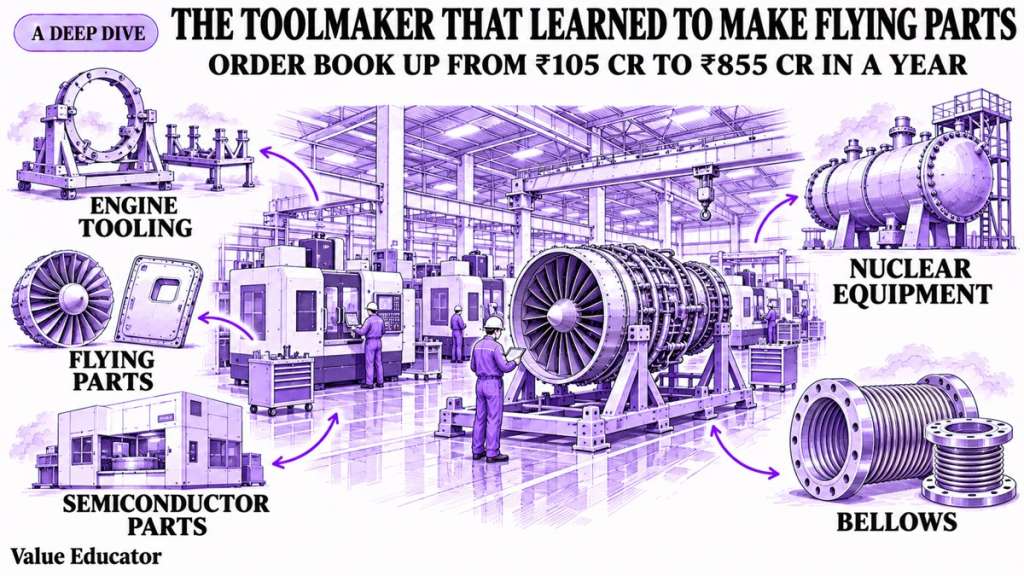
Unimech Aerospace: From Engine Tools to Flying Parts

Taneja Aerospace: The Airfield With ₹161 Cr of Rent Signed

Dynamatic Technologies: Airbus Doors, Flap Beams and Pumps
Explore our Products
Research Framework
Emerging Titans
Combination of quantitative analysis, industry tailwinds, and management assessment - SPRINT investment philosophy
Tiny Titans
Heavy emphasis on scuttlebutt research, plant visits, and early on-ground signals



Modern Warfare to Multibaggers
Key Trends. Strategic Shifts. Opportunities Ahead.
Don't Miss This Exclusive Webinar!
Join Value Educator to decode the key trends shaping India's defence sector and learn how to identify tomorrow's potential leaders in the space.
- In-depth research on India's defence sector
- Live Q&A session
- Actionable takeaways for long-term investors

 Orders
 Subscription
 Share with friends


Required Details
₹23999.00
(12 month subscription)
As per SEBI regulations, all users are mandated to complete the KYC that is validated for 1 year. Post payment, you will be redirected to the KYC screen


No comments yet. Be the first to comment!