
Kirloskar Brothers: Pumps for Water, Power and Nuclear

In 1926, an Indian company made and installed the country's first indigenous centrifugal pump. A hundred years later, the same company says its pumps provide drinking water to over 35% of India's population. Its pumps lift water for irrigation canals, cool the steam in thermal power plants, move fuel at petrol pumps and fight fires in tall buildings. It has also supplied sodium pumps for BHAVINI's fast breeder reactor.
That centrifugal pump is the most common kind of pump. A spinning wheel inside a casing throws water outwards, and that pressure pushes the water up a pipe or across a field. The same idea works for a small pump on a farm and for a pump the size of a room that feeds a power plant.
That company is Kirloskar Brothers Ltd (NSE: KIRLOSBROS), based in Pune. It calls itself the largest manufacturer of centrifugal pumps in India. It makes more than 75 types of pumps, from 0.3 kW to 30 MW, and more than 30 types of valves. It has 10 manufacturing facilities in India and 7 abroad, sells in more than 120 countries, and employs more than 6,000 people.
It is also the oldest company of a well-known family group. Kirloskar Brothers was set up in 1888 and incorporated in 1920. It later spun off its machine tool, electrical, engine and air compressor businesses into separate companies. That is how Kirloskar Oil Engines was formed in 1946 and Kirloskar Pneumatic in 1958. So this article is about the pump company, not its better-known engine cousin.
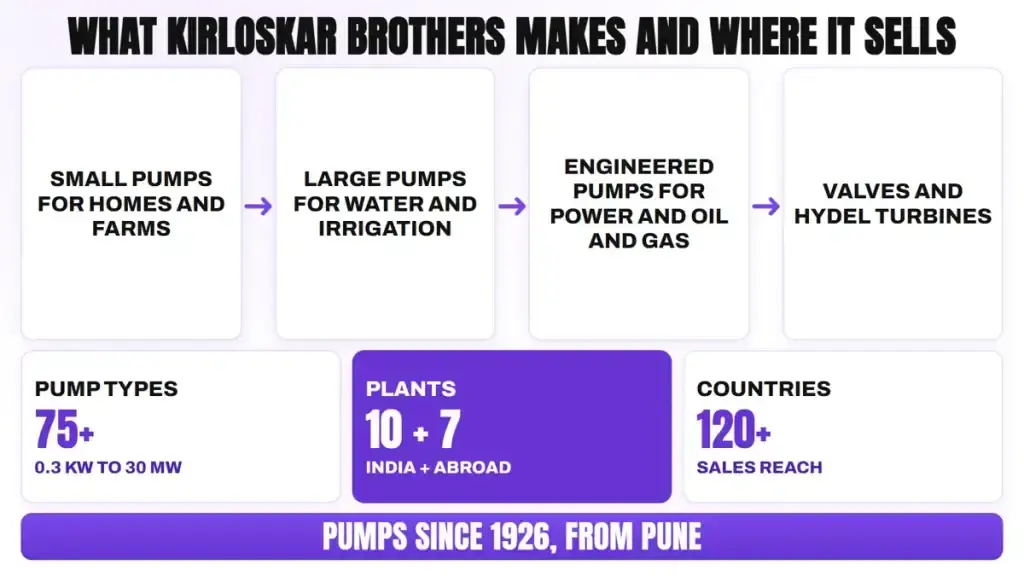
Kirloskar Brothers in five numbers
- Q2 FY27 consolidated revenue of ₹1,276.7 Cr, up 24.2%
- A consolidated pending order book of ₹4,062.2 Cr in June 2026, up 21.4% in a year
- Power at ₹599.2 Cr, or 25.2%, of the standalone pending order book
- FY26 revenue of ₹4,538.0 Cr at an EBITDA margin of 13.7%
- Standalone revenue up 15.9% in H1 FY27, against guidance of double-digit growth
So a pump maker that had a flat FY26 has just grown revenue by about a quarter. What changed, and does the order book support it? Let's first understand the company, and then look at the latest quarter.
Kirloskar Brothers: Company Overview
Kirloskar Brothers Ltd was set up in 1888 and incorporated in 1920, and it is based in Baner, Pune, where its registered office and global headquarters sit. Sanjay Kirloskar is its Chairman and Managing Director, Rama Kirloskar is Joint Managing Director, and Alok Kirloskar is Managing Director of Kirloskar Brothers International B.V., which holds the overseas companies. It makes centrifugal pumps from 0.3 kW to 30 MW, valves and hydel turbines, for water supply, irrigation, power plants including nuclear plants, oil and gas, ships, buildings and homes. It has 10 manufacturing facilities in India and 7 abroad, including SPP Pumps in the UK and SPP Pumps Inc in the USA, and employs more than 6,000 people. Consolidated revenue from operations was ₹4,538.0 Cr in FY26, and in March 2026 total equity was ₹2,475.9 Cr against borrowings of about ₹187.1 Cr. Read this Nuclear Power Stocks in India 2026: Suppliers and Orders
"The stock market is filled with individuals who know the price of everything, but the value of nothing."
— Philip Fisher
A pump is cheap next to the power it uses over 30 years. Kirloskar Brothers sells on that lifetime value, so understanding what its pumps do is the first step to reading its results.
The Quarter Revenue Grew 24.2%
Let's look at Q2 FY27, the July to September quarter that the board approved on 27 October 2026. Consolidated revenue from operations was ₹1,276.7 Cr, up 24.2% from ₹1,027.7 Cr a year ago. It was also 15.5% higher than the ₹1,104.9 Cr of Q1 FY27.

As we can see, the growth came from both sides of the business. Revenue from customers in India was ₹813.4 Cr, up 23.6% from ₹658.1 Cr. Revenue from outside India was ₹463.3 Cr, up 25.4% from ₹369.6 Cr. In FY26, about 37.9% of revenue came from outside India.

Profit did not keep pace with revenue. Read this EBITDA Explained: Uses and Limits EBITDA, which the company counts after adding other income, rose 16.0% to ₹143.2 Cr, and the margin slipped to 11.2% from 12.0%. Net profit rose only 3.5%, to ₹74.7 Cr. A year ago, net profit had been helped by a ₹4.8 Cr share of profit from a joint venture and a one-time gain of ₹2.8 Cr. This quarter the joint venture share was a loss of ₹0.5 Cr.
That gap came mainly from the cost of materials. Materials, bought-in goods and stock changes took about 52.2% of revenue, against about 47.9% a year ago. On the company's own definition, that puts the gross margin at about 49.2%, against 53.6% in Q2 FY26. In August, management said it had raised prices by about 10% since January and that this should cover the rise in raw material costs. This quarter shows that the cover was not complete.
Still, the standalone company, which holds the Indian pump business, did better than the group. Its revenue rose 22.8% to ₹799.1 Cr, and its profit after tax rose 44.7% to ₹54.4 Cr, from ₹37.6 Cr. So the pressure on the group margin came mainly from the subsidiaries, and in Q1 FY27 management had pointed to SPP UK, where high-margin service work had shrunk.
That growth also shows in the first half. H1 FY27 consolidated revenue was ₹2,381.6 Cr, up 18.7%, and standalone revenue was ₹1,472.9 Cr, up 15.9%. Net profit for the half was ₹142.3 Cr, against ₹139.7 Cr a year ago.
That growth has not yet reached cash flow. Read this Cash Flow Statement Explained Operating cash flow for the half was negative, at about ₹58.0 Cr, against a positive ₹105.6 Cr in H1 FY26. Inventory rose by about ₹155.9 Cr in the half, to ₹1,028.3 Cr in September 2026. Management had said in August that a foundry upgrade had left some orders half built, and that dispatches would pick up. The balance sheet can carry this for now: cash of ₹397.4 Cr and current investments of ₹481.7 Cr were well above borrowings of ₹212.7 Cr.
The Orders Behind the Next Few Quarters
Now let's look at the orders, because pumps for power plants and irrigation schemes are built to order and take months to deliver. A pending order book is the value of orders received but not yet delivered. The company does not count the small pump business in it, because those pumps are made to stock and sold in the same month.
Its latest split is for June 2026. The consolidated pending order book was ₹4,062.2 Cr, up 21.4% from ₹3,345.0 Cr a year earlier. Of this, ₹2,557.7 Cr was with Kirloskar Brothers and its Indian subsidiaries, and ₹1,504.5 Cr with the overseas subsidiaries.
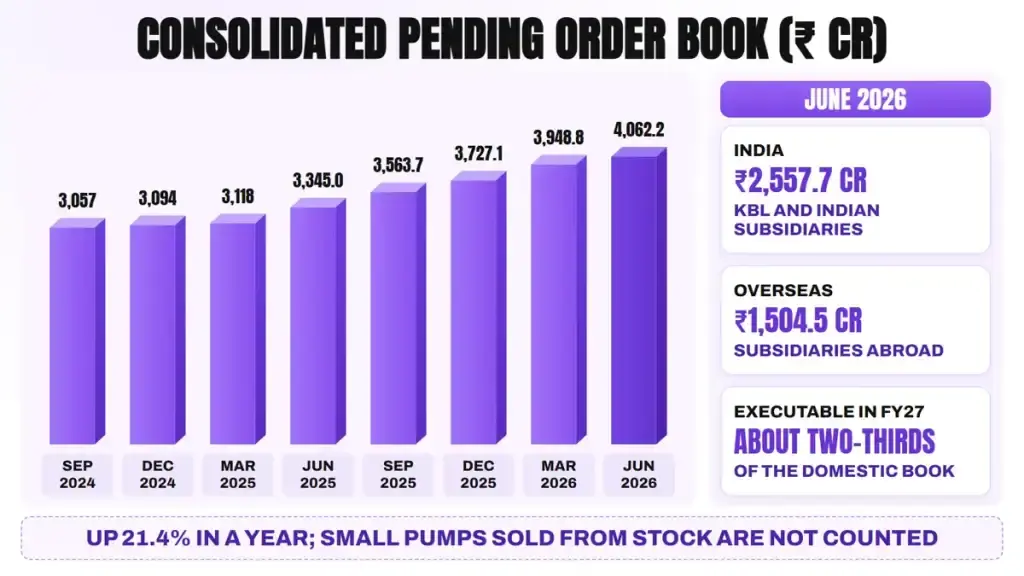
That book has grown every quarter for two years. It was ₹3,057 Cr in September 2024 and ₹3,564 Cr in September 2025. In March 2026 the domestic book was up 30% in a year and the overseas book up 21%. Orders received in Q1 FY27 were ₹1,395.4 Cr, up 4.4%, after a large order was delayed.
Management also told us how fast the domestic book turns into revenue. It said almost two-thirds of the domestic order book can be executed in FY27. It added that the small pump business, which has no order book, makes up about 45% to 50% of the standalone business.
What the order book says: at ₹4,062.2 Cr in June 2026, the consolidated book was about 0.9 times FY26 revenue of ₹4,538.0 Cr. With small pumps sold from stock on top, the book covers a large part of the next year, but not all of it.
How a 138-Year-Old Pump Maker Changed Its Mix
Now that we have seen the quarter, let's go back and see how the business got here. For most of its life Kirloskar Brothers grew inside India. Then, from 2003, it bought pump makers abroad: SPP Pumps in the UK in 2003, Braybar Pumps in South Africa in 2010, SyncroFlo in the USA in 2014 and Rodelta Pumps in the Netherlands in 2015. It also bought The Kolhapur Steel, a steel foundry, in 2007.
Beyond these purchases, the bigger change was in what kind of work it takes. In FY10, more than half of its revenue came from projects, where it built whole pumping stations and did the civil work too. Such EPC contracts (engineering, procurement and construction) are large and uneven, and they tie up cash for years. The company chose to step back from them.

That chart shows the result.
"Time is the friend of the wonderful business, the enemy of the mediocre."
— Warren Buffett
Kirloskar Brothers spent more than a decade moving away from large, uneven project work. The margin record since FY22 shows what that slower, steadier mix has done for the business. Projects went from 54% of revenue in FY10 to 3% in FY26. Made to stock products, such as small pumps sold through dealers, rose from 20% to 50%. Made to order pumps were 27% and engineered to order pumps, designed for one customer's plant, were 19%. Management says only a few old project orders remain.

That shift shows clearly in the margin. EBITDA margin rose from 7.8% in FY22 to 15.2% in FY25, and net profit grew about 4.4 times in three years. Then FY26 broke the run. Revenue grew 1.0%, the margin came down to 13.7%, and net profit came in at ₹377.2 Cr.
That year, management said, had three problems. Poor seasons cut demand for small farm pumps in the first half. Slow release of Jal Jeevan Mission funds at the state level held back dispatches, and the company would not relax its payment terms to push sales. And a new SAP system at the Kirloskarvadi foundry disrupted output of small and medium pumps for some months. The year also carried a one-time charge of ₹38.9 Cr for the new labour codes.
Even in that flat year, the business kept turning profit into cash. Operating cash flow was ₹331.0 Cr in FY26, and from FY22 to FY26 it added up to about ₹1,539.4 Cr, slightly more than the about ₹1,475.7 Cr of net profit in those years. Total equity rose to ₹2,475.9 Cr in March 2026, against borrowings of about ₹187.1 Cr. The board recommended a final dividend of ₹7 per share for FY26.
"I cannot predict wars, I cannot predict gas shortages." - Sanjay Kirloskar, Chairman and Managing Director, May 2026
Seven Markets for One Pump Maker
Now let's split the business by the customers it serves, because each market buys pumps for a different reason. The company reports one business, fluid machinery and systems. But it gives a sector-wise split of the standalone pending order book, and that is the clearest view of where its work comes from.


These markets sound alike, but as you will see, each one is driven by a different budget. Water and irrigation depend on state governments. Power depends on new power stations. Buildings depend on urban construction, and the overseas business depends on data centres, utilities and oil companies.
Small Pumps, the Half Without an Order Book
Before the engineered markets, let's look at the half of the business that never shows up in that table. Small pumps for homes and farms are made to stock and sold through dealers, and management says the retail business is done on a cash basis. Made to stock products were 50% of revenue in FY26.
Those pumps come from dedicated plants. Kaniyur, set up in 2011, makes domestic pumps and is run by an all-women workforce. Sanand, set up in 2012, makes borewell submersible pumps, and Dewas, set up in 1962, makes pumps for farms, homes and dewatering. The oldest plant, Kirloskarvadi, dates back to 1910 and builds pumps from 5 kW up to 30 MW.
This business moves with the weather and with farm incomes, as the first half of FY26 showed. Its new products in this range are designed to meet the European Minimum Efficiency Index norms, and management says the Government of India named one of its products the Appliance of the Year.
Water and Irrigation
Let's start with the largest market. Irrigation and water resource management made up ₹1,012.7 Cr of pending orders in June 2026, up 10.8% from ₹914.2 Cr a year earlier. In FY26 the company won orders from the Narmada Valley Development Authority and the Water Resources Department of Madhya Pradesh for 70 large vertical turbine pumps, and flood control pumping stations in Uttar Pradesh.
This is also the market where competition on price is the hardest. Management has said for years that it takes these jobs selectively and insists on advances or letters of credit. That choice protects cash, but it also means slower dispatches when state governments pay late, as FY26 showed.
Power, From Thermal Plants to Nuclear Reactors
Next, let's look at power, the fastest-growing part of the book. Power orders were ₹599.2 Cr in June 2026, up 30.0% from ₹461.0 Cr a year earlier. In FY26 the company booked ₹228 Cr of orders from the power sector, including concrete volute pumps for Adani Power and its group companies.
A concrete volute pump is a large cooling water pump whose casing is built in concrete instead of metal. It is used at the intake of coastal and inland power plants, often pumping seawater around the clock. The company calls itself the world's largest supplier of these pumps. Management says the first ones it supplied in 1994 have lost only about 2% of their efficiency in 30 years.
Beyond thermal plants, nuclear is the newer part of the business. The company supplied the primary and secondary sodium pumps for BHAVINI's fast breeder reactor, and it holds ISO 19443, a quality certificate for suppliers to nuclear plants. In Q1 FY27 it received primary circuit pump orders of close to about ₹70 Cr and secondary circuit orders of almost ₹40 Cr for nuclear power plants. The primary circuit carries heat from the reactor core, and the secondary circuit carries steam to the turbine.
It has also designed primary heat transport pumps for pressurised heavy water reactors on its own money, and it says a full-scale prototype will be delivered to NPCIL on schedule. The government's announced aim of 100 GW of nuclear power is what makes this part interesting. Still, orders come one reactor at a time, and each needs long approvals.
That approval work is still going on for the primary circuit pump. In August 2026 management said the pump had already proved its hydraulic and mechanical performance. It could not get the casting made in India, so foundries in Europe and India were running trials to prove the metallurgy. It said the company had come very close to the point where an order can be placed once the tender comes.
Oil and Gas, Buildings, Marine and Defence
Beyond water and power, let's look at the smaller markets that fill the rest of the book. In oil and gas, the company sells pumps for fuel stations to the three or four large public sector buyers of them, and had booked about ₹217 Cr of these orders by June 2026. Building and construction orders were ₹178.4 Cr, from fire fighting, water supply and air conditioning systems in large buildings.
Alongside these, marine and defence depend on navy shipbuilding budgets, which management says it cannot predict. Customer support and engineering services jumped to ₹233.2 Cr in June 2026, from ₹99.6 Cr a year earlier, after some large service orders. Management said this should help the standalone margin, but not to read it as a pattern.
The Overseas Business and Data Centres
Finally, let's look at the overseas business, which brought in ₹1,628.4 Cr in FY26. It is held through Kirloskar Brothers International B.V. in the Netherlands. The largest part is SPP Pumps in the UK, with FY26 revenue of ₹785.4 Cr, known for fire pump packages. Next is SPP Pumps Inc in the USA, with ₹540.2 Cr. The rest comes from the Dutch group, Thailand and South Africa.
Of these, the USA is where data centres come in. In Q1 FY27, SPP Inc's revenue rose 29.3% to ₹159.8 Cr at an EBITDA margin of 16.0%. Management says much of the US growth comes from data centres and infrastructure projects. It sells containerised packages of cooling, fire and booster pumps, and says the package for a hyperscale data centre is usually worth USD 7.5 million to USD 10 million, excluding the intake water system. It was also in the last steps of signing a multinational framework contract with a large US data-centre operator.
Inside such a data centre, the company supplies the cooling pumps, the fire fighting pumps and the booster pumps that send chilled water towards the chip cooling system and bring warm water back to the chiller. It does not make the small on-chip cooling pumps. Management says it works mainly with operators, investors and their consultants, who value pumps whose key parts can be serviced from the outside while the hall keeps running.
That growth has come with a lower margin. The overseas group's EBITDA margin went from 12.3% in FY25 to 9.2% in FY26. SPP UK's margin went from 12.3% to 7.4%, and in Q1 FY27 it was slightly negative, because service work for chemical plants in Europe dried up as energy prices stayed high.
Where Kirloskar Brothers Sits in the Water and Power Value Chain
Now let's place the company in the wider chain. A dam, a canal, a city water scheme or a power plant is planned by a government body or a utility. An EPC contractor then builds it. Somewhere in that project sits the pump house, and the pumps in it decide how much power the scheme will use for the next 30 years.

That is where Kirloskar Brothers sits. It buys steel, copper, castings and motors, casts many of its own parts in its foundries, and designs and tests the pumps itself. Kirloskarvadi has one of Asia's largest hydraulic research centres for testing pumps at full duty. Its subsidiary Karad Projects and Motors makes motor stampings, motors and steel castings, and its joint venture Kirloskar Ebara Pumps, in which it holds 45%, makes pumps and steam turbines for refineries and power plants.
That subsidiary is going through a change of its own. Karad Projects and Motors had FY26 revenue of ₹687.2 Cr. In December 2025 the loss-making steel foundry The Kolhapur Steel was merged into it, which pulled its EBITDA margin down to 7.3% in Q1 FY27 from 12.5% a year earlier. Management says large steel castings are needed for thermal and nuclear pumps, and that BHEL is a very large customer of the foundry.
In power, pumps are a small part of a plant's cost. Management has said that pumps usually make up about 1% to 1.5% of the relevant capex of a power plant. So the company does not need a plant to be ordered to grow. It needs to win the pumps in each plant that is ordered. The same holds for data centres, where the US package is a small part of a much larger building.
Why the Moat Is Hard to Copy
Now that we have seen the markets, let's understand the moat. Read this Economic Moat Explained Many companies make pumps, from small local workshops to global groups. What makes a utility or a power plant pay Kirloskar Brothers more?
One part of the moat is lifetime cost. A large pump runs for decades, so the electricity it uses costs far more than the pump itself. The company sells on lowest life cycle cost, and says it gets a price premium over multinationals for its efficient pumps. It has more than 2,000 such pumps installed worldwide.
Another layer is the hard work that few others in India can do. It makes the largest pumps by size and horsepower in India, it has supplied pumps for nuclear plants, and management says it holds 100% of the current market for the metallic volute pumps that nuclear plants ask for. Nuclear and defence buyers need years of testing and approvals before a supplier can bid, which keeps new entrants out.
"In business, I look for economic castles protected by unbreachable moats."
— Warren Buffett
Approvals for nuclear and defence pumps take years to earn, which is one of the walls around this part of Kirloskar Brothers' business.
That engineering also shows in its plants. Kirloskarvadi installed what the company calls the world's largest 3-D printer for foundries in 2013, which cuts the time needed to make moulds and cores for pump castings. Its KirloSmart devices monitor pumps remotely. Management says the installed base is in the hundreds, that it is the only company able to meet such requirements in Indian tenders at the moment, and that municipal water and irrigation schemes now ask for them because pump houses are often in remote places.
Beyond engineering, its reach adds a third layer. Its small pumps are sold through dealers across India for cash, and its overseas plants let it meet local sourcing rules in the USA, South Africa and Thailand. Out of 28 patents applied for, 20 have been granted.


That table shows us why margin is the real test of the moat. If buyers value lifetime cost and engineering, the EBITDA margin should hold even as materials cost more. It was 15.2% in FY25 and 13.7% in FY26, and 11.2% in Q2 FY27, so the next few quarters will show how strong that pricing power is.
Financials: Five Years of Revenue, Margins and Cash Flow
One quarter can mislead in a business where farm seasons and project dispatches move the numbers, so let's look at the full years together. EBITDA here includes other income, as the company presents it, and the first half of FY27 is shown for comparison.
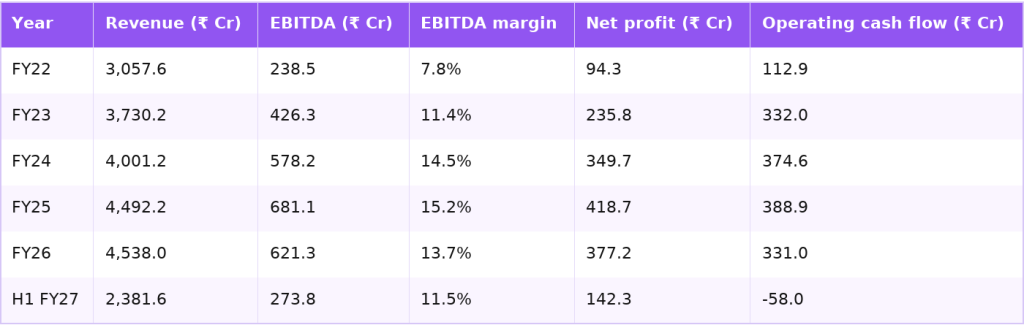
Revenue grew about 1.5 times in four years, from ₹3,057.6 Cr in FY22 to ₹4,538.0 Cr in FY26, while net profit grew about 4.0 times, from ₹94.3 Cr to ₹377.2 Cr. Most of that came from the margin: EBITDA margin rose from 7.8% in FY22 to 15.2% in FY25 as project work shrank and products grew, before it came down to 13.7% in FY26.
Cash flow has kept up with profit over the full period. From FY22 to FY26, operating cash flow added up to about ₹1,539.4 Cr, against about ₹1,475.7 Cr of net profit. The company's strict terms, with advances and letters of credit for larger pumps and cash for retail sales, help here.
The first half of FY27 is the exception. Operating cash flow was negative at about ₹58.0 Cr as inventory rose by about ₹155.9 Cr, and the EBITDA margin was 11.5%. With borrowings of about ₹212.7 Cr in September 2026 against cash of ₹397.4 Cr and current investments of ₹481.7 Cr, the balance sheet can carry this, but the second half has to turn that stock into cash.
"In the short run, the market is a voting machine but in the long run, it is a weighing machine."
— Benjamin Graham
One quarter of thin margins or one flat year can swing sentiment. Over five years, Kirloskar Brothers' profit and cash flow show what the business actually weighs.
What FY27 Could Look Like on Management's Numbers
So where does the business go from here? Management does not give a revenue number. In August 2026 it said it remains confident of double-digit revenue growth in FY27 over FY26 for the standalone business, and that the group will strive for double-digit growth too.
That plan depends on three things. First, faster execution now that the foundry work is done. Second, more orders from power, oil and gas, marine and defence and buildings, which management named as its main growth areas in India. Third, a recovery in overseas margins as service contracts at SPP UK and execution in the Netherlands and Thailand pick up.
Those three drivers have some support in the numbers we already have. The standalone EBITDA margin was 13.7% in Q1 FY27, against 12.8% a year earlier, so the Indian business entered the year in better shape than the group. At the joint venture Kirloskar Ebara Pumps, management expects double-digit growth in both bookings and revenue, helped by export enquiries from the Gulf and Africa, after a large domestic package was held back by the customer in FY26.
But one older driver is not back yet. In May 2026, asked whether the second phase of the Jal Jeevan Mission had led to new tenders, management said not yet as far as it was aware. So water supply growth in FY27 depends more on irrigation and city schemes than on village water connections. The company also keeps its rule of advances and letters of credit for these jobs, so it may let some orders pass rather than wait for late payments.
Now let's put that guidance against the first half. Standalone revenue grew 15.9% in H1 FY27, so the double-digit target is on track for now. FY26 standalone revenue was ₹2,828.1 Cr, so 10% growth would mean about ₹3,110.9 Cr for FY27. The company has already done ₹1,472.9 Cr in the first half, leaving about ₹1,638.0 Cr for the second.

Beyond revenue, capital spending stays modest. Management says capex is usually about equal to depreciation, which was ₹100.1 Cr in FY26, and goes mainly into modernisation, debottlenecking and quality.
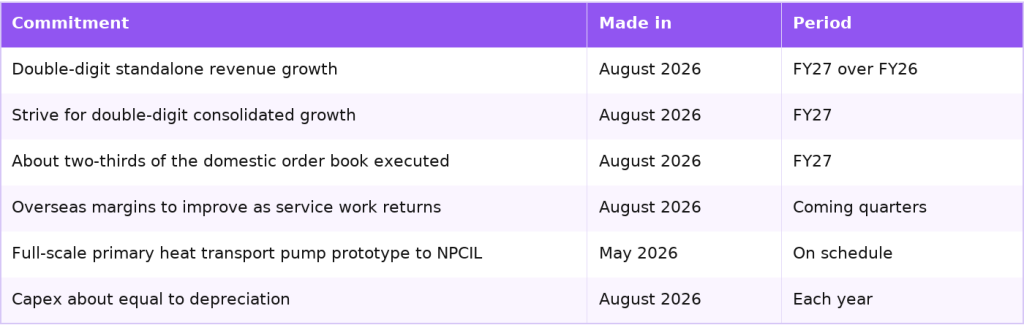
Those commitments are easier to judge against the past. So let's check what management said before against what it delivered.

That record shows us a clear pattern. Double-digit growth has been the aim every year, but FY25 came in at 6.7% and FY26 below zero, for reasons ranging from farm seasons to state funding to the foundry. The first half of FY27 is the first time in three years that growth is running ahead of the aim.
Key Risks
Now let's look at what could go wrong for Kirloskar Brothers, because the latest quarter has already shown some of these risks.
- Margin squeeze from materials: the gross margin fell to about 49.2% in Q2 FY27 from 53.6% a year ago, and the EBITDA margin to 11.2%. If metal prices stay high and price rises lag, growth will not reach profit.
- Working capital and cash flow: operating cash flow was negative at about ₹58.0 Cr in H1 FY27, and inventory rose to ₹1,028.3 Cr. A delay in dispatching half-built orders would keep cash tied up.
- Government payments: irrigation and water schemes make up 42.6% of the standalone order book. Late state funding, as in FY26, slows dispatches.
- Overseas subsidiaries: the overseas EBITDA margin fell to 9.2% in FY26, SPP UK was slightly loss-making at the EBITDA level in Q1 FY27, and the Dutch group's EBITDA was negative in Q1 FY27.
- Slow nuclear orders: nuclear pumps need long approvals and orders come one reactor at a time, so the timing of large orders is hard to predict.
- Tax and legal claims: the standalone company had contingent liabilities of ₹159.9 Cr in March 2026, including ₹103.4 Cr of excise, service tax and GST claims and ₹27.9 Cr of income tax claims under dispute.
- Weather and farm demand: small pumps, about half of standalone revenue, depend on the monsoon and on farm incomes.
- War and energy costs: management named war and gas shortages as risks it cannot predict; its foundry had to switch from gas to electricity in FY26.
"We place priority on cash flow, profitability and revenues in that order." - Sanjay Kirloskar, Chairman and Managing Director, February 2026
"Know what you own, and know why you own it."
— Peter Lynch
Kirloskar Brothers is several businesses in one: small pumps that follow the monsoon, large pumps that follow government budgets, and overseas companies that follow data centres and oil. Each carries its own risk, which the list below sets out.
Explore our Products
Research Framework

Emerging Titans
Combination of quantitative analysis, industry tailwinds, and management assessment - SPRINT investment philosophy

Tiny Titans
Heavy emphasis on scuttlebutt research, plant visits, and early on-ground signals
What to Track Next
If you follow Kirloskar Brothers, these are the signals that will show where it goes next.
- Standalone revenue growth in H2 FY27 against the double-digit aim
- The gross margin after about 49.2%, and the EBITDA margin after 11.2%
- The pending order book after ₹4,062.2 Cr, and power orders after ₹599.2 Cr
- New nuclear orders for primary and secondary circuit pumps, and the NPCIL prototype
- Operating cash flow and inventory after ₹1,028.3 Cr
- Margins at SPP UK and the Dutch group, and the US data-centre framework contract
For the other listed makers of cranes, gears, pumps, machine tools and process equipment, see Capital Goods Stocks in India 2026: The Capex Cycle.
Conclusion
Let's put it all together. Kirloskar Brothers has moved from uneven project work to products and engineered pumps, and its EBITDA margin rose from 7.8% in FY22 to 15.2% in FY25 before slipping to 13.7% in FY26. In Q2 FY27, revenue grew 24.2% and the order book stood at ₹4,062.2 Cr in June, with power the fastest-growing part. The cautious thread is profit: the gross margin was about 49.2% in Q2 FY27 against 53.6% a year earlier, and operating cash flow was negative in the first half. The next two quarters will show whether price rises and dispatches catch up.
Still, the next step is about profit, not revenue. What happens next depends on whether price rises catch up with material costs, whether the inventory built in the first half turns into cash, and whether nuclear and data-centre orders grow into a larger share of the book.
FAQs
What does Kirloskar Brothers do?
+Kirloskar Brothers makes centrifugal pumps, valves and hydel turbines for water supply, irrigation, power plants, oil and gas, ships, buildings and homes. It has 10 manufacturing facilities in India and 7 abroad. FY26 consolidated revenue was ₹4,538.0 Cr.
How did Kirloskar Brothers do in Q2 FY27?
+Consolidated revenue rose 24.2% to ₹1,276.7 Cr, with growth both in India and abroad. EBITDA rose 16.0% to ₹143.2 Cr, but the margin came down to 11.2% from 12.0% as material costs rose. Net profit was ₹74.7 Cr.
What is Kirloskar Brothers' order book?
+The consolidated pending order book was ₹4,062.2 Cr in June 2026, up 21.4% in a year. Of this, ₹2,557.7 Cr was in India and ₹1,504.5 Cr overseas. The small pump business is not counted, because those pumps are made to stock.
How much of Kirloskar Brothers' business comes from power and nuclear?
+Power made up ₹599.2 Cr, or 25.2%, of the standalone pending order book in June 2026, up 30.0% in a year. In Q1 FY27 the company received nuclear primary circuit pump orders of close to about ₹70 Cr and secondary circuit orders of almost ₹40 Cr.
What growth does Kirloskar Brothers guide for FY27?
+Management expects double-digit revenue growth in FY27 for the standalone business and says the group will strive for double-digit growth too. Standalone revenue grew 15.9% in H1 FY27. It missed the same aim in FY25 and FY26.
What are the main risks for Kirloskar Brothers?
+Material costs have squeezed the gross margin to about 49.2% in Q2 FY27, and operating cash flow was negative in the first half as inventory rose. Irrigation and water schemes depend on state government payments, the overseas margin came down to 9.2% in FY26, and contingent tax and legal claims were ₹159.9 Cr in March 2026.

High growth stock specialist, Value Educator
Shashank Mahajan is an equity research professional with over 12 years of experience in identifying high-potential SME and micro-cap stocks at an early stage. He follows a rigorous scuttlebutt research–driven approach, combining on-ground insights with deep financial analysis. Shashank specializes in uncovering under-researched and under-owned companies with strong management quality and long-term growth potential. Through disciplined research and early identification, he focuses on spotting tomorrow’s market leaders before they enter the mainstream investor radar.
More about Shashank Mahajan →
PCBL Chemical: Carbon Black Margins and Battery Materials

KEC International: Record Orders, Weak Margin, High Debt

Sona BLW: EV Revenue Now Tops Half of Its Auto Sales

HPL Electric & Power: Smart Meters, Wires and Two Engines

Kaynes Technology: EMS, Chip Plants and ₹10,563.5 Cr Orders

Sterlite Technologies: Glass Rods to Hyperscaler Deals
Explore our Products
Research Framework
Emerging Titans
Combination of quantitative analysis, industry tailwinds, and management assessment - SPRINT investment philosophy
Tiny Titans
Heavy emphasis on scuttlebutt research, plant visits, and early on-ground signals



India's Aerospace Opportunity
Global Demand. Supply Bottlenecks. Opportunities Ahead.
Don't Miss This Exclusive Webinar!
Join Value Educator to decode the key trends shaping India's aerospace sector and learn how to identify tomorrow's potential leaders in the space.
- How the aircraft value chain works, layer by layer
- Indian companies supplying global aircraft makers
- A framework to judge any aerospace company

 Orders
 Subscription
 Share with friends


Required Details
₹23999.00
(12 month subscription)
As per SEBI regulations, all users are mandated to complete the KYC that is validated for 1 year. Post payment, you will be redirected to the KYC screen


No comments yet. Be the first to comment!