
KPI Green Energy: Solar Builder Turning Power Producer
In FY23, the solar and hybrid plants owned by a company in Surat, Gujarat produced 14.8 crore units of electricity. In FY26 they produced 41.0 crore units. In the first half of FY27, from April to September 2026, they produced 53.6 crore units, already about 31% more than in all of FY26. On 13 November 2026 the company reported that selling this power had brought in ₹101.2 Cr in the July to September quarter, more than twice the ₹49.2 Cr of a year earlier.
A unit here is one kilowatt-hour, the power a one-kilowatt heater uses in an hour. Selling units of power, though, is the newer half of this company. For most of its life it made money in a different way: it built solar and hybrid plants for factories and other companies, which then owned the plants and used the power themselves. This is called captive power, because the plant is owned by the buyer of the power and not by a power company.
That building work is EPC, which means engineering, procurement and construction. The builder finds the land, designs the plant, buys the panels and structures, builds it, connects it to the grid and hands it over. The customer pays as the work moves ahead, so the builder does not need much of its own money for each plant.
The newer business works the other way round. An IPP, or independent power producer, is a company that owns the plant itself and sells the electricity. It signs a PPA, which means a power purchase agreement: a contract to sell the power at a fixed price, often for 25 years, to a state power buyer or a large company. The IPP pays for the plant upfront and earns the money back over those years.
The company is now adding a third piece, BESS, which refers to battery energy storage systems. These are large banks of batteries that store solar power during the day and release it in the evening, when demand is high and the sun has set.
That company is KPI Green Energy Ltd (NSE: KPIGREEN), part of Dr Faruk G Patel's KP Group in Surat. Its portfolio, the plants it has built or is building for itself and for customers, was 8.33 GW in September 2026, against 4.15 GW a year earlier. Of that, 3.02 GW was installed and 5.31 GW was under construction. Its own IPP portfolio was 3.22 GW, of which 1.34 GW was running.
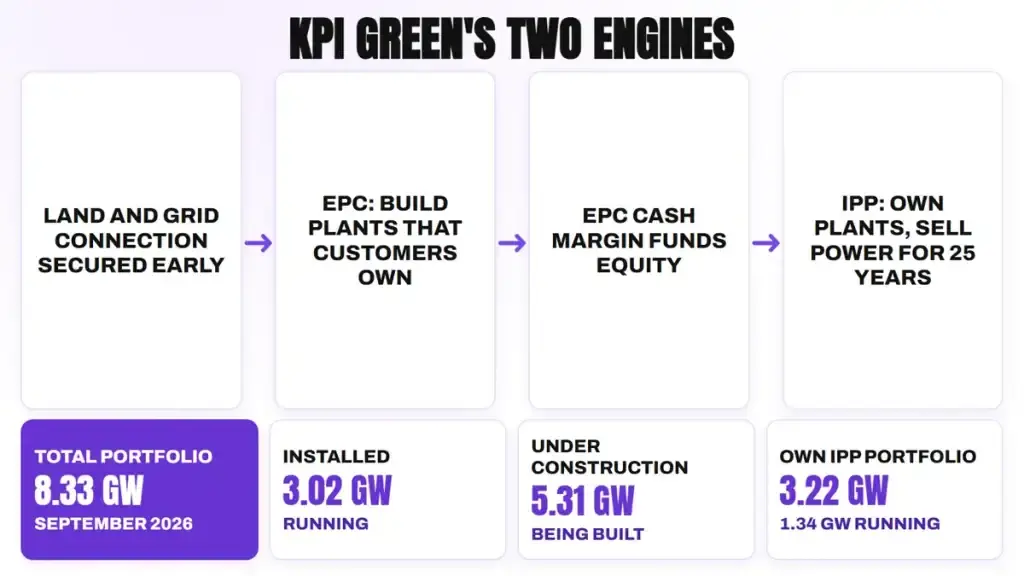
So KPI Green sits at the developer end of the renewables chain. It does not make solar panels or wind turbines. It finds land and grid connections, builds plants, and then either hands them to customers or keeps them and sells the power.
KPI Green Energy in five numbers
- Q2 FY27 revenue of ₹727.2 Cr, up 14.6%
- Power sales of ₹101.2 Cr in the quarter, up 105.5%
- A portfolio of 8.33 GW, with 1.34 GW of its own plants running
- An EPC order book of about ₹5,700 Cr
- Borrowings of ₹5,960.5 Cr in September 2026, against ₹1,125.5 Cr in March 2025
So a company that earned ₹229.9 Cr of revenue in FY22 now owns and builds plants on a far larger scale, and it borrows heavily to own them. How did that show up in the latest numbers? Let's first understand the company, and then look at the latest quarter.
KPI Green Energy: Company Overview
KPI Green Energy Ltd was incorporated in 2008 in Surat, Gujarat, under the name K.P.I. Global Infrastructure, and is part of the KP Group that Dr Faruk G Patel founded in Surat in 1994. Dr Patel is its Chairman and Managing Director, and the promoter group held 51.9% in September 2026. The company builds solar and hybrid power plants for companies and public buyers, owns its own solar, wind, hybrid and battery projects that sell power under long contracts, and holds the group's battery business through its subsidiary Sundrops Energia. It listed on the BSE SME board in 2019 and moved to the NSE and BSE main boards in 2021. It had 661 permanent employees in March 2026. Revenue from operations was ₹2,695.9 Cr in FY26, and in September 2026 it had borrowings of ₹5,960.5 Cr against total equity of ₹3,525.1 Cr, with an ICRA rating of A (Stable). Read this Power Sector Stocks in India 2026: List by Value Chain
"The stock market is filled with individuals who know the price of everything, but the value of nothing."
— Philip Fisher
KPI Green's value sits in two very different things: plants it builds and hands over, and plants it keeps and runs for 25 years. Telling the two apart is the first step to reading its numbers.
The Quarter Power Sales Doubled
Let's look at Q2 FY27, the July to September quarter in which KPI Green's power sales doubled. The company reported it on 13 November 2026. Revenue from operations was ₹727.2 Cr, up 14.6% from ₹634.3 Cr a year ago and 4.8% more than the ₹693.8 Cr of Q1 FY27. Profit after tax was ₹91.9 Cr, against ₹116.6 Cr a year ago.

As we can see, the two halves of the business moved very differently. Power sales, the IPP side, rose 105.5% to ₹101.2 Cr as new plants for the Gujarat state power buyer GUVNL came on line. Captive power project sales, the EPC side, rose 7.2% to ₹626.0 Cr. So the IPP share of revenue went up to about 14%, from about 8% a year ago.

That chart also shows the cost of owning plants. EBITDA, the profit before interest, tax, depreciation and amortisation, rose 21.9% to ₹283.2 Cr. The EBITDA margin, measured on total income including other income, went up to 38.2% from 36.2%. Read this EBITDA Explained: Uses and Limits But finance cost more than doubled to ₹92.3 Cr, and depreciation rose 90.8% to ₹60.3 Cr. So profit before tax came to ₹130.5 Cr, against ₹157.8 Cr a year ago.
Management explains this as a timing gap. When a new IPP plant is switched on, its interest and depreciation start from the first day, while the revenue builds up over the following months as the plant runs at full output.
That same gap shows in the first half. H1 FY27 revenue was ₹1,421.1 Cr, up 14.9%. EBITDA was about ₹544.7 Cr and profit after tax was ₹186.6 Cr, against ₹228.0 Cr in H1 FY26. Cash profit, which adds depreciation and deferred tax back to profit, was ₹355 Cr for the half. Operating cash flow was ₹405.9 Cr, up from ₹269.9 Cr.
The Debt Behind the New Power Plants
Now let's look at how those plants are paid for, because this is where KPI Green has changed the most. Borrowings were ₹5,960.5 Cr in September 2026. They were ₹4,532.0 Cr in March 2026 and ₹1,125.5 Cr in March 2025. So in eighteen months the company's debt has grown more than five times.
"Only when the tide goes out do you discover who's been swimming naked."
— Warren Buffett
Borrowing to build plants with 25-year contracts can work well while the plants run as planned. The test comes if a project is late or a tariff changes, which is why the debt line matters as much as the revenue line.

That money went into plants. In H1 FY27 KPI Green paid ₹1,673.8 Cr for plant and capital work in progress, and gave ₹397.3 Cr more as capital advances to suppliers. Capital work in progress, the plants being built but not yet running, was ₹2,544.8 Cr in September 2026, against ₹918.0 Cr in March.
Against that debt, total equity was ₹3,525.1 Cr. Read this Debt to Equity Ratio Explained The company puts its debt to equity at 1.84 times in September 2026, against 0.81 times a year earlier. Part of the debt is a ₹670 Cr green bond issued in FY26, with a 65% guarantee from GuarantCo. It was rated AA+(CE) by CRISIL and ICRA and carries an 8.50% coupon. The company itself is rated A (Stable) by ICRA.
Working capital also took more money in the half. Trade receivables, the money customers still owed, rose to ₹1,213.7 Cr from ₹791.8 Cr in March. Inventory came down to ₹1,276.0 Cr from ₹1,449.1 Cr.
The Orders and the Portfolio
Next, let's look at the orders, because they show how much work is already booked. Management put the EPC order book at about ₹5,700 Cr on 13 November 2026. It was about ₹5,246 Cr in May 2026 and about ₹6,000 Cr in January 2026.
In the first half of FY27, KPI Green won an EPC order of about ₹2,025 Cr for a 550 MWp solar project from NACOF Oorja in Rajasthan. It also received NTPC REL orders worth ₹621 Cr for the balance of plant of 650 MWp of solar projects, and a letter of intent for a 76.6 MWp wind-solar hybrid project. On the IPP side, it signed a PPA with SJVN for a 300 MW wind project and a storage agreement with GUVNL for a 120 MW / 240 MWh battery project.

Over the year to September 2026, the company booked 4.18 GW of new orders and commissioned 1.96 GW. Its IPP portfolio grew to 3.22 GW from 1.72 GW, and its EPC portfolio to 5.11 GW from 2.43 GW.
What the portfolio says: 5.31 GW is under construction against 3.02 GW installed. So most of the plants KPI Green has signed for are still being built, and they will turn into revenue only as they are finished.
How a Surat Solar Builder Became a Power Producer
Now that we have seen the quarter, let's go back and see how a Surat solar builder became a power producer. KPI Green was incorporated in 2008, under the name K.P.I. Global Infrastructure. It listed on the BSE SME board in 2019 and moved to the main boards of the NSE and BSE in 2021. It raised ₹300 Cr through a qualified institutional placement in 2023 and ₹1,000 Cr through a second one in 2024.
Those listings funded steady growth. Revenue grew from ₹229.9 Cr in FY22 to ₹2,695.9 Cr in FY26, about 11.7 times. In FY26 profit after tax crossed ₹500 Cr for the first time, at ₹509.2 Cr.

For most of those years, the EPC business carried the revenue. In FY26 captive power project sales were ₹2,446.5 Cr, or about 91% of revenue, and power sales were ₹248.2 Cr. The EPC side grows quickly when orders come in, because the customer pays for the plant.
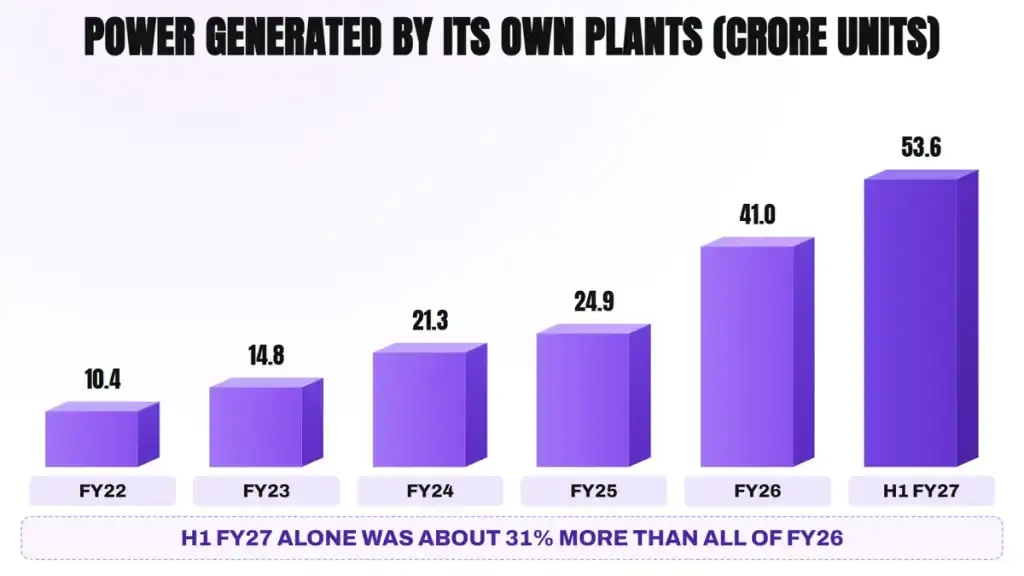
That chart shows the change. Generation from its own plants went from 14.8 crore units in FY23 to 41.0 crore units in FY26, and then to 53.6 crore units in just the first half of FY27. The company expects its IPP portfolio to produce more than 390 crore units a year once all of it runs at full output.
That shift changes what the profit and loss account looks like. Read this How to Read a Profit & Loss Statement An EPC order brings revenue within a year or two and then ends. An IPP plant brings smaller revenue each year, but for 25 years, at a high EBITDA margin. It also brings interest and depreciation from the first day, which is what the latest quarter showed.
"This substantially increases our IPP portfolio, the installed capacity of IPP from about 4 years back, which was almost negligible to 2.1 gigawatt by March 2027." - Kapil Kriplani, Group Chief Financial Officer, November 2026
The Two Engines of the Business
Now let's split the business into its parts, because each one earns money in a different way. KPI Green reports one main segment, the sale of power and solar power plants, but its results show captive power project sales and power sales separately. Management calls the two together its double engine.

These lines are connected, as you will see. The cash margin from EPC work goes into the equity of new IPP plants, and the IPP plants then give steady income. The company says this lets it grow its own plants without raising new equity all the time.
Building Plants That Companies Own
Let's start with EPC, still the largest line. Here KPI Green builds solar and hybrid plants, mostly in Gujarat, for companies that want cheaper power than what they buy from the local electricity company. The customer owns the plant, and KPI Green usually runs and maintains it under a separate contract.
That customer list has widened from factories to large public buyers. In the first half of FY27 the company commissioned a 269 MWp solar plant for Coal India's Khavda project and a 128 MWp plant for MAHAGENCO in Maharashtra. It is also building a 142 MW floating solar plant on the Kadana dam in Gujarat. The customers named in its deck include NTPC, Coal India, SJVN, Larsen & Toubro, Adani Green Energy, Aditya Birla Renewable Energy, Tata Motors and Zydus Lifesciences.
Owning Plants Under Long Contracts
Next, let's look at the IPP line, which is where the debt goes. KPI Green's largest projects are with GUVNL: a 677 MWp hybrid project, of which 511 MWp is running, and a 350 MWp solar project, of which 301 MWp is running. Smaller GUVNL plants of 240 MWp and 92 MWp, and 197 MWp of plants for companies and under the PM-KUSUM farm scheme, are already complete.
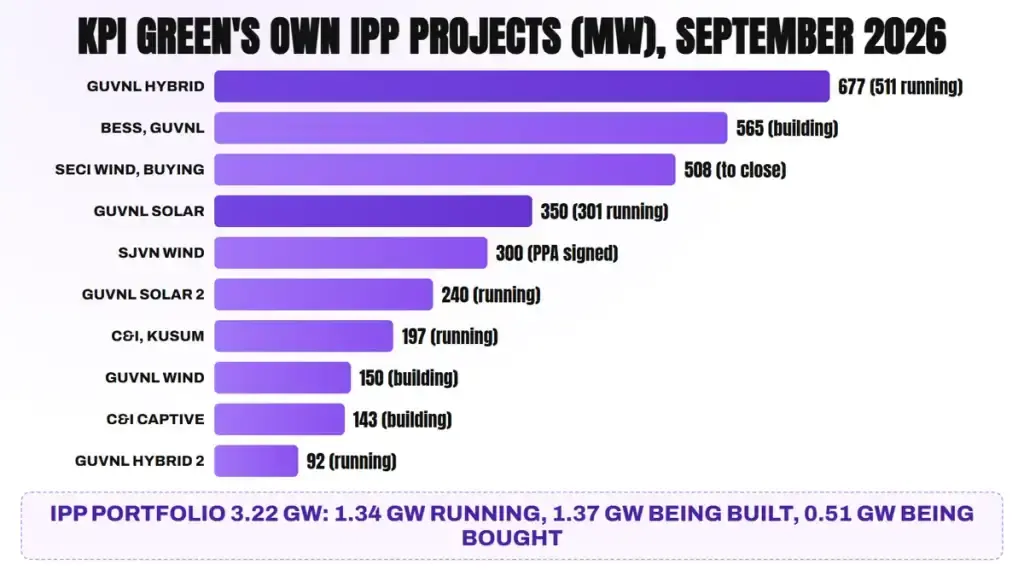
Beyond those, a 150 MW GUVNL wind project has its PPA and financing in place, and the 300 MW SJVN wind project has a signed PPA. The company has also agreed to buy Alfanar Energy and Netra Wind, which own 507.9 MW of running wind farms in Kutch, at an enterprise value of about ₹2,410 Cr. These farms sell power to SECI under 25-year PPAs, with about 21 years left. Management expects the deal to close by March 2027.
That deal shows how management thinks about cost. It says a new wind IPP costs about ₹7.5 Cr to ₹8 Cr per MW to build, so 508 MW would cost about ₹3,750 Cr to ₹4,000 Cr. It hopes to earn ₹350 Cr to ₹400 Cr of revenue from these farms once it fixes the issues the current owner has not solved.
Batteries Through Sundrops Energia
Now let's move to batteries, the newest line. Sundrops Energia, a subsidiary of KPI Green, holds the group's battery business. It has storage agreements with GUVNL for 565 MW / 1,130 MWh, all of it contracted.
That subsidiary is also building a battery campus in Gujarat on about 110 acres. The plan is 5 GWh of battery assembly from FY28, about 1,000 containers a year, then 5 GWh of cell making from FY29, and 10 GWh of each by FY31. In September 2026 Sundrops also bought 62.91% of DEK and Mavericks Green Energy, a solar EPC company, through a share swap. Management plans to list Sundrops in about 18 to 24 months.
How the KP Group Splits the Work
Finally, let's see where KPI Green ends and its sister companies begin. The KP Group has three listed companies. In September 2026 it set out a new split of work: KPI Green is the group's IPP company and builds solar and solar-led hybrid plants above 50 MW. K P Energy builds wind farms and the wind part of hybrid projects. Sundrops handles batteries and plants up to 50 MW, and KP Green Engineering makes structures and towers.
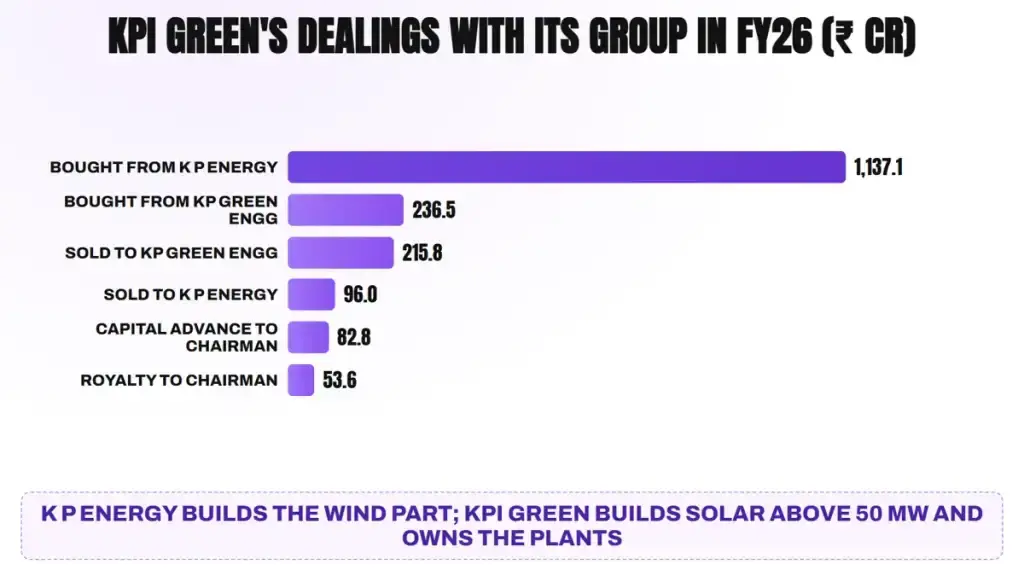
So a lot of KPI Green's spending goes to its own group. In FY26 it bought ₹267.1 Cr of goods and services and ₹870.0 Cr of capital goods from K P Energy, about ₹1,137.1 Cr in all. It bought ₹236.5 Cr of goods from KP Green Engineering. The company says all inter-company deals are at arm's length, and management says there will be no solar orders passed between KPI Green and K P Energy.
"It takes 20 years to build a reputation and five minutes to ruin it."
— Warren Buffett
When one group company builds what another group company owns, the price of each contract decides how profit is shared between their shareholders. The group's new promises on these dealings are worth checking every year.
Where KPI Green Sits in India's Renewables Chain
Now let's place KPI Green in the wider renewables chain. A solar or wind plant needs land, a grid connection, equipment, construction and then a buyer for the power. KPI Green does the land, the grid connection, the construction and, for its own plants, the selling. It buys panels, turbines and batteries from others.
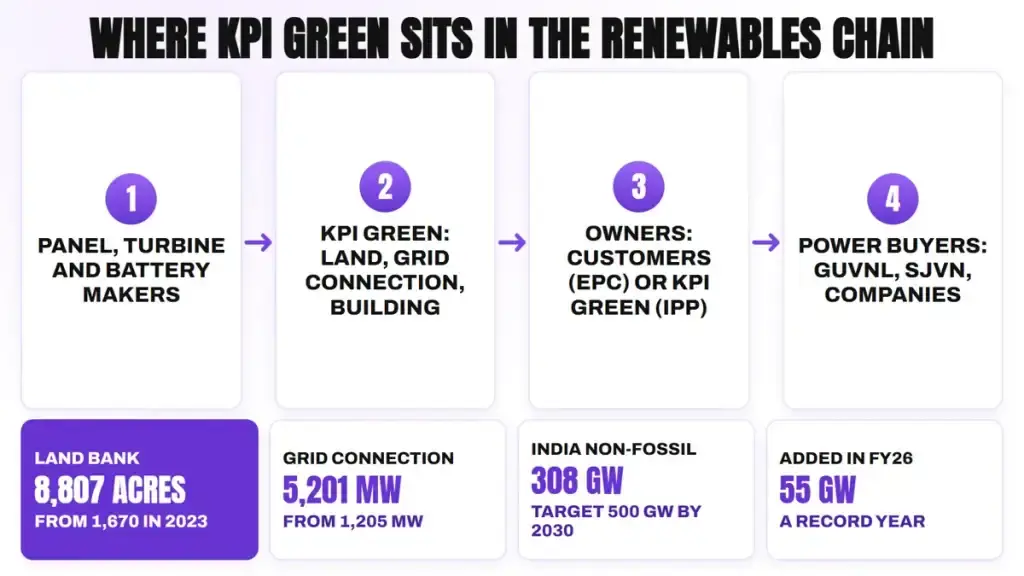
That chain is growing fast in India. The company's deck puts India's non-fossil capacity at 308 GW in September 2026, against a target of 500 GW by 2030. FY26 added a record 55 GW, and the target needs about 45 GW a year. The deck also puts India's battery storage need at 236 GWh by FY32.
Those additions need land and grid space first, and these are the two things KPI Green collects early. Its land bank, owned and leased, grew from 1,670 acres in September 2023 to 8,807 acres in September 2026. Its power evacuation capacity, the right to send power into the grid, grew from 1,205 MW to 5,201 MW over the same period. It has also built more than 2,200 km of power lines.
That base is still mostly in Gujarat. The company has 149 sites in the state, connected to all four of its power distribution companies and to the central grid. It has started to work in Rajasthan and Maharashtra, and it has signed an agreement with the government of Botswana for about 5 GW.
Data centres are a newer source of demand. They need power around the clock, which pushes buyers towards hybrid plants with wind, solar and batteries. Sundrops has an order in the UAE for a solar plant with battery storage to power a containerised data centre.
Why KPI Green's Moat Is Hard to Copy
Now that we have seen the parts, let's understand the moat. Solar panels and inverters are the same whoever buys them. So the question is why a company, or a state buyer, should give KPI Green the work, and why the group can earn an EBITDA margin of 38.2%.
One part of the moat is land and grid. In solar and wind, the plant is often quick to build, but the land and the grid connection can take years. KPI Green secures both before it has orders, which is why its land bank and evacuation capacity have grown faster than its installed plants. A rival bidding for the same Gujarat project would have to start that work from the beginning.
Another layer comes from doing more of the work in-house. The group makes its own solar and wind structures, towers and pooling substations, and KPI Green has a research and manufacturing team of more than 65 people. It runs more than 1,100 robots that clean panels without water, and a monitoring centre that tracks its plants in real time. These lower the cost per MW and the cost of running each plant.
Beyond cost, experience in one state adds a third layer. KPI Green has worked with Gujarat's power distribution companies for years, across 149 sites, and has built more than 2,200 km of lines. That record helps in tenders, where buyers look at past delivery.
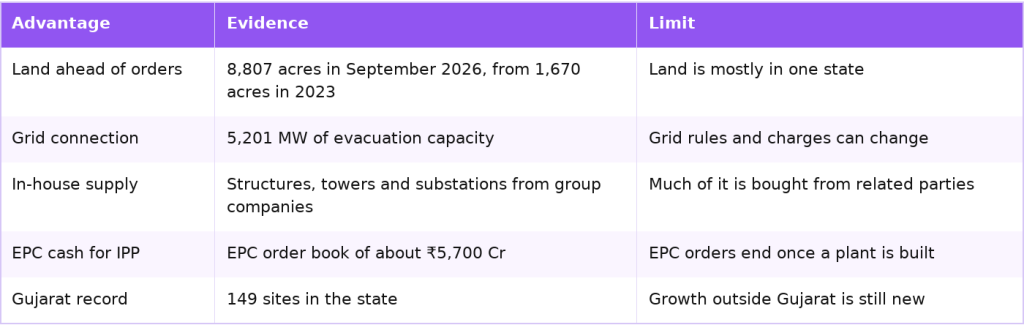
That table shows us why the margin on its own plants is the real test of the moat. If the land and grid give KPI Green cheaper plants, its IPP EBITDA margin should stay high as the portfolio grows. So far the group-wide EBITDA margin has gone up, to 38.2% in Q2 FY27 from 36.2% a year ago.
Financials: Five Years of Growth, Margins and Cash Flow
One quarter can mislead in a business that builds and owns plants, so let's look at the full years together. EBITDA here is the figure the company reports, total income less operating costs, so it includes other income, and the margin is on total income.

Revenue grew about 11.7 times in four years, from ₹229.9 Cr in FY22 to ₹2,695.9 Cr in FY26, and profit after tax grew from ₹43.2 Cr to ₹509.2 Cr. The EBITDA margin was about a third of total income from FY23 to FY25 and rose to 36.6% in FY26, as more of the company's own plants started to run.
Cash flow has trailed profit. From FY22 to FY26, operating cash flow added up to about ₹926.9 Cr, against about ₹1,149.0 Cr of profit after tax, or about 81%. FY24 was negative at ₹57.5 Cr, as receivables and inventory grew, while FY26 was the strongest year at ₹482.0 Cr.
The plants themselves have been paid for mostly with debt. Borrowings rose from ₹336.9 Cr in March 2022 to ₹4,532.0 Cr in March 2026 and ₹5,960.5 Cr in September 2026, and the company puts its debt to equity at 1.84 times. The group's own ceiling for KPI Green is 4.0 times.
"You can't predict. You can prepare."
— Howard Marks
KPI Green's profit and its cash flow have told different stories, and its debt has grown faster than both. Reading all three together is how to prepare for the next few years.
What FY27 Could Look Like on Management's Numbers
So where does the business go from here? On 13 November 2026 management said profit after tax for FY27 should be about ₹500 Cr, and that it will give FY28 guidance with the Q4 results. That is close to the ₹509.2 Cr of FY26.
Now let's put that profit target against the first half. H1 FY27 profit after tax was ₹186.6 Cr. Reaching about ₹500 Cr needs about ₹313.4 Cr in H2. That is about 11.4% more than the ₹281.3 Cr of H2 FY26. Management says H2 has usually been stronger than H1, and that the company could exceed the guidance.
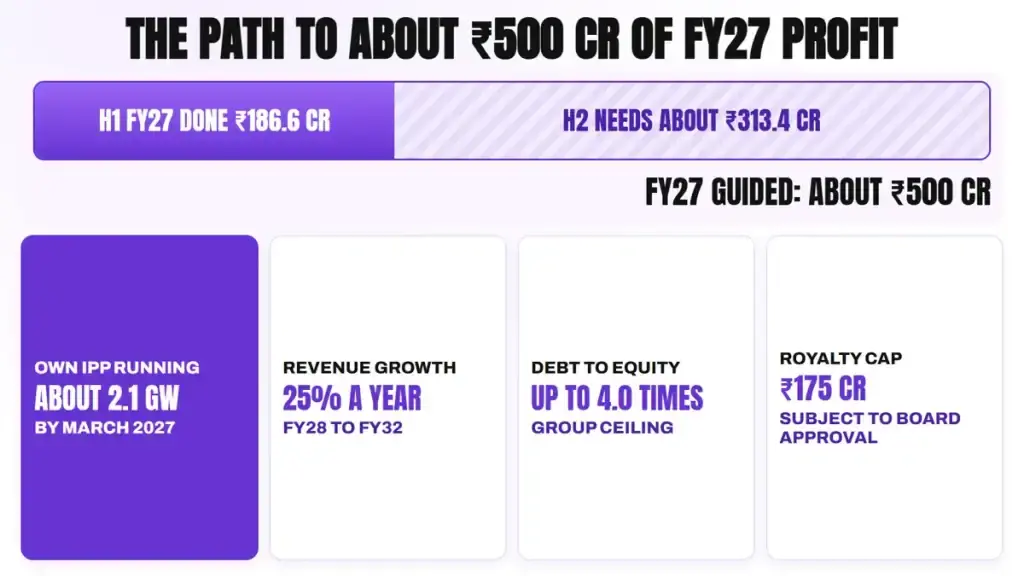
Beyond FY27, the group set out longer targets at its investor day on 30 September 2026. It aims for 25% revenue growth a year from FY28 to FY32 in each of its companies. By FY32 it targets 10 GWp of IPP plants owned by KPI Green, 10 GWp of EPC work for outside customers and a 10 GWh battery campus. It also set a ceiling on debt: debt to equity of up to 4.0 times for KPI Green, excluding Sundrops, and net debt below about 5 times the run-rate EBITDA of its running plants.
That investor day also made promises on how the group is run. The chairman's royalty, 2% of revenue, is to be capped at ₹175 Cr a year, subject to board approval. The promoter's pledged shares are to be released by March 2027. And the statutory auditor changed to M S K C & Associates, which management calls BDO, one of the six largest audit firms.
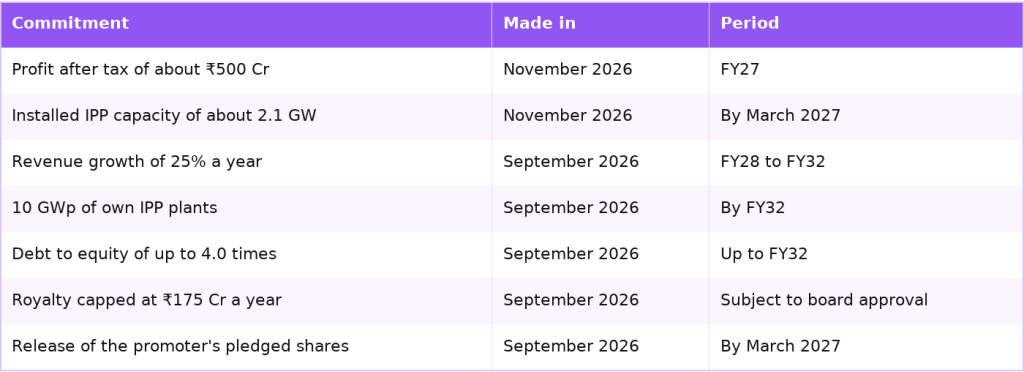
Those commitments are easier to judge against the past. So let's check what management said before against what it delivered.
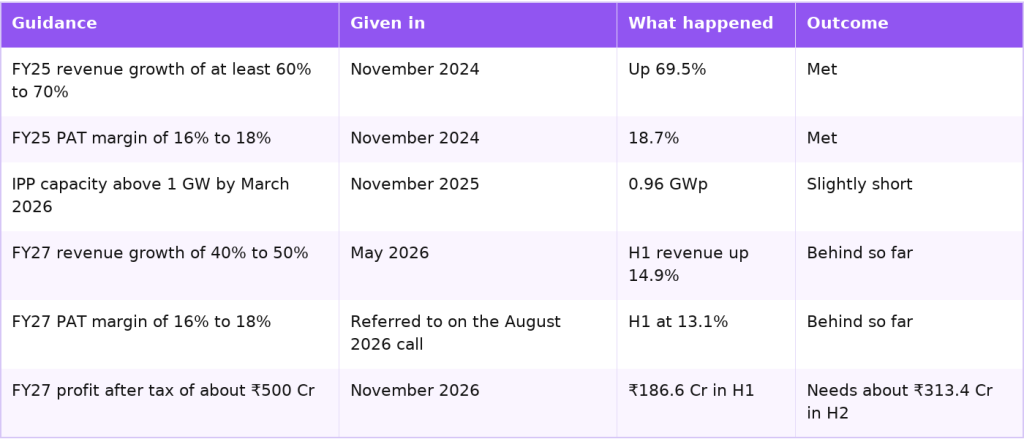
That record shows us a clear pattern. FY25 came in on target, both on growth and on margin. FY27 has started well behind the growth guidance, and the profit guidance is now about level with FY26. So the next two quarters will show whether the new plants lift profit as fast as management expects.
Key Risks
Now let's look at what could go wrong for KPI Green, because the latest half year has already shown some of these risks.
- Debt growing faster than profit: borrowings rose to ₹5,960.5 Cr from ₹1,125.5 Cr in eighteen months, and finance cost was ₹92.3 Cr in Q2 FY27, against ₹43.0 Cr a year ago. The group's own ceiling of 4.0 times debt to equity leaves room for much more borrowing.
- Profit falling behind revenue: profit after tax fell 21.2% in Q2 FY27 while revenue rose 14.6%. The FY27 guidance of about ₹500 Cr is below the ₹509.2 Cr of FY26, and FY27 growth is well short of the 40% to 50% guided in May 2026.
- Group dealings: in FY26 KPI Green bought about ₹1,137.1 Cr from K P Energy, including ₹870.0 Cr of capital goods, and ₹236.5 Cr from KP Green Engineering. It also sold ₹215.8 Cr to KP Green Engineering and ₹96.0 Cr to K P Energy. The prices of these deals decide how profit is shared between three listed companies.
- Royalty and other promoter payments: the chairman received a royalty of ₹53.6 Cr in FY26, about 2% of revenue and about 10.5% of profit after tax, against ₹34.4 Cr in FY25. The company also gave him a capital advance of ₹82.8 Cr in FY26. The proposed ₹175 Cr cap still needs board approval.
- Pledged promoter shares: 45% of the promoter's shares in KPI Green have been pledged as debt collateral. The release is planned by March 2027.
- Working capital: receivables rose to ₹1,213.7 Cr in September 2026 from ₹791.8 Cr in March. The group had also given bank guarantees of ₹30.0 Cr for other related parties in March 2026, and it faces civil cases on land and wind projects whose cost cannot yet be measured.
- Execution and acquisitions: 5.31 GW is under construction, the ₹2,410 Cr wind acquisition is still to close, and the battery campus is a new kind of business for the group. Delays would hold back revenue while interest keeps running.
- New auditor: the change of statutory auditor in August 2026 brings a new firm to the accounts. Its first full-year audit, for FY27, may take different views on related-party deals or on how revenue is booked.
- Gujarat and one buyer: most plants are in Gujarat and the largest IPP projects sell to GUVNL. A change in Gujarat's power rules or grid charges would affect a large part of the business.
"Now, whether it is 1%, 2%, all this is debatable." - Kapil Kriplani, Group Chief Financial Officer, on the chairman's royalty, November 2026
"Investment is most intelligent when it is most businesslike."
— Benjamin Graham
A businesslike look at KPI Green means looking past the growth in megawatts to the debt, the group dealings and the promoter payments that sit around it.
Explore our Products
Research Framework

Emerging Titans
Combination of quantitative analysis, industry tailwinds, and management assessment - SPRINT investment philosophy

Tiny Titans
Heavy emphasis on scuttlebutt research, plant visits, and early on-ground signals
What to Track Next
If you follow KPI Green, these are the signals that will show where it goes next.
- H2 FY27 profit after tax against the about ₹500 Cr guidance, and the IPP share of revenue after about 14%
- Installed IPP capacity against about 2.1 GW by March 2027, including the Alfanar and Netra Wind deal
- Borrowings after ₹5,960.5 Cr and finance cost after ₹92.3 Cr a quarter
- The EPC order book after about ₹5,700 Cr, and new orders outside Gujarat
- Board approval of the ₹175 Cr royalty cap and the release of the pledged shares
- The first full-year audit by the new auditor, and the size of group dealings in FY27
For the other listed solar and wind companies, from glass and cells to turbines and power producers, see Renewable Energy Stocks in India 2026: Solar and Wind.
Conclusion
Let's put it all together. KPI Green Energy has grown from ₹229.9 Cr of revenue in FY22 to ₹2,695.9 Cr in FY26, mostly by building solar and hybrid plants for others. It is now turning into a power producer, with 1.34 GW of its own plants running, 3.22 GW in its IPP portfolio and power sales up 105.5% in the latest quarter.
Still, that change is being paid for with debt, and profit has not yet caught up. What happens next depends on whether the new plants lift profit fast enough to carry ₹5,960.5 Cr of borrowings, and whether the group's promises on royalty, pledges and related-party dealings are kept.
FAQs
What does KPI Green Energy do?
+KPI Green Energy builds solar and hybrid power plants in India, mostly in Gujarat. It builds some plants for companies and public buyers, who own them, and keeps others as an independent power producer that sells the power under long contracts. Its portfolio was 8.33 GW in September 2026, of which 3.02 GW was installed.
How did KPI Green Energy do in Q2 FY27?
+Revenue from operations rose 14.6% to ₹727.2 Cr, and power sales rose 105.5% to ₹101.2 Cr. EBITDA rose 21.9% to ₹283.2 Cr. But finance cost and depreciation rose faster, so profit after tax was ₹91.9 Cr, against ₹116.6 Cr a year ago.
Why is KPI Green's profit lower when revenue is growing?
+When a new power plant of its own is switched on, its interest and depreciation start from the first day, while the revenue builds up as the plant runs at full output. In Q2 FY27 finance cost was ₹92.3 Cr, against ₹43.0 Cr a year ago, and depreciation was ₹60.3 Cr, against ₹31.6 Cr.
How much debt does KPI Green Energy have?
+Borrowings were ₹5,960.5 Cr in September 2026, against ₹4,532.0 Cr in March 2026 and ₹1,125.5 Cr in March 2025. Total equity was ₹3,525.1 Cr, and the company puts its debt to equity at 1.84 times. The group has set a ceiling of 4.0 times debt to equity for KPI Green.
What is KPI Green Energy's guidance for FY27?
+Management expects profit after tax of about ₹500 Cr in FY27, against ₹509.2 Cr in FY26. It earned ₹186.6 Cr in H1 FY27, so it needs about ₹313.4 Cr in H2. It also expects about 2.1 GW of its own IPP plants to be running by March 2027.
How is KPI Green connected to K P Energy and the KP Group?
+Both are listed KP Group companies. K P Energy builds wind farms and the wind part of hybrid projects, while KPI Green builds solar plants above 50 MW and owns the group's power plants. In FY26 KPI Green bought about ₹1,137.1 Cr of goods, services and capital goods from K P Energy, and the chairman received a royalty of ₹53.6 Cr.

High growth stock specialist, Value Educator
Shashank Mahajan is an equity research professional with over 12 years of experience in identifying high-potential SME and micro-cap stocks at an early stage. He follows a rigorous scuttlebutt research–driven approach, combining on-ground insights with deep financial analysis. Shashank specializes in uncovering under-researched and under-owned companies with strong management quality and long-term growth potential. Through disciplined research and early identification, he focuses on spotting tomorrow’s market leaders before they enter the mainstream investor radar.
More about Shashank Mahajan →
PCBL Chemical: Carbon Black Margins and Battery Materials

KEC International: Record Orders, Weak Margin, High Debt

Sona BLW: EV Revenue Now Tops Half of Its Auto Sales

HPL Electric & Power: Smart Meters, Wires and Two Engines

Kaynes Technology: EMS, Chip Plants and ₹10,563.5 Cr Orders

Sterlite Technologies: Glass Rods to Hyperscaler Deals
Explore our Products
Research Framework
Emerging Titans
Combination of quantitative analysis, industry tailwinds, and management assessment - SPRINT investment philosophy
Tiny Titans
Heavy emphasis on scuttlebutt research, plant visits, and early on-ground signals



India's Aerospace Opportunity
Global Demand. Supply Bottlenecks. Opportunities Ahead.
Don't Miss This Exclusive Webinar!
Join Value Educator to decode the key trends shaping India's aerospace sector and learn how to identify tomorrow's potential leaders in the space.
- How the aircraft value chain works, layer by layer
- Indian companies supplying global aircraft makers
- A framework to judge any aerospace company

 Orders
 Subscription
 Share with friends


Required Details
₹23999.00
(12 month subscription)
As per SEBI regulations, all users are mandated to complete the KYC that is validated for 1 year. Post payment, you will be redirected to the KYC screen


No comments yet. Be the first to comment!