
Renewable Energy Stocks in India 2026: Solar and Wind
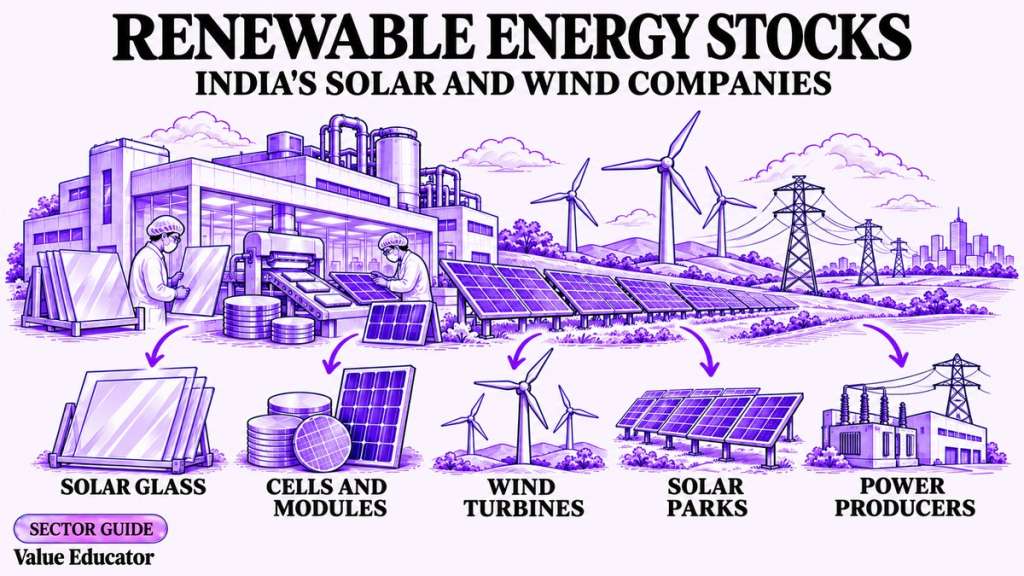
In March 2026, India had about 275 GW of renewable power capacity, and more than half of it, about 150.26 GW, was solar. In FY26 alone the country added about 55.3 GW of non-fossil capacity, including about 44.6 GW of solar, and non-fossil sources made 29.2% of India's electricity that year. India also had about 56.09 GW of wind farms running in March 2026.
Every one of those plants needs glass, cells, modules or turbines, a builder to put it up, and an owner to run it and sell the power. Many of those jobs are done by listed Indian companies. This page lists the renewable-energy companies we have studied in depth, with each one's latest figure, explains where each sits in the chain from solar glass to power producer, and then lists other listed names. Each linked row leads to our full research on that company.
Figures as of 20 November 2026. This page is research, not a recommendation to buy or sell any stock.
Renewable Energy Stocks in India at a Glance
| Company | Where it sits | What it does | Latest figure (date) |
|---|---|---|---|
| Borosil Renewables | Solar glass | Makes the glass that covers the front of solar panels, from three furnaces at Bharuch | 1,000 TPD (tonnes per day) of capacity, with 1,600 TPD planned by March 2027; FY26 standalone EBITDA margin of 32.0%, against 16.3% in FY25 |
| Premier Energies | Cells and modules | Makes solar cells and modules in Telangana and Andhra Pradesh | Cell capacity rose from 3.6 GW to 10.6 GW in September 2026; order book of ₹16,260 Cr (Sep 2026), about 2.0x FY26 total revenue |
| Waaree Energies | Modules and cells | Makes solar modules and cells in India, and modules in the US | 26 GW of module and 5.4 GW of cell capacity; order book of about ₹61,500 Cr (Apr-Jun 2026 quarter), about 2.3x FY26 revenue |
| Emmvee | Modules and cells | Makes TOPCon solar modules and cells | 10.3 GW of module and 2.94 GW of cell capacity (Jun 2026); FY26 EBITDA of ₹1,734 Cr |
| Suzlon Energy | Wind turbines | Makes wind turbines and services wind farms | Order book of 6.1 GW (Apr-Jun 2026 quarter); FY26 revenue of ₹16,679 Cr |
| Inox Wind | Wind turbines | Makes wind turbines in five plants with about 2,500 MW of yearly capacity | Order book of about 3.8 GW (Oct 2026); FY26 profit after tax of ₹449.1 Cr, but operating cash flow of minus ₹598.1 Cr |
| K P Energy | Wind balance of plant | Builds everything around the turbine: land, roads, foundations and grid lines | Order book of 1.64 GW, about ₹1,940 Cr (Sep 2026); H1 FY27 revenue of ₹1,058.1 Cr, up 103.4% |
| Waaree Renewable Technologies | Solar EPC and transmission | Builds solar plants for other companies, and transmission lines since June 2026 | Order book of about ₹5,500 Cr (Sep 2026), about 1.7x FY26 revenue; Q2 FY27 revenue of ₹1,057.84 Cr, up 36.53% |
| KPI Green Energy | EPC and power producer | Builds solar and hybrid plants for companies, and owns plants that sell power | Portfolio of 8.33 GW (Sep 2026), up from 4.15 GW a year earlier; Q2 FY27 power sales of ₹101.2 Cr, up 105.5% |
| Shakti Pumps | Solar pumps | Makes complete solar water pump sets for farmers | 51,543 solar pumps installed in H1 FY27; H1 FY27 revenue of ₹1,604.7 Cr, up 24.5% |
| Servotech Renewable | Solar inverters and rooftop | Makes solar inverters and builds rooftop solar plants; also makes EV chargers | Solar lines were about 91.5% of Jul-Sep 2026 sales, with solar inverters at 27.54%; won a 1,415 kW rooftop order from South Central Railway (Apr-Jun 2026) |
Most of these companies are growing fast, but they earn money in very different ways. A glass or cell maker earns on its factories, a builder earns on each project, and a power producer earns slowly over many years from plants it has paid for upfront.
The Renewable Energy Value Chain
A solar or wind plant passes through many hands before it sends power to the grid. Here is the chain, step by step.
- Materials and solar glass. A solar panel starts with silicon, which is made into ingots and then cut into thin wafers. India had only about 2 GW of working ingot and wafer capacity in September 2026, so most wafers are still imported. The front of every panel is covered with solar glass, a low-iron glass that lets almost all sunlight through. Borosil Renewables makes it in India.
- Cells and modules. A solar cell is the thin square of treated silicon that turns sunlight into electricity. A solar module is the panel made by wiring many cells together under glass. India's approved list of module plants (ALMM List I) held about 228.5 GW of capacity in September 2026, against only about 36.9 GW on the list for cells (List II). That gap is why Premier Energies, Waaree Energies and Emmvee are all adding cell lines. In FY26 India's cell imports rose 95% to ₹27,133.68 Cr, while module imports fell 51.6% to ₹8,835.24 Cr. Each solar plant also needs an inverter, the box that turns the panel's direct current into the alternating current the grid and homes use. Servotech makes them in India.
- Wind turbines. A wind turbine has three blades, a tall tower and a nacelle, the housing on top that holds the generator. Suzlon and Inox Wind make them in India.
- Wind balance of plant. Balance of plant means every part of a wind farm except the turbine: the land, roads, foundations, internal cables, substation and line to the grid. This is K P Energy's business.
- EPC. EPC stands for engineering, procurement and construction. The EPC company designs the plant, buys the parts, builds it and hands it over to the owner. Waaree Renewable Technologies and KPI Green do this for solar plants.
- Power producers. An IPP, or independent power producer, owns the plant and sells the power, usually under a PPA (power purchase agreement), a contract that often runs for 25 years. KPI Green is moving into this, alongside larger owners such as NTPC Green and Adani Green.
- Solar pumps. Under the PM-KUSUM scheme, the government pays most of the cost of an off-grid solar pump for a farmer. By 30 September 2026 the scheme had installed 11,90,639 such pumps. Shakti Pumps and Oswal Pumps make them.
Why Renewable Energy Demand Is Rising in India
Capacity is being added at record speed. India added about 55.3 GW of non-fossil capacity in FY26, and solar alone crossed 150 GW in March 2026.
Homes are going solar too. Under PM Surya Ghar, about 50.06 lakh homes had installed rooftop solar by August 2026, adding about 14.8 GW of capacity.
Rules favour Indian cells. Government-backed projects must use modules from the approved list, and subsidised projects such as rooftops and farm pumps must use modules made from Indian cells. That is why so many module makers are now building cell plants.
The grid has to keep up. India's transmission plan to 2032 calls for about 1,90,000 circuit kilometres of new lines, an investment of about ₹9.15 lakh Cr, to carry 600 GW of renewable power. Solar also stops at sunset: in May 2026 India was short of about 2.57 GW at peak in the evening, which is why storage matters more each year.
Other Listed Companies in Renewable Energy
These companies also work in renewable energy but are not yet covered in our in-depth research. The details come from their own filings, calls and presentations.
| Company | Where it sits | Renewable-energy work |
|---|---|---|
| Sterling and Wilson Renewable Energy | Solar EPC | 18.3 GW of solar plants commissioned and 10.4 GW under construction (June 2026) |
| Vikram Solar | Modules and cells | Module maker building a module, cell and wafer complex in Tamil Nadu; order book of 7.9 GW (June 2026) |
| Saatvik Green Energy | Modules and cells | Module maker from Ambala building cell capacity in Odisha, with total cell capacity planned at 6 GW |
| Websol Energy System | Cells and modules | Kolkata cell and module maker; FY26 revenue of ₹1,049 Cr at a 40.8% EBITDA margin |
| Tata Power | Cells, modules and power | Its module plant crossed 1,000 MW of output in a quarter for the first time (Apr-Jun 2026); plans a 10 GW ingot-wafer plant |
| Inox Green Energy Services | Wind farm services | Keeps wind turbines running under long contracts; buying about 6.5 GW of operating wind service portfolios |
| Synergy Green Industries | Wind parts | Castings such as hubs and gearbox housings; works with 6 of the 15 leading global wind turbine makers |
| Shilchar Technologies | Transformers | Transformers that step up solar power to 33 kV; FY26 revenue of ₹652 Cr |
| Siemens Energy India | Grid equipment | HVDC links and grid equipment that carry renewable power; built India's first HVDC line more than 20 years ago |
| Oswal Pumps | Solar pumps | More than 1,06,122 solar pumping systems executed under PM-KUSUM and state schemes across 15 states |
| NTPC Green Energy | Power producer | FY26 revenue of ₹2,858 Cr at an EBITDA margin of 86.59%, with FY26 capex of ₹15,264 Cr |
| Adani Green Energy | Power producer | 19.3 GW of operating capacity (FY26), with a target of 50 GW by 2030 |
| ACME Solar Holdings | Power producer | About 3.62 GWh of battery storage commissioned (Apr-Jun 2026), with more than 10 GWh targeted by FY27 |
| JSW Energy | Power producer | Locked-in generation capacity of 32.1 GW, including wind, solar, hydro and thermal (FY26) |
| IREDA | Lender | Government-owned lender that only finances renewable-energy and energy-efficiency projects; FY26 profit of ₹1,874 Cr |
How to Read a Renewable Energy Stock
- Maker, builder or owner? A maker earns on its factories, a builder on each project, and an owner over 25 years of power sales. Each has a very different need for cash and debt.
- Cells or only modules? With far more module capacity than cell capacity on the approved lists, a module maker that buys its cells can see margins shrink. Check how much of a company's capacity is cells.
- How long is the order book? Compare it with yearly revenue. Premier Energies' order book was about 2.0x its FY26 total revenue, while K P Energy's was about 11 months of its H1 FY27 revenue.
- Is profit turning into cash? Inox Wind earned ₹449.1 Cr of profit after tax in FY26, but its operating cash flow was minus ₹598.1 Cr. Watch receivables.
- How much debt? Power producers borrow to build plants. KPI Green's borrowings were ₹5,960.5 Cr in September 2026.
- Who is the customer? Some builders depend on one group company. At K P Energy, KPI Green made up 70.7% of FY26 revenue.
Key Risks for Renewable Energy Stocks
- Too much module capacity: ICRA expects India's module capacity to cross 165 GW by March 2027, while yearly installations are expected at about 45-50 GW. Prices and margins can fall when supply runs ahead of demand.
- Projects without buyers: in 2025 the power ministry reviewed about 42 GW of green projects that had no power purchase agreement, which can delay orders for builders and suppliers.
- Policy change: duties, approved lists and subsidy rules have driven much of the recent margin gain, for example in solar glass. If they change, margins can change too.
- Cash and receivables: builders and turbine makers often wait months to be paid, so profits can run ahead of cash.
- Grid limits: new plants need transmission lines on time; without them, power can be cut back and projects delayed.
Explore our Products
Research Framework

Emerging Titans
Combination of quantitative analysis, industry tailwinds, and management assessment - SPRINT investment philosophy

Tiny Titans
Heavy emphasis on scuttlebutt research, plant visits, and early on-ground signals
Conclusion
India is adding renewable power faster than ever, and that work reaches listed Indian makers of glass, cells, modules and turbines, builders of solar and wind farms, pump makers and power producers. But the chain is uneven: module capacity is running ahead of cells and demand, some companies depend on one customer, and several are growing profit faster than cash. Use the tables above to see where each company sits, then read our research on each one for its orders, margins and risks.
FAQs
Which are the renewable energy stocks in India?
+Listed renewable-energy companies include Borosil Renewables, Premier Energies, Waaree Energies, Emmvee, Suzlon Energy, Inox Wind, K P Energy, Waaree Renewable Technologies, KPI Green Energy, Shakti Pumps and Servotech Renewable, along with power producers such as NTPC Green, Adani Green, ACME Solar and JSW Energy. The tables on this page show what each one does.
How much renewable energy capacity does India have?
+India had about 275 GW of renewable capacity in March 2026, including about 150.26 GW of solar and about 56.09 GW of wind. It added about 55.3 GW of non-fossil capacity in FY26.
Which Indian companies make solar cells and modules?
+Premier Energies, Waaree Energies, Emmvee, Vikram Solar, Saatvik Green Energy, Websol Energy System and Tata Power make solar modules, and most of them also make or are building solar cells. Borosil Renewables makes the solar glass that goes on the front of the panels.
Which companies make wind turbines in India?
+Suzlon Energy and Inox Wind make wind turbines. K P Energy builds the roads, foundations and grid lines around them, Inox Green services wind farms, and Synergy Green makes castings for turbine makers.
What is the difference between an EPC company and a power producer?
+An EPC company designs and builds a plant for someone else and is paid as the work moves ahead. A power producer owns the plant, pays for it upfront, and earns money over many years by selling the power. KPI Green Energy does both.
What are the risks in renewable energy stocks?
+Module capacity is growing faster than demand, some projects have no buyer for their power, margins depend on duties and government rules, and many builders wait months to be paid. Grid and transmission delays can also hold back new projects.

High growth stock specialist, Value Educator
Shashank Mahajan is an equity research professional with over 12 years of experience in identifying high-potential SME and micro-cap stocks at an early stage. He follows a rigorous scuttlebutt research–driven approach, combining on-ground insights with deep financial analysis. Shashank specializes in uncovering under-researched and under-owned companies with strong management quality and long-term growth potential. Through disciplined research and early identification, he focuses on spotting tomorrow’s market leaders before they enter the mainstream investor radar.
More about Shashank Mahajan →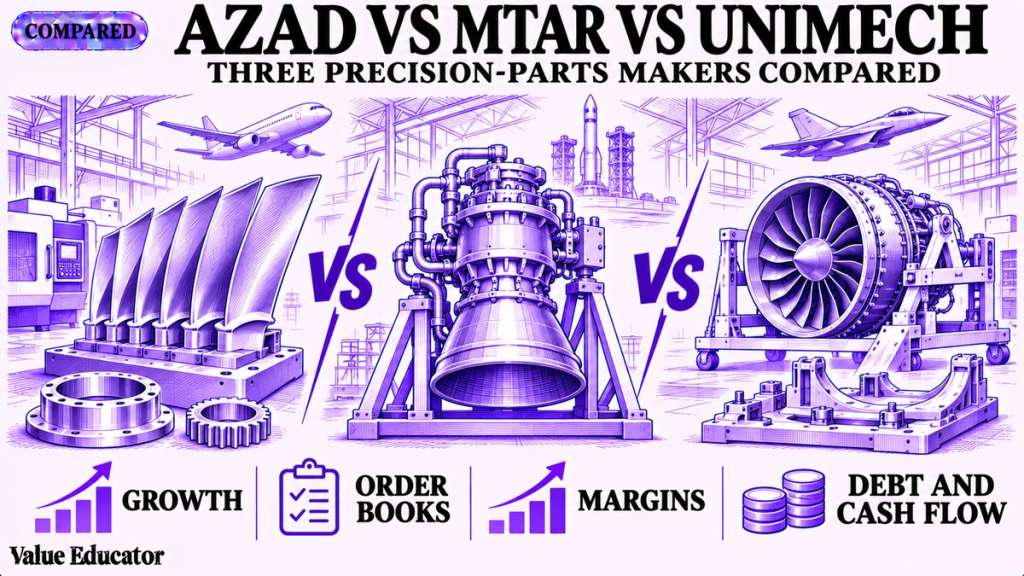
Azad Engineering vs MTAR vs Unimech: Aerospace Parts
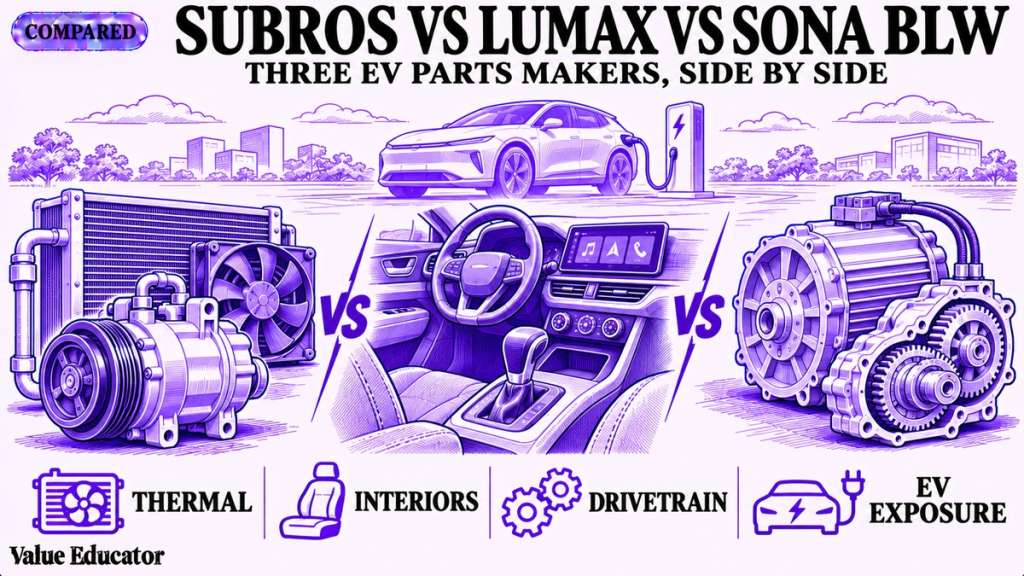
Subros vs Lumax Auto vs Sona BLW: EV Auto Parts Compared
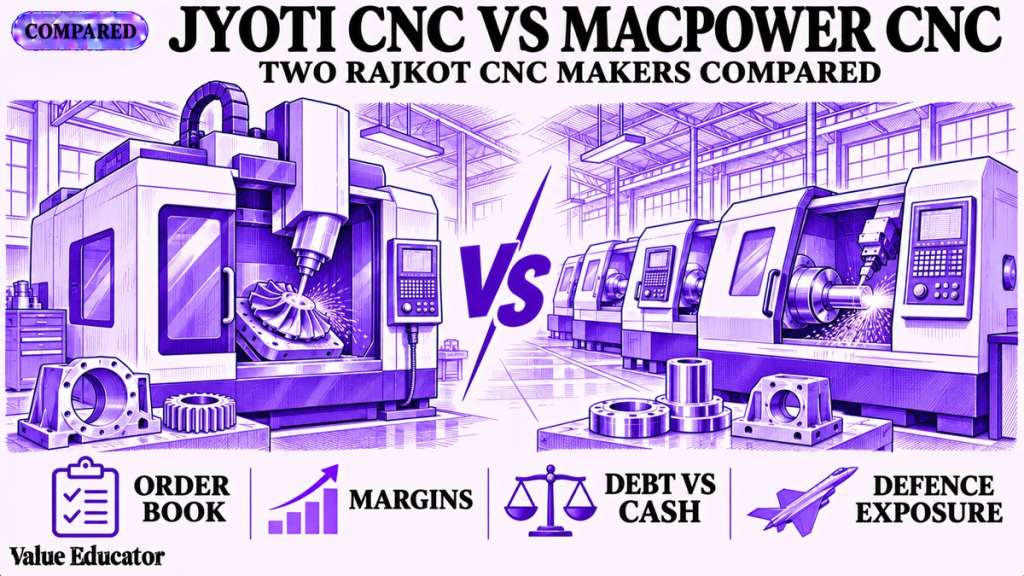
Jyoti CNC vs Macpower CNC: Machine Tool Makers Compared
Data Patterns vs Astra Microwave vs Apollo Micro

Himadri vs PCBL: Carbon Black and Battery Materials

Inox Wind vs Suzlon: Wind Turbine Makers Compared
Explore our Products
Research Framework
Emerging Titans
Combination of quantitative analysis, industry tailwinds, and management assessment - SPRINT investment philosophy
Tiny Titans
Heavy emphasis on scuttlebutt research, plant visits, and early on-ground signals



India's Aerospace Opportunity
Global Demand. Supply Bottlenecks. Opportunities Ahead.
Don't Miss This Exclusive Webinar!
Join Value Educator to decode the key trends shaping India's aerospace sector and learn how to identify tomorrow's potential leaders in the space.
- How the aircraft value chain works, layer by layer
- Indian companies supplying global aircraft makers
- A framework to judge any aerospace company

 Orders
 Subscription
 Share with friends


Required Details
₹23999.00
(12 month subscription)
As per SEBI regulations, all users are mandated to complete the KYC that is validated for 1 year. Post payment, you will be redirected to the KYC screen


No comments yet. Be the first to comment!