
Marksans Pharma: Store-Brand Medicines for US, UK Shelves
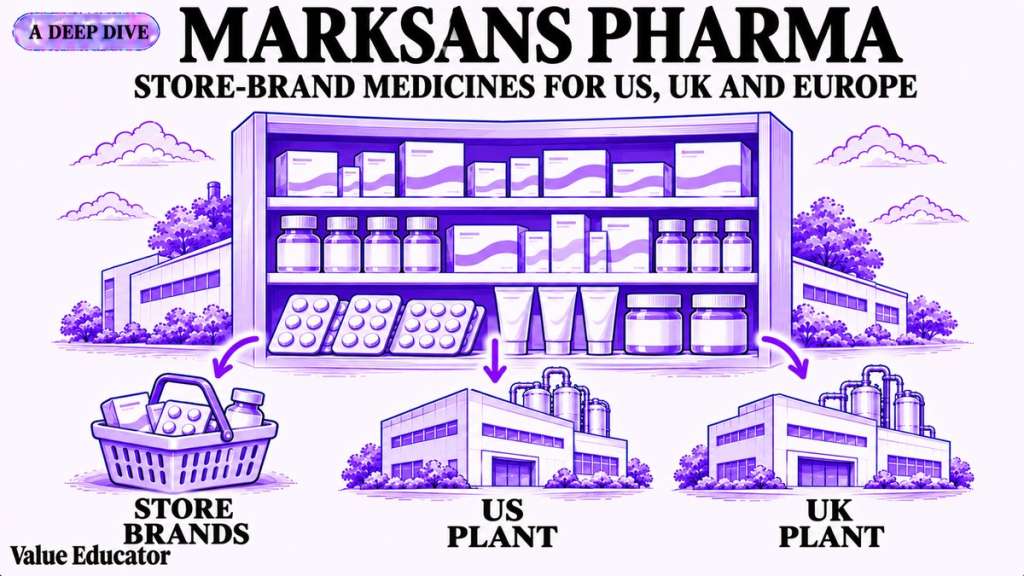
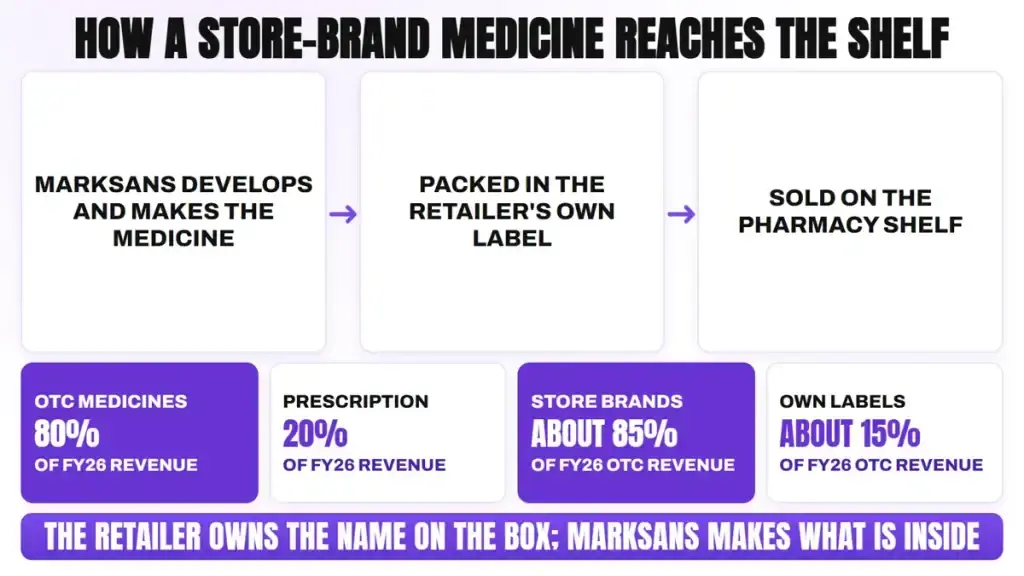
Walk into a large pharmacy chain in the US or the UK and look at the shelf for pain relief, cough syrup or antacids. Next to the famous brands, you will find the same medicines in the shop's own packaging, at a lower price. These are store brands, also called private labels. The retailer owns the name on the box, but someone else makes the tablets, fills the bottles and prints the packs to the retailer's design.
One Indian company has built most of its business on making those packs. In FY17 it earned ₹445 Cr from over-the-counter (OTC) medicines, which is the name for medicines a shopper buys without a doctor's prescription. In FY26 it earned ₹2,361 Cr from them, about 5.3 times as much. OTC medicines were 80% of its revenue that year, and about 85% of that OTC revenue came from store brands.
That growth did not come from one plant in India. In June 2015 the company bought Time-Cap Laboratories, a store-brand maker in New York state. It already owned Bell, Sons & Co. and Relonchem in the UK, and 60% of Nova Pharmaceuticals in Australia. In April 2023 it bought a second plant in Goa from Teva. In 2026 it bought two small distributors, one in the Netherlands and one in Germany. Each of these is a front end, which is the name for a company's own sales and distribution team in a country.
That company is Marksans Pharma Ltd (NSE: MARKSANS). It has four manufacturing units, in Goa, in Southport in the UK and in Farmingdale in the US, with a total capacity of about 26 bn units a year. It sells more than 350 products in over 60 countries, and in FY26 its revenue from operations was ₹2,950.9 Cr.
Most of that revenue comes from rich countries with strict drug regulators. The US was 52% of FY26 revenue, the UK and Europe 34.4%, and Australia and New Zealand 10.3%. India itself buys almost nothing; the parent company runs as a 100% export-oriented unit.
Marksans Pharma in five numbers
- Q2 FY27 revenue of ₹940.2 Cr, up 30.5%
- OTC medicines at 80% of FY26 revenue, ₹2,361 Cr
- UK and Europe revenue of ₹404.6 Cr in Q2 FY27, up 64.9%
- Net cash of ₹1,095 Cr in September 2026
- Four plants with about 26 bn units a year of capacity
So a company that makes medicines for other people's labels now earns more than ₹900 Cr in a quarter. Let's first understand the company, and then look at the latest quarter, where its three large regions all grew.
Marksans Pharma: Company Overview
Marksans Pharma Ltd is based in Mumbai and makes and sells generic medicines, mostly over-the-counter products, in regulated markets abroad. It began in 2001 as a subsidiary of Glenmark Pharmaceuticals and was spun off in 2003. Its founder, Mark Saldanha, is the Chairman and Managing Director, and Jitendra Sharma is the Chief Financial Officer. The company has four manufacturing units, in Goa, Southport in the UK and Farmingdale in the US, four R&D centres, more than 350 products and more than 2,000 SKUs. It sells in over 60 countries through Time-Cap Laboratories in the US, Bell, Sons & Co. and Relonchem in the UK, Nova Pharmaceuticals in Australia, and new front ends in the Netherlands and Germany. The promoters held 43.9% of the shares in September 2026 and OrbiMed 8.6%. FY26 revenue from operations was ₹2,950.9 Cr, and profit after tax was about ₹420 Cr. Read this Yatharth Hospital: A Quiet Healthcare Boom
"Behind every stock is a company. Find out what it's doing."
— Peter Lynch
What Marksans does is simple to see on a pharmacy shelf: it makes the shop's own-label medicines. How it built that business across four regions is what the rest of this article looks at.
The Quarter Marksans Crossed ₹900 Cr
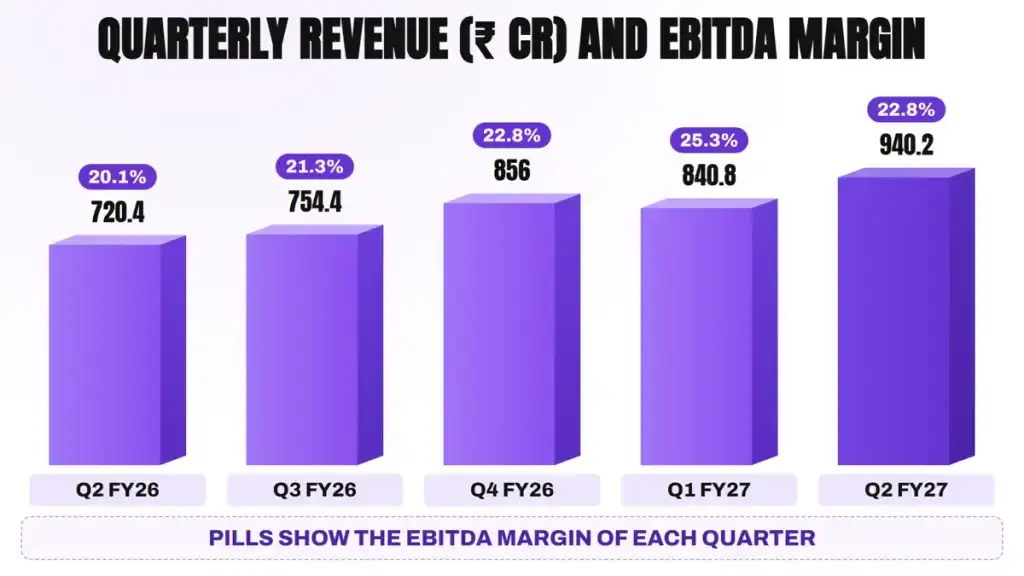
Let's look at Q2 FY27, the July to September quarter, which the company reported on 4 November 2026. Revenue from operations was ₹940.2 Cr, up 30.5% from ₹720.4 Cr a year ago and 11.8% above the ₹840.8 Cr of Q1 FY27. It was the first time the company crossed ₹900 Cr in a quarter.

As we can see, that growth came from three of the four regions together. The US and North America brought in ₹420.9 Cr, up 8.7%, its highest quarter so far. The UK and Europe brought in ₹404.6 Cr, up 64.9%. Australia and New Zealand grew 64.0% to ₹100.6 Cr. Only the Rest of the World, a small market for the company, was lower, at ₹14.1 Cr.
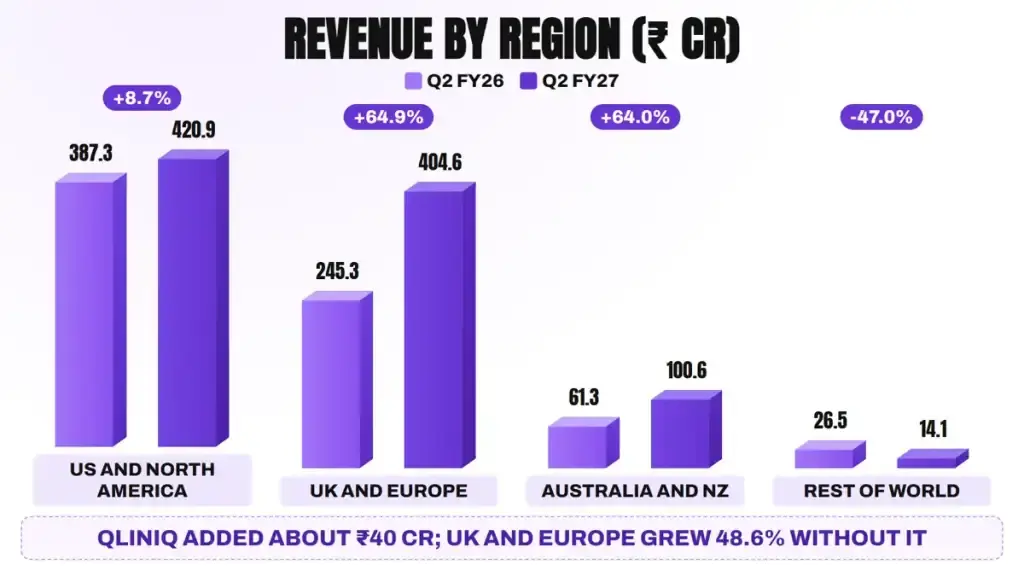
That UK and Europe jump came partly from a purchase. QliniQ, the Dutch distributor bought in June 2026, added about ₹40 Cr in the quarter. Leaving it out, UK and Europe revenue still grew 48.6% to ₹365 Cr, and group revenue grew about 25%. Management says most of the first-half growth came from higher volumes, not higher prices.
That revenue also carried a better margin. Read this EBITDA Explained: Uses and Limits The gross margin was 58.5%, against 57.2% a year ago, and EBITDA rose 48.3% to ₹214.3 Cr. Overheads grew 25.6%, slower than revenue, so the EBITDA margin rose to 22.8% from 20.1%. Of that 274 basis point gain, 135 basis points came from the gross margin and 139 from overheads growing more slowly than sales.
Against Q1 FY27, though, the margin was lower, and the reasons tell us how this business earns. In Q1 the company used up stock it had bought at lower prices. In Q2 it had to buy new raw material at higher prices, so the gross margin moved to 58.5% from 59.1%. Freight costs nearly doubled, adding about ₹20 Cr to other expenses in the quarter. Employee costs rose about ₹8 Cr as the company hired for its new markets.
Those costs also explain profit. Profit after tax was ₹143.5 Cr, up 44.8% from a year ago, but below the ₹159.4 Cr of Q1. Three items explain the gap. Depreciation and amortisation rose to ₹32.1 Cr from ₹24.9 Cr, because the company now writes off acquired brands and licences over ten years instead of only testing them for impairment. Other income was ₹18.2 Cr against ₹25.4 Cr, as currency gains were smaller. And the tax rate rose to 25.8%.
The First Half and the Cash Behind It
Now let's widen the view to the first half, where the numbers are larger. H1 FY27 revenue was ₹1,781 Cr, up 32.9%. EBITDA rose 74.7% to ₹427.3 Cr, at a margin of 24.0% against 18.2% a year ago. Profit after tax nearly doubled to ₹302.9 Cr, already about 72% of the ₹420 Cr earned in all of FY26.
That half year also brought in cash. Operating cash flow was ₹322 Cr, 4.3 times the first half of FY26, and about 75% of EBITDA, against 31% a year earlier. After ₹46 Cr of capex, free cash flow was ₹275 Cr. Read this Cash Flow Statement Explained The working capital cycle came to about 128 days for the half, against about 138 days for FY26, and about 122 days in Q2 alone.
The balance sheet shows where that cash went. The company spent about ₹95 Cr on acquisitions and ₹41 Cr on dividends in the half, and still added ₹135 Cr of net cash. Cash and current investments were ₹1,123.6 Cr in September 2026, against borrowings of ₹29.0 Cr, which left net cash of about ₹1,095 Cr. On a trailing twelve-month basis, return on capital employed was 24.7%, against 18.7% a year earlier.
What the first half says: Marksans earned ₹302.9 Cr of profit in six months, against ₹420 Cr in all of FY26, while its net cash rose to about ₹1,095 Cr after paying for two acquisitions.
How a Glenmark Unit Became a Store-Brand Maker
Now that we have seen the quarter, let's go back and see how the company got here. Marksans began in 2001 as a wholly owned subsidiary of Glenmark Pharmaceuticals. In 2003 it was spun off as a separate company, Glenmark Laboratories, and later renamed Marksans Pharma. Its founder, Mark Saldanha, had been a whole-time director of Glenmark, and he is still its Chairman and Managing Director. The promoters held 43.9% of the shares in September 2026.
Since then, the company has grown by buying businesses in the markets it wanted to sell in. Each purchase gave it a licence holder, a customer list or a plant in a regulated country. The table below shows the main steps.
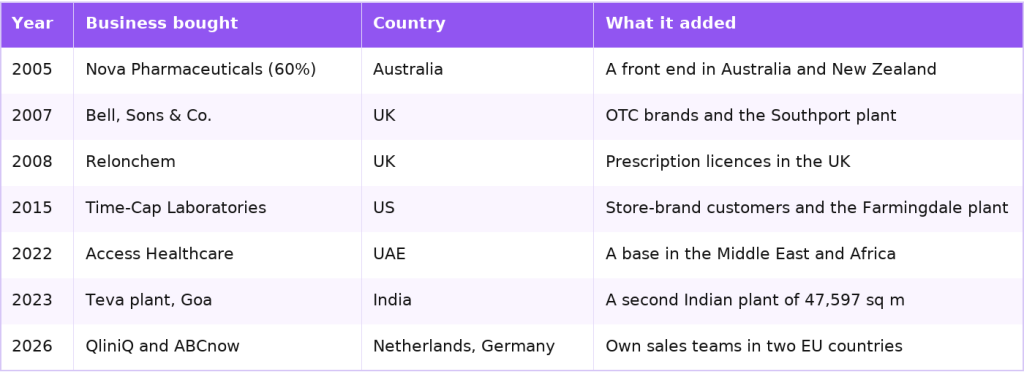
The US purchase changed the company most. After it bought Time-Cap, the company moved its US business towards OTC store brands in 2017. That choice is why OTC revenue grew from ₹445 Cr in FY17 to ₹2,361 Cr in FY26, a compound growth of 20.4% a year over that period.

Those purchases needed money, and some of it came from outside investors. In 2021, OrbiMed, a global healthcare investor, subscribed to warrants along with the promoters. Their conversion raised ₹372.40 Cr of equity, and OrbiMed held 8.6% of the company in September 2026. That cash, plus the company's own, paid for the Teva plant in Goa in April 2023, for about ₹77.9 Cr.
That plant has since become the base for the next stage. Revenue crossed ₹2,000 Cr in FY24, OTC revenue crossed ₹2,000 Cr in FY25, and total income crossed ₹3,000 Cr in FY26. Return on equity has stayed between about 15% and 18% in each of the last five years, with almost no debt.
"Price is what you pay. Value is what you get."
— Warren Buffett
Marksans has paid modest sums for small front ends and plants, and then filled them with products from its own factories. That is where most of its value has come from.
"Our growth is not dependent on a single geography or acquisition." - Mark Saldanha, Chairman and Managing Director, November 2026
Four Regions, Four Ways to Sell a Medicine
Now let's split the business by region, because each one sells in a different way. Marksans reports one segment, pharmaceuticals, but it shows revenue for four regions every quarter. Read this Segment-Wise Revenue Analysis Explained In the US it mostly makes store brands for retailers. In the UK it sells its own OTC brands and prescription generics. In Australia it sells through its own branded company, and in Europe it has just bought its first sales teams.

These regions sound alike, but as you will see, each one asks for something different. The US rewards scale and low cost on a few large retail accounts. The UK rewards a long list of approved licences. Australia and Europe reward owning the sales team that talks to doctors, pharmacies and insurers.

Across these regions, pain management is the largest group of medicines, at ₹1,310.8 Cr of FY26 revenue. Cough and cold products brought in ₹460.9 Cr and stomach medicines ₹384.0 Cr. Heart, allergy and nervous-system medicines each brought in ₹171.5-183.4 Cr.
US and North America
Let's start with the US and North America, the largest region. The global OTC market is projected at about $215 bn in 2026. The company's deck says store brands are gaining share in the US and the UK, as shoppers move to own-label medicines that cost less than the famous brands.
Marksans serves that market through Time-Cap Laboratories, bought in June 2015. Time-Cap supplies leading US retailers with store-brand OTC products and runs the Farmingdale plant in New York state. That plant makes tablets, hard gels and capsules, with a capacity of about 6 bn tablets and hard capsules a year, and lets the company offer a "Made in the USA" range. US revenue grew 2.4 times from FY22 to FY26.
That business runs on new products. The company launched 112 new SKUs in the US in FY26, and 51 more products are in its pipeline. An SKU, or stock keeping unit, refers to one pack of one product for one customer, so a single medicine can become many SKUs across retailers. For prescription generics, it files ANDAs, the abbreviated new drug applications that the US FDA approves for copies of off-patent drugs. It expects to file another five or six ANDAs by March 2027.
That pipeline sits behind an order book. Management says its US order book is about $225 Mn and should reach $300 Mn within three years. In Q2 FY27, US revenue was ₹420.9 Cr, up 11.6% from Q1, and price cuts on its US prescription products stayed in single digits.
UK and Europe
Next, let's look at the UK and Europe, the company's second-largest region. Marksans says it is among the top five Indian pharma companies in the UK. It works there through Marksans Pharma (UK), which owns two businesses. Bell, Sons & Co. runs an OTC range of more than 450 products and SKUs, and Relonchem holds more than 175 marketing authorisations, the UK licences needed to sell a prescription medicine.
The Southport plant serves that business. It makes liquids, ointments and powder sachets, with a capacity of about 2 bn bottles, 1 bn tubes and 1 bn sachets a year. It supplies the UK, West Africa and the Middle East.
That UK business had a flat year in FY26, as prices came under pressure early in the year. UK and Europe revenue was ₹1,015 Cr, up only 1%. The company used that year to file and launch products. It got 18 approvals and made 30 filings in FY26, had 24 products awaiting approval in March 2026, and plans more than 200 filings over the next four years. In Q2 FY27 those launches showed up: UK and Europe revenue without QliniQ grew 48.6%.
Beyond the UK, Europe is a new market for Marksans. On 1 June 2026 it agreed to buy QliniQ B.V., a distributor in Oldenzaal, the Netherlands, for €7.5 Mn. QliniQ sells niche medicines and medical devices in women's health, skin care and respiratory care, through wholesalers, pharmacies, hospitals and the tenders run by Dutch health insurers. In 2025 it had revenue of €9.35 Mn and a net profit of €1.01 Mn, with no debt. So Marksans paid about 0.8 times its sales.
That pattern repeated in Germany. In July 2026 Marksans agreed to buy ABCnow GmbH, an OTC distributor in Flensburg, for €892,384. ABCnow is tiny, with 2025 revenue of about €0.23 Mn, but it gives Marksans its own sales base in Germany. The company has also set up Marksans Pharma (Europe) in Ireland as its EU holding company, and Marksans Pharma GmbH in Germany.
These front ends give Marksans its own sales, marketing and distribution teams in two EU countries. It plans to use them to sell products made in its plants in India, the UK and the US, and it has started filing new products there. QliniQ brought in about ₹84 Cr in H1 FY27, and management expects ₹150-175 Cr from it in FY27. Asked whether about ₹1,000 Cr of revenue from Europe in five years is still the target, management said yes.
Australia and New Zealand
Now let's move to Australia and New Zealand, where Marksans has owned a front end the longest. It bought 60% of Nova Pharmaceuticals Australasia in 2005. Nova sells everything Marksans markets in the region, and it holds more than 100 marketing authorisations there.
That business has grown from ₹180 Cr in FY22 to ₹303 Cr in FY26, about 14% a year. In FY26 Nova started a branded prescription division and launched 11 prescription brands. Two examples are Vymaze, a nasal spray for allergies, and Rinidate, a tablet for attention deficit disorder that is listed on the PBS, Australia's public drug subsidy scheme.
Those launches drove the latest quarter. Revenue grew 64.0% to ₹100.6 Cr in Q2 FY27, and H1 revenue rose 59.0% to ₹188 Cr. The region is now 10.7% of company revenue. Management expects Nova to reach $100 Mn of revenue within three years. It also plans 17 new SKUs in FY27.
Rest of the World
Finally, let's look at the smallest region, the Rest of the World. It covers about ten countries in the CIS and MENA regions, served partly through Access Healthcare in Dubai, bought in 2022. The company holds more than 230 product licences in the UAE and these other countries.
This region made ₹99 Cr in FY26, or 3.4% of revenue. In Q2 FY27 it made ₹14.1 Cr, as the West Asia conflict held up ships to the Middle East. Management says shipments are moving again, and that ₹20-25 Cr a quarter is possible if conditions ease. Access Healthcare is still profitable, and the company is working to add many more product licences there.
Why a Store-Brand Supplier Is Hard to Copy
Now that we have seen the regions, let's understand the moat. A store-brand pack looks simple, but the retailer's name is on the box. If a batch is recalled, the retailer takes the blame. So large US and UK chains choose a few suppliers they can trust on quality, on price and on delivery, and they move slowly when they change.
That trust has to be earned in steps. A supplier needs a plant approved by the regulator in each country: the US FDA, the UK MHRA and Australia's TGA. It needs an approved licence for each product, which takes years to build in bulk. Then the retailer tests the supplier's packs, its prices and its delivery record before it moves a product line over. Once a supplier has done that for hundreds of products, a new rival would need years to match the list. Read this Economic Moat Explained
Each of those layers is one Marksans has built. Its plants carry USFDA, UK MHRA, Australian TGA, EU and Health Canada approvals. It has more than 350 approved ANDAs and marketing authorisations, more than 30 awaiting approval and more than 200 products in development. About 98-99% of what it sells comes from its own plants, so it controls cost and quality itself.
Cost is the second layer. Store brands compete on price, so the cost of each tablet matters. Most of Marksans' capacity is in Goa, and the company describes itself as a low-cost store-brand manufacturing partner. It plans to add 20-25 new products a year. Spending on research rose to ₹89 Cr in FY26, or 3.0% of revenue, from about 0.6% in FY17.
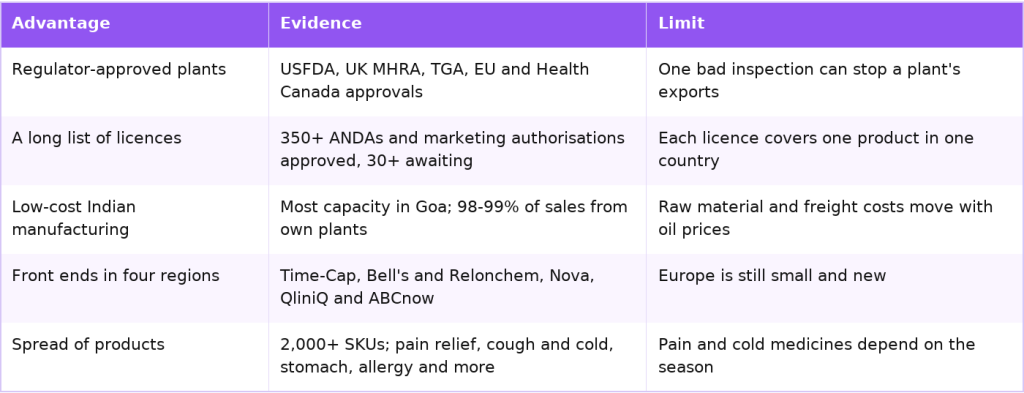

That table shows us why margins are the real test of the moat. If retailers value the approvals and the low cost, the company should hold its margin even when prices are under pressure. In FY26, when UK prices were under pressure, the EBITDA margin still stayed at 20.4%. The next test is whether it holds as freight and raw material costs rise.
"In business, I look for economic castles protected by unbreachable moats."
— Warren Buffett
For a store-brand supplier, the walls of that castle are approved plants, a long list of licences and retailers who do not like to switch.
Four Plants and a Second Goa Site
Now let's look at the plants, because they decide how far this business can grow before it needs more money. Marksans has four manufacturing units, with a total capacity of about 26 bn units a year. A unit here is one tablet, capsule, bottle, tube or sachet.
The oldest Indian plant, Unit 1 in Goa, sits on an 18,000 sq m campus. It can make about 2.4 bn softgel and hard gelatin capsules and 6 bn tablets a year. A softgel is a soft capsule filled with liquid, used for many cold and pain medicines. The US plant at Farmingdale makes about 6 bn tablets and hard capsules a year, and the UK plant at Southport makes liquids, ointments and sachets.
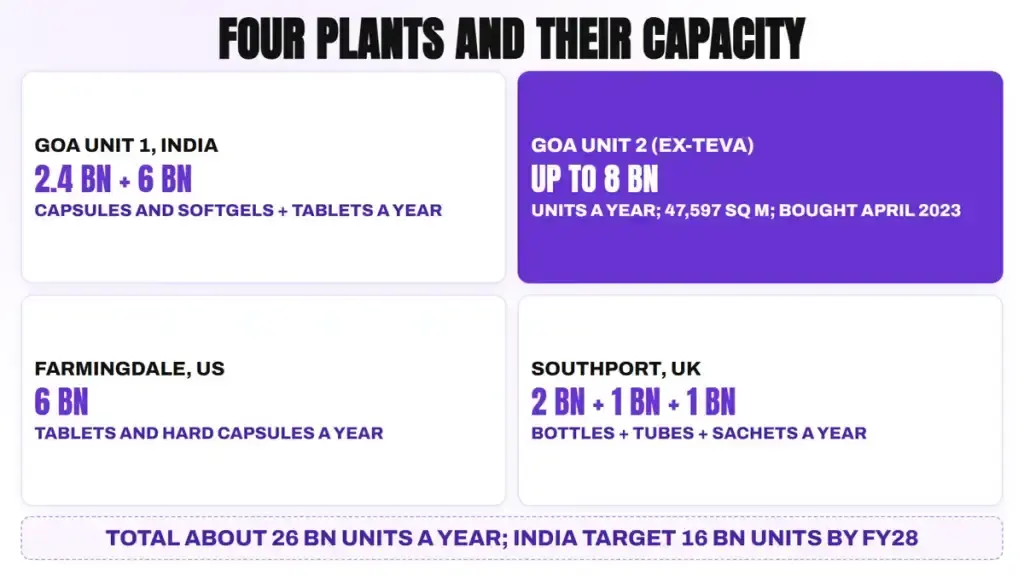
The newest plant is Unit 2 in Goa, which Marksans bought from Teva on 19 April 2023 for ₹779.47 Mn. It sits on 47,597 sq m and already had approvals from the EU, Health Canada and Japan's health authority. It can scale up to about 8 bn units a year and will make tablets, ointments, liquids and creams. Management says this plant can double the company's Indian capacity.
Filling that plant has taken time. In June 2026 management said the Teva plant was running at slightly below 50%. In February 2026 it said the Teva plant was running at about ₹560-600 Cr of revenue a year, against an aim of about ₹800 Cr.
That spare room is why profit has grown faster than revenue. A plant's fixed costs stay roughly the same as volumes rise, so each extra pack earns more. In H1 FY27, costs below gross profit grew 18.0%, while revenue grew 32.9%.
Even so, management is already planning the next step. The company aims to raise its Indian capacity to 16 bn units a year by FY28. It plans to add blocks for new dosage forms at the Teva site and is talking to two companies about buying another plant, which it hopes to close in about 12 months. It says it does not plan to make injectables or its own raw materials.
That next step can be paid for from cash the business already makes. In FY26 operating cash flow was ₹458 Cr and capex ₹131 Cr, which left free cash flow of about ₹328 Cr. In February 2026 management said a new block or plant could cost ₹150-200 Cr, against the ₹1,123.6 Cr of cash and current investments the company held in September 2026. It has also paid out about one-third of its free cash flow as dividends, and for FY26 it recommended ₹0.90 a share. Its long-term ratings are CARE AA- and IND AA-, and India Ratings moved its outlook to positive.
Financials: Five Years of Revenue, Margins and Cash
One quarter can mislead in a seasonal business like cold and pain medicines, so let's look at five full years together. These are consolidated figures for the whole group.
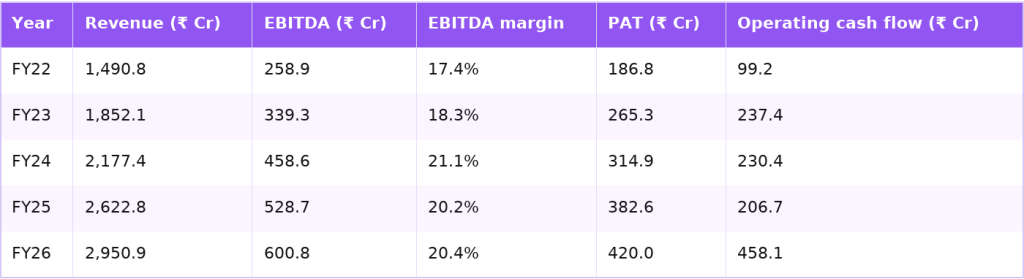
Revenue roughly doubled in four years, from ₹1,490.8 Cr in FY22 to ₹2,950.9 Cr in FY26, and EBITDA grew faster. The margin moved from 17.4% to about 20-21%, helped by the move to OTC store brands and by more volume through the Goa plants.
Cash is the part to read closely. Over the five years, operating cash flow added up to about ₹1,232 Cr, against about ₹1,786 Cr of EBITDA. Stock for hundreds of products and credit to large retailers tie up money, and inventory reached ₹972.3 Cr in March 2026. FY26 was the best year for cash, at ₹458.1 Cr, and H1 FY27 added another ₹322 Cr.
The balance sheet has carried that gap without debt. Borrowings were only ₹29.6 Cr in March 2026, against cash of about ₹990 Cr, and the company paid for the Teva plant and two European purchases from its own funds.
"In the short run, the market is a voting machine but in the long run, it is a weighing machine."
— Benjamin Graham
For Marksans, the weight comes from five years of steady margins and a cash pile that keeps growing, which is what pays for its next plant and front ends.
What FY28 Could Look Like on Management's Numbers
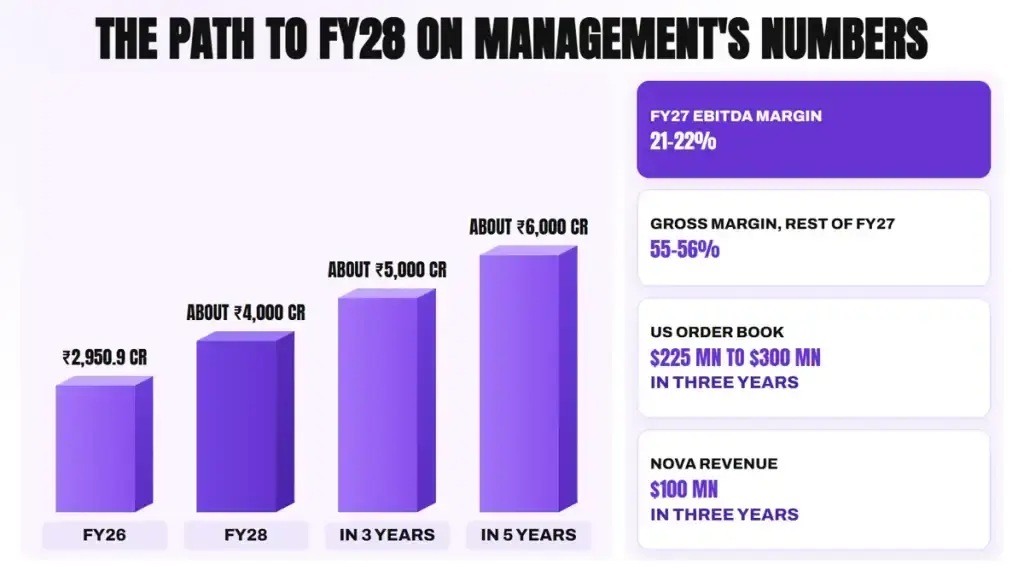
So where does the company go from here? Management says the company is close to ₹1,000 Cr of revenue a quarter, and expects to reach ₹4,000 Cr of revenue next year, in FY28. Beyond that, it is working towards ₹5,000 Cr within three years, and about ₹6,000 Cr, double the FY26 level, within five years.
Now let's put that against what has been done so far. FY26 revenue was ₹2,950.9 Cr. Reaching ₹4,000 Cr in FY28 needs growth of about 16.4% a year for two years. That is close to the 15-20% growth management guided for FY27 in June 2026, and below the 32.9% of H1 FY27. The Q2 FY27 revenue rate alone is about ₹3,760.8 Cr a year.
Beyond revenue, margins have their own path. Management guided an EBITDA margin of 20-21% for FY27 in June 2026. After an H1 margin of 24.0%, it now expects 21-22% for the year, as cheaper stock runs out and new raw material costs more. It expects the gross margin to settle at about 55-56% for the rest of the year, against 58.8% in H1.
That margin plan leans on mix, and Europe carries much of the growth plan. Management expects the region to become a large contributor over the next three years, through QliniQ, ABCnow and one or two more European purchases it hopes to close within twelve months. In the US, it expects growth to come mostly from its existing products, with new launches adding about 10% of growth. In the UK, new launches should add about 20%, and in Europe about 50-60%.
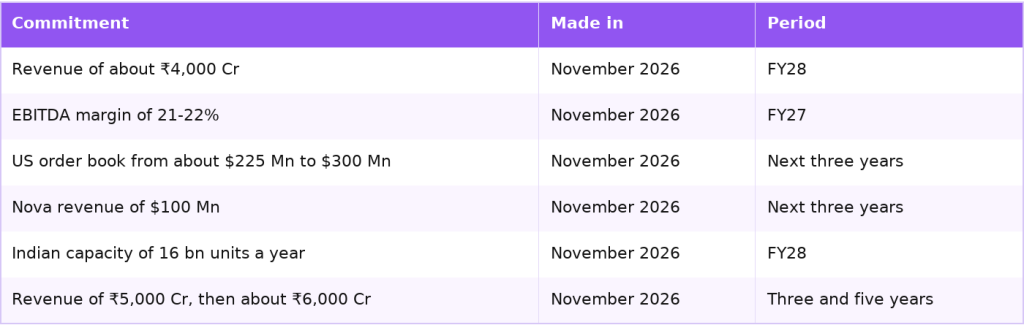
Those commitments are easier to judge against the past. So let's check what management said before against what it delivered.

That record shows us a clear pattern. Management has usually been careful on revenue and margins, and it has met or beaten those numbers for the last two years. The places where it has run late are the operating ones, like filling the Teva plant. That makes the plant ramp-up and the European front ends the things to watch from here.
Key Risks
Now let's look at what could go wrong for Marksans Pharma, because some of these risks have already shown up this year.
- Raw material and freight costs: the H1 margin was helped by stock bought at lower prices. Freight costs nearly doubled in Q2 FY27, and management expects the gross margin to fall back to about 55-56%. If oil prices or the West Asia conflict get worse, costs could rise further.
- US tariffs and US demand: the US was 52% of FY26 revenue. In August 2026, asked about a possible 200% US duty on imported medicines in two years, management said it would wait and watch, with more US production as an option. It also says rising living costs are hurting what US shoppers can afford. US growth in H1 FY27 was 11.7%, the lowest of its three large markets.
- Customer concentration: two customers each made up 10% or more of FY26 revenue, together about ₹679.1 Cr, or about 23%. A store-brand retailer can move a product line to another supplier.
- UK pricing: UK prices came under pressure in FY26, and the region grew only 1% that year. A repeat would hit the second-largest market.
- Acquisitions in Europe: QliniQ and ABCnow are new, and the company plans more purchases. Goodwill rose to ₹102.6 Cr in September 2026 from ₹45.3 Cr in March, and acquired intangibles are now written off over ten years, which raised depreciation.
- The Teva plant and the next plant: the Goa plant was still below 50% in June 2026, later than the six months management had aimed for in May 2025. A new plant or block would add cost before it adds revenue.
- Working capital and leases: inventory was ₹995.7 Cr and receivables ₹757.4 Cr in September 2026. Lease liabilities rose by about ₹121.8 Cr in six months, mainly from a new lease in the UK.
- Rest of the World: shipments to the Middle East were held up in H1 FY27, and the region's revenue fell 41.4% in the half.
"If the war goes from bad to worse, then obviously, all projections go for a toss." - Mark Saldanha, Chairman and Managing Director, November 2026
"Risk comes from not knowing what you're doing."
— Warren Buffett
For Marksans, the main things to know are outside its plants: oil and freight costs, US trade rules and a few large retail customers. The tracking list below is how to watch each of them.
Explore our Products
Research Framework

Emerging Titans
Combination of quantitative analysis, industry tailwinds, and management assessment - SPRINT investment philosophy

Tiny Titans
Heavy emphasis on scuttlebutt research, plant visits, and early on-ground signals
What to Track Next
If you follow Marksans Pharma, these are the signals that will show where it goes next.
- Q3 FY27 revenue, the cold-season quarter, and whether the company reaches ₹1,000 Cr in a quarter
- The EBITDA margin against the 21-22% expected for FY27, and the gross margin after 58.5%
- UK launches and approvals, and QliniQ revenue against ₹150-175 Cr for FY27
- New European acquisitions, and how much goodwill and amortisation they add
- The Teva plant's use, and any decision on a new block or a new plant
- US revenue growth, the US order book against $300 Mn, and any tariff decision on imported medicines
Members can read our full Research Desk report on Marksans Pharma, with its detailed scorecard and section-by-section analysis.
Conclusion
Let's put it all together. Marksans Pharma has grown from ₹1,490.8 Cr of revenue in FY22 to ₹2,950.9 Cr in FY26, mostly by making OTC store brands for US and UK retailers in its own plants. Its Australian front end and two new European ones now add a branded side to that business. In H1 FY27 it earned ₹302.9 Cr of profit, and it holds about ₹1,095 Cr of net cash.
Still, the next step is different from the last one. What happens next depends on whether costs settle so the margin holds near 21-22%, whether the Goa plants fill up, and whether the new Dutch and German front ends turn Europe into a third large market.
FAQs
What does Marksans Pharma do?
+Marksans Pharma makes and sells generic medicines, mostly over-the-counter products such as pain relief, cough and cold and stomach medicines. About 80% of FY26 revenue came from OTC products, and about 85% of that from store brands made for retailers. FY26 revenue was ₹2,950.9 Cr.
How did Marksans Pharma do in Q2 FY27?
+Revenue from operations rose 30.5% to ₹940.2 Cr, the first quarter above ₹900 Cr. EBITDA rose 48.3% to ₹214.3 Cr at a margin of 22.8%, and profit after tax rose 44.8% to ₹143.5 Cr.
Which markets does Marksans Pharma sell in?
+In FY26 the US and North America made up 52.0% of revenue, the UK and Europe 34.4%, Australia and New Zealand 10.3% and the Rest of the World 3.4%. It sells through Time-Cap in the US, Bell's and Relonchem in the UK, Nova in Australia, and QliniQ and ABCnow in Europe.
Where are Marksans Pharma's plants?
+It has four manufacturing units: two in Goa, including a plant bought from Teva in April 2023, one in Southport in the UK and one in Farmingdale in the US. Together they have a capacity of about 26 bn units a year.
What are Marksans Pharma's targets?
+In November 2026 management said it expects revenue of about ₹4,000 Cr in FY28, about ₹5,000 Cr within three years and about ₹6,000 Cr within five years. It expects an EBITDA margin of 21-22% for FY27.
What are the main risks for Marksans Pharma?
+The main risks are raw material and freight costs, possible US tariffs on imported medicines, two large customers that made up about 23% of FY26 revenue, UK price pressure, and the cost of new European acquisitions and plants.

High growth stock specialist, Value Educator
Shashank Mahajan is an equity research professional with over 12 years of experience in identifying high-potential SME and micro-cap stocks at an early stage. He follows a rigorous scuttlebutt research–driven approach, combining on-ground insights with deep financial analysis. Shashank specializes in uncovering under-researched and under-owned companies with strong management quality and long-term growth potential. Through disciplined research and early identification, he focuses on spotting tomorrow’s market leaders before they enter the mainstream investor radar.
Glenmark: The USD 700 Mn Cancer Deal and Its Brands
Pharma Stocks in India 2026: Generics, APIs and CDMOs
Granules India: From Paracetamol to a 65% Gross Margin
Natco Pharma: After Revlimid, 29 Patent Challenges
Shilpa Medicare: Cancer APIs, Films and Biosimilars
Alembic Pharma: US Plants Pay Back, Margin Hits 22.2%
Explore our Products
Research Framework
Emerging Titans
Combination of quantitative analysis, industry tailwinds, and management assessment - SPRINT investment philosophy
Tiny Titans
Heavy emphasis on scuttlebutt research, plant visits, and early on-ground signals



Modern Warfare to Multibaggers
Key Trends. Strategic Shifts. Opportunities Ahead.
Don't Miss This Exclusive Webinar!
Join Value Educator to decode the key trends shaping India's defence sector and learn how to identify tomorrow's potential leaders in the space.
- In-depth research on India's defence sector
- Live Q&A session
- Actionable takeaways for long-term investors

 Orders
 Subscription
 Share with friends


Required Details
₹23999.00
(12 month subscription)
As per SEBI regulations, all users are mandated to complete the KYC that is validated for 1 year. Post payment, you will be redirected to the KYC screen


No comments yet. Be the first to comment!