
Yatharth Hospital: A Quiet Healthcare Boom

Imagine walking into a brand-new, 300-bed hospital. Gleaming corridors, fully equipped operating theatres, ICUs ready to go, a Da Vinci robot in one wing. Now imagine being told that only about a hundred of those beds are actually staffed and running right now and that this is exactly how the people running the place want it. That is the Yatharth Hospital approach.
Most businesses in this industry rush to fill every bed they build, take whichever patient walks in first, and chase occupancy above almost everything else. Here, the strategy runs the other way. Build the full hospital. Open it in stages. Let the case mix, the specialties, the payer profile mature deliberately, floor by floor, before pushing occupancy hard. It's a slower, harder version of hospital-building one most chains don't have the patience, or the balance sheet, to attempt.
"Price is what you pay. Value is what you get."—Warren Buffett
Few businesses apply that idea as literally as this one does not at the billing counter, but across the entire value chain of running a hospital: which beds to open first, which specialties to build out, which patients to prioritize as a facility ramps up.
Meet Yatharth Hospital & Trauma Care Services Limited.
A multi-specialty healthcare provider out of Noida, with a network across Delhi-NCR that stretches into Madhya Pradesh and Uttar Pradesh too. Over 30 specialties cardiology, neurosciences, oncology, organ transplants and by now one of the larger private hospital chains in the NCR region by bed count.
Founded in 2008. Listed on the NSE and BSE. Promoted by the Tyagi family. And for the better part of two decades, Yatharth has done one thing over and over: bought hospitals that already exist, rather than building most of them from the ground up.
Yatharth Hospital: Company Overview
The network's grown fast. The shape of that growth is where things get interesting.As of the latest quarter it covers Noida Extension (450 beds, JCI accredited), Greater Noida (400 beds), Noida Sector-110 (250 beds), Jhansi-Orchha (305 beds, serving the Jhansi-Orchha-Gwalior belt), Faridabad Sector-88 (200 beds, acquired 2024), New Delhi's Model Town (300 beds, opened July 2025), and Faridabad Sector-20 (400 beds, opened September 2025). Agra joined in February 2026. Management now puts the total network at roughly 2,555 beds.
Every facility carries NABH accreditation. Major units hold NABL accreditation for their labs too.
But honestly, bed count isn't really the story here. The method is.
Growth runs almost entirely on brownfield acquisitions buying hospital structures already built, sometimes already running, and folding them into a standard playbook: uniform clinical protocols, one EMR system, consistent staffing models. Different animal entirely from greenfield construction, where a hospital has to be built from bare land before anyone can even walk through the door.
Business Model
A hospital built from scratch usually needs upwards of fifteen months of cash losses before turning a profit. That's just the cost of starting from zero construction, licensing, staffing, and slowly earning a reputation nobody in that market has heard of yet.Yatharth's whole model exists to skip that.
Buy something already standing. Sometimes already licensed, sometimes already treating patients. Run it through the same integration process every time EMR, infection protocols, staffing, clinical governance and get to profitability faster than a from-scratch build ever could.
Agra is a good example of this actually working. Management called it an already-running, NABH-accredited super-specialty hospital pulling in a revenue run rate of roughly ₹45–50 crore over the prior twelve months, already EBITDA-positive and profit-positive when it was acquired. Since it was already functioning, Yatharth skipped the long, loss-making ramp-up a comparable new build of similar size would have needed.
"It is remarkable how much long-term advantage people like us have gotten by trying to be consistently not stupid, instead of trying to be very intelligent."—Charlie Munger
Buying working hospitals instead of racing to build new ones from bare ground looks a lot like that instinct in practice.Once acquired, the actual engine underneath is simple to describe even if it's hard to run well: fill the beds, shift the mix toward higher-value specialties and better-paying patients, let scale and specialty depth do the rest.
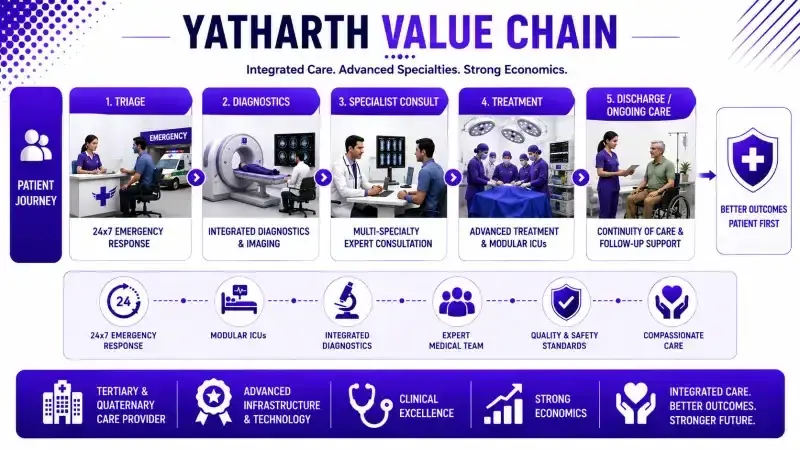
Value Chain
Inside any Yatharth hospital, a patient moves through a pretty standard pathway triage, diagnostics, specialist consult, treatment, discharge or ongoing care. What actually differs hospital to hospital, and what drives the economics more than anything, is who's coming through that pathway. Which specialties they need. How they're paying. How long they stay.Clinically, the network centres on cardiac sciences, neurosciences, renal sciences (including transplants), oncology across medical, surgical and radiation modalities, orthopaedics and spine, gastro sciences, interventional radiology. Round-the-clock emergency response, modular ICUs, integrated diagnostics tying it together this is why the company calls itself a tertiary and quaternary care provider rather than just a general hospital chain.
Commercially, three payer channels: cash, private insurance and TPA, and government schemes like CGHS, ECHS and ESI. This mix might be the single biggest lever in the entire business, because it directly drives
ARPOB average revenue per occupied bed which is probably the clearest signal of how a hospital's economics are actually changing over time. ARPOB is only one part of understanding hospital economics. To evaluate a company properly, investors also need to understand how revenue translates into profitability. Operating Profit Margin vs Net Profit Margin: Which Tells the True Story?
New Delhi and Faridabad Sector-20 were both built to pull almost entirely from cash and private-insurance patients from day one. No easing in gradually, the way the older hospitals in the network did.
Products: Care Across the Acuity Spectrum
The "product," at the end of the day, is clinical care organized around a set of specialty programmes rather than any single flagship offering.Core specialties. Cardiac sciences, neurosciences, renal sciences (nephrology, urology, transplant), oncology, orthopaedics and spine, gastro sciences, pulmonology and internal medicine, interventional radiology. Emergency and primary care sit alongside all of it, keeping the broader patient funnel active.
Oncology keeps coming up in management's own commentary as a priority, and reported segment growth is consistent with that. Revenue in this segment grew from roughly ₹63 crore to close to ₹85 crore year-on-year as of the Q3 FY26 call. Management is guiding toward oncology reaching around 15% of overall specialty revenue within 1.5 to 2 years, up from under 4% just two or three years back. New LINAC installations planned at Faridabad Sector-20 and New Delhi sit right at the centre of that push.
Technology. A Da Vinci Surgical Robot went into Agra, reportedly one of the first in that broader region, with roughly 50 robotic surgeries completed nearby since. There's clinical detail worth mentioning too: Noida Sector-110 performed a navigation-guided awake craniotomy with continuous speech monitoring; Greater Noida completed a complex pan-brachial plexus nerve transfer. Faridabad Sector-20 did 13 POEM procedures within two months of opening, which is a fairly specific, fairly early sign that real clinical capability is being built into a brand-new facility from the start rather than bolted on years later.
A handful of clinicians across the network picked up national recognitions during FY26 pediatric cardiology, neonatology, neurological services leadership, lifetime contribution to critical care medicine. Management chose to put these next to the financial results. That choice says something. They want the expansion read as a clinical story, not just a real-estate one.
Growth Drivers
"Know what you own, and know why you own it." —Peter LynchFor Yatharth, the "why" comes down to a handful of levers that all reinforce each other.
New hospitals are ramping up faster than management's own earlier commentary had suggested. Faridabad Sector-20 reached EBITDA breakeven in roughly nine months, according to management a genuinely short runway for a brand-new facility with a monthly revenue run-rate of ₹12–13 crore and ARPOB near ₹40,000, with room, per management, to reach ₹45,000–50,000. New Delhi and Faridabad Sector-20 together brought in roughly 9% of Q3 FY26 group revenue and about 11% of Q4, in their very first full quarters. For facilities only a few months into operation, that's a meaningful early contribution.
There's also a deliberate pullback from government payers reshaping the whole revenue mix. Government-scheme revenue sits close to 35% of the total right now, and management is targeting 25–28% over roughly two to two-and-a-half years. In the newer hospitals specifically, management doesn't expect government mix past 15–20%, even allowing for some rise off a near-zero base. They've tied this to newer specialty capabilities the network didn't have four or five years ago, ones that let the newer hospitals pull in more self-pay, private-insurance, and international patients right out of the gate.
Regulatory pricing revisions are actually working in the company's favour here. A CGHS/ECHS/ESI rate revision, phased in from December 2025 through the first quarter of calendar 2026, is expected to add roughly 5% to revenue and over 3% to EBITDA. Worth being precise, though FY26 only caught part of that, with the fuller benefit landing across FY27.
Capacity expansion is running on two tracks at once: fill what already exists, build what doesn't yet. As of the latest quarter, several newer facilities were sitting well below their eventual capacity Model Town at roughly 100 census beds against an eventual 300, Faridabad Sector-20 similarly under-launched against its 400-bed ceiling. That gap represents relatively low-capex growth, since the physical infrastructure is already in place. Occupancy can climb inside buildings that already exist, long before the next acquisition even needs to happen.
International patient volumes are still small in percentage terms, but the company's clearly working on it. Management flagged a temporary, industry-wide dip tied to disruptions in Bangladesh, Afghanistan, and parts of the Middle East, alongside continued investment in Africa and the CIS region, an information centre in Uzbekistan, senior marketing staff posted in Africa, more OPD centres planned across the continent. They've also connected the upcoming Jewar Airport to better international patient access, though carefully framed as something that should help the broader medical-tourism ecosystem, not guaranteed demand on its own.
And underneath the longer-term bed target sits a fairly disciplined, repeatable acquisition approach. Management talks about adding at least one hospital a year, screened on three things: does the capex per bed make sense, is the geography big and attractive enough, does the underlying market down to the micro-market have a proven track record. About 70% of the near-term pipeline (not the full eventual 5,000-bed network) is expected through acquisitions, the rest through greenfield builds.
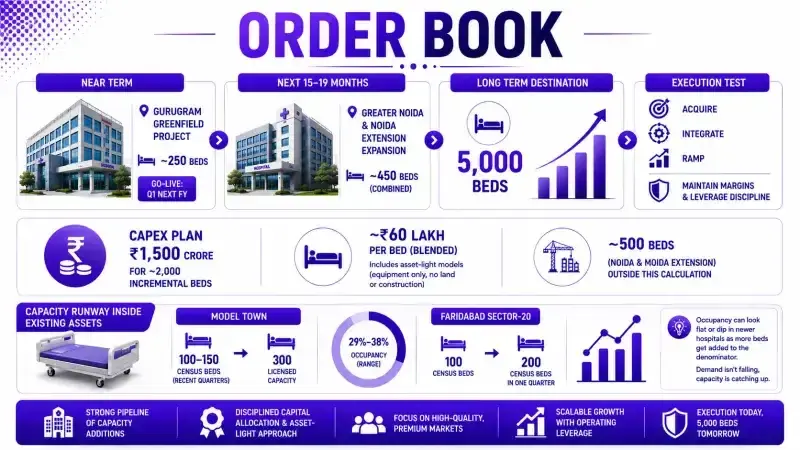
Order Book: The Pipeline of Beds Not Yet Filled
A hospital chain doesn't have a backlog the way a manufacturer does. The closest thing here is the pipeline of announced capacity, plus the runway of beds still waiting to be filled inside buildings that already exist.That pipeline isn't small. A Gurugram greenfield project, around 250 beds, is expected to go live near the first quarter of next fiscal year, a premium NCR asset, with ARPOB potential north of ₹50,000 per management.
For investors, this kind of expansion is ultimately a question of whether additional capacity can translate into sustainable earnings growth. This is why looking Beyond Revenue Growth: 10 Mid-Cap Stocks Where Profits Compound can be useful when assessing whether business expansion is actually creating shareholder value.
Separately, a brownfield expansion at Greater Noida and Noida Extension, adding roughly 450 beds combined, should start coming online over a 15–19 month window.
Longer term, management keeps pointing to 5,000 beds as the destination. And the timeline has been moving up, not out, across recent calls from an original three-year target to something closer to two-and-a-half years by more recent accounts, though the phrasing hasn't always been perfectly consistent call to call, so this is best read as a general direction rather than a fixed date. The 5,000-bed figure is probably better understood less as a near-term revenue forecast and more as a test of execution: can the company keep acquiring, integrating, and ramping up hospitals at this pace without diluting consolidated margins or pushing leverage past what management says it's comfortable with.
On the capex behind this, it's worth being precise about what management actually said rather than doing simple division. The ₹1,500 crore figure was tied specifically to roughly 2,000 incremental beds, not the full 5,000-bed target since around 500 beds of already-planned brownfield expansion at Noida and Noida Extension sit outside that number. On that base, management itself quoted a blended figure of roughly ₹60 lakh per bed, a number an investor on the call flagged as surprisingly low, which management attributed to a mix of asset-light models where only equipment needs funding, not land or new construction.
Inside the beds already in the network, there's a quieter second layer of growth: the gap between census beds, the ones actually staffed and running and total licensed capacity. Model Town, for example, ran around 100–150 census beds against an eventual 300-bed capacity in recent quarters, with occupancy on that base reported anywhere from 29% to 38% depending on which call you're looking at. That spread itself tells you something these numbers move fast as more beds get switched on. Faridabad Sector-20 saw census beds roughly double, from 100 to 200, inside a single quarter.
It's worth sitting with this for a second, because it changes how a reported occupancy number should be read. A newer hospital's occupancy can look flat, even dip, quarter to quarter not because demand is falling, but because the denominator itself keeps growing as more beds get counted as operational.
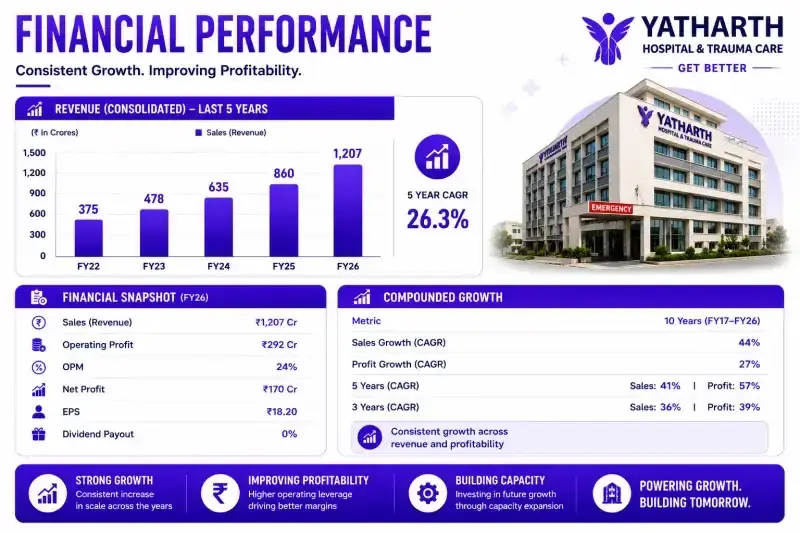
Financials
"The four most dangerous words in investing are: 'this time it's different."
— John Templeton
Growth stories in healthcare infrastructure are prone to exactly that kind of pull. So it's worth grounding this section in what management has actually reported, rather than the story around it.
The underlying question worth holding onto through all these numbers is a simple one: are growth, margins, and cash generation actually improving together, or is one of them being carried by the others?Cash generation is particularly important in a capital-intensive business like healthcare, where accounting profits can look healthy while large amounts of capital remain tied up. This is why Cash Flow Statement Explained: The Most Honest Financial Report is an important framework for understanding the quality of reported earnings.
Revenue growth has clearly been accelerating, and ARPOB has kept climbing alongside it. Consolidated margins, though, remain below what the mature hospitals alone are generating, because the newest facilities are still ramping up and dragging the blended number down. That expansion needs real capital, which is why operating cash flow and leverage matter here just as much as the EBITDA growth headline.
FY25, consolidated: revenue from operations at ₹880.5 crore (₹8,804.87 million), up from ₹670.5 crore (₹6,705.47 million) in FY24. EBITDA at ₹220.2 crore, PAT at ₹130.55 crore. Revenue compounded at roughly 40% a year across FY21–FY25.
Q3 FY26: consolidated revenue of ₹320.5 crore, up 46% year-on-year and 15% quarter-on-quarter the company's highest-ever quarterly revenue and profitability, by management's own account. Existing hospitals alone grew 33% year-on-year; the newly operational New Delhi and Faridabad Sector-20 facilities added ₹27.9 crore in their first full quarter, roughly 9% of group revenue. Reported EBITDA hit ₹74.2 crore, up 35% year-on-year; adjusted for ramp-up losses at the two newest hospitals, margin came to 29.2%. PAT stood at ₹43.1 crore, up 41%; adjusted PAT up 80%. ARPOB rose 10% year-on-year to ₹33,744.
Q1 FY27: consolidated revenue of ₹320.7 crore, up 51% year-on-year, 15% quarter-on-quarter again a record, per management. Reported EBITDA margin came to 23.3%; adjusted for the newest facilities, 28.1%. Group ARPOB (management calls it "RPO" internally) hit an all-time high of ₹34,758, up 7% year-on-year, with Noida Extension and New Delhi both crossing ₹50,000 ARPOB for the first time. Group occupancy across existing hospitals reached roughly 75%.
FY26, full year, as management has characterized it: revenue growth of 36% overall, with Q4 specifically at 47% year-on-year. Occupancy at 71% for Q4, 68% for the full year. Reported EBITDA margin was 24.2% for FY26 (23.4% for Q4 alone); adjusted for new-hospital drag, the numbers jumped meaningfully 28.5% for FY26, 30.4% for Q4. Management cited pre-tax operating cash flow of ₹286.6 crore for FY26, 98% cash conversion against EBITDA, total cash of ₹393.1 crore, and a stated net cash position of ₹116 crore.
One thing deserves flagging plainly rather than smoothed over. In the same call, management's balance sheet commentary contained what looks like an internal inconsistency a reference to gross debt near ₹230 crore, alongside a separately stated net cash figure of ₹116 crore, and then a later exchange where "net debt" and "net cash" got used in ways that don't quite square with each other. The safer read, based on the earlier and clearer statement, is gross debt around ₹230 crore against net cash of ₹116 crore. But this genuinely is a spot where the transcript contradicts itself, and it seemed better to flag that than quietly clean it up.
On margins going forward, it's worth repeating management's own framing rather than dressing it up: consolidated EBITDA margins aren't expected back at the 28–29% level seen in the mature hospital base anytime soon, because new, currently loss-making or still-ramping facilities Gurugram among them keep entering the network. Management's own aspiration is 24–25% consolidated EBITDA for FY27. That's roughly in line with what's already been delivered, not more optimistic. And it's worth being direct about what the adjusted margin figures actually mean: they're useful for understanding how the mature, fully-ramped hospitals are performing on their own, but they shouldn't be mistaken for the company's actual current consolidated profitability, which is the reported figure, not the adjusted one.
On leverage: gross debt rose from around ₹210 crore in March to roughly ₹300 crore more recently, partly acquisition-related, with management comfortable up to about 2x trailing twelve-month EBITDA.
That makes debt-servicing ability another metric worth tracking closely, especially when a company is expanding through acquisitions and new capacity. Interest Coverage Ratio: Can the Company Pay Its Debt Bills? explains how investors can assess whether a company's operating earnings provide enough cushion to service its debt.
Trade receivable days sat around 115–116 days as of the latest quarter, with a target of 105–110 days by March 2027 tied directly, per management, to the ongoing shift away from government-scheme revenue, since government receivables (ESI ones especially) have historically taken longer to collect than cash or private-insurance business.
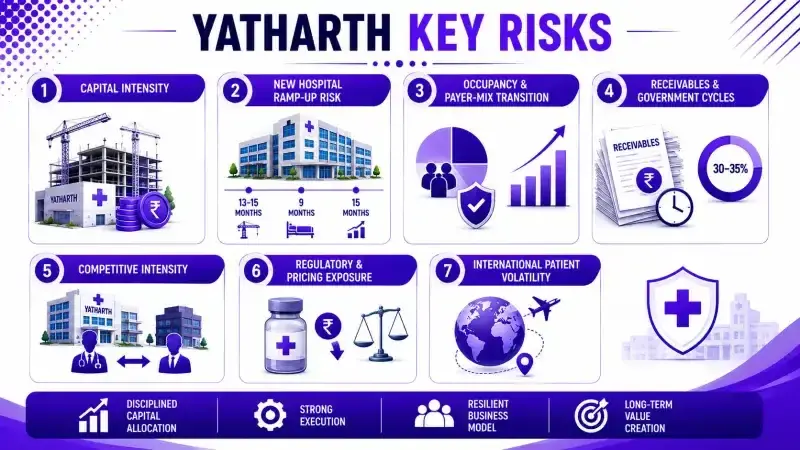
Key Risks for Yatharth Hospital
Capital intensity, and the pace of it all. A ₹1,500 crore capex plan, rising capex-per-bed at newer sites management has cited figures above ₹75–90 lakh per bed for some of the newest facilities, against a blended figure closer to ₹60 lakh across the full pipeline adds up to a real, sustained capital commitment. The cash flow pattern lately, heavy investing outflows partly funded through financing, fits a business mid-build-out. It also means near-term free cash flow is likely to stay pressured until newer facilities mature.New-hospital ramp-up risk. Every new facility carries a stretch of EBITDA drag before it breaks even. Management cited a roughly nine-month breakeven for Faridabad Sector-20, and guided Model Town toward operational breakeven within 15 months, alongside a separate, longer 13–15-month runway before Gurugram was even operational in the first place. Fast ramp-ups at some sites don't guarantee the same at every future one.
Occupancy and payer-mix transition risk. Deliberately limiting government-scheme patients at premium facilities is intentional strategy, by management's own account but it also means near-term occupancy at some sites (Noida Extension's dip was specifically tied by management to this choice) might understate the eventual, fully-ramped picture. If the expected shift toward cash and private-insurance demand doesn't land at the pace management's counting on, occupancy could stay lower for longer than currently guided.
Receivables and government collection cycles. Roughly 30–35% of outstanding government receivables sit specifically within ESI channels, which management describes as slower-paying than other government payers. Receivable days have been trending down, but how fast that continues depends on the pace of the broader payer-mix shift which is a multi-year transition, not something that resolves in a quarter or two.
Competitive intensity in core territories. Management acknowledged new hospital chains entering some of Yatharth's existing NCR markets, along with a degree of doctor-poaching risk they describe as a normal, two-way part of any competitive market entry something Yatharth itself has done entering Delhi and Faridabad.
Regulatory and pricing exposure. Certain oncology drugs saw pricing pressure of roughly 20–30% within that specific category, not across total revenue, since oncology is only about 10% of the group total. Separately, an unresolved income-tax matter was described by management as nearing conclusion, with no material financial liability expected and no operational impact so far. Worth noting this remains management's own characterization, not an independently confirmed outcome.
International patient volatility. Recent quarters saw a temporary, industry-wide dip tied to disruptions in specific source markets. Yatharth's actively building alternative pipelines in Africa and the CIS region, but this segment is still a single-digit share of overall revenue and inherently more exposed to geopolitical and travel disruption than the domestic patient base.
The thesis here isn't hard to state. Whether it plays out is a different question, and it's one that shows up in a handful of trackable numbers each quarter rather than in the story itself.
Bed additions and ramp-up. New beds commissioned, census beds versus total capacity, occupancy progression at each facility, and time to EBITDA breakeven for whichever hospital is newest in the network.
ARPOB. Group-level ARPOB, ARPOB specifically at the newer hospitals, and whether the premium facilities can hold ₹40,000–₹50,000-plus levels as they scale rather than just hitting them briefly in an early quarter.
Payer mix. Government share of revenue, cash and private-insurance share, and whether the 25–28% government-mix target actually gets hit on the timeline management has laid out.
Margins. Reported EBITDA margin against the adjusted, mature-hospital margin, and how much drag the newest facilities are still contributing each quarter.
Capital efficiency. Capex per bed on each new project, return on capital employed, operating cash flow, and free cash flow since this is a business where growth and cash generation need to be read together, not separately.
Balance sheet. Gross debt, net cash or net debt (with the reporting inconsistency flagged earlier worth watching for a cleaner disclosure going forward), how acquisitions are being funded, and receivable days.
Acquisition execution. How many hospitals actually get acquired against the stated one-a-year cadence, the purchase price and capex per bed on each deal, and how long each one actually takes to reach profitability compared to management's guided timeline.
Tracking these each quarter turns the thesis from a story into something testable, a way to see whether the pattern holds, rather than simply assuming it will because it has so far.
Explore our Products
Research Framework

Emerging Titans
Combination of quantitative analysis, industry tailwinds, and management assessment - SPRINT investment philosophy

Tiny Titans
Heavy emphasis on scuttlebutt research, plant visits, and early on-ground signals
Conclusion
"The stock market is filled with individuals who know the price of everything, but the value of nothing."—Philip Fisher
Bed count tends to dominate the headlines here. But the more revealing numbers sit one layer under that: adjusted margins running well above reported ones, a payer mix being reshaped on purpose, newer hospitals hitting breakeven faster than the company's own history would have predicted.
The core structural case holds up reasonably well. Yatharth operates in the NCR one of India's most demand-dense private healthcare corridors using a brownfield model built specifically to shrink the gap between buying a hospital and that hospital actually adding to group profit. And the playbook's already worked more than once: Greater Faridabad turning profitable in FY26, Faridabad Sector-20 breaking even in roughly nine months, Agra arriving already profitable. That track record gives the 5,000-bed ambition more weight than a number floating alone on a slide would.
The payer-mix strategy is really what sets this apart from a straightforward bed-count growth story. Capping government exposure at premium facilities, even at the near-term cost of slower occupancy, prioritizes payer quality and ARPOB potential over maximizing near-term occupancy. You can see that trade-off showing up in ARPOB figures crossing ₹50,000 at the newest, most cash-and-insurance-heavy hospitals.
Still, this is a capital-intensive growth story, and the risks reflect exactly that. ₹1,500 crore in capex. Rising capex-per-bed at newer sites. Receivables still weighted toward slower-paying government channels. A margin profile management itself says won't return to peak levels soon, because new, currently-diluting hospitals keep joining the network. None of that is a footnote. It's the actual cost of running the same playbook that's driving the growth in the first place.
Howard Marks has written that the real risk investors face is often not the risk they can see and price in, it's the risk they've stopped looking for, because a story's started to sound too convincing. The useful discipline here is treating management's stated targets: the 5,000 beds, the 24–25% margin goal, sub-30% government mix as guidance to check against actual delivery each quarter, not outcomes already banked. So far, across Greater Faridabad, Faridabad Sector-20, and Agra, execution has kept pace with or beaten management's own earlier commentary.
Put simply, the investment case rests on three things holding together: whether Yatharth can keep acquiring and ramping up hospitals at capital costs that make sense, whether the payer-mix shift can keep lifting ARPOB without giving up too much occupancy along the way, and whether consolidated margins can hold somewhere near management's 24–25% FY27 aspiration even as the network keeps expanding. If those three hold, the bed-expansion strategy has a real path to becoming sustained earnings growth rather than just a growth narrative. If they don't, the same expansion currently driving the thesis is exactly what could turn into the bigger source of capital and margin pressure down the line
FAQs
What is Yatharth Hospital's business model?
+Yatharth Hospital primarily follows a brownfield acquisition model, where it acquires existing hospitals instead of building most facilities from scratch. It then integrates them using common clinical protocols, EMR systems, staffing models and governance processes, allowing acquired hospitals to reach profitability faster.
What are the key growth drivers for Yatharth Hospital?
+The key growth drivers are new hospital acquisitions, ramp-up of existing capacity, higher-value specialties, improving payer mix and rising ARPOB. Newer facilities such as Faridabad Sector-20 and New Delhi have started contributing meaningfully, while the company is also targeting further capacity expansion toward 5,000 beds.
Why is ARPOB important for Yatharth Hospital?
+ARPOB (Average Revenue Per Occupied Bed) is an important measure of hospital economics because it reflects the revenue generated from occupied beds. Yatharth is trying to improve ARPOB by increasing the contribution from cash-paying and private-insurance patients and expanding higher-value specialties. Its newer hospitals have already reached ARPOB levels of around ₹40,000–₹50,000 or more.
What is Yatharth Hospital's 5,000-bed expansion plan?
+Yatharth Hospital has identified 5,000 beds as a longer-term network target. Management expects around 70% of its near-term pipeline to come through acquisitions, with the remainder through greenfield projects. The company is also pursuing a Gurugram greenfield hospital and additional brownfield expansion at Greater Noida and Noida Extension.
What are the key risks for Yatharth Hospital?
+The major risks include high capital requirements, new-hospital ramp-up risk, occupancy and payer-mix transition, slower government receivables, competition in NCR markets and international-patient volatility. The company's expansion also requires substantial capex, meaning cash flows could remain under pressure while newer hospitals are still being ramped up.

High growth stock specialist, Value Educator
Shashank Mahajan is an equity research professional with over 12 years of experience in identifying high-potential SME and micro-cap stocks at an early stage. He follows a rigorous scuttlebutt research–driven approach, combining on-ground insights with deep financial analysis. Shashank specializes in uncovering under-researched and under-owned companies with strong management quality and long-term growth potential. Through disciplined research and early identification, he focuses on spotting tomorrow’s market leaders before they enter the mainstream investor radar.

Zen Technologies: Revenue Fell After a Big Win




PNG Jewellers: A 194-Year-Old Name Goes National

Explore our Products
Research Framework
Emerging Titans
Combination of quantitative analysis, industry tailwinds, and management assessment - SPRINT investment philosophy
Tiny Titans
Heavy emphasis on scuttlebutt research, plant visits, and early on-ground signals


 Orders
 Subscription
 Share with friends


Required Details
₹23999.00
(12 month subscription)
As per SEBI regulations, all users are mandated to complete the KYC that is validated for 1 year. Post payment, you will be redirected to the KYC screen


No comments yet. Be the first to comment!