
MIDHANI: Special Alloys for Rockets, Jets and Reactors
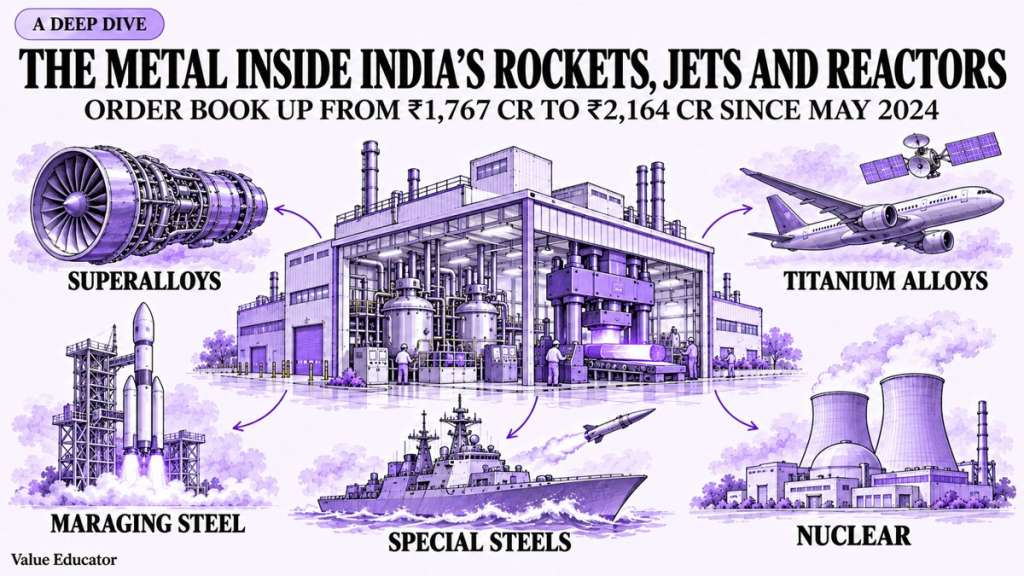
India now builds its own missiles, rockets, fighter engines, submarines and nuclear reactors. Each of them needs metals that hold their strength at temperatures and pressures that ordinary steel cannot survive. Most of those metals still come from abroad. Titanium alloys, superalloys and special steels worth about ₹8,000 Cr a year are imported into India in grades that one Indian company already makes.
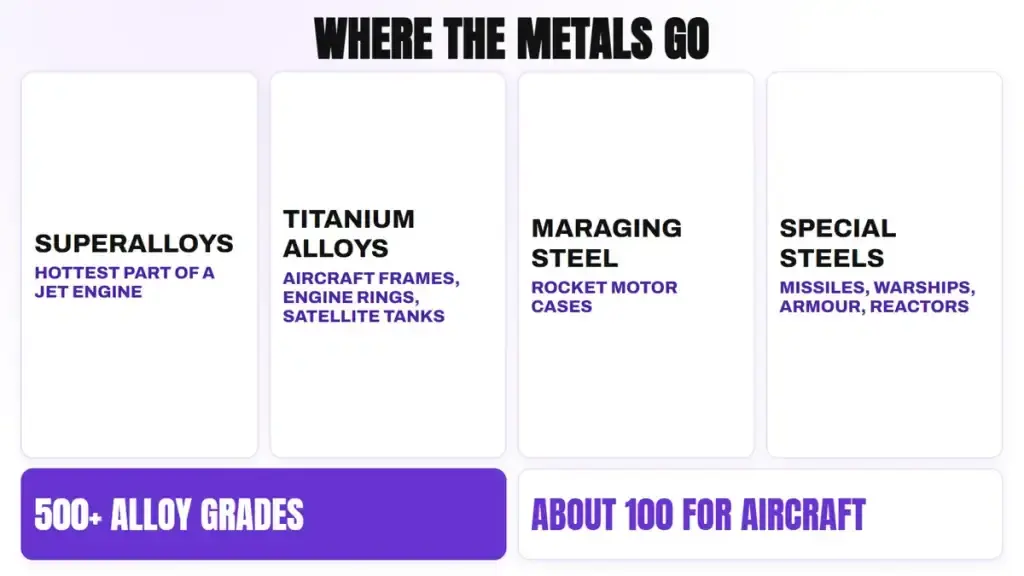
Those metals have names of their own. Superalloys means nickel-, cobalt- or iron-based alloys that keep their strength close to their melting point, which is why they go into the hottest part of a jet engine. Maraging steel is an ultra-high-strength steel that gets its strength from ageing after it is made, and it holds the fuel of a rocket motor. Titanium alloys are light and strong, so they go into aircraft frames, engine rings and satellite fuel tanks.
These metals are made in a small, slow business. A plant melts high-purity nickel, cobalt, molybdenum, tungsten and titanium sponge in vacuum furnaces, so that no air gets into the metal. It then forges, rolls and draws the metal into bars, plates, rings and wires. Every batch is tested before it ships, and a customer such as an engine maker approves each grade only after years of trials.
One Hyderabad company does all of this under one roof. Mishra Dhatu Nigam Ltd (NSE: MIDHANI), set up by the Ministry of Defence in 1973, makes more than 500 alloy grades, about 100 of them for aircraft. It describes itself as the only maker of titanium alloys and maraging steels in India. The Government of India owns 74% of it. It melts to each customer's order and sells mill products to DRDO laboratories, ISRO, HAL and other defence companies, who machine them into finished parts.
That melting work has been growing. FY26 brought record revenue of ₹1,208.63 Cr, and titanium output reached about 700 tonnes, the highest in its history. You will find its metals in every stage of the PSLV, GSLV and LVM-3 rockets.
MIDHANI in five numbers
- Q2 FY27 revenue of ₹295.91 Cr, up 41.09% from a year ago
- An order book of ₹2,164 Cr on 1 October 2026, about 1.8 times FY26 revenue
- Record FY26 revenue of ₹1,208.63 Cr, up 12.52%
- About 700 tonnes of titanium produced in FY26, the highest ever
- About ₹8,000 Cr a year of imports in grades it already makes
So what is driving a government metal mill to record numbers? Let's first understand the company, and then look at the latest quarter.
MIDHANI: Company Overview
Mishra Dhatu Nigam Ltd (MIDHANI) was set up by the Ministry of Defence in 1973 at Kanchanbagh in Hyderabad and started production in 1982. The Government of India owns 74% of its shares, and Dr. S.V.S. Narayana Murty is the chairman and managing director. The company melts, forges, rolls and draws superalloys, titanium alloys, maraging steel and other special steels, and it makes more than 500 alloy grades, about 100 of them for aircraft. It runs two plants: the main metals plant in Hyderabad and an armour and springs unit at Rohtak in Haryana. It had 760 permanent employees at March 2026. FY26 revenue was a record ₹1,208.63 Cr, and the company ended March 2026 with about ₹192.1 Cr of cash against borrowings of about ₹284.0 Cr. Read this PSU vs Private Defence Stocks for 2026
"Time is the friend of the wonderful business, the enemy of the mediocre."
— Warren Buffett
For a metal maker whose customers approve each grade over years, time works in favour of the supplier that is already approved. The question for MIDHANI is whether it can turn that head start into growth.
The Quarter Revenue Grew 41%
Let's begin with Q2 FY27, the July to September 2026 quarter. Revenue was ₹295.91 Cr, up 41.09% from ₹209.73 Cr a year ago. This time, profit grew even faster than sales.
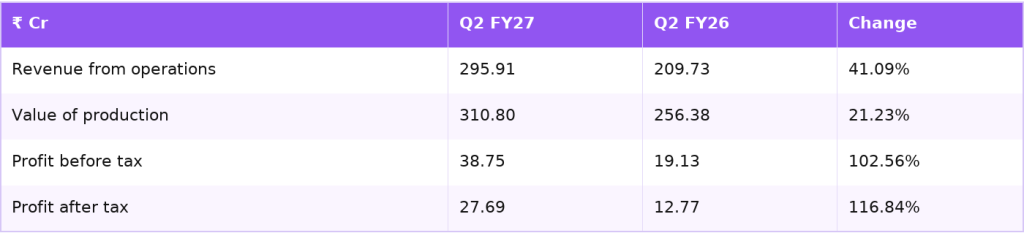
That revenue figure counts what was shipped and billed. Value of production counts what the plant made in the quarter, including metal still in process. It was ₹310.80 Cr, up 21.23%. So the plant again made more than it billed, and that extra metal is still in the pipeline for later quarters. Read this Inventory Turnover Ratio Explained
That gap between making and billing is normal for MIDHANI. Its customers take most deliveries late in the year, so the fourth quarter carries the largest share. In FY26, Q4 alone brought ₹552.75 Cr, about 46% of the year's revenue. The first half is usually the smaller half, which is why H1 FY27 matters as a starting point.
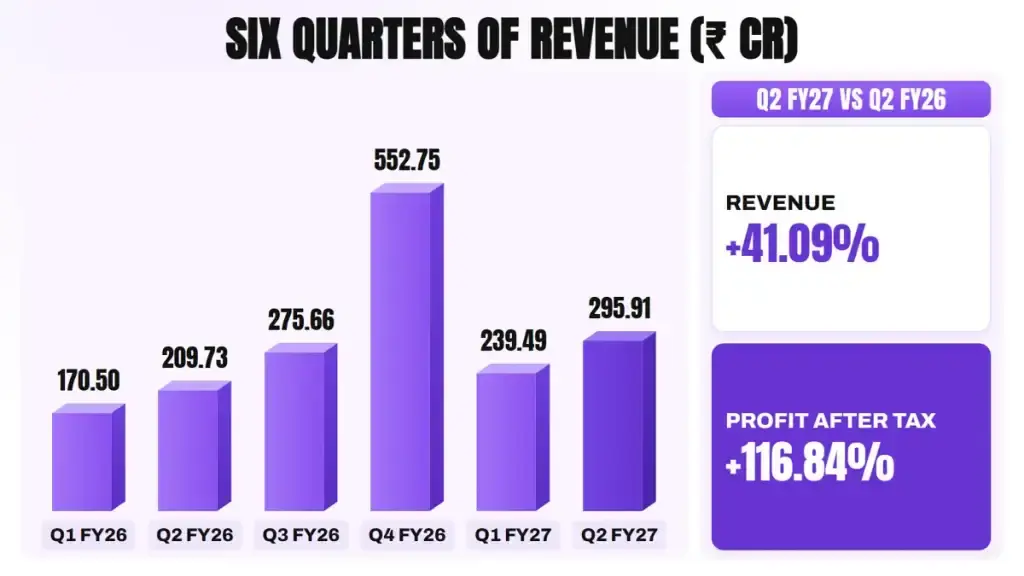
Those six quarters show the pattern clearly. Revenue was ₹170.50 Cr in Q1 FY26, ₹209.73 Cr in Q2, ₹275.66 Cr in Q3 and ₹552.75 Cr in Q4. It then started FY27 at ₹239.49 Cr and rose to ₹295.91 Cr in Q2. Each quarter of FY26 was larger than the one before it.
The profit line is where Q2 differed from Q1. Profit before tax was ₹38.75 Cr, about 13.1% of revenue, against about 9.1% a year ago, and profit after tax rose 116.84% to ₹27.69 Cr. In Q1, profit after tax had grown only 27.42%, to ₹16.31 Cr, while revenue grew 40.46%.
In Q1, two costs held profit back. The prices of nickel, molybdenum and tungsten jumped, and LPG, which fires MIDHANI's furnaces, nearly doubled in price during the West Asia crisis. At the time, management expected margins to return to normal from Q3 FY27. We come back to these costs near the end.
"Barring certain supply chain disruptions with respect to LPG and raw materials, we think the situation will stabilize in the coming quarter." - S.V.S. Narayana Murty, MIDHANI
Across the first half, revenue was ₹535.40 Cr, up 40.81% from ₹380.22 Cr, and profit after tax was ₹44.01 Cr, up 72.05% from ₹25.58 Cr. Value of production for the half was ₹571.15 Cr, up 14.76%.
That first half follows a full year that set records. FY26 revenue was ₹1,208.63 Cr, up 12.52% from ₹1,074.10 Cr. EBITDA on the company's measure was ₹275.59 Cr, up 10.69%, and profit after tax was ₹130.79 Cr, up 18.82%. The whole of that year's output was converted into sales, something the company had found hard in earlier years.
The Orders Behind the Order Book
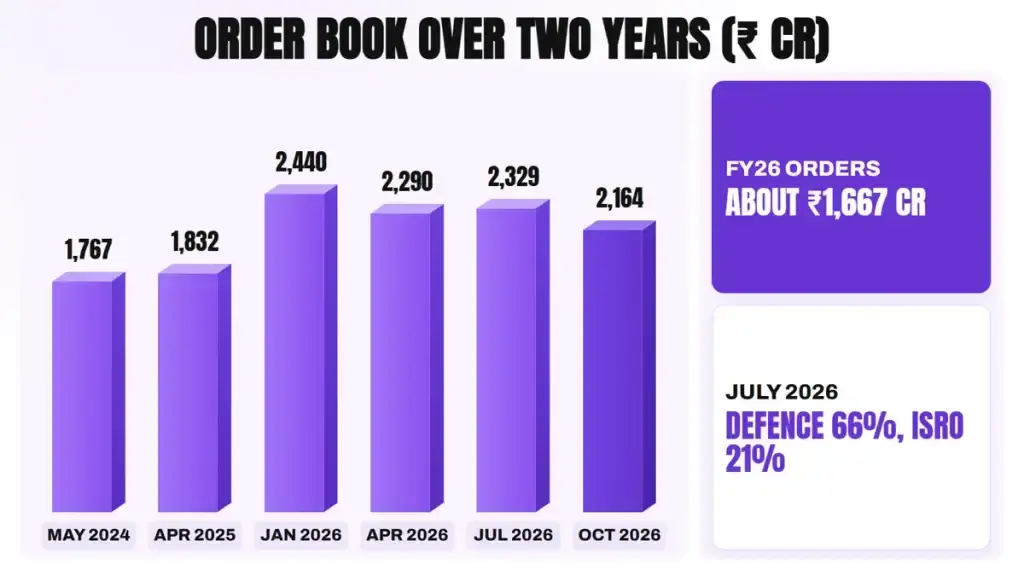
So who is placing these orders? The order book was ₹2,164 Cr on 1 October 2026, against ₹2,329 Cr on 1 July and ₹2,290 Cr on 1 April. Adding back each quarter's revenue, new orders were about ₹278 Cr in Q1 FY27 and about ₹131 Cr in Q2, so deliveries outpaced new orders in the second quarter.
That book has grown a lot in two years. It was ₹1,767 Cr in May 2024 and ₹1,832 Cr on 1 April 2025. It then rose to ₹2,440 Cr on 1 January 2026, before deliveries in the busy fourth quarter brought it to ₹2,290 Cr. Over FY26, orders of about ₹1,667 Cr came in, against ₹1,208.63 Cr of revenue.
Four of those orders were large enough to announce on their own. They came between September 2025 and February 2026.
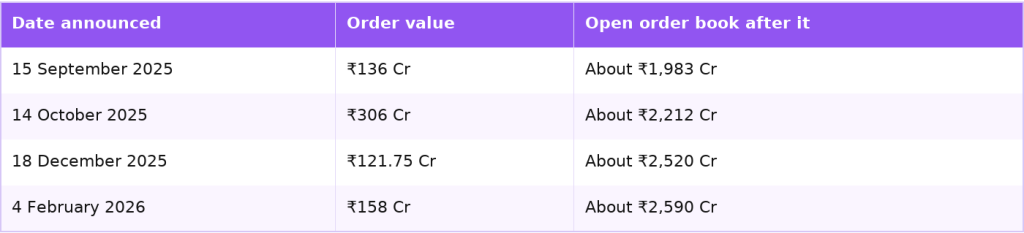
These four orders add up to about ₹722 Cr, so many smaller orders made up the rest of the year's intake. The book is also spread across customers. On 1 April 2026, defence orders were ₹1,569 Cr, space ₹488 Cr, energy ₹139 Cr and others ₹94 Cr. By July, defence made up 66% of the book, ISRO 21%, energy 9% and others 4%.
That mix matters for how long the book lasts. ISRO places orders at least two years before it needs the metal, because it plans each rocket's build calendar well ahead. Defence programmes also run for years, so the book gives visibility well beyond one quarter. For FY27, management expects new orders of about ₹1,500 Cr.
Why the book matters more than one quarter: ₹2,164 Cr of orders against FY26 revenue of ₹1,208.63 Cr is about 1.8 years of work at last year's pace. Titanium alone made up about ₹600 Cr of orders in August 2026, and titanium earns more than special steels.
How a 1973 Defence Mill Got Here
To see why the book has grown, let's go back to why the company exists. In 1973, the Ministry of Defence set up MIDHANI in Hyderabad so that India could make its own superalloys, titanium alloys and special steels. Production started in 1982. For decades, it made metals on nomination, which means a customer gave the order to MIDHANI without a tender.
That model began to change in the last five years. MIDHANI spent about ₹800 Cr on capital projects in the five years to FY24, and about ₹600 Cr of that went into a wide plate mill. The mill rolls titanium plates and wide steel plates that India used to import. A second plant at Rohtak in Haryana makes armour products such as bullet-proof jackets.
Those investments came just as demand picked up. Revenue was about ₹872 Cr in FY23 and rose about 23% to about ₹1,073 Cr in FY24. It held at about ₹1,074 Cr in FY25 and then reached the record ₹1,208.63 Cr in FY26. Over the same years, the order book roughly doubled from the ₹1,000 Cr level it held in earlier years.
That growth also brought a long list of firsts in FY26. MIDHANI received airworthiness approval from CEMILAC, India's military airworthiness authority, for 10 aerospace grades. It earned NADCAP accreditation for heat treatment, an approval that global aerospace buyers use to choose suppliers. It opened a ₹40 Cr plant to make aerospace fasteners and supplied more than 700 superalloy and titanium rings for aero engines.
Some of those firsts were visible to the public, and you may have seen them. MIDHANI supplied 31 titanium windows for the Ram Mandir in Ayodhya, the first architectural use of titanium in India. It also delivered about 90 tonnes of armour steel for the presidential dais used on Republic Day. And it made a single-crystal superalloy blade material that passed all of its customer's tests for the first time.
That last item is the hardest of them all. A single-crystal blade is cast so that the whole blade grows as one crystal, with no grain boundaries inside it. That lets it survive the heat behind an engine's combustion chamber. Management calls this the highest level of skill in metallurgy, because the chemistry must stay within very tight limits. MIDHANI now melts this feedstock for Indian engine programmes.
Four Families of Metal and Who Buys Them
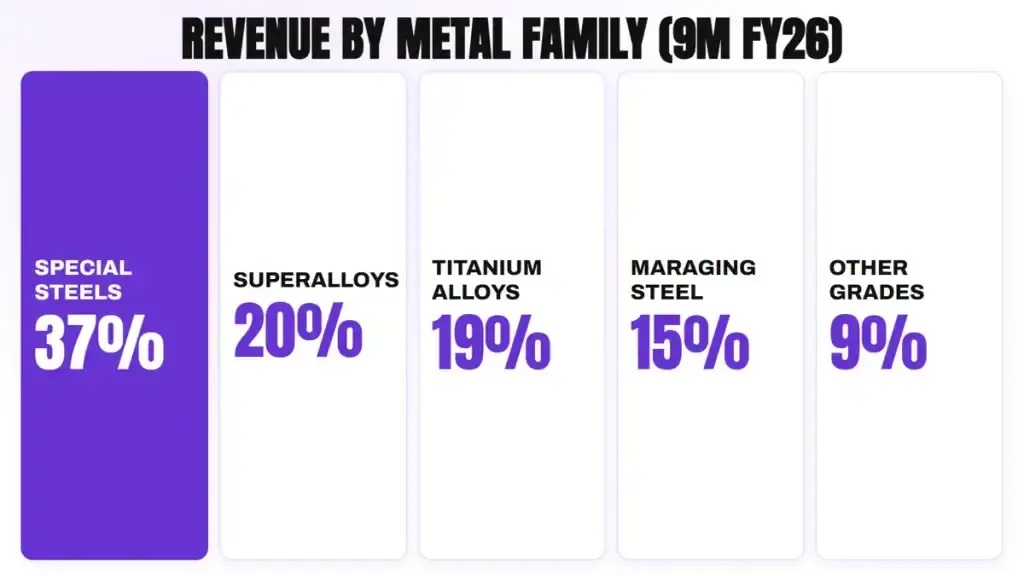
Now let's look at what MIDHANI actually sells. The company reports one segment, but it splits revenue by the family of metal it makes. Read this Segment-Wise Revenue Analysis Explained For the nine months to December 2025, special steels gave 37% of revenue, superalloys 20%, titanium alloys 19% and maraging steel 15%.
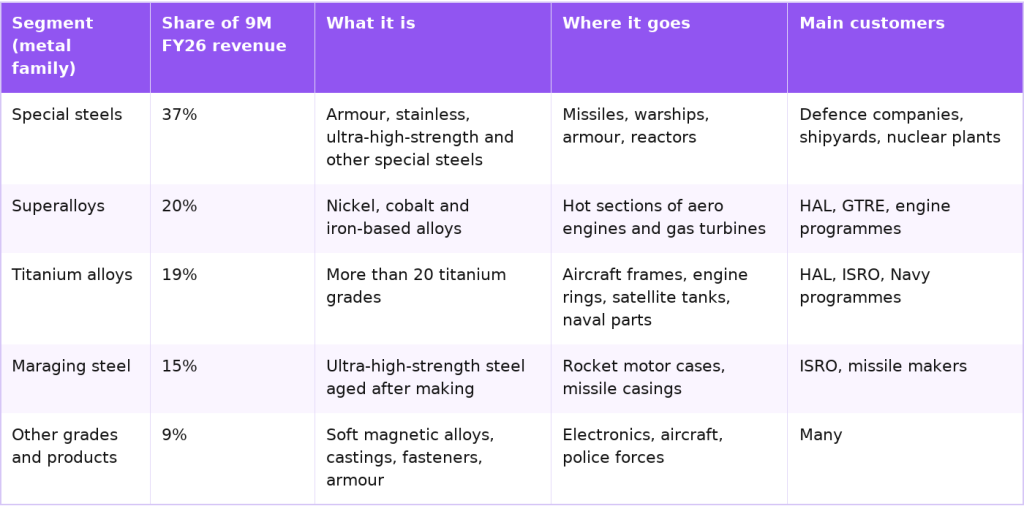
These families differ in how they are made and who uses them. Superalloys are melted for heat, so engine makers buy them for parts that sit behind the flame. Titanium is chosen for light weight, so aircraft and satellite makers buy it to save mass. Maraging and other special steels are chosen for raw strength, so rocket and missile makers buy them for casings that carry huge pressure.
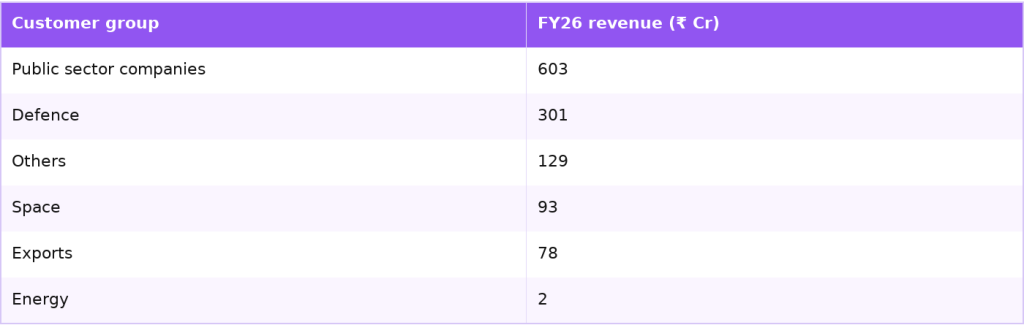
The same metals reach very different customers. In FY26, public sector companies such as HAL bought ₹603 Cr of metal, and defence customers bought ₹301 Cr. Space customers bought ₹93 Cr. Others bought ₹129 Cr, energy customers ₹2 Cr and export customers ₹78 Cr.
These families also differ in margin. Titanium and maraging steel earn a little more than superalloys, and ultra-high-strength steels for missiles and rockets earn the most. So the margin in any quarter depends on which orders the plant delivers.
"Know what you own, and know why you own it."
— Peter Lynch
With MIDHANI, knowing what you own means knowing which metal family is being delivered in a quarter, because titanium, maraging steel and special steels earn different margins. Let's take each business in turn.
Before we do, one cost runs through all of them. Every family starts with imported metal, and in FY26 MIDHANI used about ₹255 Cr of imported raw materials. So when you read about nickel or titanium prices abroad, you are also reading about MIDHANI's costs at home.
Superalloys for Fighter Engines
Let's start with superalloys, which gave 20% of revenue and carry the company's most demanding work. Every jet engine has stages of discs and blades. The hot stages behind the combustion chamber use superalloys, and the cooler stages in front use titanium.
That engine work is now a national priority. India is developing the Kaveri engine and its successors and co-producing foreign engines. Programmes such as the Kaveri, the F414 and M88 co-production, and the AMCA fighter are expected to sharply increase demand for superalloys and titanium forgings. Globally, the superalloys market was about $9.40 Bn in 2025 and is projected to reach about $23.06 Bn by 2036.
That engine work has included MIDHANI for a long time. It has worked with GTRE, DRDO's engine laboratory, on the Kaveri programme for about 24 years. Every Kaveri engine that has been flight-tested uses only MIDHANI's materials. It also melts the single-crystal feedstock from which turbine blades are cast, so any Indian blade maker buys that input from it.
That engine work moved forward in Q1 FY27. MIDHANI isothermally forged a nickel superalloy for a fighter engine on its 6,000-tonne press. Isothermal forging means the die and the metal are held at the same high temperature, so very hard alloys can be shaped without cracking. It also received orders for four superalloy grades and three titanium grades for the same programme this year.
This aero business was already large a year ago. In July 2025, about ₹761 Cr of the ₹1,827 Cr order book came from aerospace customers. The next step is supply to global engine makers, who have been auditing the plant several times. Management expects the first such supplies towards the end of FY27.
Titanium, the Fastest-Growing Metal
Next, let's look at titanium, which gave 19% of revenue and is growing fastest. Titanium is light, strong and resists corrosion, so it goes into aircraft structures, engine rings, satellite propellant tanks and submarine parts. India's titanium market was about $679.1 Mn in 2024 and is projected to reach about $1,048.5 Mn by 2033.
That demand has a supply problem behind it. Before 2022, a large share of the world's aerospace titanium came from one Russian company, VSMPO-AVISMA. Aircraft and engine makers have since looked for other qualified sources. MIDHANI buys its titanium sponge from East European countries and Kazakhstan, and it melts and processes that sponge itself.
MIDHANI has added melting capacity to meet this demand. It installed a new vacuum arc remelting furnace, which melts titanium again under vacuum to clean it, and titanium output reached about 700 tonnes in FY26. In August 2026, management put last year's titanium melting at about 750 tonnes and said it expects that to grow.
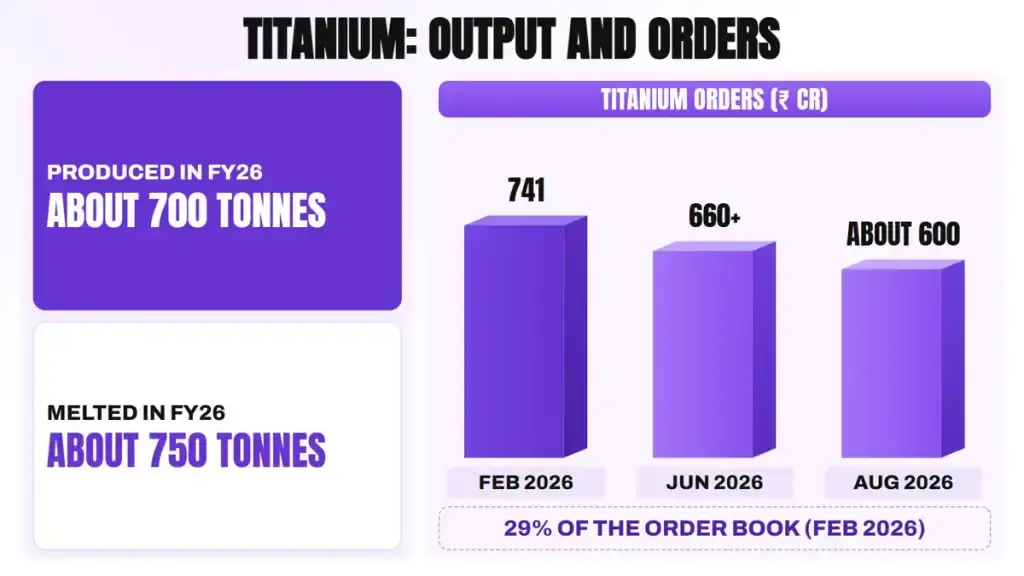
That capacity is filling with orders. Titanium orders were ₹741 Cr in February 2026, about 29% of the order book. They were more than ₹660 Cr in June 2026 and about ₹600 Cr in August, as deliveries continued. Management said the titanium plant was running at full capacity.
Titanium also brings new kinds of products. MIDHANI developed titanium alloy slabs for aircraft structures, dished heads and shells for naval vessels, and the largest titanium casting poured in India. For AMCA, India's planned fifth-generation fighter, ADA has given it development orders for special titanium alloys of hard-to-make thicknesses. Bulk orders would follow once the programme is approved.
Maraging and Special Steels for Rockets, Missiles and Armour
Now let's turn to steels, which together gave about half of revenue. Maraging steel gave 15% and special steels 37%. This is MIDHANI's oldest business, and it reaches every part of India's rocket and missile programmes.
That rocket demand is set to grow. India's space plans include the Gaganyaan crewed missions, the Bharatiya Antariksh Station, commercial launches and Mangalyaan-2 missions. Each of them needs special steel and titanium over many years.
Those rockets already carry MIDHANI's metal, and it also flew on Chandrayaan-3. Its maraging steel forms the rocket booster cases, and its titanium forms gas bottles and propellant tanks. For human spaceflight such as Gaganyaan, customers ask for 100% virgin metal with no scrap in the melt, which shows how strict this work is.
The steels business also reaches the armed forces. MIDHANI makes ultra-high-strength steels for missiles, armour plates for vehicles and armour steel for warships. India's defence exports reached ₹23,622 Cr in FY25, and more of the material for those weapons is now sourced at home.
That defence work fills most of the order book we saw earlier. Defence and space orders together made up about 90% of the book in April 2026.
Nuclear Reactors and Energy
Next, let's look at nuclear and energy, the smallest business today but one with a long runway. India plans to reach 100 gigawatts of nuclear power by 2047. That means many new reactors, and each one needs certified special metals for its tubes, vessels and fittings.
MIDHANI has supplied nuclear materials for decades. It supplied metals for the prototype fast breeder reactor at Kalpakkam, which recently reached criticality. It is now executing orders for steam generator tubes, and those grades were developed at MIDHANI. It also makes the mother hollows, the thick hollow blanks from which nuclear tubes are drawn.
Beyond reactors, energy also covers power plants. With IGCAR, Nuclear Fuel Complex and NTPC, MIDHANI developed the 740H nickel superalloy for tubes in advanced ultra-supercritical power plants, which run hotter than today's coal plants. Energy orders were ₹139 Cr on 1 April 2026, so this business is still small next to defence.
Fasteners, Armour and Other New Products
Finally, let's look at the new products MIDHANI makes from its own metal. In FY26, it called this a shift from raw material supplier to an integrated product company. The products are aerospace fasteners, castings, welding electrodes, springs, fabricated titanium parts and body armour.
Fasteners are the largest of these new lines. MIDHANI built a ₹40 Cr plant for aerospace bolts, screws and rivets made from special steel, titanium and superalloys, mainly for missile and space programmes. It expects at least ₹20-30 Cr a year of orders from this plant. Its edge is that other fastener makers import their wire, while MIDHANI draws its own.
After fasteners, armour is the next line. MIDHANI holds technology from BARC for Bhabha Kavach jackets and from DRDO and IIT Delhi for ABHED jackets, which are among the lightest in their class. The ABHED jackets are under ballistic testing, and the company plans to bid for tenders from paramilitary and police forces.
These other lines are smaller but add to the base. Investment castings bring about ₹10 Cr a year. A spring plant at Rohtak can make more than 60,000 springs a year for railway coaches and wagons, and BEML has placed a sample order. MIDHANI has also started rolling customers' aluminium ingots into plates on its wide plate mill.
Exports add a customer base beyond India. FY26 export orders worth ₹85 Cr were delivered. In Q1 FY27, exports were ₹33 Cr, with another ₹25 Cr of export orders open. Management aims for exports of about 10% of turnover.
Why MIDHANI's Metals Are Hard to Copy
Now that we have seen every business, let's understand why customers keep coming back to MIDHANI. The moat starts with approval. A customer such as an engine maker tests a new metal source through samples, first articles and batch trials before it allows that source into a flying part. That takes years for each grade, and switching means repeating it. Read this Economic Moat Explained
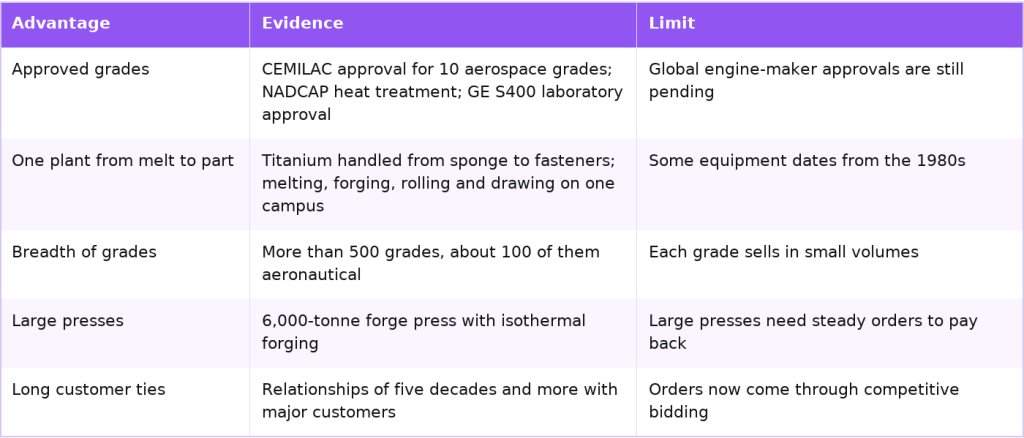
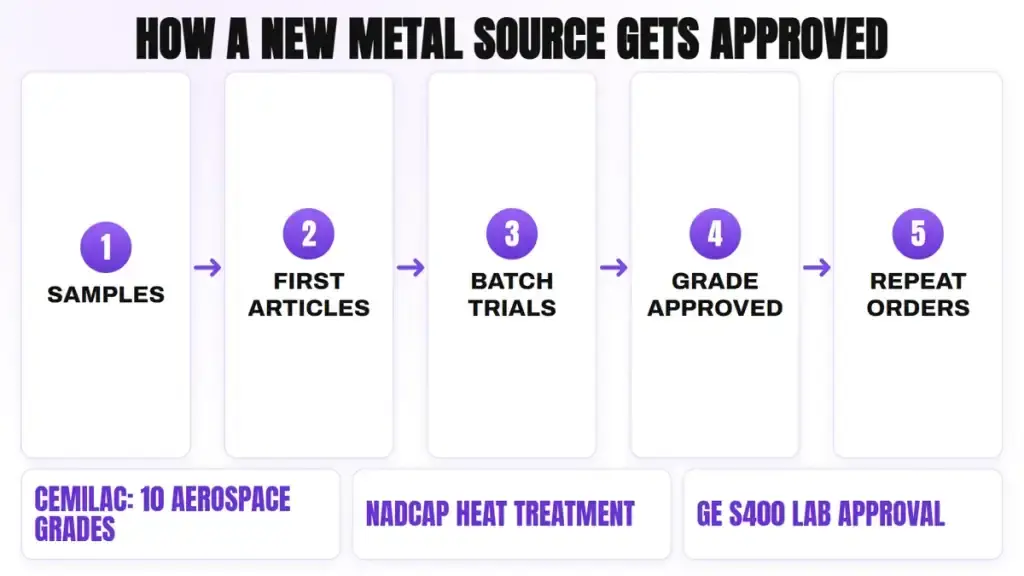
That approval wall is highest for flying parts. MIDHANI's own testing shows how much the process involves. GE's S400 approval, received on 13 August 2026, lets MIDHANI test the mechanical, chemical and metallographic properties of metal for any customer, in India or abroad. Management says it is the only laboratory in India that does all of these tests under that approval.
That testing ties into the next approval. MIDHANI's non-destructive testing staff have qualified under NAS410, a step towards NADCAP accreditation for non-destructive testing, which the company plans to get by March 2027. With each approval, Indian buyers who import special alloys today can switch to MIDHANI without new tests abroad.
That approval sits on top of a second layer, the plant itself. MIDHANI handles titanium all the way from sponge compaction to ingot, forging, plate, bar, wire and fasteners. Its Hyderabad campus has vacuum induction, vacuum arc and electroslag remelting furnaces, 1,500-tonne and 6,000-tonne forge presses, a ring rolling mill, an extrusion press and a wide plate mill.
That range of equipment matters because the grades are so many. Each engine or aircraft programme uses its own grades, often in small quantities. A plant that can switch between more than 20 titanium grades and hundreds of steels and superalloys can serve all of them. A new entrant would need years of equipment and approvals before it could match that range.
"An investment in knowledge pays the best interest."
— Benjamin Franklin
MIDHANI's edge is five decades of metallurgy knowledge built into its grades, approvals and equipment. That knowledge is what a new entrant cannot buy quickly.
Those many grades lead to a third layer, scrap, which the company calls a gold mine. Every grade leaves behind scrap that can be melted again, and specifications usually allow 50-60% scrap in a melt. Because MIDHANI makes so many grades, it holds scrap of many kinds. Management sees that scrap as raw material that is getting harder to buy as the world races for critical minerals.
"If you technically speak, this is not a scrap. It is a gold mine." - S.V.S. Narayana Murty, MIDHANI
That scrap also helps the new metal bank. MIDHANI is setting up a stock of six critical raw materials for five customers, stored on its campus but owned by the customers. When a supply route breaks, the metal is drawn from the bank and replaced later. The stock stays in the customers' books, so it does not add to MIDHANI's inventory.
Customers also invest in that plant. Some of MIDHANI's equipment has been paid for by customers, a practice the company lists among its strengths. When a customer funds a press or a furnace for its programme, it has every reason to keep its orders there.
That combination is hard to copy. Global rivals such as ATI, Carpenter Technology, VSMPO-AVISMA and Haynes International hold larger scale and engine-maker approvals. In India, though, no other plant makes titanium alloys and maraging steel together with superalloys under one roof. For India's defence and space programmes, that makes MIDHANI the first place to go for most of these metals.
Financials: Record Revenue, Lower Margins and Cash Tied in Metal
MIDHANI's last five years show revenue rising to a record while margins settled at a lower level. EBITDA here is the company's own measure, which includes other income; operating cash flow is from each year's latest annual report.
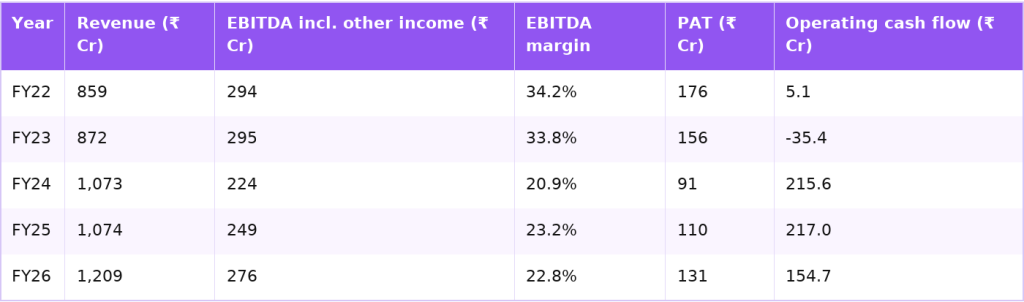
Revenue grew from ₹859 Cr in FY22 to a record ₹1,209 Cr in FY26, with most of the rise in FY24 and FY26. The EBITDA margin on the company's measure moved from about 34% in FY22 and FY23 to about 21-23% from FY24, as orders moved from nomination to competitive bidding and raw material costs rose on fixed-price contracts. Profit after tax followed the same path, from ₹176 Cr in FY22 to ₹91 Cr in FY24, before recovering to ₹131 Cr in FY26.
Cash flow tells a different side of the business. From FY22 to FY26, operating cash flow added up to about ₹557 Cr, against profit after tax of about ₹664 Cr, because metal in process and finished stock kept growing. Inventory stood at ₹1,332.6 Cr at March 2026, more than a year of revenue, and receivables were 167 days of revenue.
Debt is modest. Borrowings were about ₹284.0 Cr at March 2026 against net worth of about ₹1,530.8 Cr, a debt-to-equity ratio of 0.19, and cash was about ₹192.1 Cr. Capital spending was ₹49.3 Cr in FY26, ahead of the proposed ₹1,000 Cr modernisation plan.
"Cash is to a business as oxygen is to an individual: never thought about when it is present, the only thing in mind when it is absent."
— Warren Buffett
MIDHANI has rarely run short of cash, but its long production cycles keep a large share of its money locked in metal. Turning more of that inventory into cash is one of the plainest tests of the next two years.
What FY27 Could Look Like on Management's Numbers
So what could all of this add up to for you as a reader following MIDHANI? In June 2026, management said revenue growth of 15% was its target for FY27, with 20% possible if raw materials and energy allow. In August, it said FY27 growth would beat FY26's 12.52%, though not the 40% of Q1.
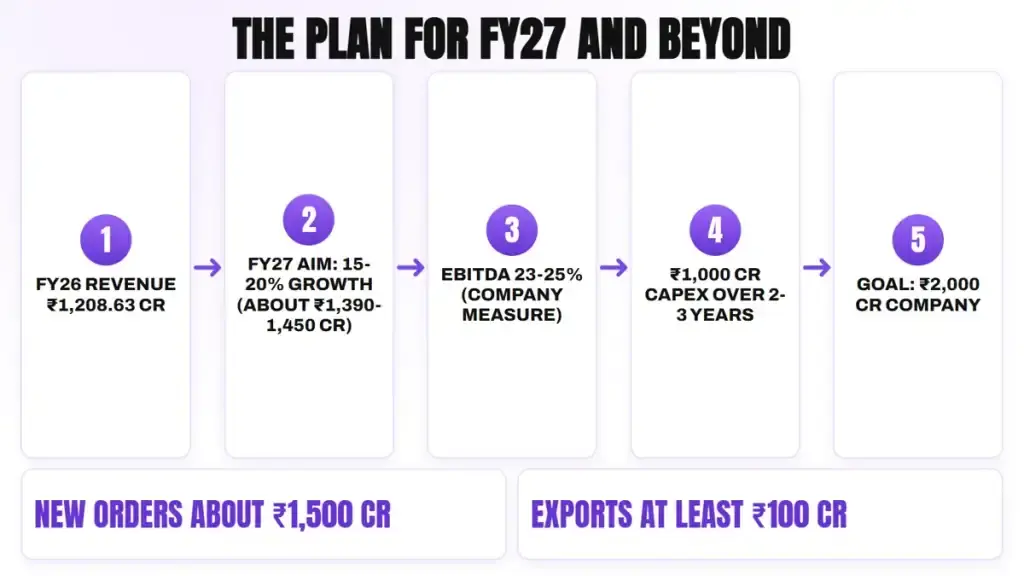
On FY26 revenue of ₹1,208.63 Cr, growth of 15-20% would mean about ₹1,390-1,450 Cr in FY27. The first half has delivered ₹535.40 Cr of that. So the second half would need about ₹855-915 Cr. In the second half of FY26, revenue was ₹828.41 Cr, so the plan needs it to grow by roughly 3-10%. Management expects an EBITDA margin of 23-25% on its own measure, which includes other income, against about 22.8% in FY26.
Beyond FY27, the plan depends on a larger capital programme. MIDHANI has proposed about ₹1,000 Cr of capital spending over two to three years, mainly for downstream forging equipment and to replace machines installed in the 1980s. The proposal is with the Ministry. Management expects the results to show from about the fourth year, once the new equipment settles in.
"We are 100% confident of executing all the orders." - S.V.S. Narayana Murty, MIDHANI
That capital plan supports a longer goal. In February 2026, management said it wants MIDHANI to move towards a ₹2,000 Cr company over the coming years. It points to the ₹8,000 Cr of imports in grades it already makes as the market it can win, once more customers accept its approvals.
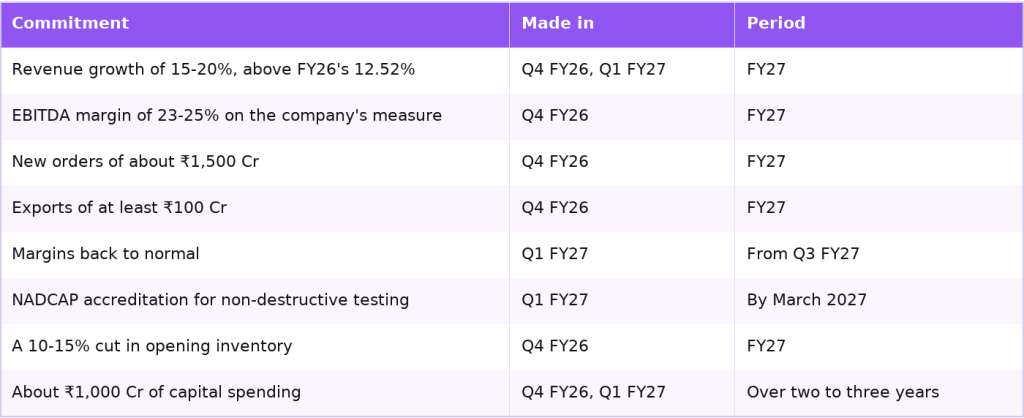
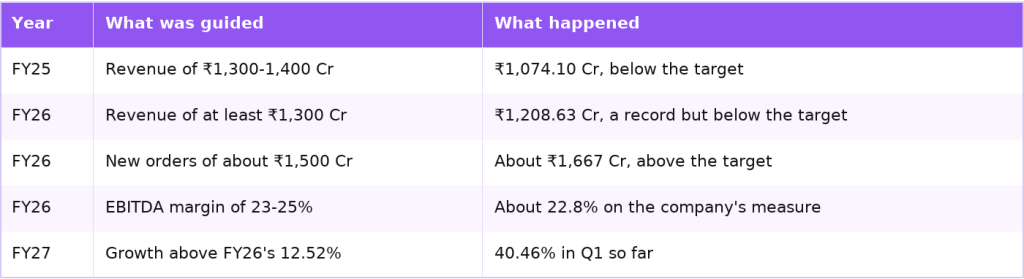
These commitments come with a record we can check. In 2024, management expected FY25 revenue of ₹1,300-1,400 Cr. Revenue came in at ₹1,074.10 Cr. The FY26 target was lower, and revenue of ₹1,208.63 Cr still came in under it. On orders, the record is better, because the ₹1,500 Cr expected for FY26 turned into about ₹1,667 Cr.
Key Risks
No business grows in a straight line, so let's look at what could go wrong for MIDHANI.
- Raw material prices on fixed-price contracts: about 75-80% of raw materials are imported, and most defence contracts carry fixed prices. In Q1 FY27, higher prices of nickel, molybdenum and tungsten caused about ₹13-14 Cr of adverse price variance that the company could not pass on.
- Energy costs: the furnaces run on LPG, and LPG prices nearly doubled during the West Asia crisis. That added about ₹5 Cr of cost in Q1 FY27, and the EBITDA margin fell to about 19.5% from about 24.2% a year earlier.
- Margins below the old level: orders that once came on nomination are now all won through competitive bidding. The EBITDA margin on the company's measure was about 22.8% in FY26, while its own MoU target with the government was 33%.
- Cash tied up in stock: inventory was about ₹1,332.6 Cr at March 2026, more than a full year of revenue, because long production cycles keep metal in process. Receivables were 167 days of revenue against a MoU target of 90 days.
- A record of missed revenue targets: revenue came in below guidance in FY25 and FY26, and the FY26 MoU revenue target of ₹1,580 Cr was missed by a wide margin. New targets need to be read against that record.
- Sanctions and shipping: titanium sponge comes from Eastern Europe and Kazakhstan, and cobalt supply is dominated by a few countries. Sanctions have already stopped some purchases, and shipments have been held up by conflicts.
- Claims and contingent liabilities: contingent liabilities were about ₹449.1 Cr at March 2026, against about ₹291.4 Cr a year earlier. They include about ₹310.1 Cr of claims not acknowledged as debt and about ₹20.8 Cr of provisional liquidated damages on late customer orders.
"Risk means more things can happen than will happen."
— Howard Marks
For MIDHANI, those things include metal prices, LPG costs, sanctions and the pace of government approvals. The risks above are the ones the numbers already show.
Explore our Products
Research Framework

Emerging Titans
Combination of quantitative analysis, industry tailwinds, and management assessment - SPRINT investment philosophy

Tiny Titans
Heavy emphasis on scuttlebutt research, plant visits, and early on-ground signals
What to Track Next
If you follow MIDHANI, these are the signals that will show whether the plan is on track.
- Q3 FY27 results, and whether profit keeps growing faster than revenue after Q2
- The EBITDA margin returning towards 23-25% from Q3 FY27 as LPG and metal prices settle
- New orders picking up after a slow Q2: about ₹409 Cr came in over H1 by our arithmetic, against about ₹1,500 Cr expected for FY27, and the order book recovering from ₹2,164 Cr
- The first supplies to a global engine maker, expected towards the end of FY27
- Ministry approval of the ₹1,000 Cr capital plan and the first equipment orders
- Inventory moving down from about ₹1,332.6 Cr and receivables from 167 days
Conclusion
Let's step back and put it all together. MIDHANI makes the metals that India's rockets, missiles, fighter engines and reactors cannot do without, and in many grades it is the only Indian source. FY26 brought record revenue of ₹1,208.63 Cr, and the order book stood at ₹2,164 Cr in October 2026, about 1.8 years of work. The cautious thread is cash and margins: operating cash flow of ₹154.7 Cr in FY26 trailed profit, inventory of ₹1,332.6 Cr is more than a year of revenue, and the margin is still below management's 23-25% aim.
So the next two years will show whether that position can turn into steady growth and better margins. The approvals, the titanium capacity and the metal bank all point the right way. If raw material and energy costs settle and the capital plan is approved, MIDHANI could grow into its ₹2,000 Cr goal; if they do not, it will stay a vital supplier with thinner margins than its metals deserve.
FAQs
What does MIDHANI make?
+MIDHANI makes superalloys, titanium alloys, maraging steel and other special steels, with more than 500 alloy grades, about 100 of them for aircraft. Its metals go into fighter engines, rockets, missiles, warships, armour and nuclear reactors, and it also makes aerospace fasteners, castings and body armour.
Who are MIDHANI's customers?
+Its customers are DRDO laboratories, ISRO, HAL and other public sector companies, the armed forces, nuclear plants and export buyers. In FY26, public sector companies bought ₹603 Cr of metal, defence customers ₹301 Cr and space customers ₹93 Cr.
How big is MIDHANI's order book?
+The order book was ₹2,164 Cr on 1 October 2026, about 1.8 times FY26 revenue, down from ₹2,329 Cr on 1 July. In July, defence made up 66% of it, ISRO 21%, energy 9% and others 4%, and management expects about ₹1,500 Cr of new orders in FY27.
How did MIDHANI perform in Q2 FY27?
+Revenue was ₹295.91 Cr, up 41.09% from a year ago, and profit after tax was ₹27.69 Cr, up 116.84%. For the first half, revenue was ₹535.40 Cr, up 40.81%, and profit after tax was ₹44.01 Cr, up 72.05%.
What is MIDHANI's plan for FY27?
+Management aims for revenue growth of 15-20% and an EBITDA margin of 23-25% on its own measure, which includes other income. It also expects about ₹1,500 Cr of new orders, exports of at least ₹100 Cr and has proposed about ₹1,000 Cr of capital spending over two to three years.
What are the main risks for MIDHANI?
+The main risks are imported raw material prices on fixed-price contracts, LPG costs for its furnaces, inventory of ₹1,332.6 Cr, receivables of 167 days, a record of missed revenue targets, sanctions on supply routes and contingent liabilities of ₹449.1 Cr.

High growth stock specialist, Value Educator
Shashank Mahajan is an equity research professional with over 12 years of experience in identifying high-potential SME and micro-cap stocks at an early stage. He follows a rigorous scuttlebutt research–driven approach, combining on-ground insights with deep financial analysis. Shashank specializes in uncovering under-researched and under-owned companies with strong management quality and long-term growth potential. Through disciplined research and early identification, he focuses on spotting tomorrow’s market leaders before they enter the mainstream investor radar.
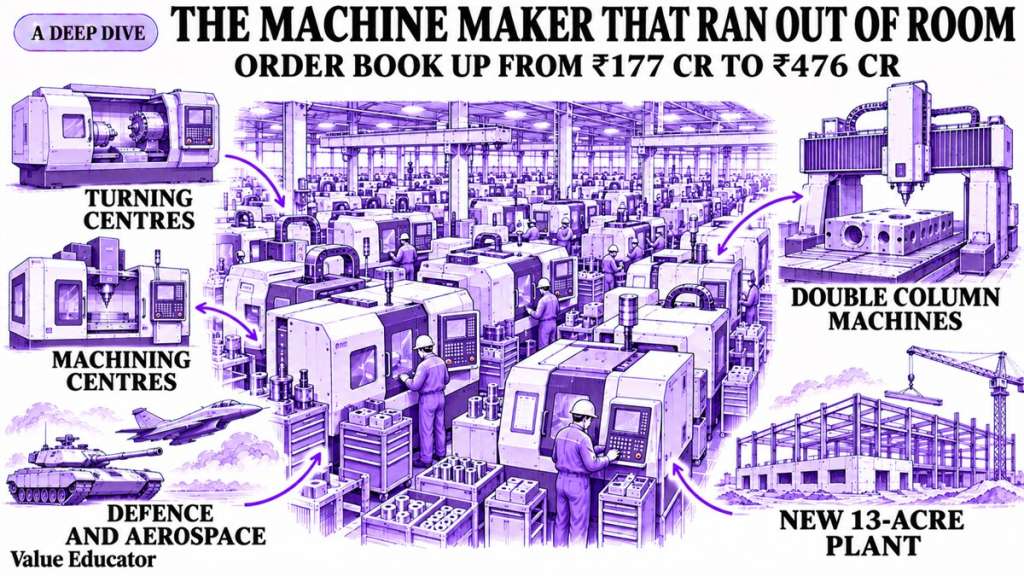
Macpower CNC: A Rajkot Machine Maker With ₹476 Cr of Orders
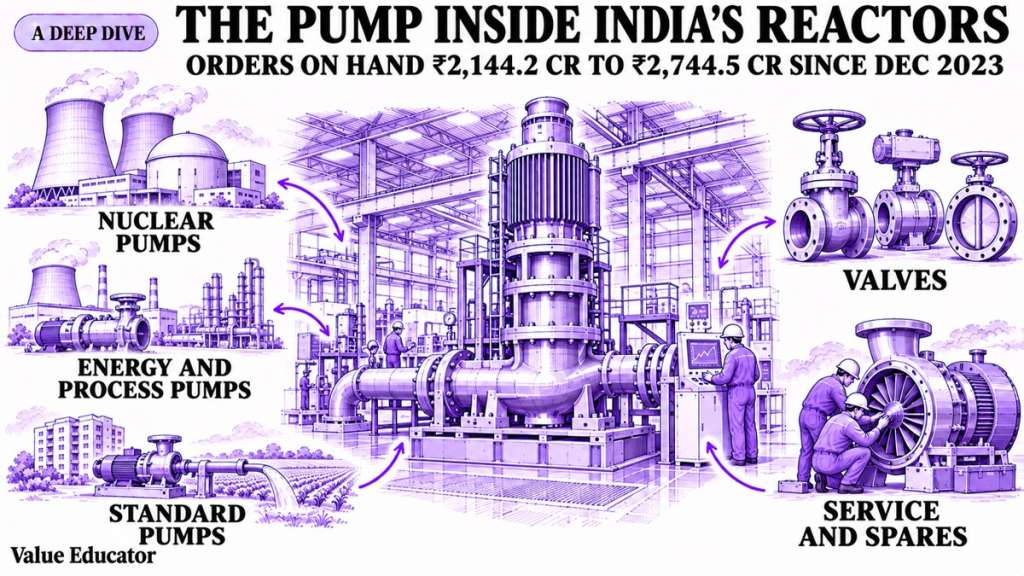
KSB: The Pune Pump Maker With ₹1,235 Cr of Reactor Orders

Kilburn Engineering: The Dryer Maker With ₹470 Cr of Orders

Rossell Techsys: Boeing and Lockheed Wiring From Bengaluru
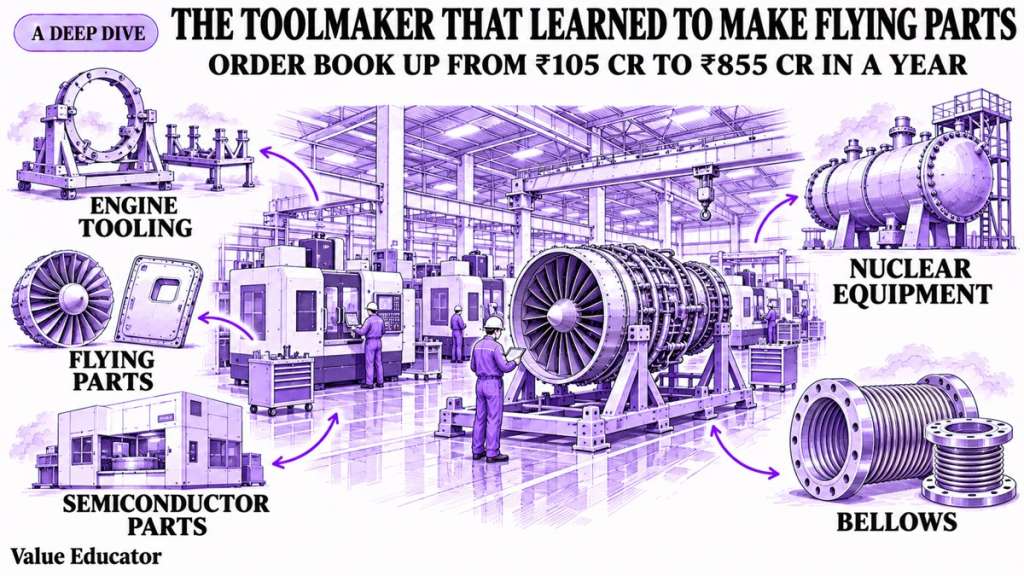
Unimech Aerospace: From Engine Tools to Flying Parts

Taneja Aerospace: The Airfield With ₹161 Cr of Rent Signed
Explore our Products
Research Framework
Emerging Titans
Combination of quantitative analysis, industry tailwinds, and management assessment - SPRINT investment philosophy
Tiny Titans
Heavy emphasis on scuttlebutt research, plant visits, and early on-ground signals



Modern Warfare to Multibaggers
Key Trends. Strategic Shifts. Opportunities Ahead.
Don't Miss This Exclusive Webinar!
Join Value Educator to decode the key trends shaping India's defence sector and learn how to identify tomorrow's potential leaders in the space.
- In-depth research on India's defence sector
- Live Q&A session
- Actionable takeaways for long-term investors

 Orders
 Subscription
 Share with friends


Required Details
₹23999.00
(12 month subscription)
As per SEBI regulations, all users are mandated to complete the KYC that is validated for 1 year. Post payment, you will be redirected to the KYC screen


No comments yet. Be the first to comment!