
Premier Explosives: Missile Propellants and a ₹1,642 Cr Book
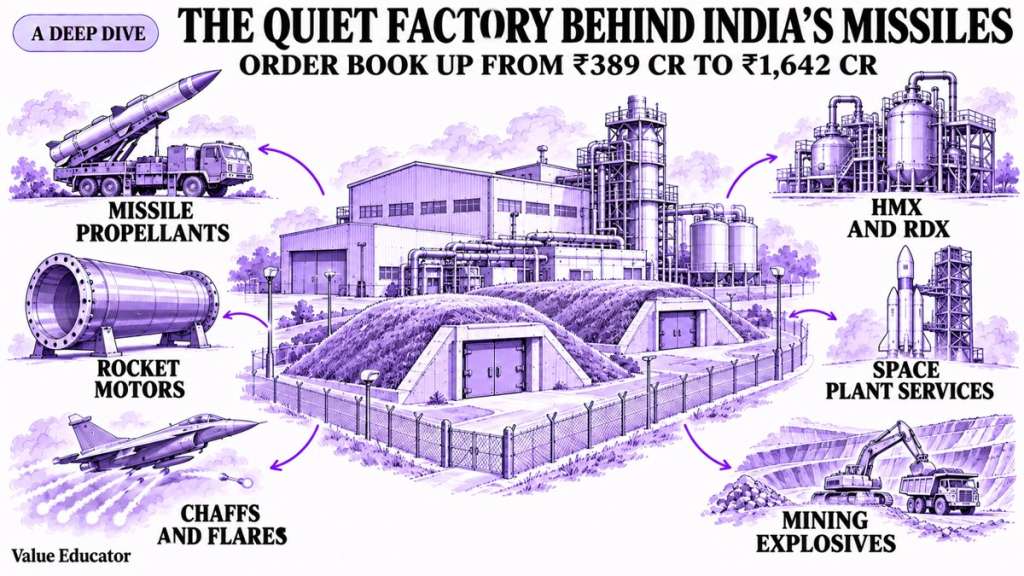
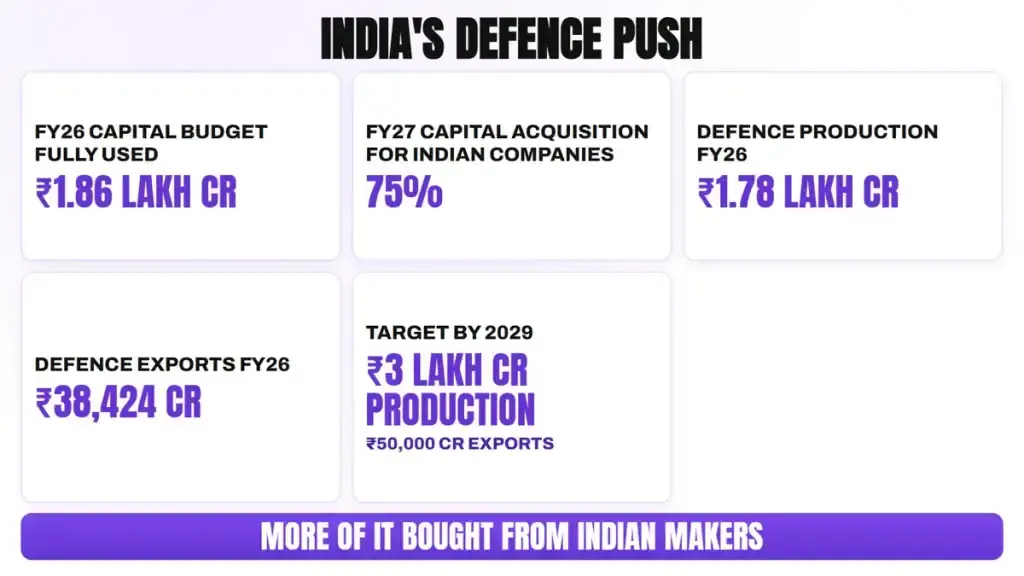
India's defence factories had their biggest year ever in FY26. Defence production reached a record ₹1.78 lakh Cr, up 15.6% from the year before. Defence exports rose 62.7% to a record ₹38,424 Cr, and Indian defence products now go to over 80 countries. The government wants ₹3 lakh Cr of yearly production and ₹50,000 Cr of exports by 2029.
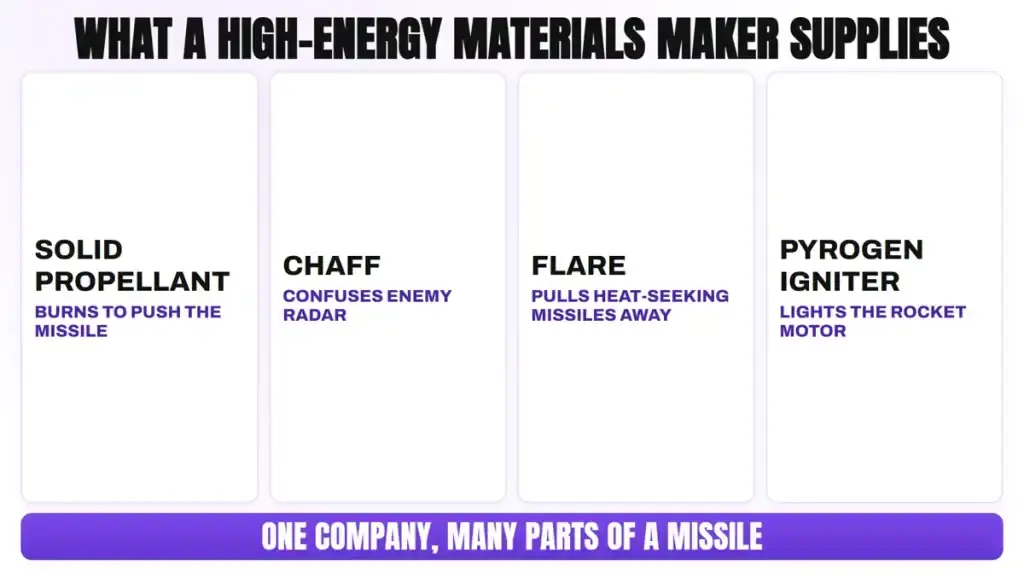
Behind every missile in that production is a small amount of material that does the real work. High-energy materials is the name for the propellants, explosives and pyrotechnics that make a missile fly, a warhead go off or a decoy burn. A solid propellant is a rubbery mix of fuel and oxidiser cast inside a rocket motor. Once it is lit, it burns steadily and pushes the missile forward.
That propellant reaches a missile through a long chain. In India, DRDO, the government's defence research body, designs a missile. Bharat Dynamics Limited (BDL), the state-owned missile maker, then builds it in series. BDL buys many parts from specialist suppliers, and for some propellant orders it hands the supplier the key ingredients itself. A supplier enters this chain only after its propellant is qualified for that particular missile. After that, its orders follow the missile's production for as long as the missile is built.
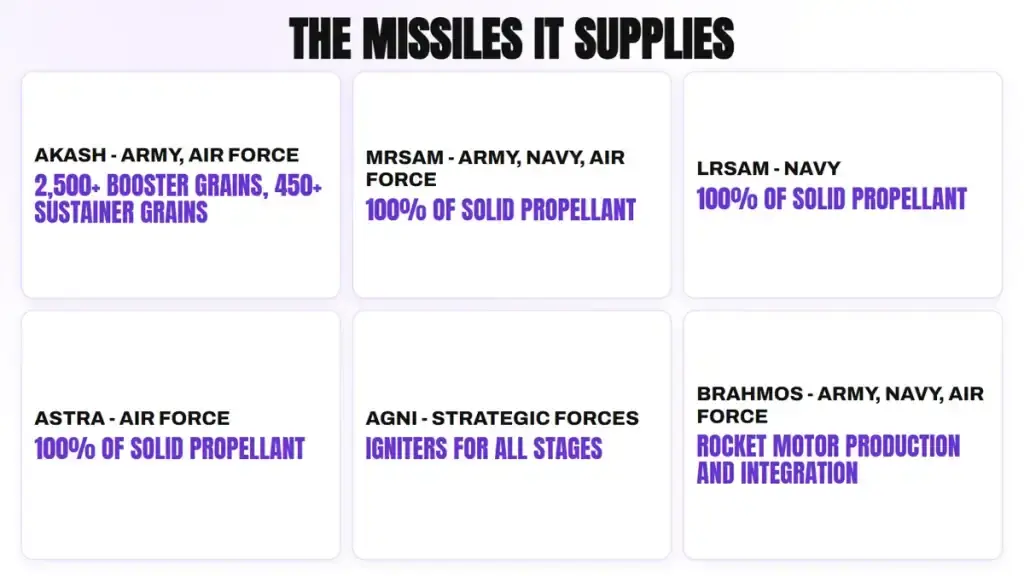
One Hyderabad company holds that position on several Indian missiles. Premier Explosives Ltd (NSE: PREMEXPLN), set up in 1980, supplies 100% of the solid propellant needed for the MRSAM, LRSAM and Astra missiles. It has supplied more than 2,500 booster grains and 450 sustainer grains for the Akash missile, and it makes the pyrogen igniters for all stages of Agni. It is also the only qualified Indian company for countermeasures. Countermeasures is the term for the chaffs and flares that protect aircraft from incoming missiles. A chaff is a cloud of fine strips that confuses an enemy radar, while a flare is a hot decoy that pulls a heat-seeking missile away from the aircraft.
Premier Explosives in five numbers
- Q2 FY27 revenue of about ₹145.3 Cr, up 92.2% from a year ago
- An order book of ₹1,642 Cr in October 2026, about 4.23 times FY26 revenue
- 96% of that order book from defence
- A ₹429.56 Cr order from the Ministry of Defence in October 2025 for chaffs and flares
- Defence and space at 86% of Q2 FY27 revenue
So how did a company that began with mining explosives end up with a record defence order book? Let's first understand the company, and then look at the latest quarter, where those orders began to turn into revenue.
Premier Explosives: Company Overview
Premier Explosives Ltd was set up in Hyderabad in 1980 by Dr A. N. Gupta and is listed on the BSE and NSE. It makes high-energy materials for defence, space and mining: solid propellants and rocket motors for missiles, chaffs and flares for the Air Force, pyrotechnic devices, HMX and RDX, warheads and mines, and bulk and packaged explosives, detonators and detonating fuse. It also runs and maintains the solid propellant plant at ISRO's Sriharikota centre. It has six plants in Telangana, Madhya Pradesh and Maharashtra and 855 permanent employees, about 100 of them engineers and scientists. FY26 revenue was ₹388.3 Cr, 81% of it from defence and space. In July 2026, Apollo Micro Systems agreed to buy the promoters' 41.33% stake, and it has since completed an open offer for another 26%. Read this Best Defence Stocks in India for 2026
"Risk comes from not knowing what you're doing."
— Warren Buffett
Explosives and propellants are a business where knowing what you are doing is the product itself. Premier Explosives has spent over four decades learning to make them safely, and the numbers below show what that know-how earns.
The Quarter When Deliveries Picked Up
Let's look at Q2 FY27, the July to September quarter, when deliveries picked up sharply. Revenue was about ₹145.3 Cr, up 92.2% from about ₹75.6 Cr a year ago and 41.6% from the quarter before. For the first half of FY27, revenue was about ₹247.8 Cr, up 13.8%. Let's see where it came from.
That jump came almost entirely from defence. Defence and space revenue was ₹1,246 Mn in Q2 FY27, up 97% from ₹632 Mn a year ago, while commercial explosives, the mining business, grew 67% to ₹207 Mn. So defence and space gave 86% of the quarter's revenue. We see that share as the clearest sign of where the company is heading.
That step up is what management had pointed to in August. It said several export licences had arrived in the previous week and that material had already left the factories. It also said imported parts for countermeasures, which had arrived late, were now in hand. Management had expected exports of about ₹150-200 Cr in Q2 FY27 once those licences came through.
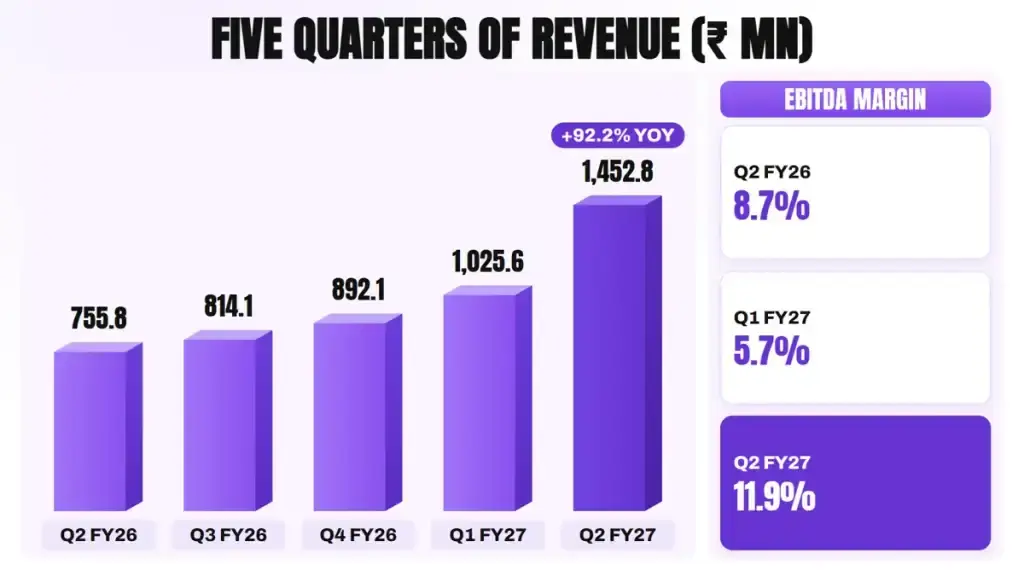
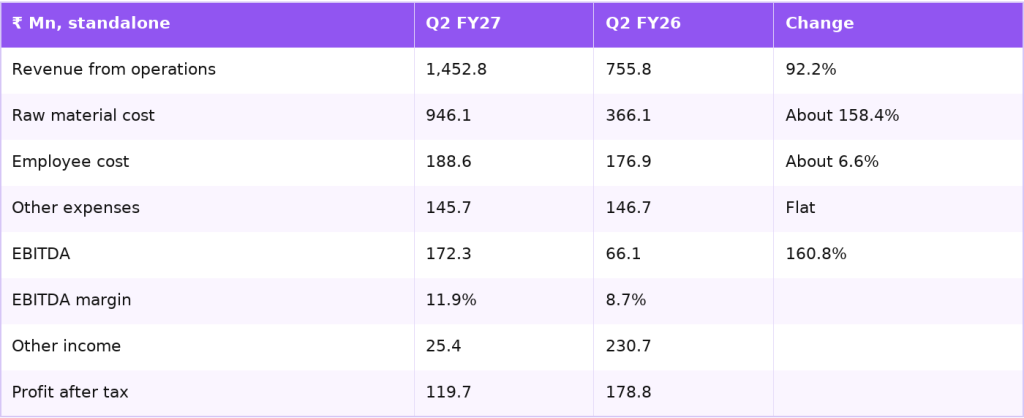
That revenue also shows how much of the cost base is fixed. Employee cost rose only about 6.6% and other expenses stayed flat, while revenue nearly doubled. Read this EBITDA Explained: Uses and Limits So most of the extra revenue reached EBITDA, which rose 160.8% to ₹172.3 Mn. The EBITDA margin was 11.9%, up from 8.7% a year ago and 5.7% in Q1 FY27.
That margin still sits below the company's own target, and the reason is materials. Raw materials took about 65.1% of revenue in Q2 FY27, against about 48.4% a year ago, as input prices rose amid global tensions. Management has said it will raise prices once current contracts are complete. It has kept its FY27 target of a 15-20% EBITDA margin.
That margin gain carried through to profit. Profit after tax was ₹119.7 Mn, nearly four times the ₹30.3 Mn of Q1 FY27. Quarterly revenue has now grown for four quarters in a row, from ₹755.8 Mn in Q2 FY26 to ₹814.1 Mn, ₹892.1 Mn, ₹1,025.6 Mn and ₹1,452.8 Mn.
That run looks steadier over the half year. In H1 FY27, defence and space revenue was ₹2,038 Mn, up 10%, and commercial explosives were ₹440 Mn, up 39%. EBITDA for the half was ₹231.1 Mn, a margin of 9.3%. So you can see the shape of the year so far. A thin first quarter was followed by a much fuller second one. We think that pattern matters more than any single quarter, because defence revenue here depends on when inspections finish and when licences arrive, not on when the work is done.
"The flares we do in our own plant. So we have the capability to complete." - T. V. Chowdary, Managing Director, Premier Explosives
That balance sheet has room for the work ahead. Borrowings were about ₹36.6 Cr in March 2026, against a net worth of about ₹289 Cr. India Ratings rates the company's bank loans A- with a stable outlook, a rating first given in September 2025 and affirmed in May 2026. Capital work in progress rose to ₹333.5 Mn by September 2026, from ₹263.9 Mn in March, as the new Katepally plant took shape.
The Orders Behind the Order Book
So where did the record order book come from? It stood at ₹1,393 Cr in August 2026 and ₹1,642 Cr in October, even after the quarter's large deliveries. Four years earlier, in March 2022, it was ₹389 Cr. That is more than four times as much work in hand.
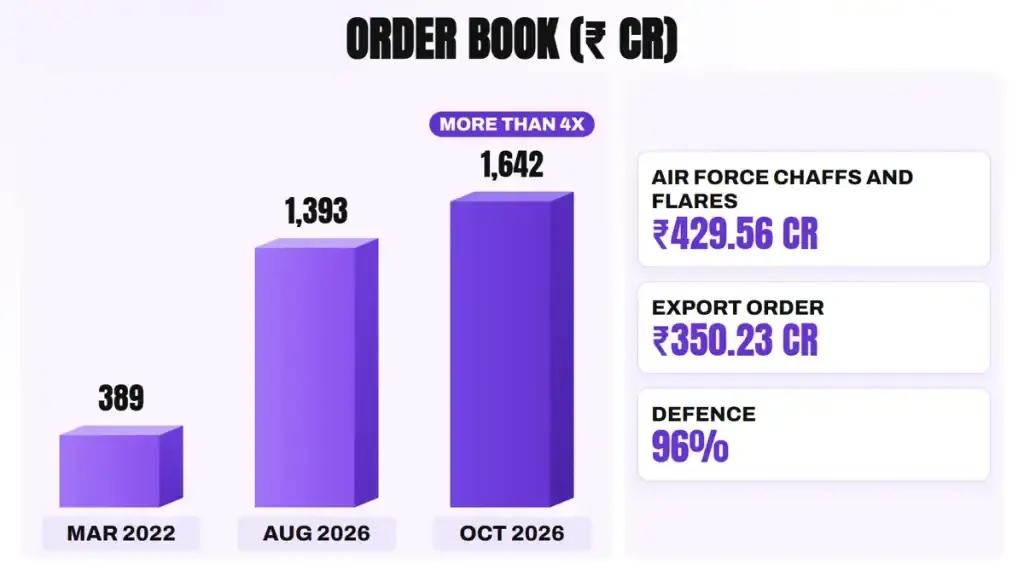
The biggest piece of that work came from the Air Force. In October 2025, the Ministry of Defence ordered chaffs and flares worth ₹429.56 Cr, including GST, to be delivered within twelve months. Exports added several large orders on top of that.
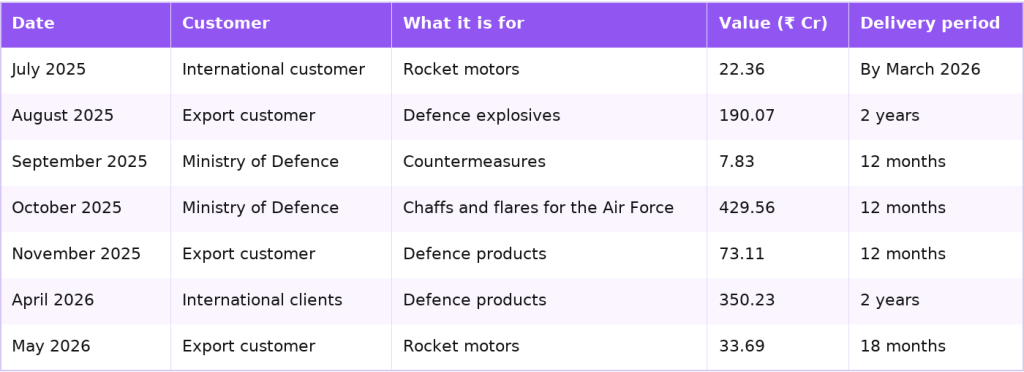
Those export orders now make up a large part of the book, as you can see. In May 2026, exports were about 54% of the order book and domestic orders about 46%. The October book was 96% defence, 2% commercial explosives and 2% services.
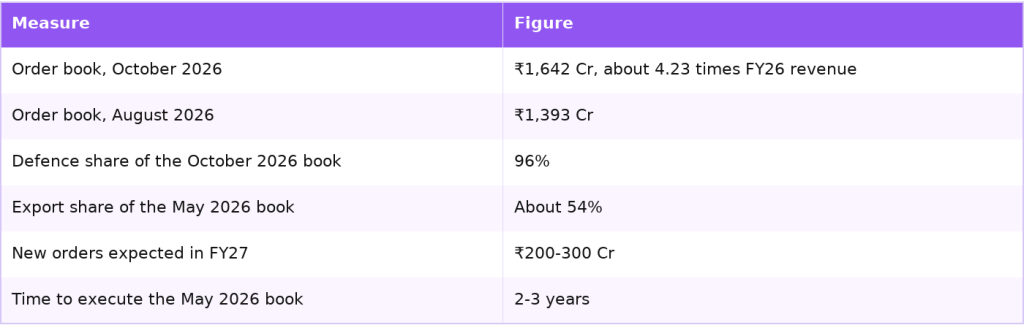
Why the book matters more than one quarter: at the ₹600 Cr of yearly revenue management is aiming for in FY27, ₹1,642 Cr of orders would keep the plants busy for about 2.7 years. Management expects the book to stay above ₹1,000 Cr even as it delivers, because new orders keep coming in.
How a Mining Explosives Maker Moved Into Missiles
To see why the defence orders keep coming, let's go back to how the company started. Premier Explosives was set up in 1980 by Dr A. N. Gupta, an alumnus of the Indian School of Mines in Dhanbad. It began with commercial explosives and detonators made with Indian technology. It was the first in India to make explosives and detonating fuse with indigenous technology.
That mining base taught it how to handle explosives safely at scale. It became a public company in 1987, and through the 1980s and 1990s it kept adding plants for detonating fuse, detonators and site-mixed slurry explosives used in mines. It also became the first company in the world to make NHN detonators on a commercial scale, a safer and greener alternative to the usual primary charge.
That base in explosives made a bigger step possible. The real shift came in 2003, when the company started developing solid propellants. It became the first private company in India to make solid propellants for missile programmes. Over the next two decades it qualified on Akash, MRSAM, LRSAM and Astra. In 2006, it also took on its first long contract with ISRO, the space agency.
Those years of qualification began to pay off in FY24 and FY25. Revenue grew about 34.5% to about ₹271.7 Cr in FY24, with an EBITDA margin of 21.5%. Then it grew about 53.6% to ₹417.5 Cr in FY25, as large chaff and flare orders were delivered to the Air Force. By FY25, defence and space gave about 81% of revenue.
Those years also changed what the company owns and makes. It split each share into five in June 2024. It also added a joint venture, Global Premier, for defence products. In November 2025, it signed a non-binding agreement with the Andhra Pradesh government to invest about ₹500 Cr in a new defence and aerospace plant.
Two Businesses, One Set of Licences
Now let's see what the company actually sells through its two businesses. Read this Segment-Wise Revenue Analysis Explained It reports them as two segments, and they serve very different buyers. Defence and space work is for the armed forces, DRDO, BDL, ISRO and export customers. Commercial explosives are for mines, cement plants and builders.

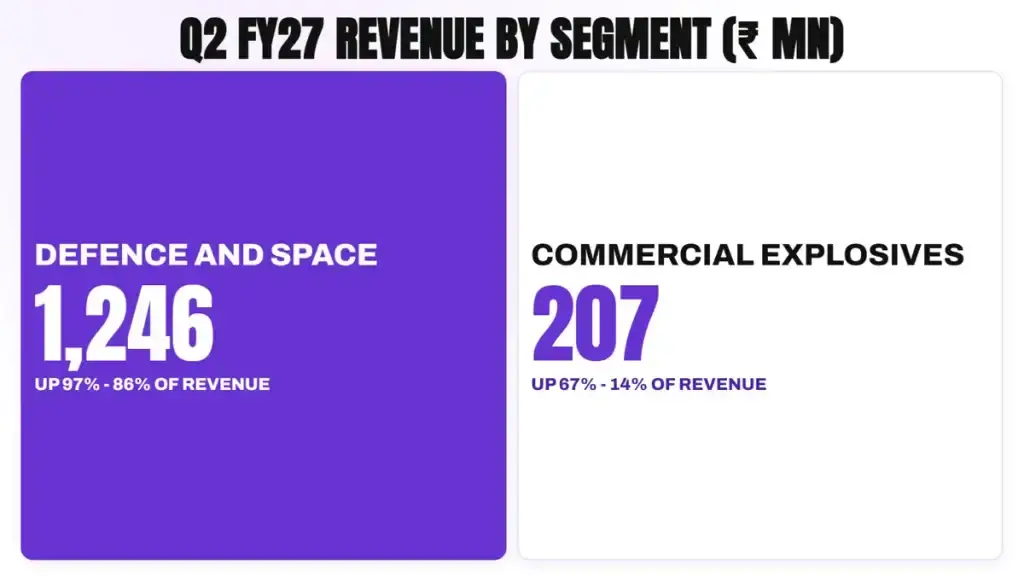
These two segments differ in how they earn. A defence product is made to a design the customer approved, and it is checked by the customer before it leaves the plant. A mining explosive is a bulk product sold on price to many buyers. Both use the same skills in handling, storing and moving explosives, and both depend on licences to make and store them.
So inside those two segments, defence and space itself has several parts. You can think of them as five businesses in all. Missile propellants and rocket motors, countermeasures, high explosives and warheads, and plant services each have different customers and timelines. So let's take them one by one.
Missile Propellants and Rocket Motors
Let's start with missiles, the work the company is best known for. In FY26, the Ministry of Defence fully used its revised capital budget of ₹1.86 lakh Cr, the money it spends on new weapons. For FY27, about 75% of the capital acquisition budget is set aside for Indian defence companies. So more of the money for new missiles is meant to stay with Indian makers and their suppliers.
That spending reaches the company through the missiles it already supplies. For MRSAM, a medium-range surface-to-air missile used by the Army, it supplies all the solid propellant. It does the same for LRSAM, the Navy's long-range version, and for Astra, the Air Force's air-to-air missile. For Akash, it has supplied more than 2,500 booster grains and 450 sustainer grains to BDL. For BrahMos Aerospace, it produces and integrates rocket motors.
Its range is wide. It makes rocket motors from 40 mm to 2,000 mm in diameter, as well as case-bonded and free-standing propellant grains, gas generators and pyro cartridges. A pyrogen igniter is the small charge that lights a rocket motor, and the company makes the igniters for all stages of Agni, India's long-range ballistic missile. In May 2026, management said it is still the single source of these igniters to DRDO.
The company also exports complete rocket motors, at a time when private companies made 45.2% of India's defence exports in FY26. It won a ₹22.36 Cr rocket motor order from an international customer in July 2025, and another ₹33.69 Cr export order in May 2026. Management expects about ₹200 Cr of export revenue in FY27.
Domestic missile orders move at a steady pace. BDL and DRDO supply some of the key ingredients themselves, and the company turns them into propellant as they arrive. In May 2026, it was producing around 40-50 motors a month across LRSAM, MRSAM and Astra.
As soon as those ingredients arrive, the company completes the product and delivers it back. That keeps the work steady, because each new batch from BDL turns into revenue within a short time.
One missile is not yet in the book at all. QRSAM is a quick-reaction surface-to-air missile meant for the Army. In May 2026, management said the company is ready to take a QRSAM order, but that QRSAM is not in its estimates. In August, it added that the tenders had not yet been called. So any QRSAM work would come on top of today's plans.
Chaffs and Flares for the Air Force
Next, let's look at countermeasures, the business behind the company's largest order. Fighter aircraft and helicopters carry chaffs and flares to fool incoming missiles, and the company is the only qualified Indian maker. The government is also pushing more defence items to Indian makers. Its sixth positive indigenisation list, notified in August 2026, added 405 items with a business potential of about ₹3,070 Cr.
That position brought the October 2025 order. The Ministry of Defence ordered chaffs and flares worth ₹429.56 Cr for the Air Force. A smaller order of ₹7.83 Cr for countermeasures came a month earlier. In August 2026, management said the whole ₹430 Cr order would be delivered within FY27, and that about ₹21 Cr was delivered in Q1.
Its own plants now make most of what that order needs. The rebuilt flare plant is producing again, so the company depends less on imports. Chaff material is still imported, and management said that part has been completed. Further countermeasure orders are under negotiation, and the company has bid in other tenders.
An older order is also close to the finish. In August 2026, about ₹75 Cr was left on a flare order from July 2023, and management expected to complete it in the next four to five months. Once it is done, the company will press a claim of about ₹30 Cr with the Ministry of Defence to get back penalties deducted on that order. Management expected a decision by October or November 2026.
High Explosives, Warheads and Mines
Now let's turn to high explosives, where the company is adding the most capacity. HMX and RDX are powerful military explosives used in warheads and other munitions. Demand for them has risen with the wars abroad, and management said prices are good for now.
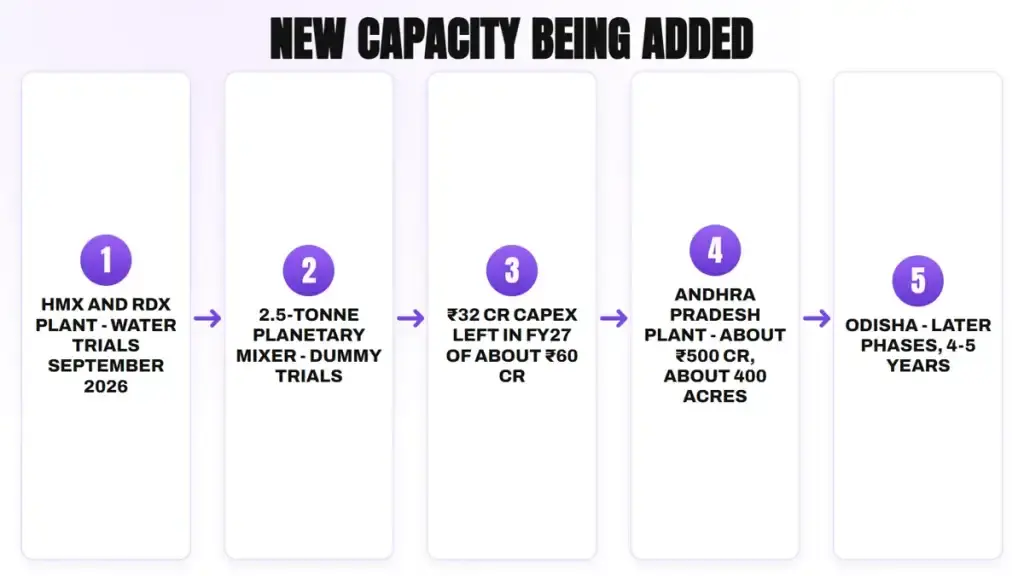
The company makes HMX and RDX at Katepally, along with ammunition, mines, warheads and bombs, and it is now expanding that HMX and RDX plant to meet the higher demand for these explosives. In August 2026 management said the pipelines and machinery were almost installed. Water trials were due in September 2026 and take about a month, after which the plant moves to production. A new 2.5-tonne planetary mixer, used to mix large batches of propellant, was due for dummy trials from the end of September.
Those same explosives lead to the next step, which is mines and drone payloads. In May 2026, management named land mines, drone payloads and medium-calibre ammunition as the new areas for FY27, and said these orders are already in the order book. It makes explosive payloads for drone and loitering-munition makers as a partner rather than building drones itself. Management said DRDO, ARDE and HEMRL were testing the company's own substitute explosive for these products. Clearance would open the door to the Adrushy and Ulka mines the Army wants.
Space and Plant Services
Next, let's look at space. Since 2006, the company has run and maintained the solid propellant plant at ISRO's Sriharikota centre. There it handles mixing, casting and integration of propellant for launch vehicles, including the PSOM-XL strap-on motors.
This service brings steady revenue. That is a useful base. Management put it at about ₹18 Cr a year, with about 2.5 years left on the contract in May 2026, and said it would bid again when ISRO calls for the next one. The October 2026 order book carried 2% services work.
Mining and Infrastructure Explosives
Finally, let's look at commercial explosives, the business the company started with. It makes bulk explosives, cast boosters, detonators and detonating fuse for coal, iron ore and limestone mines, roads, dams and tunnels. Its bulk explosive plants are at Singrauli, Chandrapur, Godavarikhani and Manuguru.
Its main mining customer is Singareni Collieries, the state coal company of Telangana, with about ₹25-30 Cr of a contract left for FY27. It also exports to countries such as Israel, Greece, Jordan, Turkey, Nepal, Thailand, the Philippines and Indonesia. It won a ₹16.40 Cr export order for commercial explosives in November 2025. This segment grew 67% in Q2 FY27 and 39% in the first half.
What Apollo Micro Systems Brings
Now that we have seen each business, let's look at the change in ownership. In July 2026, Apollo Micro Systems, a Hyderabad defence technology company with 41 years of history, agreed to buy the promoters' 41.33% stake for about ₹1,550 Cr in cash. It also made an open offer for another 26% of the company.
That open offer is now complete. Apollo bought the full 26%, about 1.40 Cr shares, and paid for them on 4 November 2026. The purchase of the promoters' stake is expected to close in Q3 FY27, by December 2026, subject to approvals. After that, Apollo would own about 67.33% of the company.
That deal brings together two businesses that fit well. Apollo designs and makes electronic, electro-mechanical and engineering systems for defence, while Premier makes the energetic materials, rocket motors, ammunition and countermeasures. Together they cover more of a complete weapon, which can help them bid for larger and more complex programmes. Premier will keep its own brand under Apollo.
"The partnership brings together Apollo's strengths in defense electronics and mission-critical systems with Premier's capability in energetic materials, rocket motors, ammunition and propulsion systems." - T. V. Chowdary, Premier Explosives
That fit still needs detail, and we will hear more soon. Management expects to share what the combination will add by December 2026. Asked about naval work, it said the full potential of the tie-up would be clear by then. So the next two quarters should show which programmes the two companies chase together. For you as a reader, the useful test is simple. Watch for the first order where Apollo's electronics and Premier's propellant or warhead go into the same product.
Why a Qualified Propellant Is Hard to Copy
So what protects the company once Apollo takes over? It starts with qualification. Read this Economic Moat Explained Let's take the layers one by one. A missile's propellant is approved for that missile alone, and a new supplier would need the same approval. That is why the company supplies all of the propellant for three missiles and the igniters for every Agni stage.
"A truly great business must have an enduring moat that protects excellent returns on invested capital."
— Warren Buffett
Premier's moat is its qualification on missiles and countermeasures. The open question, as the financials show, is whether it can turn that moat into steady returns rather than lumpy ones.
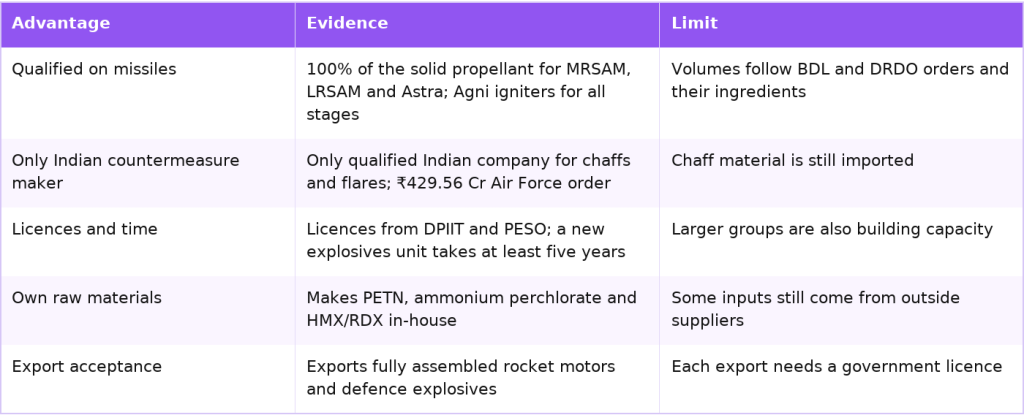
That time to build a plant is the second layer. An explosives plant needs licences from DPIIT and PESO, the explosives regulator, along with large areas of land. Management says a new entrant needs at least five years to set up such a unit.
These plants also need trained people, and that is the third layer. Let's look at who runs them. About 550 of the company's people are trained in propellant and pyrotechnic products, and it has about 100 engineers and scientists. Its laboratories are certified by DSIR and accredited by NABL. It works with Gulbarga University, IIT Madras and BITS Pilani on research in high-energy materials.
Those people also know how the customer checks the work. Every defence lot goes through pre-dispatch inspection, where the customer's inspectors test the product before it leaves the plant. In April 2026, for example, the company offered three lines worth around ₹30 Cr for inspection, and all of them were cleared and dispatched. A newcomer would have to learn that process from the start.
Those people built the combustion-stable propellants that now fly in missiles such as LRSAM, MRSAM and Astra, and the same teams make them in the company's own plants today. A combustion-stable propellant burns evenly without pressure swings inside the motor, which is what lets a missile fly true. That know-how sits with the same people who run the plants.
That learning extends to a fourth layer, which is that the company makes many of its own ingredients. It produces PETN and ammonium perchlorate at Peddakandukur, and HMX and RDX at Katepally. Ammonium perchlorate is the oxidiser in most solid propellants. Making it in-house means the company controls more of its supply chain than an assembler would.
Its board also carries deep missile experience. Dr V. G. Sekaran, an independent director, was the chief designer of the Agni 5 missile system and held senior roles at DRDO. That kind of experience helps when the company works with DRDO laboratories on new products.
Financials: Premier Explosives Over Five Years
Defence deliveries arrive in large lumps here, so one year can look very different from the next. Let's look at five full years together, on a standalone basis.
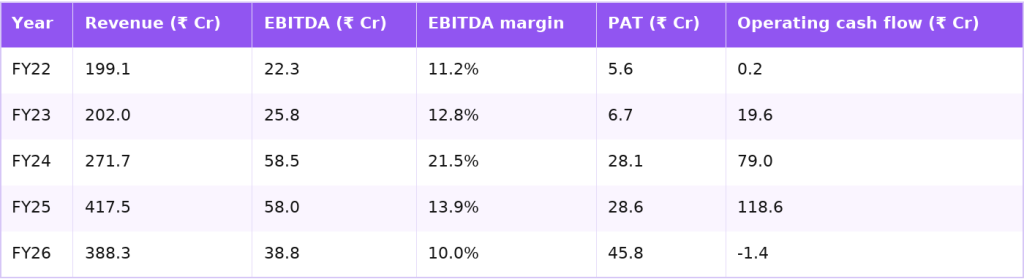
Revenue roughly doubled in four years, from ₹199.1 Cr in FY22 to ₹388.3 Cr in FY26, with the big step in FY24 and FY25 as chaff, flare and propellant orders were delivered. The EBITDA margin peaked at 21.5% in FY24 and then came down to 10.0% in FY26 as raw material prices rose and the product mix changed.
Profit after tax tells a different story from EBITDA in FY26. It rose to ₹45.8 Cr even though EBITDA fell, because other income of about ₹42.1 Cr included about ₹34.2 Cr of purchase discounts from a settlement with a supplier, which the company does not expect to repeat.
Cash flow has been uneven. Operating cash flow was strong in FY24 and FY25 as payables and other liabilities rose, then turned slightly negative in FY26 as those came down again. Over the five years, operating cash flow added up to about ₹216 Cr against about ₹114.8 Cr of profit. Borrowings were about ₹36.6 Cr in March 2026, against a net worth of about ₹289 Cr.
"Rule No. 1: Most things will prove to be cyclical."
— Howard Marks
Premier's revenue and margins have moved in waves with large defence orders. The order book now is the largest it has been, but the table shows why a single year should not be read as the trend.
What FY27 Could Look Like on Management's Numbers
So what could all of this add up to for you as a reader following the company? Management's target for FY27 is revenue of about ₹600 Cr, with an EBITDA margin of 15-20%. In May 2026 it gave a range of ₹600-700 Cr, and in August it kept the ₹600 Cr target after a slow first quarter.
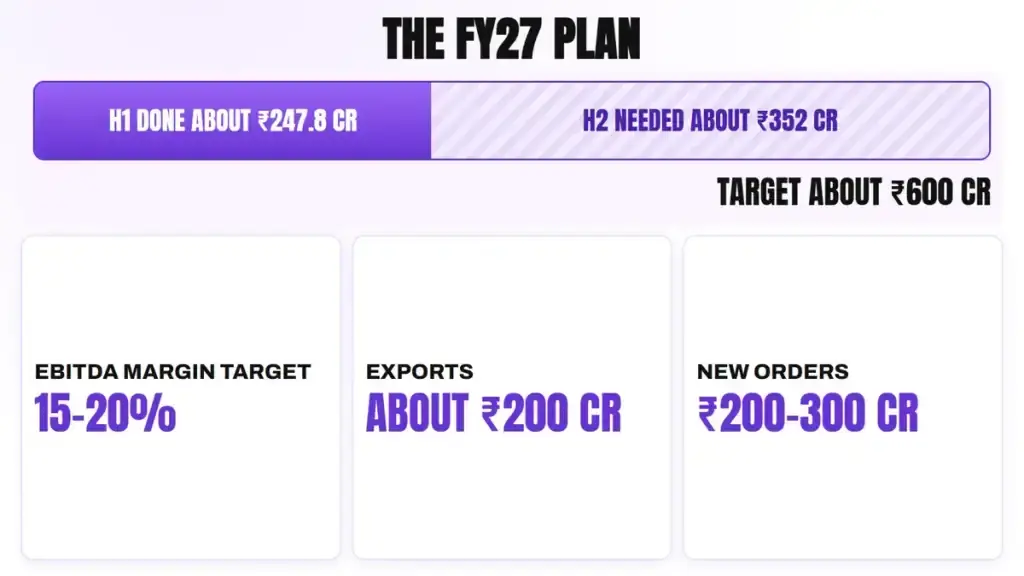
The first half has already delivered about ₹247.8 Cr. To reach ₹600 Cr, the second half needs about ₹352 Cr, or about ₹176 Cr a quarter. Q2 FY27 came in at about ₹145.3 Cr, so the plan needs a further step up in deliveries.
"No, if you look at our order book, it will not look aggressive. We are talking about an order book of INR1,500-plus crores." - T. V. Chowdary, Premier Explosives
That step up has two large blocks of work behind it. The whole ₹430 Cr Air Force order is due within FY27, and only about ₹21 Cr of it was delivered in Q1. Exports of about ₹200 Cr are also planned for FY27, including first dispatches against the ₹350.23 Cr export order in Q4 FY27.
Those deliveries also need capacity, and that is being added. In May 2026, management agreed with an analyst that about ₹32 Cr of capital spending remains for FY27, out of about ₹60 Cr planned over FY26 and FY27 for Katepally and Peddakandukur. Beyond that, the Andhra Pradesh plant waits on a land price for about 400 acres. Management expects to commission it within 1-1.5 years once the land is final.
That Andhra plant is only the first of three phases. Management plans the second and third phases in Odisha, where it is still looking at land with the state government. It expects those phases to take around four to five years. So we should read the Andhra plant as a start, with more capacity planned later. None of this is in the FY27 numbers.
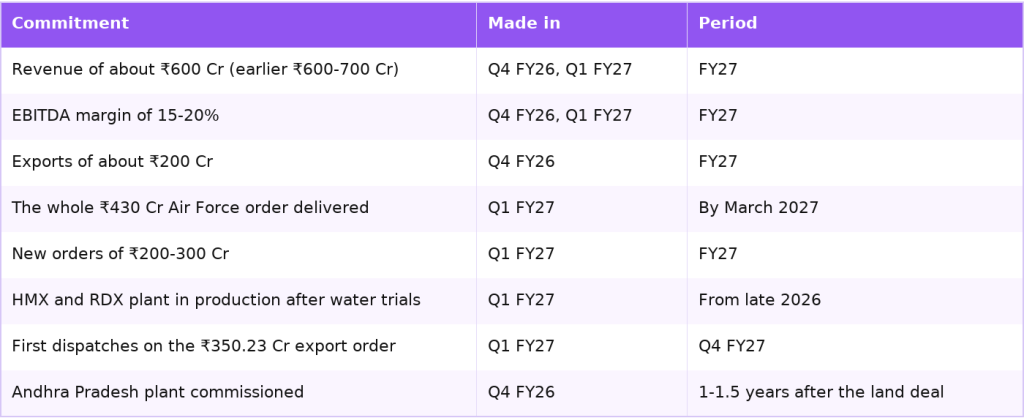
These commitments come with a record we can check.
"Well done is better than well said."
— Benjamin Franklin
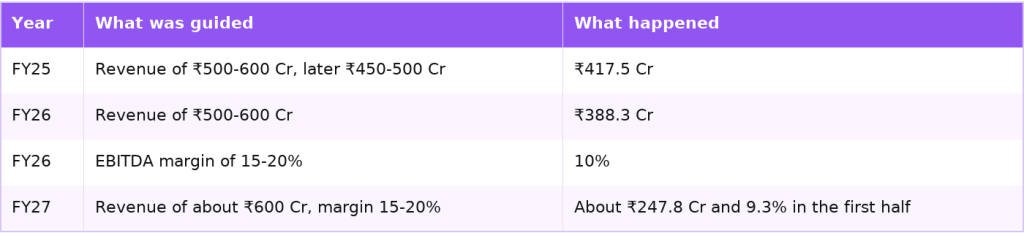
For Premier Explosives, the targets have often been ahead of the deliveries. The second half of FY27 is the test of whether this year's plan is done, not just said. You should read the plan against it. In July 2024, management expected revenue of about ₹500-600 Cr for FY25. In November 2024 it gave ₹450-500 Cr, and the year ended at ₹417.5 Cr.
That pattern repeated in FY26. In November 2025, management gave a range of ₹500-600 Cr and a margin of 15-20%, and the year ended at ₹388.3 Cr with a 10% margin.
Key Risks
No business grows in a straight line, so let's look at what could go wrong for Premier Explosives.
- Plant accidents: on 29 April 2025, a fire and explosion in the propellant mixing building at Katepally caused the loss of four lives. The state pollution board ordered the plant shut on 7 May 2025, and the closure order was finally revoked only on 16 September 2025. A second accident hit the flare plant. Any new accident could stop deliveries for months.
- A record of missed guidance: revenue guidance was missed and cut in both FY25 and FY26, and the FY26 margin of 10% was far below the 15-20% target. The FY27 plan needs about ₹352 Cr in the second half.
- Raw materials and imports: Munitions India could not supply a high explosive needed for mines, drone payloads and flares, and DRDO is still testing the substitute. Imported chaff material and parts depend on shipping, and raw material took about 65.1% of revenue in Q2 FY27.
- Export licences: every export order needs a government licence, and the buyer's country must issue an import licence first. An export order for defence explosives, announced in March 2025, was cancelled in April 2026 when the licence did not come. In May 2026, about ₹400 Cr of export orders were still waiting for licences.
- Profit quality: FY26 other income of about ₹42.1 Cr included purchase discounts of about ₹34.2 Cr from a settlement with a supplier, which the company said will not recur. Q2 FY27 profit after tax was 33% below the year before because Q2 FY26 had ₹230.7 Mn of other income.
- Penalties and slow payments: deductions such as liquidated damages for late delivery cut revenue by about ₹24.8 Cr in FY26 and about ₹43.2 Cr in FY25. 29.61% of receivables were more than 180 days overdue in March 2026, and operating cash flow was slightly negative in FY26.
- Lost work and thin margins: the company lost the operation and maintenance contract at DRDO's Jagdalpur propellant complex to a lower bidder. Bulk explosive margins are very thin and in places negative, and supply to Coal India was stopped on price.
- Change of control: Apollo Micro Systems may change strategy, management or priorities once it owns about 67.33%, and the promoters' stake sale still awaits approvals.
"An ounce of prevention is worth a pound of cure."
— Benjamin Franklin
In an explosives business, prevention is not a figure of speech. Plant safety, licences and raw material supply decide whether the order book reaches the revenue line on time.
Explore our Products
Research Framework

Emerging Titans
Combination of quantitative analysis, industry tailwinds, and management assessment - SPRINT investment philosophy

Tiny Titans
Heavy emphasis on scuttlebutt research, plant visits, and early on-ground signals
What to Track Next
If you follow Premier Explosives, these are the signals that will show whether the plan is on track.
- What management tells investors on 13 November 2026 about the ₹600 Cr target, now that Q2 FY27 is filed
- Second-half revenue of about ₹352 Cr, and the EBITDA margin moving towards 15-20%
- The ₹430 Cr Air Force order fully delivered by March 2027
- Export licences for the ₹350.23 Cr order and first dispatches in Q4 FY27
- The Katepally HMX and RDX plant moving into production, and DRDO clearance of the substitute explosive for mines
- Apollo completing the purchase of the promoters' stake by December 2026
Conclusion
Let's step back and put it all together. Premier Explosives spent more than two decades getting qualified on Indian missiles, and it is now the only Indian maker of chaffs and flares. That position has brought a record ₹1,642 Cr order book, most of it defence and more than half of it export. Q2 FY27 showed what happens when those orders ship, with revenue up 92.2% and the margin back to 11.9%.
So the next two quarters will show whether deliveries can keep that pace. The plan needs a bigger second half, the Air Force order delivered, export licences granted and the new Katepally plant running. If those come through under Apollo, the company could move from a supplier of materials to a part of complete weapon systems. The cautious thread is execution: revenue guidance was missed in FY25 and FY26, margins are below target, and FY26 profit leaned on one-off income. The second half of FY27, the Air Force deliveries and the export licences will show which thread wins.
FAQs
What does Premier Explosives do?
+Premier Explosives is a Hyderabad company set up in 1980 that makes high-energy materials. It supplies solid propellants and rocket motors for Indian missiles, chaffs and flares for the Air Force, HMX and RDX, warheads and mines, and commercial explosives for mines and builders. It also runs ISRO's solid propellant plant at Sriharikota.
Which missiles use Premier Explosives' propellant?
+The company supplies 100% of the solid propellant for the MRSAM, LRSAM and Astra missiles. It has supplied more than 2,500 booster grains and 450 sustainer grains for Akash, makes the pyrogen igniters for all stages of Agni, and produces and integrates rocket motors for BrahMos.
How big is Premier Explosives' order book?
+The order book was ₹1,642 Cr in October 2026, about 4.23 times FY26 revenue, and 96% of it was defence. It includes a ₹429.56 Cr Ministry of Defence order for chaffs and flares and a ₹350.23 Cr export order for defence products.
How did Premier Explosives do in Q2 FY27?
+Revenue was about ₹145.3 Cr, up 92.2% from a year ago, and the EBITDA margin was 11.9%, up from 8.7%. Defence and space gave 86% of revenue. For the first half of FY27, revenue was about ₹247.8 Cr.
What does the Apollo Micro Systems deal mean for Premier Explosives?
+Apollo Micro Systems agreed in July 2026 to buy the promoters' 41.33% stake for about ₹1,550 Cr and has completed an open offer for another 26%. The promoter purchase is expected to close by December 2026. Apollo makes defence electronics, so the two together cover more of a complete weapon.
What are the main risks for Premier Explosives?
+The main risks are plant accidents, a record of missed revenue guidance, raw material and import delays, export licences, one-off income in FY26 profit, late-delivery penalties and slow government payments, thin margins in bulk explosives, and the change of control to Apollo.

High growth stock specialist, Value Educator
Shashank Mahajan is an equity research professional with over 12 years of experience in identifying high-potential SME and micro-cap stocks at an early stage. He follows a rigorous scuttlebutt research–driven approach, combining on-ground insights with deep financial analysis. Shashank specializes in uncovering under-researched and under-owned companies with strong management quality and long-term growth potential. Through disciplined research and early identification, he focuses on spotting tomorrow’s market leaders before they enter the mainstream investor radar.
Macpower CNC: A Rajkot Machine Maker With ₹476 Cr of Orders
KSB: The Pune Pump Maker With ₹1,235 Cr of Reactor Orders

Kilburn Engineering: The Dryer Maker With ₹470 Cr of Orders

Rossell Techsys: Boeing and Lockheed Wiring From Bengaluru
Unimech Aerospace: From Engine Tools to Flying Parts

Taneja Aerospace: The Airfield With ₹161 Cr of Rent Signed
Explore our Products
Research Framework
Emerging Titans
Combination of quantitative analysis, industry tailwinds, and management assessment - SPRINT investment philosophy
Tiny Titans
Heavy emphasis on scuttlebutt research, plant visits, and early on-ground signals



Modern Warfare to Multibaggers
Key Trends. Strategic Shifts. Opportunities Ahead.
Don't Miss This Exclusive Webinar!
Join Value Educator to decode the key trends shaping India's defence sector and learn how to identify tomorrow's potential leaders in the space.
- In-depth research on India's defence sector
- Live Q&A session
- Actionable takeaways for long-term investors

 Orders
 Subscription
 Share with friends


Required Details
₹23999.00
(12 month subscription)
As per SEBI regulations, all users are mandated to complete the KYC that is validated for 1 year. Post payment, you will be redirected to the KYC screen


No comments yet. Be the first to comment!