
Quality Power: Reactor Maker With a ₹1,945.5 Cr Order Book
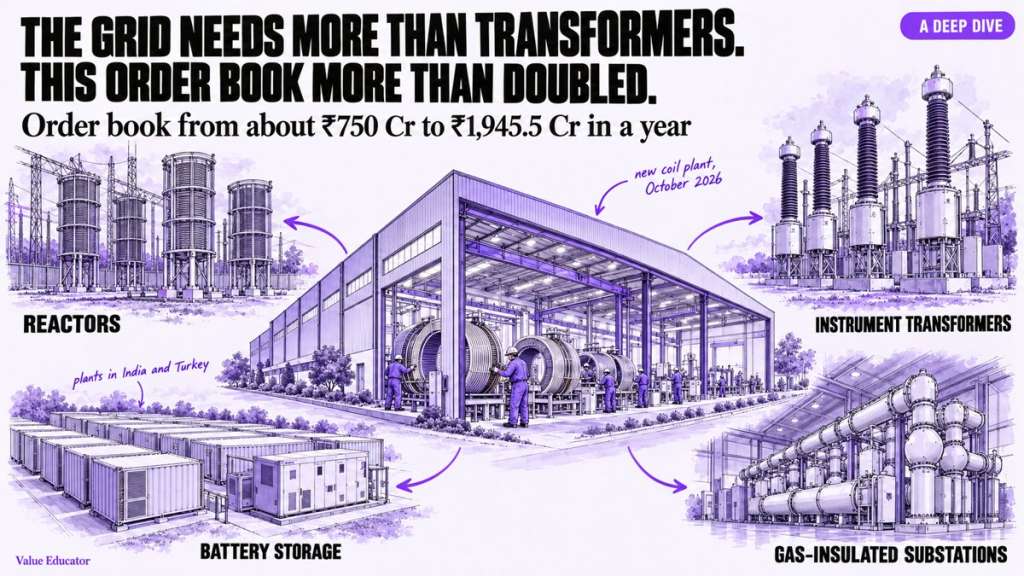
On 20 October 2026, a small company in Sangli switched on a new factory for one of the least known parts of the power grid. Grids everywhere are being rebuilt for solar, wind, data centres and batteries, and the equipment makers cannot keep up. Lead times for large power transformers have stretched to three to four years in several markets, and India's Central Electricity Authority expects the country to need 236 GWh of battery storage by 2031-32.
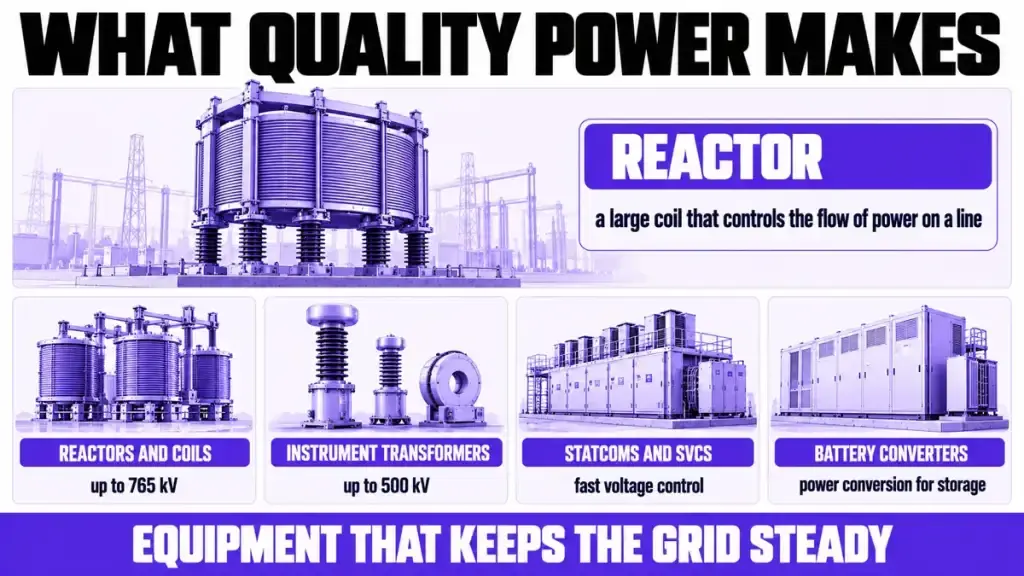
That rebuild needs more than transformers and cables. It needs parts that keep power steady as it moves over long lines and between very different sources. One of the most important is the reactor, which simply means a large coil that controls the flow of electricity on a line, soaking up excess voltage or limiting a sudden surge of current. Without reactors, long high-voltage lines and renewable parks would swing out of their safe voltage range.
Those reactors come from specialists, because the companies that build grids buy rather than make them. Global equipment makers such as Hitachi Energy, GE Vernova and Siemens Energy design substations and high-voltage direct current (HVDC) links for utilities. They build the big transformers and switchgear themselves, but they buy many reactors, instrument transformers and filters from suppliers they have tested. Utilities such as POWERGRID also buy directly through tenders.
One Sangli company has been building that kind of equipment since 2001. Quality Power Electrical Equipments Ltd (NSE: QPOWER) makes reactors, line traps, capacitor banks and special transformers up to 765 kV. Through its subsidiaries, it also makes instrument transformers in Rajasthan and power electronics in Turkey. It sells to more than 200 customers in over 100 countries from seven plants in India and Turkey.
Its newest field is battery storage. A battery stores direct current, but the grid runs on alternating current, so every storage project needs a power conversion system, which means the converter that moves power between the battery and the grid in both directions. Quality Power's Turkish subsidiary Endoks makes these converters, and its new plant for them started work on 16 October 2026.
Quality Power in five numbers
- Q1 FY27 total income of ₹256.4 Cr, up 32.1% from a year ago
- An order book of ₹1,945.5 Cr on 30 June 2026, about 1.9 times last year's revenue
- An EBITDA margin of 28.3% in Q1 FY27 before a non-cash accounting charge in Turkey
- FY26 total income of ₹1,007 Cr, up 156.9%
- A new coil factory that management says can deliver ₹1,500-1,800 Cr of revenue
So how did a reactor maker from Sangli build an order book that large in a year? Let's first understand the company, and then look at the latest quarter.
Quality Power: Company Overview
Quality Power Electrical Equipments Ltd was incorporated in Sangli, Maharashtra, in 2001 to make reactors, line traps and other coil products for power grids. It is led by its founder, Chairman and Managing Director Thalavaidurai Pandyan, who has 39 years in transformers and reactors, and by the second-generation Joint Managing Director, Bharanidharan Pandyan. The parent company makes reactors, line traps, capacitor banks and special transformers up to 765 kV. Its 51%-owned Mehru makes instrument transformers up to 500 kV in Rajasthan, and its 51%-owned Endoks makes STATCOMs, harmonic filters and battery-storage converters in Turkey. The group sells to more than 200 customers in over 100 countries from seven plants in India and Turkey, and the parent company had 249 permanent employees at the end of FY26. Consolidated total income was ₹1,007 Cr in FY26, and debt was only 0.05 times equity, with borrowings of ₹35.5 Cr against cash and bank balances of ₹247.9 Cr at March 2026. Read this The Silent Gatekeeper of India's Power Grid
"An investment in knowledge pays the best interest."
— Benjamin Franklin
For Quality Power, that knowledge is decades of reactor design and in-house testing. Each new product the group adds is sold on the same engineering record to customers who already trust it.
A Quarter of Higher Margins
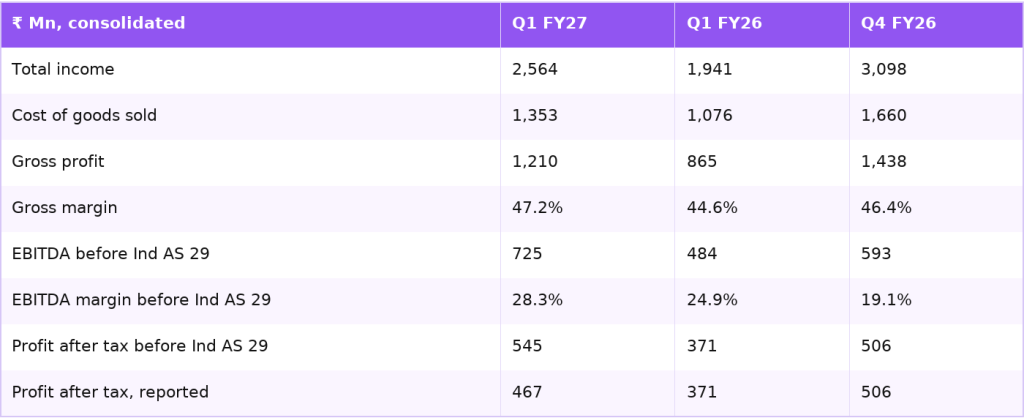
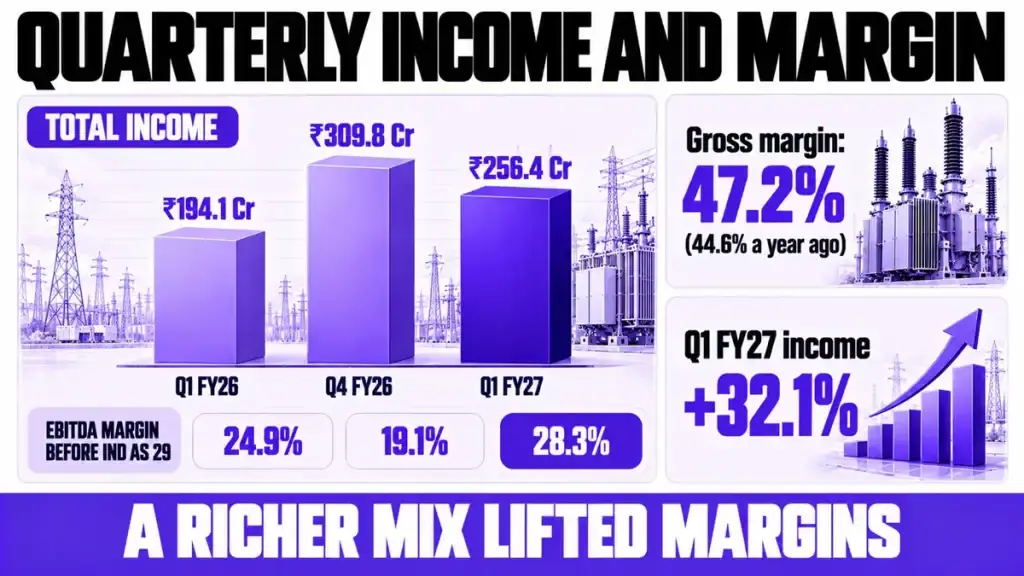
Let's look at Q1 FY27, the April to June quarter, when the product mix moved further towards high-voltage equipment. Total income was ₹256.4 Cr, up 32.1% from a year ago. Gross profit rose to ₹121 Cr, and the gross margin rose to 47.2% from 44.6%. The first quarter is usually lighter for revenue, so income was 17.2% below the March quarter.
That higher gross margin came from what the company sold. The mix moved further towards high-voltage products and power quality systems, which earn more than simpler equipment. Higher gross profit on a larger base then lifted EBITDA faster than income, by 49.8% before the Turkish charge.
The quarter's profit needs one explanation. Turkey has had very high inflation, so the accounts of Endoks must now be restated under Ind AS 29, the accounting rule for economies where prices rise very fast. That created a non-cash charge of ₹7.82 Cr in Q1 FY27. Reported EBITDA was ₹64.7 Cr, a margin of 25.2%, and reported profit after tax was ₹46.7 Cr. Read this EBITDA Explained: Uses and Limits
That charge aside, the picture is stronger. EBITDA would have been ₹72.5 Cr at a 28.3% margin, and profit after tax ₹54.5 Cr, up 46.9%. The charge does not touch cash, and the company publishes both versions so that you can compare them.
That gross profit also shows how light the fixed costs are. Finance costs were only ₹1.4 Cr in the quarter and depreciation ₹3.9 Cr, against gross profit of ₹121 Cr. So almost all of the extra gross profit from a richer mix flows down to profit, which is why we see EBITDA growing faster than income.
That quarter followed a very large year. Total income for FY26 was ₹1,007 Cr, up 156.9% from ₹391.9 Cr, mainly because Mehru, the instrument-transformer maker it bought in March 2025, was included for the full year. EBITDA, including other income, was ₹236.2 Cr, a margin of 23.5%. Profit after tax was ₹185.5 Cr, a large part of it earned by the two 51%-owned subsidiaries.
That growth has also produced cash. Operating cash flow rose every year, from ₹44.3 Cr in FY23 to ₹51.5 Cr in FY24, ₹55.1 Cr in FY25 and ₹80.3 Cr in FY26. Read this Cash Flow Statement Explained Debt stayed low, at 0.05 times equity at the end of FY26, and return on capital employed was 39.8%.
The Orders Behind the Book
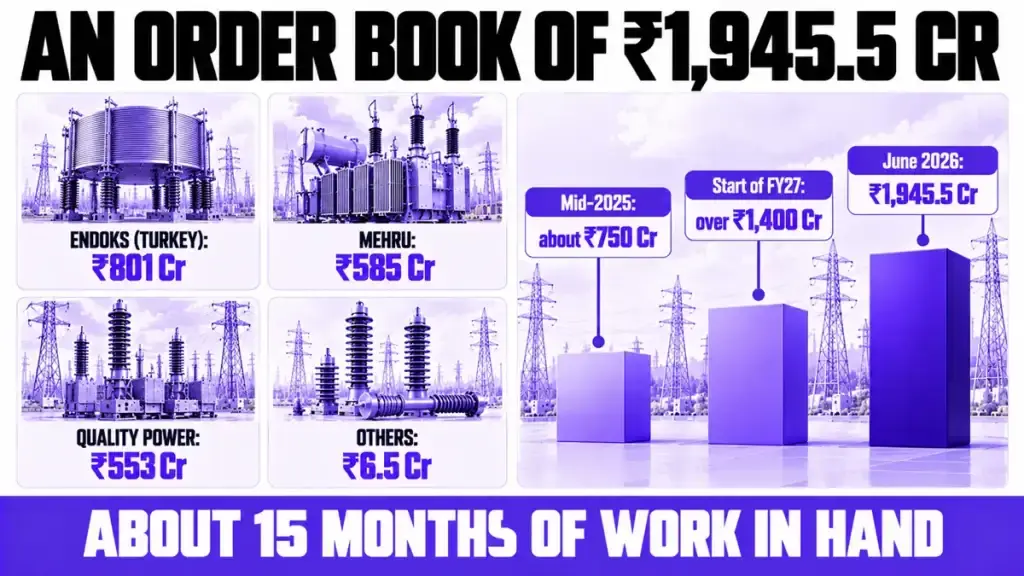
So where does the next revenue come from? The order book was ₹1,945.5 Cr on 30 June 2026, about 1.9 times FY26 revenue. A year earlier, the company had started Q2 FY26 with an order book of about ₹750 Cr, and it entered FY27 with over ₹1,400 Cr.
That book is spread across the group. Endoks held ₹801 Cr, Mehru ₹585 Cr and the parent company ₹553 Cr, with ₹6.5 Cr in smaller units. Management says the present order book should be completed in about 15 months. That is a quick turn for this kind of equipment, and it means most of today's book becomes revenue within FY27 and early FY28.
The orders announced in Q1 FY27 show where demand is coming from. Together they were worth ₹104.9 Cr.

Each of these is a different kind of buyer. A US data centre needs reactors to keep its own large power supply stable. A Japanese grid project needs FACTS, short for flexible AC transmission systems, which are devices that control how much power flows on a line. Hitachi Energy needs instrument transformers for the substations it builds in India.
Why the factories matter more than the orders: management says each of its plants sits on close to two years of orders at present capacity. The limit today is how much the factories can make, which is why the new Sangli and Turkish plants matter most.
How a Sangli Reactor Maker Became a Group
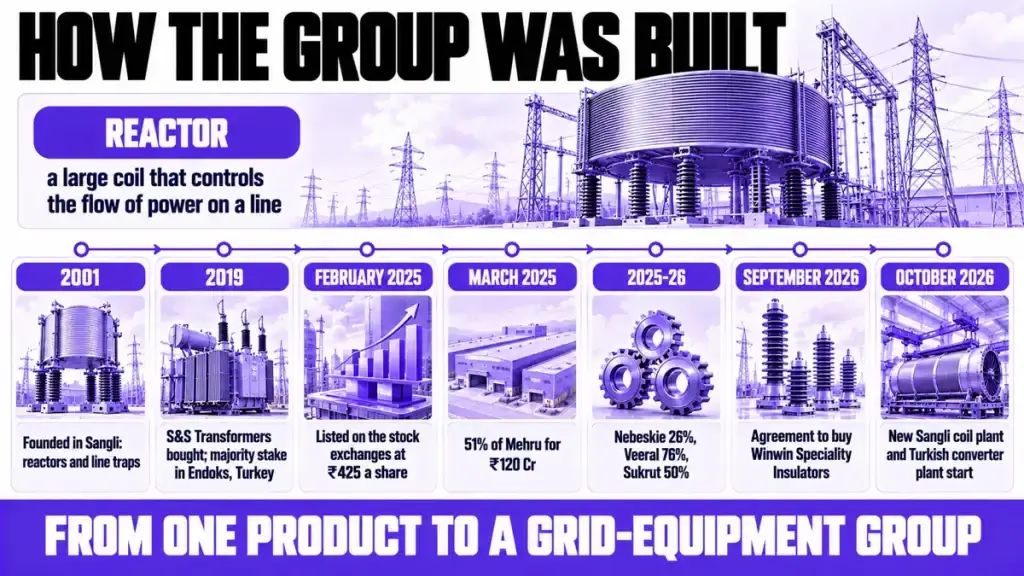
To see why this order book sits across so many companies, let's go back to how the group was built. Quality Power was incorporated in Sangli, Maharashtra, in 2001, to make reactors, line traps and other coil products for utilities. For most of its life, it was a single-product engineering company selling to Indian and overseas grids.
That changed through a series of purchases. In January 2019, it acquired S&S Transformers, which makes special and converter-duty transformers. It also took a majority stake in Endoks Enerji of Turkey, which gave it power electronics and a base inside the European customs area.
That growth needed money, and the listing in February 2025 paid for the next step. The IPO raised fresh capital for the company, alongside an offer for sale by existing shareholders, at ₹425 a share. A month later, in March 2025, Quality Power completed the purchase of 51% of Mehru for ₹120 Cr, adding instrument transformers to the group.
Since then, the deals have come faster. The group took 26% of Nebeskie Labs, an energy-software and monitoring company, and 76% of Veeral Controls, which makes high-current rectifiers for industry, rail and defence. It bought 50% of Sukrut Electric, and in September 2026 it signed to buy Winwin Speciality Insulators.
Those smaller pieces fill gaps. Veeral Controls makes high-current rectifiers and power-conversion equipment for industry, rail, nuclear and defence customers. Nebeskie Labs adds monitoring software and devices, so the group can offer real-time data on the condition of the equipment it sells.
Each purchase follows the same pattern. The group buys a specialist business, adds its own managers and capacity, and sells the new product to customers it already serves. Management now treats its managers as one pool for the whole group, so that leaders from Mehru or Endoks can run work elsewhere.
Six Businesses Under One Roof
Now let's see what the group actually makes. Quality Power reports one segment, but it is really a set of specialised businesses, each with its own product and its own place in the grid. The group calls them power products, power quality systems and ancillaries.

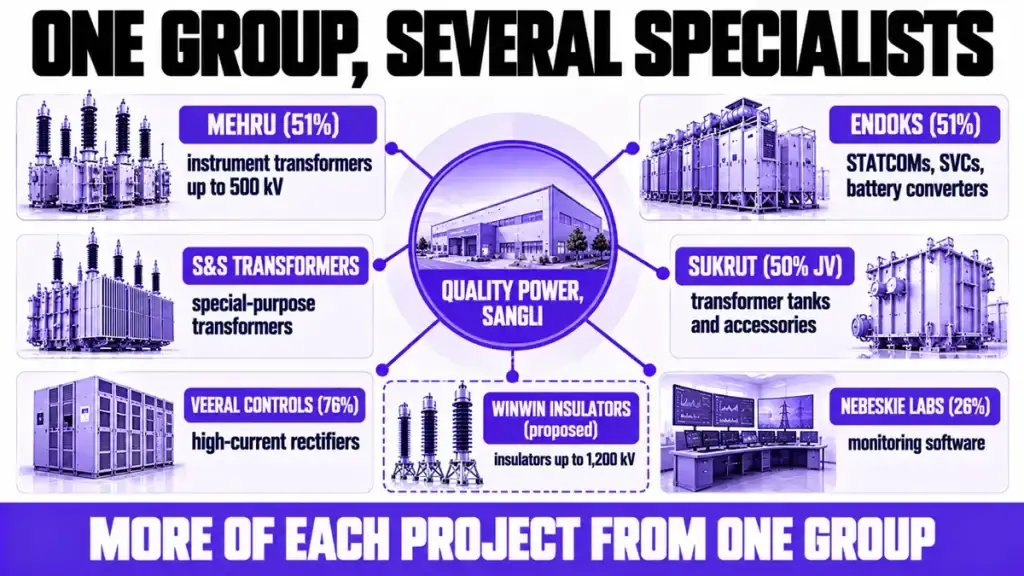
These businesses differ in what they protect. Coil products and instrument transformers sit inside substations and on lines, controlling and measuring power. Power electronics control voltage and reactive power within a fraction of a second, which matters where wind and solar swing quickly. Ancillaries supply parts to the transformer makers who build the grid's biggest machines.
They also grew at different speeds. Management said the parent company's revenue rose from about ₹37 Cr to about ₹69 Cr in Q1 FY27, and Mehru's from about ₹60 Cr to about ₹83 Cr. Endoks contributed about ₹107 Cr, a little lower than usual because of the Eid holidays in Turkey.
Reactors and Coil Products
Let's start with reactors, the business the company was founded on. Long high-voltage lines, HVDC links and renewable parks all need reactors to control voltage and limit fault currents. The government also wants FACTS devices in renewable-energy parks, and every FACTS device uses reactors and filters.
The company's founder, Thalavaidurai Pandyan, spent 39 years in transformers and reactors. He pioneered India's first 400 kV and 765 kV dry-type reactor technology, a dry-type reactor being one cooled by air rather than oil. The company now makes air-core and oil-filled reactors, line traps, current-limiting reactors and HVDC smoothing and filter reactors.
Those reactors reach a wide customer list. Beyond the global equipment makers, the group names Toshiba, Nissin Electric, Eaton, Saudi Aramco, L&T and KEC International among its customers, across utilities, oil and gas, steel, cement and rail. Those reactors are now in demand abroad. The ₹48.3 Cr order for a US data-centre project in Q1 FY27 is for high-voltage reactors. Management says the parent's coil business earns about 20% EBITDA margin, and that most orders being booked are above that.
That push abroad also depends on HVDC. Management says HVDC is a main focus, and it is adding engineering depth, simulation tools and specialist staff while it goes through technical qualifications and audits with global equipment makers and utilities. Each qualification widens the projects it can bid for.
That HVDC work is what the new Sangli plant is built for. It started production on 20 October 2026, and management says it can deliver ₹1,500-1,800 Cr of revenue once fully equipped.
The plant also makes special HVDC winding conductors, the copper or aluminium wire used inside HVDC reactors.
That wire is a new product for the group. Machines for a high-voltage CTC magnet-wire line, where many insulated strips are bundled into one conductor, are being installed. Management expects about three to five months of trial runs, and full production from the line by Q4 FY27. Making its own conductor lets the group control a key input for its largest reactors.
Instrument Transformers at Mehru
Next, let's look at instrument transformers, the business Quality Power bought into in March 2025. An instrument transformer steps a line's very high voltage or current down to a small, safe level so that meters and protection relays can read it. Every substation bay needs several of them, and you will find them in almost every substation, whatever its size.
Mehru, based in Bhiwadi, Rajasthan, makes current and voltage transformers up to 500 kV. Quality Power bought 51% of it for ₹120 Cr, and Mehru now holds a ₹585 Cr order book. In Q1 FY27, Hitachi Energy India placed multiple orders for 400 kV instrument transformers worth ₹15.7 Cr. That matters because Hitachi Energy is one of the largest builders of substations and HVDC links, so repeat orders from it show that Mehru's products have passed its tests.
Mehru is also working to get more from its existing plant before it adds new machines. Management is improving line balancing, cutting changeover times and removing bottlenecks in material flow. The aim is to raise output and asset use first, because Mehru's plant is already running close to full.
That plant is also being shown to more overseas buyers. In Q1 FY27, Mehru went through an audit by DEWA, the Dubai electricity and water utility, and the group held talks with Elsewedy Electric and visited Siemens in Germany. Each of these visits is a step towards qualification and new orders, and each new approval widens the list of projects Mehru can bid for.
Beyond that, Mehru is moving into gas-insulated equipment. A gas-insulated substation seals its equipment inside a gas-filled metal case, so it needs about one-tenth of the land of an open-air substation. Mehru has a co-development agreement with Hyosung T&D India for gas-insulated instrument transformers, made in India to IEC and IEEE standards. The global market for gas-insulated switchgear is put at about $28 Bn in 2026, rising to about $38 Bn by 2031.
That market is attractive for another reason. Gas-insulated designs already take about 40% of the overall switchgear market, and the equipment lasts more than 40 years. The parent company enters this market through a second product. Every high-voltage circuit breaker splits a fault current across several breaks in series, and grading capacitors across each break spread the voltage evenly so that no single break is overstressed. Quality Power makes these capacitors, which every multi-break breaker needs. As breaker and switchgear makers expand, that demand grows with their production.
Power Electronics and Battery Storage at Endoks
Now let's turn to Endoks, the Turkish power-electronics company. Global battery-storage additions are put at about 210 GWh in 2024, 315 GWh in 2025 and 450 GWh in 2026. In India, about 102 GWh of battery-storage tenders were issued in 2025 alone, and the government approved a second tranche of ₹5,400 Cr of viability-gap funding for 30 GWh in May 2026.
That demand reaches Endoks directly. It was founded in 2011 by three power-electronics engineers from Middle East Technical University in Ankara. It makes STATCOMs and static var compensators, which control voltage on the grid, and active harmonic filters. A battery converter uses the same core technology as a STATCOM, so Endoks has extended its existing platform into storage.
Those three founders still run the business. Dr Alper Terciyanlı is chairman, Dr Alper Cetin is chief technology officer and Cetin Adnan Açık is chief executive. Two of them held research roles at ASELSAN, Turkey's defence electronics group, and TUBITAK UZAY, its space research institute.
That engineering base is now turning into orders. Management said about $60 million of converter orders are in its pipeline, and it expects about $40 million more in the next 12 months.
The converter is about 12% of a storage project's cost, but it decides how well the project performs and earns.
It helps to see where that 12% sits. On the company's indicative numbers, the battery and its DC block are about 55% of a utility-scale storage project's cost, balance of plant and construction 18%, the converter 12%, transformers and switchgear 8%, and controls 7%. Quality Power's group can supply the converter, the transformers and the reactors and filters, so it can address a larger slice of each project than a converter maker alone.
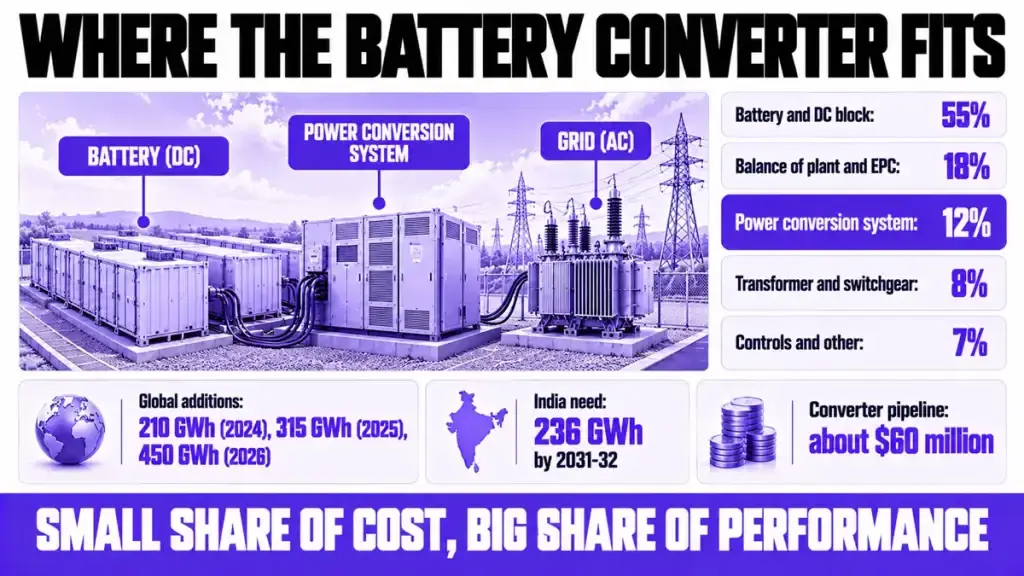
Those numbers show that India is still at the start of this. Operational battery storage in India was below 2 GWh in March 2026, against the 236 GWh the Central Electricity Authority expects by 2031-32. The company says that build-out implies very large capital spending over the coming years. Management plans to offer its storage products in India once the Turkish plant is running.
That Turkish plant at Nigde is built for this demand. It started manufacturing on 16 October 2026, and management calls it a 4 GW facility, with orders for almost 1 GW already in hand. The plant also supports a FACTS order in Japan worth ₹40.9 Cr.
That is not the only new building in Turkey. Construction of new plants for Endoks and Mehru is also under way there, to make advanced instrument transformers inside the European customs area. Making them in Turkey would put Mehru's products closer to European utilities and equipment makers, shorten lead times and help meet local-content rules. You can think of Turkey as the group's second home market, after India.
Insulators, Tanks and the Winwin Deal
Finally, let's look at the parts that sit around the main equipment. Sukrut Electric, a 50:50 joint venture with Yash Highvoltage, makes transformer tanks, fabrications and accessories. Every transformer needs these parts, and the company says transformer makers are qualifying new suppliers as they expand.
Beyond tanks, the bigger step is insulators. On 23 September 2026, Quality Power signed a share purchase agreement to buy up to 100% of Winwin Speciality Insulators for up to ₹272.34 Cr. It will pay part of that by issuing up to 10,17,123 of its own shares at ₹1,460 each, and the balance of up to ₹123.84 Cr in cash.
Winwin brings a long history and a large plant. Its brand goes back to W S Insulators, set up in Chennai in 1961, and its Visakhapatnam plant can make ceramic insulators up to 1,200 kV, with capacity of about 18,000 tonnes a year. It exports to about 55 countries. Insulators sit on the same bill of materials as the reactors and instrument transformers the group already sells.
"We are investing ahead of demand because we see a significant opportunity moving forward." - Sanjog Mhatre, Quality Power
Why Grid Buyers Rarely Change a Qualified Supplier
Now that we have seen each business, let's understand why customers stay with Quality Power. It starts with qualification. Every product and every plant must be approved by the utility or equipment maker that buys it, and high-voltage equipment is tested to strict standards before it goes near a live line.
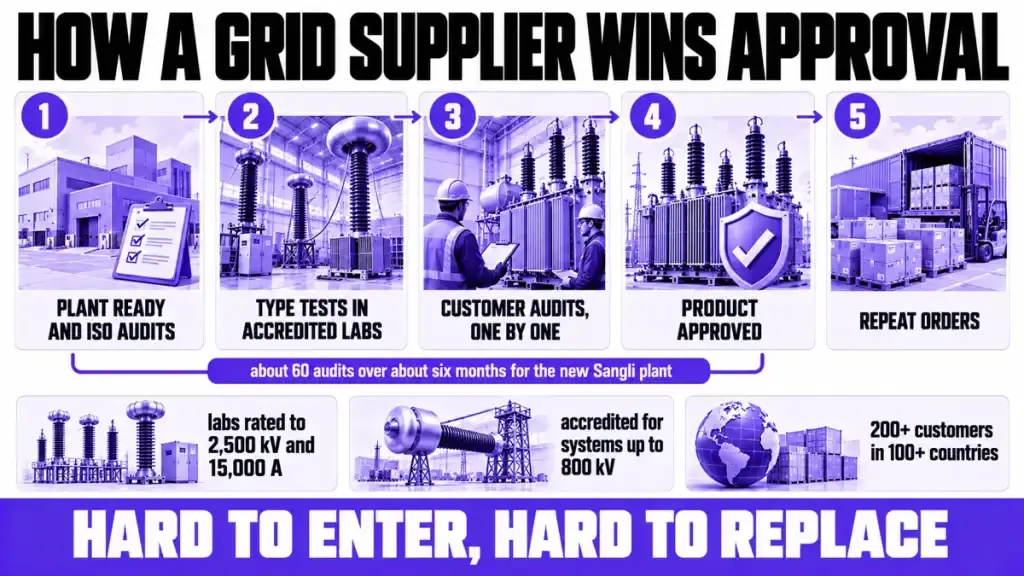
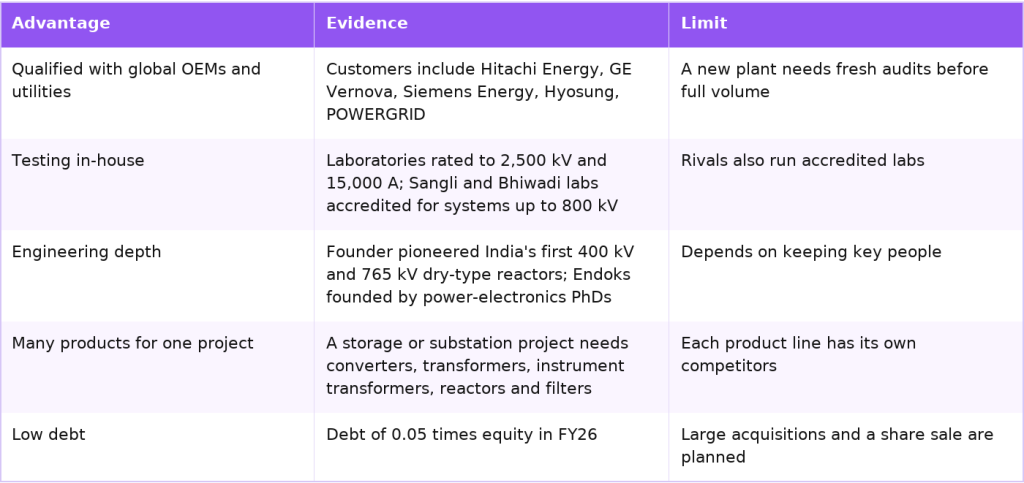
That qualification takes time even for an existing supplier. Management says the new Sangli plant faces about 60 customer audits before it can take over the full volume of the old factory. Those audits are global, scheduled one by one, and take about six months from the day the plant opens for them.
"These are highly regulated products and every, every customer has to come and review the facility." - Bharanidharan Pandyan, Quality Power
That rule works in favour of a supplier once it passes. A utility or equipment maker that has audited a plant and approved a product does not lightly switch to an untested one, because a failure on a high-voltage line can black out a region. So the long approval cycle that slows Quality Power's new plant also keeps rivals away from its existing customers. Read this Economic Moat Explained
Its laboratories shorten that cycle. The group runs test and research laboratories rated to 2,500 kV and 15,000 A, and its Sangli and Bhiwadi laboratories are accredited by NABL for systems up to 800 kV. Testing in-house lets the company take on custom engineering that commodity suppliers cannot, and prove it to the customer faster.
"It takes 20 years to build a reputation and five minutes to ruin it."
— Warren Buffett
For a grid supplier, one failure on a live line can undo years of audits. That is why buyers stay with suppliers like Quality Power once they have passed.
Beyond testing, the group's spread adds another advantage. At Endoks, the battery converter and the STATCOM share the same converter platform, with the group's own control software. So one engineering investment serves two growing markets, and we think that is hard for a pure converter assembler to match. A single battery-storage project needs a converter, transformers, instrument transformers, reactors and filters, and the group makes all of them. The company argues that this lets it win a larger share of each project than a supplier of one product. It is also pooling managers and purchasing across the group, with a new Chief Procurement Officer to combine buying.
Its people carry the technical edge. Alongside the founder, the group appointed Shylendra Kumar as Group Chief Technology Officer in Q1 FY27, after more than three decades in power quality and reactive power at Hitachi Energy, formerly ABB. At Endoks, all three founding engineers still run the business.
Financials: Fast Growth, Slower Cash
We have already seen the latest quarter and FY26. Now let's look at four years of consolidated numbers, to see how growth, margins and cash moved together.
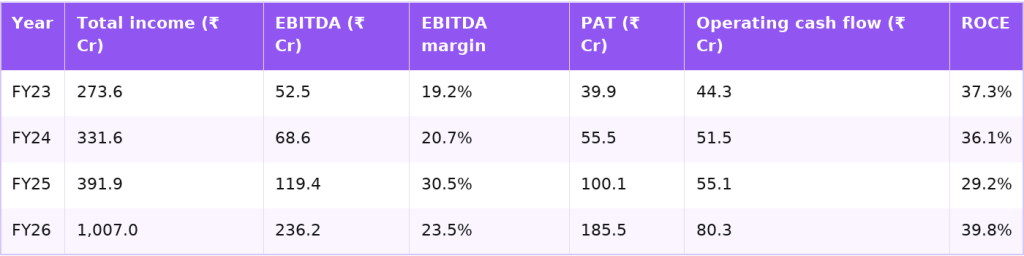
Total income grew about 3.7 times in three years, from ₹273.6 Cr in FY23 to ₹1,007 Cr in FY26, and profit after tax about 4.6 times, from ₹39.9 Cr to ₹185.5 Cr. Most of the jump came in FY26, the first full year with Mehru in the group. The EBITDA margin peaked at 30.5% in FY25 and was 23.5% in FY26.
Cash has lagged profit. Operating cash flow rose every year, but it was ₹80.3 Cr in FY26 against profit of ₹185.5 Cr, and only 0.3 times EBITDA, down from 0.8 times in FY23. Trade receivables rose to ₹241.8 Cr at March 2026 from ₹136.1 Cr a year earlier, and inventory to ₹116.1 Cr from ₹101.8 Cr.
The balance sheet carries little debt. Borrowings were ₹35.5 Cr at March 2026 against cash and bank balances of ₹247.9 Cr and total equity of ₹773.3 Cr. But about ₹64.2 Cr of FY26 profit belonged to the minority owners of Endoks and Mehru, so the profit that belongs to Quality Power's own shareholders is lower than the headline figure.
"Cash is to a business as oxygen is to an individual: never thought about when it is present, the only thing in mind when it is absent."
— Warren Buffett
Quality Power has the cash and low debt today. What it has to show next is that faster growth turns into cash as well as profit.
What the Next Two Years Look Like on Management's Numbers
So what could all of this add up to for you as a reader following Quality Power? Management guides about 20% revenue growth for FY27, which it will review at Q3. It has asked analysts to model an EBITDA margin of 20% or the high teens, and it has guided 50% growth for FY28.
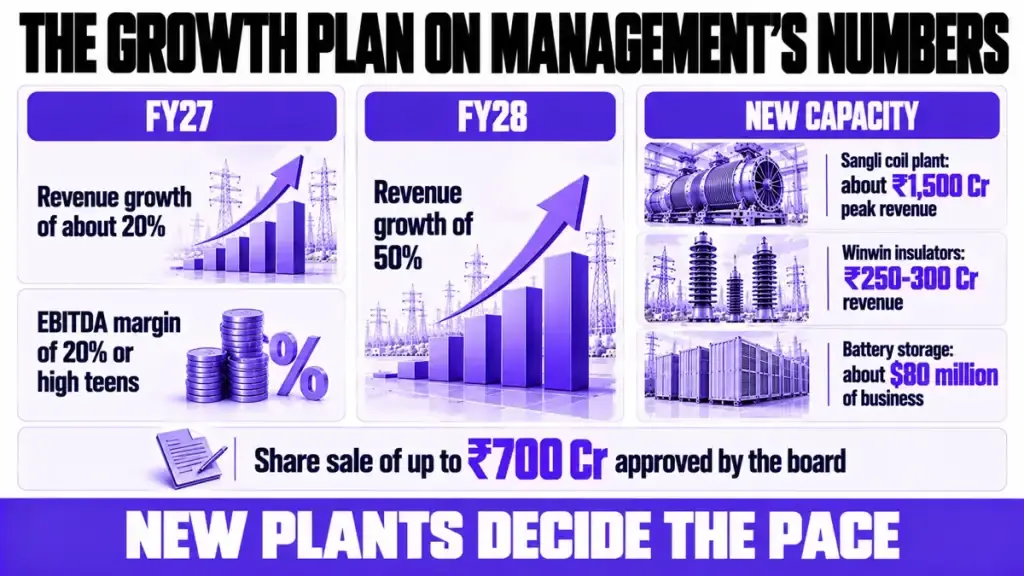
On FY26 total income of ₹1,007 Cr, growth of 20% would mean about ₹1,208 Cr in FY27. The step-up comes later. The Sangli plant needs about six months of audits before full volume, the Nigde plant began work only in October, and Winwin is expected to be consolidated from Q4 FY27.
That 20% guidance also reflects one thing management has held back on. It has said it will look at revising its targets only after the new factory is running in order, so the 20% figure is deliberately cautious. Q3 FY27 is when we will see whether it changes.
Each new piece adds to the base. If FY27 lands at about ₹1,208 Cr, growth of 50% in FY28 would take revenue to about ₹1,813 Cr, and the new plants are what would make that possible. Management puts the Sangli plant's peak revenue at about ₹1,500 Cr. It expects Winwin to bring ₹250-300 Cr of revenue without new spending and ₹450-500 Cr with spending on composite insulators. At Endoks, it expects about $80 million of storage business.
Winwin's price also looks low against its assets, on the company's own figures. When the term sheet was signed in June 2026, the company valued Winwin's land at about ₹190 Cr, its buildings at ₹100 Cr, its plant at ₹54 Cr and its brand and business at ₹46 Cr, a total of ₹390 Cr. The enterprise value agreed then was ₹315 Cr, including debt.
These plans need funding, and the company is raising it. On 23 September 2026, its board approved a qualified institutions placement of up to ₹700 Cr, along with the Winwin share issue. Shareholders were asked to approve both at a meeting on 19 October 2026.
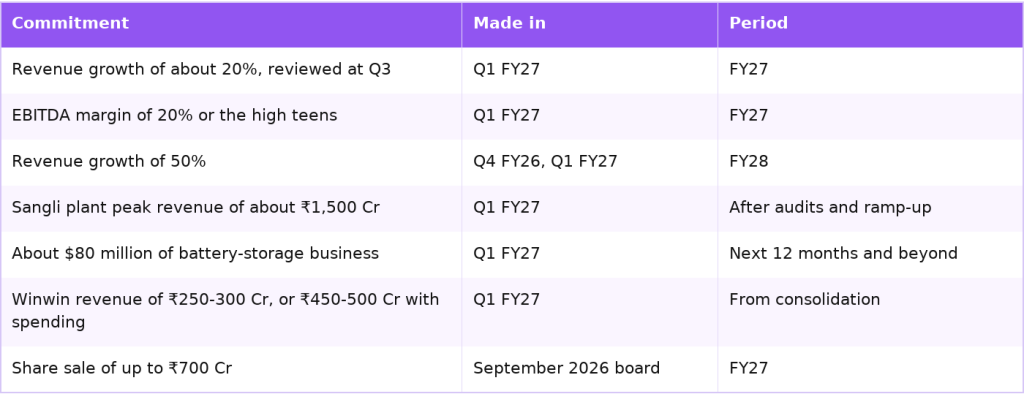
These commitments come with a short record we can check. At the start of FY26, management guided about ₹800 Cr of revenue, and later raised it to ₹900 Cr with an EBITDA margin aspiration of about 22%. The year closed at ₹1,007 Cr of total income and a 23.5% margin.
"Investing without research is like playing stud poker and never looking at the cards."
— Peter Lynch
For Quality Power, the cards are each guidance figure set against the result. FY26 beat both the revenue and the margin guided, and FY27 will be the next test.

Key Risks
No business grows in a straight line, so let's look at what could go wrong for Quality Power.
- Profit shared with minority owners: Endoks and Mehru are only 51% owned, so a large part of their profit belongs to other shareholders. About ₹64.2 Cr of FY26 profit went to minority holders, and they owned 29.9% of the group's net assets, about ₹231.2 Cr, at March 2026.
- Turkey: Endoks holds the largest order book in the group, but Turkey's high inflation forces a non-cash accounting charge that cut Q1 FY27 profit by ₹7.82 Cr. Currency swings can also reduce the rupee value of Endoks's profit.
- Acquisitions and dilution: the Winwin deal adds up to 10,17,123 new shares, and the planned share sale of up to ₹700 Cr would add more. If acquired businesses do not perform, existing shareholders bear the cost.
- Cash conversion: operating cash flow was 0.3 times EBITDA in FY26, as receivables rose with sales. Fast growth through acquisitions can keep cash conversion low.
- Plant ramp-up: the Sangli plant needs about 60 customer audits over about six months before full volume. Delays in approvals would push revenue later.
- Input costs: aluminium and copper price rises reach the parent company's margin about six months later, because aluminium is bought well before winding.
- Supply bottlenecks: IGBT semiconductors are the main bottleneck for battery converters worldwide, and shortages could slow Endoks's deliveries.
"Being too far ahead of your time is indistinguishable from being wrong."
— Howard Marks
Quality Power is building plants ahead of demand. If audits, ramp-ups or the Winwin deal take longer than planned, the cost comes first and the revenue later.
Explore our Products
Research Framework

Emerging Titans
Combination of quantitative analysis, industry tailwinds, and management assessment - SPRINT investment philosophy

Tiny Titans
Heavy emphasis on scuttlebutt research, plant visits, and early on-ground signals
What to Track Next
If you follow Quality Power, these are the signals that will show whether the plan is on track.
- Customer audits and the first orders from the new Sangli plant
- Deliveries from the Nigde converter plant, and new storage orders against the expected $80 million
- FY27 revenue growth against the guided 20%, reviewed at Q3
- Completion of the Winwin deal and its consolidation from Q4 FY27
- The size and use of the planned share sale of up to ₹700 Cr
- The order book after Q2 FY27, against ₹1,945.5 Cr in June 2026
Conclusion
Let's step back and put it all together. Quality Power began as a reactor maker in Sangli and has grown, through acquisitions in India and Turkey, into a group that makes much of the equipment around a modern substation. Its order book reached ₹1,945.5 Cr in June 2026, and its factories are full.
So the next two years will show whether its new plants can turn that demand into revenue. The Sangli coil plant and the Nigde converter plant both started work in October 2026, and Winwin should join the group from Q4 FY27. If audits and ramp-ups go to plan, the 50% growth guided for FY28 is within reach. If they take longer, the order book will wait, and a large share of the profit will still belong to minority partners. Cash is the other cautious thread: operating cash flow was only 0.3 times EBITDA in FY26. The next few quarters, starting with the Sangli audits and the first Nigde deliveries, will show how fast the order book turns into revenue and cash.
FAQs
What does Quality Power Electrical Equipments do?
+Quality Power is a Sangli company, incorporated in 2001, that makes reactors, line traps, capacitor banks and special transformers up to 765 kV. Through its subsidiaries it also makes instrument transformers in Rajasthan and power electronics, including battery-storage converters, in Turkey. It sells to more than 200 customers in over 100 countries from seven plants.
How big is Quality Power's order book?
+The order book was ₹1,945.5 Cr on 30 June 2026, about 1.9 times FY26 revenue. Endoks held ₹801 Cr, Mehru ₹585 Cr and the parent company ₹553 Cr. Management says the present book should be completed in about 15 months.
How did Quality Power do in Q1 FY27?
+Total income was ₹256.4 Cr, up 32.1% from a year ago, and the gross margin rose to 47.2%. Before a non-cash Ind AS 29 charge of ₹7.82 Cr in Turkey, EBITDA was ₹72.5 Cr at a 28.3% margin. Reported profit after tax was ₹46.7 Cr.
What is Quality Power's guidance for FY27 and FY28?
+Management guides about 20% revenue growth for FY27, to be reviewed at Q3, with an EBITDA margin of 20% or the high teens. It has guided 50% growth for FY28. In FY26 it guided about ₹800 Cr, later ₹900 Cr, and closed at ₹1,007 Cr of total income.
What is the Winwin Speciality Insulators deal?
+On 23 September 2026, Quality Power signed to buy up to 100% of Winwin for up to ₹272.34 Cr, partly by issuing up to 10,17,123 shares at ₹1,460 each. Winwin's Visakhapatnam plant makes ceramic insulators up to 1,200 kV, with about 18,000 tonnes of yearly capacity. Management expects ₹250-300 Cr of revenue from it, and consolidation from Q4 FY27.
What are the main risks for Quality Power?
+About ₹64.2 Cr of FY26 profit went to minority owners of Endoks and Mehru. Turkey's high inflation forces a non-cash accounting charge, and the Winwin deal and a planned share sale of up to ₹700 Cr will add shares. Operating cash flow was 0.3 times EBITDA in FY26, and the new Sangli plant needs about 60 customer audits before full volume.

High growth stock specialist, Value Educator
Shashank Mahajan is an equity research professional with over 12 years of experience in identifying high-potential SME and micro-cap stocks at an early stage. He follows a rigorous scuttlebutt research–driven approach, combining on-ground insights with deep financial analysis. Shashank specializes in uncovering under-researched and under-owned companies with strong management quality and long-term growth potential. Through disciplined research and early identification, he focuses on spotting tomorrow’s market leaders before they enter the mainstream investor radar.
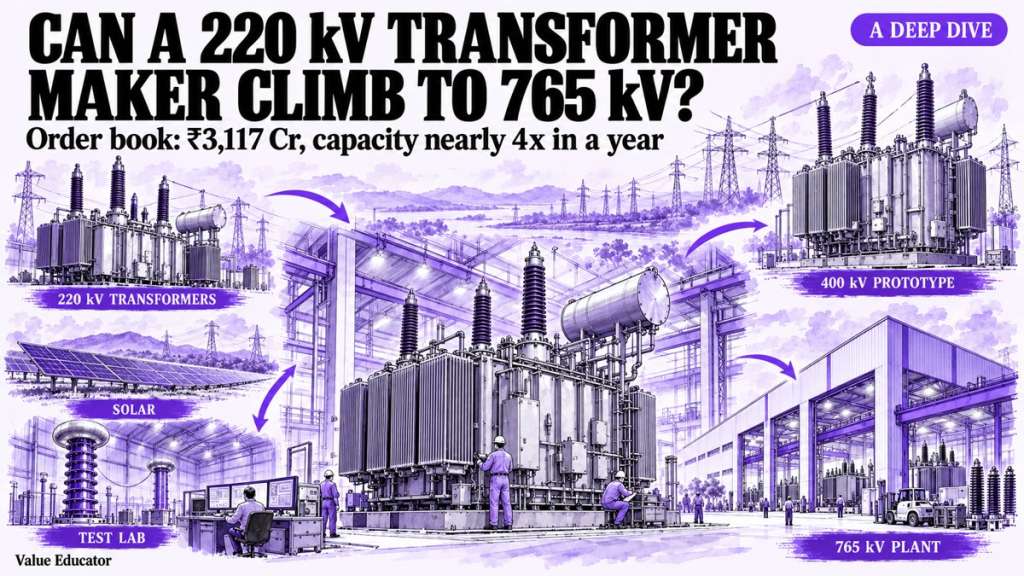
Atlanta Electricals: Capacity Nearly Quadrupled in a Year
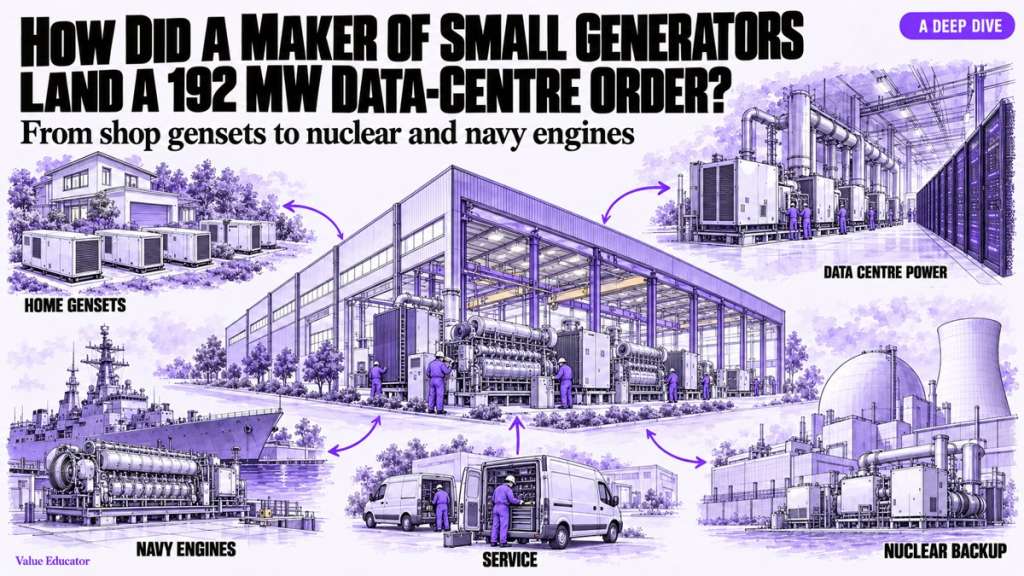
Kirloskar Oil Engines: Data Centres, Nuclear and the Navy
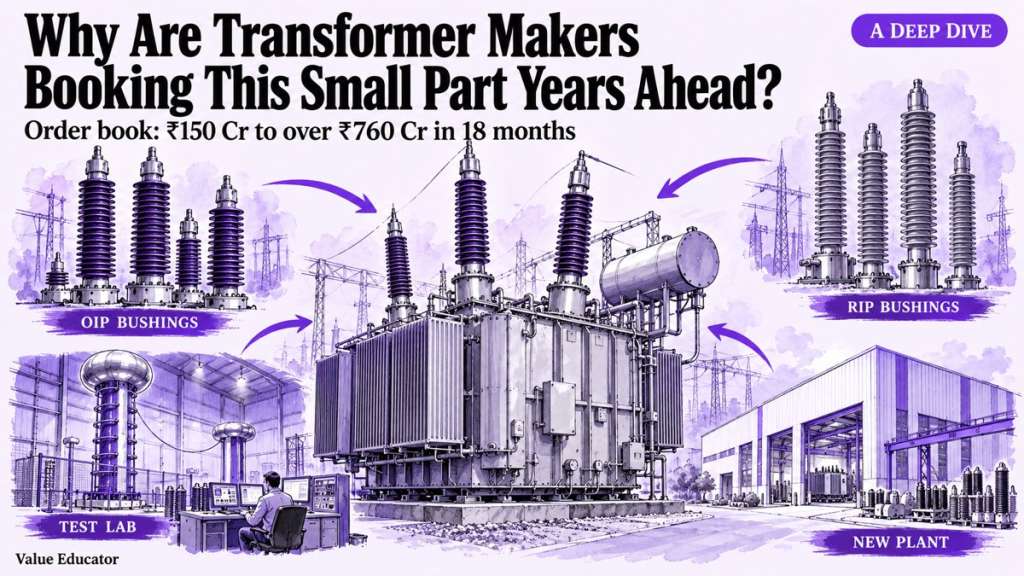
Yash Highvoltage: Bushing Maker With ₹760 Cr of Orders
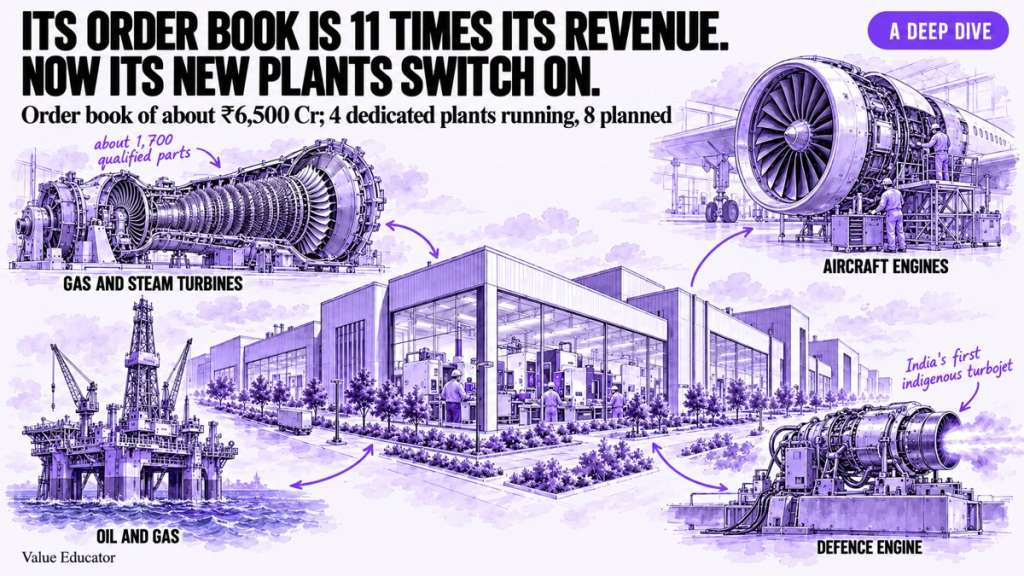
Azad Engineering: Turbine Blades, Jet Engines and Orders
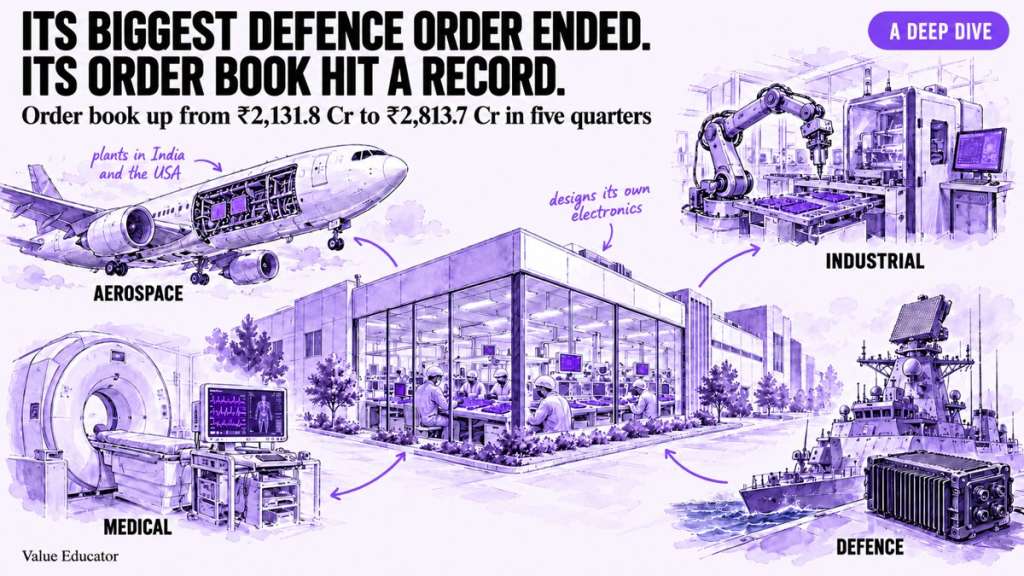
Cyient DLM: Aircraft Electronics and a Record Order Book

Zen Technologies: Revenue Fell After a Big Win
Explore our Products
Research Framework
Emerging Titans
Combination of quantitative analysis, industry tailwinds, and management assessment - SPRINT investment philosophy
Tiny Titans
Heavy emphasis on scuttlebutt research, plant visits, and early on-ground signals


 Orders
 Subscription
 Share with friends


Required Details
₹23999.00
(12 month subscription)
As per SEBI regulations, all users are mandated to complete the KYC that is validated for 1 year. Post payment, you will be redirected to the KYC screen


No comments yet. Be the first to comment!