
Servotech Renewable: EV Chargers, Solar and Cash Flow
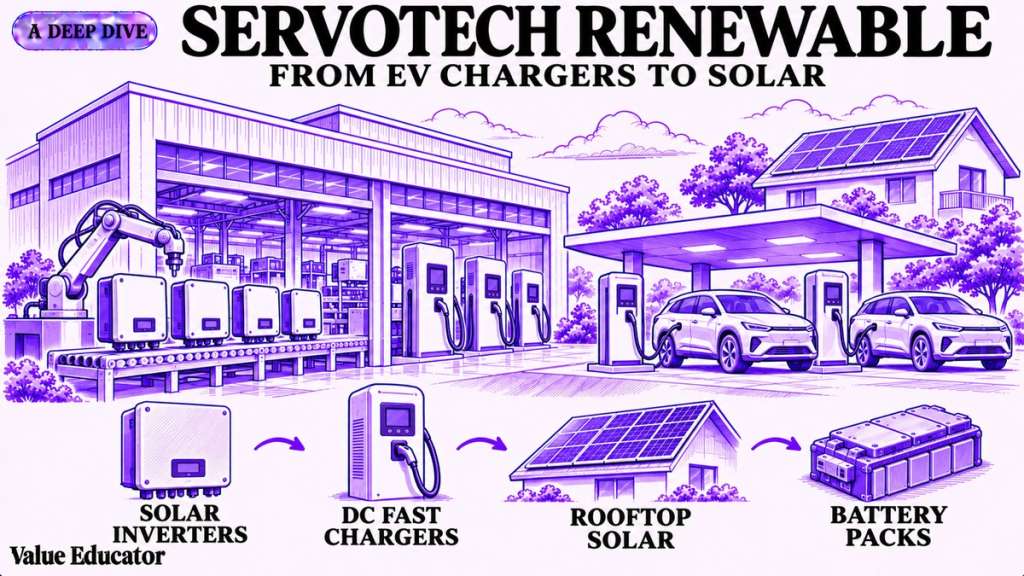
In FY26, EV chargers brought in 42.3% of the revenue of a Delhi power-electronics company. That same year, it says it won about 67% of the DC fast-charger tenders run by India's public-sector oil companies. Then the mix changed. In the April to June quarter of 2026, chargers made up only 2.5% of its sales, and in July to September they made up 3.98%. Solar plants, solar inverters and solar panels made up about 91.5%.
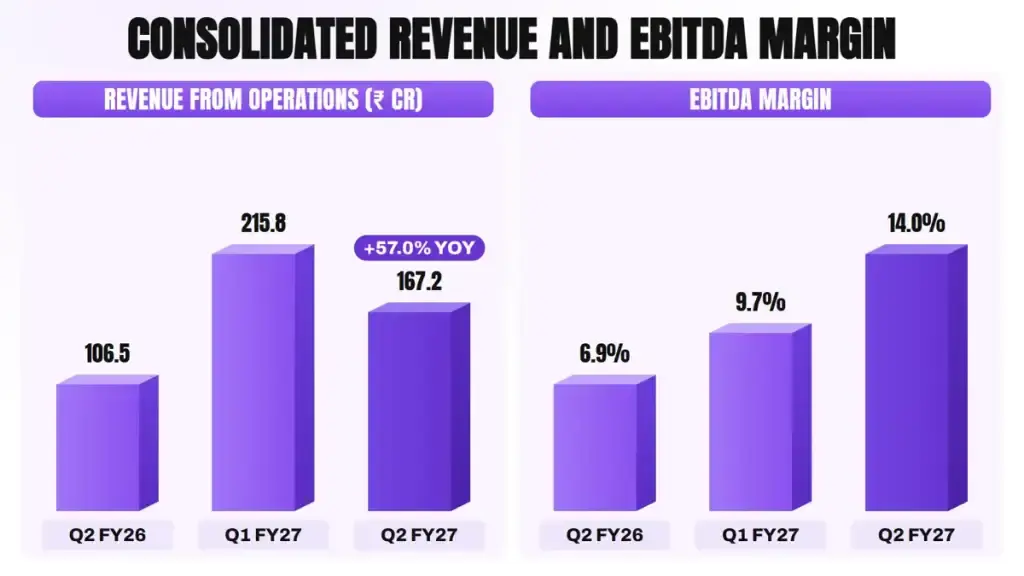
Yet the company still grew fast in those months. Its consolidated revenue from operations rose 57.0% in Q2 FY27, to ₹167.2 Cr. Its EBITDA margin, the share of revenue left after running costs and before interest, depreciation and tax, reached 14.0%, against 6.9% a year earlier. So the business that made its name in EV charging is now paid mostly by the sun.
That name comes from one product. A DC fast charger is the large box at a fuel station or highway stop that turns grid power into direct current and feeds it straight into a car's battery. Servotech's models run from 60 kW to 360 kW, so a car charges far faster than on a home socket. A home charger, by contrast, is a small AC unit that lets the car's own electronics do the conversion.
Those large chargers are mostly bought through tenders. An oil marketing company, or OMC, is a firm that runs India's petrol pumps, such as IOCL, BPCL and HPCL. Under central schemes, these companies put chargers at their fuel stations, and they buy them in large tenders.
That fuel-station charger is only one of the things this company makes. It also makes solar inverters, the boxes that turn the direct current from solar panels into the alternating current a home uses. It sells solar panels and builds rooftop solar plants. It assembles lithium-ion battery packs and a BESS, which stands for battery energy storage system, a large battery that stores power for later use. A lot of its rooftop and charger work comes as EPC contracts. EPC refers to engineering, procurement and construction, where the supplier designs the job, buys the parts, installs it and hands it over working.
That company is Servotech Renewable Power System Ltd (NSE: SERVOTECH). It is run from Delhi and makes its products at two plants in Sonipat, Haryana: Kundli for solar inverters and battery packs, and Safiabad for EV chargers. It says it has installed more than 15,000 EV chargers, and it sells solar products through more than 800 distributors and 6,000 retailers in more than 370 towns.
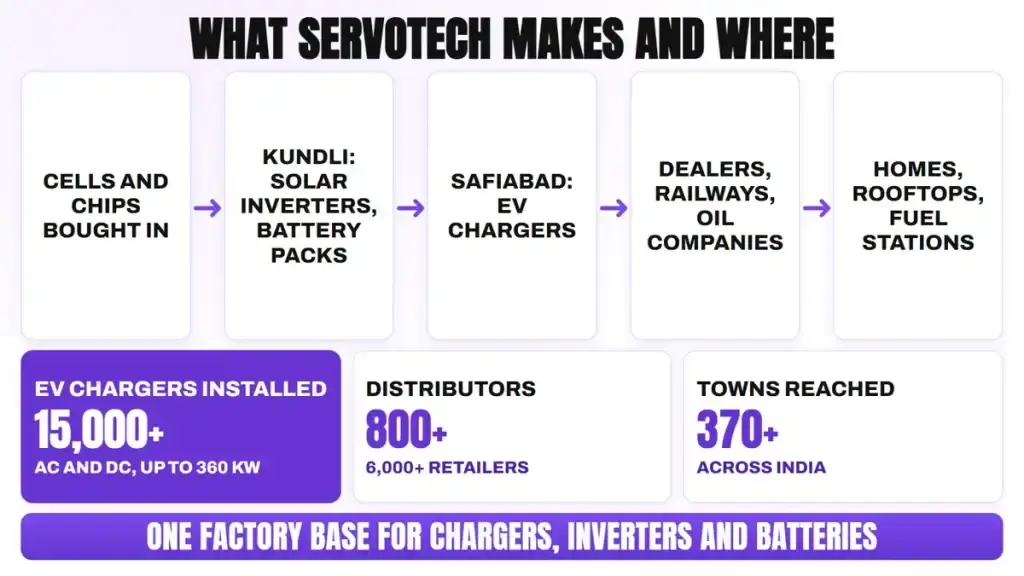
So Servotech has two kinds of buyers. Government bodies, railways and oil companies buy through tenders and pay after the job is done. Dealers buy inverters and panels for homes and shops, and they pay much sooner. As we will see, that difference shapes almost every number that follows.
Servotech Renewable in five numbers
- Q2 FY27 revenue from operations of ₹167.2 Cr, up 57.0%
- A Q2 FY27 EBITDA margin of 14.0%, against 6.9% a year ago
- About 67% of FY26 public-sector DC fast-charger tenders, by its own count
- Dealer sales of about ₹25 Cr a month in FY26, against ₹2 Cr in FY22
- Borrowings of ₹255.4 Cr in September 2026, against ₹75.1 Cr in March 2025
Those five numbers point two ways: faster growth and better margins on one side, and more debt on the other. How did both show up in the latest numbers? Let's first understand the company, and then look at the latest quarter.
Servotech Renewable: Company Overview
Servotech Renewable Power System Ltd, earlier called Servotech Power Systems, was incorporated in 2004. Its registered office is at Kundli in Sonipat, Haryana, and its corporate office is in Rohini, New Delhi. Raman Bhatia founded the company and is its Managing Director, and Sarika Bhatia is a whole-time director. Servotech makes solar inverters, solar panels and parts, DC and AC EV chargers, lithium-ion battery packs, battery storage systems and servo stabilisers, and it builds rooftop solar plants as EPC jobs. It has two plants in Sonipat, at Kundli and Safiabad, and a warehouse at Jhundpur, and it had 499 permanent employees in March 2026. Its shares listed on the NSE in 2017. Consolidated total revenue was ₹675.4 Cr in FY26, and borrowings stood at ₹255.4 Cr in September 2026. Read this Renewable Energy Stocks in India 2026: Solar and Wind
"Know what you own, and know why you own it."
— Peter Lynch
Servotech is often seen as an EV charger maker, but in the first half of FY27 solar brought in most of its sales. Knowing which line pays the bills is the first step to reading its results.
The Quarter Revenue Grew 57.0%
Let's look at the latest quarter, Q2 FY27, the July to September period that Servotech reported on 3 November 2026. Consolidated revenue from operations was ₹167.2 Cr, up 57.0% from ₹106.5 Cr a year ago. Total revenue, which adds other income, was ₹168.8 Cr, up 56.82%.

As we can see, revenue was lower than in Q1 FY27, when total revenue was ₹216.3 Cr. That is about 21.9% less from one quarter to the next. Management says the second half of its year is always stronger than the first, so a gap between quarters is normal for this business.
But profit moved the other way. EBITDA was ₹23.6 Cr, up 216.97% from ₹7.4 Cr a year ago, and higher than the ₹20.9 Cr of Q1 FY27 on less revenue. The gross margin, the share of revenue left after the cost of materials, rose to about 25.8% from about 21.9% a year ago. Profit before tax was ₹12.6 Cr, against only ₹0.5 Cr in Q2 FY26, so the growth rates on profit look very large because the base was so small.
Inside that profit, one item came from an internal fraud. In the quarter, the company found that two employees, working with an outsider, had removed stock and forged tax invoices. It puts the loss at ₹2.00 Cr to ₹2.50 Cr, has recovered about ₹75.65 lakh, and booked a net loss of ₹1.53 Cr in the quarter. A police case is open and both employees were arrested.
That consolidated picture includes the group companies. The parent company alone, which holds the factories, reported total revenue of ₹158.8 Cr, up 54.31%, and EBITDA of ₹19.98 Cr, up 105.07%. Its EBITDA margin was about 12.6%, and its profit after tax rose to ₹8.37 Cr.
That same pattern holds over the half year. H1 FY27 consolidated total revenue was ₹385.1 Cr, up 57.3% from ₹244.8 Cr. EBITDA for the half was about ₹44.5 Cr, a margin of about 11.6%. Profit to shareholders was ₹16.5 Cr, against ₹6.6 Cr in H1 FY26.
Where the Cash Went in the First Half
Now let's look at cash, because profit and cash went in different directions. Read this Cash Flow Statement Explained Operating cash flow, the cash the business makes from its daily work, was negative ₹26.8 Cr in H1 FY27. In FY26 it was negative ₹8.3 Cr, and in FY25 negative ₹55.4 Cr.
That gap comes from working capital, which means the money tied up in stock and unpaid customer bills, less what the company owes its suppliers. In the half year, customers paid down about ₹50.0 Cr of their bills. But Servotech paid its own suppliers about ₹86.3 Cr more than it took on, and inventory rose by about ₹16.7 Cr. So more cash went out than came in.
Those payments left visible marks on the balance sheet. Trade receivables, the bills customers still owe, came down to ₹200.5 Cr in September 2026 from ₹250.5 Cr in March. Trade payables fell to ₹57.1 Cr from ₹143.4 Cr. Inventory rose to ₹76.6 Cr from ₹59.9 Cr.
So borrowings filled the gap. They were ₹255.4 Cr in September 2026, against ₹209.3 Cr in March 2026 and ₹75.1 Cr in March 2025. Debt was about 0.81 times equity, against about 0.71 times in March. Read this Debt to Equity Ratio Explained Finance cost was ₹5.4 Cr in Q2 FY27, against ₹2.6 Cr a year ago.

What the cash flow says: from FY23 to FY26, profit to shareholders added up to about ₹89.1 Cr, while operating cash flow added up to about negative ₹87.1 Cr. The growth so far has been paid for with debt and new shares, more than with cash from the business.
That rise in debt matters because management set different goals in May 2026. It said FY27 would be a year of consolidation, with no fresh long-term debt, positive operating cash flow and gearing, its word for debt against equity, back below half. Six months in, long-term borrowings were ₹79.8 Cr, up from ₹53.6 Cr in March.
Still, management explained where the FY26 cash went. It said about ₹40 Cr of receivables was held up with the three oil companies, and about ₹60 Cr was tied to railway projects that were still being installed. On those railway jobs, it is paid 60% on delivery and 40% on commissioning. It also said about ₹79 Cr of the new debt went into plant, machinery and a stake in a solar panel maker.
How a Delhi Power-Backup Maker Moved Into Chargers and Solar
Now that we have seen the quarter, let's go back and see how a Delhi power-backup maker got here. Servotech was incorporated on 24 September 2004. Raman Bhatia is its founder and Managing Director, and Sarika Bhatia is a whole-time director. It listed on the NSE in 2017.
That early business was power electronics: servo stabilisers, which keep voltage steady for machines, and later LED lights and backup products. It also made oxygen concentrators and UVC devices at its Kundli plant. Over time Kundli moved to solar inverters and battery storage, and in 2023 the company opened its Safiabad plant for EV chargers.
Chargers then became the fast-growing line. Servotech supplied 30 kW and 60 kW DC chargers to BPCL fuel stations across India, and by March 2024 it had delivered more than 5,600 chargers. In FY26, EV chargers brought in ₹271.4 Cr, or 42.3% of the parent company's revenue, against ₹320.3 Cr from solar.
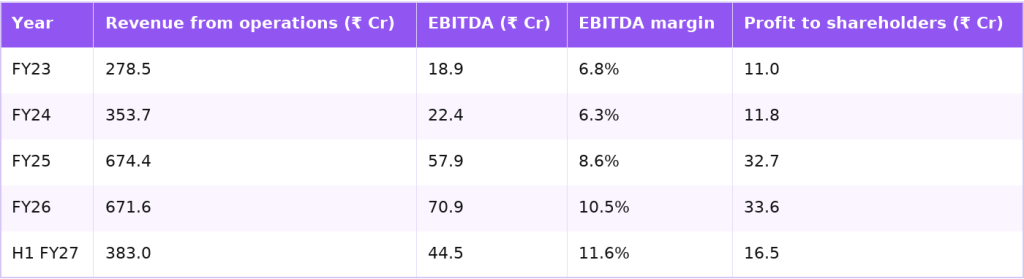
That table shows two different years in the middle. FY25 revenue nearly doubled, but part of it came from a medical-devices trading arm. In FY26 the company cut that trading back, and the subsidiary's revenue went from ₹98 Cr to ₹32 Cr. So group revenue stayed flat at about ₹671.6 Cr, while the parent company's total revenue grew 8.92% to ₹641.7 Cr.
Beneath that flat top line, the margin moved up every year after FY24. It went from 6.3% in FY24 to 10.5% in FY26 and 11.6% in the first half of FY27. Management puts this down to more inverters, larger DC chargers and battery storage in the mix, and to dealer sales, which it says carry a better margin than tenders. The parent company's EBITDA margin in the second half of FY26 was 12%, which management called the highest since listing.
"When we manufacture an electric vehicle charger or a solar inverter, 70-80 percent of the work is common because both are electronic and electrical products." - Raman Bhatia, Managing Director, May 2026
Solar Pays the Bills While Chargers Wait
Now let's split the business into its parts, because solar and chargers sell to different buyers. Servotech reports one segment, but its investor decks show revenue by solar, charger and other product lines each quarter. These shares move a lot from one quarter to the next.
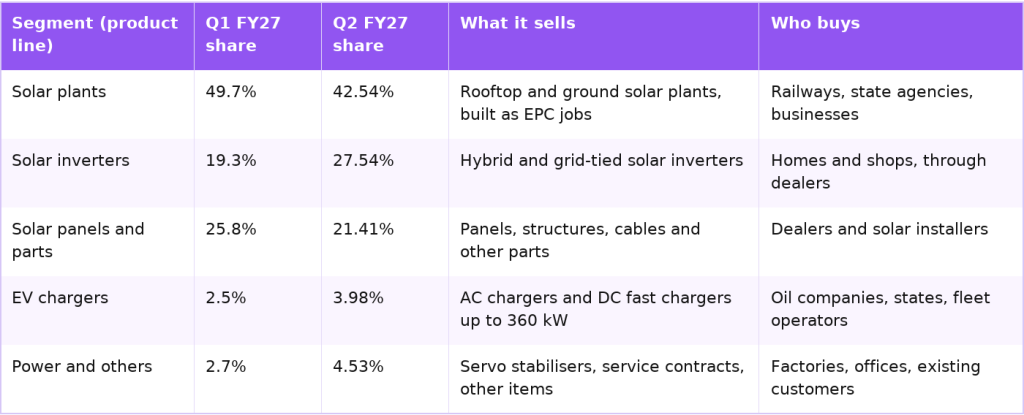
As you can see, that table makes one point plain: in the first half of FY27, Servotech was a solar company. Solar lines made up about 94.8% of Q1 FY27 sales and about 91.5% of Q2 FY27 sales.

These shares come from different documents, and they may group products in different ways. In February 2026, the MD said chargers were about 10-11% of revenue at that time. The FY26 annual report puts EV chargers at 42.3% of the year. Either way, chargers were a small part of the latest two quarters.
"Risk comes from not knowing what you're doing."
— Warren Buffett
For Servotech, knowing what you are looking at means checking the product mix each quarter, because the business behind the EV charger name is now mostly solar.
Solar Plants for Railways and Government Buyers
Let's start with solar plants, the largest line. Here Servotech designs and builds rooftop or ground-mounted solar plants as EPC jobs. In Q1 FY27 it won a 1,415 kW rooftop order from South Central Railway, and a 900 kW battery storage order in Uttar Pradesh.
That work pays well but late. Management says a small solar project takes 70 to 120 days to complete, and the money comes only after it is installed and commissioned. Large government jobs also hold back part of the payment as retention money, which is a share of the bill kept back for up to five years.
Solar Inverters and Panels Through Dealers
Next, let's look at the dealer business, which management sees as the main growth path. Servotech sells inverters, panels and small batteries under its own brand through distributors and retailers. In FY22, these dealer sales were about ₹2 Cr a month. By FY26 they were about ₹25 Cr a month.
That dealer cash comes in faster. Management says a distributor pays in about 23 to 25 days, against 70 to 80 days on a government job. It wants dealer and retail sales to make up more than 50% of revenue in FY27. It has also built inverter capacity of about 12,000 to 15,000 units a month.

This network also needs brand spending. Actor Sonu Sood is its brand ambassador, it runs TV campaigns, and it owns stakes in a cricket franchise and an events company that it uses for dealer meets. Its demand here also rides on the PM Surya Ghar rooftop solar scheme for homes, and management says it grew its dealer network to serve that scheme.
EV Chargers for Oil Companies and Fleets
Now let's come to the line that made Servotech known. It makes AC chargers and DC fast chargers from 60 kW up to 360 kW at Safiabad. Its buyers include BPCL, HPCL, IOCL and Nayara, and FY26 was its best year for charger tenders.
That tender record did not turn into charger sales this year. In July 2026, the MD said there was not much growth in the charger business, and that the market was a little stagnant. Charging has also moved toward a model where private operators build stations and the government supports them. A subsidiary, Servotech EV Infra, now installs and runs some charging stations itself.
Still, the scheme money is there. Under PM E-DRIVE, the central government set aside ₹2,000 Cr for public chargers. By 28 September 2026 it had approved ₹851 Cr for 8,147 chargers for three oil companies and ten states. Servotech's 60 kW and 120 kW DC chargers also got a BEE 5-star rating for efficiency in Q1 FY27, which helps in such tenders.
Beyond fuel stations, the company is also aiming at larger vehicles. Management says it is working with large truck makers on 120 kW, 240 kW and 360 kW chargers, and on chargers of one megawatt. It says one large charger of this kind costs about ₹15 lakh, against about ₹1,500 for a scooter charger.
Battery Packs and Storage
Next, let's look at the newest line, battery packs and storage. Servotech buys lithium-ion cells, mostly made in China, and assembles them into packs with its own battery management software, casing and cooling design. It sells packs for solar homes and for e-rickshaws, and it builds larger BESS units.
That line is still small. In May 2026 management said energy storage was only about 1% of revenue. But it is the line with the boldest plan. In July 2026, the MD said battery capacity would double in six months, triple by March 2027 and grow ten times in two years. The company also signed a ₹400 Cr MoU with the Haryana government to add manufacturing capacity in the state.
The Group Companies
Finally, let's look at the group companies around the parent. Servotech owns 95% of Rebreathe Medical Devices, a medical-devices arm it has scaled down. It owns 61.73% of Servotech Sports and Entertainment, which holds cricket franchise and league stakes, and 51% of Hertz & Pixelz, an events and content firm. It also holds 27% of Rhine Solar, a solar panel and cell maker.
These side companies cost money for now. In FY26, the minority partners' share of the group's results was a loss of ₹1.9 Cr. In July 2026, the MD said the sports company was not profitable in that quarter, but expected it to be profitable in the long term.
Where Servotech Sits in the EV and Solar Chain
Now let's place Servotech in the wider chain. A solar system needs cells, panels, an inverter, a battery and someone to install it. An EV charging network needs chargers, a site, a grid connection and an operator. Servotech works in the middle of both: it buys cells and chips, makes inverters, chargers and packs, and installs many of them itself.
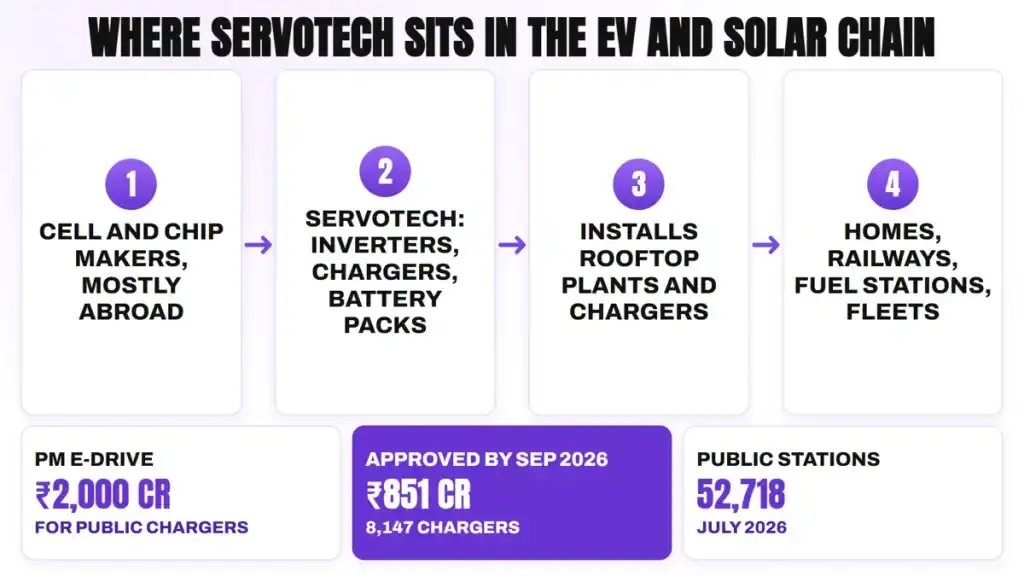
As you would expect, that middle position is crowded, and Servotech itself points to intense competition in both EV charging and renewable energy. What links Servotech's two halves is the factory. The MD says 70-80% of the work in a charger and a solar inverter is common, because both use the same circuit-board machines and assembly methods.
That shared factory also links the products. Servotech now sells EV chargers with solar panels and battery storage attached, so a fuel station can charge cars from its own solar power. In the same way, a home solar system with a battery uses the same inverter and pack that Servotech makes.
That charging network is still growing in India. In July 2026 India had 52,718 public charging stations, of which 16,561 had fast chargers for cars. Electric cars, buses and trucks with larger batteries need larger chargers, and that is the part of the market Servotech is chasing.
What Makes Servotech Hard to Copy
Now that we have seen the parts, let's ask what is hard to copy here. Many firms assemble inverters and chargers in India. So the question is what a buyer gets from Servotech that it cannot get from the next supplier. Read this Economic Moat Explained
One part is the tender record. Oil-company and state tenders ask for proven products, local manufacturing and service across India. Servotech has supplied chargers to oil companies across many states, and says it won about two-thirds of the FY26 public-sector DC charger tenders. That record helps it qualify for the next round.
Another part is the dealer network. More than 800 distributors and 6,000 retailers took years and a lot of brand spending to build. The network grew from about ₹2 Cr a month of sales in FY22 to about ₹25 Cr a month in FY26, and more than 70% of its partners stay with the company.
Beyond the network, the factory gives some flexibility. Because chargers, inverters and battery packs share much of the same work, Servotech can move its lines to whatever sells. That is what happened in FY27: when charger tenders went quiet, solar inverters took up the space.
"In business, I look for economic castles protected by unbreachable moats."
— Warren Buffett
Servotech's walls are its tender record, its dealer network and a factory that can switch between products. The margin over the next few years will show how high those walls are.
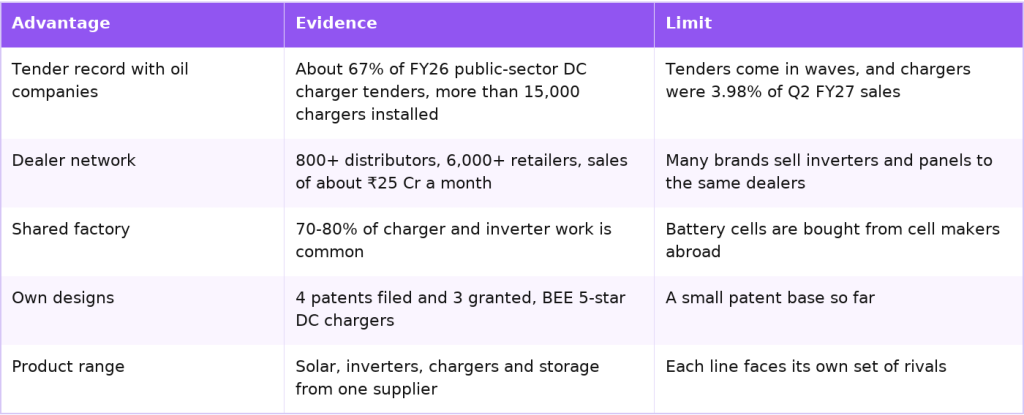
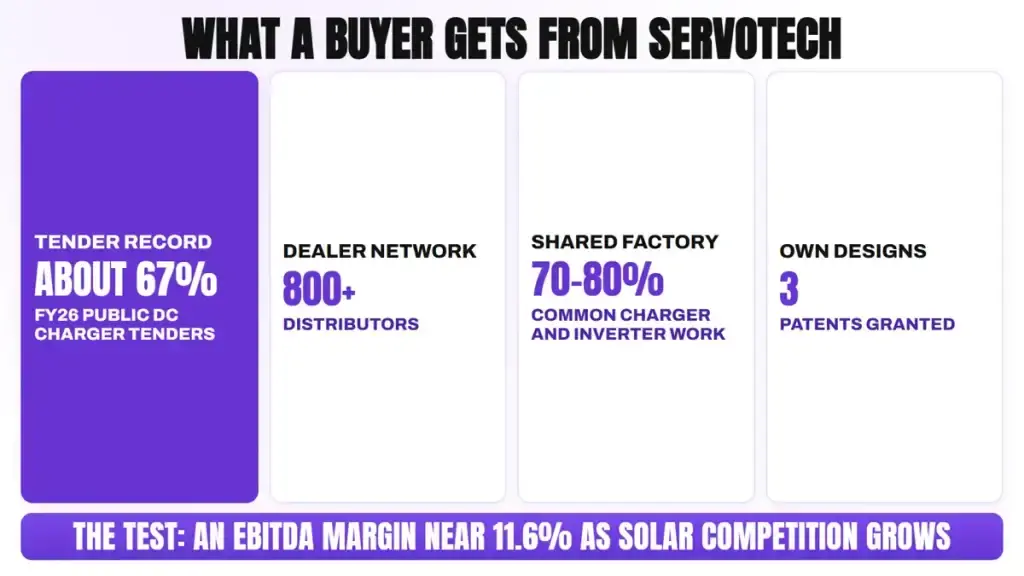
That table shows why the margin is the real test of the moat. If buyers value the brand, the range and the tender record, Servotech should hold its EBITDA margin near the 11.6% of H1 FY27. If it is mostly selling on price, the margin will move back toward the 6% to 7% of FY23 and FY24.
Financials: Four Years of Growth, Margins and Cash Flow
One quarter can mislead in a business where large EPC jobs move sales between quarters, so let's look at the full years together. These are consolidated figures; EBITDA is shown as the company computes it, including other income, and the first half of FY27 is shown for comparison.

Revenue from operations grew from about ₹278.5 Cr in FY23 to about ₹671.6 Cr in FY26, and profit to shareholders grew from about ₹11.0 Cr to about ₹33.6 Cr. The EBITDA margin rose from 6.3% in FY24 to 10.5% in FY26 and 11.6% in H1 FY27, as inverters, larger chargers and dealer sales took a bigger share.
Cash flow has not kept up with profit. From FY23 to FY26, profit to shareholders added up to about ₹89.1 Cr, while operating cash flow added up to about negative ₹87.1 Cr. Receivables from government, railway and oil-company jobs grew with the business, and in H1 FY27 the company also paid down its suppliers.
The gap has been filled with debt and new equity. Borrowings rose from ₹75.1 Cr in March 2025 to ₹255.4 Cr in September 2026, and debt was about 0.81 times equity. Management has set FY27 goals of positive operating cash flow and debt below half of equity, and the second half will show whether they are met.
"Cash is a fact, profit is an opinion."
— Alfred Rappaport
Servotech's profit has grown for four years, but its cash flow from operations has mostly been negative. Reading both together shows how much of the growth still sits in unpaid bills.
What FY27 Could Look Like on Management's Numbers
So where does the business go from here? Management does not give a revenue target for FY27. In February 2026, the MD said the company was working toward 40-50% growth in the next year. In May 2026 he said FY27 would be a year of consolidation, with the focus on cash flow, working capital and careful spending.
Now let's put the first half against that range. H1 FY27 consolidated total revenue grew 57.3%, and the parent company's total revenue grew 60.9%. The MD has also said H2 tends to beat H1. So on revenue, the first half is already above the range management talked about.

On the margin, the guide is softer. In May 2026 management said the margin gain of FY26 was structural, and that it expected to hold it or improve it a little. In July, the MD said margin is not the most important thing for the company, because it comes as a by-product of good work. The parent company's EBITDA margin was about 11.8% in H1 FY27, against 11.56% in FY26.
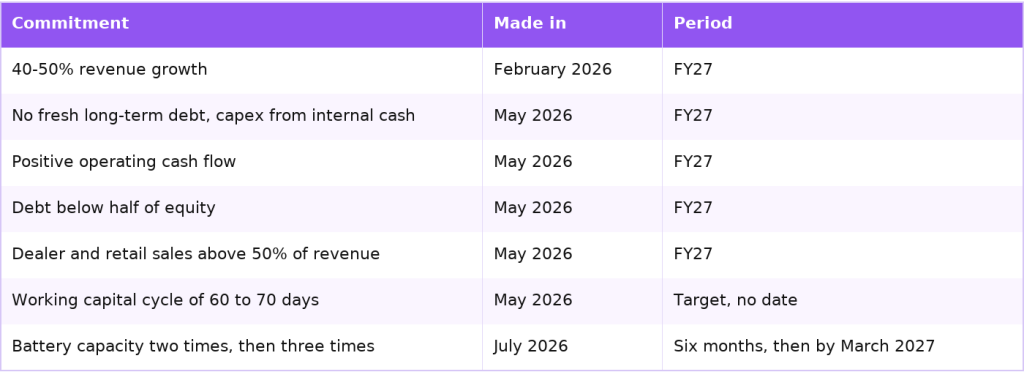
Those commitments are easier to judge against the past. So let's check what management said before against what it delivered.

That record shows us a clear split. On sales and margins, Servotech has done what it said and more. On cash and debt, the first half went against its own goals, so the second half has to carry most of the cash recovery.
Key Risks
Now let's look at what could go wrong for Servotech, because the latest half year has already shown some of these risks.
- Cash flow and debt: operating cash flow was negative in FY25, FY26 and H1 FY27. Borrowings rose to ₹255.4 Cr from ₹75.1 Cr in March 2025, and debt was about 0.81 times equity in September 2026, against a goal of below half.
- Slow government payments: about ₹40 Cr was held up with oil companies in March 2026, and railway and state jobs pay only after commissioning, with retention money held for years.
- Charger demand: chargers fell to 2.5% and 3.98% of sales in the last two quarters, from 42.3% of FY26. The MD called the market stagnant in July 2026, and new tenders depend on PM E-DRIVE, which runs to March 2028.
- Solar competition: solar inverters and panels are crowded markets, with many brands selling to the same dealers. Price pressure would hit the margin first.
- Cells from China: battery packs depend on imported cells, and the 10-times battery plan needs both demand and capital.
- Side businesses: cricket, events and medical devices sit inside the group. The minority share of group losses was ₹1.9 Cr in FY26, and the sports company was not profitable in Q1 FY27.
- Controls and disclosure: a stock and invoice fraud cost a net ₹1.53 Cr in Q2 FY27. The finance head changed on 1 April 2026, and the company does not disclose an order book or plant capacity, and its product-mix numbers do not match across documents.
- Uneven quarters: revenue fell about 21.9% from Q1 FY27 to Q2 FY27, and large EPC jobs can shift sales from one quarter to another.
"There is not much growth in that right now. Because the market is a little bit stagnant right now and it seems that there will be some growth in the future." - Raman Bhatia, Managing Director, on DC and AC chargers, July 2026
"Being too far ahead of your time is indistinguishable from being wrong."
— Howard Marks
Servotech built charger capacity early, and the charger market has been slow to follow. Whether that early bet pays off depends on PM E-DRIVE tenders and on larger vehicles that need large chargers.
Explore our Products
Research Framework

Emerging Titans
Combination of quantitative analysis, industry tailwinds, and management assessment - SPRINT investment philosophy

Tiny Titans
Heavy emphasis on scuttlebutt research, plant visits, and early on-ground signals
What to Track Next
If you follow Servotech, these are the signals that will show where it goes next.
- H2 FY27 operating cash flow against the goal of a positive full year
- Borrowings after ₹255.4 Cr and debt against equity after 0.81 times
- Trade receivables after ₹200.5 Cr, and the share of dealer sales against 50%
- The EBITDA margin against 14.0% in Q2 FY27 and 11.6% in H1 FY27
- EV charger share of sales after 3.98%, and wins in PM E-DRIVE charger tenders
- Battery capacity against the plan of two times in six months and three times by March 2027
For the other listed EV suppliers, from battery materials to car parts, see EV Stocks in India 2026: Battery Materials to Car Parts.
Conclusion
Let's put it all together. Servotech made its name with DC fast chargers for oil companies, and in FY26 chargers were 42.3% of its parent company's revenue. In the first half of FY27, solar made up more than 90% of sales, revenue grew 57.3% and the EBITDA margin rose to 11.6%. The next two quarters will show whether that margin holds as dealer sales grow, and whether the cash and debt goals for FY27 are met.
Still, the growth has used cash and debt. What happens next depends on whether the second half turns that growth into cash, whether borrowings come down from ₹255.4 Cr, and whether chargers come back as PM E-DRIVE tenders roll out.
FAQs
What does Servotech Renewable do?
+Servotech makes solar inverters, solar panels and parts, AC and DC EV chargers and lithium-ion battery packs at two plants in Sonipat, Haryana. It also builds rooftop solar plants as EPC jobs for railways and government buyers. In Q2 FY27, solar lines made up about 91.5% of its sales.
How did Servotech Renewable do in Q2 FY27?
+Consolidated revenue from operations rose 57.0% to ₹167.2 Cr. EBITDA was ₹23.6 Cr, a margin of 14.0% against 6.9% a year ago, and profit to shareholders was ₹9.4 Cr. Revenue was lower than in Q1 FY27, and management says the second half of the year is usually stronger.
How big is the EV charger business at Servotech?
+EV chargers were 42.3% of FY26 revenue, but only 2.5% of sales in Q1 FY27 and 3.98% in Q2 FY27. The company says it won about 67% of FY26 public-sector DC fast-charger tenders, but in July 2026 the MD said there was not much growth in the charger market.
Why is Servotech's operating cash flow negative?
+Government, railway and oil-company jobs pay after installation and commissioning, so receivables grew with the business. In H1 FY27 customers paid down about ₹50.0 Cr of bills, but the company paid its suppliers about ₹86.3 Cr more than it took on. Operating cash flow was negative ₹26.8 Cr in the half.
How much debt does Servotech Renewable have?
+Borrowings were ₹255.4 Cr in September 2026, against ₹209.3 Cr in March 2026 and ₹75.1 Cr in March 2025. Debt was about 0.81 times equity. Management's FY27 goals are no fresh long-term debt and debt below half of equity.
What are the main risks for Servotech Renewable?
+Operating cash flow has been negative in FY25, FY26 and H1 FY27, and borrowings have risen. Charger demand depends on government tenders, solar products face many rivals, and battery packs rely on imported cells. A stock and invoice fraud cost a net ₹1.53 Cr in Q2 FY27.

High growth stock specialist, Value Educator
Shashank Mahajan is an equity research professional with over 12 years of experience in identifying high-potential SME and micro-cap stocks at an early stage. He follows a rigorous scuttlebutt research–driven approach, combining on-ground insights with deep financial analysis. Shashank specializes in uncovering under-researched and under-owned companies with strong management quality and long-term growth potential. Through disciplined research and early identification, he focuses on spotting tomorrow’s market leaders before they enter the mainstream investor radar.
More about Shashank Mahajan →
PCBL Chemical: Carbon Black Margins and Battery Materials

KEC International: Record Orders, Weak Margin, High Debt

Sona BLW: EV Revenue Now Tops Half of Its Auto Sales

HPL Electric & Power: Smart Meters, Wires and Two Engines

Kaynes Technology: EMS, Chip Plants and ₹10,563.5 Cr Orders

Sterlite Technologies: Glass Rods to Hyperscaler Deals
Explore our Products
Research Framework
Emerging Titans
Combination of quantitative analysis, industry tailwinds, and management assessment - SPRINT investment philosophy
Tiny Titans
Heavy emphasis on scuttlebutt research, plant visits, and early on-ground signals



India's Aerospace Opportunity
Global Demand. Supply Bottlenecks. Opportunities Ahead.
Don't Miss This Exclusive Webinar!
Join Value Educator to decode the key trends shaping India's aerospace sector and learn how to identify tomorrow's potential leaders in the space.
- How the aircraft value chain works, layer by layer
- Indian companies supplying global aircraft makers
- A framework to judge any aerospace company

 Orders
 Subscription
 Share with friends


Required Details
₹23999.00
(12 month subscription)
As per SEBI regulations, all users are mandated to complete the KYC that is validated for 1 year. Post payment, you will be redirected to the KYC screen


No comments yet. Be the first to comment!