
Shakti Pumps: Solar Pumps, PM-KUSUM and a ₹1,700 Cr Plan
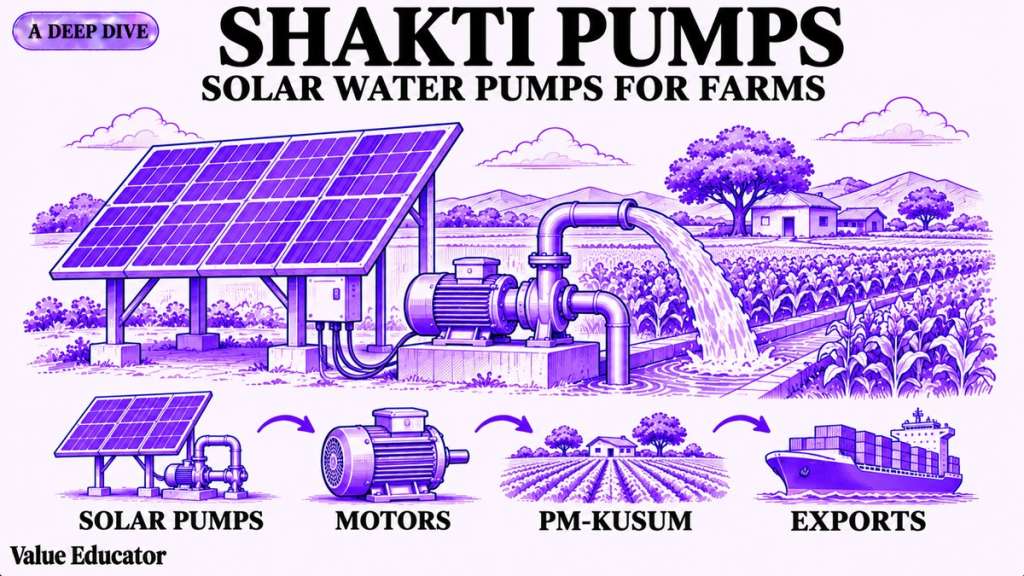
Across India, millions of farmers still lift water from their wells with diesel pumps. A pump maker's own estimate puts the diesel pumps that could be replaced with solar ones at 8-9 Mn, and the new solar pumps India could still need at 12-13.5 Mn. Each switch removes a fuel bill from a farm and a diesel engine from a field.
That switch has a government programme behind it. PM-KUSUM is the central scheme that pays most of the cost of a solar pump for a farmer. Its Component B covers the off-grid solar pump, which means a pump that runs only on the solar panels next to it, with no link to the power grid. By 30 September 2026 the scheme had sanctioned 13,07,190 such pumps, and 11,90,639 were installed.
The money in that scheme moves in a fixed order. The farmer pays 10% of the cost to the state's nodal agency. The central ministry adds 30%, and the state adds 30% to 60%, including any cheap loan to the farmer. The nodal agency then runs a tender, issues work orders, and pays the supplier after it checks each installation.
That solar pump has more parts than you might expect. There are the panels and the steel structure that holds them. There is the pump and its motor, which sit deep in the well. Between them is the variable frequency drive, or VFD, which is the controller that changes the motor's speed as the sunlight changes through the day. Government schemes also follow a domestic content requirement, or DCR, which means the solar cells inside the panels must be made in India. The company says DCR cells make up about 40-50% of the cost of a solar pump set.

That pump maker is Shakti Pumps (India) Ltd (NSE: SHAKTIPUMP), based in Pithampur near Indore in Madhya Pradesh. It makes the pumps, motors, VFDs, structures and inverters for its solar pump sets in its own plants, and it calls itself India's only fully vertically integrated solar pumping company. By 30 September 2026 it had installed about 2.85 lakh solar pumps, of which 1,93,802 were under PM-KUSUM. It also sells pumps in more than 100 countries.
Shakti Pumps in five numbers
- H1 FY27 revenue of ₹1,604.7 Cr, up 24.5%
- 51,543 solar pumps installed in H1 FY27, up 29.3%
- An EBITDA margin of 9.2% in H1 FY27, against 21.7% a year earlier
- An order book of ₹751 Cr on 23 October 2026
- A capex plan of about ₹1,700 Cr, including a 2.2 GW solar cell and module plant
So a company that installs more solar pumps every year now earns a much smaller margin on each one, and it is spending close to its net worth on new plants. How do those two facts fit together? Let's first understand the company, and then look at the latest quarter.
Shakti Pumps: Company Overview
Shakti Pumps (India) Ltd began in 1982 as a small pump unit set up by the Patidar family, became a public limited company in 1995 and listed in 1996. It is based in Pithampur near Indore in Madhya Pradesh, where it runs four plants across more than 25 acres. Dinesh Patidar is the Chairman and Ramesh Patidar the Managing Director, and the promoter group held 50.35% at the end of FY26. Shakti makes stainless steel submersible pumps, motors, VFDs, inverters and structures, and sells complete solar pump sets to farmers through state schemes such as PM-KUSUM, along with exports to more than 100 countries. It had 726 employees in FY26. Revenue from operations was ₹2,697.6 Cr in FY26, and in September 2026 its net worth stood at ₹1,787.1 Cr. Read this Power Sector Stocks in India 2026: List by Value Chain
"Know what you own, and know why you own it."
— Peter Lynch
Shakti's results move with farm solar schemes, metal prices and state payments. Knowing which of these drives a quarter is the first step to reading its numbers.
The Quarter Installations Grew and Profit Came Down
Let's look at Q2 FY27, the July to September quarter that Shakti reported on 23 October 2026. Revenue from operations was ₹746.0 Cr, up 12.0% from ₹666.4 Cr a year earlier. Profit came down much more sharply than revenue rose, because the EBITDA margin was 8.6%, against 20.4% a year earlier.

As we can see, the farm business did most of the work. Shakti installed 23,865 solar pumps in the quarter, 7.0% more than the 22,304 of Q2 FY26. Solar pump revenue was ₹543.5 Cr, up 3.2% from ₹526.7 Cr. Exports added about ₹95 Cr.

That chart shows us when the margin changed. In Q1 FY26 and Q2 FY26 the EBITDA margin was 23.1% and 20.4%. In Q3 FY26 it dropped to 10.7%, and it has stayed near that level since, at 9.7%, 9.6% and 8.6%. Revenue did not follow the margin: it was ₹622.5 Cr in Q1 FY26 and ₹551.0 Cr in Q3 FY26, then ₹857.8 Cr in Q4 FY26 and ₹858.7 Cr in Q1 FY27.
That margin change has three causes, in management's words. Read this EBITDA Explained: Uses and Limits Metal prices went up as the conflict around the Strait of Hormuz pushed up stainless steel, copper, aluminium and mild steel. Freight costs went up for the same reason, and the company used air freight for some export orders. And the price per pump was lower on some orders under Magel Tyala, Maharashtra's state scheme for solar pumps, which made up a large share of H1 revenue.
Those three reasons come with numbers. In July 2026 the CFO put the year-on-year margin hit in Q1 FY27 at about 10 points: about 6 points, or ₹36 Cr, from raw materials, and about 4 points, or ₹25 Cr, from lower prices. In Q2 FY27 raw material costs rose about 3% from the previous quarter, and cost savings such as cheaper advertising and Kaizen work cut about 2%. So the net hit to EBITDA in the quarter was about 1 point.
Even so, the price per pump has held steady. Management put the average realisation at ₹2,48,153 a pump in Q1 FY27, against ₹2,48,374 in Q4 FY26, and said the Q2 change was about 1%, from the sales mix.
That same pattern shows over the first half. H1 FY27 revenue was ₹1,604.7 Cr, up 24.5% from ₹1,288.9 Cr. Installations rose 29.3% to 51,543 pumps, and solar pump revenue rose 25.4% to ₹1,228.6 Cr. EBITDA was ₹146.9 Cr at a margin of 9.2%, against ₹279.5 Cr at 21.7% a year earlier. Profit after tax was ₹90.1 Cr, against ₹187.5 Cr, and cash profit was ₹105.8 Cr.
Beyond profit, the balance sheet also changed in the half. Trade receivables were ₹1,963.6 Cr in September 2026, against ₹1,275.7 Cr in March. Management says a payment of about ₹400 Cr from Maharashtra was due before the end of September but arrived on 20 October, because the state's funding from the Asian Development Bank came late. By 23 October receivables were ₹1,750.1 Cr, and about 50% of that was not yet due.

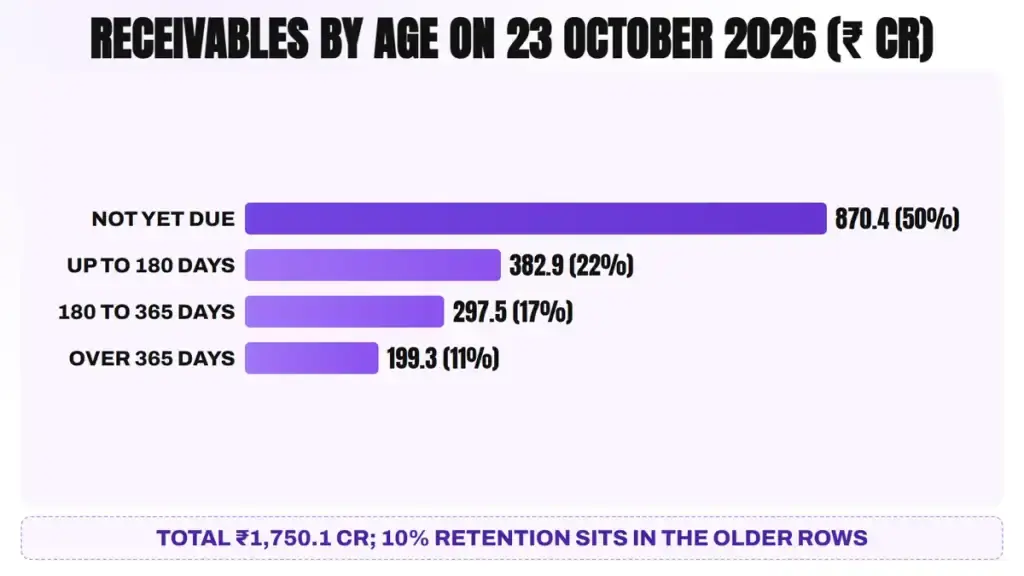
That table needs one more fact before you read it. Read this Days Sales Outstanding (DSO) Explained Under the tender terms, Shakti gets 90% of its payment only after the pump's remote monitoring system has sent seven days of data, and the last 10% after 90 days of data. That 10% is the retention, and it is why part of every receivable stays open for months after a pump is installed.
The late payment showed up in cash and debt too. Operating cash flow in H1 FY27 was negative at about ₹448.1 Cr, as working capital took ₹561.2 Cr. Short-term borrowings were ₹830.9 Cr in September, against ₹445.7 Cr in March. Management says debt was below about ₹500 Cr after the October payment, and that it should come down further by March. Its average interest cost is about 7%, and India Ratings rates it IND AA-/Stable. Net worth was ₹1,787.1 Cr in September 2026.
The Orders Behind the Next Quarter
Now let's look at the orders, because they show how much of the next quarter is already booked. On 23 October 2026 the order book was ₹751 Cr, including GST. Most of it came from two states.

That book has come down over the past year as Shakti shipped more than it booked. It was about ₹1,654.6 Cr in May 2025, ₹1,350 Cr in August 2025 and ₹1,300 Cr in November 2025. With large Karnataka orders added, it was ₹2,100 Cr in February 2026. Since then it has gone to ₹1,500 Cr in May, ₹1,000 Cr in July and ₹751 Cr in October.

That book, management says, has to be finished within 90 days. Even before taking out GST, ₹751 Cr equals about 2.8 months of revenue at the H1 FY27 pace. So revenue after December depends on new orders. Management names three sources: PM-KUSUM 2.0, the next phase of the central scheme, which it expects to be approved in the current quarter; a new Maharashtra tender for 1,00,000 pumps; and other state schemes that usually follow the central one.
What the order book says: ₹751 Cr covers about one quarter of work. In the latest Maharashtra tender, Shakti's share was 25,000 pumps, because the Asian Development Bank's funding condition caps any single bidder at 25%. So the size of the next tenders matters more for Shakti than its rank in them.
How a Pithampur Pump Maker Moved Into Solar
Now that we have seen the quarter, let's go back and see how a Pithampur pump maker moved into solar. The Patidar family started a small-scale pump unit in 1982 and began full manufacturing in 1986. The firm became a public limited company in 1995 and listed on the Bombay Stock Exchange in 1996. Dinesh Patidar is the Chairman, and Ramesh Patidar is the Managing Director.
Before solar, it made electric submersible pumps, all of them in stainless steel. In 2008 it set up a separate unit in a special economic zone to make pumps for export. In 2009 it was the first company to get a 5-star energy rating from the Bureau of Energy Efficiency for pumps. In 2014 it started making solar pumps, and in 2018 it set up its own electronics division to make VFDs.
That electronics division mattered when PM-KUSUM began in 2020.
"Show me the incentive and I will show you the outcome."
— Charlie Munger
PM-KUSUM pays most of the cost of a farmer's solar pump, and that subsidy shaped how fast the whole solar pump industry grew, Shakti included. A solar pump needs a drive that can run a motor from the changing power of a panel. Shakti already made pumps and motors, and now it also made the drive, so it could supply the whole set. Its revenue since then has moved with the scheme.

That table shows us a business that moves in steps, not in a straight line. Revenue dipped about 17.9% in FY23. It then rose 41.6% in FY24 and 83.6% in FY25, after large orders from Haryana, Uttar Pradesh and Maharashtra. In FY25 the EBITDA margin reached 24.0%, and profit after tax was ₹408.4 Cr.
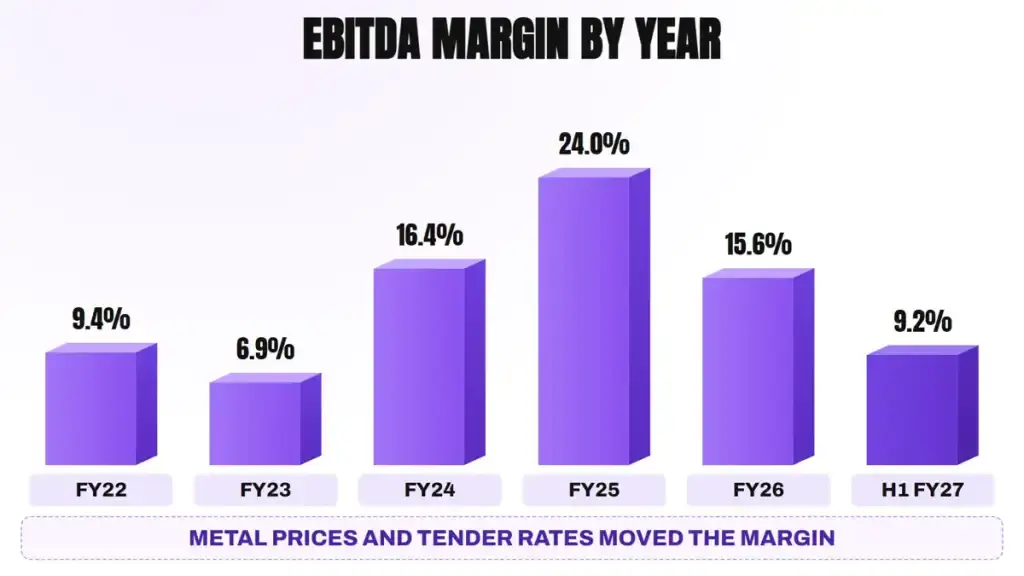
FY26 was the year the margin turned. Revenue still grew 7.2% to ₹2,697.6 Cr, the highest in the company's history, and installations rose 20% to 86,086 pumps. But the margin was 21.7% in the first half and about 10.1% in the second half, so the full year ended at 15.6%. In May 2026 management put the Q4 FY26 hit at about 6-7 points from raw materials and 3-4 points from lower prices in the newer Magel Tyala tenders, partly offset by 2-3 points of operating leverage.
That year also showed us how much the business depends on payments. In Q3 FY26 Shakti held back about ₹200 Cr of ready Maharashtra orders until it had clarity on payment. Once the money started to come, it raised execution, and Q4 FY26 revenue was a record ₹857.8 Cr. Receivables came down to ₹1,275.7 Cr in March 2026 from ₹1,697 Cr in December 2025.
That growth was funded partly by two share sales. Shakti raised ₹200 Cr through a qualified institutional placement in 2024 and ₹292.6 Cr in 2025. The promoter group held 50.35% at the end of FY26.
"Like in Maharashtra, the portal for Shakti opened for 25,000 pumps and it was fully subscribed in 25 minutes." - Dinesh Patidar, Chairman, May 2026
Solar Pumps, Exports and Newer Lines
Now let's split the business into solar pumps, exports and the newer lines, because each one sells to a different buyer. Shakti reports two segments by geography, India and overseas subsidiaries. Its own decks split revenue by customer instead, and that split is clearer.

These lines all start from the same plant, but as you will see, each one wins business in a different way. The government business wins state tenders and then installs pumps on thousands of farms. Exports sell through dealers and a few large projects. The newer lines sell through shops and distributors, where the buyer pays on purchase and the company does not wait for a state to release funds.

Solar Pumps for Farmers Under PM-KUSUM
Let's start with the largest line, the government solar pump business. In FY26 it brought in ₹2,080.6 Cr, or 77% of revenue, up from 69% in FY24. The company says this line grew at 50% a year from FY23 to FY26.
That business gets its size from the scheme. Component B of PM-KUSUM had 13,07,190 pumps sanctioned and 11,90,639 installed by 30 September 2026. Shakti's 1,93,802 pumps under the scheme equal about 16% of all installed Component B pumps. The company itself estimates its share of the scheme at about 25%. It has also installed 90,967 solar pumps outside PM-KUSUM, under state schemes such as Magel Tyala.
That spread across states is wider than it was. Shakti works in Maharashtra, Rajasthan, Haryana, Punjab, Uttar Pradesh and Madhya Pradesh, and it entered Karnataka in FY26. Management says the Karnataka scheme had barely started before it entered, and that its share there reached about 40%, with about 12,000 pumps installed. Management says that in drought conditions submersible pumps are what lift water from deep underground, which is where its pumps do well.
Beyond the current states, the next driver is PM-KUSUM 2.0. In August 2026 the government issued draft rules for pump controllers under the new scheme, and management says its controllers are ready. If the new scheme puts more weight on feeder-level solarisation, where a whole farm power line runs on a solar plant, management expects that to need new pumps too. The scheme is with the central government, and management has not given a date beyond expecting approval in the current quarter.
Exports to More Than 100 Countries
Next, let's look at exports, the business outside India. Export revenue was ₹411.1 Cr in FY26, against ₹286.1 Cr in FY24 and ₹436.8 Cr in FY25. The company says exports grew at 21% a year from FY23 to FY26, and it says this line earns the highest margin of all its businesses.
Those sales, as you can see below, are spread across regions. In FY26 the Middle East made up 41.1% of export revenue, Africa 33.4%, the United States 19.1%, Asia 3.8% and the rest 2.6%. Shakti has its own subsidiaries in the United States and the UAE, with FY26 revenue of ₹62.6 Cr and ₹47.4 Cr. Its pumps have been used for de-watering at the Burj Khalifa in Dubai and in drinking-water projects in Uganda and Bhutan.
Beyond these markets, Africa is where the solar business crosses the border. Shakti executed a contract worth USD 35.30 million from the Government of Uganda to supply solar-powered water pumping systems. Management says Uganda has written to India Exim Bank to fund a second phase. Shakti is also part of the International Solar Alliance, whose member countries have shown demand for more than 2,70,000 solar pumps across 22 countries.
That project base makes the half-year numbers uneven. H1 FY27 export revenue was ₹177.7 Cr, against ₹201.8 Cr in H1 FY26, which included about ₹20 Cr from the Uganda project. Management says export orders of about ₹100 Cr come in every quarter, and that it now offers complete solar kits, including structures, in Africa.
Retail, Rooftop and EV Motors
Finally, let's look at the three newer lines, which together are still small. One is retail, or cash sales, where farmers and homes buy pumps through Shakti's dealers without a government scheme. That business brought in ₹77 Cr in FY26 and ₹41 Cr in H1 FY27. It runs through more than 500 dealers and more than 400 service centres, and the company collects the money faster than on state orders.
Another is solar rooftop, run by the subsidiary Shakti Energy Solutions. Here Shakti sells the inverter, the box that turns the panels' direct current into power a home can use. Rooftop revenue was ₹17 Cr in H1 FY27 and ₹9 Cr in Q2 FY27, up 58% from a year earlier. Early buyers say Shakti's inverter gives about 10% more power than rival inverters, and more than 90 dealers have signed up. The target market is PM Surya Ghar, the scheme for home rooftop solar, which had 50.06 lakh installations by 4 August 2026.
The last line is EV motors, controllers and chargers, made by Shakti EV Mobility. It grew out of about eight years of in-house VFD design, and its motors and controllers are designed in-house. Shakti had invested ₹92 Cr in it by October 2026, out of a planned ₹114 Cr. Its products are in vehicle-level trials with auto makers, and management expects larger revenue only from next year, after validation.
Where Shakti Fits in the Solar Value Chain
Now let's place Shakti in the wider solar chain. A solar pump starts as a silicon cell, which goes into a panel, also called a module. The module sits on a steel structure, sends power to the drive, and the drive runs the motor and pump in the well. After that comes the work in the field: installing, testing and servicing thousands of pumps across villages.
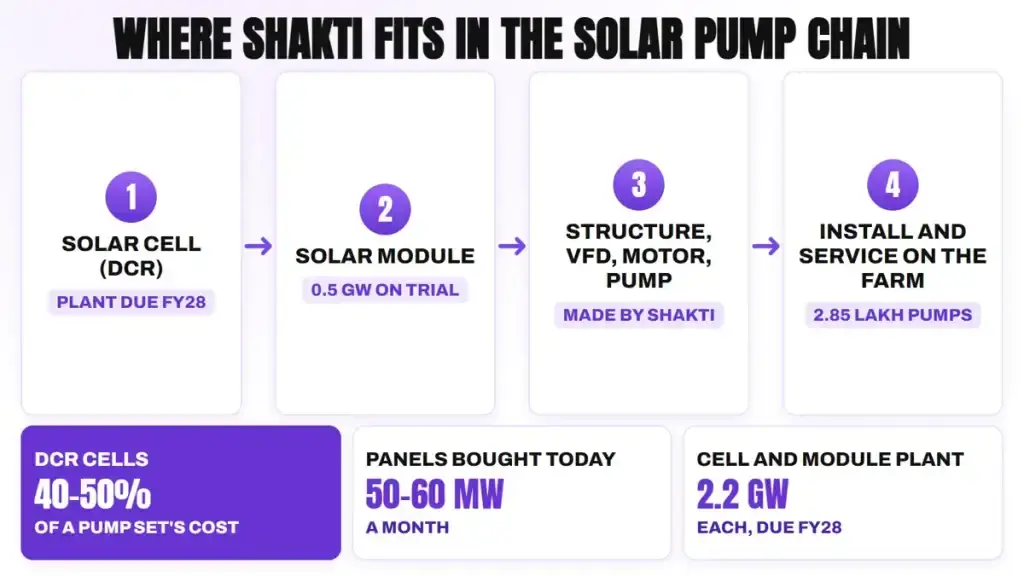
Today Shakti makes everything in that chain except the cell and the panel. It buys about 50-60 MW of panels a month, from module makers such as Premier, Tata and Adani. Management says this left it dependent on those suppliers for supply and prices, and that tender penalty clauses made delays costly.
That is why the company is moving one step back. A 0.5 GW module line at Pithampur started trial production in October 2026, and a 2.2 GW DCR cell and 2.2 GW module plant is planned for FY28. Since DCR cells are about 40-50% of the cost of a pump set, making them in-house would bring a large part of the pump set's cost into its own plants.
Shakti also sells pumps to larger solar companies. Its OEM customers include solar companies such as L&T, Mahindra, REIL, Adani and Tata Power. The company says it is now putting less effort into this line, so that it can sell more under its own brand.
Why Shakti's Moat Is Hard to Copy
Now that we have seen the parts, let's understand the moat. Many companies can win a solar pump tender. The harder question is why a farmer should pick Shakti's pump once the tender is done. Read this Economic Moat Explained
That question matters because of how these tenders work, so let's see how they run. Schemes like PM-KUSUM and Magel Tyala run as market-mode tenders. The state fixes one rate for all qualified bidders, and then the farmer chooses which brand to install. So quoting the lowest price does not bring in orders by itself. A brand that farmers ask for gets more of the allotted pumps.
"The single most important decision in evaluating a business is pricing power."
— Warren Buffett
In a market-mode tender the state sets the rate, so Shakti's brand can win more pumps but cannot raise the price. That is why its margin moves with tender rates and metal prices.
One part of the moat is the plant. Shakti's four plants in Pithampur, across more than 25 acres, can make 5,00,000 pumps and motors, 4,00,000 VFDs and inverters, and 2,00,000 structures a year. The company says it is the only player that makes pumps, motors, VFDs, controllers, structures and inverters in-house. Management argues that this gives it a cost edge over rivals that buy these parts, at the same state-fixed rate.
Another layer is design. Shakti holds 15 patents and has filed 29, including a US patent for a high starting-torque, energy-efficient motor. Its research unit is recognised by the government's Department of Scientific and Industrial Research. Its pumps are built in stainless steel, and management says they do well in high-head wells, where water has to be lifted from deep underground.
Beyond the plant and design, the field network adds a third layer. Shakti works through more than 60 distributors, more than 500 dealers and more than 400 service centres in India, and it offers farmers five years of service. Its Shakti Remote Monitoring System app lets a farmer track the pump from a phone. Once about 2.85 lakh pumps are in the field, each one is a reference for the next farmer in the village.
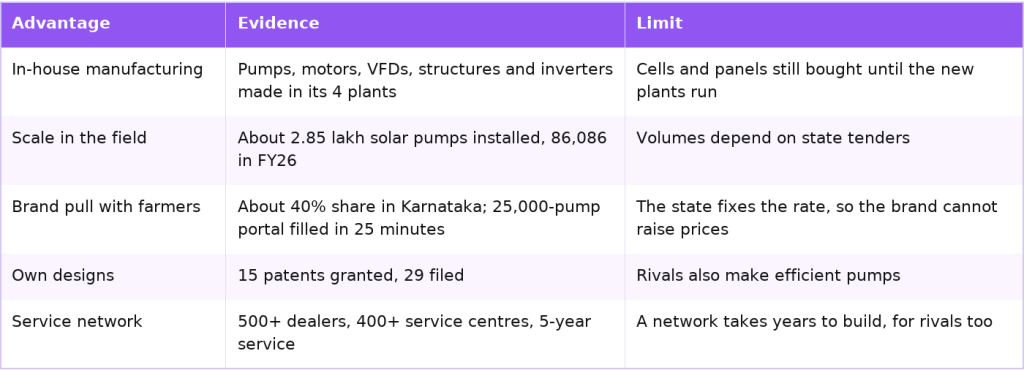
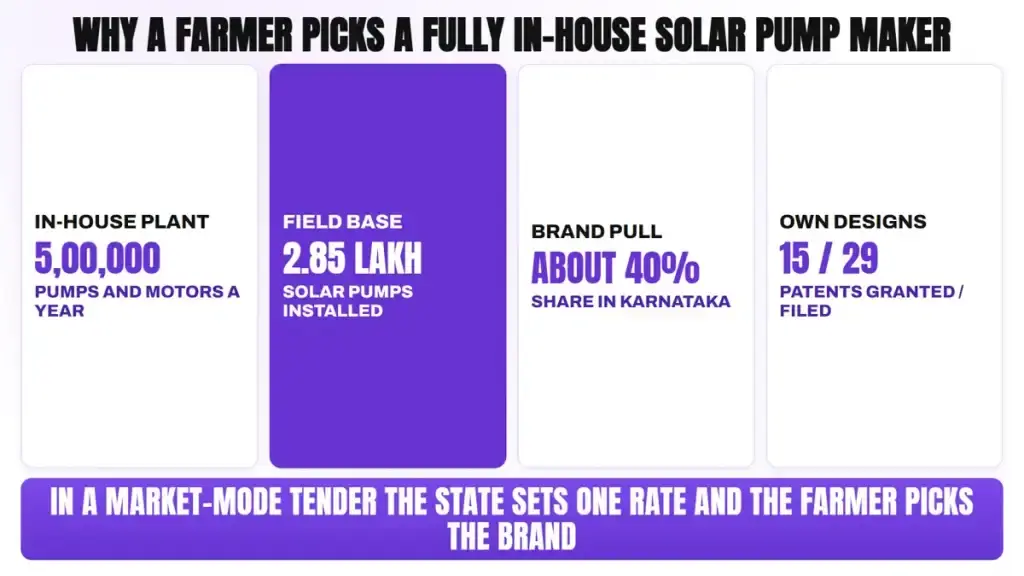
That table shows us where the moat ends. It helps Shakti win more pumps in a market-mode tender, but it does not set the rate. The EBITDA margin went from 24.0% in FY25 to 9.2% in H1 FY27 while the moat stayed in place, so the moat decides the volume more than the price.
Financials: Five Years of Revenue, Margins and Cash Flow
One quarter can mislead in a business that runs on state tenders, so let's look at the full years together. The figures are consolidated, with later years' restated values where the company restated them, and the first half of FY27 is shown for comparison.

Revenue grew about 2.3 times in four years, from ₹1,178.5 Cr in FY22 to ₹2,697.6 Cr in FY26, but not in a straight line: it dipped in FY23 and jumped 83.6% in FY25. The EBITDA margin moved even more, from 6.9% in FY23 to 24.0% in FY25 and back to 15.6% in FY26, as tender rates and metal prices changed.
Cash flow has lagged profit by a wide gap. From FY22 to FY26, operating cash flow added up to about ₹249.9 Cr, against about ₹896.6 Cr of profit after tax, or about 28%. The reason is receivables: state agencies pay after installations are checked, and 10% is held back as retention, so cash arrives months after revenue is booked.
The first half of FY27 shows the same pattern at a larger scale. Operating cash flow was negative at about ₹448.1 Cr as a ₹400 Cr payment from Maharashtra slipped into October, and short-term borrowings rose to ₹830.9 Cr. How fast receivables turn into cash will decide how much debt the ₹1,700 Cr capex plan needs.
"The essence of investment management is the management of risks, not the management of returns."
— Benjamin Graham
For Shakti, the profit line shows how many pumps it installed. The cash flow line shows when the states paid for them, and both need to be read together.
What FY29 Could Look Like on Management's Numbers
So where does the business go from here? In July 2026 management said it aims to reach ₹5,000 Cr of revenue by FY29. That would be about 1.85 times the ₹2,697.6 Cr of FY26, or growth of about 22.8% a year for three years. Management has not said how much each business would add, only that all of them should grow.
That target is tied to a capex plan of about ₹1,700 Cr, which is close to the company's net worth of ₹1,787.1 Cr. It has four parts. The VFD and structure plants are already done, and capacity there doubled to 4,00,000 and 2,00,000 units a year. The pump and motor plant is being built to double capacity, with new capacity due from Q3 FY27. The 0.5 GW module line began trial production in October 2026, and management expects commercial output within one to one and a half months. The 2.2 GW cell and module plant is due in FY28, and the company expects strong revenue from it after March 2028.
That spending, as we will see, is still mostly ahead. By October 2026 about ₹200 Cr had gone into the cell plant, and management expects about ₹400 Cr of capex in H2 FY27. Shakti has a term loan of about ₹800 Cr arranged for the 2.2 GW project, and about ₹1,800 Cr of working capital limits from about ten Indian banks and one bank in Qatar. Capacity use in pumps and motors was about 68% in H1 FY27.

Beyond revenue, management links margins to the new plants. In July 2026 it said that once all the cell and module capacity is running, it expects the EBITDA margin to gain about 3 points. For rooftop, it targets an EBITDA margin of about 15% once it sells its own modules. It has not given a company-wide margin target for FY27, and says it will do so once raw material prices settle and the KUSUM 2.0 rates are known.
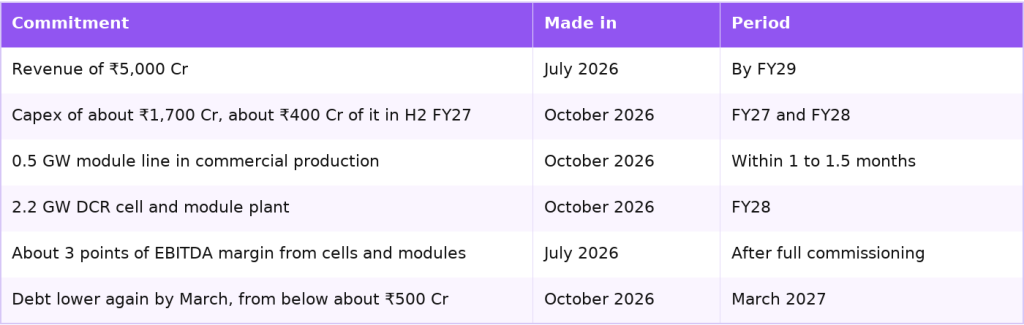
Those commitments are easier to judge against the past. So let's check what management said before against what it delivered.
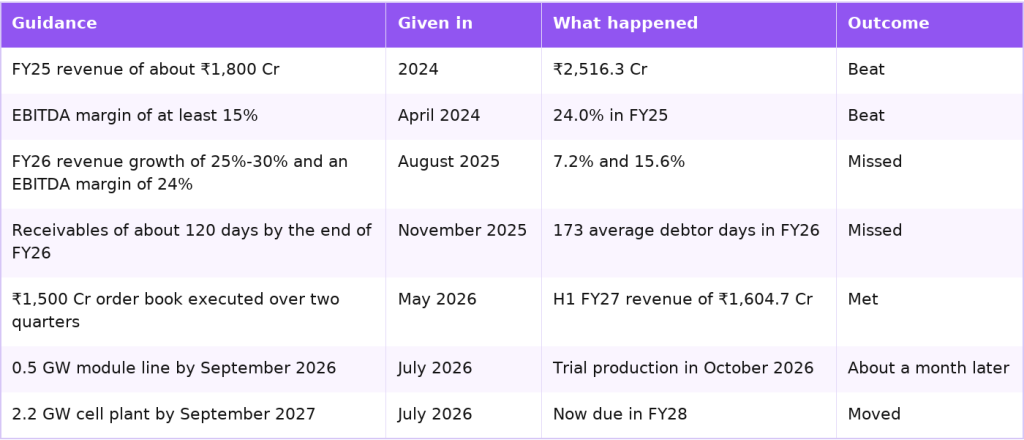
That record shows a clear pattern. When state orders and metal prices were in its favour, Shakti beat its targets by a wide margin, as in FY25. When tender prices came down and metal prices rose, it missed both the growth and the margin targets for FY26. The ₹5,000 Cr target for FY29 will depend on the same two things, the size of the next schemes and the price of metals.
Key Risks
Now let's look at what could go wrong for Shakti, because the latest year has already shown some of these risks.
- Dependence on government schemes: government projects were 77% of FY26 revenue. A further delay in PM-KUSUM 2.0, which management says is already more than six to nine months late, or in state tenders, would leave the plants with fewer orders once the ₹751 Cr book is done.
- Tender prices: in a market-mode tender the state sets the rate, and newer Magel Tyala tenders brought a 3-4% lower realisation. Management says pricing flexibility is limited while only one large tender is active and every supplier chases it.
- Metal prices: stainless steel, copper, aluminium and mild steel are the main raw materials, and the company does not hedge them. Raw materials took about 6 points off the margin in Q1 FY27.
- Receivables and cash flow: receivables were ₹1,963.6 Cr in September 2026, and about 28%, or about ₹496.8 Cr, was more than 180 days old on 23 October. Operating cash flow was negative at about ₹448.1 Cr in H1 FY27. State budgets and lenders such as the Asian Development Bank decide when the money comes.
- Rising debt and interest: short-term borrowings were ₹830.9 Cr in September, and finance cost rose to ₹18.9 Cr in Q2 FY27 from ₹13.3 Cr a year earlier. The ₹800 Cr term loan for the cell plant will add to this.
- New plant execution: cell making is new to Shakti, and the 2.2 GW plant has already moved from September 2027 to FY28. Management says the module line still needs approvals, licences, testing and time to stabilise, so its benefit will not be immediate.
- Exports and geopolitics: the Middle East was 41.1% of FY26 export revenue. H1 FY27 exports were ₹177.7 Cr against ₹201.8 Cr; even without the Uganda project they were slightly lower.
- Weather in the field: weather slowed execution in some states in Q2 FY26, and management says rains and floods decide the pace of installation work.
- Tax disputes: contingent liabilities were ₹19.83 Cr in March 2026, including ₹11.48 Cr of indirect tax matters.
"And as far as selling price is concerned, as of today, pricing flexibility remains limited in the solar business, which accounts for majority of our sales." - Dinesh Patidar, Chairman, October 2026
"An ounce of prevention is worth a pound of cure."
— Benjamin Franklin
No one can say when PM-KUSUM 2.0 will start or where metal prices will go. What an investor can do is watch the order book, the margin and the receivables each quarter, which is what the list below sets out.
Explore our Products
Research Framework

Emerging Titans
Combination of quantitative analysis, industry tailwinds, and management assessment - SPRINT investment philosophy

Tiny Titans
Heavy emphasis on scuttlebutt research, plant visits, and early on-ground signals
What to Track Next
If you follow Shakti Pumps, these are the signals that will show where it goes next.
- The launch of PM-KUSUM 2.0, its tender rates and Shakti's share of the first orders
- New orders after the ₹751 Cr book, including the Maharashtra tender for 1,00,000 pumps
- The EBITDA margin after 8.6% in Q2 FY27, and the effect of metal prices on it
- Receivables after ₹1,750.1 Cr, operating cash flow and debt against the target of below about ₹500 Cr
- Commercial output from the 0.5 GW module line and progress on the 2.2 GW cell plant due in FY28
- Rooftop, retail and export revenue, the lines that do not depend on state tenders
For the other listed solar and wind companies, from glass and cells to turbines and power producers, see Renewable Energy Stocks in India 2026: Solar and Wind.
Conclusion
Let's put it all together. Shakti Pumps has grown from ₹967.7 Cr of revenue in FY23 to ₹2,697.6 Cr in FY26, and it installed 51,543 solar pumps in the first half of FY27 alone. It makes almost every part of a solar pump set in Pithampur, and it is now building the cells and panels too.
The margin is the part that has not held. The EBITDA margin went from 24.0% in FY25 to 9.2% in H1 FY27 as metal prices rose and tender rates came down. What happens next depends on how large PM-KUSUM 2.0 turns out to be, at what rate, and whether the new cell and module plants arrive on time and bring back some of that margin.
FAQs
What does Shakti Pumps do?
+Shakti Pumps makes stainless steel submersible pumps, motors, VFDs, inverters and structures in Pithampur, Madhya Pradesh, and sells complete solar pump sets to farmers through state schemes such as PM-KUSUM. It also exports pumps to more than 100 countries. FY26 revenue from operations was ₹2,697.6 Cr.
How did Shakti Pumps do in Q2 FY27?
+Revenue from operations rose 12.0% to ₹746.0 Cr, and it installed 23,865 solar pumps, up 7.0%. EBITDA was ₹64.0 Cr at an 8.6% margin, against 20.4% a year earlier, and profit after tax was ₹38.5 Cr.
Why did Shakti Pumps' margin come down?
+Management names higher prices of stainless steel, copper, aluminium and mild steel, higher freight costs, and lower prices on some Magel Tyala orders in Maharashtra. The EBITDA margin went from 24.0% in FY25 to 15.6% in FY26 and 9.2% in H1 FY27.
What is Shakti Pumps' order book?
+The order book was ₹751 Cr, including GST, on 23 October 2026, mostly from Maharashtra and Karnataka. Management says it has to be finished within 90 days, and it expects new orders from PM-KUSUM 2.0 and a Maharashtra tender for 1,00,000 pumps.
What is Shakti Pumps' capex plan?
+Shakti plans capex of about ₹1,700 Cr to double its pump and motor capacity and to build a 2.2 GW DCR solar cell and module plant due in FY28. A 0.5 GW module line started trial production in October 2026. Management targets ₹5,000 Cr of revenue by FY29.
What are the main risks for Shakti Pumps?
+Government projects were 77% of FY26 revenue, so delays in PM-KUSUM 2.0 or state tenders matter. Receivables were ₹1,963.6 Cr in September 2026 and operating cash flow was negative in H1 FY27. Metal prices, tender rates and the new cell plant's execution are the other risks.

High growth stock specialist, Value Educator
Shashank Mahajan is an equity research professional with over 12 years of experience in identifying high-potential SME and micro-cap stocks at an early stage. He follows a rigorous scuttlebutt research–driven approach, combining on-ground insights with deep financial analysis. Shashank specializes in uncovering under-researched and under-owned companies with strong management quality and long-term growth potential. Through disciplined research and early identification, he focuses on spotting tomorrow’s market leaders before they enter the mainstream investor radar.
More about Shashank Mahajan →
PCBL Chemical: Carbon Black Margins and Battery Materials

KEC International: Record Orders, Weak Margin, High Debt

Sona BLW: EV Revenue Now Tops Half of Its Auto Sales

HPL Electric & Power: Smart Meters, Wires and Two Engines

Kaynes Technology: EMS, Chip Plants and ₹10,563.5 Cr Orders

Sterlite Technologies: Glass Rods to Hyperscaler Deals
Explore our Products
Research Framework
Emerging Titans
Combination of quantitative analysis, industry tailwinds, and management assessment - SPRINT investment philosophy
Tiny Titans
Heavy emphasis on scuttlebutt research, plant visits, and early on-ground signals



India's Aerospace Opportunity
Global Demand. Supply Bottlenecks. Opportunities Ahead.
Don't Miss This Exclusive Webinar!
Join Value Educator to decode the key trends shaping India's aerospace sector and learn how to identify tomorrow's potential leaders in the space.
- How the aircraft value chain works, layer by layer
- Indian companies supplying global aircraft makers
- A framework to judge any aerospace company

 Orders
 Subscription
 Share with friends


Required Details
₹23999.00
(12 month subscription)
As per SEBI regulations, all users are mandated to complete the KYC that is validated for 1 year. Post payment, you will be redirected to the KYC screen


No comments yet. Be the first to comment!