
Taneja Aerospace: The Airfield With ₹161 Cr of Rent Signed
India's airlines are buying aircraft faster than the country can service them. In August 2024 the civil aviation ministry said orders by domestic airlines for over 1,100 aircraft could double India's aircraft repair industry from $2 bn to $4 bn in seven years. Yet in November 2025 the Prime Minister said that earlier, about 85 percent of India's repair work was done abroad.
That repair work has a short name. MRO means maintenance, repair and overhaul, the checks and fixes that every aircraft must go through on a fixed schedule for its whole life. An airline cannot skip an MRO check, so the work comes back year after year. The government has backed it with tax cuts and open foreign investment, because sending planes abroad for repairs costs airlines time and money.
So how does an MRO company earn? It signs contracts with airlines or with the armed forces, takes an aircraft into a hangar, and charges for the hours, the parts and the checks. But it cannot do this work without three things on the ground. It needs a large hangar, a runway that aircraft can land on, and approvals from the aviation regulator for that site. Building all three from scratch takes land, money and years.
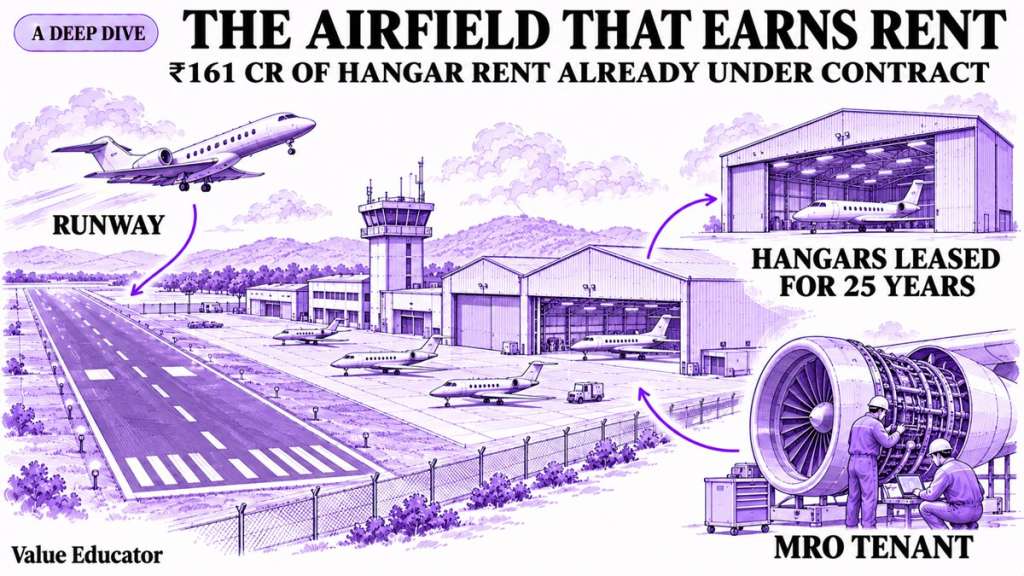
That is where a small Tamil Nadu company comes in. Taneja Aerospace and Aviation Ltd (BSE: 522229) owns a private airfield at Belagondapalli, near Hosur, with a runway, hangars and buildings. It leases hangar space and buildings to an MRO company on leases of 25 years, and charges other users for the runway and hangars. It once built aircraft parts for defence customers. It sold that factory in FY22 and FY23, and today it earns almost all its revenue from the airfield.
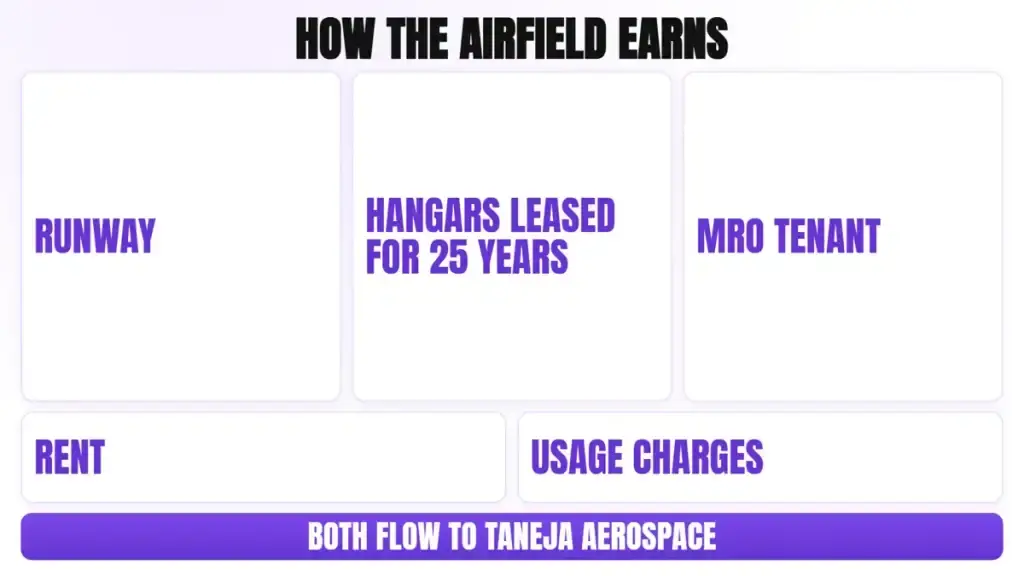
Those leases make the company's future income unusually easy to see. Future minimum rentals is the term for the rent that tenants must pay under leases they cannot cancel. At Taneja, that figure stood at about ₹161.3 Cr in March 2026, which is about four times its revenue for the year.
Taneja Aerospace in five numbers
- Q2 FY27 revenue of about ₹11.2 Cr, up about 16% from a year ago
- Q2 FY27 profit after tax of about ₹6.9 Cr, up about 78%
- About ₹161.3 Cr of rent due under hangar leases in March 2026
- About ₹72.4 Cr in investments and no borrowings in September 2026
- One customer paid about 59% of FY26 revenue
So a company with aerospace in its name earns like a landlord, and its profit is growing far faster than its rent. What changed, and why is it now buying a factory again? Let's first understand the company, and then look at the latest quarter.
Taneja Aerospace and Aviation: Company Overview
Taneja Aerospace and Aviation Ltd was incorporated in Tamil Nadu in 1988 and is listed on BSE. Its registered office and its private airfield are at Belagondapalli in Krishnagiri district, near Hosur. For years it made aircraft parts and structures for defence customers such as Hindustan Aeronautics, DRDO and Bharat Electronics, and it sold that factory in FY22 and FY23. Today it owns and runs the airfield, leases hangars and buildings to an MRO company on 25-year leases, and charges other users for the runway and hangars. The promoter company, Asscher Enterprises, held 51.86% of the shares in March 2026, and Rakesh Duda is the managing director. The company has 29 permanent employees, no borrowings, FY26 revenue of about ₹40.2 Cr and investments of about ₹72.4 Cr in September 2026. Read this Best Defence Stocks in India for 2026
"Go for a business that any idiot can run, because sooner or later, any idiot is probably going to run it."
— Peter Lynch
Renting out hangars beside a runway is about as simple as a business gets. The harder questions for Taneja are about who rents them next and what the company does with the cash.
The Quarter Where Profit Grew Almost Five Times Faster Than Revenue
Let's look at Q2 FY27, the July to September quarter. Revenue was about ₹11.2 Cr, up about 16% from about ₹9.7 Cr a year ago. Profit after tax grew much faster, to about ₹6.9 Cr from about ₹3.9 Cr. That is a rise of about 78%, almost five times the growth in revenue.

That gap between revenue and profit has two causes. Total expenses came in about 2.1% lower than a year ago, even though revenue rose. Other expenses, the running costs of the airfield, came to about ₹1.9 Cr against about ₹2.2 Cr a year earlier. Employee costs rose about 13%, but these costs are small for a company of this kind.
So more of each rupee of rent reached the bottom line. EBITDA, which leaves out other income, was about ₹7.5 Cr, and the EBITDA margin rose to about 66.4% from about 59.6% a year ago. Read this EBITDA Explained: Uses and Limits That is how a landlord business works. Once you have built the runway and hangars, an extra rupee of rent needs very little extra cost.
That leaves the second cause, which is income from the company's own money. Other income rose to about ₹2.2 Cr in the quarter from about ₹47.31 lakh a year ago. It made up about 25.6% of profit before tax. That income comes from the bonds, funds and other investments the company has bought with its cash, which we look at below.
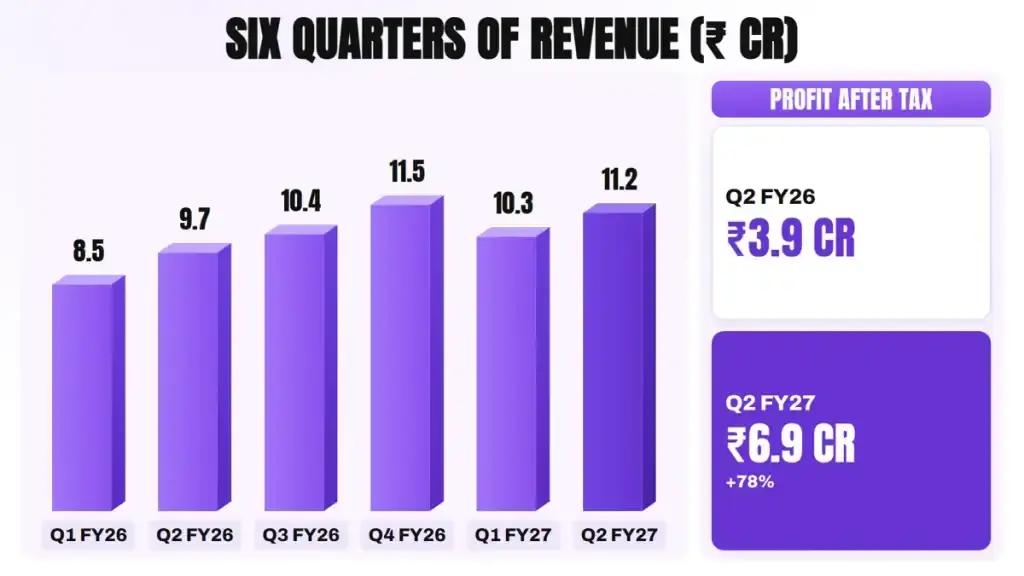
That pattern also holds across the half year. Revenue for April to September 2026 was about ₹21.5 Cr, up about 18.3%. Profit after tax for the half was about ₹12.6 Cr, up about 70.5% from about ₹7.4 Cr. Revenue has also moved up across the last six quarters, from about ₹8.5 Cr in Q1 FY26 to about ₹11.5 Cr in Q4 FY26, before about ₹10.3 Cr in Q1 FY27 and about ₹11.2 Cr now.
That profit also turned into cash. Operating cash flow for the half year was about ₹11.7 Cr, against about ₹7.5 Cr a year earlier. That cash, and more, went into investments. The company spent about ₹41.6 Cr on bonds, funds and similar instruments in the half and received about ₹15.7 Cr back from earlier ones. Its investments rose to about ₹72.4 Cr in September from about ₹46.6 Cr in March, and it has no borrowings.
The Rent Already Written Into Contracts
So how much of the next few years' income is already fixed? Taneja has no order book in the usual sense, but its leases do the same job. The table shows the rent due under its non-cancellable leases at each year end, split by when it is due.
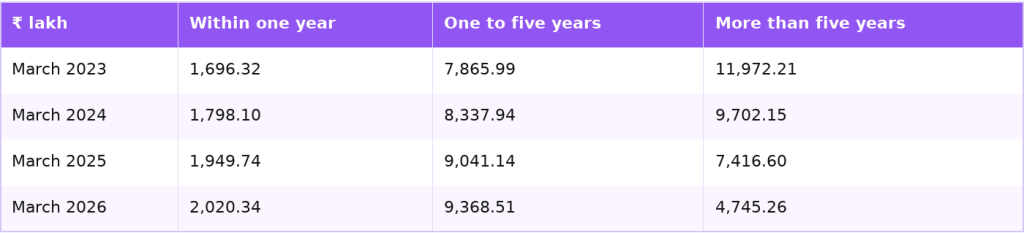
These leases are mostly for hangars, they run for 25 years, and they include terms for renewal.
"Someone's sitting in the shade today because someone planted a tree a long time ago."
— Warren Buffett
Taneja's shade comes from a runway and hangars built long ago. The leases now pay for them every year, with very little new spending. Their rent due within one year has grown each year, from about ₹17 Cr in March 2023 to about ₹20.2 Cr in March 2026. In FY26 the company booked about ₹19.1 Cr of lease income, up from about ₹18 Cr the year before.
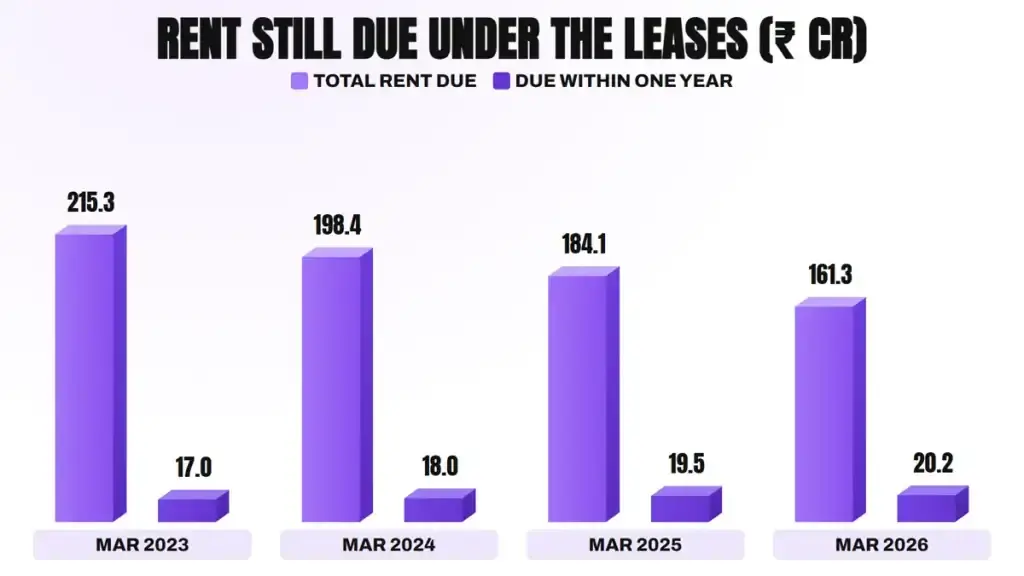
What the rent book says: the total rent due in March 2026 was about ₹161.3 Cr. At about ₹20.2 Cr due in the coming year, that is about eight years of rent at today's level. The rent due after five years has come down each year as the leases age, so the next big signal will be a renewal or a new tenant.
How an Aircraft Parts Maker Became a Landlord
Now that we have seen the quarter, let's go back and see how the company got here. Taneja Aerospace was incorporated in 1988, and for years it made aircraft parts and structures at Belagondapalli. For more than two decades, most of its manufacturing revenue came from defence customers. These included Hindustan Aeronautics, the Defence Research and Development Organisation, Bharat Electronics, the Indian Air Force and the Vikram Sarabhai Space Centre.
That manufacturing arm was a sizeable part of the business only five years ago. In FY21 the business had two divisions. The aircraft manufacturing complex brought in about ₹16 Cr, and services from the airfield brought in about ₹18.5 Cr. The company had 146 permanent employees in March 2021, and 169 in March 2017. That manufacturing revenue had also been growing, from about ₹5.9 Cr in FY19 to about ₹16 Cr in FY21. So the decision to sell came when the factory was busier, not quieter.
Then the company decided that its old factory no longer fit where it wanted to go. So in 2021 it ran a voluntary retirement scheme, under which 44 employees left. It then sold part of its manufacturing plant and equipment to Aerospace Engineers Private Limited, a Salem aerospace company, and 48 more people were let go. By March 2023 it had just 26 permanent employees.
That sale changed the shape of the income, as you can see in the revenue mix. In FY22, conversion charges, the fees for modification work on defence aircraft, were about 30.8% of revenue. By FY26 they were about ₹10.65 lakh, under 1%, and rent and airfield services made up about 99.4%. The costs changed with it.
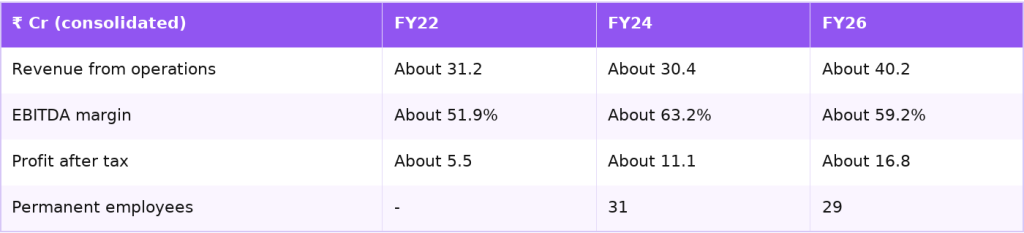
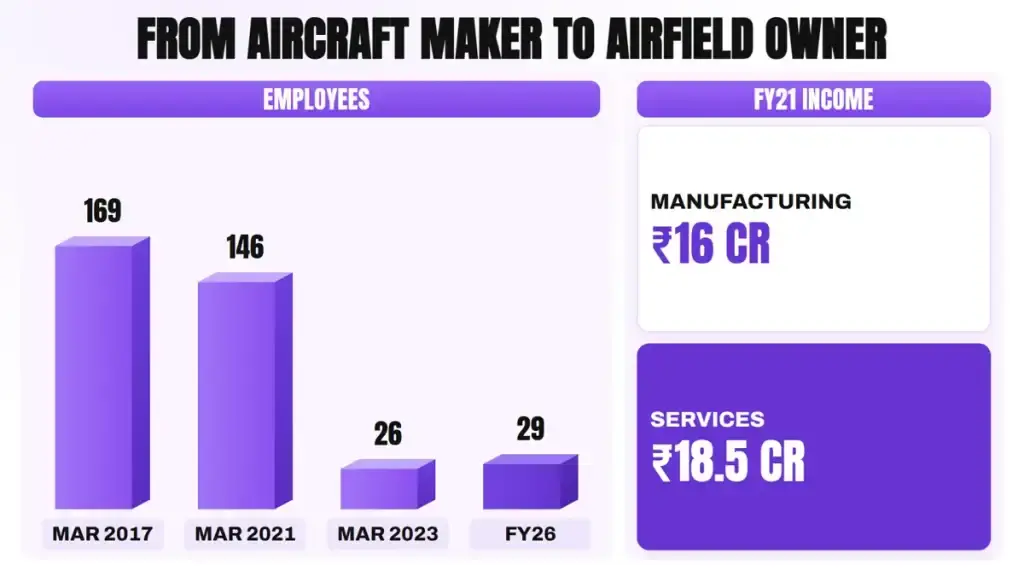
So the company now earns about the same revenue as before with a fraction of the people. Profit after tax tripled between FY22 and FY26 even though revenue grew only about 29%. Operating cash flow in FY26 was about ₹22.6 Cr, higher than the year's profit, because rent comes in as cash and depreciation is a large non-cash cost. Read this Cash Flow Statement Explained
That cash has gone in three directions. It paid an interim dividend of ₹2.50 a share for FY26, about ₹6.4 Cr in all. It raised about ₹20 Cr in FY24 by issuing 5,69,800 new shares at ₹351 each, and it put money into unlisted defence and aerospace companies. The rest is held in the investment book we saw above.
Four Ways the Airfield Earns
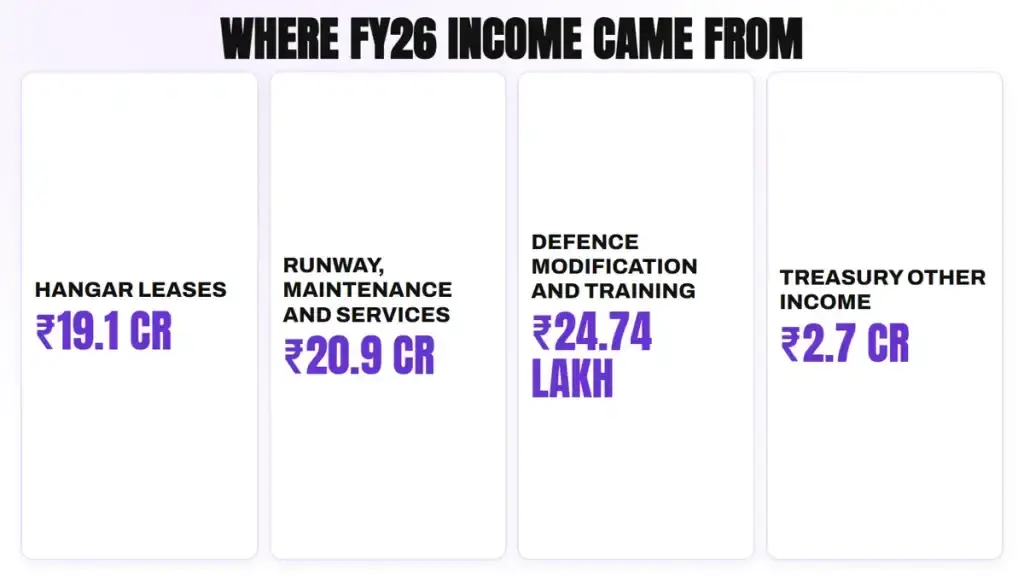
Now let's split what the airfield earns into its four parts. The company reports a single segment, aerospace and aviation, so we have built the split from its revenue and lease notes. Three of the lines below are revenue from operations. The fourth is the treasury, which shows up as other income but now matters to profit.
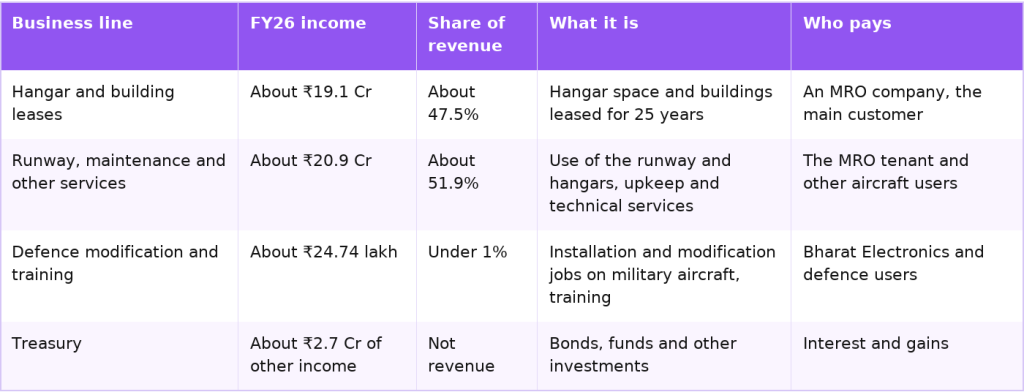
That split shows how the lines differ. Read this Segment-Wise Revenue Analysis Explained The leases are fixed rent for space, whatever the tenant does inside. The services line, by contrast, moves with how much the tenant and others use the runway and hangars. The defence line is project work that comes and goes. The treasury depends only on how the company invests its own cash.
Hangar and Building Leases
Let's begin with the hangars, since they carry the business. Every MRO check needs hangar space, so hangars matter more as repair work grows. The government has cut GST on domestic MRO services from 18% to 5% and allows 100% foreign investment in MRO without prior approval. Both steps are meant to bring repair work that now goes abroad back to India.
"Your margin is my opportunity."
— Jeff Bezos
Indian airlines that send aircraft abroad for checks pay that margin to foreign repair shops. Bringing the work home is the opportunity Taneja's MRO tenant serves, from hangars it rents at Belagondapalli.
So demand for hangar space next to a runway has a clear source. Taneja's hangars are on its own licensed airfield, so a tenant can fly aircraft straight in for checks. The company has leased hangar space and buildings to an MRO organisation for 25 years, and that tenant is its largest customer. Its annual reports do not name that tenant.
That customer paid about ₹23.9 Cr in FY26, about 59% of revenue, up from about ₹20.8 Cr in FY25. Lease income alone was about ₹19.1 Cr, and the rent due in the coming year was about ₹20.2 Cr in March 2026. The leased hangar building has a gross cost of about ₹13.2 Cr on the books, and after years of depreciation it is carried at about ₹6.3 Cr.
Runway, Maintenance and Other Services
Next, let's look at the runway itself, which earns separately from the hangar rent. Every aircraft that lands or parks at Belagondapalli uses the runway, apron and hangar services, and the company charges for that use. It also earns from upkeep and technical support at the site.
That services line was about ₹20.9 Cr in FY26, a little more than the lease income. Together, rent and airfield services were about ₹39.9 Cr, up from about ₹37 Cr in FY25. This income rises with traffic at the field, so more aircraft coming in for checks means more charges on top of the fixed rent.
Those charges should grow as India's repair work grows. The ministry expects the MRO industry to double in seven years, and a large part of that growth needs sites with a runway. That is where Taneja comes in, since it already has one, with solar lights along the aerodrome boundary and standby power.
Defence Modification and Training
Now let's look at the small line that keeps the old defence links alive. Conversion charges are fees for modifying or upgrading military aircraft, such as fitting new equipment. This was once a large business. In FY25 it still brought in about ₹3.6 Cr, mostly from the last modification jobs.
One recent example shows the kind of work involved. In March 2025 Bharat Electronics, the state-owned defence electronics maker, gave the company an order of ₹1.25 Cr. The job was to install BEL's Vihang ESM system, an electronic support kit that detects radar signals, on a Kv-28 aircraft within 12 to 15 weeks.
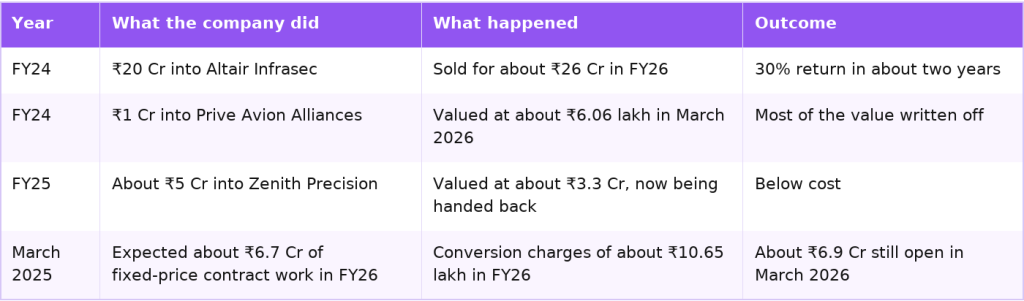
This kind of work is lumpy, as we have seen. So in FY26 conversion charges were only about ₹10.65 lakh and training about ₹14.09 lakh. But at March 2026 the company still had about ₹6.9 Cr of unfinished fixed-price contract work, which it expects to book in FY27. In Q2 FY27, material costs rose to about ₹48.76 lakh from about ₹8.76 lakh a year ago, which suggests some of that work is under way.
The Treasury Book
Finally, let's look at the money the airfield has generated for us to study. With no debt and little capex, the airfield business has built an investment book of about ₹72.4 Cr by September 2026. In March 2026 that book held bonds of finance companies such as Centrum Capital and Mpokket, preference shares of Navi Finserv, credit and treasury funds, a gold fund and bonds of Zetwerk.
That book grew fast in FY26 itself. During the year the company put about ₹42.3 Cr into bonds, alternative investment funds and similar instruments, partly with the money from one earlier bet. That book has already produced one clear gain. In FY24 the company put ₹20 Cr into Altair Infrasec, a defence company that had won an order for track-ways that help army vehicles cross sand and wet ground. In January 2026 it sold that 11.10% stake for about ₹26 Cr. That was a return of 30% in about two years, and it helped other income reach about ₹2.7 Cr in FY26.

So the treasury now adds real weight to profit. Other income of about ₹2.2 Cr in Q2 FY27 was about a fifth of the quarter's revenue. That share will depend on interest rates and on how the company uses this cash next.
Why a Private Runway Is Hard to Copy
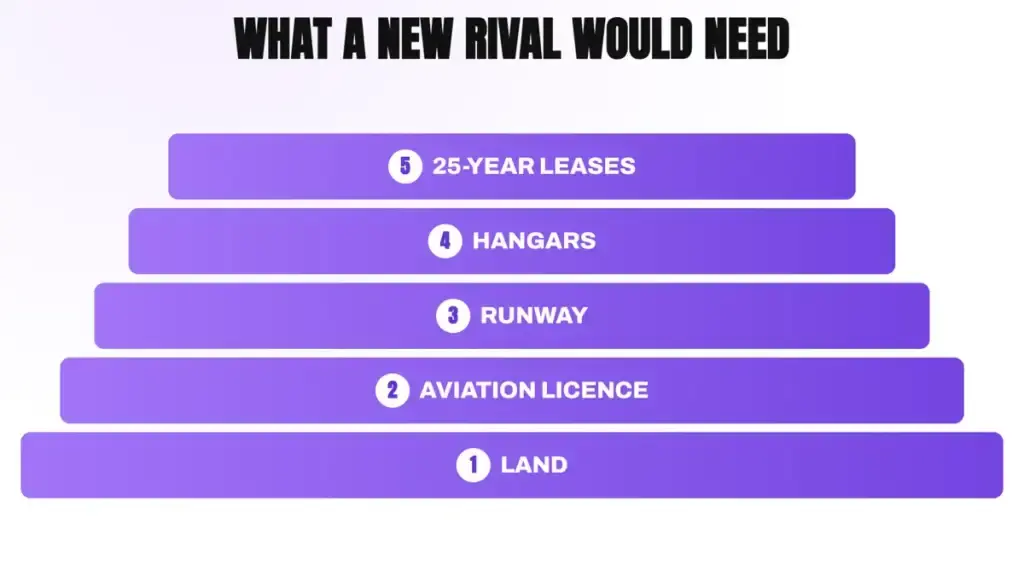
Now that we have seen all four lines, let's understand the moat. Taneja's advantage is physical and slow to copy. An MRO company that wants to service aircraft needs a hangar beside a runway, and a runway needs a large piece of land and an aviation licence. Taneja already owns both at Belagondapalli, with hangars and buildings ready for use.
That is why a tenant signs a 25-year lease rather than building its own airfield. Building a new airfield would take many years of land purchase, approvals and construction before the first aircraft lands. Moving an MRO shop to another site would mean setting up again and a break in work for its customers. So a tenant that is already in place has strong reasons to stay. Read this Economic Moat Explained
The numbers show that advantage at work. It runs its airfield with 29 permanent employees and earned an EBITDA margin of about 59% in FY26. Its rent due in the coming year has grown every year since March 2023. Its leased hangar building cost about ₹13.2 Cr and now earns about ₹19.1 Cr of rent a year.

That airfield business also keeps the company close to the defence world. Two directors who joined the board in August 2025 could take their seats only after a security clearance, and the company still takes installation work from Bharat Electronics.
That moat has limits as well, and you should weigh them. It protects rent from the tenant already in place, but it does not create new tenants. The company needs more users of the runway, or a new business on the site, to grow faster than the leases allow.
Financials: Five Years of Rent, Margins and Cash
One quarter can mislead in a business this small, so let's look at five full years together. These are consolidated figures; EBITDA here leaves out other income.
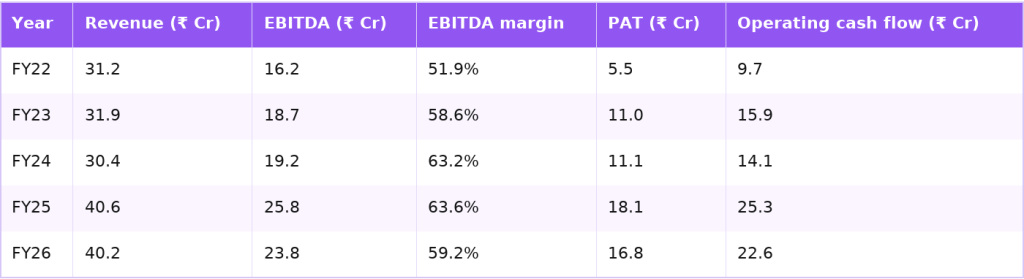
Revenue moved in a narrow band, from about ₹31.2 Cr in FY22 to about ₹40.2 Cr in FY26, with one jump in FY25. Profit after tax, though, grew about 3 times, because the company sold its factory, cut its staff and kept the airfield. The EBITDA margin rose from about 52% to between 59% and 64%.
Cash flow is the strongest number in the table. Over the five years, operating cash flow added up to about ₹87.4 Cr, against about ₹62.5 Cr of profit after tax. Rent comes in as cash, while depreciation of the runway and hangars is a cost that uses no cash.
The balance sheet has no borrowings, and the company has used its cash for dividends and investments. Dividends paid were about ₹6.4 Cr in FY26, and investments rose to about ₹72.4 Cr by September 2026.
"Only when the tide goes out do you discover who's been swimming naked."
— Warren Buffett
Taneja carries no debt and earns more cash than profit. If the rent from its one big tenant ever slowed, that cash cushion is what would give it time.
What the Next Two Years Could Look Like
So where does growth come from over the next two years, beyond the rent? Management gives no revenue or profit guidance. But its filings over the last year point to the next step, which is a return to making things. It says it remains focused on defence manufacturing, aerospace services and MRO work.
"Your Company, being one of the early organised participants in the aerospace and defence segment, remains focused on exploring opportunities in defence manufacturing, aerospace services, MRO activities and related areas." - Taneja Aerospace, management discussion, 2026
That plan now has three concrete steps. In July 2026 the company signed a master restructuring and transfer agreement with Zenith Precision Private Limited, its promoters and other shareholders. Under it, Taneja will hand back its stake in Zenith to Zenith's promoters. It will then buy a controlling stake in Zenith's SEZ division, with its assets, employees, contracts and leasehold rights, as a running business.
Then in October 2026 the company bought all of TAAL Precision Products Pvt. Ltd., a new company set up on 1 August 2026 to make precision products. It paid ₹1,000 for 100 shares of ₹10 each. Its stated aim is to enhance its aerospace manufacturing capabilities. On 30 October 2026 the board also approved merging Katra Auto Engineering, a wholly owned subsidiary that holds land, into the parent from 1 April 2027.

That Katra merger has a history of its own. The board had first approved it in May 2024 and then did not go ahead, given how the business was changing at the time. Katra has not started operations, and folding it into the parent brings its land onto the main company's books.
Those steps would turn a landlord into a landlord with a factory. Without those steps, our base case is simple. The leases put about ₹20.2 Cr of rent in the coming year. Runway and services income has run at about ₹20.9 Cr a year, and the treasury adds interest on about ₹72.4 Cr. If revenue keeps the half-year pace of about 18.3%, FY27 revenue would be about ₹47.5 Cr against about ₹40.2 Cr in FY26.
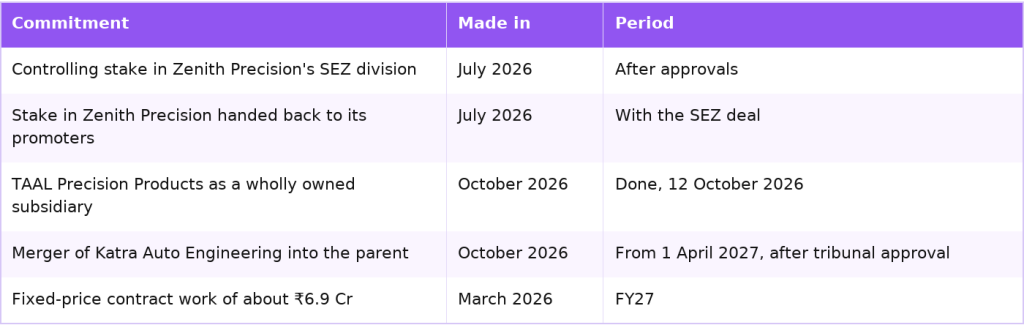
The company has made several such investment calls before, so let's check what it has said so far against what happened.
Key Risks
Now let's look at what could go wrong for Taneja Aerospace, because a landlord with one tenant carries clear risks.
- One tenant: a single MRO customer paid about 59% of FY26 revenue. The company itself says that any delay in that customer's rent could hurt the upkeep of the airfield, and that any reduction in its business could materially affect revenue and profit.
- Leases running down: total rent due fell from about ₹215.3 Cr in March 2023 to about ₹161.3 Cr in March 2026, and the part due after five years fell from about ₹119.7 Cr to about ₹47.5 Cr. Unless the leases are renewed or new tenants sign, the contracted rent keeps shrinking.
- A new business to build: the Zenith SEZ deal still needs approvals, and its price and size are not yet public. Running a factory is very different from running an airfield, and the company has only 29 permanent employees today.
- Related parties: the ₹1,000 purchase of TAAL Precision Products was a related-party deal involving the company's chief financial officer and chief operating officer. Katra Auto Engineering has received a loan of about ₹6.5 Cr in the nature of equity and has not started operations.
- Investment calls: the ₹1 Cr in Prive Avion Alliances is now valued at about ₹6.06 lakh, and Zenith Precision is valued below cost. Part of the treasury is in bonds of smaller finance companies, which carry credit risk.
- Other income: about a quarter of Q2 FY27 profit before tax came from other income. If interest rates fall, or the cash goes into the new business, profit growth will slow.
- Management: the managing director, Rakesh Duda, is 72 and has been reappointed for one year only, to June 2027.
- An old claim: a customer has claimed damages of ₹1.70 Cr since 2005-06, which the company disputes in a Bangalore civil court.
"Any reduction in business from this customer could materially impact the Company's revenue and profitability." - Taneja Aerospace, management discussion, 2026
"Risk means more things can happen than will happen."
— Howard Marks
The main tenant may renew, expand or leave, and the Zenith deal may close or not. The tracking list below is about watching which of these actually happens.
Explore our Products
Research Framework

Emerging Titans
Combination of quantitative analysis, industry tailwinds, and management assessment - SPRINT investment philosophy

Tiny Titans
Heavy emphasis on scuttlebutt research, plant visits, and early on-ground signals
What to Track Next
If you follow Taneja Aerospace, these are the signals that will show where it goes next.
- Approvals and terms for the Zenith Precision SEZ division, and what it will make
- Any lease renewal or new tenant at the airfield, seen in the rent due after five years
- The share of revenue from the largest customer, after about 59% in FY26
- Delivery in FY27 of about ₹6.9 Cr of fixed-price contract work
- Other income and the investment book after about ₹72.4 Cr in September 2026
- Q3 FY27 results, due by mid-February 2027
Conclusion
Let's step back and put it all together. Taneja Aerospace sold its old aircraft factory and kept the airfield, and that choice has worked. A few people now run a runway and hangars that earned an EBITDA margin of about 59% in FY26, with about ₹161.3 Cr of rent already contracted and about ₹72.4 Cr in investments. Profit is growing much faster than revenue because costs stay flat and the cash pile earns interest. The cautious thread is concentration: one tenant paid about 59% of FY26 revenue, and the rent due after five years has come down every year. The next few quarters, starting with the Zenith approvals and any lease renewal, will show which thread wins.
So the next two years will show us whether the company can become more than a landlord. The leases give a steady base, but those leases get shorter every year and depend on one tenant. The Zenith deal and the new precision company are the company's bet that it can make aircraft parts again, and their terms will matter more than any single quarter.
FAQs
What does Taneja Aerospace and Aviation do?
+Taneja Aerospace owns a private airfield at Belagondapalli, near Hosur in Tamil Nadu. It leases hangar space and buildings to an MRO company on 25-year leases and charges other users for the runway and hangars. Rent and airfield services made up about 99.4% of FY26 revenue of about ₹40.2 Cr.
How did Taneja Aerospace do in Q2 FY27?
+Revenue was about ₹11.2 Cr, up about 16% from a year ago, and profit after tax was about ₹6.9 Cr, up about 78%. Total expenses were about 2.1% lower, and other income from investments rose to about ₹2.2 Cr.
How much rent is already under contract?
+Rent due under non-cancellable leases was about ₹161.3 Cr in March 2026, of which about ₹20.2 Cr falls due within one year. The part due after five years has come down every year, from about ₹119.7 Cr in March 2023 to about ₹47.5 Cr.
Who is Taneja Aerospace's main customer?
+Its largest customer is the MRO company that leases its hangars, which the annual reports do not name. It paid about ₹23.9 Cr in FY26, about 59% of revenue.
What is the Zenith Precision deal?
+In July 2026 Taneja signed an agreement to hand back its stake in Zenith Precision to Zenith's promoters and to buy a controlling stake in Zenith's SEZ division as a running business, after approvals. In October 2026 it also bought TAAL Precision Products, a new company set up to make precision products.
What are the main risks for Taneja Aerospace?
+The main risks are dependence on one tenant, a shrinking long-term rent book unless leases are renewed, the execution of a new manufacturing business, related-party deals, investment calls that have not all worked, reliance on other income, and a managing director on a one-year term.

High growth stock specialist, Value Educator
Shashank Mahajan is an equity research professional with over 12 years of experience in identifying high-potential SME and micro-cap stocks at an early stage. He follows a rigorous scuttlebutt research–driven approach, combining on-ground insights with deep financial analysis. Shashank specializes in uncovering under-researched and under-owned companies with strong management quality and long-term growth potential. Through disciplined research and early identification, he focuses on spotting tomorrow’s market leaders before they enter the mainstream investor radar.
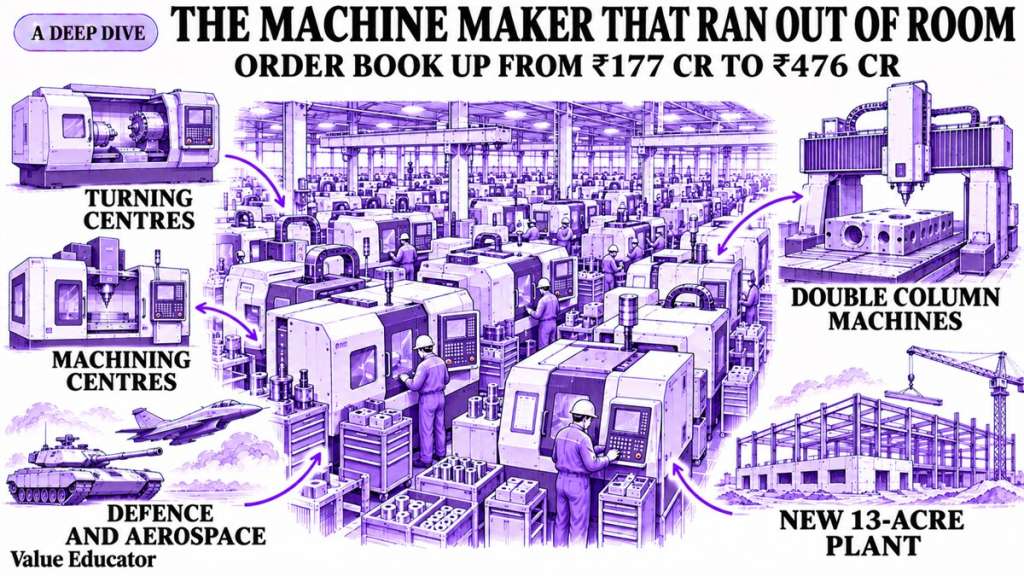
Macpower CNC: A Rajkot Machine Maker With ₹476 Cr of Orders
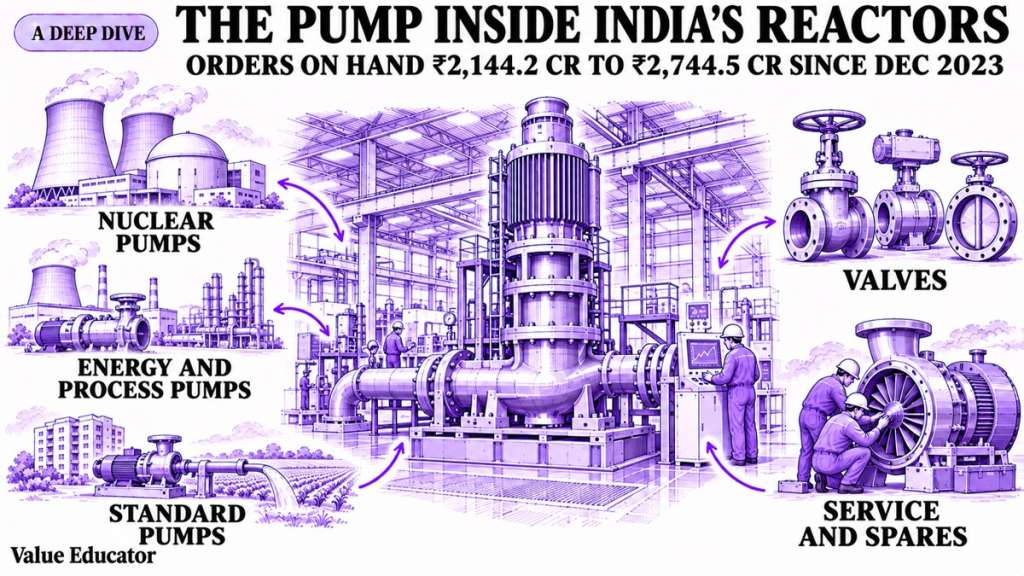
KSB: The Pune Pump Maker With ₹1,235 Cr of Reactor Orders

Kilburn Engineering: The Dryer Maker With ₹470 Cr of Orders

Rossell Techsys: Boeing and Lockheed Wiring From Bengaluru
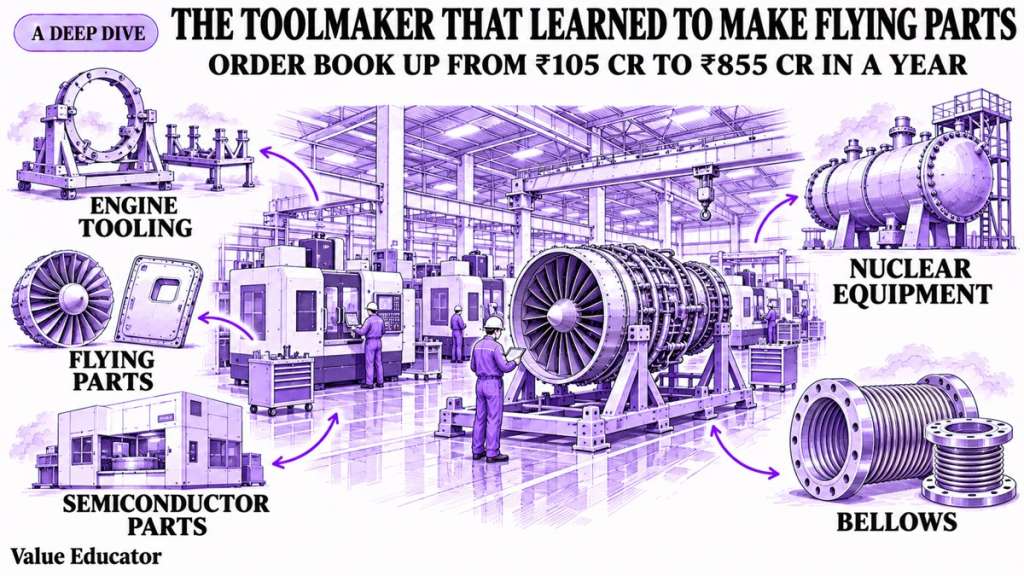
Unimech Aerospace: From Engine Tools to Flying Parts

Dynamatic Technologies: Airbus Doors, Flap Beams and Pumps
Explore our Products
Research Framework
Emerging Titans
Combination of quantitative analysis, industry tailwinds, and management assessment - SPRINT investment philosophy
Tiny Titans
Heavy emphasis on scuttlebutt research, plant visits, and early on-ground signals



Modern Warfare to Multibaggers
Key Trends. Strategic Shifts. Opportunities Ahead.
Don't Miss This Exclusive Webinar!
Join Value Educator to decode the key trends shaping India's defence sector and learn how to identify tomorrow's potential leaders in the space.
- In-depth research on India's defence sector
- Live Q&A session
- Actionable takeaways for long-term investors

 Orders
 Subscription
 Share with friends


Required Details
₹23999.00
(12 month subscription)
As per SEBI regulations, all users are mandated to complete the KYC that is validated for 1 year. Post payment, you will be redirected to the KYC screen


No comments yet. Be the first to comment!