
Techno Electric: ₹11,000 Cr of Grid Orders and Data Centres

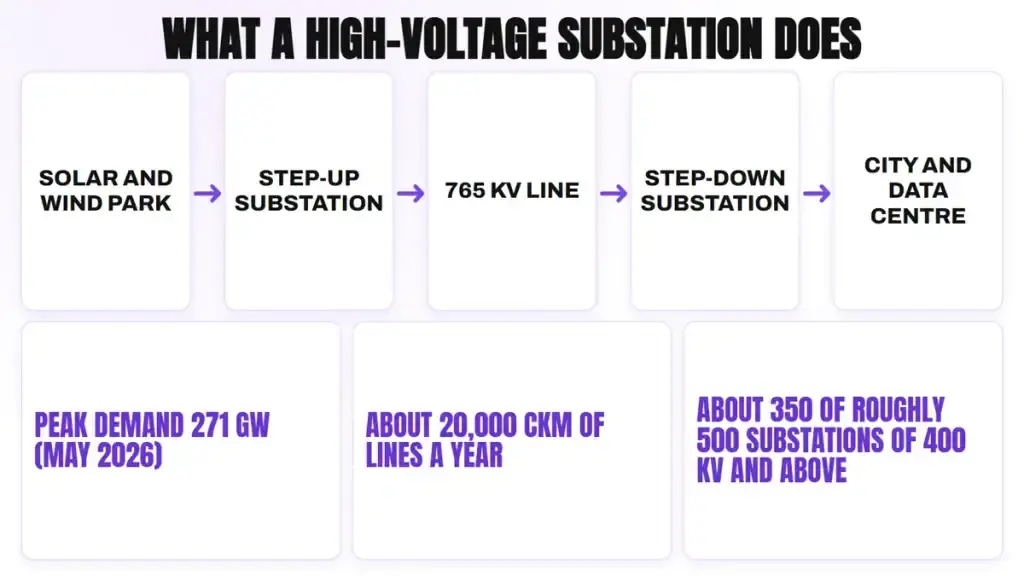
In May 2026, India met an all-time peak power demand of 271 GW. Demand is projected to rise towards 458 GW, and the country plans more than 900 GW of non-fossil capacity by 2035-36, about 548 GW of it from solar and wind. Most of that solar and wind power is made far from the cities that use it. So the grid needs about 20,000 circuit km of new lines every year just to carry it.
Every one of those lines ends at a substation. A substation is the yard of transformers, breakers and switchgear where the voltage of power is stepped up for long-distance travel or stepped down for local use. A solar park cannot send a single unit of power until its substation is built. That makes the substation the slowest and most technical part of a new grid corridor.
So who builds them? Many new inter-state lines are now awarded through tariff-based competitive bidding, which means private developers bid the lowest yearly charge for building and running a line, and the lowest bid wins. The winners are large developers, and Power Grid is the biggest of them. They own the line and earn that charge for decades. But they rarely build the substations themselves. Instead, they hire an EPC contractor, which designs the yard, buys the equipment and builds it on a fixed price and a fixed date.
That contractor, for a large share of India's highest-voltage yards, is Techno Electric & Engineering Company Limited (NSE: TECHNOE). Of roughly 500 substations of 400 kV and above built in India over three decades, about 350 carry its mark. It works up to 765 kV, the highest voltage class in India's grid. And since 2025, it has used the same power engineering to build and run its own data centres.
That second business needs a word of its own. A data centre's capacity is measured by its IT load, which means the power available to the servers themselves, not to cooling or lighting. Techno's first campus in Chennai was designed for 24 MW of IT load. In August 2026, management said the same buildings can now carry 35-40 MW.
Techno Electric in five numbers
- Q2 FY27 standalone revenue of about ₹1,097 Cr, up about 31%
- An order book of ₹11,000 Cr in August 2026, mostly transmission
- About 350 of India's roughly 500 substations of 400 kV and above
- ₹628 Cr of data-centre capex so far, against about 150 MW of IT load under discussion
- 2.24 Mn smart meters awarded, with about 77% installed by June 2026
So a substation builder now owns data centres, smart meters and transmission lines. How do those pieces fit, and what did the latest quarter show? Let's first understand the company, and then look at the quarter.
Techno Electric: Company Overview
Techno Electric & Engineering Company Limited was incorporated in 1963. Its registered office is in Gurugram, Haryana, and it runs its business from its corporate office on Park Street in Kolkata. P. P. Gupta is the chairman and managing director, Ankit Saraiya is director and CEO, and the promoter group held 56.92% of the shares in March 2026. The company builds high-voltage substations and transmission lines as an EPC contractor, and through its subsidiaries it owns smart-meter concessions, transmission assets and data centres under the Techno Digital name. It had 703 permanent employees in FY26. Consolidated revenue was about ₹3,252 Cr in FY26, and the company describes itself as debt-free, with an ICRA AA rating and a Stable outlook. Read this The Silent Gatekeeper of India's Power Grid
"Conservative investors sleep well."
— Philip Fisher
Techno Electric funds a large data-centre build from an EPC business that pays for its own working capital and a balance sheet with almost no debt. That conservatism is what lets it take a long-dated bet without borrowing heavily.
A Second Quarter Ahead of the Usual Pace
Let's look at Q2 FY27, the July to September quarter, which the company reported on 12 November 2026. Standalone revenue, which is mostly the EPC business, was about ₹1,097 Cr, up about 31% from a year ago, and it put the first half ahead of the usual pace. Management always reminds investors that its year is lopsided. It expects about 40% of a year's revenue in the first half and about 60% in the second. So a strong second quarter matters more than it looks.
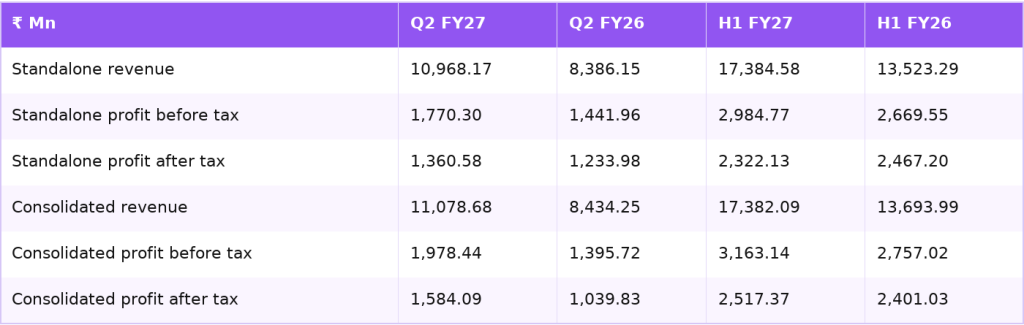
As you can see, that table shows two businesses in one company. The standalone column is the parent, which builds substations and lines for others. The consolidated column adds the subsidiaries, which own the smart-meter concessions, the transmission assets and the data centres. In Q2, consolidated profit after tax rose about 52% to about ₹158 Cr. That is faster than the parent's own profit growth of about 10%.
That growth also shows up in the steadier half-year numbers, as you can see in the table. H1 FY27 standalone revenue was about ₹1,738 Cr, up about 29%. That is about 43% of the ₹4,000 Cr management has guided for FY27, ahead of its usual 40% first-half share. H1 FY26 standalone profit also included a one-time late-payment receipt from its old power generation business, so the profit line is not like for like.

Now let's look at margins, because an EPC contractor lives on them. Read this EBITDA Explained: Uses and Limits Standalone EBITDA in H1 FY27 was about ₹237 Cr, a margin of about 13.6%. Management has guided for 13-14% in FY27, so the half year landed inside that band. At the group level, the H1 EBITDA margin was about 16.2%, up from about 14.9% a year ago. That gap comes from the subsidiaries, whose smart-meter and data-centre revenue earns more per rupee than EPC work.
That profit also came with cash, which we think matters as much. Read this Cash Flow Statement Explained Standalone operating cash flow in H1 FY27 was about ₹192 Cr, against an outflow of about ₹78 Cr in H1 FY26. Trade receivables at the group level stood at ₹11,475.51 Mn in September 2026, against ₹12,170.73 Mn in March 2026. The group held current investments of ₹20,580.01 Mn, and management describes the company as debt-free. In September 2026, ICRA reaffirmed its long-term rating at AA with a Stable outlook.
The Orders Behind the ₹11,000 Cr Book
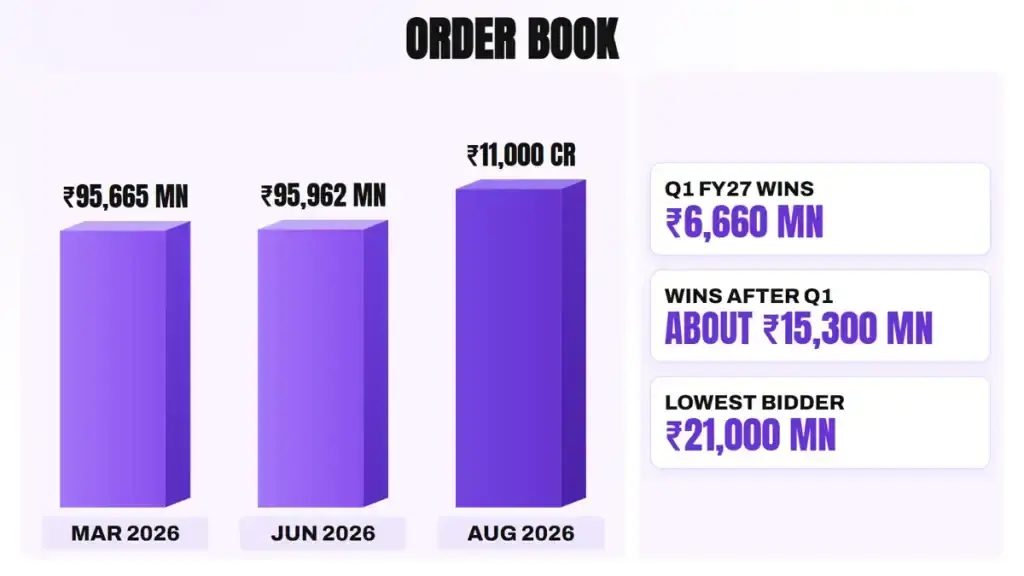
Next, let's look at the orders, because they decide the next three years of EPC revenue. The order book stood at ₹95,665 Mn in March 2026 and ₹95,962 Mn in June 2026. The company won ₹6,660 Mn of orders in Q1 FY27 and about ₹15,300 Mn more after the quarter ended. By August 2026, management put the unexecuted book at ₹11,000 Cr, and it was the lowest bidder on another ₹21,000 Mn of bids.
That book turns into revenue at a known pace. Customers usually give Techno two to two and a half years per project, but the clock often starts late because land parcels are handed over six to nine months after award. So management tells investors to think of two to three years. Management likes to hold a book of about 2.4-2.5 times a year's revenue, so that each year's orders replace each year's work.
What the order book says: at ₹11,000 Cr, the book is about 2.75 times the FY27 revenue target, above the level management likes to hold. It also plans to book at least ₹4,000 Cr of new orders in FY27. With the ₹2,200 Cr won by August and the ₹2,100 Cr where it was lowest bidder, that target is already in sight.
So who places these orders? Management names Power Grid, Adani Energy, IndiGrid and Sterlite as its major customers, along with state utilities and newer developers such as Apraava Energy. It says eight to ten transmission concessions are now being finalised every month by the bid coordinators, and each winner needs substations. Techno partners with the winners to build them.
Five Businesses Built on One Power Engineering Base
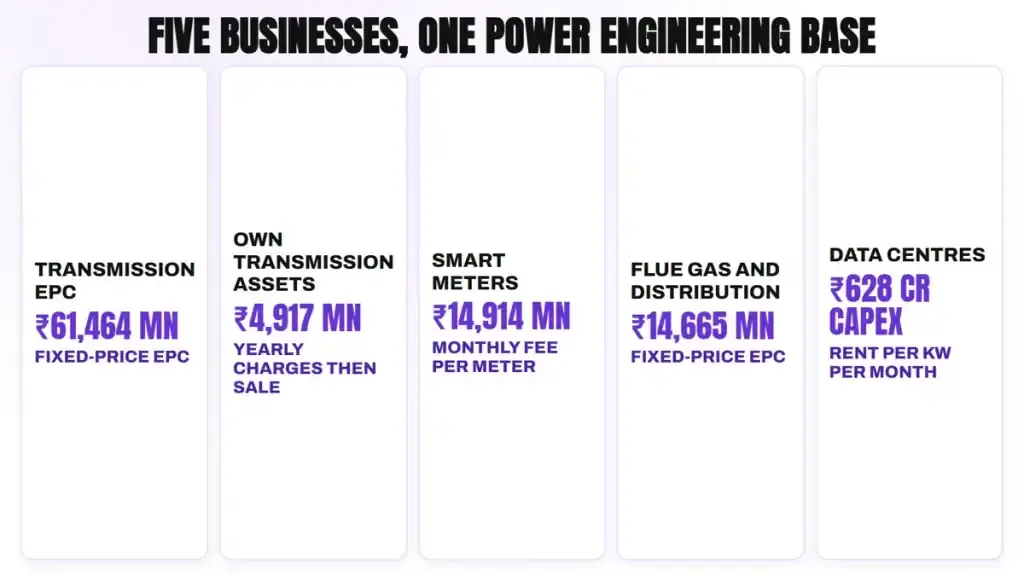
Now that we have seen the quarter, let's split the company into its businesses. The company reports a single segment, so we use the June 2026 order book and management's own figures to tell them apart. Read this Segment-Wise Revenue Analysis Explained Each one uses the same power engineering, but each earns money in a different way.
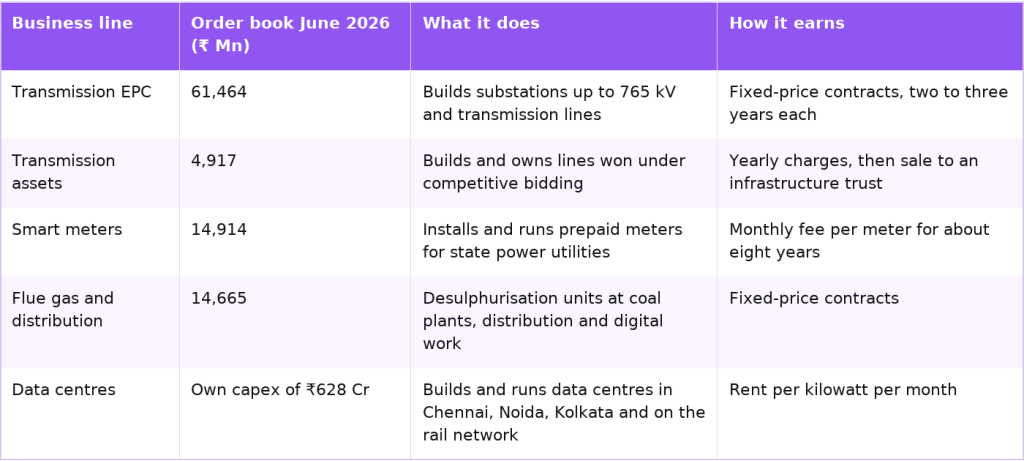
These businesses sound alike, but as we will see, they are not the same kind of money. EPC is work done for others and paid as it is built. The transmission assets and smart meters are things Techno builds for itself and then earns from for years. The data centres are the newest, and they are the only business where Techno has to find the customers after the building is ready.
Transmission Substations, the Core of the Book
Let's start with the core, the substation business. India met its 271 GW peak only because new lines carried power from solar and wind states such as Rajasthan, Gujarat and Tamil Nadu to the cities. Management says that today only about 80% of the feeders needed to evacuate this renewable power are available. The grid also needs newer equipment: synchronous condensers, dynamic reactive compensation and HVDC corridors, which are long direct-current lines that lose less power over distance.
That is the kind of yard Techno builds. Its work covers air-insulated and gas-insulated substations up to 765 kV. A gas-insulated substation packs its switchgear inside sealed, gas-filled metal enclosures, so it needs far less land than an open-air yard. Management says its product mix is moving towards these gas-insulated jobs, which are more technical. It also says that, at present, six to seven of every ten new stations under construction in India are its own.
Its newest edge is the digital substation, where protection and control signals travel over fibre instead of copper cables, so every asset can be watched in real time from a control room. In May 2026, Techno said it had won an order for a 132 kV digital substation at four locations in the DVC grid command area, which it calls one of the most advanced of its kind in India. DVC is the Damodar Valley Corporation, a central utility that runs power across West Bengal and Jharkhand.
That engineering work is done by a small team for its size. The company had 703 permanent employees in FY26, and 650-plus engineering and commercial staff run its project sites. In FY26 its standalone employee cost was ₹857.29 Mn, against revenue of ₹32,524.77 Mn. So fixed costs stay small as revenue grows.
So the EPC margin has stayed steady through that growth. The company says its EPC business has earned an EBITDA margin of about 14% over the last five years. Standalone FY26 revenue was ₹3,252 Cr, up 35.42%, and standalone EBITDA was ₹448 Cr. That is a margin of about 13.8%, close to the long-run level.
Transmission Assets It Owns and Then Sells
Next, let's look at the transmission lines Techno owns. Under tariff-based bidding, Techno sometimes bids as the developer itself, wins the concession and builds the line with its own EPC team. Once the line runs, it sells the asset and puts the money back into new projects. It has won four such projects and sold three of them, including assets built jointly with Kalpataru in the past.
The current ones are a mix of its own and partner projects. NERES XVI is a 400/220/132 kV substation with 1,400 MVA of transformer capacity and 45 km of lines. Ishanagar and Dhule are two projects built in partnership with IndiGrid, an infrastructure investment trust that buys and holds power lines. In May 2026, management said the contract work in progress on these two alone was about ₹600 Cr.
That money is what management calls a hidden asset. In August 2026 it put the company's contract assets at about ₹1,500 Cr, mostly built but not yet billed or sold. It planned to hand over Ishanagar to IndiGrid in Q2 FY27 and Dhule in Q3 FY27. When that happens, money tied up in construction comes back as cash.
Smart Meters, an Annuity After the Build
Now let's move to smart meters, the business management calls one of its most valuable. India's power distribution utilities have long struggled to collect for all the power they supply. Management says the share they cannot bill or collect has improved from 22% to 15%, and prepaid smart meters are one of the main tools. A prepaid smart meter works like a prepaid phone: the consumer pays first, and the utility can read and switch the meter remotely.
Techno builds, owns and runs these meters for utilities under ten-year concessions. Each concession runs 120 months, 27 for installation and 93 for operation and maintenance. During the 93 months, the utility pays a fixed monthly fee for each working meter. So once a meter is in, it needs no further capital, and it simply earns.
As you can see from the numbers, that portfolio is now close to fully built. Techno won 2.24 Mn meters in four states, Madhya Pradesh, Jammu and Kashmir, Jharkhand and Tripura, worth about ₹26,120 Mn in all. Installation reached 77% by June 2026, up from 70% at the end of FY26. By August 2026, it had installed about 18.5 lakh meters, with only about 4 lakh left. Madhya Pradesh is fully installed and in its annuity phase, and Jharkhand, Jammu and Kashmir and Tripura are due within FY27.
That shift changes the cash flow of the business. In FY27, management expects to collect about ₹450 Cr from monthly fees and lump-sum payments, against about ₹400 Cr still to be spent on the last meters. So the business funds itself this year. Techno also delivered 2.5 lakh meters under an earlier Jammu and Kashmir order worth ₹383.39 Cr, all of them now live.
Flue Gas Units and Distribution Work
Next come the two smaller EPC lines, which together make up about 15% of the book. A flue gas desulphurisation unit is a large scrubber that removes sulphur dioxide from the smoke of a coal power plant before it leaves the chimney. Techno's FGD work in the book was ₹7,224 Mn in June 2026. Its current jobs are at Kota and Jhalawar in Rajasthan, which management expects to finish by March 2027 and June 2027.
The distribution and digitisation line was ₹7,441 Mn in June 2026. It covers work for power utilities below the transmission level, including smart grid projects. That line also links back to the meters, since the same utilities buy both. So the size of these two lines depends on which tenders come up and which ones Techno chooses to bid for.
Data Centres, the Power Asset With Tenants
Finally, let's look at the data centres, the business management expects to become the face of the company by 2030. India's installed data-centre capacity grew from about 375 MW in 2020 to 1.57 GW in August 2026, and it is projected to reach nearly 8 GW by 2030. The Central Electricity Authority says data-centre power demand could reach 17 GW by 2031-32. So every new data centre is, first of all, a power problem.
"A data center is fundamentally a power asset and the company which understands power best will therefore build India's digital infrastructure best." - Ankit Saraiya, Director and CEO, August 2026
That is the bet we see Techno making. Its Chennai campus became operational around September 2025, with a first phase of 5.6 MW. The first customer moved in from October 2025. Chennai is the only Indian city other than Mumbai with several submarine cable landing stations, and it offers the shortest path to Singapore. It already has six to seven large operators, including Nxtra, AdaniConneX, Sify, Equinix and NTT, so Techno is the newest entrant in a crowded market.
That newness showed in the early leasing, which took time. By May 2026, Techno had leased about 0.5 MW in Chennai. In the June quarter it signed ten new customer logos, including two of India's leading telecom carriers, which together took about 130 kilowatts. Management expects the Phase 1 capacity to be fully leased within FY27. It also expects it to take about 12 months after commissioning for a hall to reach 75-80% occupancy.
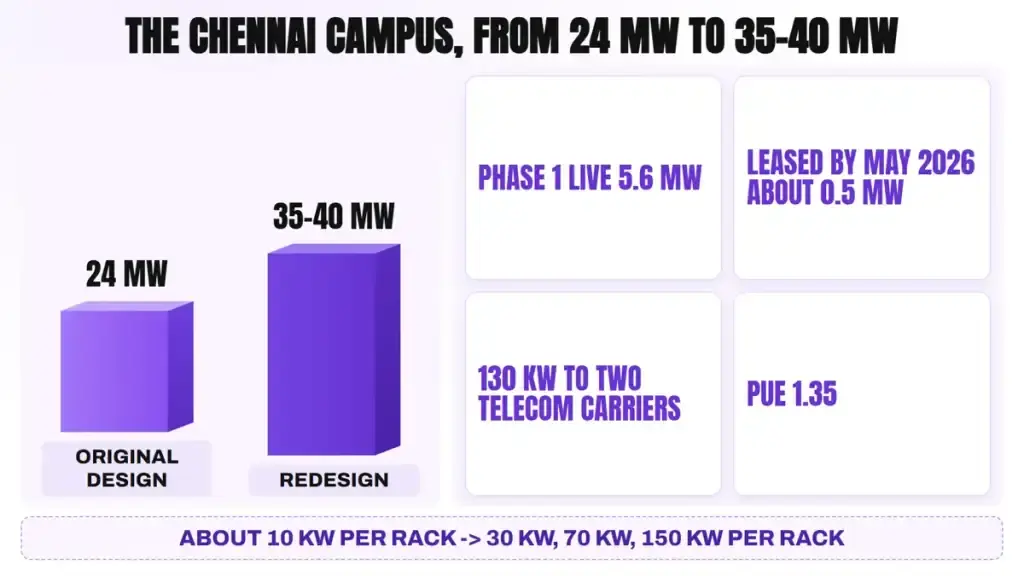
Then came the redesign that changed the size of Chennai. The campus was designed at about 10 kW per rack. AI servers need 30 kW, 70 kW or even 150 kW per rack, and denser racks put more IT load into the same floor space. So Techno's engineers reworked the electrical layout and the cooling. Management now says Chennai can carry about 35-40 MW instead of 24 MW, without buying more land or adding a building.
"We created that capacity ourselves. It converts directly into more revenue-earning capability for the capital we deploy." - Ankit Saraiya, August 2026
That extra room met a sudden rise in demand. Management says about 150 MW of IT load is now under active discussion with global hyperscale, AI and enterprise customers, including six opportunities of more than 3 MW each. It has more than 30 open opportunities. It gives two reasons for the rush: Mumbai is largely committed, so large demand there cannot be met for 18 to 24 months, and the Union Budget 2026-27 gave foreign cloud providers a tax holiday until 2047 for using Indian data centres.
The Chennai facility also meets the standards large buyers ask for. It is TIA-942-B certified for design and construction and holds an IGBC Gold green building rating. It was designed at a PUE of 1.35, which means it uses 1.35 units of power for every unit that reaches the servers. It has run on about 97% renewable power in recent months.
Beyond Chennai, the network is spreading. In Noida, Techno is building a 16 MW campus in a joint venture with RailTel, the railways' telecom company, on a revenue-share model. It received building plan approval in July 2026 and targets commissioning in Q4 FY27, with government departments as the main expected tenants. A 12 MW Kolkata campus is in foundation works and is targeted for FY29. In Andhra Pradesh, Techno signed an MoU with a global hyperscaler for a 2 MW facility built for that customer.
Then there is the edge network, the fourth piece. An edge data centre is a small facility placed close to users, so data does not have to travel to a big city campus. Under a long-term contract with RailTel, Techno plans 102 edge sites across 23 states, linked to RailTel's 63,000+ km fibre network. Gurgaon, with 0.4 MW, is fully occupied and earns a little above ₹2 Cr a year. Mumbai, with 0.8 MW, is live and onboarding customers.
So far, as you would expect, this has cost real money.
"The big money is not in the buying and the selling, but in the waiting."
— Charlie Munger
Techno Electric's data centres need capital first and tenants later. Management itself says the payoff takes years, so the waiting is part of the plan. Capex at Chennai was about ₹524 Cr by March 2026, and ₹628 Cr across all data-centre projects. Noida and Kolkata together carry a budget of about ₹500-600 Cr. Another ₹400 Cr is set aside for Chennai's second phase, which will start only when a customer signs for it.
Why a Substation Record Is Hard to Copy
Now that we have seen all five businesses, let's understand the moat. A substation is the point where a line either works or does not. If a 765 kV yard is late, the whole corridor and every solar park behind it waits. So developers give these jobs to contractors who have already built many of them on time.
That record takes decades to build.
"It takes 20 years to build a reputation and five minutes to ruin it."
— Warren Buffett
A substation builder sells its record more than its price. One late 765 kV yard can hold up a whole corridor, which is why developers keep going back to contractors who have delivered on time before. Techno has more than four decades in power infrastructure and says it has delivered more than 500 projects with a zero-penalty record, which means no customer has charged it for late delivery. About 70% of its orders in the past three years came from repeat clients. A new contractor can bid at a lower price, but it cannot show that history on its first 765 kV job. Read this Economic Moat Explained
That history is also why the big developers keep coming back. These large developers run many concessions side by side. For them, a contractor who already knows their standards, their equipment suppliers and their testing routine can save time on every new yard. Techno says it has decades-long relationships with equipment makers such as Siemens, GE, Schneider and Vertiv, which helps it secure transformers and switchgear when supply is tight.
That same edge carries over to the data-centre business. Power, not real estate, is the binding limit for a large data centre today. Techno builds the substations that feed these campuses, and it can build its own campus with its own EPC team. Management says that makes its time from a signed contract to delivered capacity the shortest in the market. The Chennai redesign, from 24 MW to 35-40 MW in the same footprint, is the first proof of that power engineering at work.
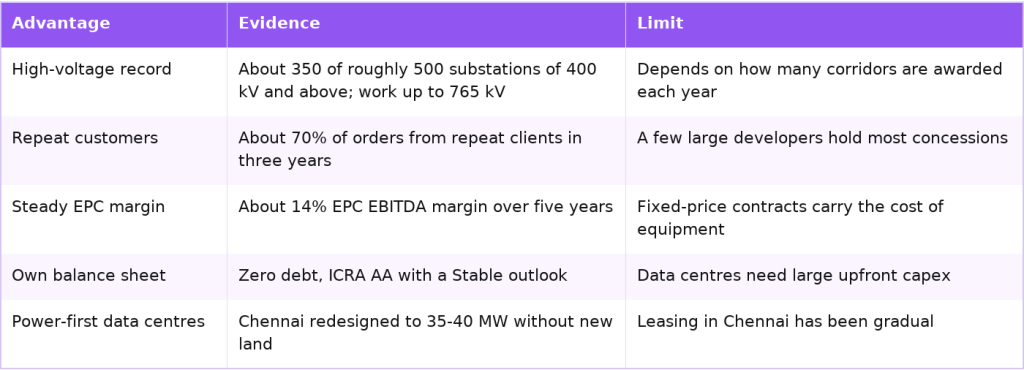
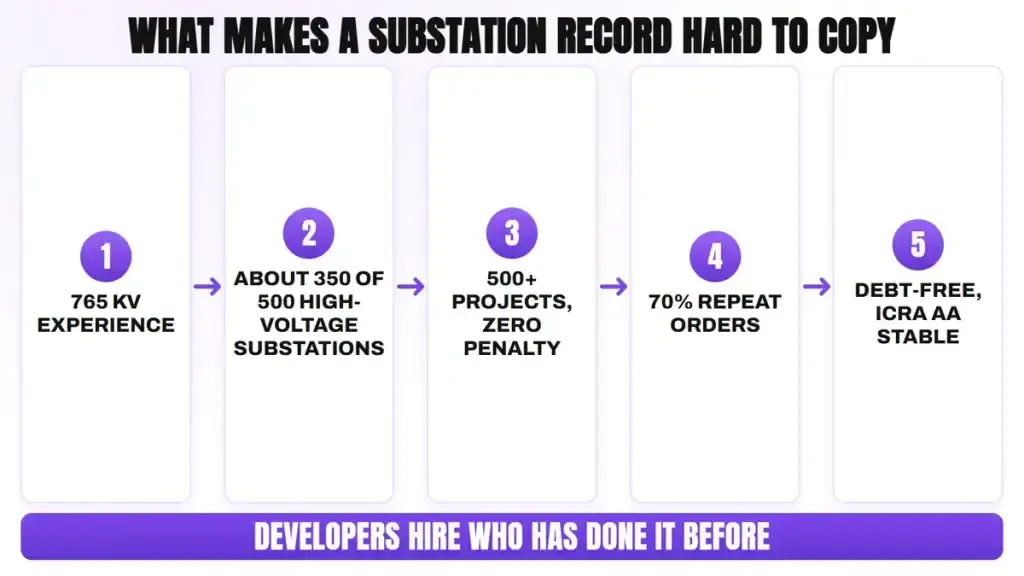
That table also shows where the moat is tested next. In EPC, the test is whether margins hold at 13-14% while equipment costs stay high. In data centres, the test is whether the power edge turns into signed tenants.
Financials: Five Years of Growth, Margins and Cash
One quarter can mislead in a project business that earns about 60% of its revenue in the second half, so let's look at five full years together. These are consolidated figures from the latest annual report that shows each year. EBITDA here excludes other income, which was about ₹149.5 Cr in FY26, and profit after tax includes the old power generation business shown as discontinued.
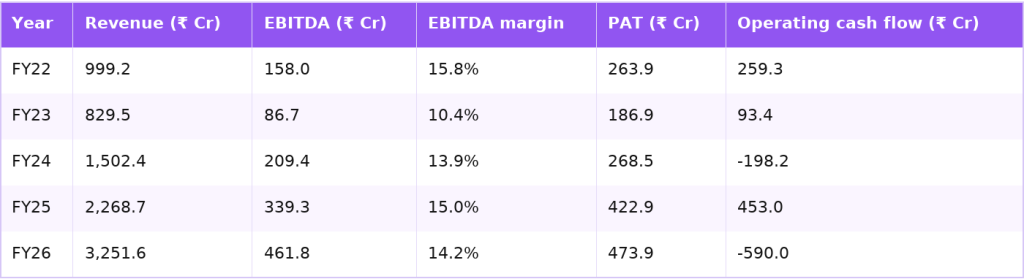
Revenue grew about 3.3 times in four years, from about ₹999.2 Cr in FY22 to about ₹3,251.6 Cr in FY26, after a dip in FY23 when the company was moving out of power generation. The EBITDA margin has stayed between about 10.4% and 15.8%, and in the last three years between about 13.9% and 15.0%, which fits a business that wins fixed-price contracts with steady pricing.
Cash flow is the part to watch. Over the five years, operating cash flow added up to about ₹17.5 Cr, against about ₹1,616.1 Cr of profit after tax. The swings follow the year-end: Q4 is the heaviest quarter, so receivables and contract assets build up in March, and FY26 ended with an operating outflow of about ₹590 Cr. In H1 FY27, standalone operating cash flow turned positive at about ₹192 Cr.
The balance sheet carried those swings with equity rather than debt. A QIP of ₹1,250 Cr in FY25 funded the data centres, smart meters and transmission assets, and the group still held current investments of ₹20,580.01 Mn in September 2026.
"Only when the tide goes out do you discover who's been swimming naked."
— Warren Buffett
Techno Electric's profit has been steady for years, but its cash flow swings with the year-end. A year like FY26, with a large outflow, is when a debt-free balance sheet shows its worth.
What FY28 Could Look Like on Management's Numbers
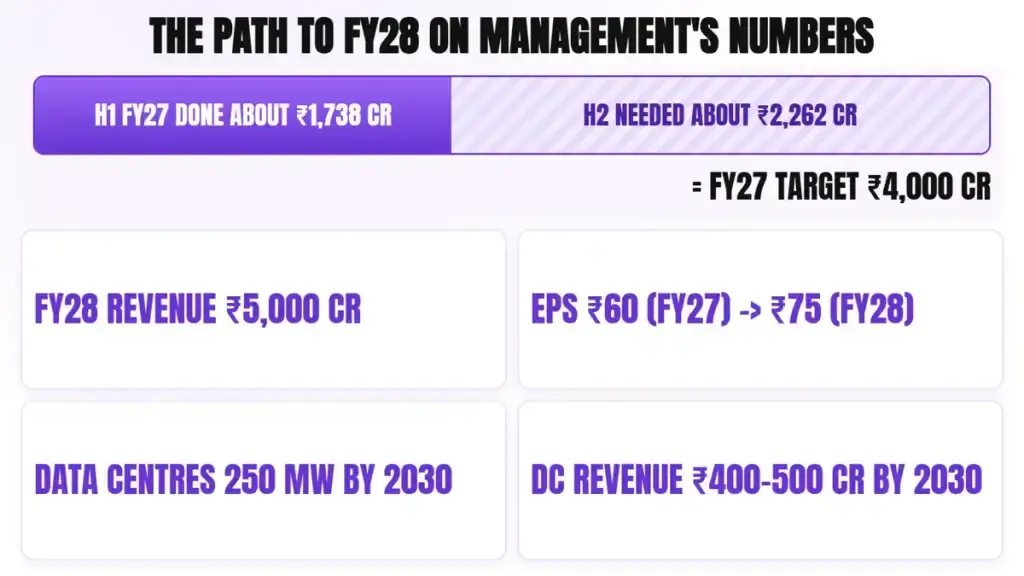
So where does the company go from here? In May 2026, management guided for FY27 standalone revenue of about ₹4,000 Cr, an EBITDA margin of about 13% and earnings per share of about ₹60. For FY28 it guided for revenue of ₹5,000 Cr and earnings per share of ₹75. In August 2026 it said it remained on track, with margins of 13-14%, and that order intake would likely beat its ₹4,000 Cr target.
"By 2030, our takeaway is that the data center or digitization will become the face of this company and transmission will be the second side of the coin." - P. P. Gupta, Chairman and Managing Director, May 2026
Let's put that FY27 target against the first half. H1 standalone revenue was about ₹1,738 Cr, so reaching ₹4,000 Cr needs about ₹2,262 Cr in H2. That is about 1.3 times the first half, close to the company's usual 40:60 split. So the target does not need anything unusual, only the normal second-half push.
Beyond FY28, the data-centre plan runs on a longer clock. Management targets 250 MW of data-centre capacity by 2030, with the 150 MW pipeline under discussion as its base. By 2030, it targets about ₹400-500 Cr of data-centre revenue at an EBITDA margin of about 50%. Management also says it will report contracted capacity and actual segment revenue during this ramp-up, rather than guide the segment.
That plan needs capital, and the company has planned for it. It set aside about ₹1,000 Cr for data centres in FY27. Smart meters need no new money this year, because their fees now cover the last installations. The EPC business funds its own working capital, management says, and the IndiGrid sales should release cash tied up in Ishanagar and Dhule.
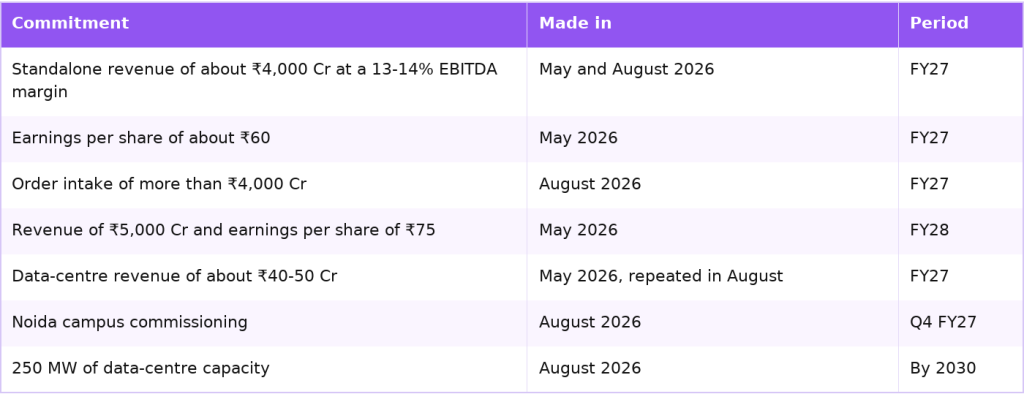
Those commitments are easier to judge against the past. So let's check what management said before against what happened.
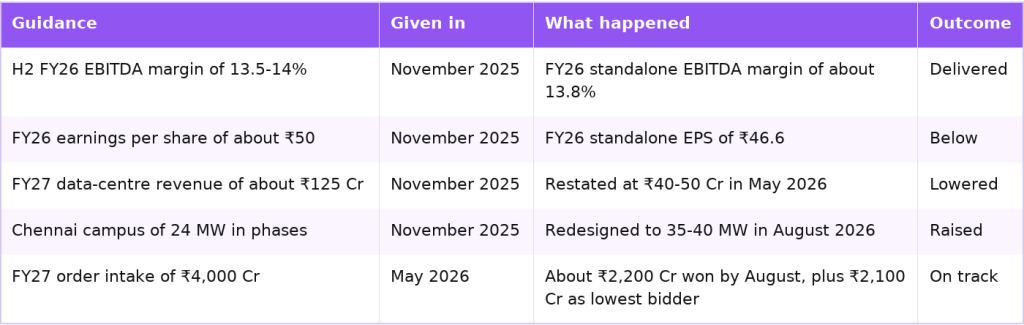
That record is mixed, as you can see. The EPC margin and the order intake have tracked guidance. The profit target for FY26 and the early data-centre revenue have come in below what management first said.
Key Risks
Now let's look at what could go wrong for Techno Electric, because some of these risks have already shown up in the numbers.
- Data-centre leasing: about 0.5 MW of Chennai's 5.6 MW was leased by May 2026, against an earlier hope of filling Phase 1 by H1 FY27. FY27 data-centre revenue guidance was cut from about ₹125 Cr to ₹40-50 Cr. Large AI deals also wait on costly servers and GPUs, so revenue can lag a signed contract by months.
- Moving targets: the Kolkata campus has been described as 16 MW, 8 MW and 12 MW in different documents, and its date has moved from late 2027 to FY29. Noida's first phase also moved from March to June 2026. Frequent changes make the plan harder to track.
- Profit below guidance: FY26 standalone earnings per share of ₹46.6 came in below the ₹50 guided, and the FY27 figure of ₹75 has moved to FY28. Management blamed the Gulf war, which it said cut about ₹200 Cr from FY26 revenue.
- Equipment costs: gas shortages after the West Asia conflict raised the cost of insulators, aluminium and transformer steel. EPC contracts are fixed-price, so these costs hit the 13-14% margin directly.
- Old receivables: the auditors drew attention to ₹896.35 Mn of overdue receivables and other assets. These include dues from a project in Afghanistan stopped in August 2021, an arbitration with Bengal Energy and ₹177.20 Mn of renewable energy certificate dues. Management believes all of it is recoverable, but none of it is provided for.
- Cash flow in FY26: group operating cash flow was an outflow of ₹5,899.56 Mn in FY26, as receivables and contract assets grew with the late-year push. Operating cash flow turned positive in H1 FY27, but a repeat would strain the funding of data centres.
- A cancelled project: the Government of India cancelled the NERGS-I transmission project, so ₹200 Cr of QIP money meant for it was moved to the Chennai data centre.
- Customer concentration: a few large developers award most concessions, so a pause at Power Grid or Adani Energy would show up quickly in the order book.
"I will say no industry, no expansion of high-tech deployment like this becomes profitable in the very first year. At least it takes 2 years to gain ground." - P. P. Gupta, May 2026
"Invert, always invert."
— Charlie Munger
Turned around, the question for Techno Electric is simple: what would make the data centres a drag on a healthy EPC business? Empty halls, moving dates and cash tied up at the year-end are the answers, and the tracking list below watches each of them.
Explore our Products
Research Framework

Emerging Titans
Combination of quantitative analysis, industry tailwinds, and management assessment - SPRINT investment philosophy

Tiny Titans
Heavy emphasis on scuttlebutt research, plant visits, and early on-ground signals
What to Track Next
If you follow Techno Electric, these are the signals that will show where it goes next.
- Management's Q2 FY27 commentary on 13 November 2026, and what drove consolidated profit above standalone profit
- H2 FY27 standalone revenue, which needs to be about ₹2,262 Cr to reach ₹4,000 Cr
- Signed IT load in Chennai, and any of the six opportunities above 3 MW closing
- Noida commissioning in Q4 FY27 and first government tenants
- The sale of Ishanagar and Dhule to IndiGrid, and the cash it brings back
- New orders against the ₹4,000 Cr target, and the order book after ₹11,000 Cr
Conclusion
Let's put it all together. Techno Electric's core is a substation builder with about 350 of India's high-voltage yards behind it, an ₹11,000 Cr order book and a steady EPC margin. The latest quarter put H1 revenue at about 43% of the FY27 target, ahead of the usual pace. The cautious thread is the data-centre side: leasing in Chennai has been slow so far, revenue guidance for FY27 was cut, and the Kolkata dates have moved. The next few quarters, starting with signed IT load in Chennai and Noida's commissioning, will show which thread is stronger.
On top of that core sits a data-centre business that is still small in revenue but large in capex and ambition. What happens next depends on whether the Chennai redesign and the 150 MW pipeline turn into signed tenants, and whether the EPC side keeps funding that build without strain.
FAQs
What does Techno Electric do?
+Techno Electric builds high-voltage substations and transmission lines as an EPC contractor, working up to 765 kV. About 350 of India's roughly 500 substations of 400 kV and above carry its mark. Through subsidiaries it also owns smart-meter concessions, transmission assets and data centres.
How did Techno Electric do in Q2 FY27?
+Standalone revenue rose about 31% to about ₹1,097 Cr, and consolidated profit after tax rose about 52% to about ₹158 Cr. H1 FY27 standalone revenue was about ₹1,738 Cr, about 43% of the ₹4,000 Cr guided for FY27. The H1 standalone EBITDA margin was about 13.6%.
What is Techno Electric's order book?
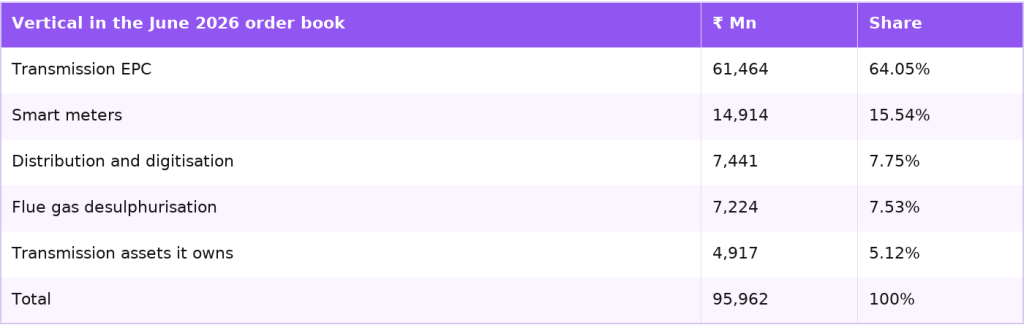
+Management put the unexecuted order book at ₹11,000 Cr in August 2026. In June 2026, transmission EPC made up 64.05% of the ₹95,962 Mn book and smart meters 15.54%. The company had won about ₹2,200 Cr of orders by August and was lowest bidder on another ₹2,100 Cr.
What is happening at Techno Electric's Chennai data centre?
+The Chennai campus went live with a 5.6 MW first phase around September 2025. It was designed for 24 MW of IT load, and management now says denser AI racks let it carry about 35-40 MW without new land. About 150 MW of IT load is under discussion across the portfolio.
How much has Techno Electric invested in data centres?
+Data-centre capex was ₹628 Cr by March 2026, including about ₹524 Cr in Chennai. The company set aside about ₹1,000 Cr for data centres in FY27, mainly for Noida and Kolkata. It targets 250 MW of capacity and about ₹400-500 Cr of data-centre revenue by 2030.
What are the main risks for Techno Electric?
+Data-centre leasing has been slow, with about 0.5 MW of Chennai's 5.6 MW leased by May 2026, and FY27 data-centre revenue guidance was cut from about ₹125 Cr to ₹40-50 Cr. FY26 earnings per share of ₹46.6 came in below the ₹50 guided. Auditors flagged ₹896.35 Mn of overdue receivables, and group operating cash flow was an outflow of ₹5,899.56 Mn in FY26.

High growth stock specialist, Value Educator
Shashank Mahajan is an equity research professional with over 12 years of experience in identifying high-potential SME and micro-cap stocks at an early stage. He follows a rigorous scuttlebutt research–driven approach, combining on-ground insights with deep financial analysis. Shashank specializes in uncovering under-researched and under-owned companies with strong management quality and long-term growth potential. Through disciplined research and early identification, he focuses on spotting tomorrow’s market leaders before they enter the mainstream investor radar.

Jyoti CNC: The 5-Axis Machines Behind India's Aircraft Parts

INOX India: The Rocket Order Behind a ₹2,268 Cr Book

APAR Industries: Google, Amazon and ₹12,025 Cr of Orders

Sansera Engineering: Aircraft and Chip Parts Hit 14.9%

PTC Industries: The Titanium Melt Shop Behind Aerolloy

HBL Engineering: Defence Batteries, Fuzes and Kavach Orders
Explore our Products
Research Framework
Emerging Titans
Combination of quantitative analysis, industry tailwinds, and management assessment - SPRINT investment philosophy
Tiny Titans
Heavy emphasis on scuttlebutt research, plant visits, and early on-ground signals



Modern Warfare to Multibaggers
Key Trends. Strategic Shifts. Opportunities Ahead.
Don't Miss This Exclusive Webinar!
Join Value Educator to decode the key trends shaping India's defence sector and learn how to identify tomorrow's potential leaders in the space.
- In-depth research on India's defence sector
- Live Q&A session
- Actionable takeaways for long-term investors

 Orders
 Subscription
 Share with friends


Required Details
₹23999.00
(12 month subscription)
As per SEBI regulations, all users are mandated to complete the KYC that is validated for 1 year. Post payment, you will be redirected to the KYC screen


No comments yet. Be the first to comment!