
HBL Engineering: Doing Things Nobody Else Can

You board a train, find your seat, put your headphones on. Somewhere around the 200th kilometre, you fall asleep. You wake up 600 kilometres later, at your destination, having thought about the journey exactly zero times in between.
That's the whole deal you signed up for without realizing it. You paid for a seat. What you actually got was a promise — that somewhere ahead, on the same stretch of track, another train wasn't going to be there at the same time. And if it somehow was, something would sense it and stop both trains before you ever found out how close it came. One of the companies building that system is HBL Engineering.
You never see that system. You never think about it. It doesn't announce itself, doesn't get a mention on the ticket, doesn't cross your mind once during the entire six-hundred-kilometre nap. It just has to work, every single time, for millions of passengers who will never know it was there.
Nobody thinks about any of this. That's rather the point.
There's a company that has spent close to four decades building exactly these kinds of products — the ones nobody sees, nobody talks about, and nobody wants to have to think about, because if you're thinking about them, something has already gone wrong.
Meet HBL Engineering.
Formerly known as HBL Power Systems, this Hyderabad-headquartered company has quietly become one of India's most important suppliers to sectors most investors barely glance at — Defence, Railways, Aviation, Oil & Gas, Power, and Telecom. It isn't a flashy business. It doesn't sell anything you'll ever hold in your hand. But dig into what it actually makes, and a very different picture starts to form.
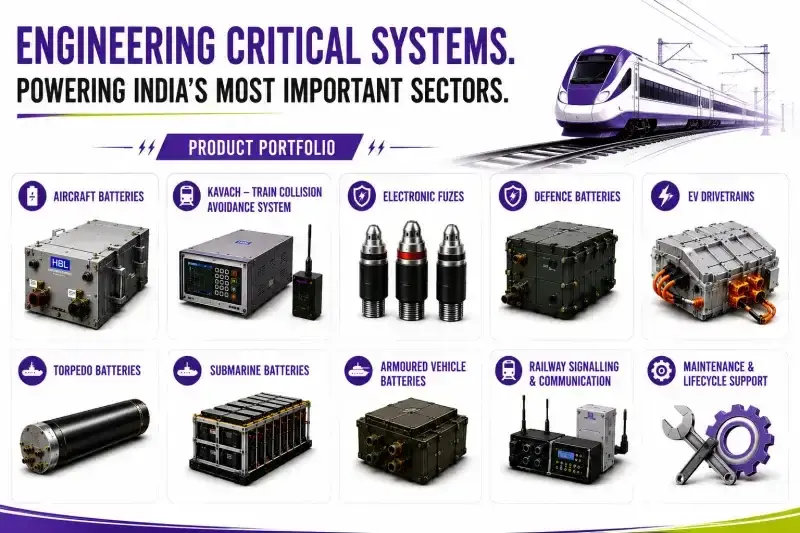
HBL Engineering Company Overview: The Gap-Filler
HBL's entire identity is built around one idea, repeated so often in the company's own language that it's practically a mission statement: find the technology gaps India has, and fill them domestically instead of importing forever.It started with aircraft batteries. Decades ago, HBL picked up a problem nobody else in India wanted to touch — building batteries good enough for military aircraft — and turned it into a foothold. That foothold became a business. That business eventually became a major supplier of specialized batteries to the Indian Air Force. And that early success set the template for everything that came after: find something critical, something technically hard, something India was quietly importing, and build it here instead.
Forty years on, that template has produced a genuinely wide spread of businesses. HBL now designs and manufactures batteries for aircraft, missiles, torpedoes, submarines, and armoured vehicles. It builds Kavach — India's indigenous train collision avoidance system, arguably the single most important It builds Kavach, India indigenous railway safety technology the country has ever developed. It makes electronic fuzes for ammunition, an area where it's the only fully indigenized player in the country. And more recently, it's been building electric drivetrains for heavy trucks, treating the EV wave not as hype to chase, but as a narrow, practical opportunity to solve.
Here's a detail that says a lot about how this company thinks. HBL changed its name in November 2024 — from HBL Power Systems to HBL Engineering. Not a rebrand for marketing's sake. A signal that the company had genuinely outgrown "power systems" as a description of what it does. It's promoter-led, with the founding family holding just over 59% of the company as of last year, and it runs five manufacturing facilities across Hyderabad and Vizianagaram, employing over 2,150 people.
None of this reads like a typical Indian manufacturing story.
It reads more like a specialized engineering house that happens to sell into some of the hardest-to-crack markets in the country.To understand why businesses like HBL can defend their position despite operating in competitive industries, it helps to look at the concept of an economic moat. Read Economic Moat Explained: Why Some Companies Stay Dominant for Decades.
Business Model: Built to Avoid Competing
Most manufacturers try to win by making more of something, cheaper than the next guy. HBL's entire strategy is built on refusing to play that game.
Here's the philosophy, more or less in the company's own words: don't compete in commodity, high-volume markets. Find the smaller, harder, more technical corner of an industry where very few players can operate, get certified into it, and stay there.
The business model, step by step, looks something like this: R&D first. Then technology development. Then product design. Then manufacturing. Then testing and certification — a stage most consumer businesses barely think about, but one that can take years in Railways or Defence. Then government or OEM approval. Then supply. Then, where applicable, installation. And finally, the part that makes this whole model work over the long run: replacement, maintenance, and repeat orders.
That last stage is the quiet engine underneath everything. Batteries wear out. Ammunition gets used and needs replenishing. Railway systems need upgrades and maintenance contracts long after the initial installation. HBL doesn't just sell a product once — it builds itself into the maintenance cycle of critical infrastructure, which means yesterday's sale often becomes next year's order too.
It's a slower way to grow than chasing volume. It's also a much harder business to disrupt.
Time is the friend of the wonderful business, the enemy of the mediocre.” — Warren Buffett
Value Chain: From Raw Material to Recurring Revenue
Strip away the different product lines, and HBL's value chain follows a consistent pattern across almost every business it runs: raw materials go in, engineering-heavy design and R&D shape them into something specific, manufacturing and rigorous testing follow, and then — critically — the product has to clear a qualification process before it can even reach a customer. That qualification step is one of the key barriers to entryFor investors, these barriers can be an important source of long-term competitive advantage. Our guide Economic Moat Explained: Why Some Companies Stay Dominant for Decades explores how such advantages can protect businesses over time.
In consumer electronics, you design a product, manufacture it, and sell it. In Defence and Railways, you design a product, manufacture it, and then spend months or years proving to a government body that it won't fail when it matters most. Very few companies have the patience, or the balance sheet, to sit through that process. HBL has been sitting through it since the 1980s.
Take the industrial battery business as an example of how this plays out end to end. Lead, nickel, and lithium cells come in as raw material, alongside various chemicals and electronic components. From there: battery design, cell and plate manufacturing, assembly, testing, and finally the finished battery pack goes out to an OEM, an EPC contractor, or a government body, before reaching the actual end customer — a telecom tower, a metro system, a refinery, a defence unit.
For its lithium-ion business, HBL is refreshingly honest about where it sits in the chain. It is not, and has no intention of becoming, a large-scale lithium cell manufacturer — that's a brutally capital-intensive, low-margin game dominated by a handful of global giants. Instead, HBL imports cells and focuses on the more specialized engineering layer above that: battery design, battery management systems, and pack integration for customers like Vande Bharat trains, metro systems, and defence platforms.
It's a deliberate choice to stay in the part of the value chain where engineering matters more than scale.
It’s far better to buy a wonderful company at a fair price than a fair company at a wonderful price.” - Warren Buffett
Products: A Portfolio Built Around Four Pillars
HBL's product range looks sprawling at first glance, but it really comes down to four core businesses.Industrial Batteries. Lead-acid VRLA and Pure Lead Thin Plate batteries serving telecom, railways, metro systems, UPS installations, and data centres. Nickel-Cadmium batteries for oil & gas, refineries, power plants, and process industries — a segment where HBL holds the number two position globally. And a growing lithium-ion battery pack business built around imported cells and in-house engineering, aimed at high-value, low-volume applications rather than the mass consumer market.
Defence Batteries and Electronics. Batteries for aircraft, missiles, torpedoes, submarines, and armoured vehicles — a business where the Ministry of Defence typically keeps a second supplier for redundancy, but where management describes HBL as a market leader. On the electronics side: fuzes that detonate ammunition (grenades, artillery shells, rockets, missiles, air-dropped bombs), voice and data communication systems for armoured vehicles, and specialized platform management systems — including work on Scorpene-class submarines.
Rail Signalling. This is where Kavach lives — the electronic safety layer that talks to a railway's existing signalling and interlocking infrastructure to automatically brake a train before a collision happens. HBL doesn't build the physical signal poles or lamps; it builds the intelligence layer on top: on-board units, station units, trackside electronics, communication systems, software, and controllers. Alongside Kavach, HBL has installed four of the six Train Management Systems currently running in India.
Electric Drive Trains. Not railway trains — heavy commercial trucks. Electric motors, controllers, battery packs, power electronics, and vehicle control software, aimed initially at 35-tonne and 55-tonne trucks. Rather than supplying components to existing truck manufacturers, HBL's stated plan is to assemble and sell complete electric trucks directly to fleet operators.
Growth Drivers: Why the Next Few Years Look Different From the Last Ten
For a long stretch, HBL was a company that grew steadily but unspectacularly. Sales sat in the ₹1,000–1,500 crore range for years, then crept up toward the ₹2,000 crore mark. Nothing that would make headlines.That's changing. And the reason is worth understanding in some detail, because it isn't a story about a hot new market — it's a story about two decades of patient R&D finally converging into revenue at the same time.
Kavach is the headline driver, by a distance. Development on this train collision avoidance system began all the way back in 2005, with essentially no funding from the railway body that first asked for it. HBL demonstrated a working concept on actual tracks in 2012. It took until 2019–2021 for trial orders to even begin. And in 2022, the specification changed entirely — upgraded from protecting trains at 110 kmph to protecting them at 160 kmph, a much harder technical bar. That new spec, version 4.0, wasn't formally frozen and approved until July 2024.
HBL was the first Kavach vendor to demonstrate a working version-4.0 system, and the first to receive formal 4.0 certification, in May 2025 — reportedly eight to nine weeks ahead of the nearest competitor. Out of five companies that originally received Kavach orders from the Railways, only two had achieved 4.0 certification by the time of the company's FY25 annual general meeting.
That head start matters enormously, because tenders covering roughly 19,000 route-kilometres have already been floated, with contracts for about 16,000 km finalized.
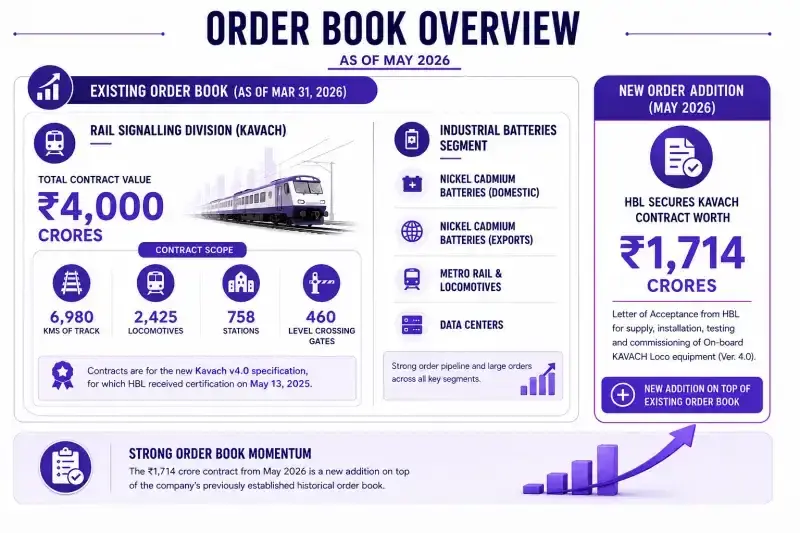
HBL alone has won contracts worth approximately ₹4,000 crore, spanning close to 6,980 km of track, 2,425 locomotives, 758 stations, and 460 level crossing gates.
Management has been candid that this delay in certification is exactly why FY25 sales came in below what was originally budgeted — the orders were real, but they simply couldn't be delivered until the certification cleared. With that bottleneck now gone, the company is expecting Kavach-related sales to stay strong through FY26, FY27, and FY28, before naturally moderating as the initial rollout matures. When that happens, management expects Train Management Systems and electronic fuzes to pick up the growth baton.
Electronic fuzes are the second major driver, and arguably the more interesting long-term story. HBL describes its electronic fuze manufacturing capability as fully indigenized — every component, from the battery to the detonator to the safety mechanism, built in-house. Twenty years of patient R&D here has suddenly collided with a very current geopolitical reality: recent security developments have sharply increased demand for modern air-defence and anti-drone ammunition, and several countries that previously supplied India with fuzes have become unreliable sources. Management expects electronic fuzes to become the largest single contributor to the Defence segment's revenue within the next few years.
Nickel-Cadmium batteries continue compounding quietly in the background. Oil & gas pipeline expansion, new refining capacity, and a notable shift by India's largest power transmission utility away from lead-acid toward Nickel-Cadmium technology have all supported strong volume growth — the company grew its Nickel-Cadmium Pocket Plate business by more than 30% in FY25 alone. Exports of industrial batteries, combining lead-acid and Nickel-Cadmium products, grew 40% in the same year, with the Middle East emerging as a particularly strong new market.
Electric trucks remain a longer-dated, smaller bet. Management has been unusually blunt about this one — early sales targets have already slipped by a year, from October 2025 to October 2026, due to unexpected technical issues. But the strategic logic is distinctive: rather than selling components to existing truck manufacturers at thin margins, HBL wants to sell complete, niche electric trucks directly to fleet operators at better margins. It's a smaller, slower opportunity than Kavach or fuzes, but one management has been thinking about for six years already.
Put together, these aren't unrelated growth stories bolted onto each other. The bigger question is whether these growth drivers can translate into sustained earnings compounding. For a broader framework on identifying such businesses, see 7 Powerful Traits of Multibagger Stocks: India’s Data-Backed Wealth Creators Blueprint.
They're the same underlying model — find a hard technical problem nobody else wants to solve, spend a decade or two solving it, then wait for the market to catch up playing out across four different sectors at roughly the same time. That's rare. And it's precisely why management has taken to describing this period as the company's "next orbit."
The big money is not in the buying or selling, but in the waiting.” - Charlie Munger
Order Book: A Backlog Two Decades in the Making
Most companies build an order book over a few quarters of sales effort. Order books can be particularly important when analysing engineering and infrastructure businesses because they provide visibility into future revenue. For a broader approach to evaluating a company, read A Fundamental Checklist: How to Research a Stock in 1 Hour.HBL's current order book is the product of a fuze program that started in 2005 and a signalling program that started the same year — both of which are only now converting into large, confirmed contracts.
The clearest, most concrete data point here is a Kavach order disclosed under SEBI regulations: Chittaranjan Locomotive Works issued a Letter of Acceptance to HBL worth ₹1,714 crore (excluding GST), for the supply, installation, testing, and commissioning of on-board Kavach 4.0 equipment. This single order sits within the broader ₹4,000 crore of Kavach contracts the company has already secured, covering thousands of kilometres of track, thousands of locomotives, hundreds of stations, and hundreds of level crossings.
What makes this backlog genuinely different from a typical infrastructure order book is the certification barrier sitting in front of it. Of the five companies originally awarded Kavach contracts by the Railways, only two — as of the company's most recent annual general meeting — had cleared version 4.0 certification. HBL was first. The certification requirement creates a significant near-term barrier to entry, because competitors must clear the same technical and regulatory process before participating meaningfully in the opportunity. Price competition alone is unlikely to be sufficient; competitors must first satisfy the relevant certification requirements. They have to get certified first, and certification here has already taken years longer than anyone originally expected.
Beyond Kavach, the order book carries real depth elsewhere too. Nickel-Cadmium order positions going into FY26 were described by management as encouraging, with strong order flow expected to continue and capacity expansion already underway through line balancing to keep up. Track-section Kavach orders — separate from the locomotive orders — are booked out roughly 24 months, giving the company a second, steadier revenue stream running alongside the more front-loaded locomotive rollout.
Longer-term, management's own math, laid out in the FY25 annual report, points to total sales reaching approximately ₹4,500 crore by FY30, with Rail Signalling remaining the single largest business through that period and Kavach-specific sales holding around ₹1,300–1,500 crore annually through FY26–FY28 before naturally tapering as Train Management Systems and electronic fuzes take over as the next growth legs.
It's worth being precise about what kind of statement this is. Management has been careful, repeatedly, to call this a budget rather than guidance or a forecast — a deliberate distinction, and one worth respecting rather than treating as a promise.
The stock market is a device for transferring money from the impatient to the patient.” — Warren Buffett
Financials: A Business That Quietly Deleveraged While Nobody Was Watching
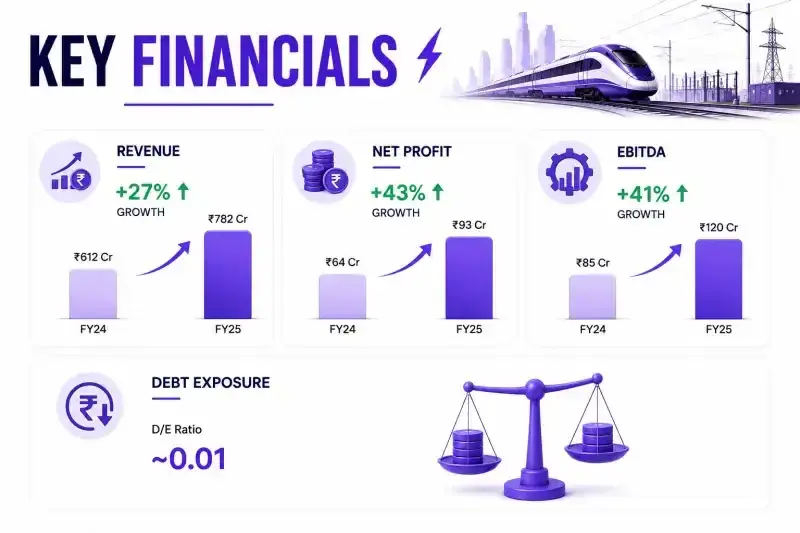
Here's where HBL's numbers get genuinely interesting, and not for the reason you'd expect from a company riding a defence and railways upcycle.FY25 standalone revenue actually declined — down about 12%, from roughly ₹2,209 crore in FY24 to ₹1,946 crore. On the surface, that looks like a company losing momentum right when its biggest growth story was supposed to kick in. The decline was largely explained by the Kavach certification timeline.
Because the Kavach 4.0 specification wasn't finalized until July 2024, and HBL didn't clear its own certification until May 2025, a meaningful chunk of already-won Kavach business simply couldn't be delivered and recognized as revenue in FY25. Management said as much directly at the AGM — sales were budgeted flat for the year, and the small decline that actually happened was close enough to that expectation not to be alarming.
What's easy to miss underneath that headline decline is how strong the rest of the business actually was. Net profit came in at ₹267.5 crore, EBITDA at ₹417 crore — a healthy 21% margin — and exports jumped sharply, from ₹291 crore in FY24 to ₹453 crore in FY25, a rise of more than 55%. Net foreign exchange earnings for the year came in at ₹269 crore.Then look at the balance sheet, and the picture sharpens further.A strong balance sheet can make a major difference when a company is entering a heavy investment or growth cycle. To understand how investors assess financial strength, read How to Read a Balance Sheet Like a Professional Investor.
Debt-to-equity sits at a remarkably low 0.04x. Net debt has actually been negative for three straight years — meaning HBL has been sitting on more cash and investments than borrowings, to the tune of roughly ₹74 crore net cash as of FY25, following ₹176 crore the year before. Return on capital employed came in at 25%, and return on net worth at over 18%.
This is not a company straining under working capital pressure to fund its growth. This is a company that has been maintaining a strong balance sheet while waiting for its largest growth opportunity, Kavach, to clear the certification process.
The sequential trend inside the numbers backs this up too. Quarterly sales, which had been sitting in the ₹450–600 crore range through most of FY24 and early FY25, jumped to ₹1,223 crore in the June 2025 quarter, before settling into ₹874 crore and ₹602 crore in the following quarters — a clear signal that Kavach deliveries had finally started flowing through, even if unevenly quarter to quarter, which is normal for lumpy, project-based defence and infrastructure contracts.
Longer-run compounding numbers tell a similarly striking story. Ten-year compounded sales growth sits at 10%, but that jumps to 29% over five years and 34% over three years — and trailing-twelve-month growth is running at 68%, reflecting just how much the Kavach unlock has changed the trajectory recently. Compounded profit growth shows the same acceleration: 49% over ten years, 118% over five years, 105% over three years, and 201% on a trailing basis.
And on capital allocation — a topic the company's chairman spent a striking amount of time on at the FY25 AGM — HBL has started returning meaningfully more cash to shareholders. Dividend payout jumped from around 10% in FY24 to roughly 27% in FY25, with management indicating at the AGM that a second annual dividend, beyond the usual one, would now become a regular practice going forward. Rather than sitting on growing surplus cash or chasing large, unrelated acquisitions, management has also set up a separate investment vehicle — described at the AGM as a way to back smaller, promising manufacturing-focused companies without diluting HBL's own core focus.
None of this is the profile of a company sprinting to keep up with demand. It's the profile of a company that has been financially disciplined for years, and is only now beginning to show what that discipline was for.
Key Risks for HBL Engineering: What Could Go Wrong
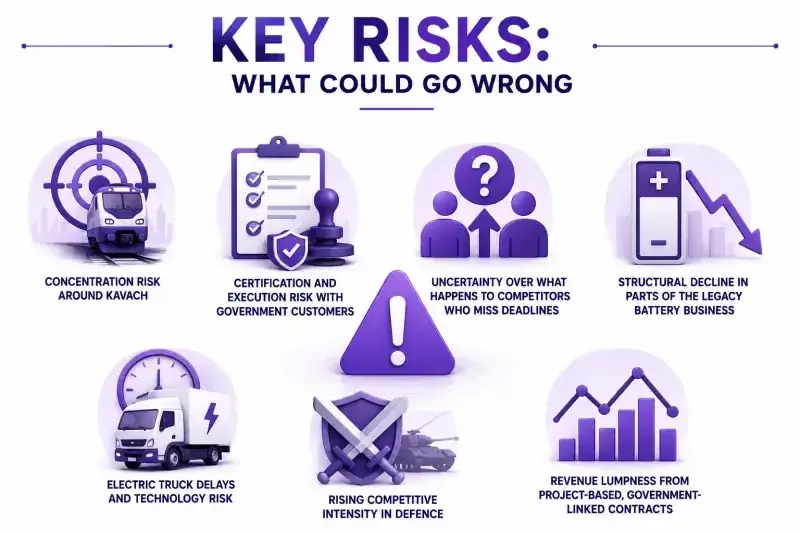
For all the structural strengths here, this isn't a risk-free story. Worth being specific about where things could go sideways.Concentration risk around Kavach. A very large share of near-term growth is tied to a single program. Management itself has flagged that Kavach-related sales are expected to stay strong only through FY26–FY28, with a probable decline in FY28 as the initial rollout matures. If Train Management Systems and electronic fuzes don't scale up fast enough to fill that gap, growth could soften meaningfully around that point.
Certification and execution risk with government customers. The entire Kavach story has already been shaped, and delayed, by regulatory certification timelines outside HBL's direct control — the version 4.0 spec alone took roughly two years longer to finalize than originally planned. Future product cycles, in fuzes, TMS, or electric trucks, carry similar exposure to approval processes that can move at their own pace regardless of how ready the underlying technology is.
Uncertainty over what happens to competitors who miss deadlines. At the AGM, management was candid that it genuinely doesn't know whether competitors who fail to meet Kavach delivery timelines will have their orders forfeited and re-tendered, or simply given extensions. Either outcome changes the competitive and pricing dynamics of the remaining Kavach opportunity in ways that are hard to predict in advance.
Structural decline in parts of the legacy battery business. The telecom sector's shift toward lithium-ion batteries, away from HBL's traditional VRLA lead-acid products, is already underway and expected to accelerate. Management has been explicit that this will meaningfully shrink the 2V-VRLA battery business over the coming years — and, notably, HBL has chosen not to chase the telecom lithium opportunity itself, judging current pricing unattractive and warranty risk too high given cell suppliers won't offer matching warranties.
Electric truck delays and technology risk. The EV drivetrain business has already slipped a full year, from an October 2025 sales target to October 2026, due to unexpected technical issues involving magnets. This remains a genuinely unproven, smaller bet, and management's own commentary suggests continued caution here rather than aggressive scaling.
Rising competitive intensity in Defence. Large private players — including major conglomerates now building significant ammunition manufacturing capacity — are entering segments adjacent to HBL's fuze business, even if they're not yet direct competitors in electronic fuzes specifically. Management has expressed confidence that HBL's decades of indigenization work provide a durable edge here, but this is a dynamic worth watching rather than assuming away.
Revenue lumpiness from project-based, government-linked contracts. As the FY25 quarterly numbers already show, revenue recognition tied to large government and defence contracts can swing sharply from quarter to quarter based on delivery timing and certification milestones, rather than tracking smoothly with underlying demand.
None of these risks undermine the core thesis outright. But they're a reminder that a two-decade R&D moat, however real, still has to be converted into steady, predictable execution — and that process is inherently lumpier and more exposed to external timelines than a typical consumer or industrial business.
The worst thing you can do is invest in companies you know nothing about.” — Peter Lynch
Conclusion
Step back far enough, and HBL tells a story you don't see often in Indian markets.
A company that spent twenty years pouring money into things most investors would have quietly written off — too slow, too niche, too uncertain to ever matter. And now, almost all at once, those bets are starting to pay.
The Kavach opportunity alone is worth sitting with. A confirmed order book north of ₹4,000 crore, and a certification lead that's currently locking competitors out — not on paper, in practice. That buys the company two, maybe three years of genuinely rare visibility for a business this size. Add electronic fuzes to that picture — the one segment in India where HBL stands completely alone, indigenised end to end, riding a surge in demand that geopolitics handed it rather than a marketing campaign. Throw in a Nickel-Cadmium and export business that just keeps compounding quietly in the background, and you've got growth coming from more than one direction. Not a single lucky break dressed up as a thesis.
The numbers back this up too. Negative net debt. Debt-to-equity at 0.04x — practically nothing. Return on capital employed at 25%. Profit growth accelerating hard on a trailing basis. This isn't a company that gambled its way here. It got here the slow way — twenty years of R&D, quietly funded by a business that stayed profitable and disciplined the entire time, waiting for its moment.
But let's not pretend this is a straight line from here.
Management itself expects Kavach sales to cool off by FY28. What happens after that depends on whether Train Management Systems and electronic fuzes can scale up in time to take over — and right now, those are real, order-generating businesses, but nowhere near Kavach's size yet. The electric truck bet is smaller still, and genuinely unproven; it's already missed one of its own deadlines.
So here's the honest version of the thesis. HBL is a company where two decades of unglamorous, mostly unnoticed R&D spending is finally turning into a real, multi-year earnings story — Kavach doing the heavy lifting right now, fuzes and TMS stepping in next, electric trucks sitting further out as a smaller, longer-shot call option. If you can live with the lumpiness that comes from revenue tied to government certifications and defence timelines — and you're willing to look past a FY25 revenue dip that had a clear, temporary, well-understood cause — HBL offers a genuinely different way into India's push to build its own defence and railway technology.
The only real question left is whether the company keeps doing what it's done for forty years now: finish what it starts, quietly, without needing anyone to notice.
Explore our Products
Research Framework

Emerging Titans
Combination of quantitative analysis, industry tailwinds, and management assessment - SPRINT investment philosophy

Tiny Titans
Heavy emphasis on scuttlebutt research, plant visits, and early on-ground signals
FAQs
What does HBL Engineering do?
+HBL Engineering is an engineering and manufacturing company serving specialised sectors such as Defence, Railways, Aviation, Oil & Gas, Power and Telecom. Its key businesses include industrial and defence batteries, railway signalling systems such as Kavach, electronic fuzes and electric drivetrains for heavy commercial vehicles.
What is Kavach and why is it important for HBL Engineering?
+Kavach is India's indigenous railway collision-avoidance system. HBL Engineering develops the electronic safety layer, including on-board units, station equipment, trackside electronics, communication systems, software and controllers. The company was the first Kavach vendor to achieve version 4.0 certification, positioning it strongly for the railway safety rollout.
What are the major growth drivers for HBL Engineering?
+Kavach is currently the biggest growth driver, supported by railway contracts covering thousands of kilometres of track and locomotives. Electronic fuzes are another major opportunity, with HBL expecting them to become the largest contributor to its Defence segment. Nickel-Cadmium batteries and exports of industrial batteries are also growing, while electric trucks represent a longer-term opportunity.
What is HBL Engineering's financial position?
+HBL Engineering entered its current growth phase with a strong balance sheet. FY25 standalone revenue was around ₹1,946 crore, while EBITDA stood at ₹417 crore and net profit at ₹267.5 crore. Debt-to-equity was only 0.04x, and the company had approximately ₹74 crore of net cash. Its return on capital employed was 25%.
What are the key risks for HBL Engineering?
+The biggest risks include dependence on the Kavach rollout, delays in government certification and project execution, revenue volatility from large government contracts, declining demand for some legacy lead-acid battery products, delays in the electric truck business and increasing competition in Defence. The article also highlights the possibility of a growth slowdown if newer businesses such as electronic fuzes and Train Management Systems do not scale as Kavach matures.

High growth stock specialist, Value Educator
Shashank Mahajan is an equity research professional with over 12 years of experience in identifying high-potential SME and micro-cap stocks at an early stage. He follows a rigorous scuttlebutt research–driven approach, combining on-ground insights with deep financial analysis. Shashank specializes in uncovering under-researched and under-owned companies with strong management quality and long-term growth potential. Through disciplined research and early identification, he focuses on spotting tomorrow’s market leaders before they enter the mainstream investor radar.
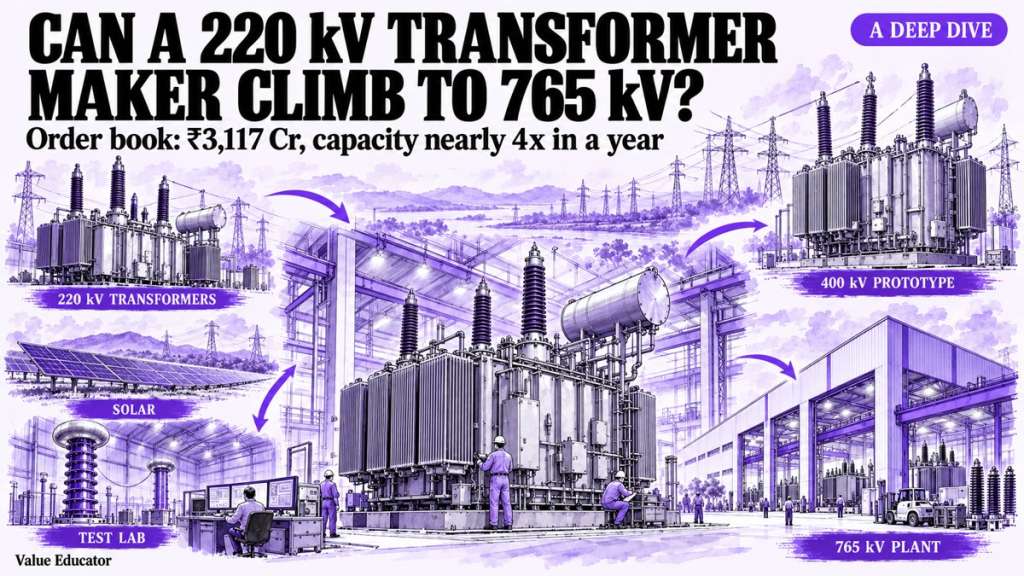
Atlanta Electricals: Capacity Nearly Quadrupled in a Year
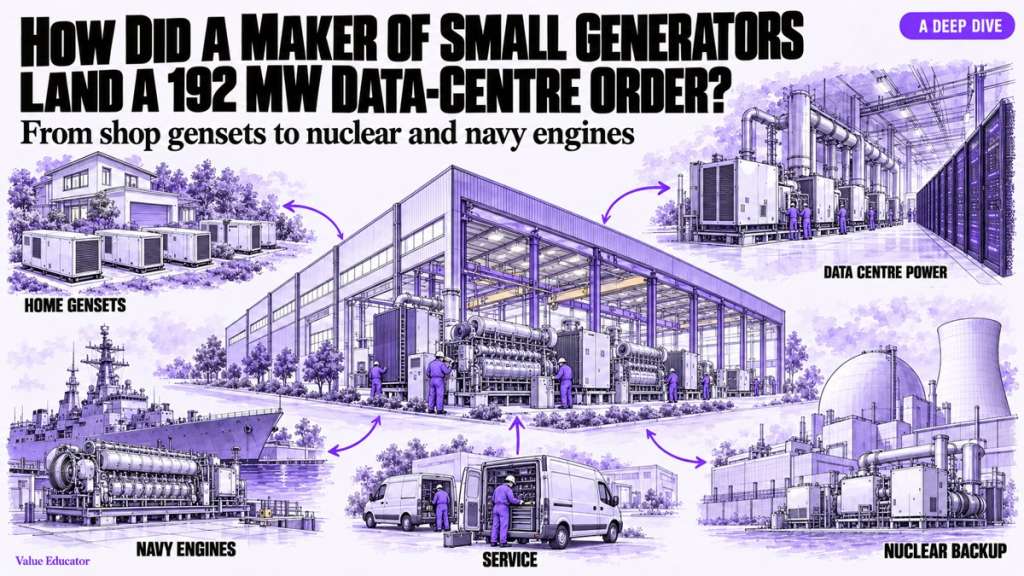
Kirloskar Oil Engines: Data Centres, Nuclear and the Navy
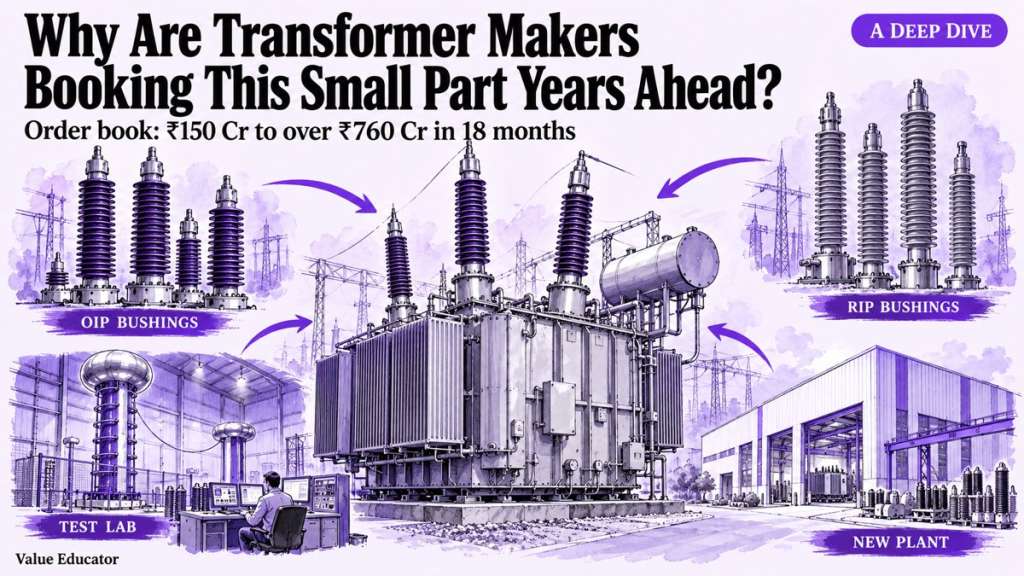
Yash Highvoltage: Bushing Maker With ₹760 Cr of Orders
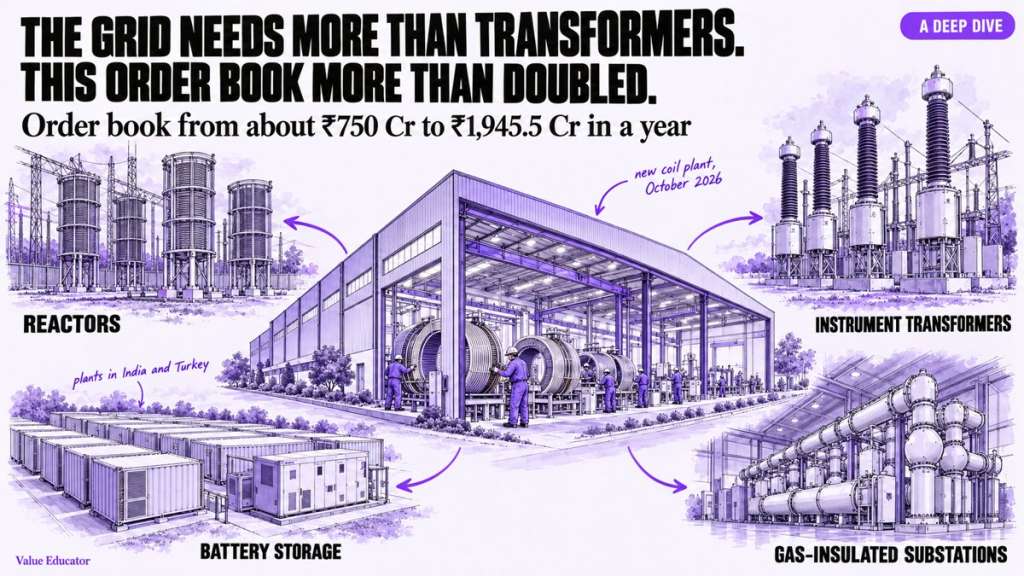
Quality Power: Reactor Maker With a ₹1,945.5 Cr Order Book
Azad Engineering: Turbine Blades, Jet Engines and Orders
Cyient DLM: Aircraft Electronics and a Record Order Book
Explore our Products
Research Framework
Emerging Titans
Combination of quantitative analysis, industry tailwinds, and management assessment - SPRINT investment philosophy
Tiny Titans
Heavy emphasis on scuttlebutt research, plant visits, and early on-ground signals



Modern Warfare to Multibaggers
Key Trends. Strategic Shifts. Opportunities Ahead.
Don't Miss This Exclusive Webinar!
Join Value Educator to decode the key trends shaping India's defence sector and learn how to identify tomorrow's potential leaders in the space.
- In-depth research on India's defence sector
- Live Q&A session
- Actionable takeaways for long-term investors

 Orders
 Subscription
 Share with friends


Required Details
₹23999.00
(12 month subscription)
As per SEBI regulations, all users are mandated to complete the KYC that is validated for 1 year. Post payment, you will be redirected to the KYC screen


No comments yet. Be the first to comment!