
INOX India: Cryogenics for the Energy Shift
It's two in the morning on a highway somewhere in India.
A massive LNG tanker is making its way through the darkness. From the outside, it looks like any other industrial truck. But inside that polished metal vessel is liquefied natural gas sitting at roughly minus 162 degrees Celsius. There is no room for ordinary engineering here, and tanks like this are a speciality of INOX India, a Gujarat-based cryogenic engineering company.
The tank has to keep the gas cold enough to remain liquid, protect it from the heat outside, survive thousands of kilometres on the road, and do all of this safely. Because if that temperature rises too much, the entire system starts behaving differently. And this is the strange world of cryogenics. The colder it gets, the harder the engineering becomes.
And yet, these systems quietly sit behind industries we rarely think about — moving LNG across countries, storing oxygen for hospitals, supplying gases to semiconductor factories, holding hydrogen, and even supporting some of the world's most advanced scientific experiments.
That is where INOX India comes in.
For decades, the company has been designing and manufacturing equipment built to handle some of the coldest environments created by industry.
And today, the interesting question isn't simply what INOX India makes.
It's how far this expertise can travel as the world invests in LNG, hydrogen, semiconductors, space technology, energy storage and advanced scientific research.
INOX India: Company Overview
INOX India was incorporated back in 1976 as Inox India Private Limited and has stayed headquartered in Vadodara, Gujarat ever since — you can still see the year embedded in its corporate identification number, which starts with L99999GJ1976. It listed on the NSE and BSE in late 2023, and the promoter family, led by Chairman Mr. Pavan Kumar Jain, has held onto roughly 75% of the company through FY25. The company's tagline — "Historically Futuristic" — actually captures the business fairly well. INOX India has been building cryogenic equipment since long before most of its current customers existed as an idea, and it now finds itself sitting, almost by accident of timing, at the intersection of several genuinely interesting industrial shifts: the move toward LNG as a transition fuel, the slow build-out of a hydrogen economy, the return of large-scale private space launches, and the growing appetite of semiconductor fabs for very specific, ultra-pure gas handling.Manufacturing runs out of Kalol and Savli, with a third facility under construction at Kandla, all in Gujarat, plus a smaller parts-and-service operation in Brazil and a stock-and-distribution point in the Netherlands for European customers. At Kalol, the company generates part of its own power through a 1.65 MW windmill and a 1 MW solar setup — a small detail, but a telling one for a business whose entire model depends on energy-hungry cooling.
"Someone's sitting in the shade today because someone planted a tree a long time ago."
— Warren Buffett
That line fits neatly with the newer, unproven parts of INOX India's story — the hydrogen bets, the CO₂ energy-storage tie-up, the data-center cooling research — none of which pay a single bill yet, but all of which management is clearly planting for a later harvest.
INOX India's Business Model
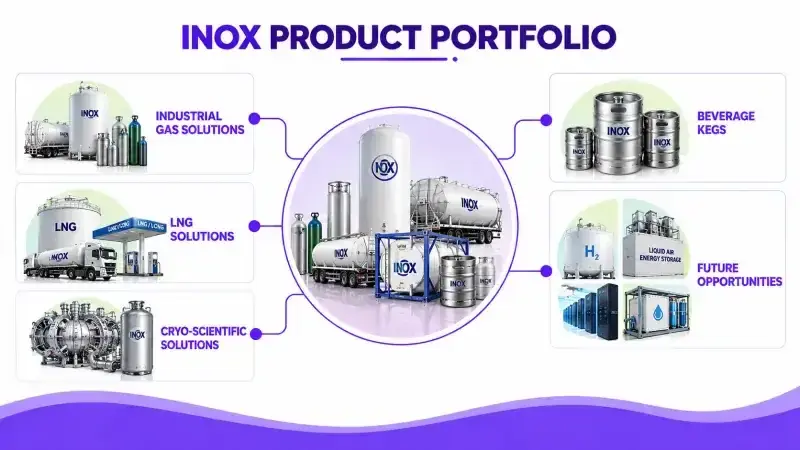
Four business lines sit under one roof here: Industrial Gas Solutions, LNG Solutions, the Cryo-Scientific Division, and a newer stainless-steel beverage keg business. The first three go back years; the keg business only launched in FY25, in partnership with Italy's Supermonte Group, and is still finding its footing.
Across all four, the commercial logic runs the same way. INOX India isn't really selling a standardized product off a shelf — it's engineering to spec, whether the customer is a dairy cooperative needing a semen-storage Dewar, a shipyard needing marine LNG tanks built to one vessel's exact dimensions, or a fusion research consortium in France needing cryostat panels refurbished to millimeter tolerances. And the mix has been shifting: standard, catalog-style products once dominated, but project-style work has taken over. Management noted on the Q4 FY26 call that project orders made up around 30% of the order book a few years back and now sit above 60%."Know what you own, and know why you own it."
— Peter Lynch
Worth sitting with that for a second, because INOX India isn't one business wearing four hats so much as four fairly different demand cycles — industrial gas capex, LNG infrastructure spending, scientific research budgets, and consumer packaging preferences — bundled together under one listed entity, each running on its own clock.
That makes understanding the underlying business economics especially important when evaluating a company with multiple segments and growth drivers. Segment-Wise Revenue Analysis: How to Find a Company's True Growth Engine
Value Chain
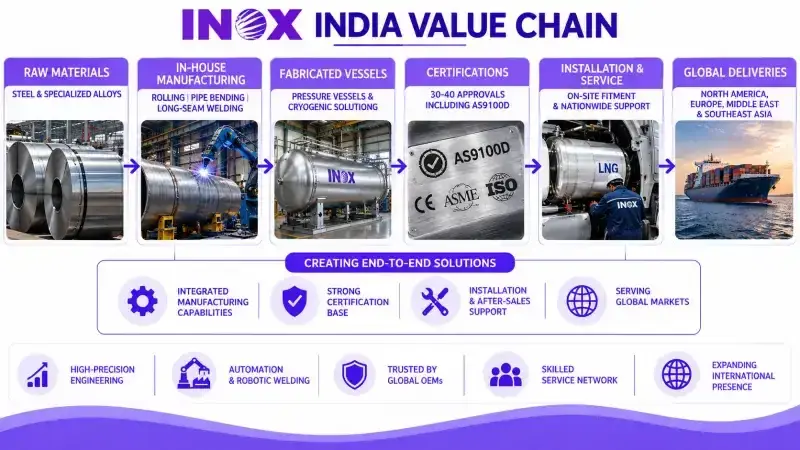
It starts with steel and specialized alloys, most of it shaped in-house through precision rolling, pipe bending, and long-seam welding — the company has been investing in automation here too, including robotic welding cells at Savli. From there, fabricated vessels pass through an unusually heavy layer of certification. The CEO mentioned on one call that INOX India holds somewhere between 30 and 40 separate approvals, spanning pressure-vessel codes and, more recently, the AS9100D aerospace quality certification secured in the June 2026 quarter — a certification that opens the door to onboard flight components rather than just ground support gear.After fabrication comes installation, and often ongoing service. The company has placed its own technicians on truck assembly lines to support LNG fuel-tank fitment, and it keeps service centers running across India's north, south, east and west. Export logistics form the last, and lately the most troublesome, link — a meaningful share of output travels by sea to North America, Europe, and increasingly the Middle East and Southeast Asia, which leaves the business more exposed to freight rates and ship availability than a purely domestic manufacturer would be.
Products and Services
Industrial Gas Solutions is the largest division and covers cryogenic storage tanks, transport tanks and semi-trailers, disposable and refillable gas cylinders, and the Cryoseal line of liquid cylinders — the same product family behind that early-morning insemination scene. It has recently branched into ultra-high-purity ammonia ISO tank containers for semiconductor and solar customers.
LNG Solutions spans static storage tanks, transport trailers, LNG and LCNG fueling stations, marine fuel-gas tanks, and modular mini-LNG terminals — practically the whole chain needed to move LNG from a terminal to whoever's using it, whether that's a truck, a ship, or a small island with no domestic gas grid.
The Cryo-Scientific Division serves a smaller but more prestigious set of customers. Work continues for ITER, the fusion project in France, and CERN recently joined as a customer for specialized cryogenic modules used in particle physics research. The division has also supplied a liquid-oxygen tank for a submarine-related defense application — the kind of order that doesn't come around often, but says something about the technical bar the company can clear.
The beverage keg business, still the smallest of the four, makes stainless-steel reusable kegs and has picked up approvals from Heineken, AB InBev, and Molson Coors — three breweries that together, per management, account for over 40% of global beer volumes.
And then there's a cluster of things that aren't really businesses yet, more like bets in progress: liquid hydrogen storage and transport, a tie-up with UK-based Highview Power on cryogenic tanks for liquid-air energy storage, early research into liquid-nitrogen cooling for data centers, and a partnership with Sweden's Wayout on modular water-purification units to be manufactured in India.
Growth Drivers
The clearest near-term driver is aerospace. A US-based private space company has placed orders across three straight quarters now — Q4 FY26, then Q1 and Q2 of FY27 — that management said, on the August 2026 call, now add up to more than ₹1,000 crore cumulatively, to be delivered by the end of FY28. Between that relationship and the new AS9100D certification, this looks like management's strongest near-term bet.LNG is the second lever, and arguably the more interesting one structurally. Segment revenue nearly doubled year-on-year — from ₹231 crore in FY25 to ₹457 crore in FY26, per the company's annual report — and the pipeline keeps widening rather than thinning out. An order from Cochin Shipyard for six 800-cubic-meter marine fuel tanks, worth around ₹85 crore according to management, marks the company's entry into marine LNG. Its mini-LNG terminal work, already delivered in Scotland and the Caribbean and now underway in the Bahamas, has generated follow-on orders from nearby islands like Eleuthera and Great Abaco.
Semiconductor exposure is smaller but growing. The company has supplied storage and transport equipment to Dholera-based projects for customers including Micron and Tata, and it's partnered with ITM SLS Baroda University to train workers in the specialized pipe-welding skills these fabs need — a shortage management described as a genuine industry-wide bottleneck, not one specific to INOX India.
Then there's the beverage keg business, which is really more a capacity story. Installed capacity sits at 300,000 kegs a year, expandable to 1 million without major machinery changes, management says. As of the May 2026 call, utilization was around a third of that, with FY26 sales of roughly 61,000 kegs against an order book for 65,000. By August, management was guiding toward 50–60% utilization by year-end, helped along by new approvals from Molson Coors and orders from ORBEN in Germany and Heineken in India. That's a big jump from a third to over half in a matter of months — and it's worth watching closely, because a keg business built on brewery trials that don't convert to standing orders would leave a lot of installed capacity sitting idle.
Finally, there's the capacity build-out underneath all of it. The Kandla facility, on a 30-year lease near Kandla Port, will let the company manufacture ultra-large tanks — up to 9 meters across, 60 meters long, 500 tons — that its existing plants simply can't handle. Management has guided to commissioning around December 2026 or January 2027. Savli, by contrast, already appears to be running at full production on both its cryogenic and keg lines, as of the August 2026 update.
For capital-intensive businesses like this, capacity expansion is only valuable if the additional assets ultimately translate into higher utilization, revenue and returns. Read this Capital-Intensive Businesses Explained: Risks, Economics, and Investor Insights
"The big money is not in the buying and selling, but in the waiting."
— Charlie Munger
That patience requirement threads through nearly every part of this order book. The Cochin Shipyard order stretches over two to three years. The private space company's orders run through FY28. ITER work, management says, continues for another seven or eight years. Growth here doesn't show up neatly every quarter — it arrives in lumps, on timelines set largely by other people's projects.
Order Book / Pipeline
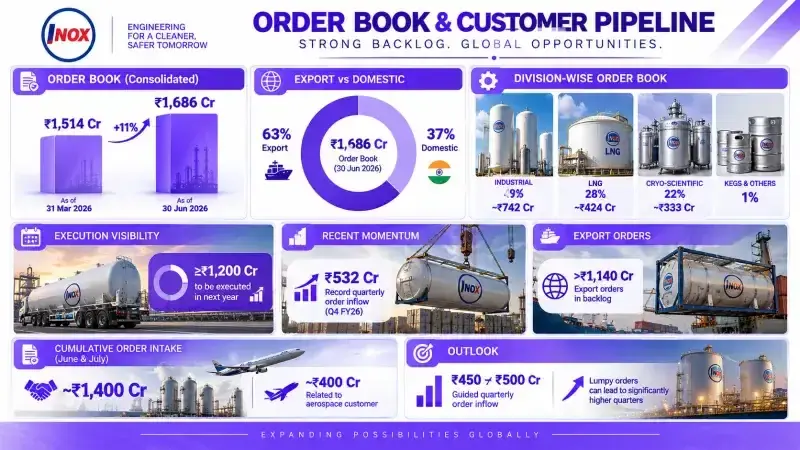
As of 31 March 2026, the consolidated order book stood at ₹1,514 crore, per management on the Q4 FY26 call — roughly 63% export, 37% domestic. The FY26 annual report splits that backlog by division: Industrial Gas around 49% (about ₹742 crore), LNG at 28% (around ₹424 crore), Cryo-Scientific at 22% (about ₹333 crore), with kegs and other smaller lines making up the last 1%. Management guided, on the same call, that at least ₹1,200 crore of that backlog would be executed within the coming year.Three months later, by 30 June 2026, the picture had shifted noticeably. The order book had climbed to ₹1,686 crore — the highest in company history, per management — on the back of what it called a record quarterly order inflow of roughly ₹532 crore. Export orders within that backlog exceeded ₹1,140 crore. On that same call, one analyst tallied cumulative order intake, including bookings disclosed in June and July, at around ₹1,400 crore, of which management indicated roughly ₹400 crore related to the aerospace customer — though it isn't entirely clear from the transcript whether this is fresh inflow or a restated view of backlog composition, so it's best treated as a rough directional figure rather than a precise reconciliation.
Management's stated guidance is for quarterly order inflow somewhere between ₹450 crore and ₹500 crore going forward, with the repeated caveat that lumpy orders — a big aerospace win, a mini-LNG terminal contract — can push any single quarter well past that baseline.
Financials
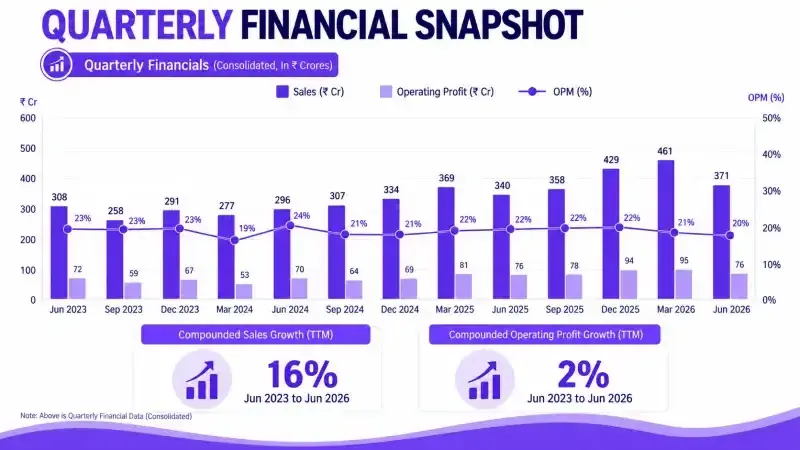
On a consolidated basis, per Screener, revenue grew from ₹966 crore in FY23 to ₹1,133 crore in FY24, ₹1,306 crore in FY25, and ₹1,587 crore in FY26 — a three-year compounded growth rate of roughly 18%, and 22% over five years. That FY26 number sits a bit below the ₹1,632 crore "total income" figure management cited on the concall for the same year; the gap likely comes down to other income and presentation differences between Screener's sales line and the company's own total-income reporting, though it's worth noting rather than treating the two as interchangeable.Operating margin has stayed in a fairly narrow band — 21% to 23% from FY22 through FY25, 22% in FY26 per Screener — broadly matching management's own guided range of 21% to 24% and its reported adjusted EBITDA margin of 23.8% for FY26. Net profit for FY26 came to ₹258 crore per Screener, close to management's cited adjusted PAT of ₹261 crore, with return on equity at 26% for the year and averaging around 29% across both the three- and five-year windows.
The quarterly numbers are a bit messier. Q1 FY27 revenue (quarter ended 30 June 2026) came in at ₹371 crore, up 8.3% year-on-year — well short of the 18–20% full-year growth management keeps guiding toward. Management pinned most of the shortfall on logistics: roughly ₹32–35 crore of equipment sat ready for dispatch but couldn't ship, thanks to a spike in freight rates — sending a container to Europe, management said, had jumped from around $3,000–4,000 to $8,000–9,000 during July 2026 — plus limited ship availability, especially toward the Middle East. Operating margin for the quarter came in at 20% on Screener's numbers, a touch below both the FY26 average and management's guided range, though management continues to describe this as normal quarter-to-quarter variation driven by product mix.
Here's the part worth dwelling on a little longer: operating cash flow hasn't kept pace with reported profit. FY23 saw cash flow from operations of ₹177 crore against a PAT of ₹155 crore — comfortably ahead. By FY26, operating cash flow had actually fallen to ₹117 crore even as PAT climbed to ₹258 crore, less than half the conversion ratio. Management's own explanation, given directly in response to an analyst's question on the Q4 FY26 call, comes down to working capital. As project-style orders have risen from around 30% to over 60% of the order book, revenue recognized under the percentage-of-completion method increasingly runs ahead of cash actually collected, since collections follow milestone-based payment terms — 10%, 30%, 50%, 70%, 90%, and final — rather than the pace of physical production. Working capital rose from ₹731 crore in FY25 to ₹990 crore in FY26 as a result, per management, though customer advances of around ₹500 crore offer some offset, and management has described inventory and vendor payments as well under control.
When an analyst pressed on whether this would normalize as order mix diversified, management's answer was fairly candid: as long as the project-order share keeps rising, operating cash flow growth is likely to stay muted relative to profit growth, not catch up to it.
"The stock market is filled with individuals who know the price of everything, but the value of nothing."
— Philip Fisher
Fitting, here — a rising PAT number alone doesn't tell you whether that profit is showing up as cash in the bank, and in this case, over three years, it increasingly hasn't.
This is exactly why investors should look beyond reported earnings and examine whether accounting profits are actually converting into cash. Read this Cash Flow Statement Explained: The Most Honest Financial Report
On the balance sheet, total assets grew from ₹1,223 crore in FY24 to ₹2,012 crore in FY26 (Screener), funded mostly through retained reserves (₹1,099 crore by FY26) rather than debt — borrowings sat at just ₹81 crore. Total fund availability stood at ₹257 crore as of 31 March 2026 and had risen to ₹331 crore by 30 June 2026, per management, which should comfortably cover near-term capex needs. FY26 consolidated capex came to ₹100.16 crore (₹47.38 crore domestic, ₹52.77 crore overseas), down from ₹129.11 crore the year before — and notably, the annual report doesn't lay out an explicit rupee figure for FY27 capex, framing future spending instead around the Kandla and Savli expansions and continued automation.
Key Risks
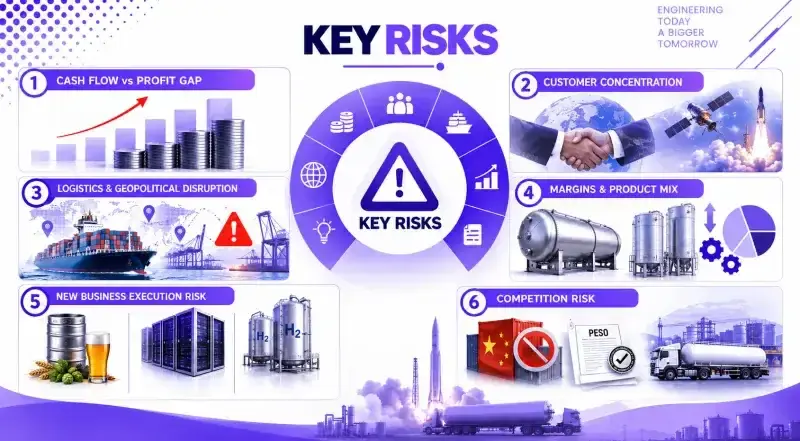
The cash-flow-versus-profit gap above is the most quantifiable risk in the numbers, and management itself has suggested it's likely to persist rather than reverse as project-based orders keep growing as a share of the mix.Customer concentration deserves attention too. The FY26 annual report discloses that the top ten customers accounted for 51% of revenue, and a single US-based private space customer now represents a cumulative order value north of ₹1,000 crore — a sizable chunk of the current backlog resting on one relationship, in an industry where launch schedules, funding rounds, and program priorities can shift fast.
Logistics and geopolitical disruption showed up directly in the Q1 FY27 numbers, in delayed dispatches and sharply higher freight costs, and management has pointed to the West Asian conflict as an ongoing source of uncertainty for shipping routes and energy prices more broadly. Whether this proves temporary, as management suggests, or a more lasting drag on execution timing, isn't something the data can settle yet.
Margins, while guided within a 21–24% band, have shown some quarter-to-quarter movement tied to product mix — standard versus non-standard tanks carry different economics, and management has admitted this mix isn't fully within its control, since it depends on what customers happen to be ordering at any given time.
One useful way to put this margin discussion into perspective is to compare operating profitability with what ultimately reaches the bottom line. Read this Operating Profit Margin vs Net Profit Margin: Which Tells the True Story?
The newer growth avenues carry their own, harder-to-quantify risk. Management has described the beverage keg business, in its own words, as "a little dicey," reflecting a history of slow conversion from brewery trials to standing orders. The data-center cooling initiative remains early-stage R&D, with commercialization pegged by management at one to one-and-a-half years out and no confirmed commercial order yet. The Highview Power relationship similarly depends on a first project in Manchester getting successfully commissioned before any larger follow-on materializes — management floated a potential scale-up of 8 to 10 times the current order size, but that's management's expectation, not a signed contract.
On competition, management has expressed confidence that India's PESO regulatory regime shields the company from Chinese LNG tank imports, given the customization and servicing these tanks require — a reasonable argument, though one resting on that regulatory barrier holding up over time.
"You can't predict. You can prepare."
— Howard Marks
A lot of what INOX India is doing right now — the Kandla capacity, the aerospace certification, the hydrogen and energy-storage groundwork — reads less like a bet on any single outcome and more like an attempt to be ready for several of them at once.
Explore our Products
Research Framework

Emerging Titans
Combination of quantitative analysis, industry tailwinds, and management assessment - SPRINT investment philosophy

Tiny Titans
Heavy emphasis on scuttlebutt research, plant visits, and early on-ground signals
Conclusion
There's a straightforward version of this story: a fifty-year-old cryogenic engineering business, still run by the family that's controlled it since long before it went public, riding a genuinely favorable set of structural tailwinds — LNG adoption, an early-stage hydrogen economy, a private space industry expanding its launch cadence, and semiconductor fabs needing gas-handling equipment almost nobody else in India quite makes. Read that way, the order book tells most of the story: it's grown, it's increasingly export-facing, and it's now anchored by a handful of large, multi-year relationships giving the company more revenue visibility than it's had in years.But there's a second, more cautious thread running underneath, and it's mostly about the distance between what shows up in the order book and what shows up in the bank account. As the company has taken on more large, milestone-billed project work, operating cash flow has fallen even as reported profit keeps climbing — not because anything's gone wrong exactly, but because that's simply how project accounting behaves when the mix shifts this fast. Management has said, plainly, that this gap is likely to stick around rather than close on its own, and that's a reasonable thing for anyone following the company to hold onto rather than wave away.
Then there's a third layer, really about optionality more than certainty. The hydrogen work, the CO₂ battery and liquid-air storage tie-up, the data-center cooling research, the water microfactories — none of these are revenue lines yet, and management has been fairly upfront that most sit somewhere between early R&D and under trial. In time, one or more could become the next LNG-sized growth engine. Or they could stay interesting footnotes in an annual report, the way plenty of corporate R&D eventually does. What the next several quarters will likely clarify isn't really whether the core cryogenics business keeps growing — the order book suggests it probably will — but whether cash conversion stabilizes as Kandla and Savli capacity comes fully online, whether the keg business actually reaches the utilization levels management's now guiding toward, and whether any of these newer bets start turning into orders instead of just partnerships.
For investors trying to distinguish genuine long-term compounders from companies simply benefiting from a temporary growth narrative, a structured fundamental research process can help. Read this A Fundamental Checklist: How to Research a Stock in 1 Hour
FAQs
What does INOX India do?
+INOX India is a cryogenic engineering company that designs and manufactures equipment for storing, transporting, and handling extremely cold gases and liquids. Its businesses span Industrial Gas Solutions, LNG Solutions, Cryo-Scientific equipment, and stainless-steel beverage kegs.
What are the key growth drivers for INOX India?
+The company's key growth opportunities include aerospace, LNG infrastructure, semiconductor manufacturing, and the emerging hydrogen economy. Aerospace has emerged as a particularly significant opportunity, with a US-based private space company placing cumulative orders worth more than ₹1,000 crore, according to management.
What is INOX India's current order book?
+INOX India's consolidated order book stood at ₹1,686 crore, its highest reported level at the time. More than ₹1,140 crore of this backlog was from exports, while management indicated that quarterly order inflow could generally remain around ₹450–500 crore, with individual quarters potentially being higher because of large project wins.
What are the major risks for INOX India?
+Key risks include weak cash conversion, high customer concentration, logistics and freight-cost volatility, fluctuations in product mix and execution delays. In FY26, operating cash flow was ₹117 crore against PAT of ₹258 crore, while the top ten customers accounted for 51% of revenue.
What new businesses is INOX India exploring?
+Beyond its established cryogenic businesses, INOX India is exploring liquid hydrogen storage and transportation, cryogenic tanks for liquid-air energy storage through its Highview Power relationship, liquid-nitrogen cooling for data centres, and modular water-purification systems through its partnership with Wayout. These initiatives are still at different stages of development and are not yet established revenue drivers.

High growth stock specialist, Value Educator
Shashank Mahajan is an equity research professional with over 12 years of experience in identifying high-potential SME and micro-cap stocks at an early stage. He follows a rigorous scuttlebutt research–driven approach, combining on-ground insights with deep financial analysis. Shashank specializes in uncovering under-researched and under-owned companies with strong management quality and long-term growth potential. Through disciplined research and early identification, he focuses on spotting tomorrow’s market leaders before they enter the mainstream investor radar.

Zen Technologies: Why Revenue Fell After Its Biggest Win

Data Patterns: India's Radar Designer and Its Waiting Orders
KSH International: The Wire Inside India's Transformers

Krishna Defence: The Steel Behind India's Warship Hulls

PNG Jewellers: A 194-Year-Old Name Goes National
Axiscades: From Services to Missile and Radar Electronics
Explore our Products
Research Framework
Emerging Titans
Combination of quantitative analysis, industry tailwinds, and management assessment - SPRINT investment philosophy
Tiny Titans
Heavy emphasis on scuttlebutt research, plant visits, and early on-ground signals


 Orders
 Subscription
 Share with friends
 Logout


Required Details
₹23999.00
(12 month subscription)
As per SEBI regulations, all users are mandated to complete the KYC that is validated for 1 year. Post payment, you will be redirected to the KYC screen


No comments yet. Be the first to comment!