
Atlanta Electricals: Riding the Grid Cycle

Think about your usual morning for a second. You wake up, charge your phone, switch on the lights, turn on the fan, open your laptop, and maybe take the metro to work. Electricity is there in almost everything you do, but most of the time, you don’t even notice it.
Unless it goes off.
That is usually the only time we stop and think about power. But there is one basic question we rarely ask: how does electricity actually travel from a power plant, a solar park, or a wind farm to our homes, offices, factories, railway stations, or data centers?

The answer is not as simple as “wires.”
Behind every working switch, every running machine, every charging device, and every growing city, there is a large power network quietly doing its job. And inside that network, there is one machine that may look boring from the outside, but is absolutely critical to India’s power story.
Transformers.
Not the small transformers we often see on electricity poles near residential colonies. I am talking about the real industrial giants — large machines that sit inside substations, weigh several tons, and help electricity move safely and efficiently over long distances.
Every time India builds a solar park, expands a transmission line, strengthens a power grid, lectrifies a railway route, sets up a data center, or modernizes distribution infrastructure, transformers sit at the center of that system. Without them, electricity cannot properly travel from the place where it is generated to the place where it is finally consumed and this is where one company starts becoming interesting.
For years, it operated in a specialized corner of India’s electrical equipment market. It was not a glamour stock. It was not part of a sector that ordinary investors discussed every day.
But while the market was looking elsewhere, the company was quietly expanding capacity, moving into higher-voltage products, strengthening its balance sheet, improving its product mix, and preparing itself for a much larger opportunity.
That company is Atlanta Electricals Ltd.
But before understanding why Atlanta Electricals deserves attention, we need to understand the bigger changes happening in India.
Because this is not just a story about one transformer manufacturer.
This is a story about India’s power backbone being rebuilt.
India Is Rebuilding the System That Carries Electricity
The first thought that investors have when considering power demand is typically very straightforward. There will be increased demand for electricity if there are more factories. There will be a greater demand for electricity in more homes. The demand for power will only rise with more ACs, EVs, Railways, data centers, and industries in India.
That's easy to understand.
But there is another story which is not mentioned enough. The production of electricity is just a first step. The actual challenge is ensuring that electricity can be conveyed from its source to its end-use.
Imagine one of the solar power plants in Rajasthan. Where it's capable of reaching industries, cities, railway networks, data centers and distribution companies it can be useful in making power. As is the case with a wind project in Gujarat. The project can only be important if the grid can take the power and transfer it efficiently. It is also impossible to rely on power being created somewhere distant for a data center to operate. It requires constant and dependable power to its own site. Railway electrification is also based on solid related power facilities.
Hence, the role of transmission/distribution infrastructure becomes crucial.
India is not just increasing the power generating capacity. It is also increasing the country's power distribution network. To grasp this concept simply consider the power network as a highway network. Bridges, flyovers, tunnels, signals, and tolls are all vital to the proper functioning of roads. Similarly, electricity networks require transformers, substations, conductors, towers and control systems.
The transformers are one of the most significant components of this system. If electricity is needed to travel long distances, the electricity is stepped up. If it needs to be used safely in a home, a factory, an office, a railway or a data center, the voltage is stepped down by transformers. They are responsible for interconnection of electricity generation with transmission, transmission with distribution, and renewable energy with distribution.
To put it in simple terms, transformers operate similar to a pressure regulator in the electric power system. They are essential for the proper movement of electricity.
Because of this, the transformer industry is gaining significance. It has nothing to do with the short term excitement in the market. It is a true need because of the expanding and evolving power grid in India.
To understand the broader sector tailwinds behind this trend, you can also read: Why Power Sector Stocks are Booming – Data & Trend Analysis.
Why the Transformer Industry Is Entering a Strong Cycle
A business usually becomes worth studying when demand is not just a story, but is backed by real spending. That is what seems to be happening in the transformer industry today. The sector is not depending on one single trigger. It is getting support from several demand drivers at the same time.
The first and most visible driver is India’s investment in transmission infrastructure. As renewable energy grows, electricity has to move from states where power is generated to regions where power is actually consumed. Solar and wind projects are not always located close to large cities or industrial clusters. A solar park in one state may need to supply power to consumers hundreds of kilometers away. That creates the need for long-distance transmission lines, substations, and high-capacity transformers.
At the same time, India is also developing its distribution network. Power losses, ageing infrastructure, and weak distribution systems have been long-standing problems in the country. As these networks are improved, demand is created for transformers and related electrical equipment.
Renewable energy is also changing the type of transformers required. Solar and wind projects need specific transformer solutions, including inverter duty transformers and higher-capacity units that can handle variable power flows. Railways add another layer of demand as electrification and network upgrades continue. Data centers are also becoming a new power-heavy segment, because they need reliable electricity and strong power infrastructure to operate smoothly.
This is why the cycle looks interesting. When an industry gets one tailwind, it can grow. But when several tailwinds arrive together, the cycle can last much longer.
That is what makes the transformer space worth studying.
Charlie Munger once said, “The big money is not in the buying and the selling, but in the waiting.”
But there is one important point investors should remember: not every transformer company will benefit equally.
Not Every Transformer Company Is Equal
Transformers may appear to be a standard commodity product at a first glance. How is it that a transformer is a transformer, right?
Not exactly.
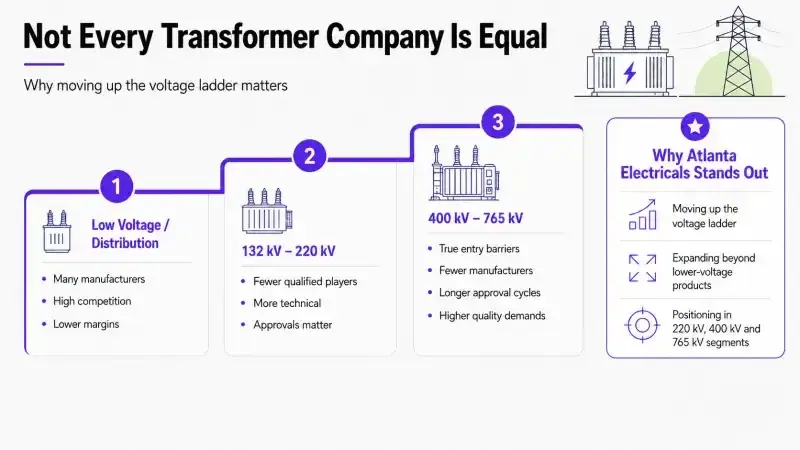
There are strata of the industry. The smaller transformers that are used in distribution and at low voltage are at the bottom. There are several companies that can produce these. The competition is more intense, margins tend to be smaller, and there are restrictions on entry.
The middle level is made up of 132 kV and 220 kV transformers. This is the fewest number of companies that qualify. The product is more technical, customers are more selective, approval is more of a factor, and track record of execution is more important.
Next, the high-voltage and extra-high-voltage area such as 400kV and 765kV transformers. It's in this part that the true entry barriers start. The more critical the infrastructure needed for testing, the more important the quality, reliability and execution, the longer the customer approval cycle and the fewer the manufacturers.
That's why it's so important to move up the voltage ladder. One company that produces only lower voltage transformers is facing competition in a saturated market. This company is playing in a ball park that is much more specialized: it can make 220 kV, 400 kV, and 765 kV transformers.
That's the concept behind Atlanta Electricals. It's not only about capacity growth. It is attempting to move up the voltage ladder.
What Atlanta Electricals Actually Does
Atlanta Electricals has been making transformers in Gujarat for over thirty years. The company builds large industrial transformers that go into power grids, renewable energy projects, railways, steel plants, industrial units, and other infrastructure setups across the country.
Their product lineup covers Power transformers, Autotransformers, Inverter duty transformers, Furnace transformers, Generator transformers, and Special duty transformers. Each one is built for a different job, but they all belong to the same world — electrical infrastructure.
Power transformers are the heart of the business and go into transmission and distribution networks. Autotransformers handle voltage adjustments inside grid networks and railway systems. Inverter duty transformers are built for solar and wind projects, where power output tends to fluctuate. Furnace transformers go into steel mills and heavy industrial setups that draw enormous amounts of power. Generator transformers sit close to generation sources and step voltage up for transmission. Special duty transformers are built to order for specific industrial or technical needs.
Atlanta is not selling to retail consumers. It is selling essential electrical equipment to infrastructure buyers. That distinction matters because the company's performance is tied directly to India's long-term spending on power, renewable energy, railways, and industrial infrastructure.
To get a feel for where Atlanta fits, think of India's electricity system as one long chain. Power gets generated at one end — through thermal plants, solar farms, wind installations, hydro projects, or other sources. Once generated, that electricity has to be pushed up to a much higher voltage so it can travel long distances without losing too much energy along the way. It flows through transmission lines, reaches substations, gets stepped back down, and finally reaches factories, cities, railways, data centers, and homes.
Atlanta operates inside the equipment manufacturing part of that chain. It does not produce electricity. It does not run distribution networks. It does not construct transmission lines. What it does is supply one of the most important pieces of hardware that makes the whole chain function.
That is what makes Atlanta a picks-and-shovels bet on India's power infrastructure. Whenever renewable energy expands, grid capacity grows, high-voltage transmission gets built out, industries electrify, or data centers and storage projects come up — Atlanta stands to gain from all of it.
That is what makes the business genuinely interesting. It is not riding a single narrow theme. It is positioned inside several things that India is prioritizing at the same time.
From Capacity Constraint to Capacity Expansion
For any manufacturing company, growth depends on two things: demand and capacity. If demand is strong but capacity is limited, revenue cannot grow beyond a point.
This is also why investors should understand how capital-heavy businesses work before judging capacity expansion stories: Capital-Intensive Businesses Explained: Risks, Economics, and Investor Insights.
This was one of the key issues for many transformer companies. Legacy plants were running at high utilization. Demand was visible, but manufacturing capacity had to catch up. Atlanta has addressed this aggressively.
Over the last 18 months, the company expanded its manufacturing capacity from around 16,000 MVA to around 63,000 MVA. That is almost a four fold increase. This is not a small expansion. It changes the size of orders the company can execute, the type of customers it can serve, the voltage classes it can participate in, and the revenue potential of the business.
The company now operates five manufacturing facilities, including legacy units and newer facilities such as Vadod and Ankhi Unit, acquired via the BTW–Atlanta Transformers Private Limited. The Vadod facility is especially important because it is designed for larger transformers and higher-voltage products. It gives Atlanta the ability to participate in 400 kV class opportunities. The Atlanta unit gives the company capability in the 400 kV and 765 kV class, pushing it deeper into the extra-high-voltage segment.
This is where the story becomes more serious. A company expanding capacity in a weak market can struggle. But a company expanding capacity just when demand is rising can see operating leverage. That is exactly what started showing up in FY26.
FY26: The Year the Expansion Started Showing in Numbers
For Atlanta Electricals, FY26 was an excellent year. The company has delivered strong growth across revenue, EBITDA, and profit.
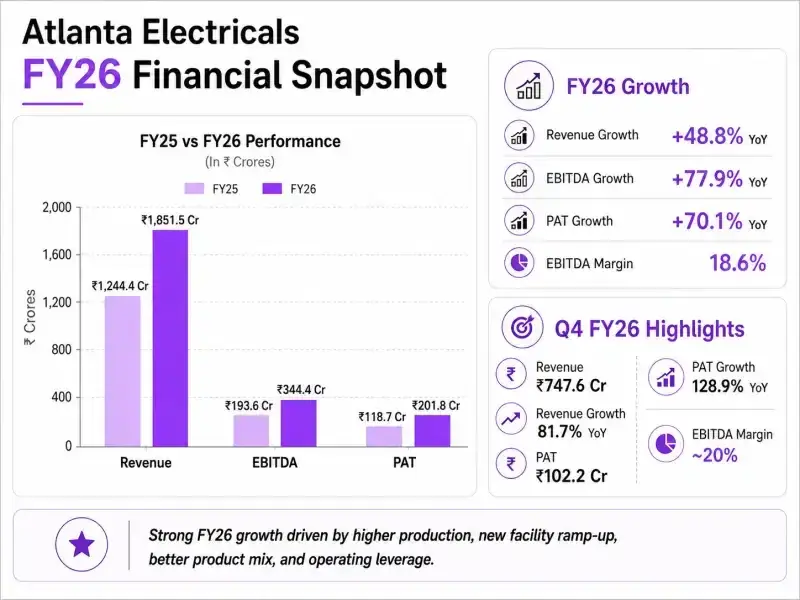
Revenue from operations for FY26 stood at around ₹1,851.5 crore, growing nearly 49% year-on-year basis. EBITDA stood at around ₹344.4 crore, growing nearly 78% year-on-year. EBITDA margin expanded to around 18.6%. Profit after tax stood at around ₹201.8 crore, growing around 70% year-on-year.
This is important because the growth was not only in sales. Margins have also improved. That usually happens when higher volumes, better product mix, and operating leverage come together.
In Atlanta’s case, the company benefited from higher production, ramp-up of new facilities, stronger contribution from higher-voltage products, and better procurement efficiency. Q4 FY26 was particularly strong, with revenue at around ₹747.6 crore, year-on-year growth of more than 80%, EBITDA margin almost touching 20%, and PAT more than doubling year-on-year.
This tells us that the company exited FY26 with strong momentum. But one good year is not enough. The more important question is whether the company has visibility for future revenue. That is where the order book matters.
The Order Book: Proof That Demand Is Real
In small and mid-cap investing, stories are easy to create. Management can talk about opportunity. Presentations can talk about market size. Analysts can talk about themes. But the real question is simple: Are customers placing orders?
That is why order books matter.
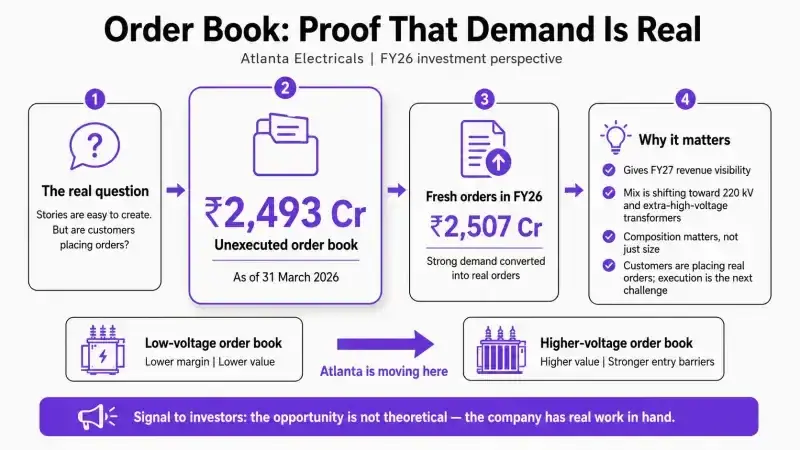
Atlanta’s unexecuted order book stood at around ₹2,493 crore as of 31 March 2026. This gives the company meaningful revenue visibility going into FY27. Even more importantly, the quality of the order book appears to be improving.
The company has indicated that the mix is moving toward 220 kV and extra-high-voltage transformers. This matters because higher-voltage products typically carry better technical positioning and stronger entry barriers.
Order book growth is not just about size. It is about composition. A ₹2,000 crore order book in low-margin, low-voltage products is very different from a ₹2,000 crore order book that includes higher-voltage, higher-value products. Atlanta is trying to move toward the second category. That is the key.
For investors, this order book gives an important signal. It shows that the sector opportunity is not just theoretical. Customers are placing real orders. The company has work in hand. The next challenge is execution.
This is also why earnings visibility matters so much in power-sector investing; for a broader comparison, read: Top Power Sector Stocks with Strong Earnings Visibility.
The Vadod Facility: Why It Matters
Vadod is one of the most significant developments in the development of Atlanta. This plant was a considerable investment of the company and is now starting to pay back well from FY26.
The size of Vadod is not what makes them important. It is the products that it can produce. Plant for higher capacity and higher voltage transformers, including 400 kV class transformers.
Approvals are important in the transformer business. High voltage orders are not placed at the customer's whim – particularly utilities and government-related customers. They must have proven manufacturing capability, testing infrastructure, quality systems, and qualification approvals. Now, if a plant is approved for a higher voltage class, then the addressable market grows.
Atlanta also landed its first 400kV orders for FY26. It's a symbolic significance as it indicates that the company is not merely promoting a higher voltage, but is in fact achieving it. It's starting to turn that capability into orders.
The company has also adopted a conservative stance. It also does not want to place too many 400 kV orders up front, but instead wants to build, test and validate the initial prototype before entering into scaling. It might seem slow at the beginning, but in high voltage transformers discipline has its advantages. If there's one product that goes wrong, it can mean the end of the reputation. There is one product which is proven that can open doors.
Atlanta Trafo and the 765 kV Opportunity
Vadod is important to the 400 kV opportunity and Atlanta Trafo is important to the 765 kV opportunity.
Atlanta Trafo was incorporated when the company acquired BTW-Atlanta Transformers India Private Limited (now renamed Atlanta Trafo Private Limited). This facility provides extra-high-voltage capabilities such as 400kV and 765kV transformers for the city of Atlanta.
The 765 kV segment is significant as the transmission network in India is shifting towards higher voltage lines with the growth of renewable energy and the demand for electricity to be transported over greater distances. The longer the distance, the more efficient and less losses to achieve the higher voltage, but the higher voltage requires more advanced equipment.
There are only a few approved manufacturers in this segment. That is where companies with the right stuff to do it and do it well, have an opportunity. Atlanta Trafo provides Atlanta with a way to play in this more upscale market.
This is the reason for the expansion of the company to be more than just a capacity expansion. It is an increased ability, a growth. Capacity can make a company make more. With the help of Capability, it has the ability to produce better and more specialized products. Atlanta is attempting to do both.
Why Higher Voltage Can Change the Business
The concept of “moving up the voltage ladder” is more of a technical term, but the business logic is the same.
The competition is greater at lower voltage levels. The competition decreases as the voltage increases. When it comes to customers, they are more selective. Qualification cycles get longer. Testing gets its importance. The risk of execution increases. However, fewer players can play and so margins can be better too.
This is what is common across a lot of manufacturing industries. There are numerous competitors for a company producing basic components. If the company is producing something that has been proven technically and is very special in nature, then there will be less competition for that company.
That is why Atlanta is in the process of moving towards 220kV, 400kV and 765kV is important. It enhances the company's strategic positioning. It could help to enhance order quality. May help with margins. It can help to build stronger customer relationships. This could also help to diminish direct competition from lesser competitors.
It also puts more execution responsibility on the shoulders of course. The higher voltage transformers are not simple products. They have to be extremely well engineered, well controlled, tested and reliable after-sales. The upside does have meaning but the bar for the execution is higher.
The Renewable Energy Link
Renewable energy is one of the strongest demand drivers for transformer companies. India is adding solar and wind capacity at scale. But renewable energy creates a unique challenge.
Solar power is generated when the sun shines. Wind power depends on wind conditions. Generation may happen far away from consumption centers. This creates the need for evacuation infrastructure, substations, pooling stations, transmission lines, and transformers.
A solar park is not just panels. It needs electrical infrastructure. A wind project is not just turbines. It needs grid connectivity. This is where transformer companies participate.
Atlanta’s inverter duty transformers are used in renewable projects. These transformers are designed to handle conditions that ordinary transformers may not manage as efficiently. As India’s renewable capacity grows, this segment can remain important.
But renewable energy also brings competition. Many companies want to supply this sector. So the key is not just being present in renewables. The key is having approvals, scale, execution capability, and cost competitiveness. Atlanta appears to be building these advantages through capacity expansion and higher-voltage capability.
Data Centers and Battery Storage: Future Optionality
Power equipment is turning into a demand pocket for data centers. A data center consists of a lot of servers. However, behind those servers is a tremendous amount of power use.
Electric power supply, backups, cooling, and good electrical equipment is critical in data centers. This puts a demand for transformers and related equipment. While it may not be a big revenue earner for Atlanta in the short term, it could be significant in the long run as India's digital infrastructure grows.
Another emerging opportunity is battery energy storage systems. With the rise of renewable energy, storage is becoming a crucial component of the puzzle as solar and wind power are not necessarily on demand when it is needed most. Battery storage is used as a grid balancing tool.
These systems will need some custom transformer solutions due to the charging/discharging bidirectional flow of power. This is still a nascent theme in India, but nascent themes can grow into a big theme if backed by policy, renewable capacity, and grid requirements.
Today, it's not all about data centers and batteries for Atlanta. The core is still transformers for grid, transmission, renewables and industrial. These new segments, however, provide options for the future.
Raw Materials: The Invisible Risk
Transformer companies do not operate in a vacuum. Their margins are affected by raw materials.
The major raw materials include copper, CRGO steel, transformer oil, insulation material, tap changers, bushings, tanks, and radiators. Copper is used in windings. CRGO steel is used in transformer cores. Transformer oil is used for cooling and insulation. Specialized components are needed for higher-voltage products.
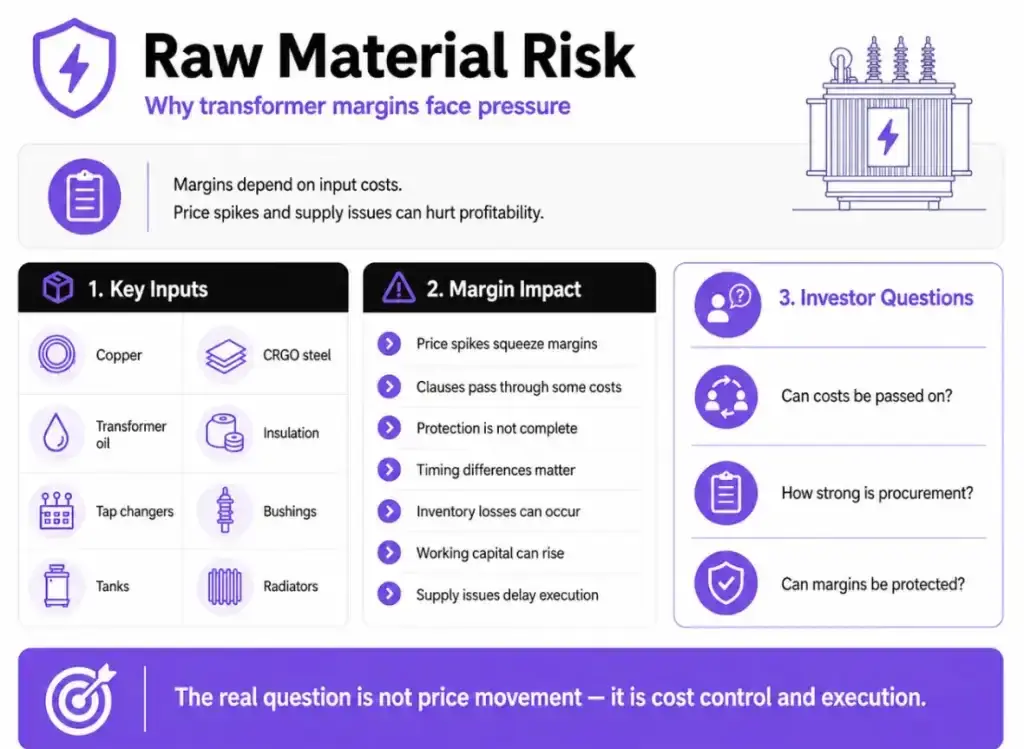
When copper or steel prices rise sharply, transformer companies can face margin pressure. Many contracts include price variation clauses, which allow cost increases to be passed on to customers. This reduces risk, but it does not eliminate risk completely.
There can be timing differences. There can be inventory losses. There can be short-term working capital pressure. There can be supply disruptions.
A company can have strong demand and still face margin pressure if input costs move against them. So the key question is not whether raw material prices move. They always do. The key question is whether the company can pass them on, manage procurement well, and avoid execution delays.
This is one risk investors should never ignore in transformer companies.
“Risk is an indispensable aspect of investing; it must be controlled but can’t be eliminated.” — Howard Marks.
Backward Integration: A Quiet but Important Lever
Backward integration is also happening in Atlanta. This sounds dull but it is crucial.
Tanks and Radiators are important parts in the manufacturing of a transformer. They impact quality, delivery time, corrosion and supply chain control. However, if a business is overly reliant on external suppliers for critical parts, this can lead to delays, quality issues, or price pressures.
Atlanta can increase control in their supply chain by establishing tank and radiator production. This can decrease reliance on external vendors, ensure quality consistency, meet export needs and help margins in the long-term.
Not all backward integration is necessarily good. It requires investment, implementation and application. In Atlanta, however, the line seems to be going hand in hand with the company's upswing in size and voltage of transformers. The more complex the product, the more critical the control of components will become.
That is why backward integration can actually be a beneficial part of the company.
Balance Sheet: Debt Repayment Strengthens the Story
In manufacturing, growth funded by too much debt can become dangerous. Capacity expansion requires capital. Working capital requirements can rise. Raw material prices can fluctuate. Customer payments may take time.
If a company is heavily indebted during this phase, even strong demand can become stressful. Atlanta’s balance sheet improved meaningfully in FY26. The company repaid all long-term debt by 31 March 2026.
This is important because a debt-light balance sheet gives the company flexibility. It reduces finance costs, improves resilience, gives more room to fund CAPEX through internal accruals, and allows the company to handle working capital needs more comfortably.
This does not mean the business has no risk. Transformer manufacturing still requires working capital. Orders need raw materials. Inventory needs to be managed. Receivables need monitoring. Bank guarantees and non-fund-based limits matter. But debt repayment reduces one major risk.
In small and mid-cap investing, balance sheet strength can be the difference between surviving a cycle and suffering through it. Atlanta’s improved balance sheet is a clear positive.
Margins: Can the Improvement Sustain?
Atlanta’s EBITDA margin expanded in FY26. This was driven by higher volumes, operating leverage, improved product mix, and procurement efficiency.
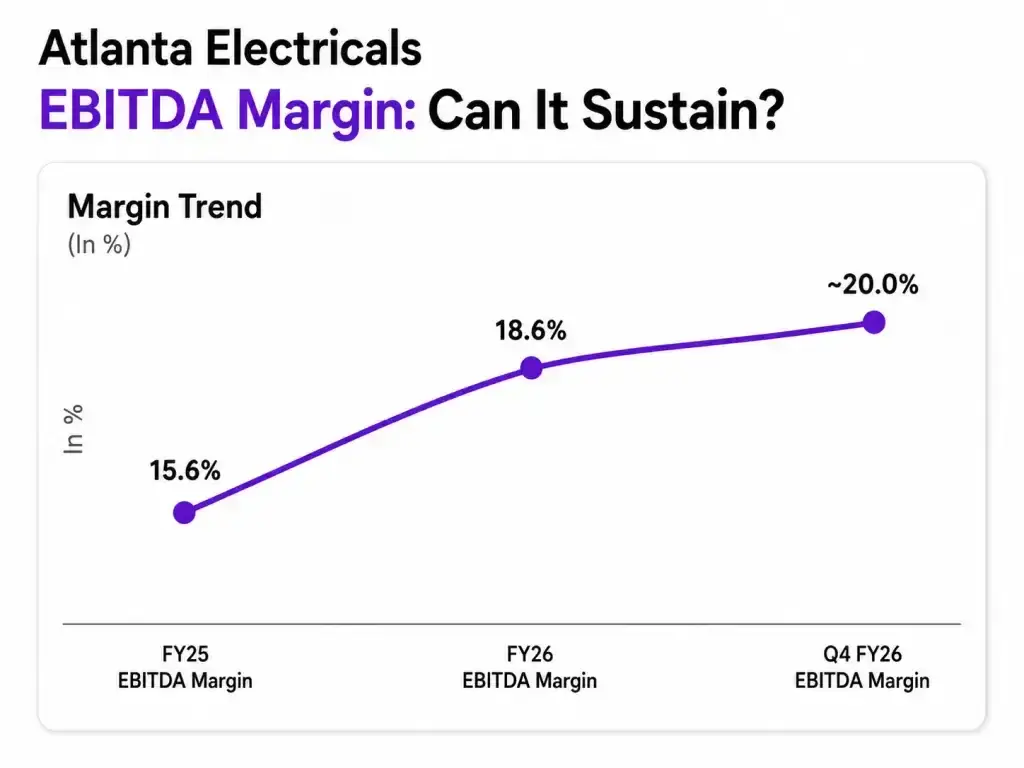
The company’s FY26 EBITDA margin stood around 18.6%, with Q4 margins almost touching 20%. This is impressive, but investors should be careful.
For readers who want to understand why EBITDA is useful but should not be viewed in isolation, this guide will help: EBITDA Explained: Why Investors Use It — And When It Misleads.
Margins in manufacturing businesses can move. They depend on product mix, commodity prices, order pricing, execution efficiency, capacity utilization, and competitive intensity.
If the company continues to increase higher-voltage products, margins may remain healthy. If raw material volatility increases or competition becomes aggressive, margins may soften. If new capacity is underutilized, operating leverage may not fully show. If execution delays occur, profitability can be affected.
So the right way to think about margins is not to assume that every strong quarter will repeat forever. Instead, investors should watch whether the company can maintain margins through a full cycle.
One strong year is encouraging. Three to five strong years prove the model.
Competitive Position: Where Atlanta Stands
India has several listed transformer and electrical equipment companies. Some are larger. Some are more export-focused. Some operate in lower-voltage ranges. Some have stronger balance sheets. Some have better margins.
Atlanta’s key differentiator is its aggressive movement up the voltage ladder. Its capacity now allows it to compete in higher-value segments. Its Vadod facility gives it 400 kV capability. Atlanta Trafo gives it 765 kV capability. Its order book has grown strongly. Its balance sheet has improved. Its product mix is moving toward higher-voltage transformers.
That said, competition is not absent. At the higher-voltage end, competition is lower but more serious. Customers are demanding. Approvals are strict. Execution mistakes are costly. So Atlanta’s opportunity is large, but it must keep proving itself.
The market will not reward capability alone. It will reward execution.
What Makes Atlanta Interesting
The investment case for Atlanta Electricals starts with the sector. India is investing in transmission, renewables, grid modernization, railways, data centers, and storage. These are not one-quarter themes. These are long-term infrastructure priorities.
The second part of the story is capacity. Atlanta has expanded capacity at the right time, moving from around 16,000 MVA to around 63,000 MVA. This gives the company room to grow if demand continues.
The third part is capability. The company is moving into higher-voltage products, which have stronger entry barriers and better strategic positioning.
The fourth part is financial validation. FY26 numbers showed strong revenue growth, margin expansion, PAT growth, and a large order book.
The fifth part is balance sheet improvement. The company repaid long-term debt, reducing financial risk.
Put together, Atlanta is not just a transformer manufacturer. It is a transformer manufacturer entering a larger scale and higher-voltage phase during a strong industry cycle. That combination is what makes the story interesting.
What Can Go Wrong
“Most investors are primarily oriented towards return, how much they can make, and pay little attention to risk, how much they can lose.” — Seth Klarman
Every good business story has risks. Ignoring them is dangerous.
The first risk is valuation. If a stock already prices in years of growth, even a good company can deliver poor returns from a bad entry price. Investors must separate business quality from stock valuation.
The second risk is execution. Atlanta is scaling fast. New facilities, higher-voltage products, exports, backward integration, and larger orders all increase complexity. Fast growth is good only if execution keeps up.
The third risk is order conversion. An order book gives visibility, but it does not guarantee smooth revenue. Orders can be delayed, modified, or affected by customer-side approvals and project timelines.
The fourth risk is working capital. Transformer manufacturing needs raw materials, inventory, testing, dispatch planning, and customer payments. If working capital stretches, cash flow can suffer.
The fifth risk is raw material volatility. Copper, steel, CRGO, oil, and specialized components can affect margins despite price variation clauses.
The sixth risk is customer concentration and utility dependence. Government utilities provide strong demand but can also create payment and timeline risks.
The seventh risk is competition. Domestic players and potential international competition can affect pricing.
The eighth risk is margin sustainability. FY26 margins were strong. Investors need to see whether these margins remain stable as the company scales further.
A stock should never be studied only from the upside. The downside decides whether the upside is worth taking.
The Right Way to Look at Atlanta Electricals
“Successful investors tend to be unemotional, allowing the greed and fear of others to play into their hands.” — Seth Klarman.
India’s transformer demand is strong. Atlanta has expanded capacity. The company is moving into higher-voltage products. FY26 showed strong numbers. The order book gives visibility. The balance sheet has improved. But valuation, execution, raw material volatility, customer concentration, and margin sustainability need careful tracking.
This is how serious investors think. They do not fall in love with a story. They test the story.
They ask whether the sector is growing, whether the company is gaining capability, whether customers are placing orders, whether margins are improving for real reasons, whether the balance sheet is strong, whether the valuation is reasonable, whether growth can continue, and what can break the thesis.
Only after answering these questions does the stock become investable.
If you want a broader checklist for studying similar businesses, read: How to Analyze a Mid-Cap Company – A Complete, Practical Framework.
Key Metrics to Track Going Forward
For Atlanta Electricals, investors should track order inflow every quarter because a strong order book today is good, but fresh order inflow decides future visibility.
They should also track the order book mix. The key question is how much of the order book comes from 220 kV and above, and how much comes from 400 kV and 765 kV products. The segment mix between utilities, renewables, data centers, exports, and storage will also matter.
Revenue execution is another important metric. The company needs to convert its order book into revenue smoothly. EBITDA margin should also be watched closely because the market will want to see whether current margins are sustainable.
Working capital is equally important. Receivables, inventory, and cash flows can reveal whether growth is healthy or becoming stretched. Capacity utilization at Vadod and Atlanta Trafo will show whether the expansion is delivering expected results.
Investors should also monitor approvals, export traction, backward integration progress, and valuation. These metrics will tell whether the story is strengthening or weakening.
Explore our Products
Research Framework

Emerging Titans
Combination of quantitative analysis, industry tailwinds, and management assessment - SPRINT investment philosophy

Tiny Titans
Heavy emphasis on scuttlebutt research, plant visits, and early on-ground signals
Conclusion
Atlanta Electricals is a strong business story within India’s power infrastructure cycle. The company is benefiting from rising demand for transformers across transmission, renewable energy, railways, data centers, and industrial power systems.
What makes the stock interesting is its move beyond regular transformer manufacturing. With capacity expansion, a stronger order book, debt repayment, and focus on higher-voltage products like 220 kV, 400 kV, and 765 kV transformers, the company is trying to position itself in a more specialized and higher-entry-barrier segment.
FY26 numbers show that the growth story of the stock has begun and could be seen in their performance. Revenue, EBITDA, margins, PAT, and order book have all improved for the company. But investors should still track execution, working capital, raw material costs, order conversion, margin sustainability, and valuation before making any decision.
Overall, Atlanta Electricals is a stock worth watching closely for long-term investors who believe in India’s power infrastructure growth story. The opportunity is real, but the returns will depend on how well the company executes and the price investors pay.
Want more such deep-dive stock stories? Comment Value Stocks
FAQs
Why should investors care about a transformer manufacturer?
+Because transformers sit at the center of the power value chain. Generating electricity is only the first step. That power still needs to move from power plants, solar parks, wind farms, and transmission networks to factories, homes, railways, data centers, and industrial users. Transformers help step up and step down voltage so electricity can travel safely and efficiently. As India invests in grid expansion, renewable energy, railway electrification, data centers, and industrial power infrastructure, transformer manufacturers become important beneficiaries of that larger cycle.
Are all transformer companies equally placed to benefit?
+No. That is one of the most important points. Lower-voltage transformers are more competitive because many companies can manufacture them. As voltage levels move higher, especially toward 220 kV, 400 kV, and 765 kV, the product becomes more technical, approval cycles become longer, testing requirements become stricter, and the number of qualified players reduces. So, a company moving up the voltage ladder may be better positioned than one focused only on lower-voltage products.
What does “moving up the voltage ladder” mean?
+It means shifting from lower-voltage transformer products toward higher-voltage and extra-high-voltage transformers. In simple terms, the higher the voltage class, the more specialized the product becomes. Higher-voltage transformers usually require better engineering, stronger quality systems, reliable testing infrastructure, and a proven execution record. This can create stronger entry barriers and potentially better business quality over time.
Why is capacity expansion important in this story?
+For any manufacturing company, growth depends on demand and capacity. Even if industry demand is strong, a company cannot grow meaningfully if it does not have enough manufacturing capacity. In this case, the business has expanded capacity significantly, which allows it to handle larger orders, serve more customers, and participate in higher-voltage segments. The key question now is whether this capacity can be converted into revenue, margins, and cash flow.
Why does the order book matter so much?
+In small and mid-cap investing, stories can be easy to create, but orders show whether customers are actually committing money. A strong order book gives revenue visibility and shows that demand is real. The important point is not only the size of the order book but also its quality. If the order book is shifting toward 220 kV and extra-high-voltage products, it may indicate a better product mix and stronger positioning.

High growth stock specialist, Value Educator
Shashank Mahajan is an equity research professional with over 12 years of experience in identifying high-potential SME and micro-cap stocks at an early stage. He follows a rigorous scuttlebutt research–driven approach, combining on-ground insights with deep financial analysis. Shashank specializes in uncovering under-researched and under-owned companies with strong management quality and long-term growth potential. Through disciplined research and early identification, he focuses on spotting tomorrow’s market leaders before they enter the mainstream investor radar.

Zen Technologies: Why Revenue Fell After Its Biggest Win

Data Patterns: India's Radar Designer and Its Waiting Orders

KSH International: The Wire Inside India's Transformers

Krishna Defence: The Steel Behind India's Warship Hulls

PNG Jewellers: A 194-Year-Old Name Goes National

Axiscades: From Services to Missile and Radar Electronics
Explore our Products
Research Framework
Emerging Titans
Combination of quantitative analysis, industry tailwinds, and management assessment - SPRINT investment philosophy
Tiny Titans
Heavy emphasis on scuttlebutt research, plant visits, and early on-ground signals


 Orders
 Subscription
 Share with friends
 Logout


Required Details
₹23999.00
(12 month subscription)
As per SEBI regulations, all users are mandated to complete the KYC that is validated for 1 year. Post payment, you will be redirected to the KYC screen


No comments yet. Be the first to comment!