
10 Mid-Caps Where Profits Compound

Behind every Pepsi bottle sold in India lies a multi-thousand-crore profit engine — quietly built by the bottler, Varun Beverages Ltd.
But this wasn’t always the case!
Back in FY2013, Varun Beverages was still struggling. It reported a net loss of around ₹40 crore. Margins were weak. Nothing about the business looked special.
If we look ahead to FY2024, things have taken a significant turn.
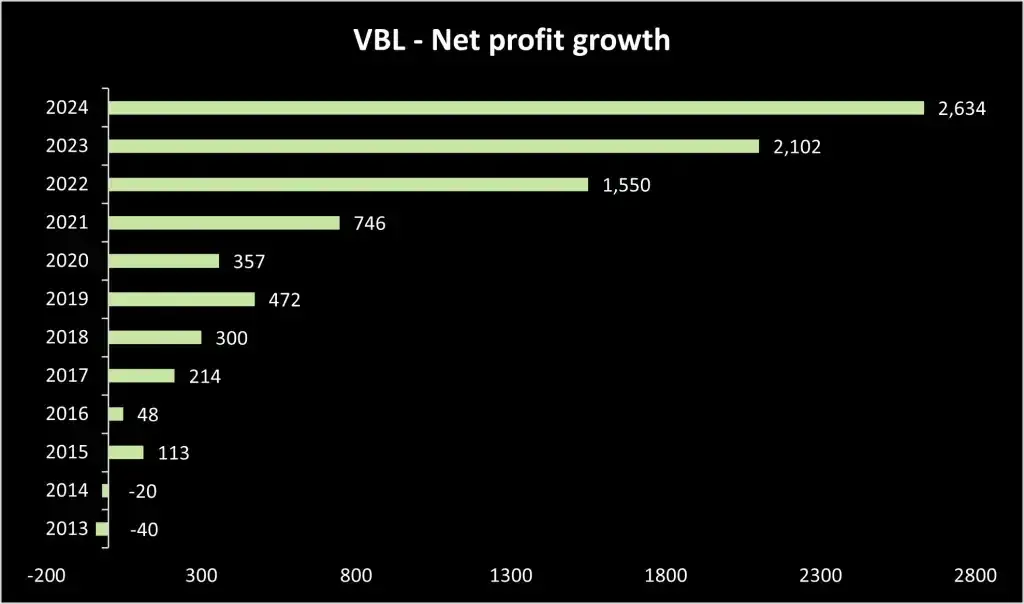
The company is earning roughly ₹2,634 crore in net profit, with net margins above 13% and an EPS of ₹7.67. The business didn’t change overnight — it scaled.
Over the last 10 years, profits have compounded at a CAGR of around 63%. Even over the past 5 years, profit growth has stayed above 40% CAGR. The last 3 years show just how powerful operating leverage can be for a company when execution goes right.
There was no dramatic re-rating moment. Just more bottles sold, better cost control, expanding margins — and profits rising year after year.
This is how real compounding works.
Today, Varun Beverages is a large, widely tracked stock.
But not long ago, it was a mid-cap company quietly proving itself through numbers.
You can also refer to our article on: Why Mid Cap Stocks are the Sweet Spot for Long-Term Investors
That’s the exact pattern this article focuses on — 10 mid-cap stocks showing consistent profit growth, before the story becomes obvious to everyone else.
The Selection Criteria: Why These Stocks (and Not Just Any Mid-Caps)
This list isn’t based on stories, recent stock price moves, or one-year turnarounds. Every company here passes a clear, repeatable filter focused on business quality and the ability to grow profits consistently.
Even if you disagree with some of the stocks, the idea is simple: you shouldn’t be able to disagree with the logic
Here’s what qualified a company for this list:
Defined Mid-Cap Universe
These companies are the Goldilocks of the stock market—not too big, not too small. They've figured out how to survive but have a lot of room to grow. (Their market value is usually between ₹5,000 and ₹50,000 crore.)
Multi-Year Profit Growth (Not One-Off Spurts)
Each company shows a minimum 4-year track record of profit growth. The focus has been on consistent growth of net profit margins, and not just a low base effect or a single cyclical up-year. Temporary volatility is acceptable; structurally rising earnings are non-negotiable.
Cash Profits, Not Just Accounting Profits
Positive and improving operating cash flows were a key filter. Companies that grow profits but struggle to convert them into cash over time were avoided.
No Balance Sheet Blow-Ups
Leverage is monitored closely. These businesses may use debt, but there are no extreme leverage cycles, repeated equity dilution, or balance-sheet stress events that threaten long-term compounding.Core Business Clarity
Each company has a clear profit engine — whether it’s infra equipment, healthcare delivery, pharma brands, engineering niches, BPM services, specialty chemicals, real estate rentals, or medical devices. No unrelated diversification. No sudden “story pivots” just to chase growth.Evidence of Operating Leverage or Mix Improvement
Across annual reports and concall commentary, there is a visible path to profit growth through scale, better product/service mix, recurring revenue, or margin expansion — not just volume at any cost.Apply these filters strictly, and most mid-caps drop out.
What’s left are businesses where profit growth is not a hope or a projection — it’s already visible in the financials. Different sectors, different cycles, but the same underlying pattern: profits growing faster as the business scales.
If you’re wondering how to apply similar filters on your own, this 1-hour research checklist can help you quickly separate quality businesses from noise.
Read our article on: A Fundamental Checklist: How to Research a Stock in 1 Hour
The section below walks through 10 such mid-cap companies, explaining where their profit growth is coming from and what needs to go right for it to continue.
Where the Profits Are Coming From: 10 Mid-Cap Businesses Explained
1) Action Construction Equipment (ACE) – Quietly Compounding Profits
If there’s one mid-cap that clearly shows the difference between a temporary cycle bounce and real, structural profit growth, it’s Action Construction Equipment (ACE).Not a One-Year Jump — Real Profit Compounding
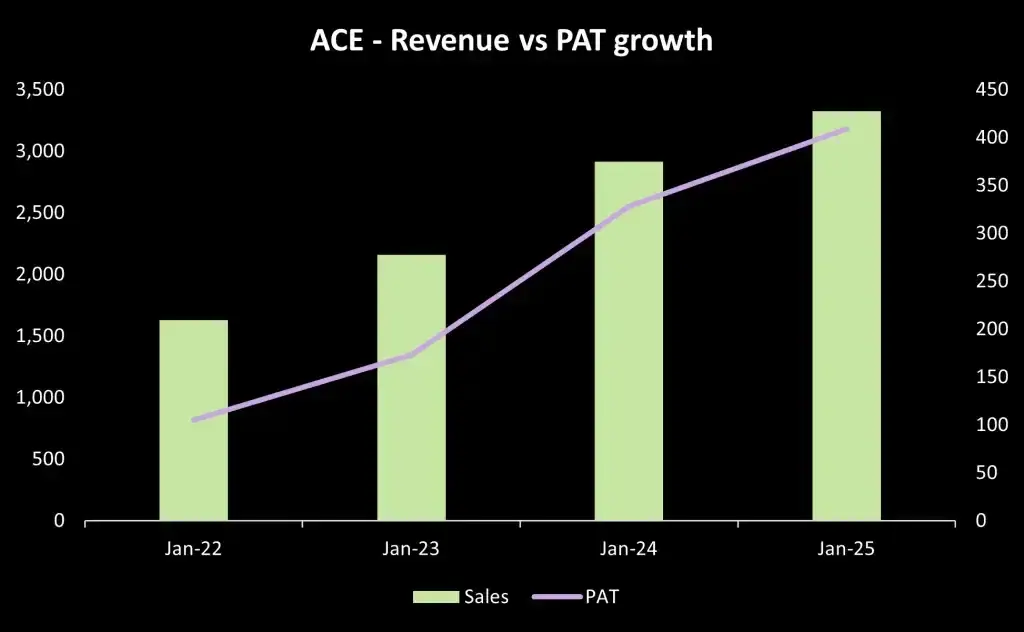
From FY22 to FY24, ACE didn’t just sell more machines — it made more money at every level. Profits more than doubled in FY24, while operating profits nearly did the same. Importantly, this wasn’t due to a single lucky year. Profits and margins improved consistently, which supports management’s claim of steady, predictable growth.
Margins Tell the Real Story
The biggest change at ACE is how profitable the business has become. Operating margins moved from around 10–11% to nearly 18%, the highest in the company’s history. This came from better products, higher volumes, sensible pricing, lower raw-material pressure, and tighter cost control.In simple terms — ACE isn’t just getting bigger; it’s getting smarter.
Cranes: The Cash Engine
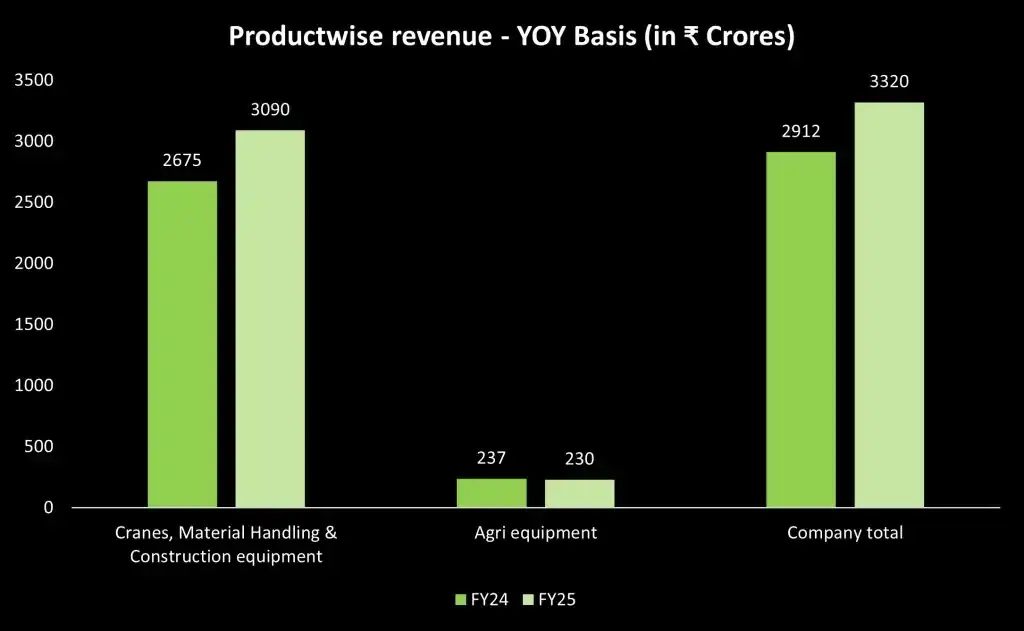
Cranes are really important for ACE, making up about two-thirds of their revenue and bringing in the most profit. Demand is up, and they're seeing better margins. Being the top player in the market gives ACE an edge with pricing and steady cash flow, which helps them grow in other areas too.
Construction Equipment Emerging as a Key Growth Driver
Earlier, the company was mostly a crane's story. Now, its construction equipment side is gaining pace and doing better than the rest of the business. That mix change gives it stronger profits and more stable growth, rather than leaning on a single line.
Debt-Free and Cash-Rich
ACE has stayed debt-free, even while expanding capacity. It funds growth using its own cash flows. As a result, returns on capital are among the best in the sector. For investors, this means clean profits, lower risk, and better quality earnings.Why Profits Can Grow Faster Than Sales
ACE’s factories are designed to make different products using the same setup. As volumes rise, fixed costs get spread out, and profits grow faster than revenues. This gives the company structural operating leverage, not just cyclical upside.
Management That Delivers
Over multiple years, management has met or exceeded its targets, protected margins during tough periods, avoided unnecessary debt, and delivered what it promised. This isn’t a turnaround story or a hope-based bet — it’s execution in action.2) Narayana Hrudayalaya Ltd – Profits Built on Process, Not Pricing Power
Narayana Hrudayalaya (NH) is a rare hospital business where profit growth comes from efficiency and scale, not from charging patients more.Structural Profit Growth, Not a Hospital Cycle
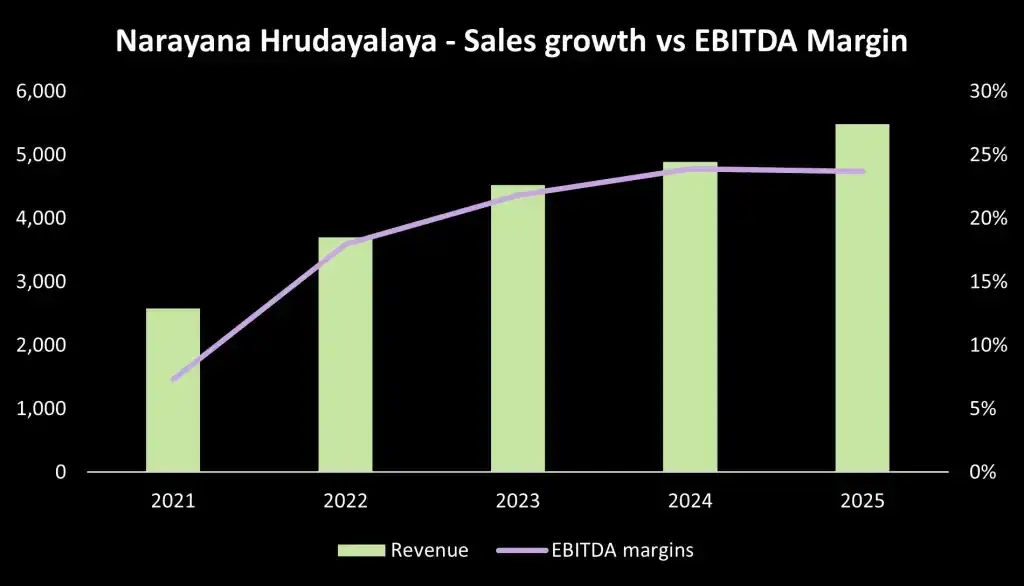
Over the last few years, NH has delivered steady double-digit revenue growth while keeping margins strong. FY24 EBITDA margins were ~24.5% — among the highest in the hospital sector — even as the company continued to add beds. That’s unusual, because hospitals typically see margins fall during expansion. NH has managed to grow and improve profitability.
The Cayman Hospitals: A Built-In Profit Engine
NH’s overseas hospitals in the Cayman Islands are the group’s biggest strength. Mature Cayman hospitals operate at 40%+ EBITDA margins and generate enough cash to fund expansion back in India. Even when new Cayman hospitals temporarily dilute margins, management has shown that profitability comes back faster than expected. Overseas profits help NH grow without stretching the balance sheet.India Business Is Getting Better in Quality
In India, NH is steadily shifting toward more complex and higher-value treatments. Even when patient volumes fluctuate, revenue per bed keeps rising — a sign of better case mix and payer profile. Importantly, newer hospitals that were once loss-making have now turned profitable, removing a long-standing drag on earnings.This marks a shift from “more patients” to “better patients.”
Capital Discipline Sets NH Apart
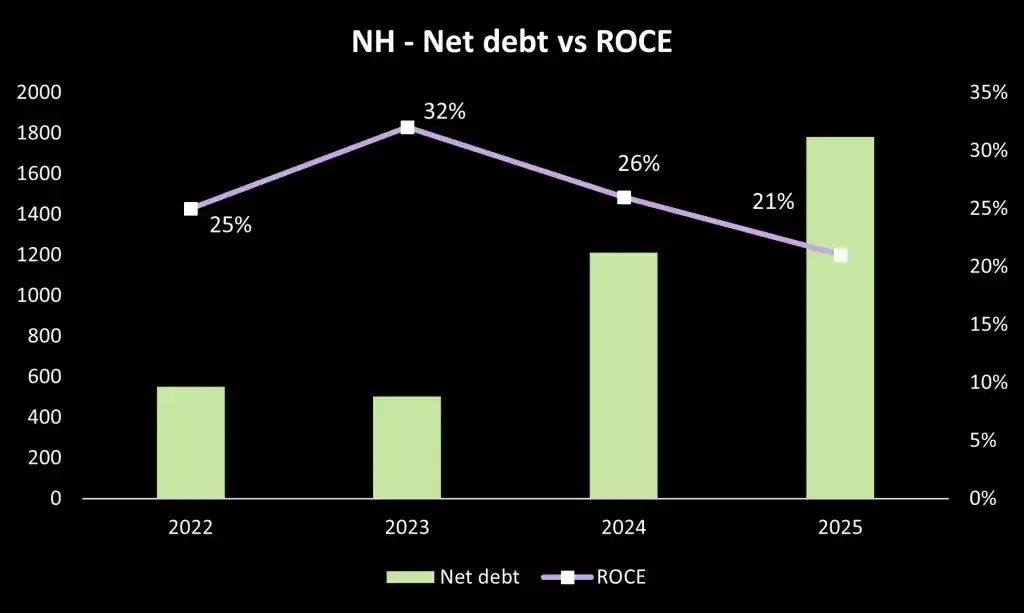
Hospitals are capital-hungry businesses, but NH stands out:- Very low debt, even during expansion
- Focus on brownfield growth and high-return specialties
- Strong returns on capital instead of aggressive bed additions
For investors, this means profit growth without financial risk.
Operating Leverage Works with Time
Once a hospital reaches decent utilization, costs stabilize while revenues grow. NH benefits from this across its mature hospitals, which explains why profits are now growing faster than revenues in many locations.Affordable Care Is a Competitive Advantage
NH is known for cardiac care, which makes up ~34% of revenues, followed by oncology, gastro sciences, renal, and neuro care. Even though NH has lower prices than its competitors, it still makes great profits. That's because they handle a lot of patients, have set ways of doing things, and get patients in and out faster.3) J B Chemicals & Pharmaceuticals: Consistency Built on Margins & Discipline
Structural Revenue Growth That Beats the Industry
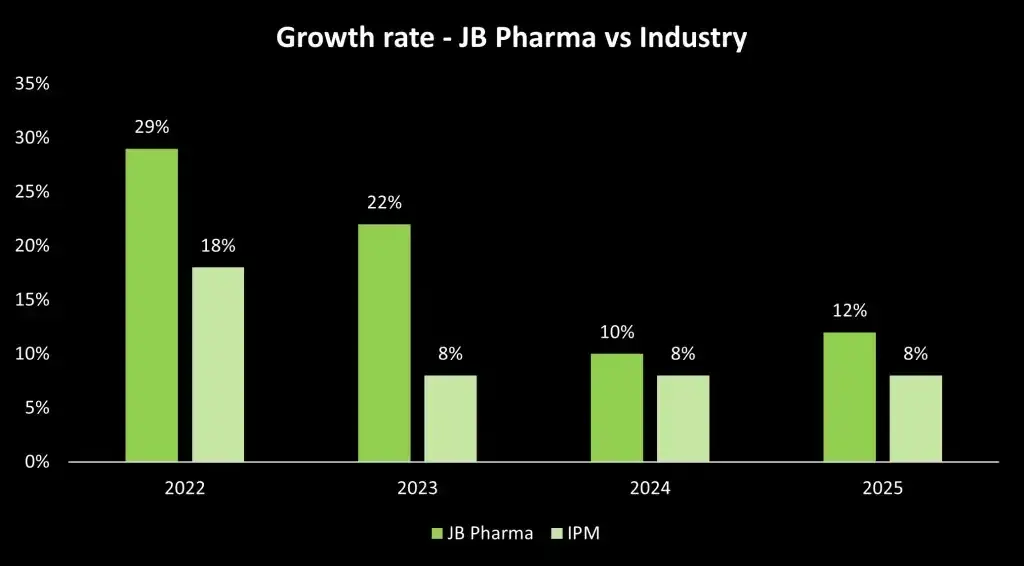
JB Chemicals & Pharmaceuticals Ltd hasn’t relied on a lucky year—it’s been growing steadily. In FY24, sales climbed about 12.5% to ₹3,918 crore, even while it cut back in South Africa.By March 2025, it was still growing faster than the Indian pharma market (12% vs 8%). Over the years, this has mostly come from its brands doing well and clean execution, not just price hikes or export moves.
The KKR Effect: Faster Growth, Higher Profits
After KKR took over, the company experienced significant growth and profitability. Before the acquisition (FY16–20), revenue grew at about 10% per year, and profits rose around 14% annually. But after KKR came on board (FY20–25), revenue growth jumped to about 17%, and profits increased by around 20%. This boost in profits—including revenue, EBITDA, and PAT—shows how KKR's focus on smart capital use, domestic brands, and strong execution made a real difference.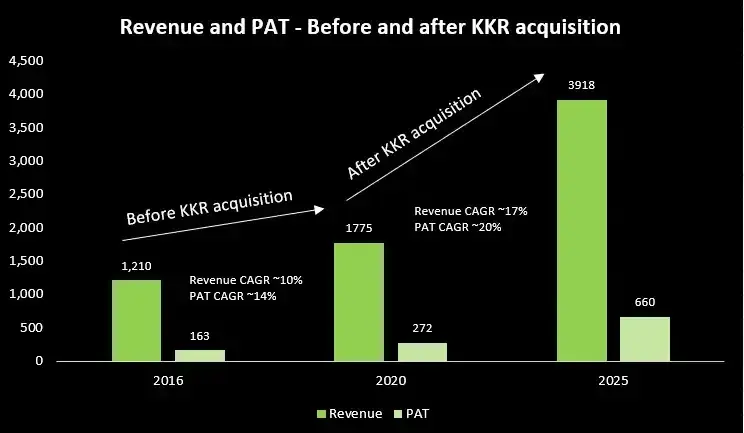
Domestic Branded Formulations Anchor Profit Stability
JB Pharma’s domestic branded formulations business is the core profit engine, contributing ~55–60% of total revenue.
- Domestic business grew at 23% CAGR (FY19–24)
- Chronic therapies grew 18% YoY, versus industry chronic growth of ~10% (IQVIA)
- ~75% of the portfolio is in fast-growing therapy segments
Chronic therapies—cardiac, gastro, ophthalmology—now account for nearly half of the portfolio, providing predictable prescriptions and pricing power.
A chronic-heavy domestic mix reduces earnings volatility and ensures steady profit compounding.
“Big Brands Getting Bigger” Strategy Is Working
Rather than chasing endless launches, JB Pharma focuses on scaling proven brands.Legacy brands Metrogyl, Nicardia, Rantac, and Cilacar (incl. Cilacar-T) contribute ~53% of domestic sales. The number of ₹20+ crore brands has risen from 8 to 25 in four years, while medical representative productivity has nearly doubled. JB Pharma compounds profits by deepening dominance, not expanding complexity.
Disciplined M&A Strengthens, Not Dilutes
Acquisitions have been earnings-accretive and well integrated:- Sanzyme (Sporlac) scaled at ~30% CAGR
- Ophthalmology portfolio growing at high-teens pace
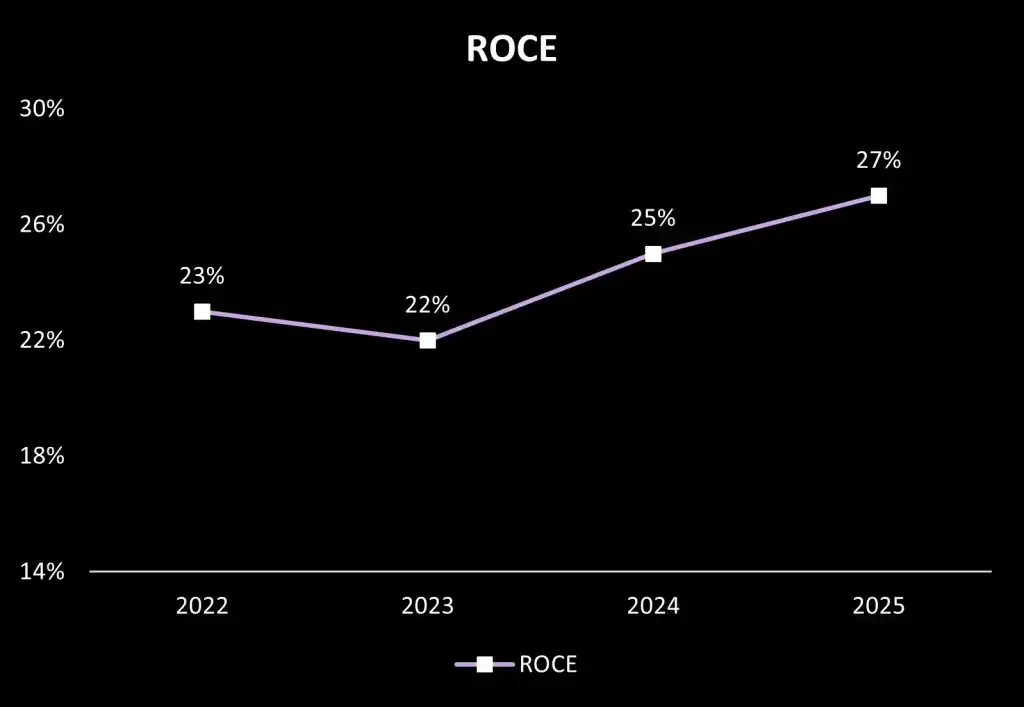
Strong cash flows, rising ROCE (~27%), and a net-cash balance sheet add downside protection.
4) Force Motors: A Cyclical OEM Quietly Turning into a Profit Compounder
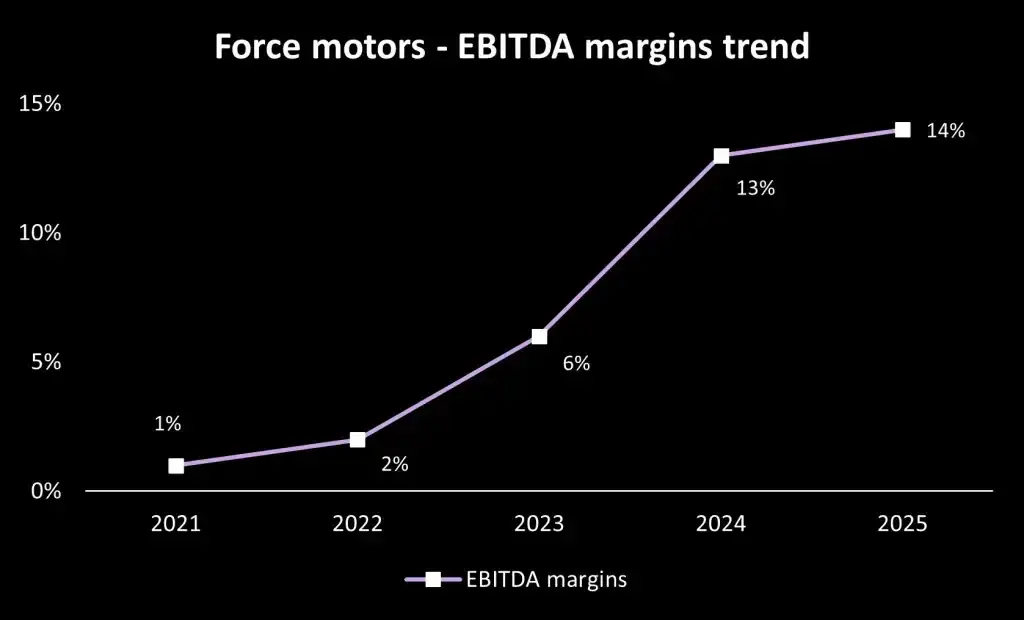
Profit Growth Is Outpacing Revenue - Operating Leverage at Work
Force Motors is growing well! Their profits are growing a lot quicker than sales, which usually tells you the business is getting more efficient. In the first half of the year, sales rose around 14%, but profit before tax jumped nearly 50%, and net profit ended up more than double. That’s a big gap in the right direction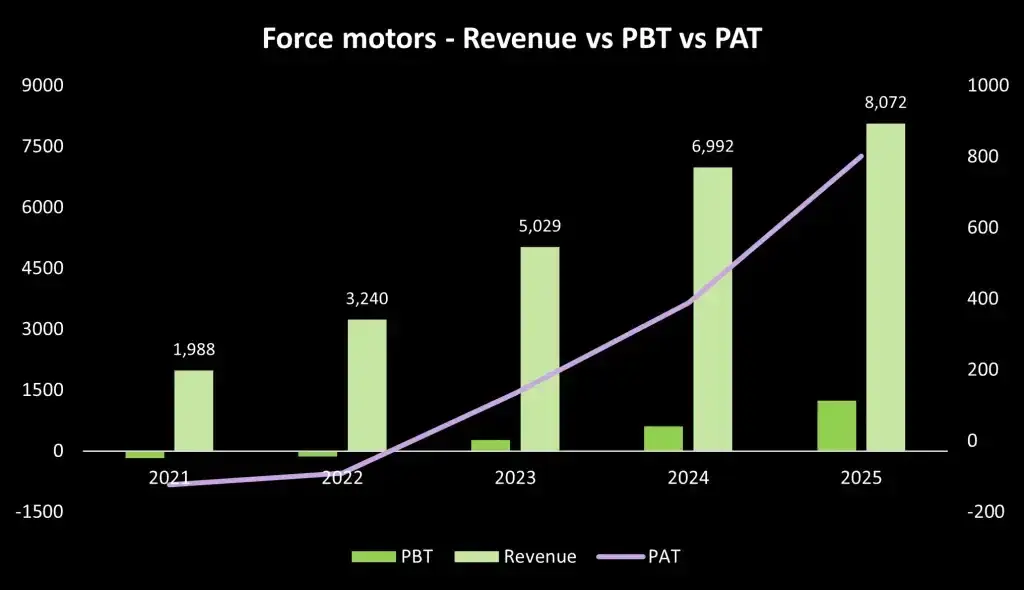
This growing gap shows that as the company sells more, it's helping its profits a lot more than before. It's not just about a rebound in demand; it means they have better profit margins moving forward.
Margin Gains Driven by Better Mix, Not Just Higher Volumes
The company has intentionally moved away from low-profit legacy products and is now focusing on more valuable platforms:- Vans (Traveller, Urbania)
- Monocoque buses
- Engine and axle supplies to global OEMs
FY23–FY25 saw record four-wheeler sales and all-time high exports, showing that both scale and realizations are improving simultaneously.
Profit growth here is structural, driven by better products—not just a cyclical CV upturn.
“India’s Largest Van Maker” = Hidden Monopoly Economics
Force Motors dominates the Indian van segment, with an estimated ~70% share in school buses and ambulances. Platforms like Traveller and Urbania are hard to substitute due to:- Customization-heavy applications
- Proven reliability
- Deep service network
This dominance allows Force Motors to maintain margins even during weak CV cycles. This isn’t a flashy OEM—it’s a category owner, which explains its margin resilience.
Premium Vehicles + OEM Engines = Stable Profit Engine
Force Motors’ profit consistency is anchored by premiumization and a steady OEM engine business.Urbania is positioned as a premium, aspirational van with higher realizations and better margins, serving tourism, institutional, and staff transport markets. Management views it as a margin and ROCE expansion lever, rather than a volume play—rare in commercial vehicles —and once established, it is difficult to dislodge.
Alongside this, Force Motors supplies engines and axles to global OEMs like BMW, Mercedes-Benz, and MTU. Its Force MTU plant is the only global producer of Series 1600 engines, making this business contract-driven, less volatile, and higher margin.
In short, premium vehicles lift margins in upcycles, while OEM supplies cushion earnings in slowdowns—creating profits that compound across cycles.
5) Sagility: A Healthcare Annuity Business Quietly Compounding Profits
What Sagility Really Is — And Why That Matters
Sagility Ltd is not a hospital, pharma company, or typical IT services firm. It works behind the scenes of the U.S. healthcare system, handling day-to-day operations for health insurance companies and hospitals.About 90% of Sagility’s revenue comes from health insurers, while the rest comes from hospitals and doctors’ networks.
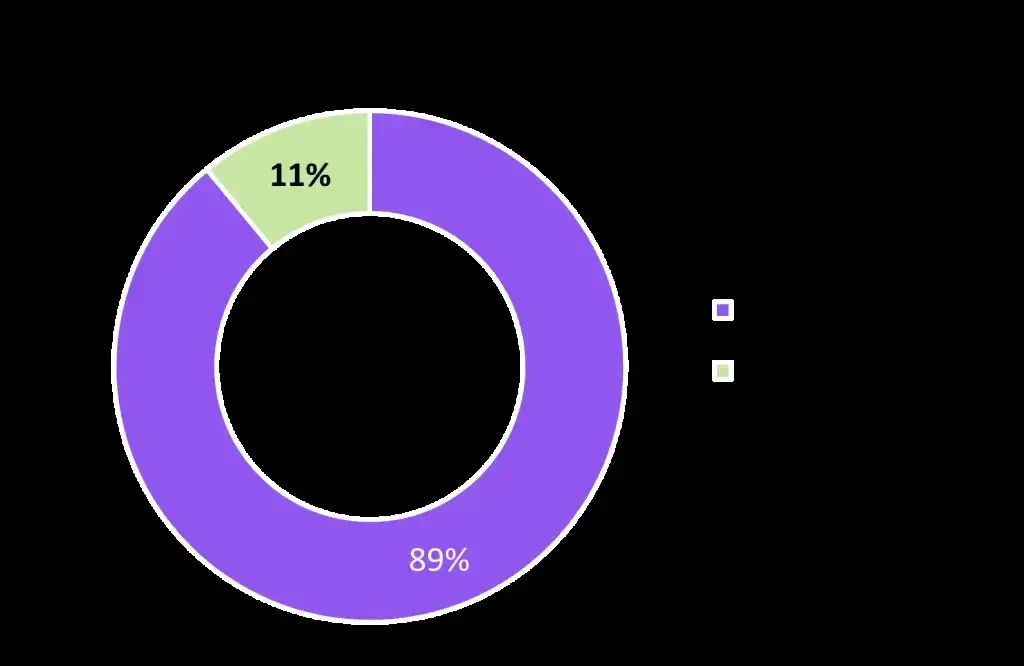
This is important because insurance companies cannot stop these services even in a slowdown. Claims still need to be processed, members still need support, and payments still need to be checked. In simple terms, Sagility helps U.S. healthcare companies run their operations more efficiently.
The Reasons Demand Holds Up Long Term
The healthcare system in the United States is huge and plays a critical role, but costs have been climbing fast. Because of this, insurance companies are always seeking practical ways to control spending, and outsourcing routine yet important work has become one of the simpler levers.Once you outsource these tasks, they're usually gone for good. Switching to a new vendor is a big hassle—risky, expensive, and a real pain. This makes Sagility’s services non-optional, which gives the company steady demand and good visibility on future revenue.
For retail investors, this means that Sagility’s business is less dependent on economic cycles than that of most IT or services companies.
Why Customers Stick Around for Years
Sagility doesn’t offer one-off projects. It handles core, everyday work such as processing insurance claims, checking payments, supporting members, and managing hospital billing.These activities are deeply linked to a client’s systems and processes. Because of this, clients tend to stay with Sagility for a long time and gradually increase the amount of work they give it. Many of Sagility’s largest customers have been with the company for over a decade.
This long-term relationship model creates a steady income rather than unpredictable wins and losses.
How Profits Keep Improving Over Time
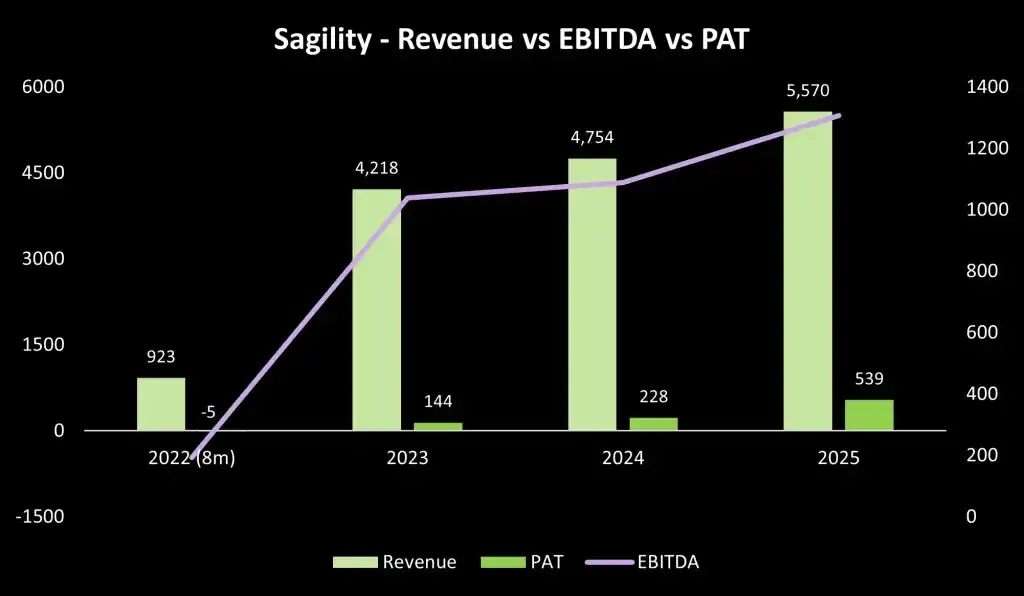
Sagility’s profit growth comes from doing more work with the same setup. It employs about 40,000 people across multiple delivery centers and handles millions of healthcare transactions every year.Over time, the company has invested in software and automation to reduce manual effort. As volumes grow, costs do not rise at the same pace. This allows profits to grow faster than revenue, which has been clearly visible in recent years.
Simply put: once the system is built, extra work becomes more profitable.
Smart Expansion Without Overstretching
Sagility has made a few acquisitions, but they have been carefully chosen. These deals helped the company add new capabilities like faster claim checks and better customer support tools. They were not made to chase size, but to strengthen existing relationships.At the same time, the company has been reducing debt and improving cash flows, making the balance sheet safer for long-term investors.
6) Himadri Specialty Chemicals: From Commodity Cycles to Specialty Compounding
Himadri Specialty Chemicals Ltd is quietly undergoing a transformation that many commodity chemical businesses struggle to achieve. What started decades ago as a coal-tar distillation operation is now evolving into an integrated specialty and advanced materials platform spanning specialty carbon black, battery materials, and high-value chemical derivatives.
A Structural Shift, Not a Cycle
Management’s strategy is clear: value over volume. Instead of chasing commodity spreads, the company is moving toward specialty grades, downstream integration, and application-driven innovation. That shift is already visible in earnings stability. Profit swings that once tracked raw material cycles are moderating as specialty products form a larger share of the mix.A simple way to frame it: Himadri is no longer just selling inputs — it is selling performance materials with pricing power.
Profit Growth Backed by Better Economics
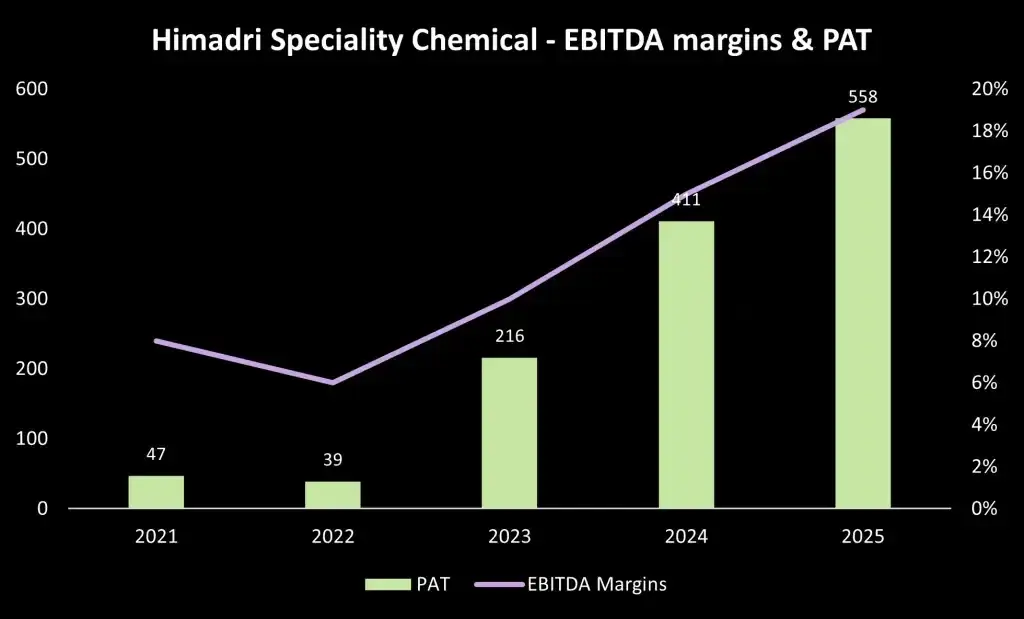
FY25 marked record profitability. Revenue reached ₹4,596 crore, while PAT rose to ₹558 crore versus ₹411 crore the year before. EBITDA margins and net margins both expanded, reflecting better product mix and operating efficiencyImportantly, profitability held firm even when raw-material prices corrected — a sign of cost control and pricing discipline rather than luck.
Scale Is Becoming a Moat
The brownfield expansion at Singur and capacity additions in specialty carbon black are building scale that few domestic peers can match. Management has guided meaningful additions in specialty carbon black capacity by FY26, reinforcing its position in a niche where quality and consistency matter more than headline volume.In specialty chemicals, scale at the right end of the value chain often translates into customer stickiness and better margins.
Forward Integration = Higher Value per Tonne
New projects like anthraquinone and carbazole extract more value from the same coal-tar stream. These products serve dyes, pigments, pharma, and electronics — areas where India still relies on imports. Forward integration improves asset turns, margin profile, and cash-flow visibility, turning a single raw material into multiple profit pools
Battery Materials Add Optionality
Himadri’s moves into lithium-ion materials — including technology partnerships and cathode/anode material development — position it for the EV and storage theme. This is not yet the core profit driver, but it offers upside without being fully priced into current earnings.7) HBL Engineering: Niche Technologies Driving Quiet Profit Compounding
HBL Engineering Ltd is not a typical engineering play chasing broad industrial cycles. Its profit growth comes from technology-heavy niches—rail safety systems, defence electronics, and specialized batteries—where entry barriers are high, and competition is limited.
Profits Are Compounding Across Cycles
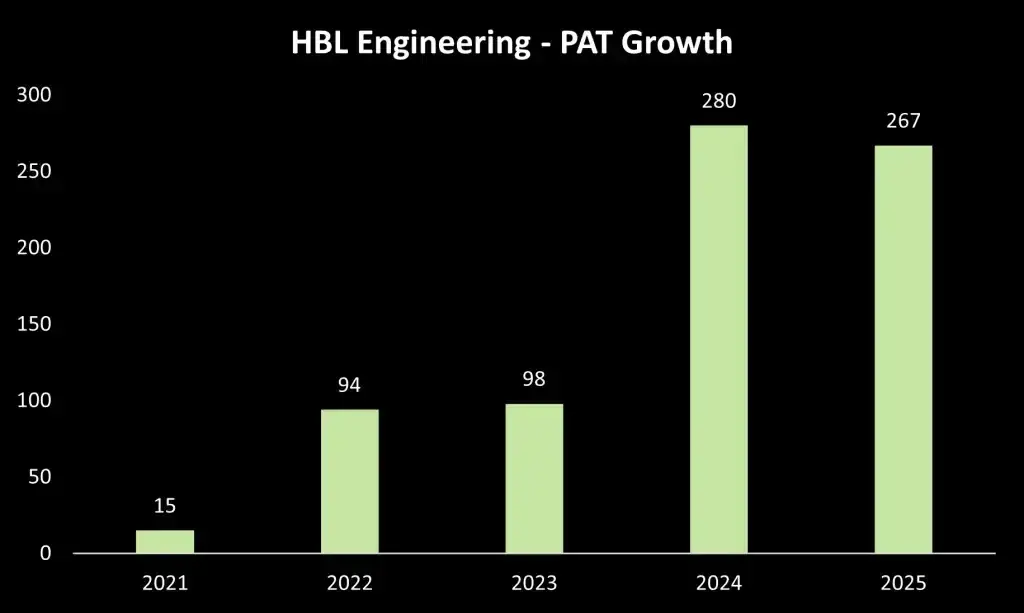
Over five years, PAT has moved from ₹15 crore in FY21 to ₹267 crore in FY25. The interesting part is FY25: even with Kavach tender delays, profits held steady rather than correcting sharply.EBITDA margins are around 21%, and net margins are near 14%, showing that earnings growth is coming from operating leverage and product mix, not just revenue expansion.
Kavach Creates Rare Visibility
Kavach, India’s indigenous train collision avoidance system, is moving into execution mode. HBL became the first OEM to receive Kavach v4.0 certification in May 2025.
It has already secured ~₹4,000 crore of Kavach orders covering nearly 7,000 km of track, over 2,400 locomotives, and 750+ stations. Tenders were delayed earlier due to specification upgrades—not demand issues.
For a mid-cap, this provides unusually strong medium-term earnings visibility
Defence Adds Recurring Revenue
HBL supplies batteries and electronics for aircraft, submarines, missiles, and armoured vehicles. These batteries are replacement-driven, which creates repeat demand.The company is also India’s only fully indigenized electronic fuze manufacturer, a category with high certification barriers and limited competition. Exports are becoming a meaningful contributor. This segment behaves more like a steady annuity than a cyclical business.
Portfolio Strategy Reduces Volatility
Instead of relying on one engine, HBL operates across rail signalling, defence electronics, and industrial batteries. When one slows, others compensate. Management has repeatedly prioritised profitability over chasing topline.
That portfolio approach is a key reason profits have stayed stable even in uneven years.
Strong Balance Sheet, Clean Growth
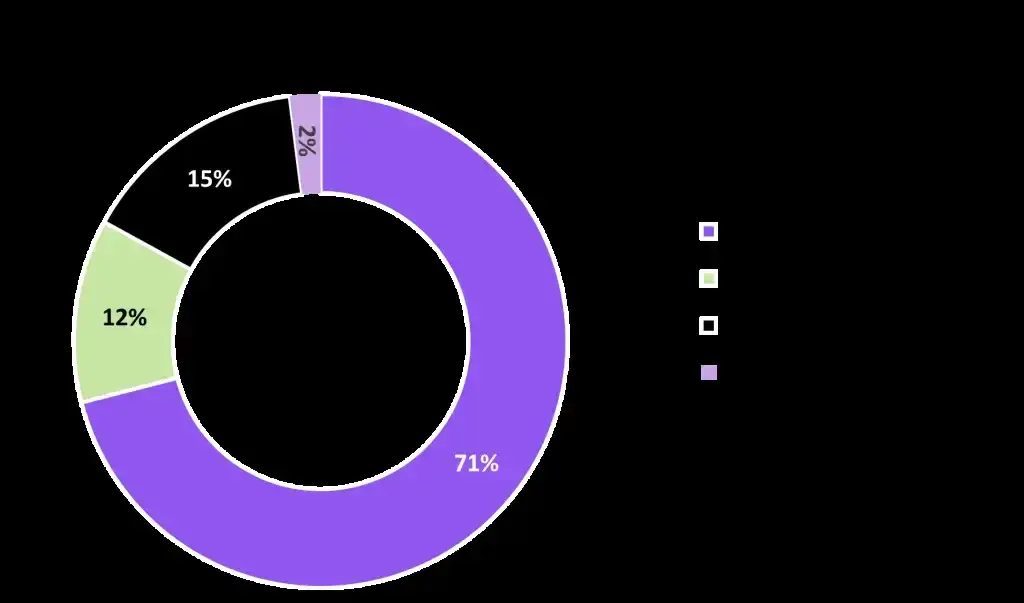
Debt-to-equity is just 0.04x, and the company remains in a net-cash position. Net worth has risen from under ₹800 crore a few years ago to ₹1,458 crore in FY25.
This is consistent growth without leverage risk.
R&D and Capital Discipline Matter
HBL’s culture is R&D-led, with long development cycles. Kavach itself took nearly two decades from idea to commercial scale. The company avoids capital-heavy commodity bets—such as large lithium cell investments—and instead focuses on engineering-led niches.Dividend payouts have also increased, and surplus cash is being deployed cautiously rather than into empire-building.
8) Jyoti CNC Automation Ltd: Precision Engineering, Precision Profits
Jyoti CNC is emerging as one of the more interesting profit compounders in India’s capital goods space. Unlike many machine-tool companies that swing with cycles, Jyoti’s recent numbers show something different — operating leverage, specialization, and execution discipline.
Profit Growth Is Outpacing Revenue
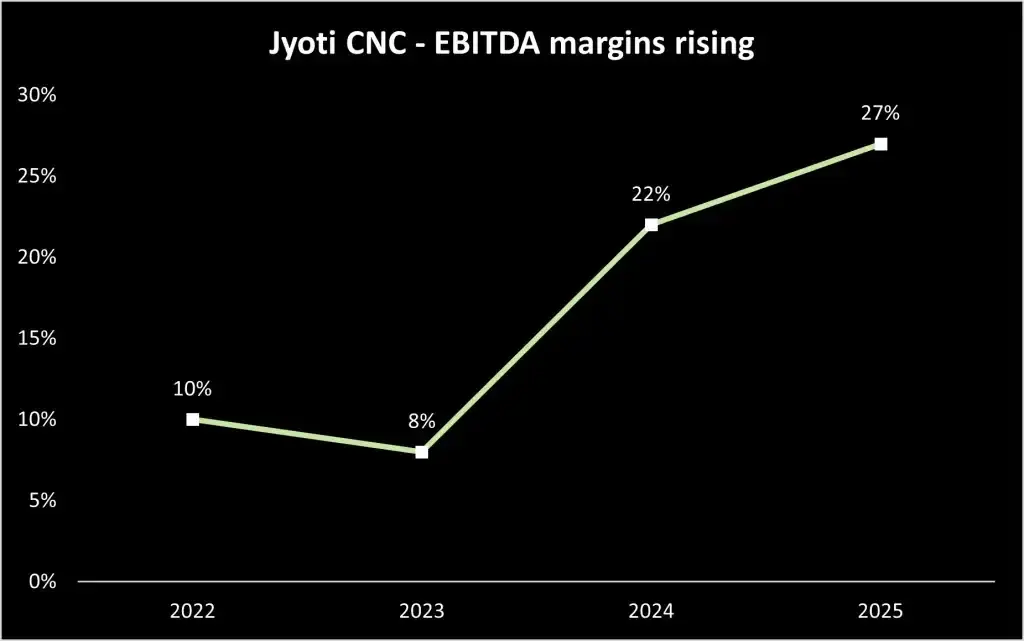
Revenue growth has been strong, but profits have scaled much faster. In FY25, EBITDA and PAT have expanded sharply relative to sales, with margins moving into the mid-20s.This signals genuine operating leverage — the company is earning more from each additional rupee of revenue, not just shipping more machines
For a capital goods company, that’s a sign the business model is maturing.
Aerospace Is a High-Margin Core
Aerospace is not a side segment here — it is a major profit driver. It contributes a large share of revenue and order inflows, and involves high-precision 5-axis machines that are custom-engineered for mission-critical applications.
This is a specialization moat, not a volume game. Aerospace customers prioritize precision and reliability over price, which supports healthier margins
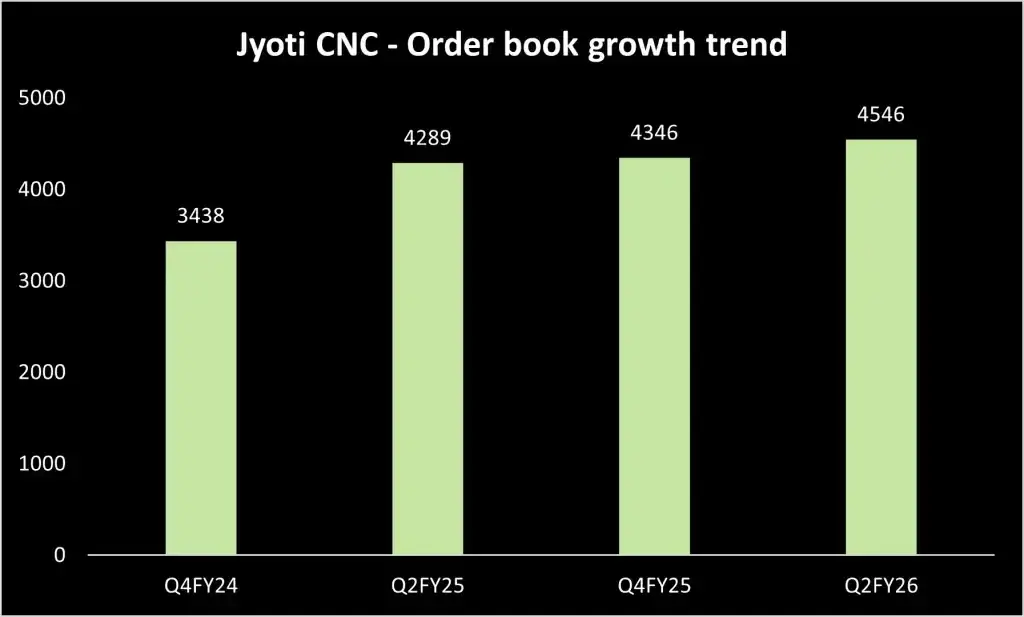
Order Book Adds Visibility
Jyoti has maintained a large, diversified order book across aerospace, auto, electronics manufacturing services (EMS), and general engineering.A strong backlog helps smooth revenue recognition and protects margins during slowdowns — an underrated driver of profit consistency in capital goods
Vertical Integration Protects Margins
The company manufactures many critical components in-house — from castings to precision assemblies.
This reduces supplier dependence and shields margins during inflationary or supply-chain shocks. In a business where input costs can swing, this structure matters
Technology Edge via Huron
Its acquisition of Huron Graffenstaden gives access to advanced 5-axis technology and European aerospace customers.This positions Jyoti as a technology player rather than a low-cost manufacturer — a crucial distinction when competing globally
Capacity Expansion Backed by Demand
Capacity is being scaled meaningfully over the next two years, and current utilization levels are already high.That suggests expansion is demand-led, not speculative — a positive sign for future profit visibility
Cleaner Balance Sheet Improves Profit Quality
IPO proceeds were used to reduce debt, lowering the interest burden and improving earnings stability.
For a capital goods firm, lower leverage significantly reduces downside risk during slow cycles
9) Anant Raj Ltd: Real Estate Cash Flows Funding a Digital Pivot
Anant Raj is no longer just a NCR-focused developer riding a property cycle. The company is evolving into a hybrid model where real estate drives near-term cash and digital infrastructure builds recurring income. That combination is beginning to show up clearly in profits.
Multi-Year Profit Compounding Is Visible
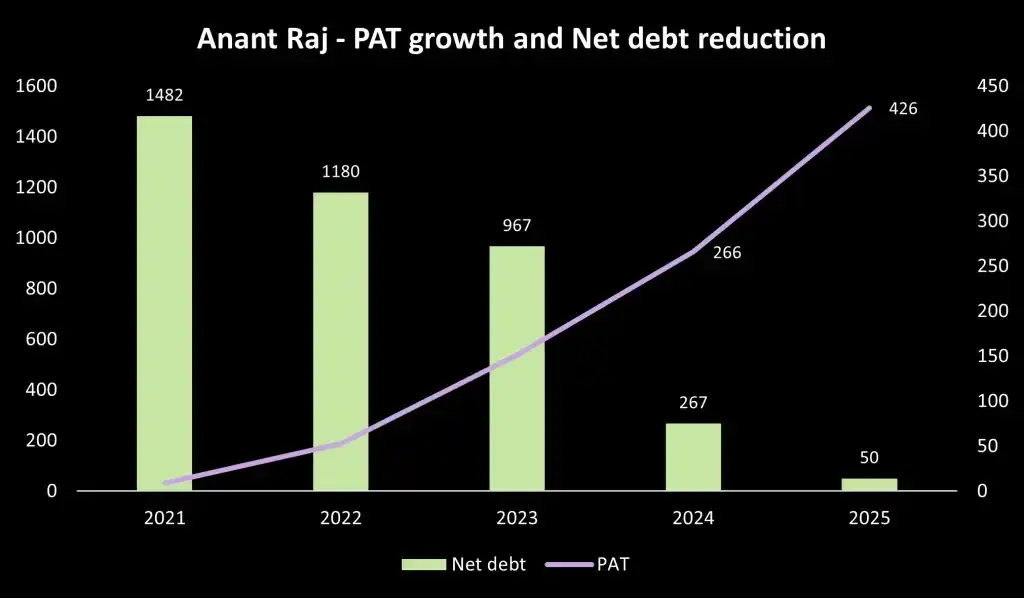
Profit growth here is not a one-year story.PAT has moved from ₹151 crore in FY23 to ₹266 crore in FY24 and further to about ₹426 crore in FY25. That translates to a ~149% CAGR since FY21.
Revenue has also scaled steadily, but profits are growing faster, helped by better realizations and lower finance costs. This shows earnings momentum, not a spike.
Balance Sheet De-Risking Boosts Profit Quality
Net debt has fallen sharply from over ₹1,400 crore a few years ago to around ₹50 crore in FY25. Interest costs have dropped accordingly, directly supporting PAT growth.The company is now adequately capitalized for expansion without relying heavily on leverage
Sector 63A: Pricing Power, Not Volume Push
The flagship Anant Raj Estate in Sector 63A, Gurugram, is the key profit engine. Premium projects like Ashok Estate and Estate Residences have seen strong demand and sell-through.
Importantly, growth is coming from price realization and premium positioning rather than discount-led sales. The company also sits on a large, historically acquired land bank in the same belt, providing visibility for future launches
Data Centres Are Moving Toward Revenue Mode
Anant Raj’s data centre strategy is shifting from plans to execution.
Operational capacity has already been commissioned at Manesar, with multiple sites across Manesar, Panchkula, and Rai forming a larger pipeline. The company is targeting meaningful IT load capacity over the next few years, using its own tech parks to control costs
Data centres add annuity-like income, which can smooth real estate cyclicality.
Cloud Adds a Higher-Margin Layer
Through its cloud platform and partnerships, the company is moving beyond colocation into services.Infrastructure-as-a-Service is already live, with plans to expand into platform and software services. This shifts the model from pure asset ownership to value-added digital services
Cash-Backed Growth Matters
Strong collections and internal accruals have funded expansion and debt reduction. Capital is being deployed into execution and digital infrastructure rather than aggressive land hoarding.That improves earnings durability.
10) Poly Medicure Ltd: Global MedTech Player with Steady Profit Compounding
Poly Medicure is one of the few Indian medical device companies that has translated scale, exports, and innovation into consistent profit compounding. This is not a turnaround or a one-cycle recovery — the numbers show a steady multi-year trend.
Multi-Year Compounding Is Clear
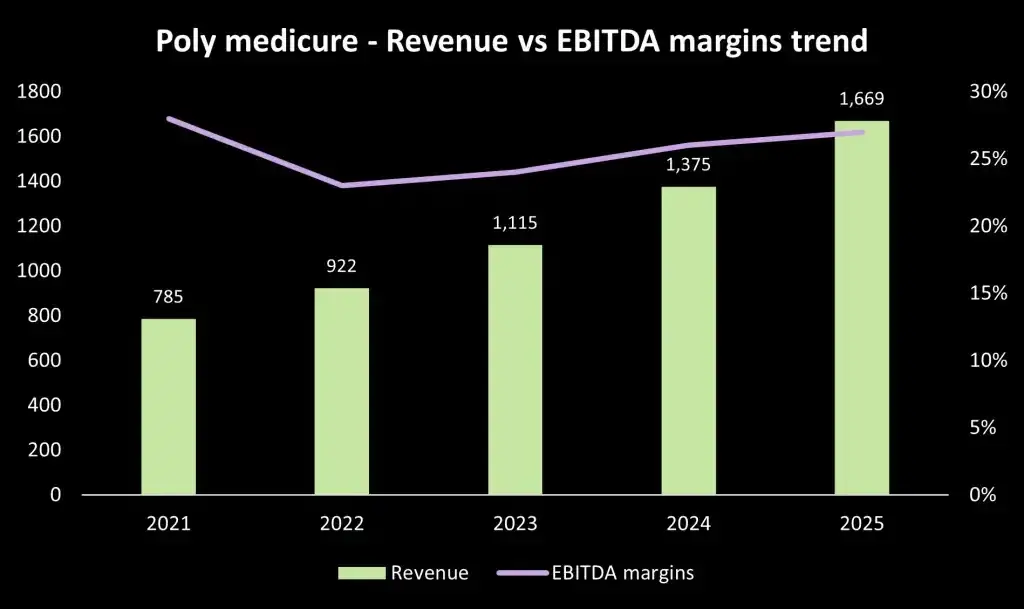
Over the past five years, revenue has climbed from under ₹800 crore to about ₹1,670 crore, while PAT has moved from ₹136 crore to ₹339 crore. EBITDA has more than doubled in the same period.FY25 itself delivered ~21% revenue growth and ~30% EBITDA growth, with margins improving further. That’s a rare combination of growth plus profitability in manufacturing
High Margins Provide a Cushion
EBITDA margins are above 30%, among the best in Indian healthcare manufacturing. Gross margins remain strong as well, helped by automation and product mix.
High margins matter because they absorb raw material or freight volatility without derailing profits
Export-Led Model Adds Stability
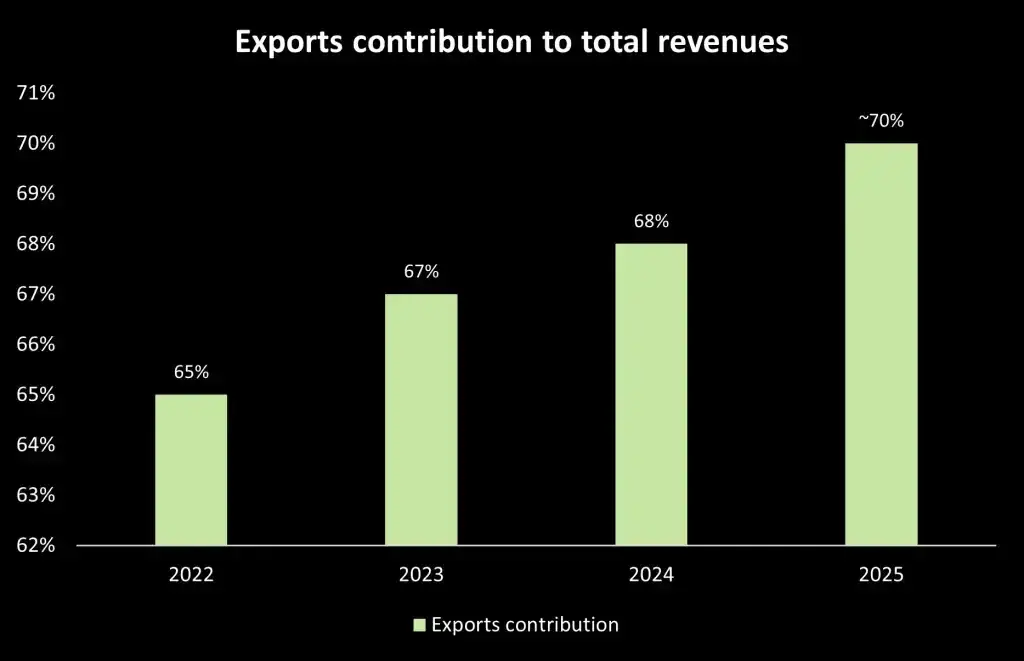
Around 70% of sales come from exports to regulated markets across Europe, the US, and other developed regions. The company sells to 125+ countries and has long-standing distributor relationships.This diversification reduces dependence on any one geography and supports pricing power
Innovation Is a Real Moat
Poly Medicure isn’t just a contract manufacturer. It has a DSIR-approved R&D centre and 334+ global patents.
Its 200+ product portfolio spans infusion therapy, oncology, anesthesia, urology, and dialysis — categories where safety and reliability matter more than price. That depth creates customer stickiness.
Strong Balance Sheet, Clean Growth
The company operates with a net cash position and funds most capex through internal accruals. ROCE remains healthy, showing efficient use of capital. This keeps profit growth from being leverage-driven
Policy Tailwinds Support Visibility
PLI schemes and regulatory separation of devices from pharma are helping domestic manufacturers scale. As India pushes medical-device self-reliance, organized players like Poly Medicure stand to benefitFor readers who want a deeper framework to evaluate businesses like these, here’s a complete guide on analyzing mid-cap companies step-by-step.
Read our article on: How to analyze a Mid Cap Company?
Explore our Products
Research Framework

Emerging Titans
Combination of quantitative analysis, industry tailwinds, and management assessment - SPRINT investment philosophy

Tiny Titans
Heavy emphasis on scuttlebutt research, plant visits, and early on-ground signals
Conclusion: Profits Tell the Story Before Prices Do
If there’s one takeaway from this list, it’s this: profit growth leaves clues long before stock prices fully reflect it.In markets, narratives get attention, but numbers build wealth. The companies in this list operate in very different sectors — hospitals, chemicals, engineering, healthcare services, real estate, and medical devices — yet the pattern is similar. Over time, they learned how to:
- Earn more from the same assets
- Improve margins instead of chasing volume
- Convert accounting profit into real cash
- Grow without stretching their balance sheets
That’s what real business quality looks like in practice.
None of these companies are guaranteed winners. Some will slow down. Some may misallocate capital. Some may face sector headwinds. Profit compounding is never a straight line.
You can also read our article on: Common Mistakes Every Small-Cap Investor Makes (And How to Avoid Them)
But studying businesses where profits have already compounded teaches something more valuable than any single stock idea: it shows what to look for.
Look for rising margins.
Look for repeatable demand.
Look for capital discipline.
Look for businesses that quietly execute year after year.
Because by the time a story becomes popular, the easy money is usually gone. Profit trends, on the other hand, show up early — for those willing to read financials instead of headlines.
In the end, markets reward companies that make more money over time. Everything else is noise.
FAQs ( Frequently Asked Questions )
How should I size positions in mid-cap stocks?
+What’s a sensible time horizon for mid-cap investing?
+How do I track whether management execution is slipping?
+Watch for:
Repeated delays in projects
Changing guidance frequently
Rising receivables or inventory without a clear reason
Promoter selling without explanation
Patterns matter more than one bad quarter.
What documents should retail investors actually read?
+You don’t need everything. Start with:
Annual reports (management discussion & capital allocation)
Investor presentations
Earnings call transcripts
These usually reveal strategy, risks, and priorities.
How important is promoter behavior?
+
High growth stock specialist, Value Educator
Shashank Mahajan is an equity research professional with over 12 years of experience in identifying high-potential SME and micro-cap stocks at an early stage. He follows a rigorous scuttlebutt research–driven approach, combining on-ground insights with deep financial analysis. Shashank specializes in uncovering under-researched and under-owned companies with strong management quality and long-term growth potential. Through disciplined research and early identification, he focuses on spotting tomorrow’s market leaders before they enter the mainstream investor radar.

Zen Technologies: Revenue Fell After a Big Win



PNG Jewellers: A 194-Year-Old Name Goes National
Explore our Products
Research Framework
Emerging Titans
Combination of quantitative analysis, industry tailwinds, and management assessment - SPRINT investment philosophy
Tiny Titans
Heavy emphasis on scuttlebutt research, plant visits, and early on-ground signals


 Orders
 Subscription
 Share with friends


Required Details
₹23999.00
(12 month subscription)
As per SEBI regulations, all users are mandated to complete the KYC that is validated for 1 year. Post payment, you will be redirected to the KYC screen


No comments yet. Be the first to comment!