
VA Tech Wabag: Water Plants and a ₹20,207 Cr Order Book

On 14 November 2026, a Chennai water company told the stock exchanges that one of its largest orders was gone. Saudi Water Authority had cancelled the tender for a 300 MLD seawater desalination plant at Yanbu, an award worth about ₹2,332 Cr that the company had signed in July 2025. Only nine days earlier, the same company had reported an order book of ₹20,207 Cr, above ₹20,000 Cr for the first time. So the cancellation takes out about 11.5% of that book in one go.
To see what that means, we first need to see what this company builds. Its biggest jobs are desalination plants. Desalination means taking the salt out of seawater so that people can drink it or factories can use it. Most new plants use seawater reverse osmosis, or SWRO, which pushes seawater at high pressure through membranes that hold the salt back.
These plants are sized in MLD, which stands for million litres a day. A 300 MLD plant makes 300 million litres of fresh water every day. The same company also builds sewage treatment plants, plants that clean factory waste water, and plants that recycle treated sewage so that it can be used again in industry.
At the top end sits ultra-pure water. Ultra-pure water is the name for water cleaned to such a level that it can be used to make solar cells and computer chips. Data centres need large amounts of water too, mostly for cooling, and that is where this company hopes to find a new set of buyers.
That water company is VA Tech Wabag Ltd (NSE: WABAG). It earns money in two ways. Under EPC, which stands for engineering, procurement and construction, it designs a plant, buys the equipment, builds it and hands it over. O&M, which stands for operation and maintenance, means it runs the plant for the owner for years after that and earns a fee every year. Wabag has executed more than 1,500 plants since 1995, works in more than 25 countries and has developed more than 125 patents, trademarks and other rights of its own.
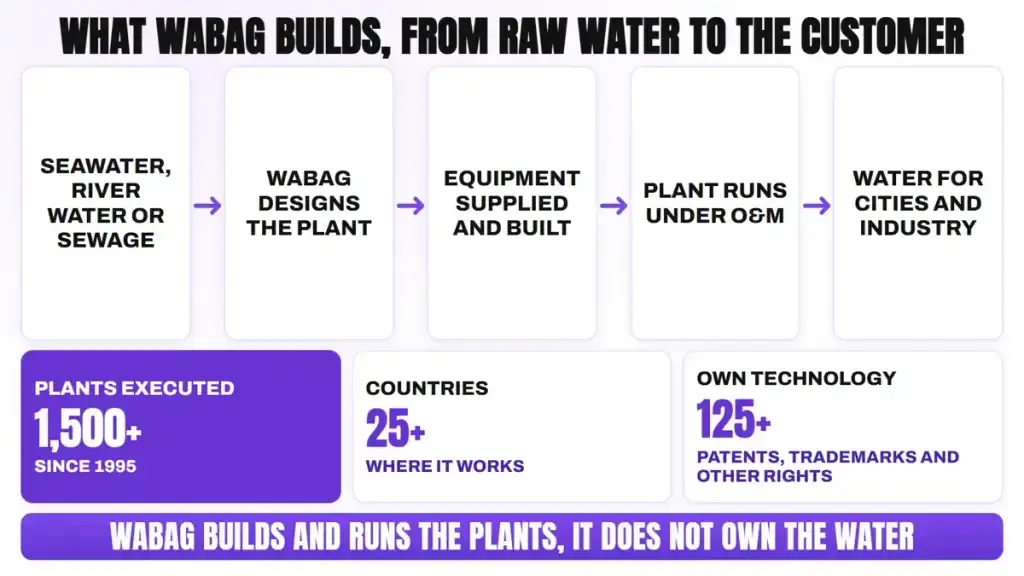
So Wabag sits at a clear point in the water chain. It does not own the water or sell it to homes. It designs, builds and runs the plants that clean it, mostly for city water boards and large industrial companies.
VA Tech Wabag in five numbers
- An order book of ₹20,207 Cr in September 2026, before the Yanbu cancellation
- H1 FY27 revenue of ₹1,887.0 Cr, up 20.3%
- H1 FY27 profit after tax of ₹194.7 Cr, up 29.3%
- Net cash of ₹1,144.2 Cr in September 2026, leaving out its HAM projects
- Return on capital employed of 20.5% in H1 FY27
So a company that lost a ₹2,332 Cr order still holds a book of more than four times its yearly revenue. How did that book show up in the latest numbers? Let's first understand the company, and then look at the latest quarter.
VA Tech Wabag: Company Overview
VA Tech Wabag Ltd is a water treatment company based in Chennai, with roots that go back to a filter maker founded in Wroclaw in 1924. The Indian company took over the WABAG Austria group in 2007 and listed on the NSE and BSE in 2010. Rajiv Mittal is its Chairman and Managing Director, and the promoters held 19.03% of the shares in September 2026. Wabag designs, builds and runs desalination plants, sewage and drinking water plants, industrial effluent plants and water recycling plants for city water boards and industrial companies. It has executed more than 1,500 plants since 1995, works in more than 25 countries and has more than 2,000 employees. Revenue from operations was ₹3,944.2 Cr in FY26, and it held net cash of ₹1,144.2 Cr in September 2026, leaving out its HAM projects. Read this Data Centre Stocks in India 2026: Suppliers and Operators
"Know what you own, and know why you own it."
— Peter Lynch
Wabag's results move with a few large plants in a few regions. Knowing which plants, which customers and which countries make up its book is the first step to reading its numbers.
The Quarter Revenue Crossed ₹1,000 Cr
Let's look at Q2 FY27, the July to September quarter that Wabag reported on 5 November 2026. Revenue from operations was ₹1,000.2 Cr, up 19.9% from ₹834.5 Cr a year ago. It was also 12.8% higher than the ₹886.8 Cr of Q1 FY27. The company says it was its highest second-quarter result so far, with revenue above ₹1,000 Cr and profit after tax above ₹100 Cr.

As we can see, profit grew faster than revenue. EBITDA rose 20.0% to ₹144.6 Cr, at a margin of 14.5%. Profit after tax rose 23.3% to ₹104.6 Cr. Wabag's EBITDA here includes foreign exchange gains on its contracts abroad, which were ₹20.2 Cr in the quarter against ₹31.2 Cr a year ago.
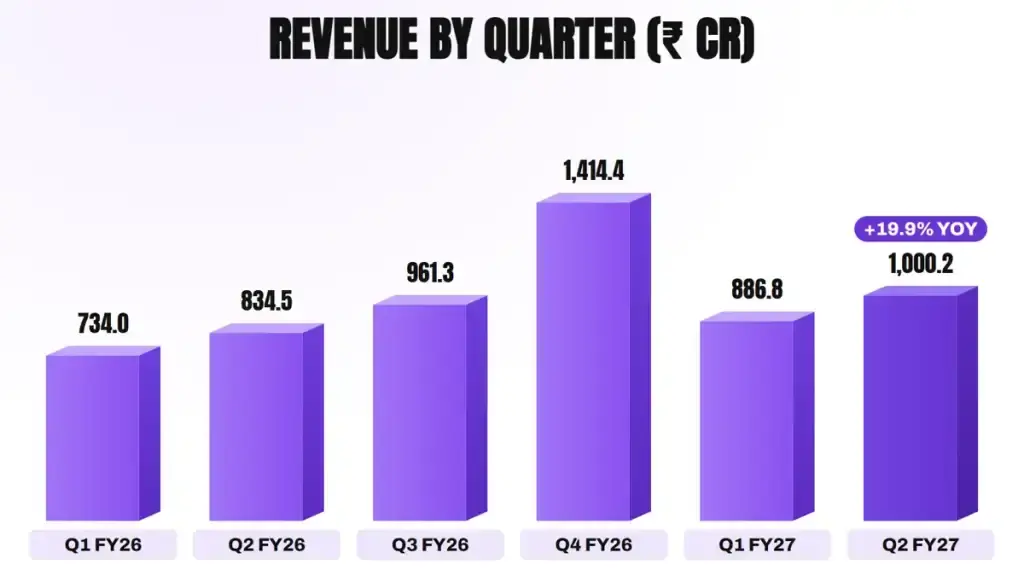
That chart also shows how uneven a project business can be. Revenue was ₹734.0 Cr in Q1 FY26, ₹961.3 Cr in Q3 FY26 and ₹1,414.4 Cr in Q4 FY26. Then it went back to ₹886.8 Cr in Q1 FY27. In a business where a large plant can take three years to build, as in Kuwait, the year matters more than the quarter.
Beyond that line, two costs moved up faster than the top line. Employee cost was ₹98.5 Cr, against ₹75.6 Cr a year ago. Management says this came from yearly pay increases and the new wage code, which raises provident fund and gratuity costs, and that the wage code part will stay. Other expenses were ₹60.3 Cr, against ₹23.2 Cr. Management calls these regular provisions that even out over the year.
Even with those costs, an analyst pointed out that the gross margin was higher than in recent quarters. When he asked if this was a one-off, the finance head said there was no one-off. He called it a structural improvement and asked investors to judge Wabag over a year, not a quarter.
That same pattern shows in the first half. H1 FY27 revenue was ₹1,887.0 Cr, up 20.3%. EBITDA was ₹260.8 Cr, up 20.7%, at a margin of 13.8%. Profit after tax rose 29.3% to ₹194.7 Cr, and the PAT margin went up to 10.3% from 9.6%.
Cash kept pace with that profit. Read this Cash Flow Statement Explained Operating cash flow for the half was ₹224.6 Cr, about 1.15 times the profit after tax. Net cash, leaving out its HAM projects, reached ₹1,144.2 Cr in September 2026, up from ₹950.0 Cr in March. HAM, or hybrid annuity model, is a way of building public projects where the government pays part of the cost during construction and the rest in instalments over many years. Wabag's HAM projects carry their own debt, so the company shows its net cash with and without them. Including them, net cash was ₹1,036.1 Cr.
That cash also shows up in the working capital. Read this Days Sales Outstanding (DSO) Explained Net working capital, the money stuck in the business between paying suppliers and collecting from customers, was 101 days of revenue in September 2026, against 104 days in March 2026 and 121 days in September 2025. Return on equity was 16.3% and return on capital employed was 20.5%.
The Orders Behind the Next Few Years
Now let's look at the orders, because they show how much revenue is already booked. Wabag won ₹5,190.8 Cr of new orders in H1 FY27: ₹3,431.3 Cr in Q1 and about ₹1,759.5 Cr in Q2. It started the year with an order book of ₹16,623.5 Cr, billed ₹1,868.2 Cr of it in the half, and closed September at ₹20,207.1 Cr.
Those orders came from many places. Wabag signed its first order in Kuwait, a 60 MIGD, or about 272 MLD, seawater desalination plant for the Ministry of Electricity, Water and Renewable Energy, built with its partner HEISCO. It covers 36 months of construction and five years of O&M after that, and management puts the project at almost USD 400 million with its partner. Solar panels on the site will meet part of the plant's power needs.
In India, Reliance Industries gave Wabag an order for a 201 MLD desalination plant at Jamnagar, which can grow to about 302 MLD, and a 72 MLD remineralisation plant. Wabag also won a 60 MLD sewage plant at Ajman in the UAE, a water works expansion in Vienna and two sewage projects in Bengaluru. Wabag calls an order Mega when it is above ₹1,000 Cr in India or above USD 150 million abroad, and both Kuwait and Jamnagar are Mega orders.
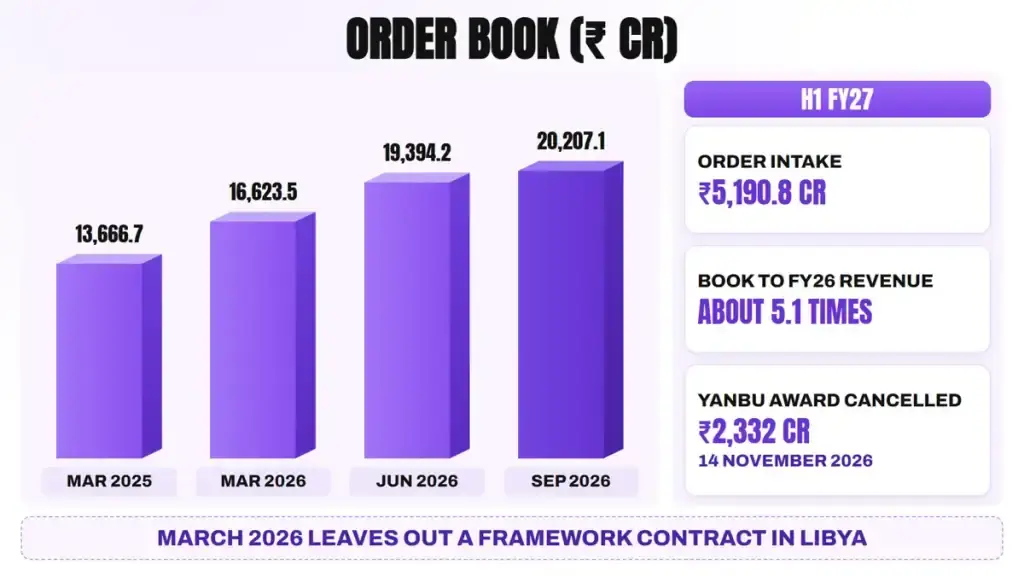
That book has grown fast. It was ₹13,666.7 Cr in March 2025 and ₹16,623.5 Cr in March 2026, leaving out a framework contract in Libya. It reached ₹19,394.2 Cr in June 2026 and ₹20,207.1 Cr in September. Order intake was about ₹7,500 Cr in FY26, up 31% on FY25.
What the order book says: ₹20,207 Cr is about 5.1 times FY26 revenue of ₹3,944.2 Cr. Even if the full ₹2,332 Cr Yanbu award comes out, about ₹17,875 Cr is left, or about 4.5 times FY26 revenue.
That book also has a clear shape. EPC work makes up 68% of it and O&M 32%. City and state water boards account for 81%, and industry for 19%. India is 56% of the book and other countries 44%. Management says Chennai alone is about 15% to 20% of the EPC book, and the Middle East is about 60% to 70% of the international book.
How a 1924 Filter Maker Became an Indian Water Multinational
Now that we have seen the quarter, let's go back and see where this company came from. WABAG was founded in 1924 as a water filter maker in Wroclaw. Over the next decades it passed through German and Austrian owners, including Deutsche Babcock and then VA TECH of Austria. VA TECH WABAG Ltd was set up in Chennai in 1996 as the Indian arm.
That Indian arm then took over its parent. In 2005 its managers bought out the Indian business, backed by ICICI Venture. In 2007 the Indian company took over the WABAG Austria group from Siemens, and in 2010 it listed on the NSE and BSE. Rajiv Mittal is its Chairman and Managing Director today.
The work since then has moved towards larger and harder plants. Wabag executed the first sewage plant under Namami Gange at Varanasi, the 140 MLD Dinapur plant. In 2023 it won a 400 MLD desalination plant at Perur, near Chennai, which it calls the largest in Southeast Asia. In 2025 it won Yanbu, and in 2026 it entered Kuwait.

Those years came after a plan to change the kind of work Wabag takes. In May 2023, management said it would focus on EP jobs, where it does the engineering and supplies the equipment but leaves the civil construction to others. Civil work brings revenue but little margin, and it is often held up by land and right-of-way issues outside Wabag's control.
"One of the best way to put barriers is to use technology as your barrier." - Rajiv Mittal, Chairman and Managing Director, May 2023
That change shows in the margin. The EBITDA margin was 7.95% in FY22. It reached 12.0% in FY23 and 13.2% in FY24, and has stayed between 13% and 14% since. Revenue took longer to move. It was ₹2,979.3 Cr in FY22 and ₹2,856.4 Cr in FY24, before rising to ₹3,944.2 Cr in FY26.
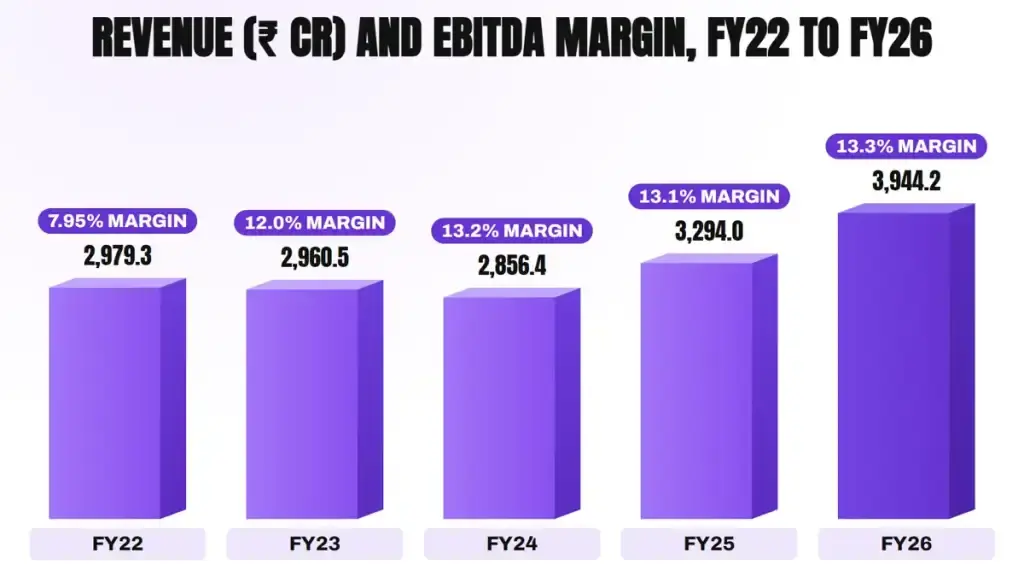
That FY23 year also carried one-time charges of ₹289.2 Cr, so profit after tax was only ₹13.0 Cr. Without those charges, the business was already earning a double-digit EBITDA margin. Since then profit after tax has grown from ₹245.6 Cr in FY24 to ₹370.5 Cr in FY26.
Two Ways to Earn and Three Kinds of Customer
Now let's split the business into its parts, because each part earns money differently. Wabag reports one business, water and waste water treatment, but it shows how its project revenue and order book split by type of work, by customer and by country.

These splits sound alike, but as you will see, each one tells us something different. The type of work decides the margin. The customer decides how Wabag gets paid. And the country decides who the rivals are.

EPC Work That Builds the Plants
Let's start with EPC, which brought in 82% of H1 FY27 project revenue. This covers the full build of a plant, from the design to the last test before handover. Wabag's largest EPC job today is the 400 MLD Perur plant near Chennai. In November 2026 the deputy managing director said about 90% of its concrete work was done, close to 1 lakh cubic metres, and that the plant was on schedule to finish in the coming year.
Inside EPC, Wabag prefers EP work. Both the Kuwait and Jamnagar orders are jobs where Wabag does everything except the civil work, which the customer or a partner handles. Management says these two made up about 80% of the first quarter's order intake. Over time it wants at least 20% to 30% of its orders to be EP.
O&M Work That Runs Them for Years
Next, let's look at O&M, the slower but steadier line. It brought in ₹330.1 Cr in H1 FY27, or 18% of project revenue, up 13% from a year ago. The O&M order book reached about ₹6,500 Cr, its highest so far, because many new plants come with five or more years of running work after they are built.
That matters for margins and visibility. Management calls O&M a high-margin, recurring line, and wants it to reach 20% of revenue. Wabag runs plants under long contracts in India, such as the O&M of water systems in Agra and Ghaziabad, and the Kuwait plant will add five years of O&M once it is built. In H1 FY27 it also signed an O&M contract with Adani.
Municipal Water and Sewage
Now let's move to the customers. City and state water boards brought in 79% of H1 FY27 project revenue. These are jobs for drinking water, sewage treatment and desalination, often paid for by national programmes such as Namami Gange and AMRUT in India, or by lenders such as the World Bank.
The way these jobs are paid for is what Wabag watches most closely. Management says it takes only projects with full payment security: a sovereign guarantee, as with ministries in Saudi Arabia or Namami Gange in India, or funding from lenders such as the World Bank, JICA, ADB and KfW. On some projects it also asks for a letter of credit.
That focus also shapes how Wabag takes part in public projects that need private money. In Kolkata, for example, it is building a sewage project under Namami Gange on the hybrid annuity model. We also see that it has brought in equity partners for most of its HAM projects, so the capital stays off its own books. Its long-term credit rating is AA-/Stable and its short-term rating is A1+.
Industrial Water and New Sectors
Next, the industrial side, which brought in 21% of H1 FY27 project revenue and holds 19% of the book. Here Wabag treats water for refineries, steel plants and power plants. Its customers include Reliance Industries, BPCL, GAIL and CPCL in India, and Saudi Aramco and PETRONAS abroad.
The newer part of industrial work is what management calls future energy: solar, semiconductors, data centres and green hydrogen. Wabag already supplies ultra-pure water to a solar cell plant for RenewSys, and it holds a ₹1,000 Cr order for a 100 MLD desalination plant for Indosol, a solar maker in Andhra Pradesh. Management says these sectors need a view of ten years, and expects only one or two such orders in the next 12 to 18 months.
That mix between cities and industry moves with the capital spending cycle. Management says that up to FY25 industry brought in about 30% of revenue on average. We should expect that share to move with large city projects such as Perur. So the 21% share in H1 FY27 tells us more about the timing of city projects than about industrial demand.
India and International
Finally, let's look at geography. International work brought in 54% of H1 FY27 project revenue and India 46%. Most of the international work is in the Middle East. There Wabag is building the 200 MLD Al Haer sewage plant in Saudi Arabia, an order worth ₹1,721.2 Cr, with commissioning targeted for Q4 FY27.
Beyond the Middle East, Wabag works in Africa, Europe and South Asia. It is building two sewage plants in Lusaka, Zambia, and a sewage plant at Pagla in Bangladesh funded by the World Bank. In Europe it won the Vienna order and a project in Georgia. Management says the European market, quiet for years, has picked up in the last couple of quarters.
Where Wabag Sits in the Data-Centre Value Chain
Now let's place Wabag in the data-centre chain, because this is the newest reason investors look at it. A data centre needs land, power and cooling before a single server goes in. Management says power and water are the two things a data centre uses most, and that the water goes mainly into air conditioning.
That water has to come from somewhere. Management says cities can meet that need by recycling treated sewage with membranes, so that data centres reuse water in place of fresh water. Wabag already runs such recycling plants. Its tertiary treatment reverse osmosis plants at Koyambedu and Kodungaiyur in Chennai and at Ghaziabad turn treated sewage into water clean enough for industry.

So Wabag's place in the chain is the water layer. It does not build the data hall or the cooling system. It can supply recycled water, desalinated water or ultra-pure water to the site, and run the plant that makes it. Management says it has started talking to potential clients, and named Google, Adani and Reliance.
Management also makes a case for water cooling itself. In November 2026 the chairman said many data centres had chosen air-cooled systems. He argued that water-cooled systems cost less to build and to run, as long as the water supply is reliable and affordable.
That said, the data-centre line is still small. Wabag has not named a data-centre order so far. Management says these orders will be far smaller than its usual desalination jobs, never ₹1,000 Cr or ₹5,000 Cr in a single order, and will take about 12 to 15 months to build. The upside it sees is repeat work, since each data-centre owner adds units as it grows. Because these jobs are smaller and must be built in about a year, Wabag has set up a separate team and vertical for them, so that they do not compete for attention with its large desalination plants. For now, data centres are a target market for Wabag, not a revenue line.
"In the short run, the market is a voting machine but in the long run, it is a weighing machine."
— Benjamin Graham
A new theme such as data-centre water can draw attention long before it shows up in orders. For Wabag, the weight will come from named orders and the revenue they bring.
Why Wabag's Moat Is Hard to Copy
Now that we have seen the parts, let's understand the moat. Building a water plant is not new, and many Indian and foreign companies bid for the same tenders. Most public water tenders still go to the lowest bidder. So the question is how Wabag wins without simply cutting its price. Read this Economic Moat Explained
One part of the moat is technology. Wabag has more than 125 patents, trademarks and other rights of its own, and research centres in Europe and India. If you buy a large desalination plant, you judge bidders on their past plants and on the running cost over the plant's life. You also check whether their plants meet the quality standard. Those tests keep newer bidders out of the largest jobs.
"In business, I look for economic castles protected by unbreachable moats."
— Warren Buffett
Wabag's castle is its record of large plants that work. The question is how wide that moat stays as more bidders build the same kind of plants.
The track record adds another layer. Wabag has executed more than 1,500 plants since 1995 and says it is among the world's top three private water operators and desalination plant suppliers. A city that needs a 400 MLD plant to work from day one tends to pick a bidder that has built one before.
Beyond technology and references, the way Wabag works adds a third layer. It stays asset light, which means it does not own the plants it builds, and it leaves most civil work to partners. That keeps its own capital small and is why its return on capital employed reached 20.5%. Its long O&M contracts then keep it close to the customer for years after the build.

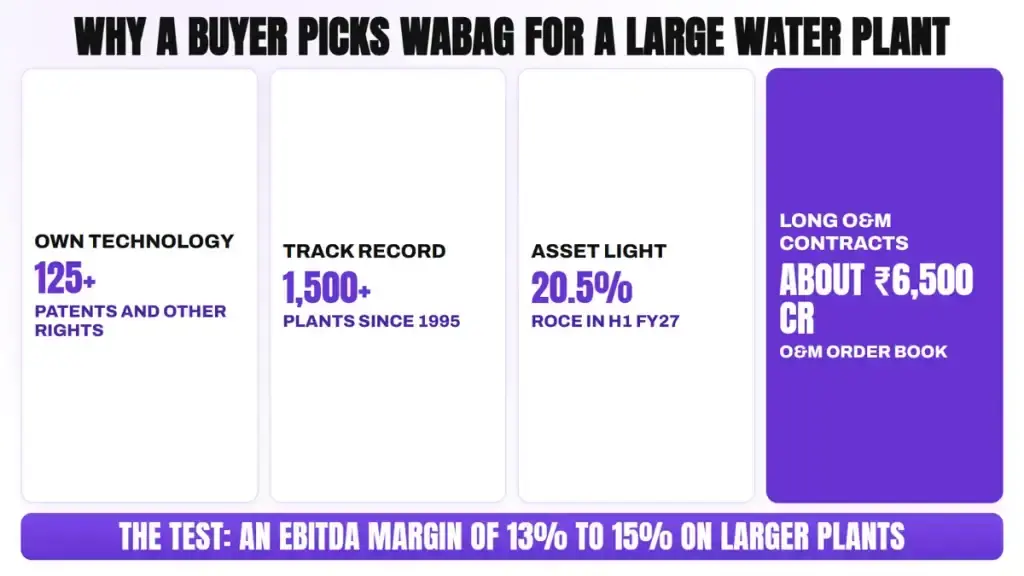
That table shows us why the margin is the real test of the moat. If buyers pay for the technology and the track record, Wabag should hold an EBITDA margin in its 13% to 15% range even as it bids for larger plants. So far it has: the margin was 13.1% in FY25, 13.3% in FY26 and 13.8% in H1 FY27.
Financials: Five Years of Revenue, Margins and Cash Flow
One quarter can mislead in a project business, so let's look at the full years together. EBITDA here is as the company reports it, including foreign exchange gains on its contracts; FY22 and FY23 still include two European subsidiaries that were later sold.
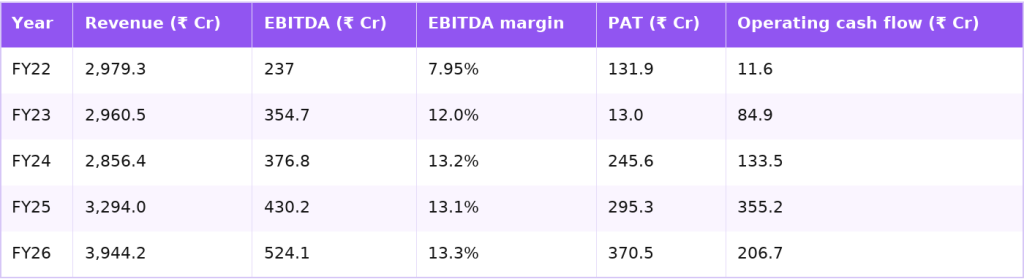
Revenue grew about 1.32 times in four years, from ₹2,979.3 Cr in FY22 to ₹3,944.2 Cr in FY26, while profit after tax grew about 2.8 times, from ₹131.9 Cr to ₹370.5 Cr. The gap came from the margin: the EBITDA margin rose from 7.95% in FY22 to 13.3% in FY26 as Wabag moved towards EP and technology-heavy jobs. FY23 carried one-time charges of ₹289.2 Cr, which is why profit after tax was only ₹13.0 Cr that year.
Cash flow has lagged profit. From FY22 to FY26, operating cash flow added up to about ₹791.9 Cr, against about ₹1,056.3 Cr of profit after tax, or about 75%. Public water projects are paid in stages, and trade receivables stood at ₹2,580.7 Cr in September 2026. Operating cash flow was ₹224.6 Cr in H1 FY27 alone.
The balance sheet carries little debt. Borrowings were ₹182.1 Cr in September 2026, against a net cash position of ₹1,144.2 Cr, leaving out the HAM projects. So the company funds its growth mostly from its own cash, not from loans.
"Only when the tide goes out do you discover who's been swimming naked."
— Warren Buffett
FY23 showed how one year of charges can wipe out a year's profit. Wabag's cash and its net cash position are the numbers that show how well it can absorb such a year.
What the Next Few Years Could Look Like on Management's Numbers
So where does the business go from here? On 6 November 2026 management repeated its medium-term targets, which it first set out in May 2024 for the next three to five years. It aims for revenue growth of 15% to 20% a year, an EBITDA margin of 13% to 15%, return on capital employed above 20% and return on equity above 15%. It also wants O&M at 20% of revenue and a positive net cash position.
Those targets come with a new plan. Wabag calls its current five-year plan Wriddhi 1.0, which ends this financial year. Management says it has met or beaten most of its numbers, and plans to show Wriddhi 2.0, the plan for the next five years, at its investor meet in May 2027.
Now let's put the revenue target against the first half. If FY27 revenue grows 15% to 20% on FY26, it would be about ₹4,535.8 Cr to ₹4,733.0 Cr. H1 FY27 brought in ₹1,887.0 Cr, so the second half would need about ₹2,648.8 Cr to ₹2,846.0 Cr. That is about 11.5% to 19.8% more than the ₹2,375.7 Cr of H2 FY26.

That second half has a few large milestones in it. The Al Haer plant is due to be commissioned in Q4 FY27, and Perur is due to finish in the coming year. Management also hopes the next 12 to 18 months will bring a very large order intake. It says it is working to become the preferred bidder on several large jobs in the next one or two quarters.
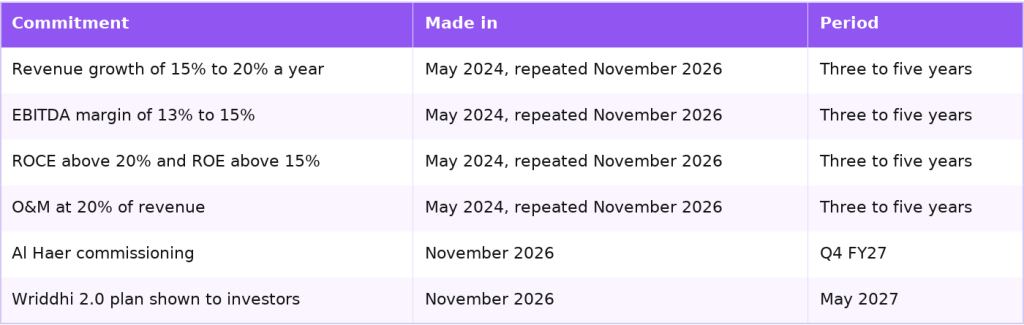
Those commitments are easier to judge against the past. So let's check what management said before against what it delivered.

That record shows us a clear pattern. Revenue and margin targets have been met for two years and a half, and the return on capital crossed its target only in the latest half. O&M is the one target still short. That makes the order book, the margin and the O&M share the numbers to watch from here.
Key Risks
Now let's look at what could go wrong for Wabag, because the last few weeks have already shown one of these risks.
- The Yanbu cancellation: the ₹2,332 Cr Yanbu award was about 11.5% of the September book. On 6 November management said long-lead equipment had already been ordered ahead of the formal start. The company is still asking the customer about the reason and the next step, so any cost from that early work is not yet known.
- Middle East exposure: the Middle East is about 60% to 70% of the international book. Management says the conflict in the region has caused large shipping delays and higher commodity prices, and that new Saudi projects have been slow to start.
- Project delays: the Indosol solar customer lost part of its land after a change of government in Andhra Pradesh and has secured 900 of 1,000 acres. The World Bank-funded Bangladesh project is running about six months late.
- Receivables: trade receivables were ₹2,580.7 Cr in September 2026, about 65.4% of FY26 revenue, with another ₹594.0 Cr due after more than a year. Public customers can pay late even when the project is funded.
- Tax disputes: indirect tax matters under dispute rose to ₹227.9 Cr in March 2026, from ₹101.1 Cr a year earlier, and income tax demands under appeal were ₹19.3 Cr.
- Concentration in Chennai: Chennai projects make up about 15% to 20% of the EPC book, so delays at one water board would show in the numbers.
- Rising costs: employee cost rose to ₹98.5 Cr in Q2 FY27 and the wage code part will stay. Indian contracts carry price escalation formulas, but a long fixed-price job abroad depends on hedging and early buying.
- Uneven quarters: revenue swung from ₹1,414.4 Cr in Q4 FY26 to ₹886.8 Cr in Q1 FY27. A delay in one large plant can move a quarter a lot.
- Succession: the chairman leads the company and its largest client ties. Management says it is grooming internal and outside talent. His son Rohan Mittal has been in the business for nine years and handles the Middle East, GCC and Africa region.
- Data-centre hopes: Wabag has no named data-centre order yet, and management expects such orders to be small. A reader who buys the data-centre angle alone may be disappointed for some years.
"These order sizes are never going to be INR 5,000 crores or INR 1,000 crores, a single order. They are going to be much smaller." - Rajiv Mittal, Chairman and Managing Director, November 2026
"All I want to know is where I'm going to die, so I'll never go there."
— Charlie Munger
For Wabag, the places to watch are clear: cancelled or delayed awards, the Middle East and slow-paying public customers. The list below sets out each one.
Explore our Products
Research Framework

Emerging Titans
Combination of quantitative analysis, industry tailwinds, and management assessment - SPRINT investment philosophy

Tiny Titans
Heavy emphasis on scuttlebutt research, plant visits, and early on-ground signals
What to Track Next
If you follow Wabag, these are the signals that will show where it goes next.
- The order book after the Yanbu cancellation, against ₹20,207 Cr in September 2026
- H2 FY27 revenue against the 15% to 20% growth range, and the EBITDA margin against 13% to 15%
- Net cash after ₹1,144.2 Cr, and net working capital after 101 days
- Al Haer commissioning in Q4 FY27 and the finish of the Perur plant
- The O&M share of revenue against the 20% target, after 18% in H1 FY27
- A first named data-centre or semiconductor water order, and the Wriddhi 2.0 plan in May 2027
Conclusion
Let's put it all together. VA Tech Wabag has grown its order book from ₹13,666.7 Cr in March 2025 to ₹20,207.1 Cr in September 2026, and its revenue from ₹2,856.4 Cr in FY24 to ₹3,944.2 Cr in FY26. Its EBITDA margin has stayed within its 13% to 15% range, and it has held net cash for 15 quarters in a row. The cautious thread is the Yanbu cancellation and the Middle East, which together decide how much of the September book turns into revenue. The next two quarters will show how the book looks after Yanbu.
Still, the next step is about more than one large book. What happens next depends on how much of the Yanbu work Wabag recovers, whether the Middle East keeps paying and shipping on time, and whether the newer water markets, data centres among them, turn into orders.
FAQs
What does VA Tech Wabag do?
+VA Tech Wabag designs, builds and runs water treatment plants: desalination plants, sewage and drinking water plants, industrial effluent plants and water recycling plants. It works for city water boards and industrial companies in India and in more than 25 countries. FY26 revenue from operations was ₹3,944.2 Cr.
How did VA Tech Wabag do in H1 FY27?
+Revenue from operations rose 20.3% to ₹1,887.0 Cr. EBITDA was ₹260.8 Cr at a margin of 13.8%, and profit after tax rose 29.3% to ₹194.7 Cr. Net cash, leaving out its HAM projects, reached ₹1,144.2 Cr in September 2026.
What is VA Tech Wabag's order book?
+The order book was ₹20,207 Cr in September 2026, about 5.1 times FY26 revenue. It included the ₹2,332 Cr Yanbu desalination award in Saudi Arabia, which the customer cancelled in November 2026. Without the full Yanbu value, about ₹17,875 Cr would be left.
Does VA Tech Wabag supply water to data centres?
+Not yet through a named order. Wabag sees data centres as a target market for recycled water, desalinated water and ultra-pure water, mainly for cooling. Management says these orders will be much smaller than its usual desalination jobs and expects only one or two such future energy orders in the next 12 to 18 months.
What are VA Tech Wabag's medium-term targets?
+Management targets revenue growth of 15% to 20% a year, an EBITDA margin of 13% to 15%, return on capital employed above 20%, return on equity above 15% and O&M at 20% of revenue, with a positive net cash position. In H1 FY27 it reported 20.3% growth, a 13.8% margin, 20.5% ROCE and 16.3% ROE.
What are the main risks for VA Tech Wabag?
+The ₹2,332 Cr Yanbu award was cancelled, and the Middle East is about 60% to 70% of the international book, where shipping delays have grown. Trade receivables were ₹2,580.7 Cr in September 2026, and indirect tax disputes stood at ₹227.9 Cr in March 2026.

High growth stock specialist, Value Educator
Shashank Mahajan is an equity research professional with over 12 years of experience in identifying high-potential SME and micro-cap stocks at an early stage. He follows a rigorous scuttlebutt research–driven approach, combining on-ground insights with deep financial analysis. Shashank specializes in uncovering under-researched and under-owned companies with strong management quality and long-term growth potential. Through disciplined research and early identification, he focuses on spotting tomorrow’s market leaders before they enter the mainstream investor radar.
More about Shashank Mahajan →
PCBL Chemical: Carbon Black Margins and Battery Materials

KEC International: Record Orders, Weak Margin, High Debt

Sona BLW: EV Revenue Now Tops Half of Its Auto Sales

HPL Electric & Power: Smart Meters, Wires and Two Engines

Kaynes Technology: EMS, Chip Plants and ₹10,563.5 Cr Orders

Sterlite Technologies: Glass Rods to Hyperscaler Deals
Explore our Products
Research Framework
Emerging Titans
Combination of quantitative analysis, industry tailwinds, and management assessment - SPRINT investment philosophy
Tiny Titans
Heavy emphasis on scuttlebutt research, plant visits, and early on-ground signals



India's Aerospace Opportunity
Global Demand. Supply Bottlenecks. Opportunities Ahead.
Don't Miss This Exclusive Webinar!
Join Value Educator to decode the key trends shaping India's aerospace sector and learn how to identify tomorrow's potential leaders in the space.
- How the aircraft value chain works, layer by layer
- Indian companies supplying global aircraft makers
- A framework to judge any aerospace company

 Orders
 Subscription
 Share with friends


Required Details
₹23999.00
(12 month subscription)
As per SEBI regulations, all users are mandated to complete the KYC that is validated for 1 year. Post payment, you will be redirected to the KYC screen


No comments yet. Be the first to comment!