
Staying Calm in a Market Crash
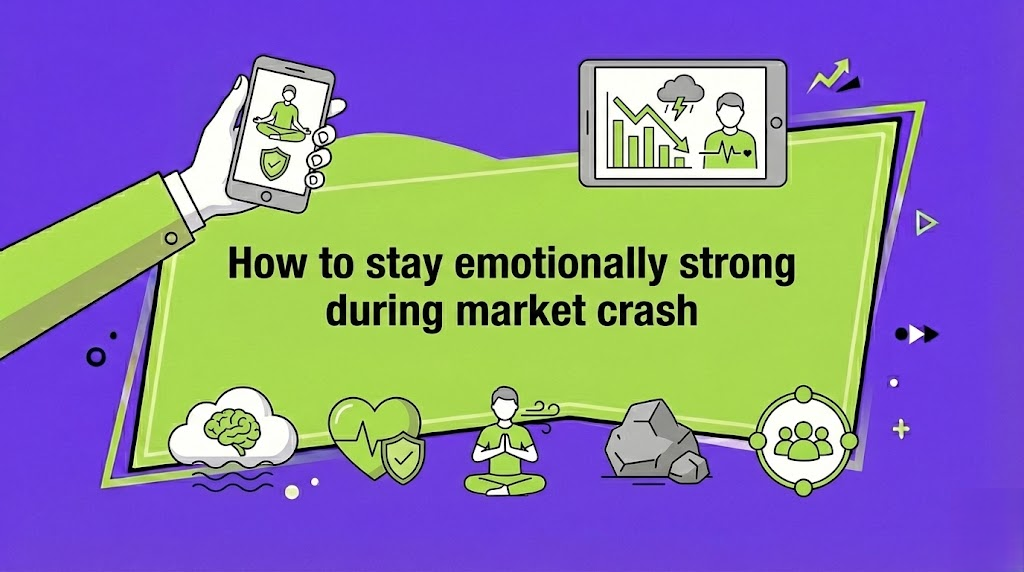
“The biggest enemy of investment success is the emotions of the investor.” – Benjamin Graham.
This line captures what plays out in real life for most investors.
Most investors don’t lose money because they chose a bad business. They lose money because, at the wrong moment, they choose emotion over clarity. Everything feels fine when markets are calm. Prices move slowly, confidence stays high, and logic feels easy.
You remember why you bought the stock, because you trust the business. Then a market crash arrives. Screens turn red. Social media spreads fear. Suddenly, the same stock you believed in yesterday starts to feel risky today, not because the business changed overnight, but because your emotions did.
This is where many investors fell. They stop thinking like business owners and start reacting like frightened traders.
Take the case of the Adani Group. Before the controversy, many investors held Adani stocks. They believed in their infrastructure, heavy businesses, ports, airports, power assets, and long-term contracts, which are backed by years of capital investment. These were not short-term trades; they were long-term bets on India’s infrastructure growth.
Then one morning, suddenly everything changed
A report was released by Hindenburg Research, a foreign short-selling firm. The report made serious allegations at the company by questioning governance, leverage, and ownership structures.
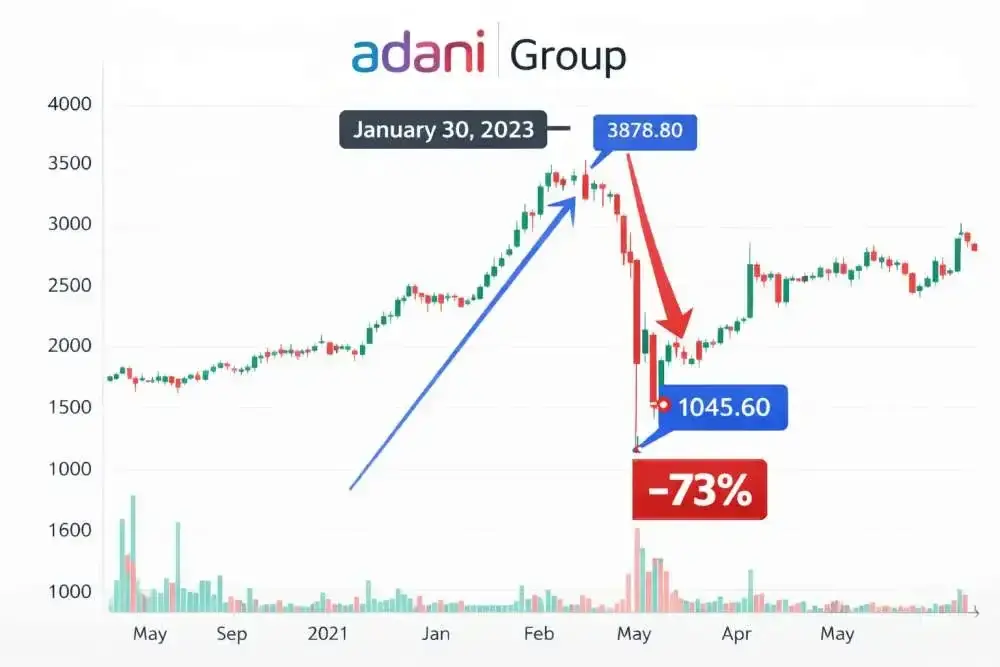
The market reacted instantly. But here’s the important part of the story.
What actually changed overnight?
- Was it the ports, which are still operating?
- Were it airports, which are still running?
- Was it the Power plants, which are still generating electricity?
- Or was it Long-term contracts which are still intact?
The truth is, the businesses were functioning exactly as they had the day before.
What changed was the story investors were hearing.
- Television debates grew louder.
- Social media turned aggressive.
- Headlines screamed words like “collapse, “fraud” and “zero.”
- Fear travelled faster than facts.
- Prices fell, and panic followed.
Sebi Report
What was the impact of this fear on the market? Many investors sold not after checking the business, but because holding the stock felt emotionally uncomfortable.
The Adani case shows that “Risk of losing doesn’t begin with allegations. It begins when Emotion overtakes Clarity.”
A similar pattern played out earlier in the case of Tata Motors.
There was a time when the market wrote off Tata Motors. The stock kept falling. Everyone was talking about the headlines focused on high debt, weak auto demand, and problems of its subsidiary, Jaguar Land Rover. Investors assumed that the business was broken andthat there was nothing left in the stock of Tata Motors.
But beneath the falling price, the company was still operating. Cars were still being sold. Brands still had value.
Management was working on cost control, debt reduction, and long-term strategy. The problems were real, but they were cyclical, not terminal. Many investors didn’t even bother to understand the company’s operations, financials or their strategies to tackle this situation by reading its annual reports or conference call transcripts. They just sold because, in that moment, fear felt more comfortable than patience. They booked their losses. Once again, emotion replaced clarity.
What happened next is history repeating itself. During a bad cyclical period, the price of a strong business may fall, but the business itself often remains unchanged. And when recovery finally came through, improving cash flows, stronger margins, and renewed EV momentum, the stock price once again soared to new highs.
What happened in Adani and Tata Motors is not new.
The same emotional pattern had played out in every major market crash.In 1992, during the Harshad Mehta scam, many investors chased rising prices without really understanding how the system worked. When reality surfaced, confidence collapsed almost overnight, and panic selling took over. Share prices fell sharply, not because all businesses had suddenly failed, but because trust in the market had disappeared.
During the Dot-com crash of 2000–02, investors happily ignored fundamentals while prices kept rising. Later, when prices fell, the market turned, and they ignored even strong businesses. In both the boom and the bust, decisions were driven more by emotion than by understanding.
In the 2008 financial crisis, the same behaviour played out on a much larger scale. The global financial crisis triggered fear everywhere. Investors sold almost everything; strong companies and weak are treated the same, simply to escape uncertainty. Those who stayed invested eventually recovered. Those who sold in panic turned temporary declines into permanent losses.
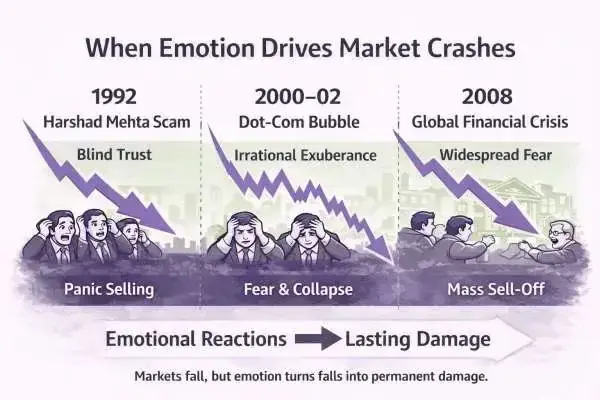
The risk of loss doesn’t come from market volatility. It comes from investing in something you don’t fully understand.
Warren Buffett captured this perfectly when he said, “Risk comes from not knowing what you’re doing.” And this isn’t just about investing, it’s how life works.
“If you don’t know how to swim, even a calm river feels dangerous.”
“If you don’t know how to drive, a wide highway feels frightening.”
Markets work the same way.
During a crash, prices fall for everyone. But panic appears only when understanding is missing. If you don’t truly know the business you own, every headline feels threatening, every red candle feels alarming, and every dip feels like it might never end.
Understanding risk makes wealth creation easier, but real wealth is built patiently over time. If you also want to make wealth in the long term, you can read our article: The Power of Compound Interest - How to create wealth in the stock market.
And that is what separates great investors from everyone else.
How Great Investors Control Emotion When Markets Crash
Take the case of Rakesh Jhunjhunwala, during the COVID crash.When the pandemic hit in 2020, fear did not selectively attack weak businesses. It attacked entire sectors. Hospitality was among the worst hit. Lockdowns brought travel to a complete halt. Hotels had zero occupancy. Revenues collapsed almost overnight. Headlines openly questioned whether luxury hotels would even be relevant in a post-COVID world.
The stock market reflected this fear brutally. Indian Hotels Company Limited, the owner of the iconic Taj Hotels, saw its stock price collapse along with the sector. For most investors, the logic felt obvious: no travel, no revenue, no future. Many exited simply because holding a hotel stock during a global lockdown felt emotionally unbearable. But Jhunjhunwala did not look at Indian Hotels the way the market did. While others were staring at quarterly losses and empty hotel rooms, he was asking very different questions:
- Has the Taj brand lost its relevance overnight?
- Will people stop travelling permanently?
- Can a business with irreplaceable assets and a century-old legacy disappear because of one bad year?
The answers were obvious to anyone looking beyond fear. The Taj hotels still stood on some of the most valuable land parcels in India. The brand still carried unmatched trust and prestige. The company was backed by the Tata Group, with access to capital and the ability to survive a prolonged downturn. What had collapsed was short-term demand, not long-term value.

This is where understanding overpowers emotion.
Jhunjhunwala did not see Indian Hotels as a “hotel stock facing losses.” He saw it as a collection of irreplaceable assets temporarily mispriced due to panic. While prices were falling, the business itself was not shutting down.Hotels were empty - but not destroyed.
Cash flows were stressed - but survival was intact.
The market was reacting to fear, not reassessing intrinsic value.
That clarity gave him emotional strength.
He didn’t need to predict when travel would resume.
He didn’t need to guess the bottom.
He simply needed to know that the business would still exist on the other side of the crisis.
And when travel eventually returned, pent-up demand kicked in, domestic tourism surged, margins improved, and Indian Hotels emerged stronger. Those who stayed patient benefited. Those who sold early realised, once again, that their loss did not come from choosing a bad business; it came from abandoning understanding at the worst possible moment.
This is the common thread across every example: Adani, Tata Motors, and Indian Hotels.
The businesses didn’t collapse overnight.
Confidence did, Patience did, and Clarity did.
This reminds us of the famous quote of Warren Buffett, “The stock market is a device for transferring money from the impatient to the patient.”
Market crashes don’t test your ability to pick stocks. They test your ability to remember why you picked them in the first place. And that is the real meaning of emotional strength in investing.
So, how do you design your portfolio to survive your own emotions?
It is emotion that makes investors sell Adani even when the core business is still intact.It is emotion that forces them to exit Tata Motors during a temporary downturn.
And it is the same emotion that repeatedly turns market volatility into personal loss.
That is why emotional strength matters.
To build this strength, you don’t need to block the news or shut out the world.
You need clarity - clarity about what you own, why you own it, and what truly matters when prices fall.
That is why we have designed this 7-step checklist.
These steps act like a shield.
They protect your decisions by keeping you grounded in fundamentals and preventing emotions from taking control during market crashes.
Building Emotional Strength: A 7-Step Checklist for Market Crashes
1. Asset Allocation
The first step to becoming emotionally strong is not stock selection, but how you allocate your money.A wise investor does not put all their funds into one asset class. Instead, spread across equity, debt, and commodities - especially gold.
Each asset plays a different role:
- Equity helps create long-term wealth but comes with volatility.
- Debt provides stability and predictability during uncertain periods.
- Gold acts as a hedge, often protecting value when markets are under stress.
This is exactly why investors are often reminded: “Don’t put all your eggs in one basket.”
When a market crash happens, equities may fall sharply. But debt and gold usually hold up better. Because of this balance, your entire portfolio doesn’t fall at once, and neither does your confidence.
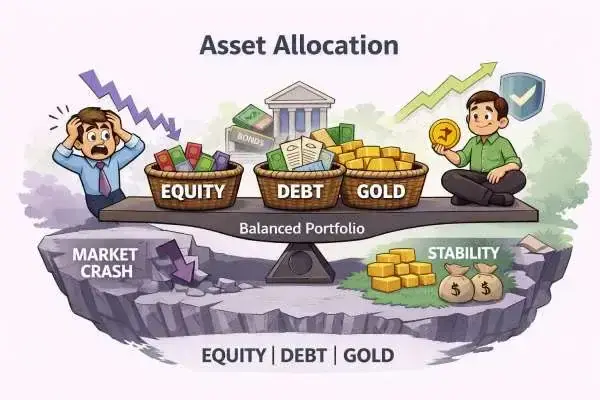
Historically, It has been seen that gold has often shown an inverse relationship with equities. So when stock markets struggle, gold tends to hold value or perform better, which helps being emotionally strong during the downturn.
For beginners, understanding asset allocation early makes a huge difference. If you’re starting, A Beginner’s Guide to the Indian Stock Market explains these foundations in detail.
2. Diversification (Within Equity)
Putting too much money into one stock or one sector makes every market move feel personal. A single bad news item can shake your confidence. Diversification reduces that pressure.
By spreading your equity investments across different companies and sectors, one mistake or one downturn doesn’t decide your entire outcome. A fall in one stock is easier to handle when the rest of the portfolio isn’t falling the same way.
Diversification isn’t about owning many stocks. It’s about not depending on one idea.
When markets fall, diversified portfolios across sectors help you minimise your losses and help you make a rational decision.
Diversification becomes even more important when investing in small and micro-cap stocks. We’ve explained the risks and opportunities. I have rps 50,000 to invest. How to build a diversified portfolio
3. Know What You Own
Now that you have diversified your money across asset classes and spread your investments within equity, the next step becomes more personal. This is the stage where you stop looking at portfolios and start looking at businesses.Before choosing a stock, you must be clear about one thing:
Why do you want to own this business?
Knowing why you own a stock is what separates confident investors from emotional ones. “Without clarity, every market fall feels like a mistake”.
If you want to understand how strong businesses reveal themselves over time, our data-backed study Common Traits of Every Multibagger Stock – Data-Based study, breaks down what successful companies consistently share.
Let’s take the example of Indian Hotel Ltd, and why did Rakesh Ji choose it?
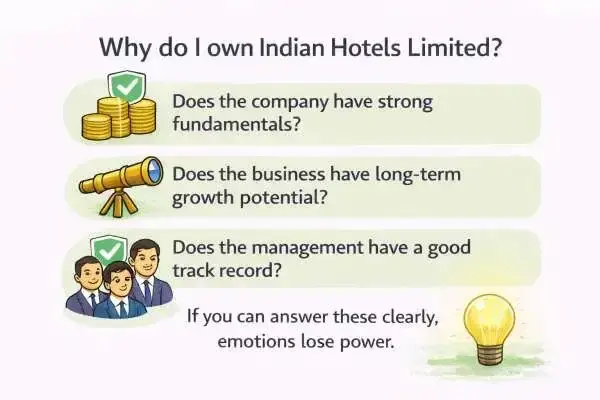
Do Indian Hotels have strong fundamentals?
Yes. It owns premium assets like the Taj brand, has a strong balance sheet, and is backed by the Tata Group.
Does the business have long-term growth potential?
Yes. Travel and hospitality are cyclical, not disappearing. Demand returns over time as tourism and incomes grow.
Does the management have a good track record?
Yes. Tata Group companies are known for disciplined management, good governance, and long-term thinking.
“In investing, what is comfortable is rarely profitable.” – Robert Arnott.
So do your own analysis. When fundamentals, growth, and management are understood, emotions no longer drive decisions. Understanding replaces fear.
4. Focus on Survival, Not Just Growth
During market crashes, growth stories pause. What matters first is whether the company can survive.Instead of asking, “How fast will this company grow?”, emotionally strong investors ask
- Can it survive one or two bad years?
- Is the debt manageable?
- Does it generate cash or have strong financial support?
Take Indian Hotels Limited during COVID.
Hotels were empty, and revenues collapsed, but the company had valuable assets, a strong brand, and the Tata Group backing. Growth stopped, but survival was never in doubt.
Now, take the case of Adani Group during the period of intense allegations and market panic.
Stock prices fell sharply, and sentiment collapsed. But the underlying assets - ports, airports, power businesses, and long-term contracts - continued to operate. Cash flows didn’t disappear overnight. The stress was real, but the core businesses were still alive.
Investors who focused only on price and headlines panicked.
Those who focused on whether the businesses could survive were able to separate fear from reality.
Now contrast this with companies like Ola Electric Mobility or Zomato.
These companies operate in high-growth sectors and show long-term potential. But they are still burning cash, generating losses, and proving their business models. When survival depends heavily on continuous funding, one or two bad years can seriously threaten the business.
This doesn’t mean such companies are bad.
It means that during market stress, survival matters more than growth stories.
5. Pre-Define Exit Rules
After following the first five steps, the next step is to set your pre-defined exit rules so that short-term negative news does not disturb your thinking.Before buying a stock, an investor should already be clear about when and why they would exit. This begins with doing their own valuation of the company and setting a reasonable target price.
Based on their expected return and risk appetite, they can also define a stop-loss level - the maximum loss they are willing to accept if the investment does not work as planned. This level should be proportional to their potential upside and overall portfolio risk, not decided randomly.
By deciding this in advance, investors avoid making emotional decisions during sudden market falls. Exits then happen because the plan says so - not because fear takes over.
6. Don’t Give Outside Noise More Weight Than Your Own Research
After asset allocation, diversification, understanding the business, building a margin of safety, focusing on survival, and setting exit rules, the final step is learning who you listen to during market stress.Market crashes are noisy.
Television debates become louder.
Social media turns aggressive.
Every headline sounds urgent and alarming.
If you give more importance to outside opinions than to your own research, confusion is inevitable.
Emotionally strong investors do the opposite.
They rely on the work they have already done - studying the business, understanding the fundamentals, valuing the company, assessing survival, and defining exit rules. When negative news appears, they don’t react immediately. They pause and filter the information through their own analysis.
They ask:
- Does this news actually change the business?
- Does it affect long-term cash flows?
- Or is it just sentiment and short-term fear?
Because of this, they don’t panic when prices fall.
They don’t exist just because everyone else is selling.
Instead, they trust their process.
This doesn’t mean ignoring news. It means not letting noise overpower understanding.
When research leads, and emotion follows, investors stay calm, consistent, and disciplined - even during market crashes.
“In the end, emotional strength matters more than market knowledge.”
And that is the final layer of emotional strength in investing.
Final Thought: Emotional Strength Is the Real Edge
Market crashes are inevitable. What decides outcomes is not the fall itself, but how investors react to it. Strong businesses rarely collapse overnight. What usually breaks first is confidence, patience, and clarity. When emotion takes over, even good decisions feel wrong and temporary declines turn into permanent losses. Emotional strength isn’t about ignoring volatility. It’s about being prepared before it arrives. When your decisions are backed by understanding, discipline, and a clear process, fear loses its power.
In the end, investing rewards those who stay calm when others panic, patient when others rush, and disciplined when emotions run high. That is how wealth is built slowly, quietly, and consistently over time.
Comment “DISCIPLINE” if you believe mindset matters more than market noise.
Explore our Products
Research Framework

Emerging Titans
Combination of quantitative analysis, industry tailwinds, and management assessment - SPRINT investment philosophy

Tiny Titans
Heavy emphasis on scuttlebutt research, plant visits, and early on-ground signals
FAQs
Why do market crashes feel so stressful even for good investors?
+Because prices fall faster than understanding. When clarity about the business is missing, fear fills the gap. Even strong investors feel stressed if they are not clear about what they own and why.
Is it normal to feel fear during a market crash?
+Yes. Fear is natural. The problem isn’t fear itself, it’s acting on fear without thinking. Emotionally strong investors feel fear too, but they don’t let it drive decisions.
Should I sell my stocks during a market crash?
+Not automatically. Selling makes sense only if the core business has permanently changed or the original investment thesis is broken. Price falls alone are not a valid reason to exit.
How does asset allocation help during market crashes?
+Proper asset allocation ensures your entire portfolio doesn’t fall at once. When equity falls, debt and gold often provide stability, which helps you stay calm and think rationally. When fundamentals, growth, and management are understood, emotions no longer drive decisions. Understanding replaces fear.
Why is understanding the business more important than tracking prices?
+Prices move every day, but businesses change slowly. If you understand the business its fundamentals, cash flows, and survival ability short-term price volatility becomes easier to handle.
What role do pre-defined exit rules play in emotional control?
+Exit rules remove panic from decision-making. When you already know why and when you’ll exit, you don’t react to headlines or sudden price drops.
How can I ignore market noise without missing important information?
+You don’t ignore news, you filter it. Emotionally strong investors compare news against their own research and fundamentals. If the business hasn’t changed, they don’t panic.

High growth stock specialist, Value Educator
Shashank Mahajan is an equity research professional with over 12 years of experience in identifying high-potential SME and micro-cap stocks at an early stage. He follows a rigorous scuttlebutt research–driven approach, combining on-ground insights with deep financial analysis. Shashank specializes in uncovering under-researched and under-owned companies with strong management quality and long-term growth potential. Through disciplined research and early identification, he focuses on spotting tomorrow’s market leaders before they enter the mainstream investor radar.

Zen Technologies: Why Revenue Fell After Its Biggest Win

Data Patterns: India's Radar Designer and Its Waiting Orders

KSH International: The Wire Inside India's Transformers

Krishna Defence: The Steel Behind India's Warship Hulls

PNG Jewellers: A 194-Year-Old Name Goes National

Axiscades: From Services to Missile and Radar Electronics
Explore our Products
Research Framework
Emerging Titans
Combination of quantitative analysis, industry tailwinds, and management assessment - SPRINT investment philosophy
Tiny Titans
Heavy emphasis on scuttlebutt research, plant visits, and early on-ground signals


 Orders
 Subscription
 Share with friends
 Logout


Required Details
₹23999.00
(12 month subscription)
As per SEBI regulations, all users are mandated to complete the KYC that is validated for 1 year. Post payment, you will be redirected to the KYC screen


No comments yet. Be the first to comment!