
Beginner's Guide to Indian Stock Market
In the early 1970s, Pidilite was just another tiny chemical maker lost in Mumbai’s industrial lanes. Its main product? A modest white adhesive that sat unnoticed on hardware store shelves. When a chair broke, carpenters casually grabbed any glue they could find — it didn’t matter which brand. Glue was glue. Nothing special.
But inside that ordinary product, Pidilite saw something others had missed — an opportunity to create trust. To turn a commodity into a name people remembered. Slowly, something unusual started happening. Carpenters realised this glue held furniture tighter. Shopkeepers noticed customers returning and asking for the same thing again and again.

One day, the question flipped:
Not “glue de do”…
but “Fevicol milega?”
That single shift transformed a nondescript adhesive into a household name, a cultural icon, and a consumer monopoly. While the glue stuck furniture together, the brand quietly compounded wealth for early believers.
Lesson for investors: Don’t just follow the stock price. Look at the business behind it—its brand, moat, and growth potential—which ultimately drives long-term wealth.
“Price is what you pay. Value is what you get.” – Warren Buffett
The lesson is clear: wealth doesn’t always come from flashy ideas or big risks. Often, it comes from ordinary businesses growing steadily over time — and the key is having a way to participate in their growth.
So, the real question isn’t:
“Can investing create wealth?”
It’s:
“How do I take the first step?”
Investing Starts Here: The Role of the Stock Market
The stock market is the bridge that connects investors with growing companies. When businesses want to expand — opening new stores, launching products, or investing in technology — they need money. Instead of just borrowing loans, they sell shares to the public.By buying shares, you become a part-owner of the company. You take a share in its profits, growth, and long-term success. Your money works alongside India’s strongest businesses.
Investing: The Smart Path to Beating Inflation & Building Wealth
Once you understand ownership through shares, the next question is—why invest? Unlike a bank deposit, quality stocks can grow your wealth faster, beat inflation, and let you benefit directly from India’s economic growth. It’s not just saving—it’s making your money work alongside well-run companies.With passive investing, you don’t need to manage day-to-day decisions. By investing in index funds or ETFs, your capital grows automatically with the market, while experienced management teams run the businesses you own. This way, your money works hard, even while you focus on other things.
Here’s how investing creates wealth over time:
Compounding Over Time
The longer you stay invested, the more your money multiplies. Small investments today can grow into large sums over the years—helping you achieve goals like buying a house, planning for retirement, or gaining financial freedom.
Read More : How to Analyze a Mid-Cap Company – A Complete, Practical Framework
This is the power of compounding: we will understand this further in this.
Faster Wealth Growth than Savings
Bank deposits are safe but often grow too slowly to beat inflation. Stocks, on the other hand, can help your money grow much faster over time.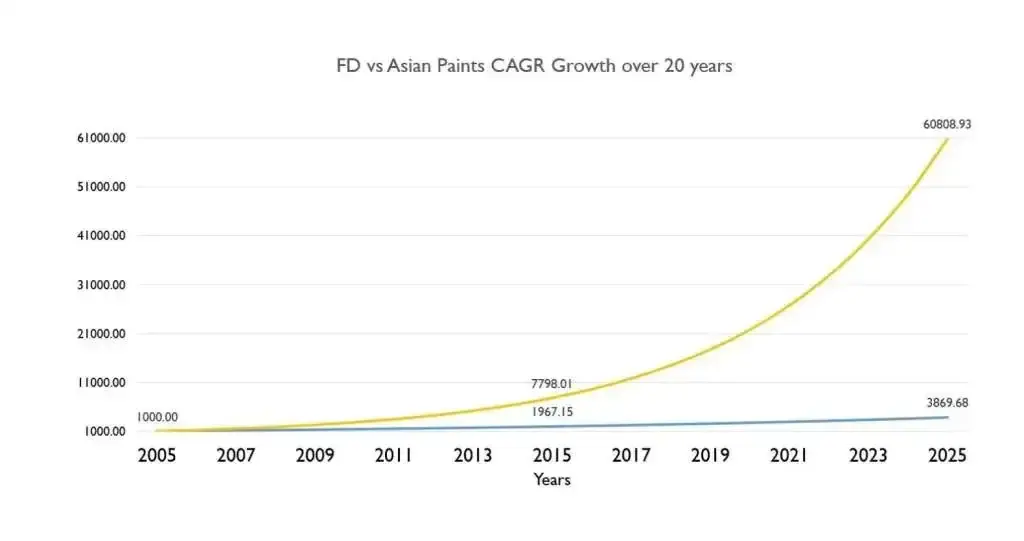
The chart proves that investing in Stocks generates dramatically higher returns than a Fixed Deposit (Savings) over 20 years.
- Fixed Deposit (FD): ₹1,000.00 grew to ₹3,869.68. (Slow, linear growth)
- Asian Paints Stock: ₹1,000.00 grew to ₹60,808.93. (Exponential, high growth)
Conclusion: The stock investment created over 15 times the wealth of the FD, clearly showing the potential of equity to achieve faster wealth growth in Rupees.
Insight:
- Year 10: ₹10,000 grows to ~₹31,000 — roughly 3x growth.
- Year 20: ₹10,000 grows to ~₹96,000 — over 3x more in the second decade alone, showing exponential growth due to compounding.
“Compound interest is the eighth wonder of the world. He who understands it,earns it… he who doesn’t… pays it.” – Albert Einstein
Own a Piece of Growing Businesses
When you invest in the stock market, you’re not just parking your money—you’re buying a stake in strong companies like Reliance, HDFC Bank, Infosys, or Maruti.As these businesses grow, earn profits, and pay dividends, your investment grows too, letting you benefit directly from their success and India’s economic growth.
So how does this ownership actually work? That’s where shares come in.
What Exactly Do You Own? — Understanding Shares
Shares represent fractional ownership in a company. When you buy a share, you’re not just betting on its price—you legally own a small part of that business. This ownership gives you a claim on the company’s profits, growth, and future value.Think of it this way: if you buy even one share of Reliance Industries, you’re no longer just a Jio user—you become a co-owner of the company. As Reliance expands, earns more profits, and strengthens its brand, the value of your ownership grows too. Over time, this combination of ownership and growth becomes a powerful engine for long-term wealth creation.
So now that you understand what shares are, the next question is—how should you approach the market? Should you trade frequently for short-term gains, or invest for long-term growth?
Trading vs. Investing — Two Very Different Mindsets
Trading is about quick buying and selling to earn from short-term price moves. Investing, on the other hand, is about buying shares of strong companies and holding them for the long term.Why hold for the long term? Because investing unlocks the power of compounding—where your money grows, and then that growth itself grows again over time.
As Warren Buffett famously said, “The stock market is a device for transferring money from the impatient to the patient.” Patience isn’t just a mindset in investing—it’s the engine that turns small beginnings into meaningful wealth.
Albert Einstein famously called compounding the “eighth wonder of the world.” A simple way to see it is the Rule of 72:
In this rule: you divide 72 by your annual return to estimate how fast your money doubles.
- At 12%, it doubles in 6 years
- At 18%, in just 4 years.
Each doubling accelerates the next, showing why time is the real advantage for long-term investors.
Take Warren Buffett as an example. He started investing as a child, but the bulk of his fortune wasn’t made until after he turned 60. The secret? His early investments had decades to compound again and again, turning modest beginnings into a billion-dollar snowball.
The graph shows how Warren Buffett's investment compounded over the years.
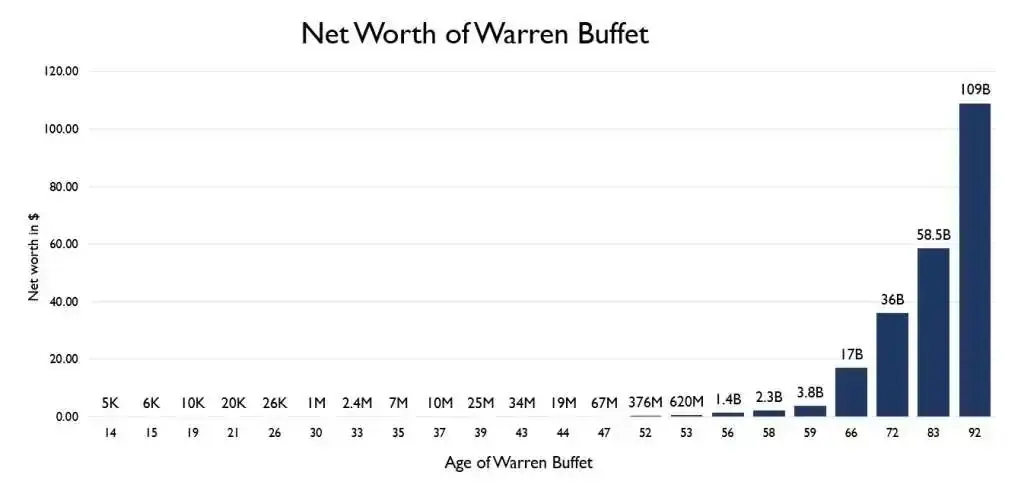
So, the lesson is clear: trading might chase short-term wins, but investing with time is what truly creates extraordinary wealth.
Who Really Controls Market Moves? — Retail vs FIIs vs DIIs
Now that you understand how investing and compounding create wealth over time, you might wonder: who actually drives the ups and downs of the stock market?The truth is, the market isn’t just random—it’s shaped by the actions of different types of investors. Some are individuals investing their own money, while others are large institutional players whose trades can move prices significantly. Knowing who the key players are helps you understand market trends, manage risk, and make smarter long-term investment decisions.
Let’s break it down:
Retail Investors
Individual investors putting their own money to work. While their trades are smaller and usually don’t move the market on a daily basis, collectively they have an increasing influence thanks to rising financial awareness, online apps, and SIPs.
FIIs (Foreign Institutional Investors)
Global giants like Vanguard, BlackRock, and Fidelity. Their massive trades can swing the market, and historically, their inflows and outflows have caused major bull and bear phases in India.
DIIs (Domestic Institutional Investors)
Indian institutions such as LIC, SBI MF, and HDFC MF. They often act as stabilisers, stepping in when foreign investors panic, helping reduce volatility and supporting long-term market growth.
DIIs Stabilized the Market During the COVID-19 Crash
The COVID-19 pandemic triggered one of the sharpest, fastest market crashes in history, and the behavior of FIIs and DIIs during this period clearly demonstrated their contrasting roles.1. The FII Panic Exit (March 2020)
As the pandemic spread globally and lockdowns began, FIIs initiated a massive and rapid withdrawal of capital from emerging markets like India, fearing a global economic collapse.- Trigger: Global risk-off sentiment, fear of economic recession, and a rush to safety (US Dollar).
- FII Action: Foreign investors sold heavily and pulled their money out of the Indian market.
- Net FII Outflow (March 2020): Approximately ₹65,817 Crore (across equity and debt). This was the single largest monthly outflow in Indian market history up to that point.
- Market Impact: The Sensex and Nifty plummeted, losing over 35% from their January 2020 peaks in just a few weeks.
2. The DII Counterbalance (The Stabilizing Force)
Just as in 2008, DIIs—primarily Mutual Funds and Insurance Companies (like LIC)—stepped in to absorb the selling pressure from the FIIs.
- DII Action: Domestic institutions saw the sharp correction as an opportunity to buy strong Indian companies at severely discounted prices. They deployed capital from steady inflows via SIPs (Systematic Investment Plans) and fresh institutional money.
- Net DII Inflow (March 2020): Approximately ₹55,595 Crore (across equity and debt).
- Market Impact: The massive DII buying prevented a complete freefall. The domestic institutions essentially acted as a large anchor, soaking up the supply and reducing the market's volatility, which helped establish a bottom for the market by late March 2020.
Long-Term Insight: DIIs as the New Anchor
The COVID-19 event highlighted an important insight for beginners:
- FIIs (Foreign Institutional Investors): Their flows are influenced by global macro factors like US interest rates and overall risk sentiment, causing short-term market swings.
- DIIs (Domestic Institutional Investors): Supported by steady domestic savings through mutual funds and SIPs, they provide consistent inflows that stabilize the market. They function as the shield during panic and keeping markets grounded.
This DII presence has made the Indian market more resilient than in 2008, ensuring that while global events can trigger corrections, the strong domestic buying power often facilitates a quicker recovery.
Bull vs Bear — Why Market Emotions Matter More Than You Think
Understanding bull and bear markets shows that the stock market isn’t just about prices—it’s about opportunities and the right mindset.A bull market is when stock prices keep rising for a long period, driven by confidence and strong economic growth. A bear market is when prices fall sharply, and fear takes over.
As Warren Buffett says: “Be fearful when others are greedy, and greedy when others are fearful.”
During bull markets, like India’s Sensex rise from ~6,000 → 21,000 between 2004–2008, staying invested in strong companies created huge wealth. Conversely, during the COVID crash in March 2020, the Sensex fell ~38%, but investors who bought companies like HDFC Bank, Reliance, or Infosys saw massive gains within a year.
The lesson? Bull or bear — opportunities only reward those who are prepared. You can spot great companies, stay disciplined, and react wisely to market moods… but none of it matters if you don’t have the right tools to invest. To truly benefit from India’s growth story, your first step is to open a Demat and Trading account so you can participate whenever the opportunity appears.
“The market rewards action — not intention.”John C. Bogle
Read more on “How to Open a Demat Account: A Step-by-Step Guide”
Demat vs Trading Account — Your Gateway to Investing in India
To buy stocks in India, you need two accounts:
Demat Account – Your Digital Vault
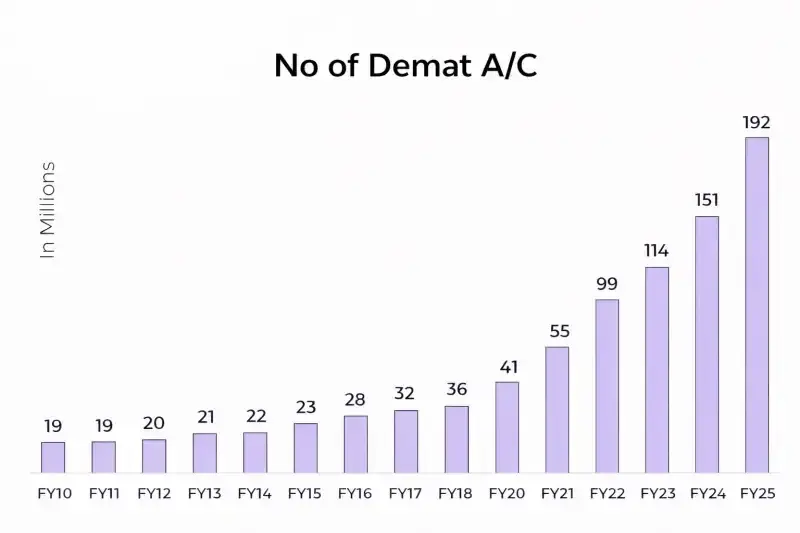
A Demat account securely stores your shares in electronic form, just like a bank account stores money. It ensures your holdings are safe, easy to access, and can be transferred instantly.Number of Demat Accounts in India
In India, this system is managed by two central depositories:
- NSDL (National Securities Depository Limited): Holds and manages investors’ securities electronically.
- CDSL (Central Depository Services Limited): Another central depository providing electronic custody and transfer of securities.
Your broker connects you to one of them and keeps a permanent record of your holdings, even if you switch brokers.
Why it matters: As investing goes digital — stocks, mutual funds, bonds, ETFs — your Demat becomes your all-in-one wealth locker for life.
Trading Account – Your Market Gateway
Trading Account — Where Buying & Selling Happens
A Trading account allows you to place orders to buy or sell shares through your broker’s app.If Demat is for storage, Trading is for execution.
- You place a buy order → Broker executes it on NSE/BSE → Shares move to your Demat.
- You sell shares → Shares move from Demat → Money comes to bank account
Together, Demat + Trading accounts make investing smooth, fast, and fully online.
Open Your Stock Market Account in a Few Minutes
- Select a SEBI-registered broker (like Zerodha, Groww, Upstox, etc.)
- Upload Aadhaar, PAN, and bank details
- Complete a quick video KYC
- Account gets activated in a few hours
Now that your Demat and Trading accounts are ready, you’re officially equipped to invest in the stock market. But where exactly do your investments go, and how do shares move once you buy them?
This brings us to the two main parts of the market: the Primary Market, where companies raise funds for growth through IPOs, and the Secondary Market, where shares are traded daily between investors. Understanding this distinction helps you know how companies get capital, how you buy shares, and how prices fluctuate in the Indian stock market.
Primary Market vs Secondary Market — IPOs and Daily Trading Made Easy
Primary Market – Where Companies Raise Money
The Primary Market is where companies sell shares for the first time through an Initial Public Offering (IPO). This is how businesses raise capital to expand—whether it’s opening new stores, building factories, or hiring more staff.Example: When Mamaearth or Nykaa launched their IPOs, investors had the first chance to buy shares directly from the company. The company received money to grow, and investors became co-owners from day one.
Explore our Products
Research Framework

Emerging Titans
Combination of quantitative analysis, industry tailwinds, and management assessment - SPRINT investment philosophy

Tiny Titans
Heavy emphasis on scuttlebutt research, plant visits, and early on-ground signals
Secondary Market – Where Shares Trade Daily
Once an IPO is complete and the company is listed on the NSE or BSE, its shares move to the Secondary Market. Here, shares are bought and sold between investors, and the company does not receive money from these trades. Prices fluctuate based on demand and supply, investor sentiment, and company performance.
Why This Matters for Beginners:
Understanding the difference helps you know how companies get capital, how your investments grow, and why stock prices change every day. It also highlights that your Demat and Trading accounts are your gateway to both markets, letting you participate in IPOs and daily trading alike.Now that you know where your investments go and how shares trade, the next question is: how do you pick the right companies to invest in?
In the stock market, it’s easy to get distracted by price movements or hype, but successful investors focus on fundamentals—the real health and value of a business.
As Benjamin Graham once said:
“In the short run, the market is a voting machine, but in the long run, it is a weighing machine.”-Benjamin Graham
Which simply means that in the near term, stock prices move based on emotions, narratives, popularity, and market mood, just like people “voting” for what looks exciting. But over time, the market stops caring about hype and starts “weighing” the true strength of a business — its earnings power, balance-sheet quality, and ability to generate real cash flows. In the long run, it is not the loudest story that wins — it is the business that consistently performs.
Understanding key value metrics helps you separate short-term noise from long-term opportunity. By examining metrics such as revenue growth, profit margins, and return on equity, you can identify companies that are truly strong and likely to generate wealth over time, rather than just chasing the next hot stock.
Key Valuation Metrics
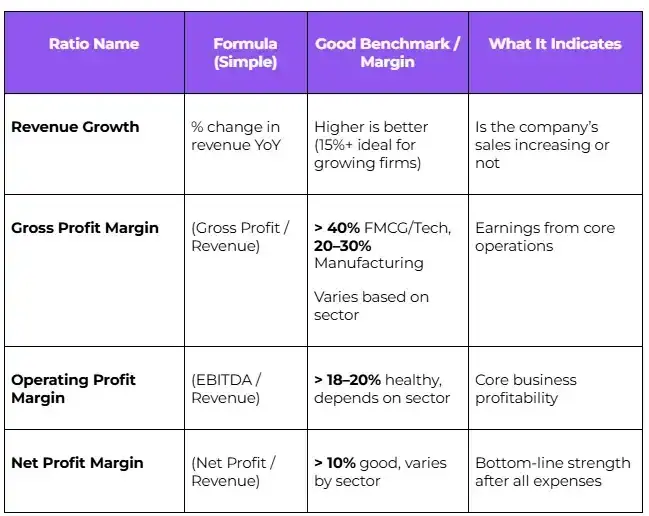
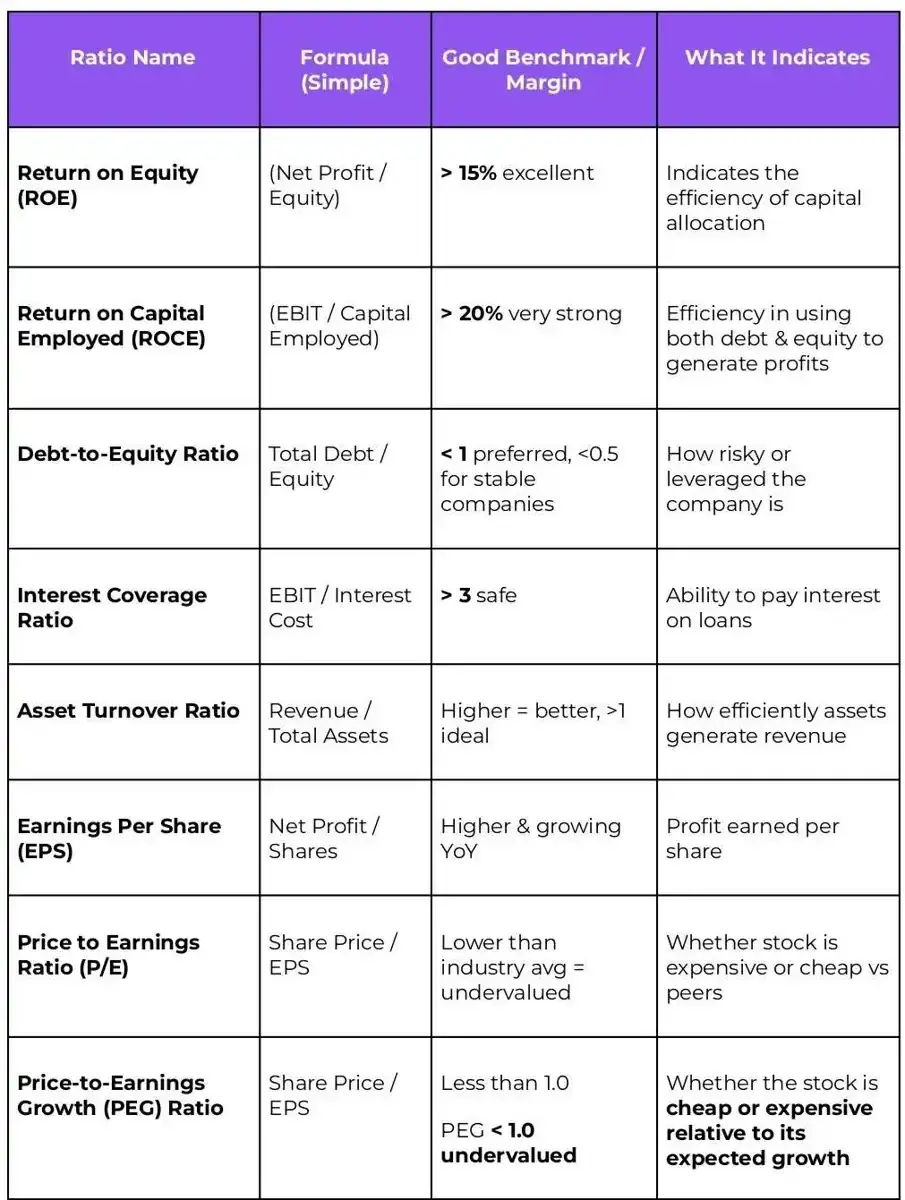
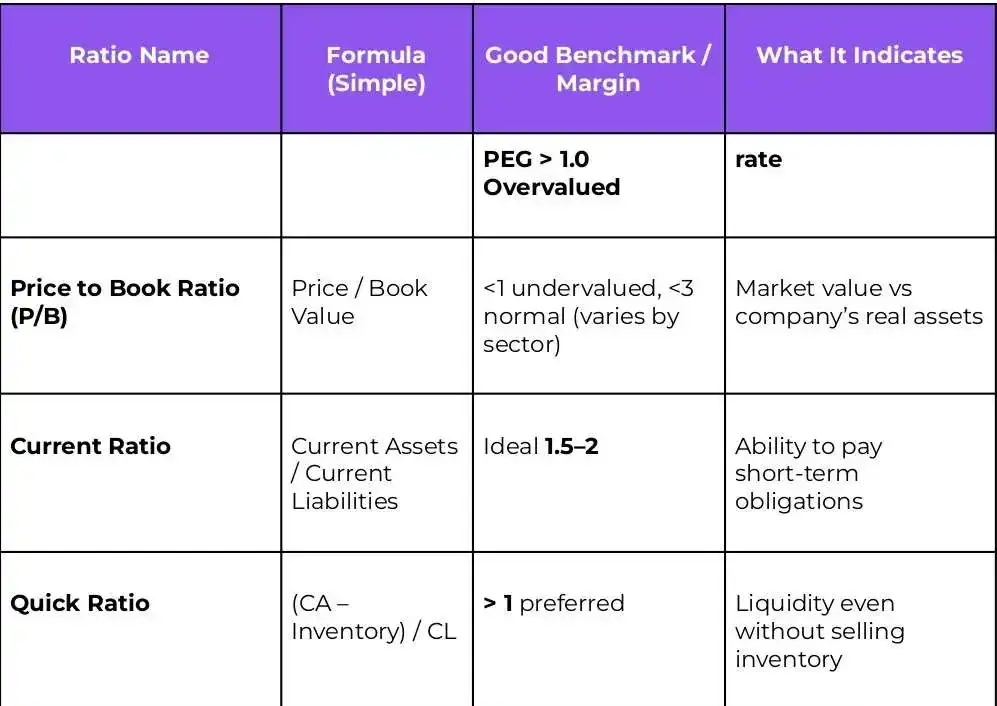
How to Analyse a Stock (Simple Checklist for Beginners)
The SPRINT framework is a quick way to check if a company is worth investing in. It looks at key things like growth, profitability, risk, innovation, financial health, and management trends. Think of it as a simple “health check” for a business before you invest.
Learn more and check the full details of SPRINT
Once you know how to analyze a stock using SPRINT, the next step is equally important: avoiding common mistakes that trap beginners. Even if you pick fundamentally strong companies, poor decisions driven by fear, greed, or impatience can erase gains.
Warren Buffett once said, “Never invest in a business you cannot understand.” This ties directly to SPRINT—if you don’t evaluate growth, risk, or financial health, you’re essentially flying blind.
Common Pitfalls to Watch Out :
- Panic Selling – Markets always have short-term dips.Example: In March 2020, during COVID, the Sensex fell ~38% but fully recovered within a year. Selling in panic locks in losses and prevents compounding from working its magic.
- Following Tips Blindly – Don’t invest just because a friend or WhatsApp group recommends a stock.
Tip: Always check company fundamentals and understand what you’re buying. - Investing Without Understanding the Business – Buying blindly is like driving without knowing traffic rules.
- Tip: Learn the business model, revenue sources, and growth potential before investing.
- Ignoring Valuation – Timing the market perfectly is nearly impossible.
Tip: Focus on long-term investments and buy stocks when reasonably priced or undervalued. - No Diversification – Putting all money in one stock or sector is risky.
Tip: Spread investments across multiple stocks, sectors, or mutual funds to reduce risk.
By combining the SPRINT framework with awareness of these common mistakes, beginners can invest smartly, reduce risk, and stay disciplined, letting long-term wealth creation unfold naturally.
Conclusion — Your Wealth-Building Journey Starts Now
Most beginners think investing is about timing the market or finding the next hot stock — but real wealth in India has always been built through patience, discipline, and staying invested in strong businesses for years. Ordinary companies quietly grow into extraordinary wealth creators when profits, brand strength, and execution improve over time — and investors who stay consistent allow compounding to do the heavy lifting. The real advantage is not intelligence or luck — it is time, behavior, and commitment to the process.This guide was designed to help you take the first step the right way — understanding ownership, compounding, market players, Demat accounts, IPOs vs secondary markets, valuation basics, and common mistakes to avoid. You don’t need to predict markets or monitor prices daily — you need a simple, repeatable approach and the confidence to stay invested while businesses grow.
If this guide made investing clearer and less intimidating, comment “START” below.
Like the post if you want more beginner-focused finance breakdowns, share it with someone starting their investing journey, and tell me — what is the one concept from this guide that finally “clicked” for you?
Wealth isn’t built in moments of excitement — it is built quietly, through consistency, patience, and learning to let time work for you.
FAQs ( Frequently Asked Questions )
How do I start investing in India?
+Do I need to check the stock market every day?
+Can I start with just ₹500 or ₹1,000?
+How do I pick a good company to invest in?
+What if I need money suddenly?
+
High growth stock specialist, Value Educator
Shashank Mahajan is an equity research professional with over 12 years of experience in identifying high-potential SME and micro-cap stocks at an early stage. He follows a rigorous scuttlebutt research–driven approach, combining on-ground insights with deep financial analysis. Shashank specializes in uncovering under-researched and under-owned companies with strong management quality and long-term growth potential. Through disciplined research and early identification, he focuses on spotting tomorrow’s market leaders before they enter the mainstream investor radar.

Glenmark: The USD 700 Mn Cancer Deal and Its Brands

Pharma Stocks in India 2026: Generics, APIs and CDMOs

Granules India: From Paracetamol to a 65% Gross Margin

Natco Pharma: After Revlimid, 29 Patent Challenges

Shilpa Medicare: Cancer APIs, Films and Biosimilars

Alembic Pharma: US Plants Pay Back, Margin Hits 22.2%
Explore our Products
Research Framework
Emerging Titans
Combination of quantitative analysis, industry tailwinds, and management assessment - SPRINT investment philosophy
Tiny Titans
Heavy emphasis on scuttlebutt research, plant visits, and early on-ground signals



India's Aerospace Opportunity
Global Demand. Supply Bottlenecks. Opportunities Ahead.
Don't Miss This Exclusive Webinar!
Join Value Educator to decode the key trends shaping India's aerospace sector and learn how to identify tomorrow's potential leaders in the space.
- How the aircraft value chain works, layer by layer
- Indian companies supplying global aircraft makers
- A framework to judge any aerospace company

 Orders
 Subscription
 Share with friends


Required Details
₹23999.00
(12 month subscription)
As per SEBI regulations, all users are mandated to complete the KYC that is validated for 1 year. Post payment, you will be redirected to the KYC screen


No comments yet. Be the first to comment!