
Corporate Actions Explained
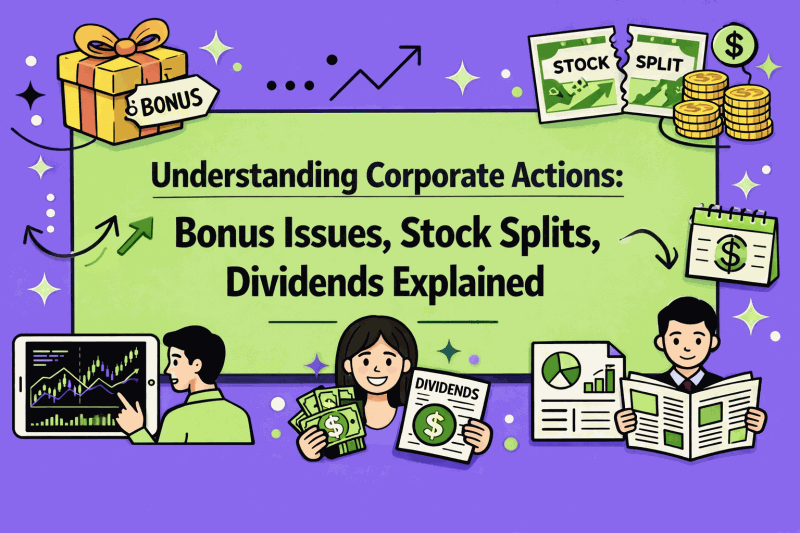
"Imagine waking up to see your top holding has shed half its value overnight. For most, it’s a heartbeat-skipping moment of panic; for the informed, it’s a non-event, a simple stock split.
The difference between a frantic exit and a calm hold lies in understanding the 'why' behind the numbers. When you master these corporate maneuvers, you stop merely trading tickers and start decoding the very language of business growth."
"Price fluctuations are just noise; corporate actions are the signal that tells you the company's true intent." — Prof. Aswath Damodaran
Corporate actions are the strategic levers a company pulls to reshape its future, and for you, the investor, they are the "fine print" that determines how your portfolio actually grows over time.
Beyond just watching stock prices tick up and down, understanding these maneuvers like Bonus Issues and Stock Splits is important, because both result in more shares landing in your account.
Stock Splits: This is a technical recalibration. Think of it as cutting a "share pizza" into smaller, more affordable slices. The goal is to boost market liquidity by making the stock accessible to a broader range of investors.
Bonus Issues: This is a reward sourced from the company's accumulated earnings. It is a sign of financial health, as the company converts its reserves into free shares for you.
Bonus Issues: Dividends are the most direct way a company shares its success, turning corporate profits into cash in your bank account. However, there is a nuance often missed by Mutual Fund investors. The NAV Adjustment: A dividend payout is not "free money." When a fund pays a dividend, its Net Asset Value (NAV) drops by the exact amount distributed. You aren't gaining extra wealth in that moment; you are simply realizing a portion of your investment as cash.
Ultimately, these actions are the heartbeat of a company's financial health and strategy. Just as picking a Direct Plan over a Regular Plan can save you lakhs in commissions over decades, staying sharp about these corporate actions ensures you aren't just a passenger, but a pilot in your wealth-building journey.
Now that you see why these signals matter more than the daily noise, let’s peel back the curtain. What exactly are these 'mechanics' that turn a regular company into a wealth-generating machine? Let’s break down the DNA of a Corporate Action.
What is Corporate Action
In simple terms, a Corporate Action is any move a company makes that significantly changes its shares, its financial structure, or the direct benefits its shareholders receive. Think of it as the "behind the scenes" mechanics of a business.These aren't just random market fluctuations; they are deliberate, strategic decisions made by the Board of Directors that fundamentally alter what you own. Whether it’s splitting a single share into five to make it more affordable or cutting you a check from the company’s profits, these actions are the bridge between a company’s boardrooms and your personal bank account.
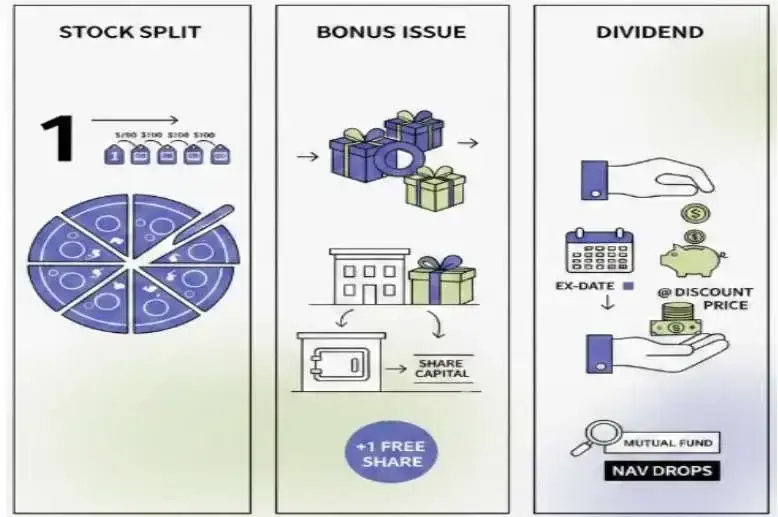
For you, the investor, these actions are the pulse of a company’s health and a major driver of how your portfolio grows over time. While some actions happen automatically, like a bonus issue appearing in your demat account, others are invitations, like a rights issue, where you get to decide if you want to double down on your investment.
By paying attention to these "fine-print" maneuvers, you move from being a passive observer to a "pilot" of your wealth. Instead of panicking when a stock price "drops" by 80% overnight, you’ll recognize it as a strategic pivot, such as a stock split, designed to make the company’s growth accessible to a wider world.
Understanding the 'what' is the first step, but how do companies actually manipulate their share count without changing their value? It starts with the most common psychological trick in the book, the Stock Split, and here is why it’s a game-changer for your entry strategy.
Read More: Power Sector Stocks in India 2026: List by Value Chain
1. Stock Splits
A Stock Split is exactly what it sounds like: a company divides its existing shares into multiple new shares.Think of a Stock Split like breaking a ₹2,000 note into four ₹500 notes. You haven’t suddenly become richer; you just have more pieces of paper that add up to the same amount. In the market, a company simply divides its existing shares into smaller, multiple units.
Why do companies do this?
If the value stays the same, why bother? It usually comes down to psychology and liquidity:- Making it "Affordable": If a stock price climbs to ₹5,000 or ₹10,000, it becomes "heavy." Small retail investors might hesitate to buy even a single share. By splitting it down to ₹500, the company makes the stock accessible to more people.
- Boosting Liquidity: When more people can afford the stock, more shares are traded daily. This makes it easier for buyers and sellers to find each other.
- The "Feel Good" Factor: Investors often perceive a stock split as a sign that the company is confident. It’s a signal that the price has risen so much that they had to break it down.
Real-World Example: IRCTC (2021) or Tech Mahindra (Recent)
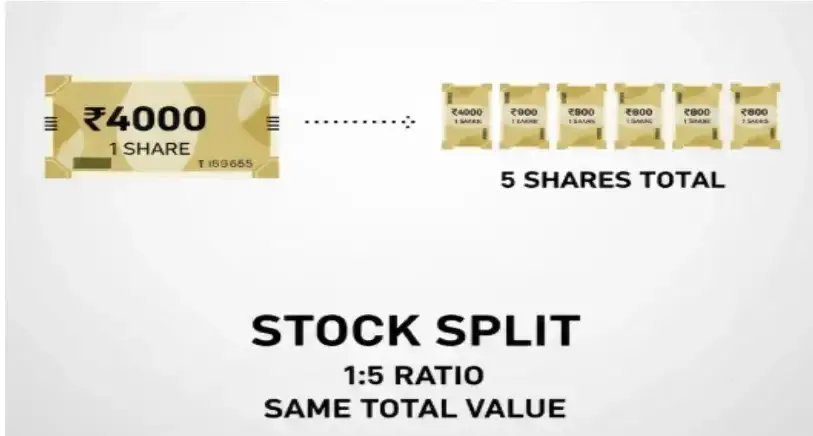
Imagine a stock like IRCTC back in the day. It was trading around ₹4,000. For a student or a small saver, buying one share was a big deal. They did a 1:5 split.- One share of ₹4,000 became 5 shares of ₹800.
- Suddenly, someone with only ₹1,000 could become a shareholder.
If a split is just 'changing a note for coins,' what if the company actually gave you something for free? While splits are cosmetic, our next move is a total 'flex' of financial muscle. Welcome to the Bonus Issue, where loyalty literally pays in shares.
Power Sector Stocks in India 2026: List by Value ChainPower Sector Stocks in India 2026: List by Value Chain
2. Bonus Issue
A Bonus Issue is basically the company giving you "loyalty points" in the form of extra shares. Unlike a dividend, where you get cash, here you get more of the stock itself, and you don't have to pay a single paisa for it.Why do companies do this?
- Saves Cash for Growth: Companies can reward shareholders with extra "skin in the game" without actually spending any cash. This keeps the bank account full for big projects or paying off debt.
- Fixes "Sticker Shock": When a stock price gets too expensive for the average person to buy, a bonus issue drops the price per share. It doesn't change the company's value, but it makes the stock much easier to trade.
- Signals Real Strength: You can’t issue bonus shares without having massive "savings" (reserves) on the books. It’s a huge flex that tells the market the company is financially rock-solid and confident about the future.
Real-World Example: Tech Mahindra (2015)
The Tech Mahindra move in 2015 is the perfect "case study" for why investors get confused. They didn’t just do a split or a bonus—they did both at the exact same time, pulling off a massive structural "reset" of their stock.
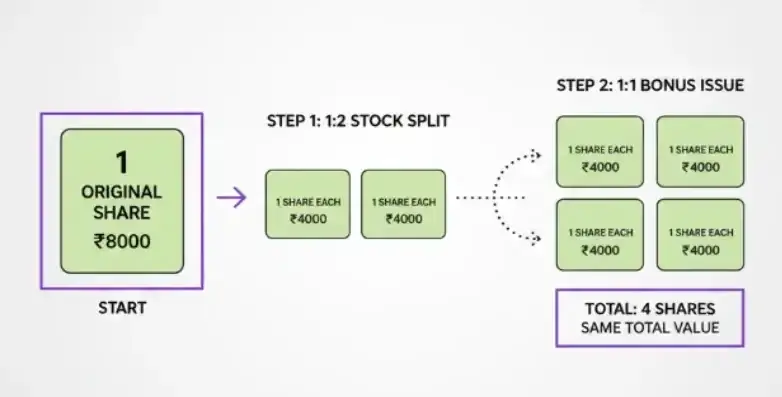
The Action: In March 2015, the board pulled the trigger on a 1:1 Bonus and a 1:2 Split simultaneously.
How it felt for the user: It was like a "magic multiplier" in your portfolio. If you went to sleep with just 1 share, you woke up looking at 4 shares.
- The Split first chopped your 1 share into 2.
- Then, the Bonus kicked in, giving you 1 extra share for every 1 you already held, instantly doubling those 2 shares into 4.
Read More:Top Stocks with Heavy Promoter Buying in the Last 6 Months
3. Dividend
Simply put, a Dividend is a company sharing its "loot" with you. When a company makes a profit, it has two choices: keep it all to grow the business, or send a slice of that cash directly to the shareholders as a reward for owning the stock.
Reasons Why Companies Pay Dividends?
- Sharing the Wealth: It’s the most direct way to keep investors happy. It proves the company isn't just "growing on paper" but is actually generating cold, hard cash.
- Attracting "Safe" Investors: Retired people and big funds love "Dividend Yield" stocks. It provides them with a steady income stream without having to sell their shares.
- Signaling Stability: Only a company with consistent, surplus cash can afford to pay dividends regularly. It tells the market, "We are making more money than we know what to do with."
Real-World Example: TCS or Vedanta
- TCS: Known for being a "Dividend Paymaster." They often give out ₹30–₹60 per share throughout the year because they generate massive profits and don't need all that cash to run their offices.
- The "Income" Factor: If you own 1,000 shares of a company paying a ₹20 dividend, you just made ₹20,000 for doing nothing but holding the stock.
"You now know the 'Big Three' strategies, but in the heat of the market, could you spot them on a stock ticker? Before you make your next trade, let’s look at the Cheat Sheet to identify these actions like a pro before the rest of the crowd even notices."
Read More: What are Dividend Stocks? Are They Good for Passive Income?
How to identify
1. Bonus Issue: The "Loyalty Reward."
A bonus issue is when a company takes its accumulated profits (reserves) and converts them into new shares for you.
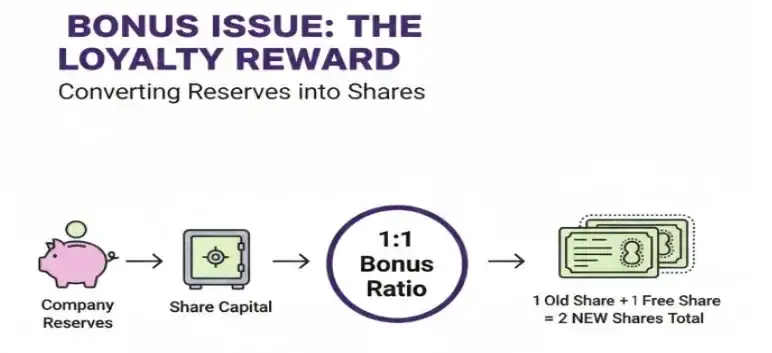
How to Identify: Look for a "Ratio" (e.g., 1:1 or 2:1).
- The Math: If you have 100 shares at ₹2,000 and they give a 1:1 bonus, you now have 200 shares, but the price drops to ₹1,000.
- The "Secret": The company's Net Worth stays the same. They just moved money from their "Savings Account" to their "Capital Account." It’s a sign of massive internal strength.
2. Stock Split: The "Affordability Play."
A stock split has nothing to do with profits. It’s a purely cosmetic change to make the stock price look "cheaper," so more people can buy it.
How to Identify: Look at the Face Value (FV). If the FV changes from ₹10 to ₹2, that’s a split.
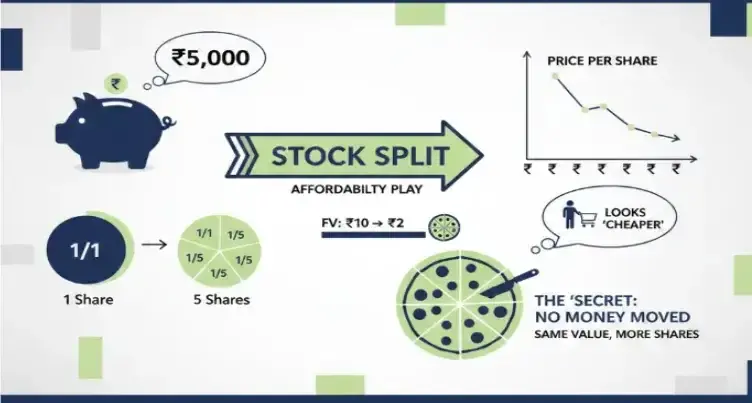
- The Math: In a 1:5 split, your 1 share worth ₹5,000 becomes 5 shares worth ₹1,000 each.
- The "Secret": No money moved inside the company. They just cut the existing "pizza slices" into smaller pieces. It’s usually done when a stock price gets too high for retail investors.
3. Dividends: The "Cash Paycheck."
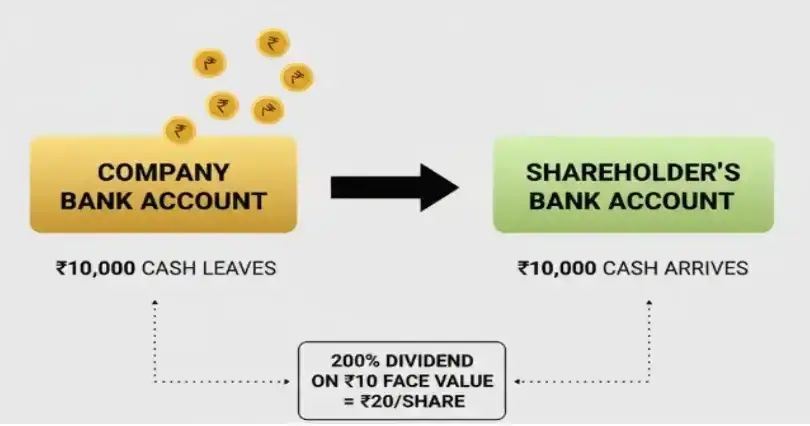
This is the only action where actual money leaves the company’s bank account and enters yours.
How to Identify: Announced as a percentage of Face Value.
Example: A "200% Dividend" on a share with a ₹10 Face Value means you get ₹20 cash per share.
- The Math: If you own 500 shares, you get ₹10,000 credited to your bank account.
- The "Secret": On the "Ex-Dividend" date, the stock price usually drops by the dividend amount because that cash has now left the company's valuation.
Which one do we have to choose
1. Choose Dividends if you want, Immediate Income
If you are looking for a "second salary" or passive income to pay your bills, dividends are your best friend.
- The Vibe: Real cash hits your bank account.
- The Catch: You pay tax on this income every time it arrives (added to your total income tax slab).
- Ideal for: Retired investors or those who want to see regular cash flow from their investments.
2. Choose Bonus Issues if you want... Long-term Wealth (Compounding)
A bonus issue is generally seen as the "gold standard" because it doesn't just split the stock; it signals that the company is so profitable it’s converting its savings into permanent capital.
- The Vibe: No immediate cash, but you own more "pieces of the pie" for free.
- The Advantage: No immediate tax! You only pay tax when you eventually sell the shares.
- Ideal for: Young investors or those looking to stay invested for 10+ years. More shares mean higher future dividends if the company continues to pay them.
3. Choose Stock Splits if you want... Affordability & Entry
You don't usually "choose" a split for its value, but for the opportunity it creates.
- The Vibe: It makes an expensive stock "cheap" again.
- The Advantage: If you couldn't afford a ₹5,000 share, a 1:10 split brings it down to ₹500, letting you start your investment.
- Ideal for: Small retail investors who want to buy into high-quality companies that have become too expensive.
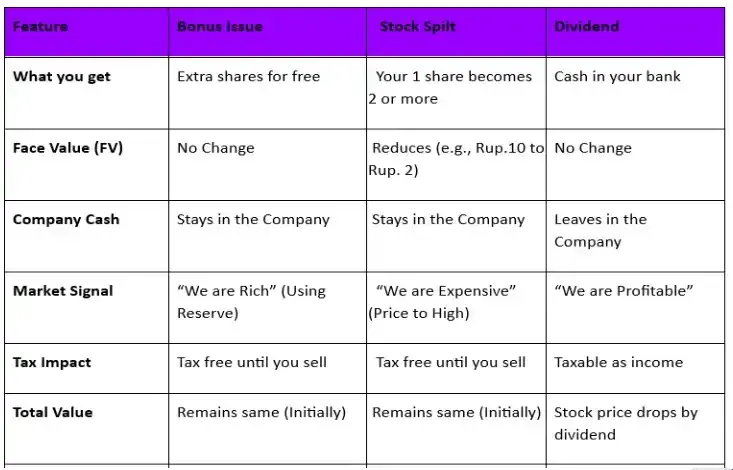
"Strategy is nothing without clarity. To make sure you never confuse a 'split' with a 'bonus' ever again, I’ve distilled everything we’ve discussed into a Side-by-Side Showdown that you’ll want to bookmark immediately."
Comparison Chart: Bonus vs. Split vs. Dividend
"The theory is solid, but numbers tell the real story. Let’s follow a single investor’s journey through a decade of growth to see how 100 shares can explode into a massive portfolio. This is the 'Growth Corp' Case Study in action."
Read More: Technical vs Fundamental Analysis - Which One Should You Follow?
Case Study: The "Growth" Journey of 100 Shares
Look, I’ll be honest—dropping $100,000 on a single position definitely gets the heart rate up a bit. Even if you've done the homework, hitting "confirm" on 100 shares of Growth Corp at $1,000 a pop feels like a heavy lift.
Phase 1: The Stock Split (Improving Accessibility)
The company’s share price rises to $2,000. It becomes "too expensive" for new retail investors. The board announces a 1:10 Stock Split.
- New Quantity: Your 100 shares multiplied by 10, leaving you with 1,000 shares.
- New Price: The market price adjusts proportionally, dropping from $2,000 to $200 per share.
- Investment Value: Your total stake is still $20,000. You haven't "gained" money yet, but you now hold way more "units" at a price point that's much easier for the public to buy into.
Phase 2: The Bonus Issue (Capitalizing Reserves)
Years later, the company has massive profits sitting in its "Reserves." To reward you without giving away cash, they announce a 1:1 Bonus Issue.
- The Action: Think of this as a "buy one, get one free" deal from the company. For every 1 share you already own, they hand you 1 extra share completely for free.
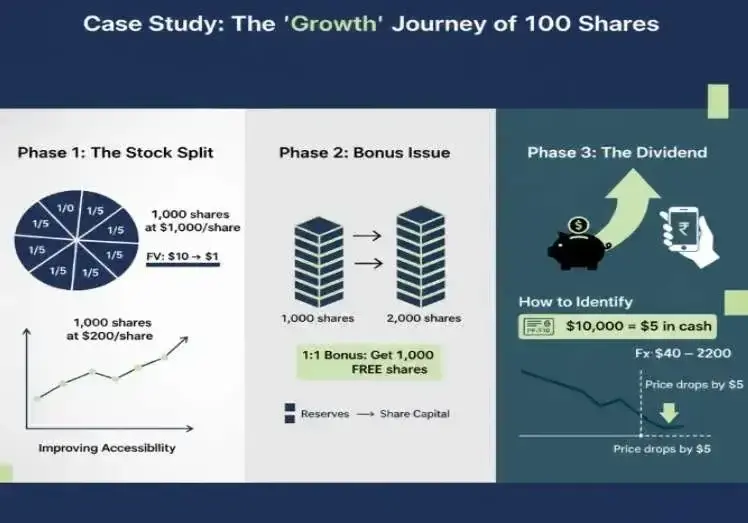
The Change: Since you were already sitting on 1,000 shares after the split, the company matches that and drops another 1,000 into your account.
- New Quantity: You’re now looking at a total of 2,000 shares.
- New Price: The market does its math to keep the value fair. If the stock was trading at $400 right before the bonus hit, the price automatically adjusts down to $200.
Phase 3: The Dividend (The Cash Reward)
Now you own 2,000 shares. The company is mature and declares a Cash Dividend of $5 per share.
The Action: This is the best part, it’s a direct cash transfer from the company’s bank account straight into yours. No selling required.
The Math: Because of that split and bonus magic we did earlier, your share count is huge.
The Impact: You still own every single one of those 2,000 shares, but now you’ve also got $10,000 sitting in your brokerage account. Just keep in mind that on the "Ex Dividend" date, the stock price usually takes a small dip of roughly that same $5 because that value has literally left the company's books to land in your pocket.
"You’ve seen the math, the strategy, and the real-world results. You are no longer just a passenger in the markets; you are now the pilot. Let’s bring it all home with the Final Verdict on your wealth-building journey."
Read More: The Power of Compound Interest: How to Create Wealth in the Stock Market.
Explore our Products
Research Framework

Emerging Titans
Combination of quantitative analysis, industry tailwinds, and management assessment - SPRINT investment philosophy

Tiny Titans
Heavy emphasis on scuttlebutt research, plant visits, and early on-ground signals
Conclusion
Mastering corporate actions is like learning to read the "hidden language" of the stock market. While most investors see a sudden 50% drop in a stock price and panic, the informed investor looks at the Face Value or the Ex-Date and recognizes a strategic move toward liquidity or a reward for loyalty.
Whether a company is slicing the "equity pizza" into smaller pieces through a Stock Split, converting its hard-earned savings into new shares via a Bonus Issue, or sharing its "loot" through Dividends, these actions are signals of intent. They tell you if a company is hungry for new retail investors, rock-solid in its reserves, or generating more cash than it needs for operations.
Like this, subscribe for more practical insights, and comment “WEALTH” below with your own experiences or questions!
FAQs
Do I need to pay any tax when I receive Bonus shares or a Stock Split?
+No immediate tax is due when these shares hit your account. You are only taxed when you eventually sell them. For bonus shares, the "cost of acquisition" is treated as zero, which may increase your capital gains tax later, while for splits, your original cost is simply divided across the new number of shares.
What is the "Record Date" vs. the "Ex-Date," and which one matters more?
+The Record Date is when the company officially lists eligible shareholders, but the Ex-Date is your actual trading deadline. To be eligible for any benefit, you must buy the stock at least one business day before the Ex-Date. If you buy on or after the Ex-Date, you will not receive the dividend or bonus shares.
If I sell my shares on the Ex-Date, do I still get the dividend/bonus?
+Why does the stock price drop exactly by the dividend or bonus amount?
+This is a mechanical adjustment by the exchange to ensure market equilibrium. For dividends, the company's value decreases because cash is leaving its bank; for bonus/splits, the value is simply spread across more shares. This ensures the total Market Cap remains the same, preventing new buyers from getting "free" value without prior ownership.

High growth stock specialist, Value Educator
Shashank Mahajan is an equity research professional with over 12 years of experience in identifying high-potential SME and micro-cap stocks at an early stage. He follows a rigorous scuttlebutt research–driven approach, combining on-ground insights with deep financial analysis. Shashank specializes in uncovering under-researched and under-owned companies with strong management quality and long-term growth potential. Through disciplined research and early identification, he focuses on spotting tomorrow’s market leaders before they enter the mainstream investor radar.

Glenmark: The USD 700 Mn Cancer Deal and Its Brands

Pharma Stocks in India 2026: Generics, APIs and CDMOs

Granules India: From Paracetamol to a 65% Gross Margin

Natco Pharma: After Revlimid, 29 Patent Challenges

Shilpa Medicare: Cancer APIs, Films and Biosimilars

Alembic Pharma: US Plants Pay Back, Margin Hits 22.2%
Explore our Products
Research Framework
Emerging Titans
Combination of quantitative analysis, industry tailwinds, and management assessment - SPRINT investment philosophy
Tiny Titans
Heavy emphasis on scuttlebutt research, plant visits, and early on-ground signals



Modern Warfare to Multibaggers
Key Trends. Strategic Shifts. Opportunities Ahead.
Don't Miss This Exclusive Webinar!
Join Value Educator to decode the key trends shaping India's defence sector and learn how to identify tomorrow's potential leaders in the space.
- In-depth research on India's defence sector
- Live Q&A session
- Actionable takeaways for long-term investors

 Orders
 Subscription
 Share with friends


Required Details
₹23999.00
(12 month subscription)
As per SEBI regulations, all users are mandated to complete the KYC that is validated for 1 year. Post payment, you will be redirected to the KYC screen


No comments yet. Be the first to comment!