
Sovereign Gold Bonds (SGBs) Explained

Most gold investments work in only one way: you buy, you wait, and you hope prices go up.
But imagine an instrument where your gold exposure stays intact - and yet you’re paid simply for holding it.

“Gold is a hedge against stupidity.” - Warren Buffett
This is where many investors get surprised. Gold itself doesn’t generate income. In fact, depending on how you own it, charges, storage costs, and taxes can quietly eat into returns, even when prices rise.
Read More: Why Compounding Is the Foundation of Real Wealth Creation
Asset Allocation 101: The Key to Reducing Risk and Smoothing Returns
Sovereign Gold Bonds were designed to change how gold is owned, not what is owned. The exposure remains the same, but the structure does more of the work.
Gold itself hasn’t changed. What has changed is how we choose to hold it. And that choice can quietly make a big difference to returns.
How Most People Own Gold, And What They Often Miss
Most investors already have some kind of gold exposure, even if they don’t think of it as an “investment.”Physical gold, in the form of jewelry, coins, or bars, remains the most popular choice. It’s tangible, familiar, and reassuring. But financially, it comes with quite a few drawbacks: making charges reduce actual value, purity isn’t always guaranteed, storage is an ongoing concern, and most importantly, physical gold doesn’t generate any income while you hold it.
Then, of course, there are gold ETFs and gold mutual funds. These are linked to the price of gold without the need to actually hold gold. ETFs can be traded on the stock market like stocks, and they require a demat account. Gold mutual funds or funds of funds that invest in gold ETFs provide similar exposure to gold without the need for a demat account.

What are Sovereign Gold Bonds (SGBs)? A Smarter Way to Own Gold
All these provide exposure to the price of gold, but the experience is quite different. Some involve convenience trade-offs, others carry hidden expenses, and none offer a way to earn from gold while simply holding it.
This is where Sovereign Gold Bonds come in, offering a more structured, income-generating way to own gold.
Read more : What is Value Investing? Complete Guide for Beginners
Explaining Sovereign Gold Bonds: The Concept Behind These Bonds
“Investment is most intelligent when it is most businesslike.” - Benjamin GrahamSovereign Gold Bonds, or SGBs, are government securities that are priced in gold. Rather than investing in gold, investors can purchase SGBs, which are tied to gold prices. There is no need to physically store or secure the gold.

read more: How to Invest in Government Securities (G-Secs) and Bonds for Safety
SGBs were introduced in 2015 with a clear objective. Historically, India has been heavily invested in physical gold, which does not generate any income or add to the economy. The government, through the introduction of SGBs, wanted to cut down on gold imports and also provide investors with an opportunity to invest in gold, along with earning an extra interest income.
For several years, these bonds were issued in tranches by the Reserve Bank of India (RBI). However, the last primary issuance took place in February 2024, and since then, no new tranches have been announced. In fact, there is currently no intention to resume fresh issuances.
The reason is largely financial. For the government, SGBs became an expensive form of borrowing. Along with paying a fixed interest every year, it also had to repay investors based on prevailing gold prices at maturity.

With the rise in gold prices over the years, the repayment burden also increased, making the instrument expensive for the issuer.
Consequently, SGBs are now issued only in the secondary market, where investors trade existing bonds on stock exchanges.
How investors can hold and earn from SGBs
SGBs can be held either:In demat form, where they are:
- Stored electronically in your demat account, similar to shares or ETFs
- Most secondary-market purchases happen this way, making buying and selling simpler
As a physical certificate, which is:
- Issued as a certificate at the time of purchase instead of being credited to demat account.
- No physical gold involved; only proof of ownership lis inked to gold prices
Each bond is linked to gold prices and is redeemable in cash at the prevailing gold price, there is no physical delivery of gold.
In addition to gold price movements, SGBs pay a fixed interest of 2.5% per annum, which is credited semi-annually. This interest is earned regardless of how gold prices move.
The bonds have a tenure of 8 years, with an option for early exit after the 5th year through the RBI’s redemption window.
The key value proposition is simple: investors don’t just benefit from gold price appreciation, they also earn a steady interest income, making SGBs a more structured way to own gold than holding it physically.
Now that we know what SGBs are and why they were introduced, let’s break down how they work in practice and what you’re really getting as an investor.
How SGBs Work, And the Features That Shape Returns
When you invest in an SGB, your investment is denominated in grams of gold. This means its value moves in line with gold prices, when gold rises, so does the value of your bond; when gold falls, the bond reflects that as well.What differentiates SGBs from most other forms of gold ownership is that they don’t just track prices. Along the way, investors earn a fixed interest, and at the end of the bond’s life, the investment is redeemed in cash at the prevailing gold price. There is no physical delivery involved at any stage, only the value of gold.
Because SGBs are purely financial instruments, they eliminate several friction points associated with physical gold. There are no storage concerns, no locker costs, and no purity-related risks. Ownership is linked entirely to price, not possession.
read more: The Power of Compound Interest: How to Create Wealth in the Stock Market
Different maturities, same underlying gold
Since fresh issuances have stopped, all SGB transactions today take place in the secondary market. This means investors are buying bonds that were issued at different points in time.
As a result, SGBs available today come with varying remaining maturities; some may be closer to redemption, while others may still have several years to go. Although the underlying exposure to gold is the same, the remaining tenure may have an impact on the market pricing and liquidity, and therefore, it is an important factor for investors to be aware of.
Tax treatment: what has changed and why it matters
For many years, SGBs enjoyed a significant tax advantage. Capital gains earned at maturity were entirely tax-free, which made them particularly attractive for long-term gold investors.That benefit still exists, but only for a specific group. Investors who purchased SGBs directly from RBI during primary issuances continue to enjoy tax-free capital gains on redemption.
For investors buying SGBs from the secondary market today, this exemption no longer applies. While capital gains at maturity were earlier tax-free, the provision was modified in Budget 2026, and gains on SGBs purchased from the secondary market are now taxable, similar to other market-linked investments.
The interest earned on SGBs, meanwhile, has always been taxable, regardless of when or how the bond was acquired.
The takeaway is subtle but important: the gold remains the same, but the structure around it has changed. With SGBs, the source of purchase and method of access can materially influence post-tax returns, something investors need to factor in alongside gold price movements.
Now that we understand what SGBs offer structurally, the real question is how they stack up against other ways of owning gold.
SGBs vs Other Gold Investments (Value-Creation Focus)

Historically, SGBs have delivered better total returns than other gold options by combining gold price appreciation with interest income, without compromising on safety.
Read More: Portfolio Diversification – How Many Stocks Should You Hold?
“The four most dangerous words in investing are: ‘This time it’s different.” - Sir John Templeton
Example:
Suppose you have ₹1,00,000 to invest in gold.
You choose to invest in physical gold first. You approach the jeweler, and after paying making charges of ₹10,000 (10%) and GST of ₹300 (3%), your net investment in gold will be ₹89,700. After eight years, gold appreciates at a compound rate of 5% per annum, and your ₹89,700 becomes approximately ₹1,32,700. However, you cannot overlook the storage cost of ₹500 per annum, which amounts to ₹4,000. By the time you sell your gold, your final value is around ₹1,27,752.
Now let’s see what happens with the same ₹1,00,000 invested in SGBs. Here, your money grows at the same gold price increase of 5% per year. After eight years, the gold portion alone is worth ₹1,48,000. On top of that, you’ve been earning 2.5% interest per year, which adds another ₹20,000 to your investment. Because SGBs are government-issued, there are no making charges, no GST, and no storage costs eating into your returns. By the end of eight years, your total wealth from SGBs is ₹1,68,000 , a full ₹39,300 higher than physical gold.
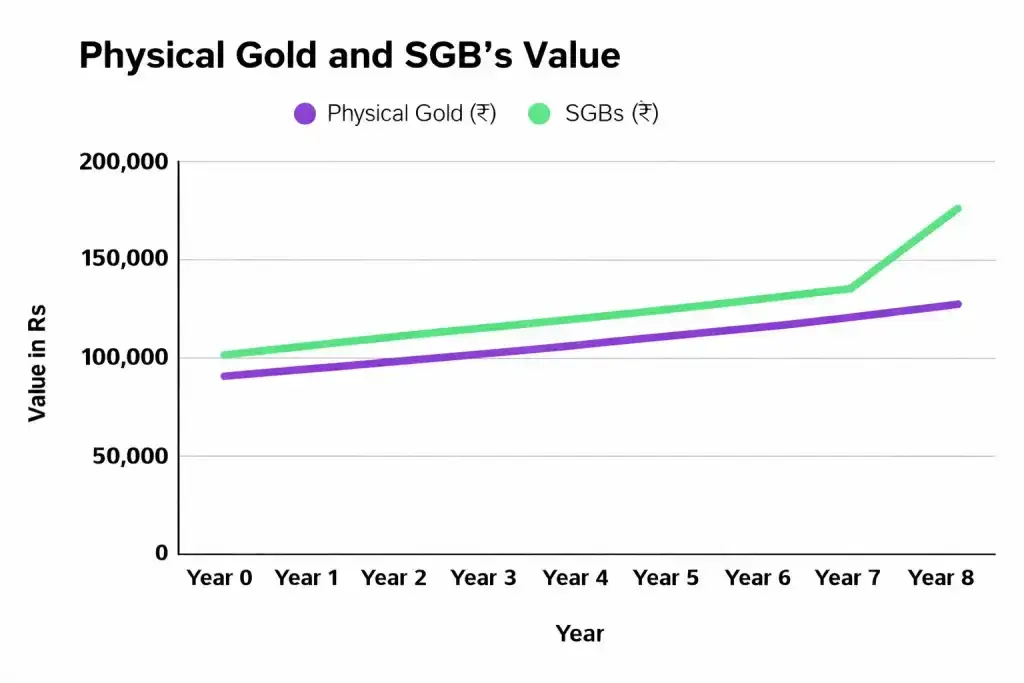
The story here is simple: you’re owning the same gold, but in a structured way that earns extra income and avoids hidden costs. SGBs incrementally create value, demonstrating why sometimes structure is as valuable as the underlying asset.
“Price is what you pay. Value is what you get.” - Benjamin Graham
Risks & Limitations
Though SGBs are less risky than physical gold in many ways, they are not entirely risk-free.“Risk comes from not knowing what you’re doing.” – Warren Buffett
- Gold price volatility: The price of SGBs fluctuates along with the price of gold. If the price of gold drops in the short term, the market price of your SGB may also drop, although gold generally performs better in the long term.
- Liquidity in the secondary market: As the issuing of new SGBs has been stopped, it may take some time to sell them in the stock market. In some cases, investors may have to sell them at a slight discount if there are not many buyers. As Howard Marks says, “Liquidity is not a feature, it’s a condition.”
- Price mismatch vs gold: The price of SGBs in the stock market may not always be in perfect sync with the current gold price, which can impact short-term returns more.
- Tax implications for secondary buyers: Those who buy SGBs from the secondary market do not have the same tax advantages as the original allottees. Capital gains taxes are also applicable in this case, which may impact the returns.
- Long-term investment: SGBs are meant for long-term investment. Although there are ways to exit the investment early through exchanges, they may not necessarily provide the best rates, which makes waiting an important consideration.
Takeaway: SGBs have removed all hassles related to investing in physical gold. Nevertheless, it is important for investors to know about the price movements, liquidity, and tax implications before investing.
Explore our Products
Research Framework

Emerging Titans
Combination of quantitative analysis, industry tailwinds, and management assessment - SPRINT investment philosophy

Tiny Titans
Heavy emphasis on scuttlebutt research, plant visits, and early on-ground signals
Who Should Consider SGBs Today
SGBs aren’t just for traditional gold investors; they can serve a variety of purposes depending on your goals and risk appetite.“The biggest risk is not taking any risk.” - Mark Zuckerberg
- Primary holders: Investors who purchased SGBs in RBI’s earlier tranches can continue to enjoy tax-free returns and fixed interest rates.
- Long-term investors: Investors who are not averse to holding bonds for several years and are willing to take on secondary market risks.
- Conservative investors: Anyone seeking a safe way to gain gold exposure while earning guaranteed interest.
- Active traders/option sellers: SGBs can be pledged as collateral to get 100% margin for selling options, making them popular among traders who value government-backed, liquid, and fully acceptable collateral.
Beyond gold appreciation and interest, SGBs are versatile; they can protect wealth, provide steady returns, and even support trading strategies.
Turning Gold into Smarter Wealth
“Good investing is not about excitement, it’s about discipline.” - Charlie MungerMost investors don’t get hurt by owning gold,they get hurt by ignoring structure, hidden costs, and tax implications, or by holding assets passively without considering smarter alternatives. Simply buying physical gold or ETFs doesn’t guarantee wealth; what matters is having a clear approach that maximizes returns while managing risk and convenience.
Read More: What is Rebalancing? Why and When You Should Adjust Your Portfolio
If this breakdown helped you see why structure and planning matter when owning gold, comment “SMART GOLD” below. Like the article to support research-driven investing, share it with friends who are thinking about building wealth with gold, and comment one insight you’ll apply the next time you invest.
The strongest investing advantage often comes not from just owning assets,but from choosing the right form, understanding the trade-offs, and structuring your holdings to create value consistently. With SGBs, the gold is the same, but the way you hold it can make all the difference.
FAQs
Are SGBs safer than physical gold?
+Can i sell SGBs before maturity?
+What are the tax benefits of SGBs?
+What happens if gold prices fall?
+Are SGBs still available for fresh investment?
+
High growth stock specialist, Value Educator
Shashank Mahajan is an equity research professional with over 12 years of experience in identifying high-potential SME and micro-cap stocks at an early stage. He follows a rigorous scuttlebutt research–driven approach, combining on-ground insights with deep financial analysis. Shashank specializes in uncovering under-researched and under-owned companies with strong management quality and long-term growth potential. Through disciplined research and early identification, he focuses on spotting tomorrow’s market leaders before they enter the mainstream investor radar.

Glenmark: The USD 700 Mn Cancer Deal and Its Brands

Pharma Stocks in India 2026: Generics, APIs and CDMOs

Granules India: From Paracetamol to a 65% Gross Margin

Natco Pharma: After Revlimid, 29 Patent Challenges

Shilpa Medicare: Cancer APIs, Films and Biosimilars

Alembic Pharma: US Plants Pay Back, Margin Hits 22.2%
Explore our Products
Research Framework
Emerging Titans
Combination of quantitative analysis, industry tailwinds, and management assessment - SPRINT investment philosophy
Tiny Titans
Heavy emphasis on scuttlebutt research, plant visits, and early on-ground signals



Modern Warfare to Multibaggers
Key Trends. Strategic Shifts. Opportunities Ahead.
Today at 7:00 PM IST. Room opens 30 minutes before.
Don't Miss This Exclusive Webinar!
Join Value Educator to decode the key trends shaping India's defence sector and learn how to identify tomorrow's potential leaders in the space.
- In-depth research on India's defence sector
- Live Q&A session
- Actionable takeaways for long-term investors

 Orders
 Subscription
 Share with friends


Required Details
₹23999.00
(12 month subscription)
As per SEBI regulations, all users are mandated to complete the KYC that is validated for 1 year. Post payment, you will be redirected to the KYC screen


No comments yet. Be the first to comment!