
Stocks With Heavy Promoter Buying

Who knows a company better, the "Company Captain" sitting in the boardroom or the passengers reading news on their phones?
The promoter sees the daily sales figures, the new contracts, and the profit margins months before that data ever reaches a public balance sheet. While analysts start guessing and retail investors gamble on rumors, promoters operate on hard facts. So, when the person with all the "inside" information decides to ignore the market noise and pump their own hard-earned money back into the stock, it is not a gamble; it is the ultimate scream of confidence that the company is undervalued.

This phenomenon is the legal equivalent of "insider trading," and it serves as the most reliable cheat code for retail investors. You have to remember one golden rule: a promoter might sell shares for a hundred personal reasons: buying a luxury home, funding a child’s wedding, or just diversifying their wealth, but they buy for only one reason: they are certain the stock price is going higher.
In this article, we won't just list stock names; we will decode the specific mechanics of how these insiders are buying and will analyze top Indian companies where promoters are aggressively increasing their stake right now, helping you spot the opportunity before the crowd does.
How Do Promoters Actually "Buy"?
You might think a promoter just opens a Demat account and clicks "Buy" as we do, but it is rarely that simple. When you own the company, you have to follow strict rules to ensure everything is fair. Understanding how they buy tells you a lot about their urgency and their cash flow. Here are the four main ways promoters increase their stake, and what each method signals to us.
1. Open Market Purchase (The "Creeping" Buy)
This is the most direct method where the promoter buys shares directly from the stock exchange (BSE or NSE), just like any retail investor. They might buy in small quantities over time or execute large "Bulk Deals" or "Block Deals" visible to everyone. However, they cannot buy as much as they want; according to SEBI’s SAST (Substantial Acquisition of Shares and Takeovers) rules, a promoter is generally limited to buying up to 5% of the company in a single financial year through this route, often called "Creeping Acquisition."When a promoter chooses this method, it is usually a sign of pure value, they believe the current market price is too cheap and are slowly accumulating shares, which you will see reflected in the shareholding pattern updated at the end of every quarter.
2. The Strategic Injection: Warrants vs. Preferential Allotment
When a company needs cash for growth, promoters often step in using two methods. In a Preferential Allotment, they pay 100% upfront to get shares immediately, signaling urgent commitment. However, Warrants are a smarter, strategic bet: promoters pay just 25% now to "book" the right to buy shares later, with an 18-month window to pay the rest. This locks in today's price, betting the stock will soar before the final payment is due. To keep it fair, SEBI mandates that the issue price be the higher of the last 90-day or 10-day average, preventing promoters from grabbing cheap shares during market dips.3. Buybacks (The Indirect Way)
In this method, a promoter’s stake increases without them spending a single rupee of their personal money. A buyback happens when the company uses its own profits to buy shares back from the public and then cancels or "extinguishes" them. If the promoter decides not to participate in the buyback (meaning they don't sell their shares back to the company), the total number of shares in the market decreases while their number of shares stays the same.Mathematically, this increases their percentage ownership of the company. This move signals that the promoter is confident in the business's cash flows and prefers owning a larger piece of the existing pie rather than using that cash for risky new acquisitions.
Read More: Why Promoter Buying is the Strongest Signal in Stock Markets
Now you know the ways promoters build their stake, but even the owners can’t buy whenever they want. Let’s now look at the strict "Blackout" rules that force them to sit on their hands.
The "Blackout" Period: When Insiders Are Locked Out
You might think promoters can buy shares whenever they feel like it, but SEBI has put strict "handcuffs" on them to keep the game fair. They are actually banned from trading for a large part of the year. This period is called the "Trading Window Closure." The moment a financial quarter ends (e.g., March 31st or September 30th), the trading window gets shut. The promoter is locked out and cannot buy a single share while the company's financial results are being prepared. This restriction ensures they cannot use their secret knowledge of upcoming profit numbers to buy low before the public finds out.The window stays closed until the results are finally released, and even then, there is a catch. The promoter is allowed to buy only 48 hours after the results are publicly declared. For example, if the company announces a massive profit on Monday evening, the promoter is forced to wait until Wednesday evening to trade. This 48-hour "cooling-off" period gives the market time to digest the news, ensuring that when the promoter finally buys, they are paying the fair market price, just like you and me, without any unfair speed advantage.
Read more: How to Stay Emotionally Strong During Market Crash
The rules are set, the windows are open, and the money is moving. So let’s uncover the Top Stocks where promoters are aggressively loading up right now.
Top Stocks with Heavy Promoter Buying
Now that we understand the methods, let's look at the specific companies where promoters are betting big on themselves. Here is the breakdown of the Top stocks where promoters are buying and the exact reasons for it.1. SMS Pharma (+3.4%): The Hidden Margin Expansion
While most investors are obsessed with the top-line sales numbers, the promoters of SMS Pharma are focused on the bottom line. Over the last year, they have aggressively increased their stake by 3.4%, a massive move for a small-cap company.
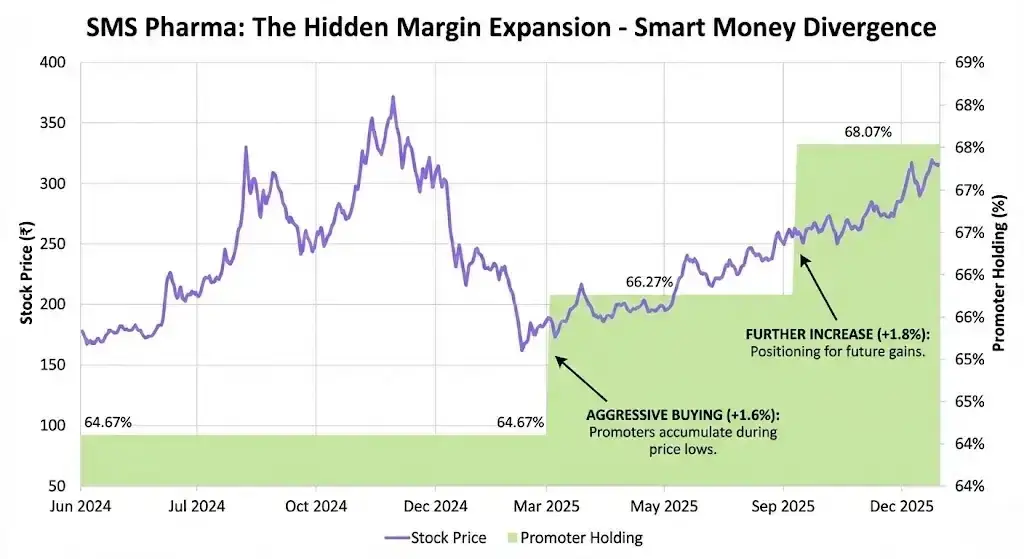 The trigger here is a strategy called "Backward Integration." In simple terms, instead of buying expensive raw materials from others to make their medicines, the company has started manufacturing these ingredients in-house. This strategy requires heavy upfront investment, which often scares away short-term investors because it temporarily eats into profits.
The promoters are buying now because they know something the market is missing: once these new manufacturing units are fully operational, the cost savings will kick in, and profit margins will jump significantly. They are accumulating shares during this quiet investment phase, positioning themselves to capture the full upside before those improved margins finally show up in the quarterly Profit & Loss (P&L) statements. It is a classic case of buying the business before the efficiency kicks in.
2. Jyoti Resins (+3.06%): Buying the Fear
The makers of the famous "Euro 7000" adhesive saw their stock price correct by nearly 28% from its 52-week high. The market panic was caused by "margin compression", a fancy way of saying that the cost of raw materials went up, squeezing their profits. Retail investors saw flat profits and started selling, fearing the growth story was over. However, the promoters saw this differently. They stepped in to buy an additional 3.06% stake, effectively putting a floor under the falling stock price.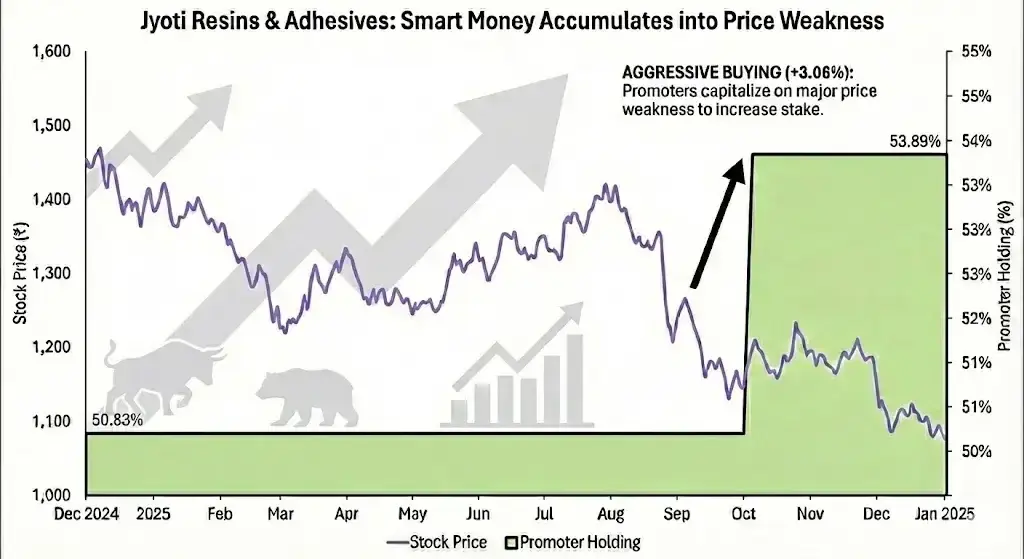
This is a classic case of the market looking at next week while the owners look at next year. Promoters know that raw material prices go up and down, but customer loyalty stays put. By stepping in now, they are effectively betting that the market’s fear is irrational. They are locking in cheap shares today because they know exactly what will happen to the stock price once those input costs normalize.
3. Refex Industries (+2.6%): Buying the "Pivot".
Refex Industries is in the middle of a massive identity change. The company is pivoting from its traditional business of refrigerant gases into high-growth sectors like green mobility and ash handling. Usually, when a company changes direction, the stock price consolidates or moves sideways as the market waits to see if the new plan works. The promoters, however, aren't waiting. Between June and October 2025, they increased their stake by 2.6% through open market buys.
This is a critical confidence vote because transitions are risky. By buying shares from the open market during this consolidation phase, the promoters are telling shareholders that they are fully committed to this new "Green" vision. They are not just asking investors to believe in the new business model; they are putting their own money into the transition. They are betting that the new verticals will generate far more value than the old gas business ever did.
Read more: 7 Powerful Traits of Every Multibagger Stock – Data-Based Study
4. Bajaj Consumer Care (+2.02%): The "Passive" Power Move
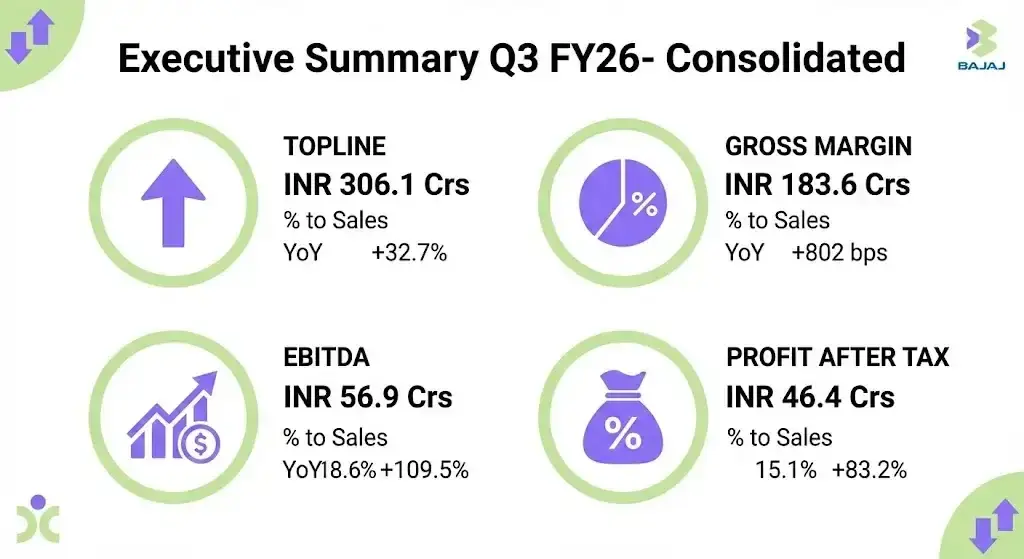
In a market chasing high-growth stocks, Bajaj Consumer Care executed a silent power move. The company launched a buyback at ₹290, offering a premium exit to investors, but the promoters explicitly refused to sell. By holding tight while the company bought out public shareholders, the total share count dropped, automatically boosting the promoter's stake from 40.95% to ~42.97%. This happened without them spending a single rupee of personal cash, effectively tightening their grip on the company using its own balance sheet.
This conviction was immediately validated by their latest Q3 FY26 results. Just months after rejecting the buyback offer, the company reported a massive 83% jump in Net Profit and a 30.6% surge in Revenue (YoY). The promoters refused the "guaranteed cash" because they knew these numbers were coming. While the market saw a value trap, the "Company Captains" saw a turnaround in motion, proving that the intrinsic value of the "Almond Drops" brand was worth far more than the buyback price.
5. SG Finserve (+1.92%): Aggressive Accumulation
The Gupta family, who are the promoters, have increased their stake by 1.92% (via open market purchases) in the latest quarter, pushing their total ownership to over 50%. In the financial world, crossing the 50% mark is a massive psychological milestone; it signifies absolute control. SG Finserve is an NBFC (Non-Banking Financial Company) that is rebooting itself with a specialized focus on supply chain financing. This isn't just a casual buy; it is an aggressive grab for equity before the engine fully starts.
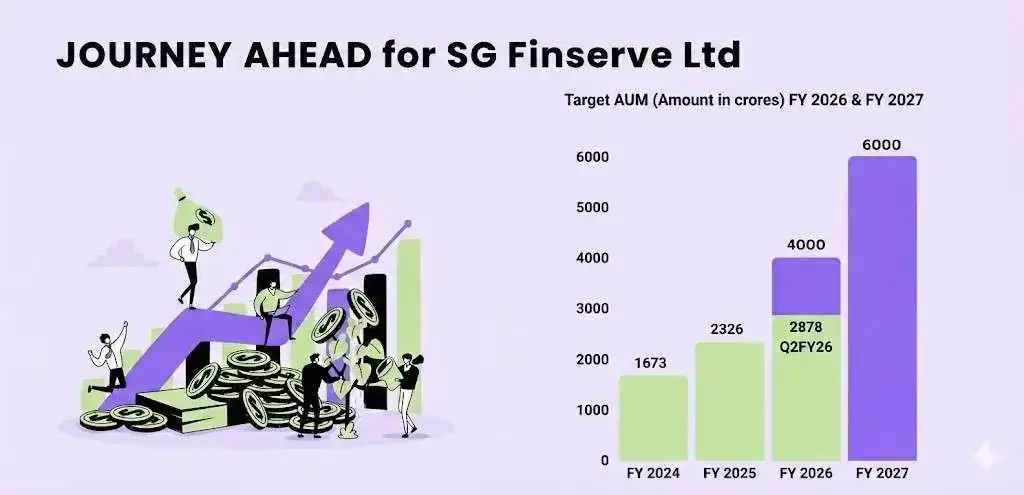
The timing of this buying is the key trigger. It coincides with the company receiving its Certificate of Registration for Factoring business from the RBI. This license is a game-changer, allowing them to legally finance invoices for dealers and vendors, a huge untapped market in India. The promoters are loading up on shares right at this "starting line," just before the company begins to scale its loan book. They are anticipating a high-growth phase and want to ensure they capture the maximum benefit of the value creation that comes from a freshly capitalized lending business.
6. Indus Towers (+1.03%): The Stability Bet
This is a battle of giants. The promoter buying here is driven primarily by Bharti Airtel, which has increased its stake by 1.03% through open market purchases. For a long time, Indus Towers was under a cloud of uncertainty because its major customer, Vodafone Idea, was struggling to pay bills. Airtel's decision to buy more stake now is a signal that the worst of the telecom crisis might be over.Airtel knows the tower business better than anyone. By increasing their holding, they are essentially saying that the sector has stabilized and the rental income from these towers is secure. They view Indus Towers as a "Cash Cow": a business that requires heavy setup costs but generates steady, massive cash flow once established. With the telecom duopoly (or triopoly) stabilizing, Airtel is positioning itself to enjoy the long-term dividends and stability that this infrastructure giant provides.

Read More: 7 Early Signals That a Stock Can Turn Multibagger
Read more: How to Analyze a Mid Cap Company – Complete Framework
You’ve seen the list of stocks, now here’s how to find the next one yourself. Follow this simple 3-step method to spot promoter buying before it hits the news.
How to Spot These Moves Yourself
You don't need a Bloomberg terminal or expensive paid subscriptions to track these "insider" moves. The data is publicly available for free, in real-time, on the exchange websites. The trick is simply knowing where to click. Instead of waiting for a news article to tell you what happened yesterday, you can see the trades as they are reported.
Step 1: Go to the Source. Head to the BSE India or NSE India website. Under the "Corporates" or "Filings" tab, look for a section titled "Insider Trading Disclosures" (specifically Regulation 7(2) of SEBI prohibitions). This is the official logbook where every promoter and designated person must report their buy or sell transactions within two days of the trade. It is the rawest, purest form of data you can get.- NSE Insider Trading Page: NSE Insider Trading
- BSE Insider Trading Page: BSE Insider Trading
Step 2: Decode the "Mode of Acquisition." Once you open the data, do not get overwhelmed by the numbers. Focus immediately on the column labeled "Mode of Acquisition." This is your filter.
- Ignore: If it says "Gift," "ESOP," or "Inter-se Transfer," skip it. These are internal adjustments and don't involve fresh cash.
- Focus: If it says "Open Market," stop and pay attention. This means the promoter went into the live market and bought shares just like you, paying the full current price.
Step 3: Look for "Clustering". A single buy order might be a one-off event, but patterns never lie. Look for "Clustering", this happens when you see the same promoter's name appear 5, 10, or 15 times over a few weeks, buying small quantities every single day. This repetitive buying is the "Creeping Acquisition" we discussed earlier. It tells you the promoter is in a rush to accumulate as much as possible before the price runs away, revealing their high confidence in the business's immediate future.
Read more: A Fundamental Checklist: How to Research a Stock in 1 Hour
Explore our Products
Research Framework

Emerging Titans
Combination of quantitative analysis, industry tailwinds, and management assessment - SPRINT investment philosophy

Tiny Titans
Heavy emphasis on scuttlebutt research, plant visits, and early on-ground signals
Conclusion: The Ultimate Insider Signal
In a market obsessed with noise, breaking news, and quarterly drama, promoter buying is the only signal that cuts through the chaos. When the "Captains" of the industry, who see the order books, margins, and cash flows before anyone else, decide to bet their own legacy on the future, they are seeing a picture the rest of the market has missed. Investing alongside them turns the stock market from a casino into a calculated business decision.
Successful investing is about finding these rare moments of alignment, not chasing every green tick on a screen. If you are ready to stop guessing and want more deep dives into how the "Smart Money" moves, make sure to follow and subscribe so you don't miss our next framework. And if this article helped you understand why "skin in the game" matters more than headlines, drop the word "OWNER" in the comments below. Let’s stop trading tickers and start owning businesses.
FAQs ( Frequently Asked Questions )
Should I worry if promoter buying happens during falling profits?
How much time should I give after spotting promoter buying?
Promoter buying is a medium-to-long-term signal, not an instant trigger. Give it at least 6–12 months to play out. Many of the biggest gains come after a long period of silence and boredom.
Can promoter buying be misleading in heavily debt-loaded companies?
Is repeated small buying better than one large bulk deal?
Can promoter buying fail even when intentions are genuine?
+What is the biggest mistake investors make after spotting promoter buying?
Acting too fast and allocating too much. Promoter buying improves odds, not certainty. Position sizing, diversification, and patience are what turn a good signal into real wealth.

High growth stock specialist, Value Educator
Shashank Mahajan is an equity research professional with over 12 years of experience in identifying high-potential SME and micro-cap stocks at an early stage. He follows a rigorous scuttlebutt research–driven approach, combining on-ground insights with deep financial analysis. Shashank specializes in uncovering under-researched and under-owned companies with strong management quality and long-term growth potential. Through disciplined research and early identification, he focuses on spotting tomorrow’s market leaders before they enter the mainstream investor radar.

Zen Technologies: Why Revenue Fell After Its Biggest Win

Data Patterns: India's Radar Designer and Its Waiting Orders

KSH International: The Wire Inside India's Transformers

Krishna Defence: The Steel Behind India's Warship Hulls

PNG Jewellers: A 194-Year-Old Name Goes National

Axiscades: From Services to Missile and Radar Electronics
Explore our Products
Research Framework
Emerging Titans
Combination of quantitative analysis, industry tailwinds, and management assessment - SPRINT investment philosophy
Tiny Titans
Heavy emphasis on scuttlebutt research, plant visits, and early on-ground signals


 Orders
 Subscription
 Share with friends
 Logout


Required Details
₹23999.00
(12 month subscription)
As per SEBI regulations, all users are mandated to complete the KYC that is validated for 1 year. Post payment, you will be redirected to the KYC screen


No comments yet. Be the first to comment!