
Dividend Stocks for Passive Income

The Silent Wealth Builder – Dividend Stocks
In a volatile Indian market, stock prices are opinions, but dividends are facts. A stock price is what people think the company is worth; a dividend is the company actually writing you a cheque from its profits.
“Owning stocks is great, but owning companies that pay you regularly is even better.” — Peter Lynch

For most Indian families, the stock market often looks like a casino. It flashes red and green, prices swing wildly, and the fear of losing hard-earned capital is real. So, we want the safety of Fixed Deposits (FDs). But deep down, we know FDs are losing the battle against inflation.
So is there any middle ground?
Yes. Dividend Stocks. They are the heavyweights of the market. Companies like ITC or Coal India, that pay you a share of their profits simply for owning a piece of their business. They are the "Smart Bridge" that offers the regular payouts of an FD with the growth potential of equity.
Now that we know they exist, let’s bust the biggest myth about them. To understand why they matter and how they generate passive income, let’s break down the Anatomy of Dividends and Dividend stocks.
The Anatomy of Dividends and Dividend Stocks
A dividend is the distribution of a portion of a company's earnings. When a company generates a profit, the management faces a capital allocation decision with two primary paths:
- Retain the Earnings: The capital is reinvested back into the business to fund future expansion, research and development (R&D), or acquisitions. This strategy is typical of "Growth Stocks" (e.g., Zomato, Paytm) which believe they can generate a higher return on capital than the shareholder could elsewhere.
- Distribute the Earnings: The cash is returned to shareholders. This path is chosen by "Dividend Stocks.” Usually mature, stable companies with steady cash flows and limited scope for hyper-aggressive expansion (e.g., ITC Ltd, Power Grid Corporation).
So are Dividends “free money” or is there a catch?
How are Dividends created – A Simple Explanation
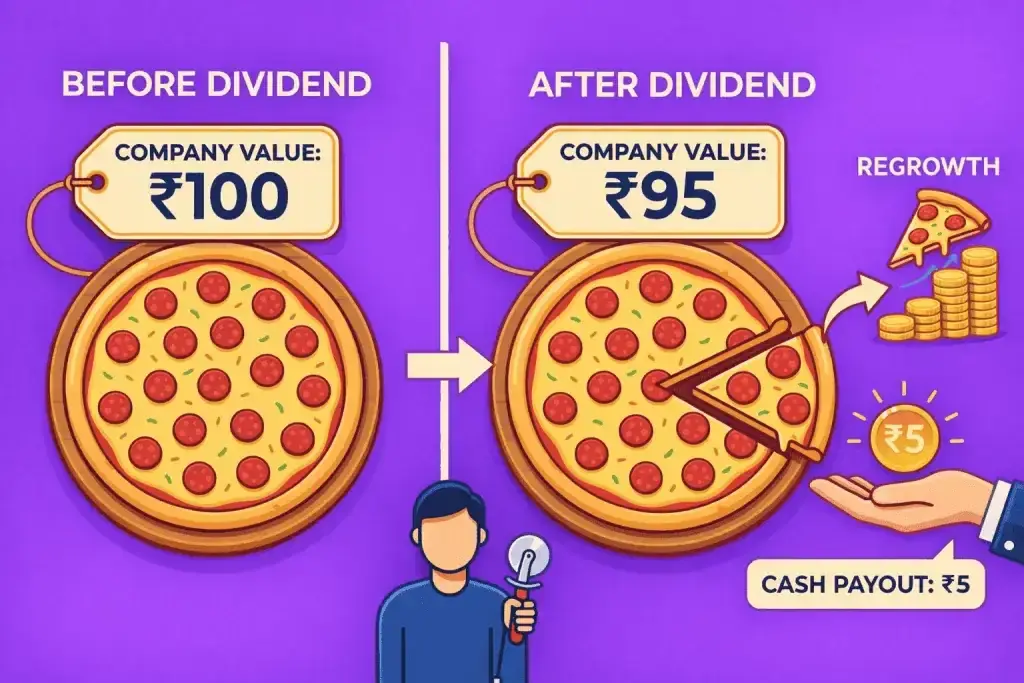
Beginners often think a dividend is "free money" printed out of thin air. It is not. To understand this, imagine a company is a large Pizza worth ₹100. If the company decides to pay you a ₹5 dividend, they are essentially cutting off a small slice of that pizza and handing it to you in cash.
- Before Dividend: You owned a pizza worth ₹100.
- After Dividend: You own a pizza worth ₹95 and have ₹5 cash in your pocket.
On the Ex-Dividend Date, the stock price literally drops by the amount of the dividend. So, why bother?
The magic lies in the regrowth. A high-quality business (like the pizza) regenerates that slice. Over time, the stock price increases to ₹100, then ₹110, and you also get to collect the ₹5 cash payouts along the way.
Now that you understand how dividends are created, let’s look at what you actually receive, because not every payout comes as cash.
Types of Dividend Payouts in India
While the goal is hard cash, companies have more than one way to share the pie and not all of them put money in your pocket immediately.
- Interim Dividend: Declared during the financial year, before the final annual accounts are settled.A classic example is HCL Technologies which often pay multiple interim dividends.
- Final Dividend: Declared after the financial year concludes and requires approval from shareholders at the Annual General Meeting (AGM).
- Special Dividend: A one-time payout triggered by black-swan event, such as the sale of a subsidiary or extraordinary profits. For instance, Aurum Proptech Ltd. distributed a massive special dividend in 2020 of ₹974 after selling its US business, a rare event that significantly altered investor returns.
- Stock Dividend (Bonus Issue): Instead of cash, the company issues additional shares. This increases the number of shares held, but it does not immediately increase the total value of the investment, as the price per share drops proportionally. It is more of a psychological reward and a liquidity booster than a direct income stream.
Since we have understood the concept, but if we miss the specific dates, we get nothing. So, here is the Dividend Timeline.
Read more about stock terminology: 10 Stock Market Terms Every Beginner Must Know Before Investing
Dividend Timeline – Dates That Decide Your Payout
Navigating dividend investing requires strict adherence to a specific timeline. Missing a date by even one day results in missing the payout entirely.
- Declaration Date: The Board of Directors announces the dividend amount. This is when the market reacts to the news.
- Record Date: The company reviews its books to determine who the "shareholders of record" are. An investor must be listed in the company's records on this specific date to be eligible.
- Ex-Dividend Date: This is the most critical date for the passive investor. Due to the T+1 settlement cycle in India (where shares take one day to reach the Demat account), an investor must purchase the stock before the Ex-Dividend Date to appear on the Record Date. If shares are bought on the Ex-Dividend Date, the buyer is not eligible for the upcoming payment; the previous owner receives it.
- Payment Date: The date the dividend is credited directly to the investor's linked bank account.
"Everyone lists the 'Top Dividend Stocks,' but are they all worth your money? Absolutely not. Let’s find out which ones pay your bills and which ones build your wealth."
Dividend Stocks: Cash Cows vs. Compounders
Dividend stocks represent an investment in companies that regularly share a portion of their profits to their shareholders in the form of dividends. These payments can serve as a consistent income stream for investors, making dividend stocks a popular choice for those seeking passive income.
In India, dividend stocks usually fall into two buckets:
- The "Cash Cows" (PSUs): Government companies like Coal India, ONGC, and Power Grid. The government demands high dividends to fund its budget, so these stocks offer massive yields (often 5-8%).
- The "Compounders" (Private): Companies like ITC, Hindustan Unilever, or TCS. They pay lower yields (1-3%) but grow their profits faster, meaning your dividend pay cheque grows every year.
Read more on Compounding: The Power of Compound Interest: How to Create Wealth in the Stock Market
Real-World Examples: The Indian Chronicles
The "Dividend Pillar": ITC Limited
ITC is the best example of an Indian dividend stock. For nearly a decade, when the stock seemed to go nowhere, it was mocked as a stock that "doesn't move." However, it consistently paid out 80-85% of its profits as dividends. Investors who held ITC through its stagnant years earned a consistent 4-5% yield. When the stock price finally rallied (2022-2024), they enjoyed the double engine of capital appreciation and the accumulated dividends. ITC demonstrates the virtue of patience in this strategy.

Read more about: How to start Investing in Stock Market with just ₹1,000
The "Growth-Dividend Hybrid": TCS
Tata Consultancy Services (TCS) typically offers a modest yield (1-1.5%), which discourages yield chasers. However, TCS grows its profits consistently and increases its payout regularly. Furthermore, TCS frequently conducts Buybacks, repurchasing shares from investors at a premium For a passive investor, TCS represents the "Sweet Spot" of safety, growth, and income.

The "Cyclical Cash Machine": Coal India
Coal India is a pure income play. It pays massive dividends because it has low capital expenditure needs and huge cash reserves. However, its stock price is cyclical, rallying when power demand peaks and falling otherwise. An investor who bought Coal India at its peak in 2010 might still be underwater on capital appreciation a decade later, with dividends serving only to mitigate the loss rather than generate wealth. This highlights that entry price matters, even in dividend stocks.

Why not just stick to FDs or Rental Income for Passive Income? Let’s look at the "Why" through the lens of a lazy investor.
Why Choose Dividends for Passive Income?
“Dividends are the ultimate form of passive income because they pay you for owning, not trading.” — Howard Marks
The "Bird in Hand" Psychology
“A bird in the hand is worth two in the bush.” – Benjamin Graham
Stock prices are volatile. Seeing your portfolio down 10% is painful. But dividends are real cash. When the market crashes, a dividend investor doesn't panic; they think, "Great, I can use my dividend cash to buy more shares at a discount." It creates a psychological floor that prevents you from selling at the wrong time.
Inflation Protection (The FD Killer)
An FD pays you the same interest in 2025 as it did in 2015. But inflation makes that money worth less.
Dividend Growth: A company like Asian Paints or Pidilite tends to increase its dividend as its profits grow. Your "passive salary" effectively gets an annual appraisal, keeping up with or beating inflation.

Are all Dividends Stocks ideal for Investment? Let’s find out by looking upon Traps and Evaluation Criteria.
How to Execute: The Traps & The Evaluation
The "Yield Trap" - How to Lose Money Fast
This is the most important point. Do not blindly buy the stock with the highest dividend yield.
The Trap: Company A is in trouble. Its stock price crashes from ₹100 to ₹50. It paid a ₹10 dividend last year. The screeners show a "20% Dividend Yield" (10/50).
The Reality: The company has no money left. It will likely cut the dividend to zero next year. You bought it for the yield, but you ended up with a junk stock and no income.
Case Study (Vedanta): Vedanta often shows a massive yield (sometimes 20%+). However, its dividends are frequently driven by the debt repayment needs of its parent company rather than pure operational surplus. It is a high-risk, cyclical play, not a "safe" income stream like an FD.
Before we jump into evaluation, we must also face the "Uncomfortable Truth" regarding taxes.
Taxation: The "Uncomfortable Truth”
Passive income isn't tax-free. In India, the tax rules have changed recently significantly.
Earlier Regime (Before April 1, 2020): Dividend Distribution Tax (DDT)
Dividends earlier were taxed at the company level through Dividend Distribution Tax (DDT).
Investors received dividends tax-free, making dividend stocks very attractive for passive income seekers, High-net-worth individuals (HNIs) and retirees strongly preferred dividend stocks as it was perceived as clean, predictable, post-tax income. Companies like ITC and Coal India were valued primarily for high payout ratios.
Current Regime (Post April 1, 2020): Tax at Investor’s Slab Rate
DDT has been removed. Dividends are taxed in the investor’s hands at their applicable income-tax slab rate, making them less efficient for high-income earners.
Due to which, dividend stocks have become less attractive for high-salaried individuals, creating a shift towards growth stocks and capital gains oriented strategies.
TDS Update (FY 2025): From April 1, 2025, TDS is deducted only if dividend income from a single company exceeds ₹10,000, which is increased from earlier ₹5,000, TDS rate remains 10% however.
Buyback Bombshell: Earlier, companies used to pay 23.3% tax on buyback “distributed income,” and investors received the money tax-free. But, from October 1, 2024, buybacks are treated as deemed dividends and taxed in the investor’s hands as per their slab rate up to ~35.88% for high earners. This effectively removes the tax advantage buybacks once had.
Dividend investing still remains an attractive option for retirees and low-tax investors, but high-income investors must focus on quality and growth, not just yield. So, how do you filter out the junk? We Use the Five-Step Evaluation Checklist.
Five-Step Evaluation Checklist: Ideal DNA of Dividend Stocks
To avoid traps and select winners, an investor must look beyond the headline yield figure. A robust screening checklist is essential.
1. Sales Growth – The Foundation of a Strong Business
Consistent revenue growth over the past 10-15 years is a key sign of a growing company. It shows that demand for its product and services is increasing, allowing it to expand operations, gain market share, and invest in future growth. Businesses that can consistently grow sales tend to have strong competitive advantages, making them resilient in any market condition.
2. Cash Flow vs. Net Profit – Fuel of Dividend Growth
“Cash flow tells you what’s real. Profits can be an opinion.” — Jim Chanos
Dividends are paid from cash, not accounting profits. A company can show high profits on paper (due to accrual accounting) but have zero cash in the bank if clients haven't paid. Always verify Free Cash Flow (FCF). If a company is paying dividends by borrowing money (Dividend > FCF), it is a Ponzi-like structure that will eventually collapse.
Learn more about Financial Analysis: How to Read a Balance Sheet Like a Professional Investor
3. Dividend Payout Ratio (DPR) – Protecting Your Passive Income
This metric reveals what percentage of net profit is being distributed to shareholders. A ratio between 30%-60% is typically healthy for most of the sectors and indicates the company is rewarding shareholders while retaining enough earnings to fund future growth opportunities.
4. History of Consistency – True Measure of Financial Strength
Consistency is a proxy for management integrity and business stability. An investor should look for companies that have paid dividends for at least 10 consecutive years, preferably without a reduction. Companies like Asian Paints, Pidilite Industries, and HDFC Bank have a long history of not just paying, but increasing dividends, even if the initial yield is low.
5. Debt Burden – Avoiding Financial Traps
Too much debt can cripple a company, even if its revenue and profits look great. We analyze how well a company manages its liabilities, ensuring that debt levels are under control. High debt is the enemy of dividends. In tough times, debt holders get paid first; shareholders get paid last. Look for Debt-to-Equity ratios below 1.0, or ideally, debt-free companies (e.g., many IT and FMCG firms).
The strategy sounds great on paper, but does the math work in real life? Here’s a detailed price tag comparison for financial freedom with pros and cons.
Read more on Debt management: What is Debt to Equity Ratio? Why It Matters for Small-Cap Investing
How Much Capital Do We Actually Need?
Assume that we want to generate a passive income of ₹50,000 per month (₹6 Lakhs/year), how much capital do we need for that?
We can frame Three scenarios and base our calculations as per scenario assumptions:
1. Conservative Portfolio (Yield ~2%): You buy high-growth companies (Titan, Asian Paints).
· Capital Needed: ₹3 Crores.
· Pros: Your capital will likely grow massively over time.
2. Balanced Dividend Portfolio (Yield ~4%): A mix of PSUs (Power Grid) and FMCG (ITC).
· Capital Needed: ₹1.5 Crores.
· Pros: A realistic balance of income and safety.
3. Risky High-Yield Portfolio (Yield ~6-7%): Mostly PSUs and Commodities (Coal India, Vedanta).
· Capital Needed: ₹85 Lakhs - ₹1 Crore.
· Pros: Low capital required.
· Cons: Very high risk of capital erosion. Your "principal" might shrink.
Passive income is not built by predicting markets, but by owning businesses that pay you regardless of market moods. With that perspective, let us now conclude this with key takeaways.
Conclusion
“Dividends are the silent partner in long-term equity returns.” — Jeremy Siegel
Most investors fail at dividend investing not because dividends don’t work, but because they chase yield without a framework. Reading “top dividend stock” lists may feel productive, but building a repeatable process, focused on cash flows, balance-sheet strength, and consistency across cycles, is what creates durable passive income.
Dividend investing is not about excitement; it is about discipline, patience, and letting quality businesses work in the background while markets remain noisy.
If this framework helped you rethink dividends beyond FDs and yield traps, comment “DIVIDEND” and share your view. Like the post to support research-driven investing content, share it with investors who value process over shortcuts.
The best income strategies are refined through structured discussion, not stock tips.
New to investing? Start with the: A Beginner's Guide to the Indian Stock Market
Explore our Products
Research Framework

Emerging Titans
Combination of quantitative analysis, industry tailwinds, and management assessment - SPRINT investment philosophy

Tiny Titans
Heavy emphasis on scuttlebutt research, plant visits, and early on-ground signals
FAQs ( Frequently Asked Questions )
How do I actually get the dividend money?
+Can I avoid paying tax on dividends?
+Is it better to buy "Growth" or "Dividend" stocks?
+What is the "Ex-Dividend Date"?
+Are PSU stocks good for dividends?
+What happened to Buyback tax benefits?
+
High growth stock specialist, Value Educator
Shashank Mahajan is an equity research professional with over 12 years of experience in identifying high-potential SME and micro-cap stocks at an early stage. He follows a rigorous scuttlebutt research–driven approach, combining on-ground insights with deep financial analysis. Shashank specializes in uncovering under-researched and under-owned companies with strong management quality and long-term growth potential. Through disciplined research and early identification, he focuses on spotting tomorrow’s market leaders before they enter the mainstream investor radar.

Glenmark: The USD 700 Mn Cancer Deal and Its Brands

Pharma Stocks in India 2026: Generics, APIs and CDMOs

Granules India: From Paracetamol to a 65% Gross Margin

Natco Pharma: After Revlimid, 29 Patent Challenges

Shilpa Medicare: Cancer APIs, Films and Biosimilars

Alembic Pharma: US Plants Pay Back, Margin Hits 22.2%
Explore our Products
Research Framework
Emerging Titans
Combination of quantitative analysis, industry tailwinds, and management assessment - SPRINT investment philosophy
Tiny Titans
Heavy emphasis on scuttlebutt research, plant visits, and early on-ground signals



Modern Warfare to Multibaggers
Key Trends. Strategic Shifts. Opportunities Ahead.
Today at 7:00 PM IST. Room opens 30 minutes before.
Don't Miss This Exclusive Webinar!
Join Value Educator to decode the key trends shaping India's defence sector and learn how to identify tomorrow's potential leaders in the space.
- In-depth research on India's defence sector
- Live Q&A session
- Actionable takeaways for long-term investors

 Orders
 Subscription
 Share with friends


Required Details
₹23999.00
(12 month subscription)
As per SEBI regulations, all users are mandated to complete the KYC that is validated for 1 year. Post payment, you will be redirected to the KYC screen


No comments yet. Be the first to comment!