
Union Budget: What Matters for Investors
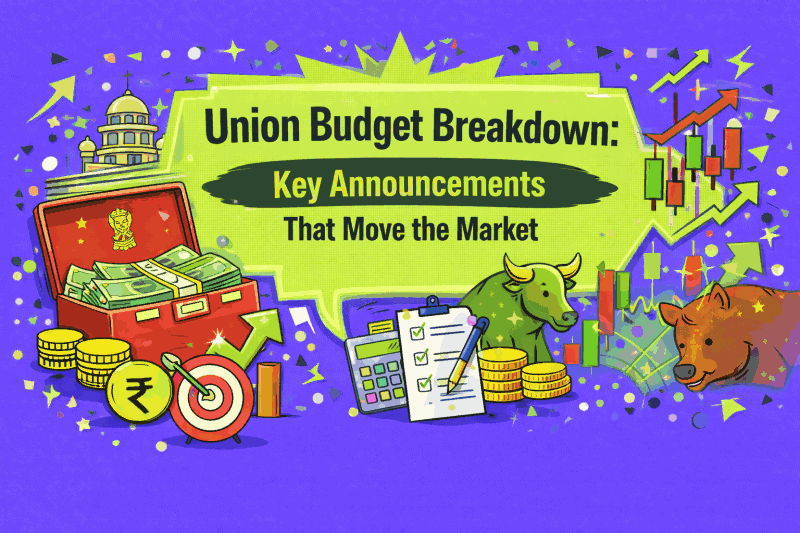
Budget 2026 didn’t fail the market.
The market failed to read the budget.
There were no headline tax cuts, no quick boost to consumption, and no attempt to rescue sentiment for a single trading session. And when markets realised there would be no instant reward, prices reacted exactly the way impatience usually does — they sold.
But this budget was never written for traders chasing the next candle.
It was written for something slower, quieter, and far more important: the economic machinery that compounds long after headlines fade.
As the Finance Minister spoke, markets initially held steady. Capital expenditure stayed elevated. Manufacturing, defence, infrastructure, and critical technologies remained in focus. Fiscal discipline wasn’t sacrificed for applause. On the surface, nothing looked alarming.
The disappointment came later — when it became clear that comfort had been postponed in favour of construction.
That reaction says more about market psychology than about policy quality. Structural budgets rarely feel good on day one. They feel boring. Restrained. Even uncomfortable. And yet, they are often the ones that quietly shape earnings, capacity, and competitiveness over the next decade.
As Warren Buffett once put it:
“The stock market is a device for transferring money from the impatient to the patient.”
Budget 2026 was not designed to win an afternoon ticker battle.
It was designed to survive multiple cycles.
If you’re new to how policy events shape markets, A Beginner’s Guide to the Indian Stock Market offers a simple foundation before diving deeper.
If you judged Budget 2026 by the first market reaction, you likely missed its real message.
Budget Day: What Happened in the Market
The market’s response unfolded almost like a two-act play, exposing the persistent divide between long-horizon investors and short-term traders. The sequence itself was revealing.
During the Speech: A Carefully Positive Outlook
While the Finance Minister was delivering his speech, the markets remained surprisingly composed. The prices did not oscillate; neither were there any investors rushing to sell. The general mood was that stocks basically inched higher as participants absorbed the announcements.
The early impressions indeed seemed to suggest that a host of reasons, duly helped stem nerves: an emphasis on building infrastructure was there, backing for sectors such as MSMEs and manufacturing continued unabated, an attempt was made to keep government finances in control, and spending plans seemed thoughtful rather than extravagant.
Taken together, the message seemed one of less headline-grabbing change and more of staying the course. To many investors, especially large institutions, that kind of continuity is more often reassuring than bold surprises. When the direction of policy appears stable, planning is easier, longer-term confidence rises, and the chances of balanced growth with manageable inflation tend to rise.
After the Speech: Sentiment Turns
The tone changed once the details were fully absorbed.
Several triggers converged at once:
- A hike in Securities Transaction Tax on derivatives
- No meaningful personal tax relief
- Limited near-term catalysts for foreign inflows
- Markets are already trading at elevated valuations
For retail participants and tactical traders, that combination proved enough to lock in profits. Selling gathered pace through the afternoon, especially in index heavyweights and higher-beta counters.
Closing Numbers: A Sharp Reset
By the closing bell, the damage was hard to miss:
- Nifty 50 slipped nearly 2%, ending around 24,825
- Sensex dropped more than 1,800 points to roughly 80,700
- Fifteen of sixteen sectoral indices finished lower
- Mid- and small-cap stocks fell more sharply than large caps
- Momentum and derivatives-linked names absorbed outsized losses
It marked the steepest Budget-day decline in about six years.
Looking Past the Sell-Off
Yet interpreting the fall requires nuance.
The market was not rebelling against the government’s economic direction. Rather, it was reacting to three immediate discomforts:
- Higher trading costs
- A shortage of short-term triggers
- No consumption-led surprise
Put differently, the disappointment was tactical, not philosophical.
This kind of reaction is common during volatile events; something long-term investors learn to manage, as explained in How to Stay Emotionally Strong During Market Crash.
“In the short run, the market is a voting machine. In the long run, it is a weighing machine.” - Benjamin Graham
The market did not reject Budget 2026. It rejected the absence of immediacy.
For seasoned investors, the episode echoed a familiar pattern: structural budgets often unsettle prices before they strengthen the foundations beneath them.
The Big Picture: Understanding the 3-Kartavya Framework
To understand this budget properly, one has to step back from line items and look at the governing philosophy behind it.
Budget 2026 was not assembled through scattered incentives. It rested on a clearly articulated framework; the state’s three “Kartavyas,” or duties, which help explain both what was prioritised and what was intentionally avoided.
Kartavya 1: Sustain Growth and Competitiveness
The basic job right now is to make sure growth doesn’t stall just because the world has become messy. Global trade isn’t reliable, supply chains break without warning, and capital doesn’t come easily anymore. This isn’t theory; it’s already happening.
So the response is fairly practical. Focus on what can be built and controlled within the country. Strengthen infrastructure, deepen manufacturing, and reduce dependence where it actually matters.
That’s why sectors like semiconductors, capital goods, logistics, defence manufacturing, and public investment keep showing up. These aren’t quick-return ideas. They’re slow, heavy, and meant to create scale. The thinking seems clear: real competitiveness lasts longer than short-term demand pushes.
Kartavya 2: Build Capacity for a Future Workforce
Growth can look strong in numbers, but it fades if people can’t move with it. Skills and the ability to adapt matter more than speed.
This is why the budget keeps circling back to training, research, and how technology is used. AI in government systems and agriculture, more support for healthcare workers, creative fields, and smoother movement from education to jobs; all of it points in the same direction.
People aren’t being treated as a cost item here. They’re being treated as something that needs long-term investment. And this isn’t just about urban tech jobs. Services, tourism, logistics, healthcare, and MSMEs all come into play. A young population helps only if it can actually find work and adjust as things change.
“The best investment you can make is in yourself.” - Warren Buffett
Kartavya 3: Inclusive Development
The last part is about who gets pulled into growth.Instead of handing out money and hoping it sticks, the focus is on helping people earn more by being more productive. Farmers, women entrepreneurs, rural workers, MSMEs, and less-developed regions are clearly in view.
This spending doesn’t look like a quick fix. It looks more like an effort to pull more people into growth instead of letting it stay concentrated in a few places.
Why investors should pay attention
For investors, frameworks matter because they signal intent.
The 3-Kartavya approach points to continuity, not sudden policy shifts. Rather than swinging between stimulus and restraint, the government seems set on a steadier course, one built around capital spending, capacity building, and fiscal discipline.
Markets may enjoy drama, but long-term capital usually values predictability.
Budget 2026 offered more clarity than excitement, and that’s not a bad thing.
Fiscal Math That Anchored the Budget
If there was one element quietly reinforcing investor confidence, it was the arithmetic behind the announcements.
Despite wide-ranging sectoral pushes, the government held firm on its most consequential promise: discipline. In a world where election cycles often tempt policymakers toward excess, choosing credibility over applause sends a clear signal.
The fiscal deficit for FY27 was pegged near 4.3% of GDP, extending the previously outlined glide path. Numbers alone rarely tell the full story, but direction does. And here, the direction remains unmistakable.
This matters for investors because government spending decisions eventually show up in growth and company earnings.
Debt as a share of GDP is also expected to come down over time, which slowly frees up money for useful investment instead of it being spent on interest.
What makes this stance notable is that restraint coexists with expansion. Public capex is still rising, close to ₹12.2 lakh crore, directed toward assets that crowd in private investment; roads, logistics, urban infrastructure, and energy; rather than short-term sentiment boosts.
The message wasn’t loud, but it was clear:
- No fiscal blow-up.
- No populist shortcuts.
- No compromise on long-term stability.
“Good economics is not about doing what is popular; it is about doing what is sustainable.”- Raghuram Rajan
The bet is on steady capital spending, slow reform, and predictable policy. It may not light up markets overnight, but it’s designed to hold up across cycles.
Sectoral Winners: Where Policy Turned Into Capital Flow
Budget 2026 sent a simple message. Growth isn’t going to come just from pushing consumption. Money is being steered toward areas that build capacity, reduce reliance on the outside world, and support more stable earnings over time.
For investors, this matters. When policy intent, execution, and capital flows align, multi-year opportunities often emerge; quietly at first.
That’s also why allocation matters as much as selection, a point explored in Portfolio Diversification – How Many Stocks Should You Hold?
Infrastructure & Logistics: The Economic Spine
Infrastructure stayed front and centre in the budget. Public capex was raised again to around ₹12.2 lakh crore, showing that the government is still doing the heavy lifting on demand while private investment remains cautious and selective.
What’s changed is the emphasis. The focus has shifted from just building assets to improving efficiency, reducing logistics friction that quietly taxes productivity. Key priorities included:
- Freight corridors linking industrial clusters to ports
- Greater use of waterways and coastal shipping
- Ports, urban infrastructure, and last-mile connectivity
Infrastructure matters because it creates long-duration cash flows. Each rupee spent ripples across multiple sectors, while providing something markets value deeply: earnings visibility measured in years, not quarters.
Infra stocks rarely celebrate on budget day. But long-duration earnings rarely announce themselves with fireworks.
Manufacturing, AI & Semiconductors: The Strategic Layer
If infrastructure forms the base, manufacturing represents the strategic layer, where competitiveness meets economic sovereignty.
Budget 2026 reinforced India’s push toward supply-chain resilience, particularly in import-sensitive and technology-heavy segments. Announcements included:
- India Semiconductor Mission 2.0, extending beyond fabrication
- Incentives for electronics components and capital goods
- Support for critical inputs such as rare earths
This is not branding. It is positioning.
Control over key inputs like chips, components, and machinery often decides who actually makes the money and who just assembles parts. Companies aligned with this push tend to enjoy policy support, longer demand visibility, and better pricing power, which helps keep earnings more stable over time.
Defence & Aerospace: From Narrative to Order Books
Defence is steadily moving from a thematic trade to an order-book-driven story.
Budget 2026 avoided theatrical announcements, instead reinforcing continuity through:
- Customs duty exemptions on key inputs
- Support for domestic Maintenance, Repair & Overhaul ecosystems
- Incentives for indigenous aircraft parts and defence electronics
The emphasis now is on execution, pulling domestic suppliers deeper into procurement chains while gradually building export capability.
For investors, defence is starting to look less like a headline trade and more like a predictable business, driven by long-term contracts, operating leverage, and some protection from economic cycles.
Quiet sectors sometimes compound the loudest.
MSMEs & Industrial Clusters: Strengthening the Middle Layer
One of the budget’s most structurally important, yet least headline-friendly, themes was its focus on MSMEs and industrial ecosystems.
Key measures included:
- A ₹10,000 crore MSME Growth Fund to scale viable enterprises
- Expansion of TReDS to ease liquidity constraints through invoice discounting
- Revitalisation of nearly 200 legacy industrial clusters via infrastructure and technology upgrades
MSMEs matter a lot to jobs and manufacturing, but many have always struggled to get steady credit. These steps are trying to fix that by making funding easier, bringing businesses into the formal system, and connecting them better to supply chains. If it works, the impact won’t be loud; it will show in firms lasting longer, working better, and manufacturing becoming more stable.
The Pattern Beneath the Allocations
Step back, and the philosophy is clear:
- Build capacity rather than engineer consumption
- Reduce structural dependencies
- Improve earnings visibility instead of chasing sentiment
Markets rarely reward such groundwork immediately, but corporate profit cycles often begin here, long before stock prices reflect them.
Sectors That Didn’t Get Their Moment
Not every budget needs to create universal winners. In fact, part of what made Budget 2026 feel restrained was its refusal to manufacture excitement where fundamentals may not yet justify it.
FMCG: Stability Without a Sugar Rush
FMCG entered the budget with high expectations, particularly around tax relief to revive consumption. That relief never came.
There were no major personal tax cuts, and rural support remained largely indirect, routed through infrastructure, employment creation, and productivity rather than direct transfers. The market response reflected this reality: muted, not negative.
The message feels intentional. Consumption should return gradually as jobs and incomes settle, not because of quick stimulus. For FMCG firms, this means slow, steady growth, where margins and execution count more than sudden volume jumps alone.
Real Estate: Let Infrastructure Do the Talking
Real estate also stayed out of the spotlight. There were no fresh homebuyer incentives or transaction-driven boosters. Instead, the emphasis remained on infrastructure-led urban development; improving connectivity and productivity so that housing demand follows employment, not incentives.
The Honest Interpretation
FMCG and real estate remained quiet because policymakers chose:
- Capital formation over consumption engineering
- Structural growth over headline appeal
- Economic durability over immediate market applause
Restraint rarely excites in the moment, but it often leads to healthier, less volatile earnings cycles over time.
Taxes & Market Sentiment Shockers
If one part of the budget jolted markets instantly, it was taxation, specifically where it intersected with trading rather than long-term investing.
STT Hike on F&O: The Catalyst
The biggest surprise was the increase in Securities Transaction Tax on derivatives. Higher STT on futures, options premiums, and option exercises raised transaction costs for active participants such as intraday traders, retail F&O users, and proprietary desks.
The immediate impact was predictable:
- High-turnover strategies became less profitable
- F&O volumes softened
- Broker and intermediary stocks faced pressure
- Risk appetite faded quickly
Why Investors May Read It Differently
The STT hike barely affects delivery-based investing, SIP flows, or long-term ownership. Its intent appears simple: discourage excessive speculation and improve market quality. For patient capital, lower leverage-driven volatility can be constructive.
Subtle Signals Beyond STT
Just as telling was what didn’t change. There were no sweeping income tax cuts or consumption giveaways, reinforcing the budget’s non-populist stance. At the same time, import duties were adjusted to make raw materials cheaper and finished goods relatively costlier, nudging firms toward genuine manufacturing rather than low-value assembly.
The Bigger Picture
Markets sold off not because the economic blueprint weakened, but because trading became costlier and short-term expectations were punctured. For long-term investors focused on compounding, the structural support for capacity-building remains intact, even if the adjustment felt uncomfortable on Day One.
Gold & Silver: Quiet Indicators of Market Mood
While equities dominated attention, precious metals offered a subtler read on investor psychology. Neither gold nor silver reacted to any direct policy change; their movement reflected shifts in liquidity and risk appetite.
On Budget Day, both metals saw mild corrections; largely profit booking after prior gains rather than panic-driven selling. Two factors were at play: a firmer US dollar, which tends to pressure dollar-denominated assets, and a brief risk-off tilt as traders trimmed leveraged positions.
Importantly, the budget itself offered no negative signal for precious assets. From a medium-term perspective, gold’s role as a hedge and portfolio stabiliser remains intact, supported by ongoing geopolitical uncertainty and central bank reserve diversification. Silver continues to benefit from industrial demand linked to electronics and the energy transition.
Short-term corrections rarely rewrite long-term roles. For investors, the takeaway is simple: view precious metals through a portfolio lens, not daily price swings.
The Day After: When Emotion Gave Way to Interpretation
Budgets are often judged in real time; sometimes unfairly. Prices move fast; understanding moves slower. The more revealing verdict on Budget 2026 arrived not during the speech, but in the session that followed.
Once the initial turbulence passed, markets began to steady. Panic selling receded, volatility cooled, and cautious buyers reappeared. That shift mattered. Had the budget genuinely damaged growth expectations, selling would likely have persisted. Instead, capital edged back in.
Calm After the Reset
The recovery was measured, not speculative. Infrastructure and capital goods names attracted interest first, while defensive large caps with stronger balance sheets found favour. Notably absent was any rush into high-beta stocks; a sign of deliberate, not emotional, positioning.
What the Price Action Revealed
The post-budget response highlighted three quiet truths:
- The budget wasn’t rejected; it simply lacked instant gratification
- Much of the sell-off reflected valuation resets and derivatives positioning
- Markets were searching for equilibrium, not signalling policy doubt
Once the noise faded, the narrative shifted from “What didn’t I get?” to “What is being built?”That question is often where durable opportunities begin.
Political & Historical Context: Why Continuity Carries Weight
Beyond economics, Budget 2026 conveyed a quieter political signal; one markets sometimes underestimate but rarely ignore.
Finance Minister Nirmala Sitharaman presented her ninth consecutive Union Budget, marking the longest uninterrupted tenure for a finance minister in independent India. Such continuity at the helm of fiscal policy is uncommon, and its implications extend beyond symbolism.
Why Investors Tend to Value Stability
Markets care less about personalities and more about predictability. When policy direction remains stable:
- Businesses plan capex with greater confidence
- Supply chains are built with longer horizons
- Hiring decisions become less tentative
- Risk premiums gradually compress
Budget 2026 reflected that steadiness. There were no abrupt reversals or ideological swings; only a reinforcement of a familiar trajectory: manufacturing-led growth, infrastructure expansion, fiscal discipline, and incremental reform.
In investing, predictability rarely generates headlines, but it often generates returns.
Excitement is episodic. Stability compounds.
What Investors Should Actually Do After Budget 2026
When the headlines thin out and budget-day candles disappear from charts, positioning matters far more than commentary.
Budget 2026 did not rewrite the rules overnight. What it did was clarify which kinds of capital the current policy environment is likely to reward.
For Traders: Adapt, Don’t Retreat
The increase in STT on derivatives sends a fairly unambiguous message; hyperactive churn is being discouraged.
Expectations worth internalising:
- Short-dated options may see lower volumes
- Margins will matter more than before
- Undisciplined overtrading will become costlier
- Volatility strategies may still work, but only with tighter execution
Trading is not being extinguished; impatience is simply becoming more expensive.
The traders most likely to endure will not necessarily be those who trade more, but those who trade better.
For Long-Term Investors: Follow Policy Gravity
If the budget revealed one strategic truth, it is that the government is underwriting growth in specific corridors of the economy.
Capital with a longer horizon may find itself gravitating toward:
- Infrastructure and logistics: roads, rail, freight corridors, waterways
- Manufacturing and capital goods: electronics, chemicals, equipment makers
- Defence and aerospace: indigenisation, MRO ecosystems, multi-year orders
- Industrial enablers: MSMEs, cluster-based manufacturing, supply-chain participants
These are not stories designed for a quarter. They are execution arcs that typically unfold across five to ten years; often compounding quietly while sentiment oscillates.
The Mistake Investors Repeatedly Make
Post-budget environments tend to tempt investors into three familiar errors:
- Panic-selling because markets fell on announcement day
- Chasing stocks that rallied during the speech
- Confusing policy timelines with trading timelines
One-day moves capture emotion. Budgets express direction.
Orders, contracts, capacity expansion, and balance-sheet improvements take time, but those are the forces that ultimately shape earnings.
The Right Mental Model
Budget 2026 did not promise immediacy. It promised direction. It promised discipline.
And perhaps most importantly, it promised durability.
Investors aligned with that tempo, willing to tolerate periods when markets appear impatient, are typically better positioned than those reacting to every headline flicker.
Execution rarely feels dramatic while it is happening. Its effects are usually recognised only in hindsight.
Explore our Products
Research Framework

Emerging Titans
Combination of quantitative analysis, industry tailwinds, and management assessment - SPRINT investment philosophy

Tiny Titans
Heavy emphasis on scuttlebutt research, plant visits, and early on-ground signals
Conclusion: Reading Budget 2026 With the Right Lens
Union Budget 2026 was never meant to win the final hour of trading. It was designed to outlast market moods.
This was a builder’s budget; one that placed factories ahead of flash, balance sheets ahead of buzz, and execution ahead of excitement. The immediate volatility reflected short-term disappointment more than any weakness in the underlying framework.
Step back, and the contours sharpen:
- Public capex remains elevated
- Manufacturing depth is being reinforced
- Infrastructure build-out continues
- Defence and supply-chain resilience are being prioritised
- Fiscal discipline has been preserved, not diluted
These are precisely the conditions under which corporate earnings expand quietly, long before they show up in stock prices.
Markets vote every day. Economies compound over the years.
Budget 2026 chose compounding.
This is also why long-term investors focus less on headlines and more on time; the quiet force explained in The Power of Compounding: Why Starting Early in Stocks Beats Everything Else.
Comment “BUDGET” if you want a deeper breakdown of how these policy choices could shape long-term investing opportunities.
FAQs
What are the main highlights of Budget 2026?
+What was the market reaction to Budget 2026, and why did it turn negative?
+What is the government’s long-term focus in Budget 2026?
+What does Budget 2026 signal for India’s future?
+
High growth stock specialist, Value Educator
Shashank Mahajan is an equity research professional with over 12 years of experience in identifying high-potential SME and micro-cap stocks at an early stage. He follows a rigorous scuttlebutt research–driven approach, combining on-ground insights with deep financial analysis. Shashank specializes in uncovering under-researched and under-owned companies with strong management quality and long-term growth potential. Through disciplined research and early identification, he focuses on spotting tomorrow’s market leaders before they enter the mainstream investor radar.

Zen Technologies: Revenue Fell After a Big Win



PNG Jewellers: A 194-Year-Old Name Goes National
Explore our Products
Research Framework
Emerging Titans
Combination of quantitative analysis, industry tailwinds, and management assessment - SPRINT investment philosophy
Tiny Titans
Heavy emphasis on scuttlebutt research, plant visits, and early on-ground signals


 Orders
 Subscription
 Share with friends


Required Details
₹23999.00
(12 month subscription)
As per SEBI regulations, all users are mandated to complete the KYC that is validated for 1 year. Post payment, you will be redirected to the KYC screen


No comments yet. Be the first to comment!