
The Power of Compound Interest
Albert Einstein famously called compound interest the “eighth wonder of the world.”
Not because it is complicated — but because it is so deeply misunderstood.
Those who understand the power of compounding earn from it.
Those who don’t unknowingly work against it.
When people think about wealth creation, they often focus on quick gains, high returns, or perfect timing. But sustainable wealth — the kind that lasts across decades — is rarely built through dramatic moves. It is built quietly, through compounding working patiently over time.
Compounding doesn’t apply only to money. It shapes habits, businesses, careers, and even personal growth. Small actions repeated consistently don’t feel powerful in the beginning. Yet given enough time, they create outcomes that appear extraordinary in hindsight. This is why the richest investors, strongest companies, and most successful individuals all share one common trait: they allow compounding to do the heavy lifting.
The irony is that compounding rarely looks impressive at first. Early progress feels slow, almost disappointing. But beneath the surface, momentum is building — and once time enters the equation, results accelerate in ways most people never anticipate.
To appreciate why compound interest investing works so well, it’s important to first understand what compounding actually means — without formulas, jargon, or unnecessary complexity.
What Is Compounding? A Simple Explanation
Compounding is like growing bamboo.For the first few years, bamboo grows underground. You water it daily, but nothing seems to happen. No height, no visible growth. Many people give up at this stage.
Then suddenly, in one season, bamboo shoots up several feet in just a few weeks.
Your money works the same way.
In the beginning, returns look small and boring. Growth feels slow. But what’s happening is that your money is building a base. Once that base becomes big enough, growth becomes fast — because returns start earning returns.
Simple Interest vs Compound Interest: The Quiet Difference
With simple interest, your money grows linearly. You earn returns only on the original amount you invested. No matter how long you stay invested, the base remains the same. Growth is predictable, steady, and limited.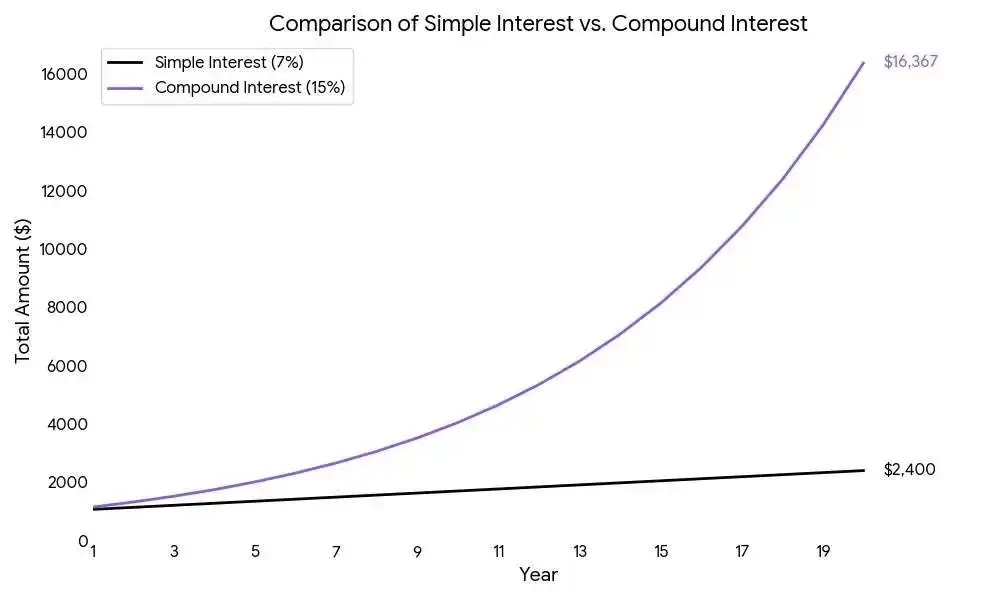
With compound interest, the story is very different. You earn returns not only on your original investment, but also on the returns generated along the way. Each year, the base grows larger, and future growth builds on this expanding base. What starts slow gradually becomes powerful.
“Patience is not simply the ability to wait — it’s how we behave while we’re waiting.” – Joyce Meyer
Think of it like a snowball rolling down a hill.
At the top, the snowball is tiny. For the first few meters, it barely grows — you might even think nothing special is happening. That’s simple interest territory: steady, predictable, and honestly… boring.
But as the snowball keeps rolling, something changes.
Each new layer of snow sticks not just to the original ball, but to everything it has already accumulated. Now the snowball is growing because it is already big. That’s compounding.
Over time, the size doesn’t increase linearly — it accelerates.
Growth starts feeding on past growth.
The distance covered may be the same, but the result looks wildly disproportionate to the effort.
This is why compounding feels unimpressive in the early years and unbelievable in the later ones.
Most people quit while the snowball is still small.
The real magic only shows up for those who keep pushing it long enough.

This single distinction explains why wealth created through compounding appears ordinary in the beginning — and extraordinary in the end.
Once this difference is clear, it becomes easier to understand what actually drives compound returns over long periods.
The Three Forces That Drive Compounding
Three key forces shape compound returns.The first is the initial principal — the amount you start with. A larger base helps, but it is not the most important factor.
The second is the rate of return. Higher returns do accelerate growth, but they often come with higher risk and inconsistency.
The third — and most underestimated — is time.
Time is the true engine of compounding. Given enough years, even modest returns can grow into surprisingly large outcomes. Without time, even the best returns struggle to create meaningful wealth. This is why compounding rewards patience far more than intelligence or activity.
Understanding this shifts how you think about money. Instead of asking, “How fast can I grow my wealth?”, the better question becomes, “How long can I allow my wealth to grow without interruption?”
Most people spend endless energy chasing higher returns. Very few stop to realize that time, not returns, is the real multiplier.
To understand why some investors build enormous wealth with average returns — while others fail despite taking higher risks — we need to look closely at the role of time.
Read more on : How to Start Investing in the Indian Stock Market with Just ₹1,000
Time: The Hidden Multiplier Everyone Ignores
When people talk about compounding, they usually fixate on percentages — 12%, 18%, 25%. But the real magic of compounding has very little to do with rates.It has everything to do with time.
Given enough time, average returns can create extraordinary wealth. Without time, even great returns fail to move the needle. Most investors search endlessly for the “perfect investment” but ignore the most powerful advantage available to them: staying invested for long, uninterrupted periods.
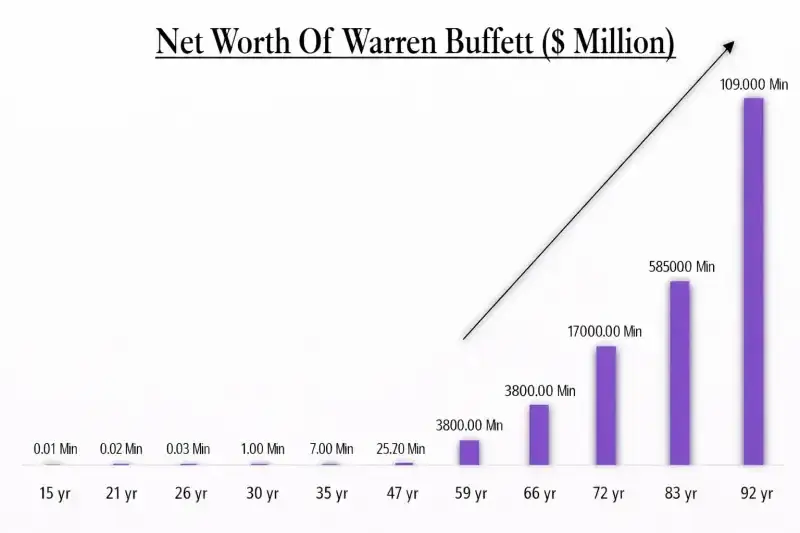
Warren Buffett understood this early. When asked what his biggest advantage was, he didn’t say intelligence, connections, or information. He said time. He started early and had a very long runway.
There’s a famous moment from a Berkshire Hathaway Annual meeting where Buffett was asked:
“You are already one of the richest people in the world — what do you want now?”
His answer was classic Buffett sarcasm:
“I want to become the oldest man in the world.”
Why? Because as long as he is alive, compounding keeps working.
This is also why a majority of Buffett’s wealth was created after the age of 50. Not because he suddenly became smarter — but because compounding finally reached full momentum.
Time allows gains to stack, mistakes to get absorbed, and volatility to smooth out. Without time, compounding never gets a chance to reveal its true power.
To make this intuition concrete, we now need perspective — not formulas, but numbers that stretch the imagination.
“The best time to plant a tree was 20 years ago. The second best time is now.” – Chinese Proverb
How Compounding Actually Grows: The 10–20–30 Year Lens
Compounding is slow at first, then builds momentum, then surprises you with results that almost feel unreal.Imagine you invest ₹1,00,000 at different annual returns.
The pattern is clear.
At 10 years, growth feels modest — almost boring.
At 20 years, results begin to surprise you.
At 30 years, outcomes feel almost unbelievable, even from modest beginnings.
A simple mental shortcut makes this clearer
The Rule of 72: A Quick Way to See Compounding in Action
The Rule of 72 is a simple mental shortcut to estimate how long it takes an investment to double at a given annual return. Instead of complex formulas, you just divide 72 by your expected rate of return.• At 7%, your money doubles in roughly 10 years.
• At 15%, it doubles in about 5 years.
• At 25%, it doubles in just 3 years.
Small differences in returns matter — but only when time is allowed to work. The real multiplier is patience, not speed.
And yet, this leads to a common question: if compounding is so powerful, why does it feel almost invisible in the early years?
The Hidden power of slow beginnings
Early compounding often feels underwhelming. You invest, you wait, and progress seems almost boring. Days turn into months, statements change only slightly, and it’s easy to feel like nothing meaningful is happening. This slow start is not a flaw of compounding — it is the test. It quietly filters out those who demand quick results from those who understand long-term growth.
A centuries-old story explains this illusion better than any chart or formula. Long ago, a wise scholar and inventor named Sissa ibn Dahir presented the game of chess to an Indian king. Impressed by the game’s depth and strategy, the king offered him any reward he desired — gold, land, or power. Sissa made a request that sounded almost laughable in its simplicity. He asked for one grain of rice to be placed on the first square of the chessboard. Two grains on the second. Four on the third. And for the grains to keep doubling across all 64 squares. The king laughed. The request felt insignificant — almost embarrassing. He agreed immediately.
At first, everything seemed normal. A few grains here, a small pile there. Even after several rows, the rice barely filled a bowl. The courtiers watched casually. The king lost interest.
Then something strange began to happen. As the board progressed, the piles grew faster than intuition could grasp. What once looked modest suddenly became alarming. By the final squares, the numbers had exploded — so large that the kingdom could not supply the rice. The total exceeded all the rice that could be produced in the world. The mistake was not arithmetic. It was human intuition. Exponential growth always starts quietly. The early part hides the ending.

This is exactly how compounding behaves in real life. The early years feel slow because the base is small. Nothing looks impressive. But every small gain is laying the groundwork for something far larger later. Those who quit early never reach the squares where compounding reveals its true power.
James Clear explains the same idea through the 1% rule, using a modern lens.

Imagine improving just 1% every day — in your skills, habits, health, or finances. On day one, nothing changes. On day ten, still nothing noticeable. Even after a month, you might feel disappointed. You’re doing the work, but the results refuse to show up.
Most people quit here.
But those who don’t keep stacking tiny improvements. The gains don’t reset each day — they accumulate. One percent builds on yesterday’s one percent. Over months, the progress becomes measurable. Over years, it becomes unrecognizable compared to where it started.
The difference between someone who gets 1% better every day and someone who gets 1% worse isn’t dramatic at first. It’s invisible. But over time, the gap becomes massive — not because of talent or intelligence, but because of consistency.
Money works the same way. Early returns feel slow because the base is small. Each gain has little to build on. But as the base grows, every future return becomes more powerful than the last. What once felt boring quietly turns inevitable.
This is why compounding is invisible in the beginning — and unstoppable in the end.
And once this truth sinks in, the stock market stops looking like a place for excitement or clever timing. It reveals itself as something far more powerful: a long-term engine where patience, not prediction, creates extraordinary results.
Compounding becomes real when you study businesses that actually allowed time to work. Patterns repeat — steady earnings growth, disciplined reinvestment, and long holding periods.
The Stock Market: Compounding in Practice
The stock market allows compounding to work uninterrupted over decades.Historically, Indian equities have delivered around 12–15% annual returns over long periods. That’s not sensational. It’s average. Yet investors who start early and remain invested often build wealth far beyond what short-term strategies could ever achieve.
Consider early Infosys employees who received ESOPs in the 1990s. They didn’t time the market or chase trends. They simply stayed invested while time did the heavy lifting.
The same pattern appears across Indian business compounders. Companies like Titan, Asian Paints, Page Industries, and APL Apollo didn’t grow through sudden breakthroughs. They compounded steadily — reinvesting profits, executing consistently, and expanding intelligently over decades. Investors who stayed invested alongside them benefited quietly and disproportionately.

But compounding isn’t a smooth, straight line. Markets fluctuate. That’s where volatility enters the picture.
For real example read Top Multibagger Stocks of the Last 10 Years – What We Can Learn
Volatility: The False Enemy of Compounding
Volatility is simply the short-term movement of prices. It’s noise.Think of 2008 or 2020. Markets fell sharply. Fear peaked. Yet investors who stayed invested eventually recovered and grew their wealth. Volatility didn’t destroy wealth — emotional reactions did.
Volatility is natural and necessary. It resets expectations, rewards patience, and punishes impatience. When you understand this, short-term fluctuations stop feeling like threats and start looking irrelevant.
This brings us to the behaviors that allow compounding to actually work.
The Behavioral Foundations of Long-Term Wealth
Extraordinary wealth is rarely about brilliance. It’s about behavior.Three principles matter:
- Time in the market beats timing the market
- Starting early creates an unfair advantage
- Discipline protects compounding from emotional damage
Buffett summarized this perfectly with his famous line:
“Rule No. 1: Never lose money. Rule No. 2: Never forget Rule No. 1.”
He wasn’t talking about avoiding volatility. He was talking about avoiding permanent loss — because compounding cannot recover from capital destruction.
These principles repeat across successful investors and businesses.
I get the behavior. What mistakes should I avoid?
Read more: Common Mistakes Every Small-Cap Investor Makes (And How to Avoid Them)
Where Compounding Truly Shows Its Power
Compounding works best when capital is placed behind the right foundations. Businesses with durable competitive advantages can reinvest profits efficiently. Ethical and capable management thinks in decades, not quarters. And sensible valuations matter, because overpaying today simply pulls future returns forward.History offers a striking illustration of this principle. In 1626, Manhattan was acquired for goods worth just $24. What appeared insignificant at the time evolved into one of the most valuable and scarce assets on earth. Today, Manhattan is estimated to be worth around $20 trillion, with average real estate values of roughly $1,000 per square feet.

Now consider this through a compounding lens. If that same $24 had instead been invested and allowed to compound patiently over centuries at reasonable long-term rates, the accumulated value would translate to over $31,000 per square foot in equivalent purchasing power. In other words, the compounded capital alone could theoretically buy Manhattan more than 30 times over at today’s prices.
This is not a story about clever timing or extraordinary intelligence. It is a lesson in what happens when quality, scarcity, and time work together. Compounding does not reward constant action or short-term excitement. It rewards placing capital behind durable assets — and then having the discipline to let time do the heavy lifting.
That is the quiet truth of long-term wealth creation:
when ordinary capital meets extraordinary time, the outcomes stop looking reasonable — and start looking inevitable.
“An investment in knowledge pays the best interest.” — Benjamin Franklin
So quality + valuation matter. How do I analyze that?”
Read more on : A Fundamental Analysis Checklist: How to Research a Stock in 1 Hour
The Quiet Truth About Wealth
Most people miss the true power of compounding not because they lack intelligence, but because they lack patience, consistency, and a long-term lens. Wealth is rarely created through extraordinary returns — it is created when ordinary returns are allowed to work uninterrupted over decades. The investors who benefit from compounding are not the ones who chase opportunities; they are the ones who respect time, avoid permanent capital loss, and stay invested when others lose conviction.Compounding is not a shortcut or a trick — it is a discipline. It rewards those who prioritize behavior over excitement, earnings over price moves, and time in the market over timing the market.
If this article helped you understand compounding in a clearer, more practical way — comment “TIME” below to show your support
Like the post if you want more research-driven investing breakdowns, share it with someone who wants to build long-term wealth the right way, and tell me in the comments — what principle do you personally follow to stay patient during market volatility?
The best investing lessons are not found in shortcuts — they are refined through thoughtful reflection and long-term perspective.
Explore our Products
Research Framework

Emerging Titans
Combination of quantitative analysis, industry tailwinds, and management assessment - SPRINT investment philosophy

Tiny Titans
Heavy emphasis on scuttlebutt research, plant visits, and early on-ground signals
FAQs ( Frequently Asked Questions )
How to use compound interest to grow wealth?
+What does Warren Buffett say about compound interest?
+What will ₹20,000 be worth in 20 years?
+What is the 7% rule in stocks (Rule of 72)?
+Why do most people fail to benefit from compounding?
+
High growth stock specialist, Value Educator
Shashank Mahajan is an equity research professional with over 12 years of experience in identifying high-potential SME and micro-cap stocks at an early stage. He follows a rigorous scuttlebutt research–driven approach, combining on-ground insights with deep financial analysis. Shashank specializes in uncovering under-researched and under-owned companies with strong management quality and long-term growth potential. Through disciplined research and early identification, he focuses on spotting tomorrow’s market leaders before they enter the mainstream investor radar.

Glenmark: The USD 700 Mn Cancer Deal and Its Brands

Pharma Stocks in India 2026: Generics, APIs and CDMOs

Granules India: From Paracetamol to a 65% Gross Margin

Natco Pharma: After Revlimid, 29 Patent Challenges

Shilpa Medicare: Cancer APIs, Films and Biosimilars

Alembic Pharma: US Plants Pay Back, Margin Hits 22.2%
Explore our Products
Research Framework
Emerging Titans
Combination of quantitative analysis, industry tailwinds, and management assessment - SPRINT investment philosophy
Tiny Titans
Heavy emphasis on scuttlebutt research, plant visits, and early on-ground signals



Modern Warfare to Multibaggers
Key Trends. Strategic Shifts. Opportunities Ahead.
Today at 7:00 PM IST. Room opens 30 minutes before.
Don't Miss This Exclusive Webinar!
Join Value Educator to decode the key trends shaping India's defence sector and learn how to identify tomorrow's potential leaders in the space.
- In-depth research on India's defence sector
- Live Q&A session
- Actionable takeaways for long-term investors

 Orders
 Subscription
 Share with friends


Required Details
₹23999.00
(12 month subscription)
As per SEBI regulations, all users are mandated to complete the KYC that is validated for 1 year. Post payment, you will be redirected to the KYC screen


No comments yet. Be the first to comment!