
Apollo Micro Systems: From Missile Parts to Whole Weapons

On 3 July 2026, India's Defence Acquisition Council cleared the purchase of a sea mine designed in India. It is called the Multi-Influence Ground Mine, or MIGM, and before it only the United States, Russia, China and Italy had built mines of this kind. The programme's budget is about ₹3,500 Cr, for 1,000 mines over three years.
That mine is part of a much larger shift. India's FY27 defence budget sets aside ₹2,19,306 Cr for capital outlay, which is the money spent on new weapons and equipment. About 75% of the capital acquisition budget is reserved for Indian companies. So more of the missiles, mines and rockets India buys will be made at home. That is the shift.
Most of those weapons start inside DRDO, the government's defence research body. DRDO designs a weapon and picks companies to build its parts during development. A development-cum-production partner, or DcPP, means a company that helps DRDO develop a weapon and is then named to produce it. Production orders usually go to a large integrator such as Bharat Dynamics (BDL) or Bharat Electronics (BEL), which then buys parts from the suppliers that were qualified during development.
That last step is where the money is made. A supplier that passed the trials of a weapon usually keeps supplying it for as long as the weapon is produced, because a new supplier would have to repeat those trials. Our company has spent four decades getting qualified in exactly this way.
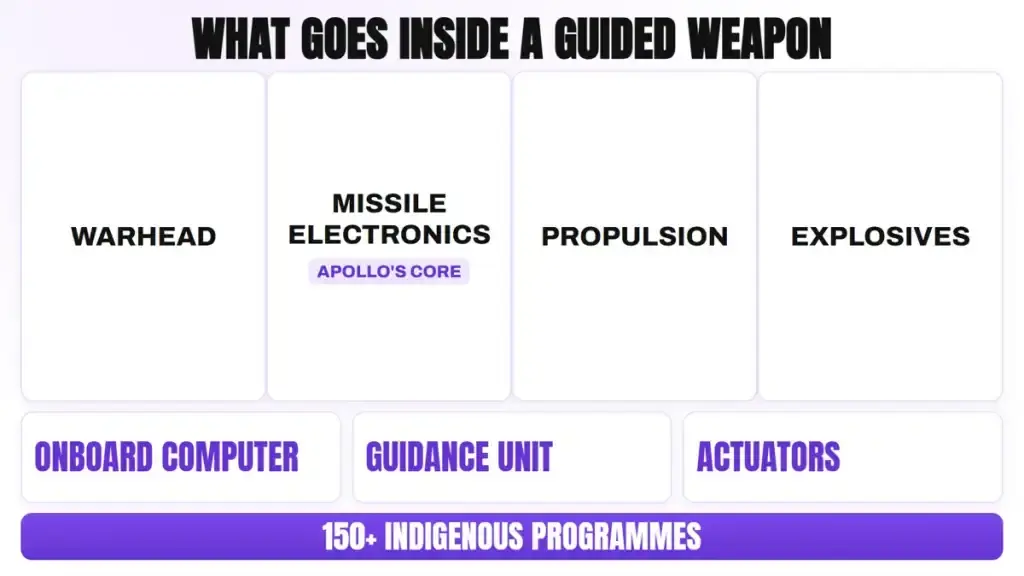
One such supplier is Apollo Micro Systems Ltd (NSE: APOLLO), set up in Hyderabad in 1985. It designs and builds the electronics that guide and control weapons, such as onboard computers, guidance units and actuators. An onboard computer is the small computer inside a missile that reads its sensors and steers it to the target. The company has taken part in more than 150 indigenous defence programmes and more than 60 DcPP programmes, and it is the approved production agency for MIGM.
Apollo Micro Systems in five numbers
- Q2 FY27 consolidated revenue of ₹388 Cr, up 72.3% from a year ago
- A standalone EBITDA margin of 35.1% in Q2 FY27, its highest ever
- An order book of ₹1,765 Cr on 30 September 2026, also a record
- A MIGM programme of about ₹3,500 Cr, of which the company expects 70%
- Participation in more than 150 indigenous defence programmes
So how did a maker of missile parts end up as the production partner for a complete sea mine? Let's first understand the company, and then look at the quarter that showed how fast the business is now growing.
Apollo Micro Systems: Company Overview
Apollo Micro Systems Ltd was founded in Hyderabad in 1985 by its managing director, Karunakar Reddy Baddam, and is listed on the NSE and BSE. It designs and makes the electronics and electro-mechanical systems that guide and control India's missiles, torpedoes, mines and rockets, and it now also builds complete mines, rockets and bombs. It has developed more than 700 technologies over 41 years of work with DRDO and has taken part in more than 150 indigenous defence programmes. It works from plants in Hyderabad, where the first phase of its third unit is now producing, and had 434 permanent employees in March 2026. Through its subsidiary IDL Explosives, bought in November 2025, it also makes explosives, and it has agreed to buy control of Premier Explosives. Consolidated revenue was about ₹904 Cr in FY26, and the promoter group held 49.98% of the shares in September 2026. Read this Defence Electronics Stocks to Watch (2026)
"Does the company have products or services with sufficient market potential to make possible a sizable increase in sales for at least several years?"
— Philip Fisher
For Apollo, the products are already inside many of India's weapons. The question the numbers below try to answer is how fast those weapons move from development into production.
The Quarter With Apollo's Highest Revenue Yet
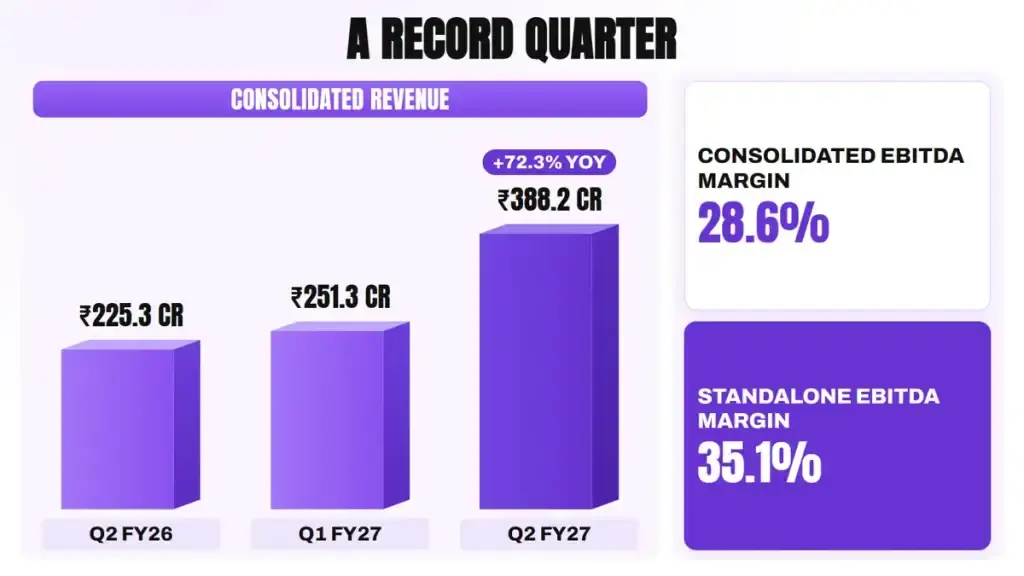
Let's look at Q2 FY27, the July to September quarter, which gave Apollo its highest quarterly revenue so far. Consolidated revenue was about ₹388 Cr, up 72.3% from a year ago and 54.5% above Q1 FY27. These group numbers include IDL Explosives, the explosives maker Apollo bought in November 2025.
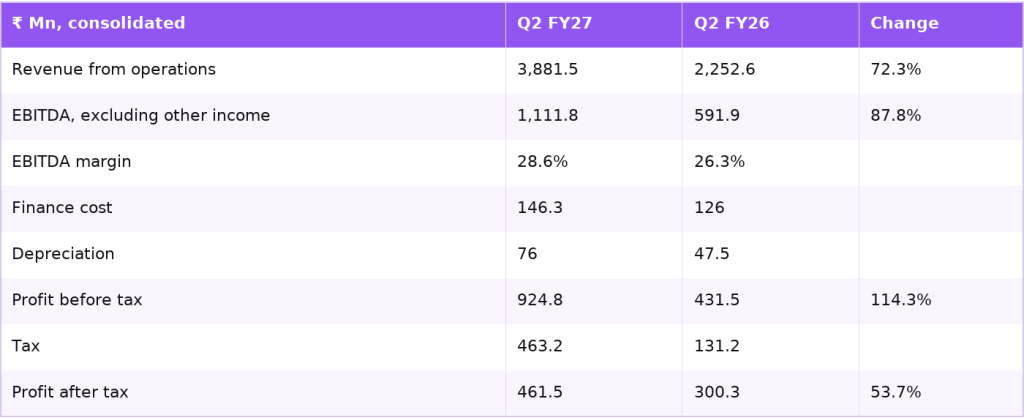
Those group numbers hide an even better result in the core business. Standalone revenue, which leaves out the explosives subsidiary, was about ₹306 Cr, up 36% from a year ago. Standalone EBITDA rose 81.6% to about ₹108 Cr, so the EBITDA margin moved to 35.1% from 26.3% a year ago.
That jump came from the kind of work delivered. In Q2 FY27, Apollo executed one Indian Navy order and continued its work on the Pinaka rocket. Management said these production orders, set against a smaller share of development projects, drove the margin up.
Those margins also show up in the cost lines, as you can see below. Standalone costs before depreciation and interest rose to ₹1,987.3 Mn from ₹1,660.4 Mn a year ago, an increase of about 19.7%. Revenue grew 36%, so about 60% of the extra revenue reached EBITDA. That is operating leverage at work, where the factory and design team stay much the same while output grows. Read this Operating vs Net Profit Margin Explained
You can see that leverage in one comparison the company itself made.
"What we earned at the operating level a quarter ago, we now delivered at the bottom line." - A. Krishna Sai Kumar, Apollo Micro Systems
That line refers to two numbers. Standalone EBITDA in Q1 FY27 was about ₹48 Cr, and standalone profit after tax in Q2 FY27 was also about ₹48 Cr. Profit after tax still grew more slowly than pre-tax profit, because the tax charge was much higher. The CFO said the company's tax rate moved this year from 25% to 30% under the income-tax rules for companies of its size.
So the first half shows the pace more clearly than one quarter. Consolidated revenue for H1 FY27 was about ₹639 Cr, up 78% from about ₹359 Cr. EBITDA rose 65% to about ₹165 Cr, and profit after tax rose 50% to about ₹71 Cr. Standalone revenue grew 29% to about ₹462 Cr, with a half-year EBITDA margin of 33.7%.
That half year also brought cash in. Cash flow from operations was positive at ₹224.4 Mn for the group. Working capital days, the company's measure of how long money stays tied up in stock and dues, came down to 353 from 359 in FY26. Management also asks investors to compare quarters year on year, because defence deliveries bunch up unevenly through the year.
The Orders Behind the Order Book
So who is giving Apollo this work? Let's look at the order book. The order book stood at ₹1,765 Cr on 30 September 2026, its highest so far. A little less than ₹1,300 Cr of it belongs to the standalone business, and the rest sits with IDL Explosives.
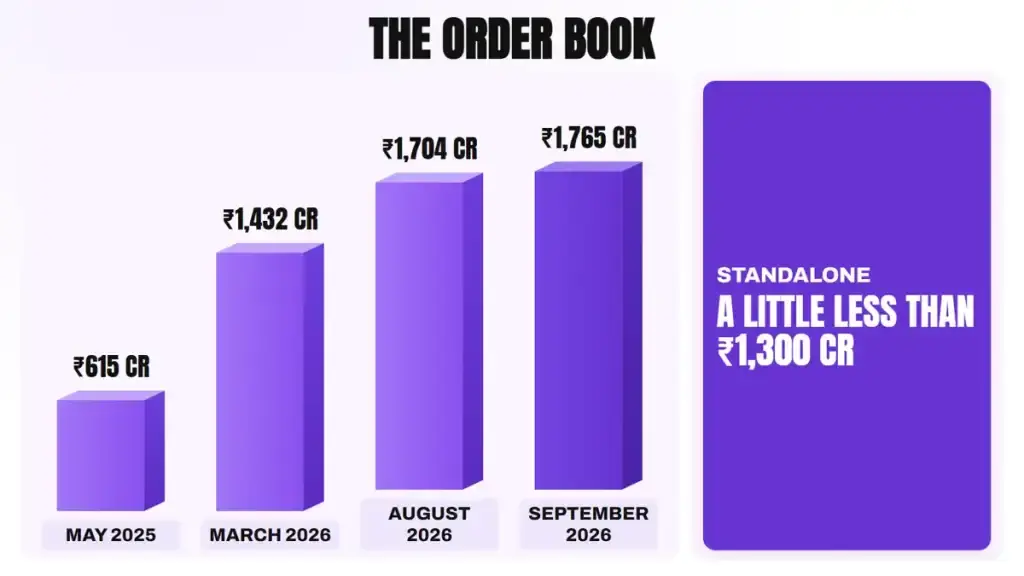
That book has grown fast. It nearly tripled in under a year and a half. It was ₹615 Cr in May 2025. By March 2026, it was ₹1,432 Cr on a consolidated basis, after IDL joined the group. On 8 August 2026, it was ₹1,704 Cr, of which ₹1,224 Cr was standalone and ₹480 Cr was at IDL.
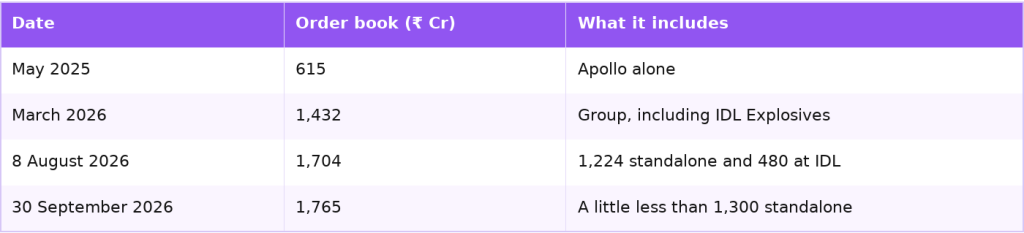
These orders come in many small pieces. Every month, Apollo receives development orders, limited-series orders and production orders from DRDO laboratories, defence PSUs and private defence companies. Limited-series orders are small batches of 50 or 100 units made before full production. New orders usually run for about 18 months, so most of today's book turns into revenue over the next year and a half.
Why the book matters more than one quarter: an order book of ₹1,765 Cr against H1 FY27 revenue of about ₹639 Cr means about 1.4 years of work at the first half's pace. The big production orders that management expects, such as MIGM, are not yet in this number.
That gap between today's book and the expected production orders is what we will keep coming back to. Before the orders, let's look at how the company got here.
"Being too far ahead of your time is indistinguishable from being wrong."
— Howard Marks
Apollo's designs are often years ahead of the orders. Until a weapon moves into production, that early work shows up as inventory and development orders, not as large revenue.
From Processor Boards to Complete Weapons
Let's go back to where Apollo started, because it did not start with weapons. In 1985, it began as a design services firm for electronic circuit boards. Over the next few years it offered processor boards for defence use, then started supplying onboard systems for defence. Later it supplied a payload checkout system to ISRO and configured the launcher controller for the Agni range of missiles.
That slow climb took decades, but the last six years moved faster. Consolidated revenue rose from ₹2,030.7 Mn in FY21 to ₹9,043.2 Mn in FY26. Over the same years, the EBITDA margin rose from 19% to 24.1%, and profit after tax rose from ₹102.5 Mn to ₹1,073.8 Mn.
Then the company changed what it sells. Management describes five steps: design engineering services, then build to specification, then weapon manufacturing, then weapon system integration, and finally becoming a global original equipment maker. Build to specification means the customer gives only the requirement and Apollo designs the item itself. Apollo says it is now moving into the fourth step, where it puts complete weapons together.

That step needs explosives and rocket fuel, which Apollo did not make. So it bought IDL Explosives, which joined the group on 17 November 2025. IDL makes bulk explosives for mining and holds licences for defence explosives such as TNT and HMX. Then, in July 2026, Apollo agreed to buy a 41.33% promoter stake in Premier Explosives for about ₹1,550 Cr in cash.
Premier is much bigger. It is the only Indian maker of chaffs and flares, the decoys that protect aircraft and ships from incoming missiles. It was also the first private Indian maker of solid fuel for missiles, and it has made that fuel for missiles such as MRSAM and Astra. India's Competition Commission approved the deal in Q2 FY27, which cleared the way for the open offer to Premier's other shareholders.
Together, IDL and Premier give Apollo every main block of a guided weapon. The company lists four blocks: warheads, missile electronics, propulsion and explosives. Before Premier, it had to buy explosives for weapons such as MIGM from other companies. The managing director explained the change in plain words.
"Like MIGM is there, without Premier, I have to depend on a third party." - Karunakar Reddy Baddam, Apollo Micro Systems
That push into complete weapons also has a design arm. In Q2 FY27, Apollo formed ShauryAstra Defence Systems, in which it holds 34%. It is led by Dr V. K. Saraswat, a former DRDO chairman, and the plan is simple: ShauryAstra will design long-range weapons, and Apollo will produce them. The armed forces are looking at rockets with ranges of 300 km, 500 km and 900 km, against the 120 km of today's longest Pinaka.
Four Lines of Work Inside One Defence Business
Now let's see what Apollo actually makes, because this is where you can judge each order. The company reports one business segment, defence, and does not split revenue by product. In practice, its work falls into four lines that serve different weapons and customers.
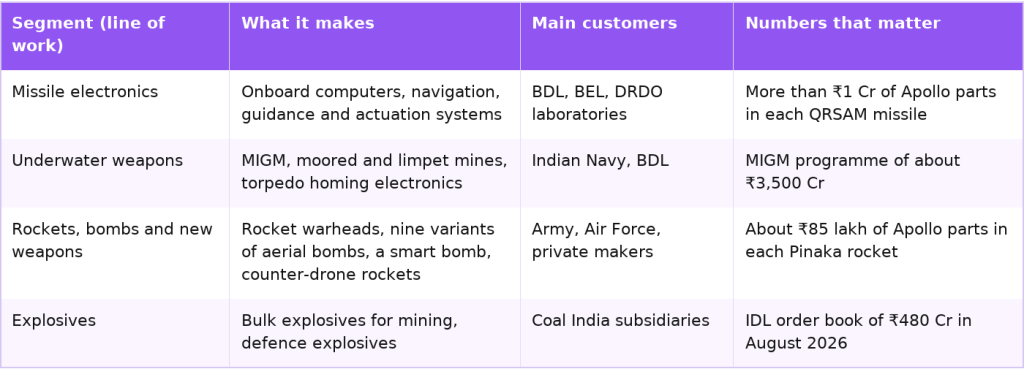
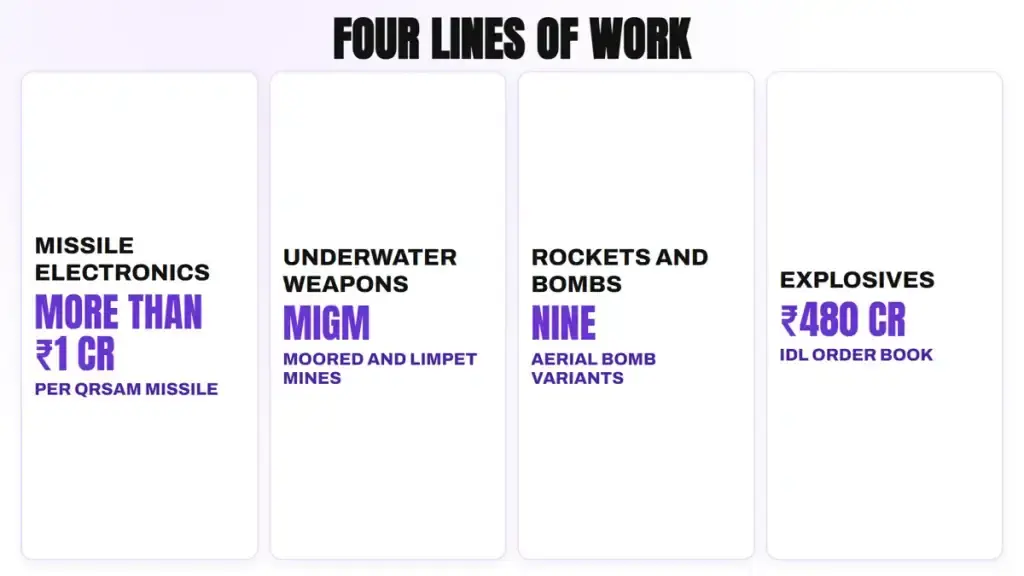
These lines differ in what Apollo delivers. In missiles, Apollo supplies parts that go inside a weapon assembled by BDL or BEL. In mines and some rockets and bombs, it delivers the complete weapon. The explosives business sells mainly to coal mines today, and it is the base for the defence explosives that Apollo's own weapons will need.
The scale of the business also differs between the parts. In FY26, standalone revenue was ₹764 Cr out of consolidated revenue of about ₹904 Cr. Most of the difference came from IDL, which was in the group for only four and a half months of the year.
Missile Electronics
Let's start with missiles, Apollo's oldest work. India's missile needs are expected to grow as the forces add a large number of ships, submarines and aircraft. Apollo's electronics already go into nine missile categories, from surface-to-air and anti-tank missiles to cruise, ballistic and nuclear missiles such as Agni and Pralay.
That presence comes from decades of DRDO work. For each programme, Apollo designs the electronics during development and then supplies them in production. For QRSAM, a quick-reaction missile that protects army units from aircraft and drones, Apollo makes about five subsystems. These include the complete guidance system, the onboard computer and the front and rear actuation systems that move the missile's fins.
Let's do the maths. That adds up quickly. Apollo's parts are worth more than ₹1 Cr in each QRSAM missile, and the same is true for Akash-NG, a newer air-defence missile. The Ministry of Defence is looking at 1,000 missiles of each. For QRSAM alone, management expected BDL's missile order to be about ₹11,000-12,000 Cr in August 2026.
That QRSAM order is now being split. The ministry plans to place half of the first 1,000 missiles with BDL and half with private industry. Apollo says it is in the race for the private share. Its group would cover most of the missile, with Apollo making the onboard systems and Premier the propulsion.
Apollo also expects a strong position in either half. It is the only qualified source so far for QRSAM's guidance unit and onboard computer, so it expects some subsystems on a nomination basis, without a tender. For two or three other subsystems, a second vendor is also qualified, and the order will be shared.
The same rule applies to other missiles. DRDO wants at least two vendors for each part, but a second vendor must absorb the technology, make samples, pass qualification tests and perform in trials. Until then, the first supplier keeps the orders. Apollo is also one of the companies shortlisted for complete production of Pralay, a short-range ballistic missile, which is at the request-for-quotation stage.
Pinaka orders, unlike QRSAM, are close. The Indian Army plans to order 2,000 Pinaka rockets of the 80 km version from three makers: Munitions India, Solar Industries and Bharat Forge. Negotiations are complete, and the orders are expected by December 2026. Apollo has already quoted for Munitions India's share of 300 rockets.
Underwater Weapons
Next, let's turn to the sea, where Apollo moves from parts to complete weapons. The Navy's share of India's capital acquisition budget rose from 36% in FY24 to 43% in FY26. That money buys ships and submarines, and also the mines, torpedoes and decoys they carry.
For us, mines are the clearest example. Apollo calls itself the only Indian company with all three kinds of sea mine. MIGM lies on the seabed and is set off by signals from a passing ship. A moored mine is tied to an anchor and floats at a set depth, where deep water rules out a bottom mine. A limpet mine is fixed to a ship's hull by a diver, using magnets.
So MIGM is the order we are all waiting for. All MIGM trials are done. The Navy is expected to issue the request for quotation in November 2026 and the purchase order before February 2027. It also wants to pay a 20% advance before the financial year ends in March. Of the programme of about ₹3,500 Cr, Apollo expects about 70%.
That share comes from the work Apollo did during development. Apollo alone supplied MIGM's electronic systems and critical sensors to DRDO, and there is no second source for them. So even the part of MIGM built elsewhere needs Apollo's electronics. Apollo also says it handles every step from fibres to electronics and explosives in-house.
The other mines follow MIGM. Apollo has completed combat trials of its limpet mines for the Navy, and it expects the first limpet orders from Q4 FY27, the January to March 2027 quarter. Moored mines have the Defence Acquisition Council's first approval, and Apollo expects their orders in FY28 after technical trials are complete.
Beyond mines, torpedoes are older work for Apollo. For decades, Apollo has made sensor, homing and onboard electronics for India's torpedoes, including Varunastra, the heavyweight torpedo fired from ships. BDL recently received a Varunastra order, and Apollo expects about ₹100 Cr or more of work from it. The Navy has also asked BDL for 30 heavyweight torpedoes on an urgent basis, to be delivered within nine months. A larger requirement of about 125 torpedoes is expected to follow.
Beyond mines and torpedoes, Apollo is building unmanned boats. In July 2026, the Navy gave it a Make-II prototype order for SAVIOR-ASW, a semi-submersible autonomous vessel for surveillance and anti-submarine work. Under Make-II, the company funds the prototype itself, and the forces commit to buy if it passes trials.
Rockets, Bombs and New Weapons
Next, let's look at the weapons Apollo is adding for the Army and Air Force. Recent conflicts have used up large stocks of rockets and ammunition around the world. In India, the Defence Acquisition Council approved emergency purchases of about ₹40,000 Cr of arms and ammunition during Operation Sindoor.
That demand, as we will see, fits several Apollo products. The company developed the warhead for the 122 mm BM-21 Grad rocket in-house, and it integrates warheads with its own rocket motors. The Grad remains in service in dozens of countries, so it also offers an export market. Apollo has developed nine variants of aerial bombs that drones can drop, as well as medium-range rockets to shoot down drones.
The Air Force has also picked Apollo for precision bombs. In July 2026, it gave Apollo a Make-II prototype order for a 500 kg smart bomb. It also named Apollo the prime developer for IPREK, a kit that turns an ordinary bomb into a guided bomb with a longer range. If the trials succeed, both offer a clear path to production orders.
Apollo is also taking DRDO technology for newer weapons. It received technology transfers for a 10 kW laser weapon from DRDO's CHESS laboratory, and for the electro-optical tracking system that aims it. In Q2 FY27, it also received the technology for a semi-active laser homing system. That system lets a munition find a target that a laser marks for it.
Explosives Through IDL and Premier
Finally, let's look at explosives, the newest line. The global explosives market is expected to reach $9.37 Bn by 2029, growing 8.8% a year. India's defence exports crossed ₹23,622 Cr in 2024-25, and a large part of the defence PSUs' exports was explosives and ammunition parts.
IDL is a working business. It sells bulk explosives to Coal India's subsidiaries under long-term contracts. In Q2 FY27, it commissioned a silo unit at Bolkunda near Asansol, on 8.5 acres, with 9,000 tonnes of bulk explosive storage. Its order book was ₹480 Cr in August 2026. That is real work.
That business is being reshaped, and management expects the change to take a few more quarters. Management is cutting costs, improving margins in mining explosives and adding defence explosives as a new revenue stream. It also plans to make some of the key chemicals itself, so that input costs swing less. Q2 is also IDL's off-season.
That defence side will come mainly from Premier once the deal closes. Its propellants, rocket motors and explosives will go into Apollo's mines, rockets and bombs. Apollo expects its own need for explosives and propellants to rise sharply as these weapons enter large-scale production. Management will give guidance for the explosives business only after the Premier deal is complete.
Why a Qualified Supplier Is Hard to Replace
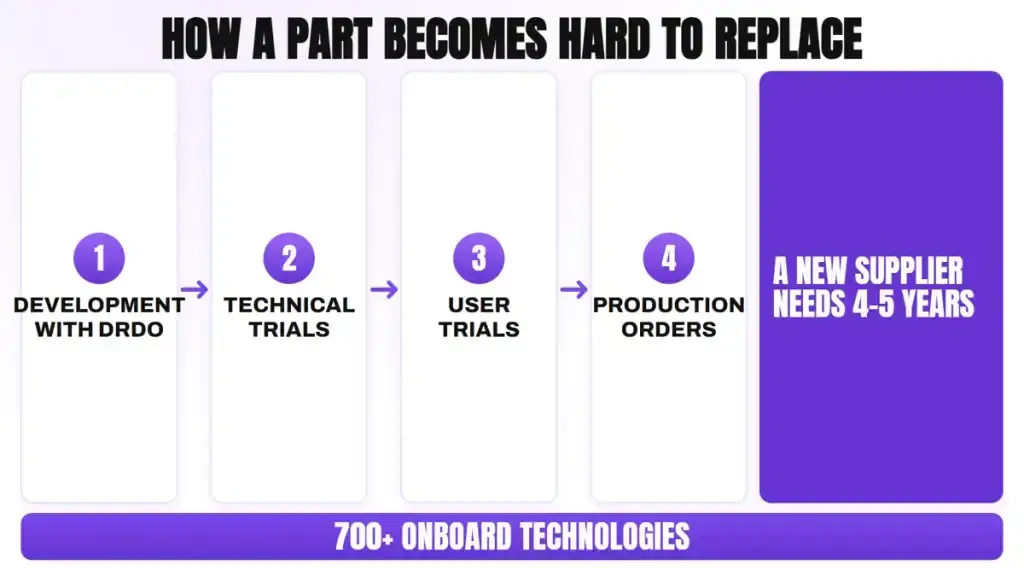
Now that we have seen all four lines, let's understand why Apollo keeps getting the follow-on orders. It starts with qualification. A defence supplier's part goes through technical trials, user trials and quality audits inside the weapon before production. Whoever supplied a subsystem during development, the producer usually has to use the same vendor in production.
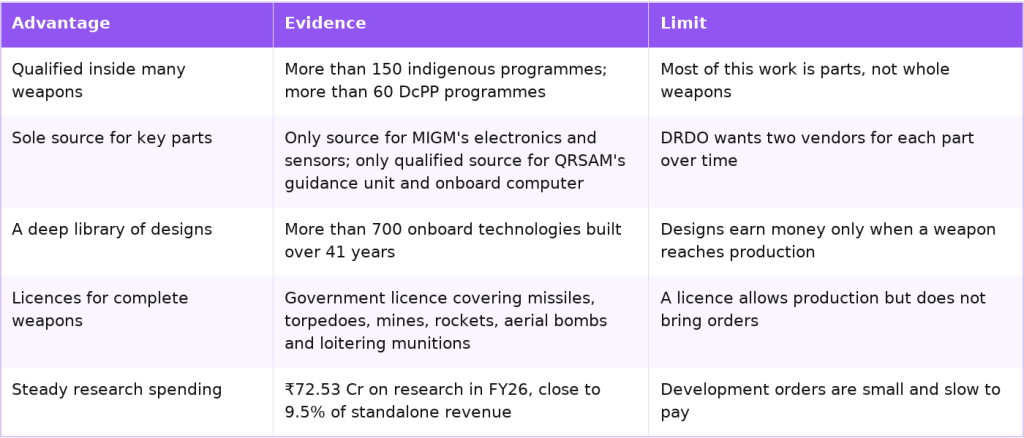
That qualification takes years, and management puts a number on it. The managing director says any new company needs at least four to five years to enter defence, because it must first learn the quality standards and clear the audits. A newcomer can win development work in that time, but it cannot take over a part that is already proven inside a weapon. Read this Economic Moat Explained
"I can say at least four, five years time it will take for anybody getting into defense business." - Karunakar Reddy Baddam, Apollo Micro Systems
That barrier is strongest where Apollo is the only source. For MIGM, there is no second vendor for the electronics and sensors. For QRSAM, Apollo is the only supplier so far for the guidance unit and onboard computer. So for the present quantity, Apollo expects those two parts on nomination, whichever company wins the missile order.
That position needs a large design team, and we can see how it is organised. The research team has about 11 department heads, each handling one field such as pyrotechnics, controls or radio frequency. Under them sit team leaders with six to eight years of experience and younger engineers. Retired DRDO scientists and former armed forces staff add knowledge of how the weapons are used.
That team now has its own test equipment as well. Apollo has used third-party and DRDO test facilities, and it sometimes waited weeks or months for a slot. It is now installing its own EMI/EMC test facility, which checks that electronics neither give off nor pick up electrical interference, along with guidance test and calibration systems. In late October 2026, management expected them within about a month, and it says they will cut production time.
That design work also builds a library. Apollo has developed more than 700 onboard technologies over 41 years of work with DRDO. Many are common across naval, air-defence and missile programmes, so a design proven in one weapon can be reused in the next. Each new programme adds to that library.
"The key to investing is not assessing how much an industry is going to affect society, or how much it will grow, but rather determining the competitive advantage of any given company and, above all, the durability of that advantage."
— Warren Buffett
For Apollo, the advantage is qualification: once its part passes the trials inside a weapon, the producer usually keeps buying it for as long as the weapon is made.
Financials: Five Years of Growth and Tied-Up Cash
One record quarter can hide a lot in a defence business, so let's look at five full years together. These are consolidated figures from the company's latest presentation, converted to ₹ Cr.
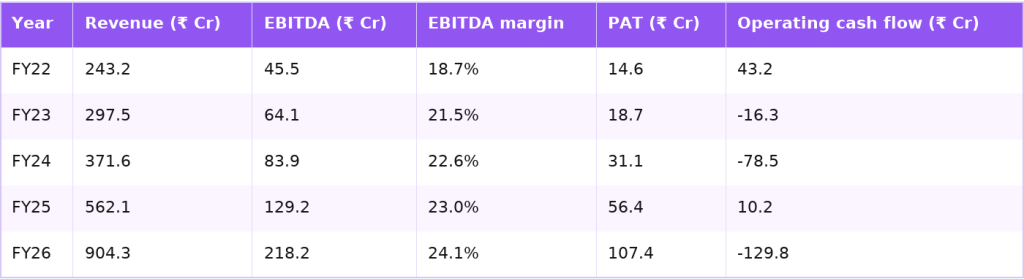
Revenue grew about 3.7 times in four years, from about ₹243 Cr in FY22 to about ₹904 Cr in FY26, and profit after tax grew more than seven times. The EBITDA margin rose every year, from 18.7% to 24.1%, as production orders and a larger scale spread the fixed costs of the design team and the plants. FY26 includes IDL Explosives only from November 2025.
Cash is the weak spot. Over the five years, operating cash flow added up to about -₹171 Cr, against about ₹228 Cr of profit after tax. The reason is the way defence programmes pay: long trials and acceptance steps keep money in inventory, which was about ₹795 Cr in March 2026, and in receivables of about ₹481 Cr.
That gap has been funded with debt and new shares. Borrowings rose from about ₹116 Cr in FY22 to about ₹543 Cr in FY26, and share capital rose as new shares were issued. Management expects operating cash flow to turn positive in every quarter only from FY29, when production orders with advances make up most of the work.
"Cash is to a business as oxygen is to an individual: never thought about when it is present, the only thing in mind when it is absent."
— Warren Buffett
Apollo has grown profit every year, but most of that profit is still sitting in stock and dues. The MIGM advance and other production orders are what would turn it into cash.
What the Next Two Years Look Like on Management's Numbers
So what could all of this add up to for you as a reader following Apollo? In Q2 FY27, management guided revenue growth of 35-45%, a little lower at the bottom than the 40-45% it gave in August. On FY26 consolidated revenue of about ₹904 Cr, that range would mean about ₹1,221-1,311 Cr in FY27.
That range starts from a first half that has already delivered about ₹639 Cr. So the second half would need about ₹581-672 Cr, against about ₹545 Cr in the second half of FY26.
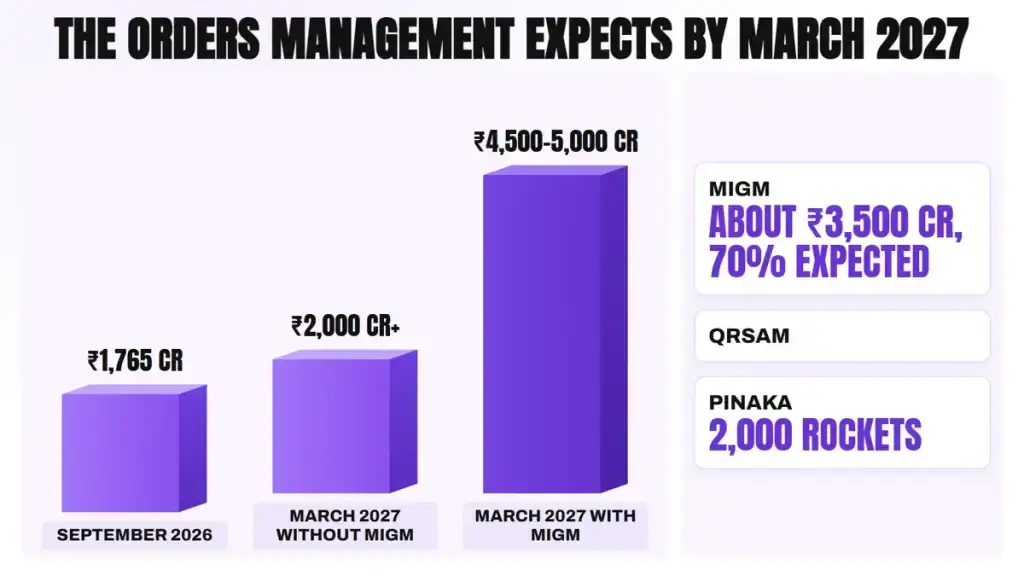
For you, orders matter even more. Management expects the order book to grow to more than ₹2,000 Cr by March 2027 without MIGM. With the MIGM order, it expects ₹4,500-5,000 Cr. On a programme of about ₹3,500 Cr, a 70% share would be about ₹2,450 Cr, to be delivered over about 2.5 years.
That growth needs factories, and Apollo is building them on a scale that we have not seen from it before, starting with its third unit in Hyderabad. The first phase of Unit III is already producing, and the full unit is due before March 2027. The expansion will give about 12 times today's capacity. Management says this space can handle the subsystem business and larger systems such as MIGM for the next five or six years.
That space is also what opens exports. Apollo has so far kept its capacity for Indian orders, and export revenue was nil in FY26. It is in touch with many overseas companies and expects to take export orders from the next financial year. Management says positive operating cash flow in every quarter will come only from FY29, when production orders with advances make up most of the work.
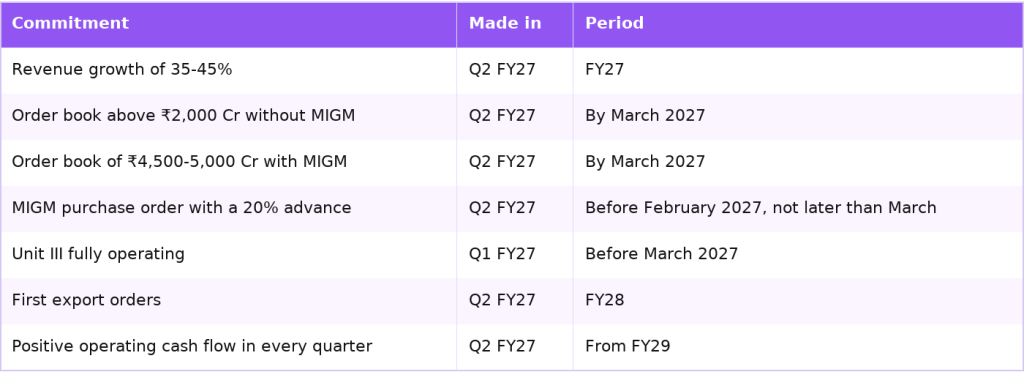
Beyond two years, the managing director has a much bigger aim. He has spoken of a group revenue of about ₹25,000 Cr in five years, which would need new explosives plants, more land near Hyderabad and fresh capital. The company also plans a few more acquisitions. These are aims, not guidance, and the record below shows why they need checking.
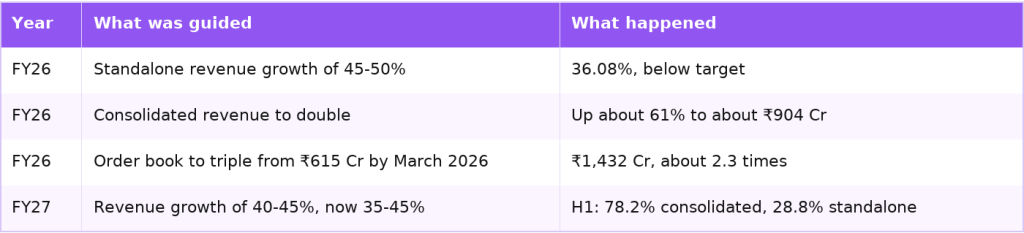
These commitments come with a record we can check. In May 2025, management guided standalone revenue growth of 45-50% a year over FY26 and FY27, and said consolidated revenue would double in FY26. Standalone revenue grew 36.08% in FY26, and consolidated revenue grew about 61%. It also said it would triple the order book of ₹615 Cr by March 2026, and the book reached ₹1,432 Cr, about 2.3 times.
Key Risks
No defence supplier grows in a straight line, so let's look at what could go wrong for Apollo.
- Large orders can slip: QRSAM's ordering is delayed while the ministry decides how to split it. MIGM was first expected by December or January, and is now expected before February. If either moves into FY28, the March 2027 order book will fall short of the ₹4,500-5,000 Cr management expects.
- Missed targets: FY26 standalone growth of 36.08% missed the 45-50% guided, and the order book reached about 2.3 times, not three times. H1 FY27 standalone growth of 28.8% is still below the 35-45% now guided for the year.
- Cash stays tied up: operating cash flow was -₹1,297.6 Mn in FY26 and -₹784.9 Mn in FY24. At March 2026, inventory was ₹7,952.9 Mn and receivables ₹4,813.2 Mn, against FY26 revenue of ₹9,043.2 Mn. Long trials and acceptance cycles keep this money locked up until FY29, on management's own timeline. Read this Cash Flow Statement Explained
- Borrowing and new shares: borrowings rose from ₹3,353.5 Mn to ₹5,432.6 Mn in FY26. Equity share capital rose from ₹282.4 Mn in FY24 to ₹357.3 Mn in FY26 as new shares were issued, and the Premier deal is being paid for from a new fund-raise, of which about ₹2,500 Cr goes to the purchase. Each issue spreads profit over more shares.
- Losses at IDL: IDL was loss-making when Apollo bought it. In Q2 FY27, consolidated profit was below standalone profit because of its off-season. Premier is a much larger deal of about ₹1,550 Cr, and a few more acquisitions are planned.
- A high tax charge: standalone tax was ₹498.3 Mn on pre-tax profit of ₹975.6 Mn in Q2 FY27, about 51%, well above the 30% rate the CFO gave. If that rate stays high, profit will keep growing more slowly than operating profit.
- Promoter pledge: some promoter shares are pledged with lenders. Management said the pledge came down in the June quarter and would be fully released in about a year.
"The essence of investment management is the management of risks, not the management of returns."
— Benjamin Graham
For Apollo, the returns depend on a few large orders arriving on time. The signals below show early whether they are.
Explore our Products
Research Framework

Emerging Titans
Combination of quantitative analysis, industry tailwinds, and management assessment - SPRINT investment philosophy

Tiny Titans
Heavy emphasis on scuttlebutt research, plant visits, and early on-ground signals
What to Track Next
If you follow Apollo Micro Systems, these are the signals that will show whether the plan is on track.
- The MIGM purchase order and its 20% advance before the end of March 2027
- The order book crossing ₹2,000 Cr by March 2027 without MIGM
- QRSAM and Pinaka orders, and Apollo's share of each
- H2 FY27 revenue of about ₹581-672 Cr, needed for 35-45% growth
- Operating cash flow and working capital days, now 353
- Completion of the Premier deal and the first guidance for the explosives business
Conclusion
Let's step back and put it all together. For four decades, Apollo built the electronics inside India's missiles, torpedoes and rockets, and it got qualified in more than 150 programmes along the way. Those years of trials now give it sole-source positions in weapons such as MIGM and QRSAM. With IDL and Premier, it is adding the explosives and propulsion needed to build complete weapons.
So the next few months will show how much of that position turns into orders. Q2 FY27 gave a record quarter and a record order book of ₹1,765 Cr. If MIGM, QRSAM and Pinaka orders arrive on time, the book could more than double by March 2027. If they slip, Apollo will still have a growing business, but it will keep tying up cash and issuing shares while it waits.
FAQs
What does Apollo Micro Systems do?
+Apollo Micro Systems is a Hyderabad company founded in 1985 that designs and makes the electronics that guide and control weapons, such as onboard computers, guidance units and actuators for missiles, torpedoes and rockets. It is also the production agency for the MIGM naval mine and builds complete mines, rockets and bombs. Through IDL Explosives it makes explosives.
How did Apollo Micro Systems do in Q2 FY27?
+Consolidated revenue was about ₹388 Cr, up 72.3% from a year ago, with an EBITDA margin of 28.6%. The standalone business, without the explosives subsidiary, had revenue of about ₹306 Cr and an EBITDA margin of 35.1%, its highest ever. Management said production orders delivered in the quarter drove the margin.
How big is Apollo Micro Systems' order book?
+The order book was a record ₹1,765 Cr on 30 September 2026, of which a little less than ₹1,300 Cr was standalone and the rest at IDL Explosives. Management expects more than ₹2,000 Cr by March 2027 without the MIGM order, and ₹4,500-5,000 Cr with it.
What is the MIGM order?
+MIGM is the Multi-Influence Ground Mine, a sea mine designed by DRDO that the Defence Acquisition Council cleared on 3 July 2026. The programme's budget is about ₹3,500 Cr for 1,000 mines over three years, and Apollo expects about 70% of it. Management expects the purchase order before February 2027, with a 20% advance.
What is Apollo Micro Systems' guidance for FY27?
+Management guides revenue growth of 35-45%, a little lower at the bottom than the 40-45% it gave in August 2026. In the first half, consolidated revenue grew 78.2% and standalone revenue 28.8%. It expects export orders from FY28 and positive operating cash flow in every quarter from FY29.
What are the main risks for Apollo Micro Systems?
+The main risks are delays in large orders such as MIGM and QRSAM, a record of missed growth and order targets, cash tied up in inventory and receivables, rising borrowings and new shares, losses at IDL Explosives, a high tax charge and the larger Premier Explosives purchase.

High growth stock specialist, Value Educator
Shashank Mahajan is an equity research professional with over 12 years of experience in identifying high-potential SME and micro-cap stocks at an early stage. He follows a rigorous scuttlebutt research–driven approach, combining on-ground insights with deep financial analysis. Shashank specializes in uncovering under-researched and under-owned companies with strong management quality and long-term growth potential. Through disciplined research and early identification, he focuses on spotting tomorrow’s market leaders before they enter the mainstream investor radar.
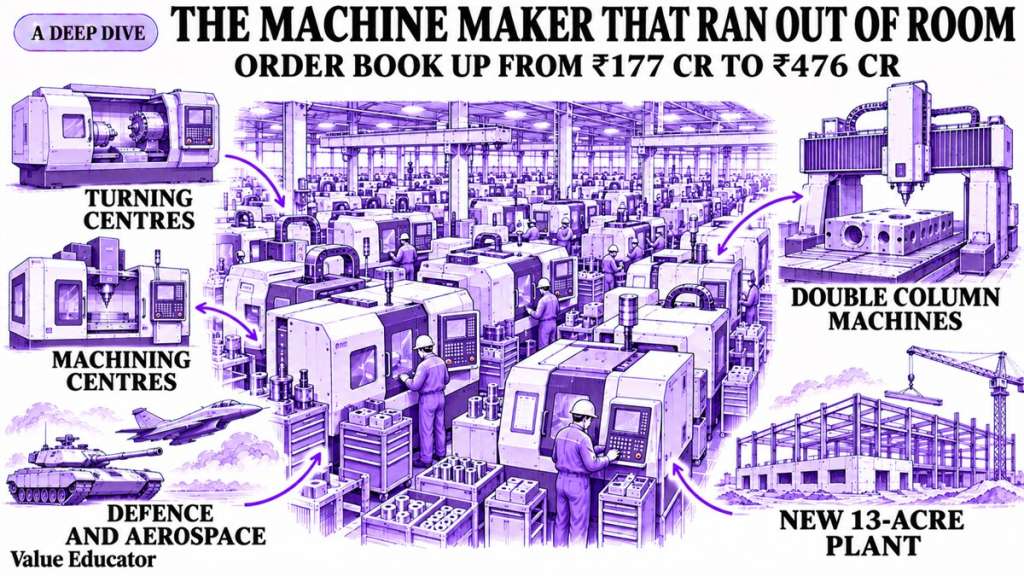
Macpower CNC: A Rajkot Machine Maker With ₹476 Cr of Orders
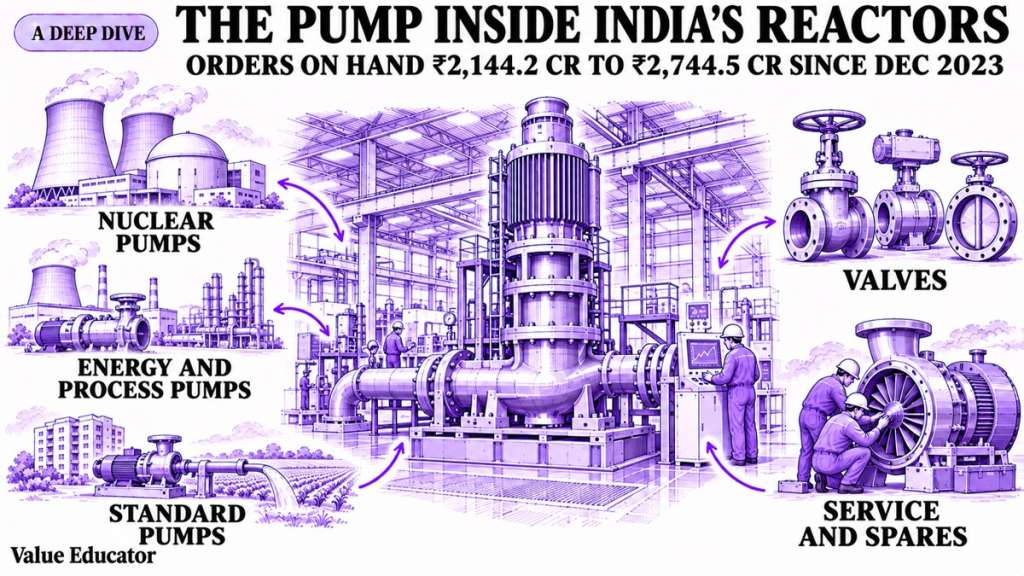
KSB: The Pune Pump Maker With ₹1,235 Cr of Reactor Orders

Kilburn Engineering: The Dryer Maker With ₹470 Cr of Orders

Rossell Techsys: Boeing and Lockheed Wiring From Bengaluru
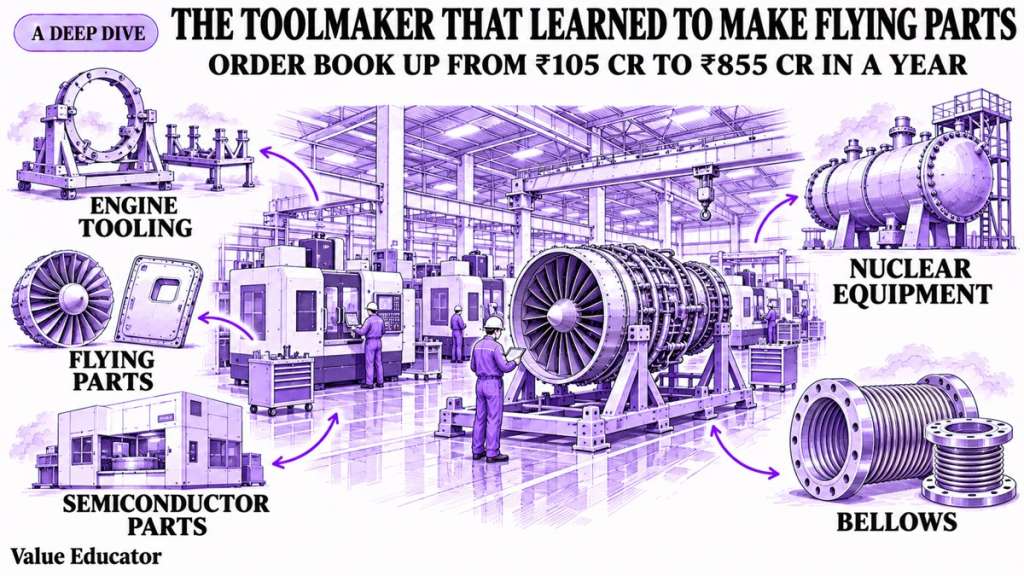
Unimech Aerospace: From Engine Tools to Flying Parts

Taneja Aerospace: The Airfield With ₹161 Cr of Rent Signed
Explore our Products
Research Framework
Emerging Titans
Combination of quantitative analysis, industry tailwinds, and management assessment - SPRINT investment philosophy
Tiny Titans
Heavy emphasis on scuttlebutt research, plant visits, and early on-ground signals



Modern Warfare to Multibaggers
Key Trends. Strategic Shifts. Opportunities Ahead.
Don't Miss This Exclusive Webinar!
Join Value Educator to decode the key trends shaping India's defence sector and learn how to identify tomorrow's potential leaders in the space.
- In-depth research on India's defence sector
- Live Q&A session
- Actionable takeaways for long-term investors

 Orders
 Subscription
 Share with friends


Required Details
₹23999.00
(12 month subscription)
As per SEBI regulations, all users are mandated to complete the KYC that is validated for 1 year. Post payment, you will be redirected to the KYC screen


No comments yet. Be the first to comment!