
Azad Engineering: Turbine Blades, Jet Engines and Orders
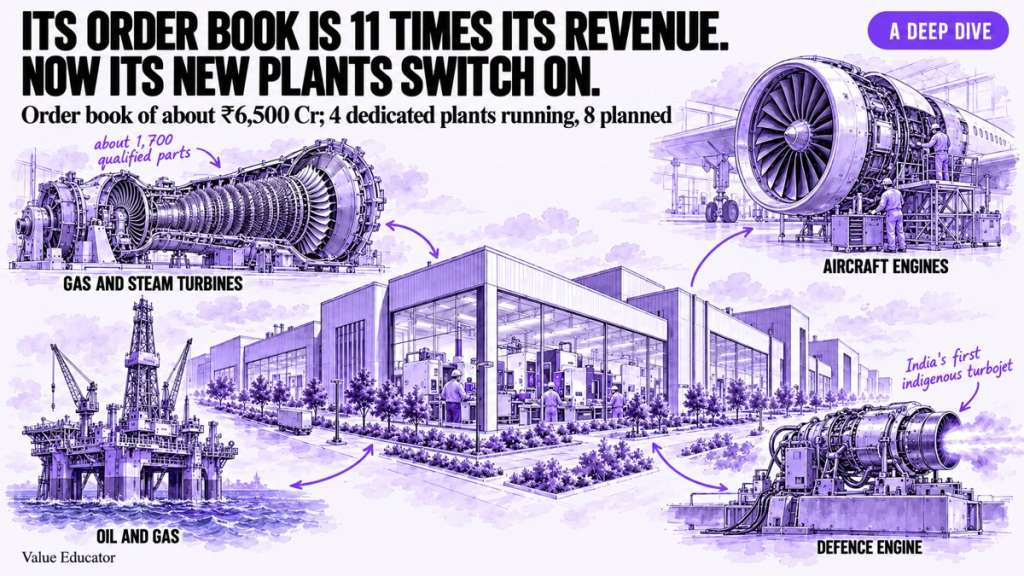
In March 2026, Mitsubishi Heavy Industries of Japan signed an eight-year contract with a Hyderabad company to make one of the hottest parts inside its gas turbines, as its single source. Deals like this are rare, and they are happening because the world needs more turbines and jet engines than it can build. Power companies are ordering gas turbines to feed new data centres and grids, and airlines are waiting for new aircraft. Boeing and Airbus alone hold a backlog of about 15,000 aircraft, and about 84% of them are narrow-body jets such as the A320 and the Boeing 737.
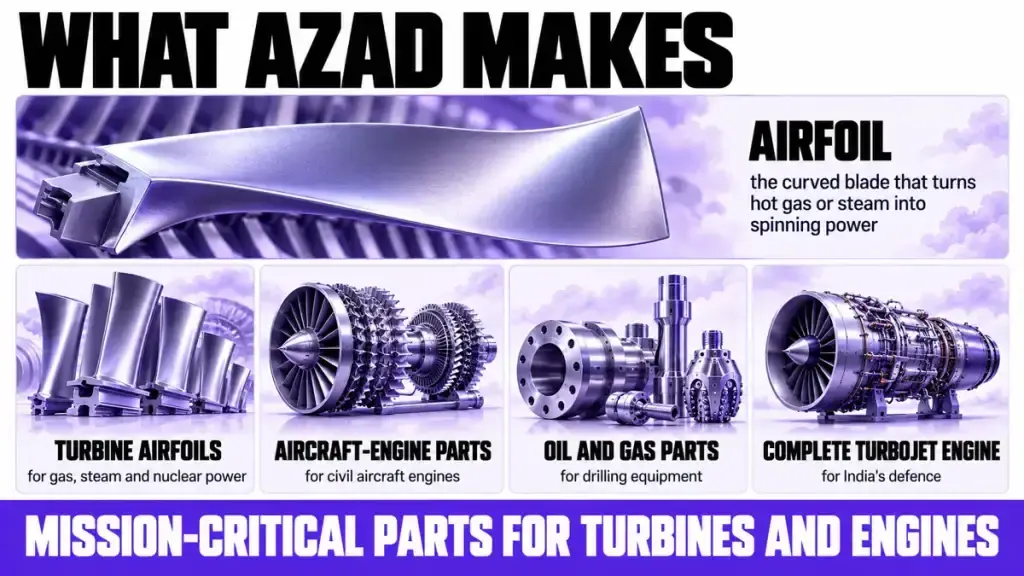
Every one of those turbines and engines spins on hundreds of blades. In the trade, these blades and vanes are called airfoils, which simply means the curved metal parts that turn the flow of hot gas or steam into spinning power. They work at extreme heat, pressure and speed, and a single faulty blade can wreck a machine worth crores. So turbine and engine makers buy them only from suppliers they have tested for years.
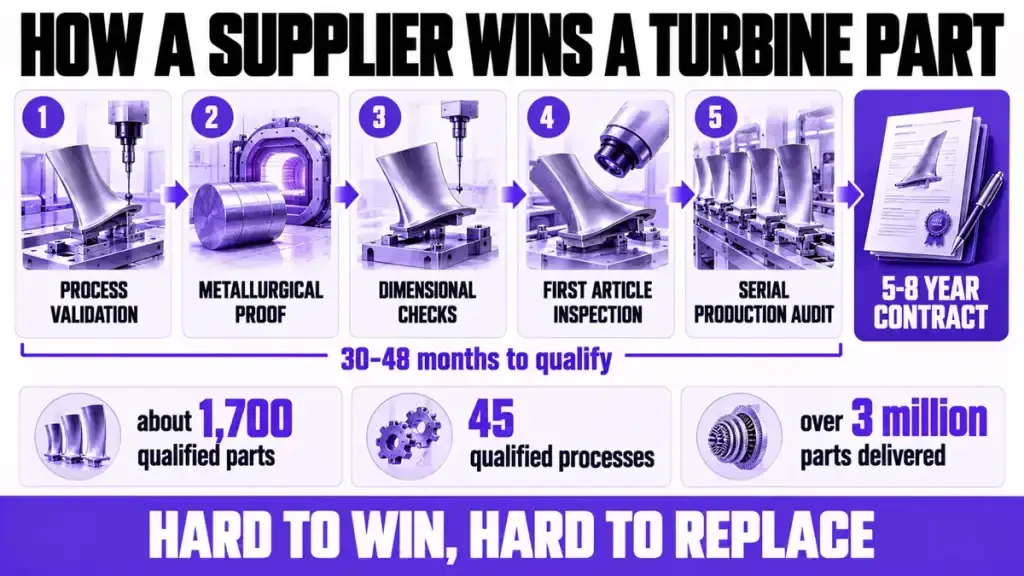
Those makers are a small club. Mitsubishi Heavy Industries, GE Vernova and Siemens Energy build most of the world's large gas turbines, and Rolls-Royce, Pratt & Whitney and Safran build many of its aircraft engines. They design the machine, but they buy many of the machined parts from outside suppliers. A new supplier must qualify each part separately, a process that can take 30-48 months, and then it signs contracts that run for five to eight years.
One Hyderabad company has spent close to two decades inside that club. Azad Engineering Ltd (NSE: AZAD) machines turbine airfoils, aircraft-engine parts and oil and gas parts for global makers. It supplies customers that control about 75% of the world's gas-turbine market, and about 93% of its FY26 revenue came from exports. It has also assembled a complete jet engine for India's defence programme, designed by DRDO's Gas Turbine Research Establishment (GTRE).
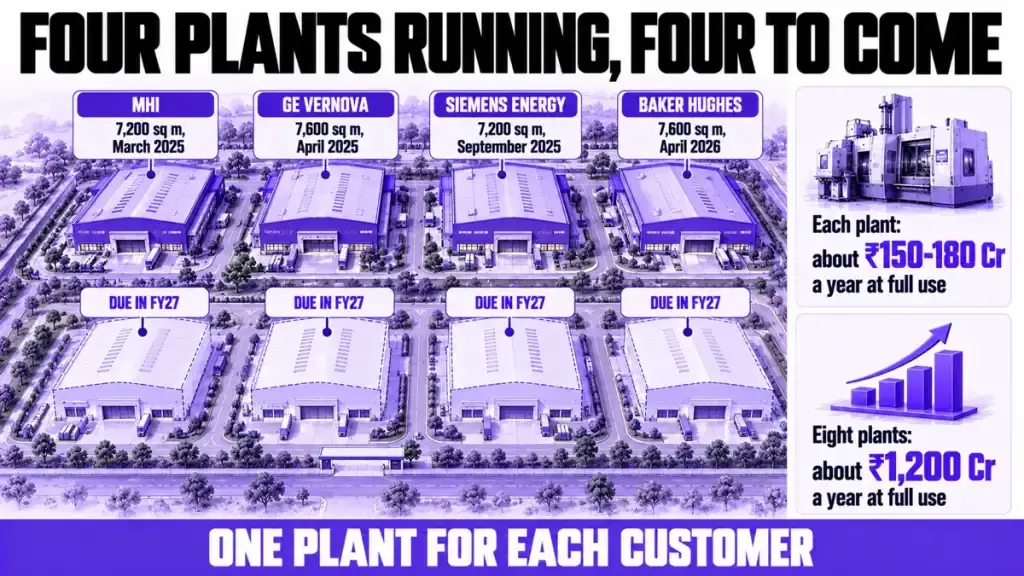
Its newest step is the dedicated plant, which means a separate factory that Azad builds and runs for one customer only. It has opened four such plants, for MHI, GE Vernova, Siemens Energy and Baker Hughes, at a new campus outside Hyderabad. Each plant can earn about ₹150-180 Cr a year at full use, and Azad plans eight in all on that campus.
Azad Engineering in five numbers
- Q1 FY27 standalone revenue of ₹170.5 Cr, up 26.8% from a year ago
- An EBITDA margin of 37.6% in Q1 FY27
- An order book of about ₹6,500 Cr, about 11 times FY26 revenue
- 4 dedicated customer plants running, with 8 planned on the new campus
- About 1,700 qualified parts and 45 qualified manufacturing processes
So what stops a ₹6,500 Cr order book from showing up faster in revenue? Let's first understand the company, and then look at the latest quarter.
Azad Engineering: Company Overview
Azad Engineering Ltd was incorporated in Hyderabad in 1983, and its turbine business began in 2008, when Rakesh Chopdar, now its chairman and chief executive, set up a CNC machine shop to make airfoils. It machines blades and vanes for gas, steam and nuclear turbines, parts for aircraft engines and parts for oil and gas equipment, and it has assembled a complete turbojet engine designed by DRDO's Gas Turbine Research Establishment. Its customers include Mitsubishi Heavy Industries, GE Vernova, Siemens Energy, Baker Hughes, Honeywell, Rolls-Royce and BHEL, and about 93% of its FY26 revenue came from exports. It works from its older plants at Jeedimetla and a new campus at Tunikibollaram outside Hyderabad, where four plants built for single customers are running. It had 2,168 permanent employees at the end of FY26, a year in which consolidated revenue was ₹603 Cr, borrowings were ₹457 Cr and net debt was about ₹272 Cr. Its order book of long-term contracts was about ₹6,500 Cr, and the promoter group held 55.84% of the company. Read this Best Defence Stocks in India for 2026
"It takes 20 years to build a reputation and five minutes to ruin it."
— Warren Buffett
Azad took close to two decades to qualify with the world's turbine makers, part by part. A single faulty blade in a machine worth crores could undo that, which is why quality matters as much as growth in the numbers below.
The Quarter Before the New Plants Switch On
Let's look at Q1 FY27, the April to June quarter, the last one before Azad's new plants start to show in revenue. Standalone revenue was ₹170.5 Cr, up 26.8% from ₹134.5 Cr a year ago and 8.3% from the March quarter. On a consolidated basis, which includes its two subsidiaries, revenue was ₹172.6 Cr.

That quarter shows how little of Azad's cost is metal. Materials consumed were only about ₹8.6 Cr, about 5% of revenue, against about ₹16.3 Cr a year ago. Two Indian steel mills, Sunflag and Star Wire, are now approved for some of the special alloys Azad used to import. Buying them in India cut both the price and the freight, which used to add about 4-5%.
Most of the cost is people and machines. Employee expenses rose to about ₹40.7 Cr from about ₹28.4 Cr, because Azad hires 150-200 people a month and trains them for up to 90 days before they work on the shop floor. Management said these people were hired for the output due in the second half of the year. EBITDA still grew 32.1% to ₹64 Cr, faster than revenue, and the margin rose to 37.6%.
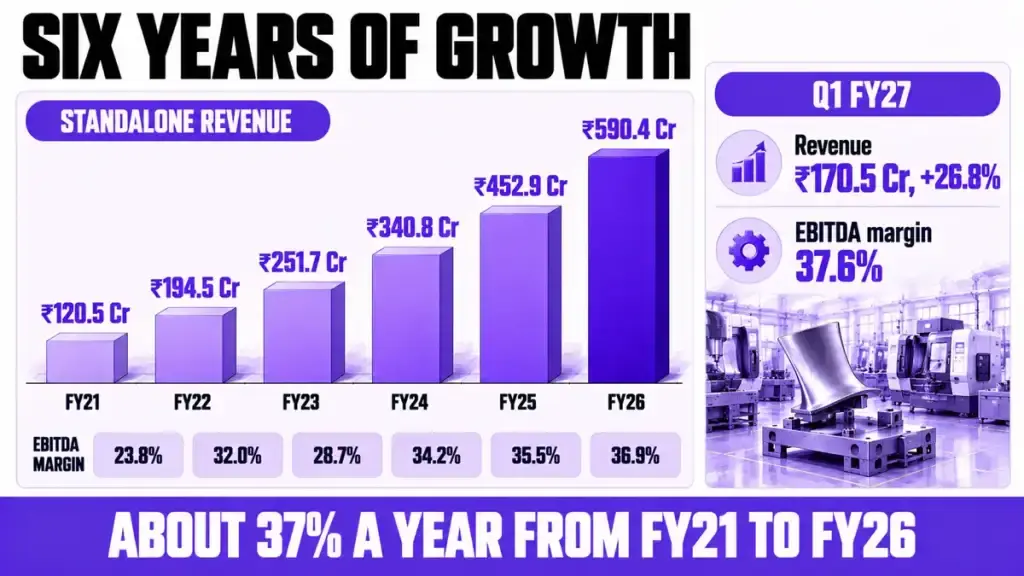
That margin has climbed a long way. In the early years, the chairman said, Azad earned an EBITDA margin of 18-19% on the same kind of parts. Standalone revenue grew from about ₹120.5 Cr in FY21 to about ₹590.4 Cr in FY26, and the EBITDA margin was 36.9% in FY26. Profit after tax was about ₹132.2 Cr in FY26.
Below EBITDA, the quarter carried the cost of the new plants. Depreciation rose to about ₹17.9 Cr from about ₹9.6 Cr, and finance costs to about ₹10.1 Cr from about ₹5.6 Cr. Other income came to ₹4 Cr, against ₹17 Cr in the March quarter, when it included large currency gains. Profit after tax still rose 21.2% to ₹36.4 Cr, helped by a lower tax charge.
The Order Book Behind the Plants
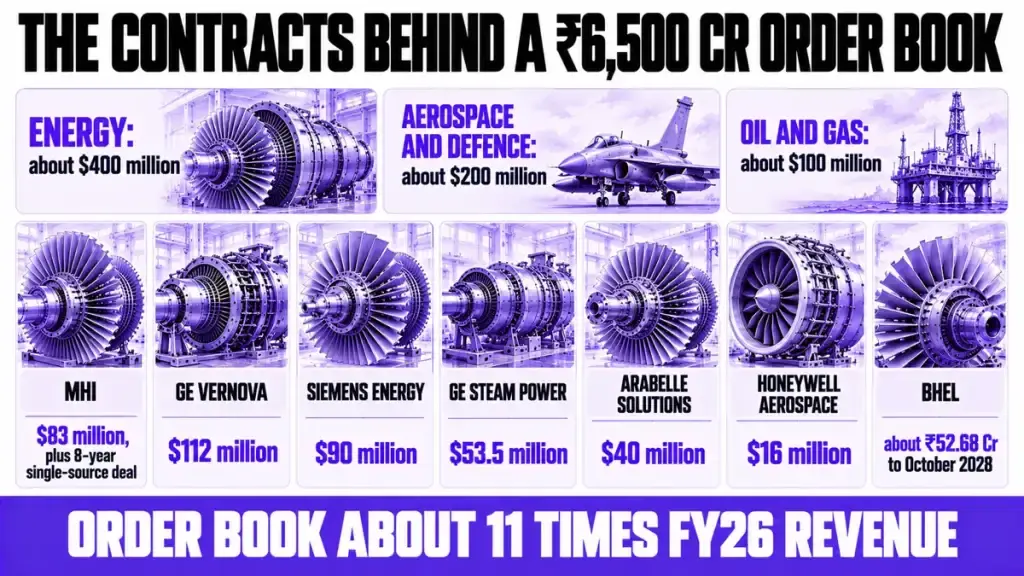
So what fills these plants? Azad counts as its order book the value of long-term contracts still to be delivered. It was about ₹6,500 Cr at the end of FY26, after ₹600 Cr was delivered during the year. That is about 11-12 times FY26 revenue.
That book splits across three businesses. About $400 million is for energy turbines, about $200 million for aerospace and defence, and about $100 million for oil and gas. Most contracts run for five to eight years, with delivery schedules fixed part by part.
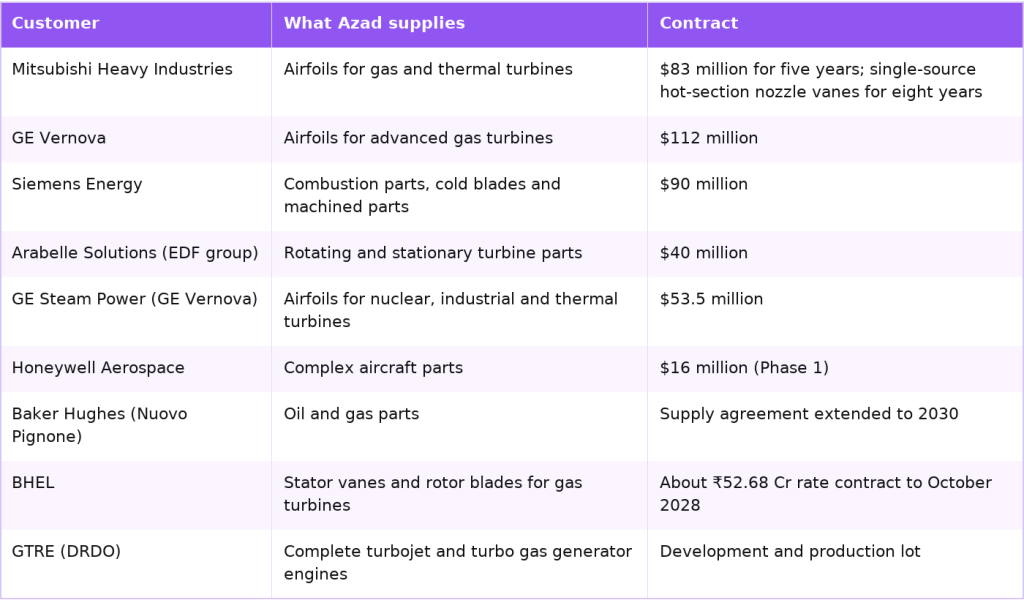
That book turns into revenue at a pace set by three things, management explained. Each customer has agreed a production schedule, each part must be qualified, and Azad must have the machines ready. For the first time, it said in May 2026, all three are lined up at this scale. Capacity is largely in place, qualifications are moving, and customer schedules are firm.
Why revenue lags the order book: about ₹6,500 Cr of contracts against about ₹600 Cr of yearly revenue means the limit today is factory space and qualified parts, not demand. That is why the four new plants matter more than any one quarter.
From One Machine Shop to Eight Customer Plants
To see why customers trust Azad with these contracts, let's go back to where it started. The company was incorporated in Hyderabad in 1983, but its turbine business began in 2008, when Rakesh Chopdar set up a CNC machine shop to make airfoils. In the energy business, Azad earned its qualifications one process and one part at a time.
That shop grew step by step. In 2012, Azad built a forge shop and a heat-treatment facility, so it could control more of each part's making. In 2014, it moved to a larger plant, and in 2017 it opened its exclusive bay for Mitsubishi Hitachi Power Systems. Between 2019 and 2021, it signed long-term contracts with Honeywell, GE Aviation and other key customers.
Those contracts needed money for machines. Azad raised ₹60 Cr in 2021 and ₹217.3 Cr in 2022, then listed on the stock exchanges through an IPO. In FY25, it raised more money from institutions to build its new campus. It also bought the assets of two smaller companies, which became Azad VTC for coatings and special processes and Azad Prime for large parts.
The campus is the biggest step so far. Phase 1 at Tunikibollaram covers about 95,000 sq m and was 70-80% complete at the end of FY26. Three dedicated plants were open by March 2026, the Baker Hughes plant followed in April, and the rest are due in FY27. In FY26 alone, Azad capitalised ₹392 Cr of assets and added ₹191 Cr of work in progress and capital advances.
That build-out explains the shape of FY26. Consolidated revenue rose about 31.8% to about ₹603 Cr, with an EBITDA margin of 37.4% and profit after tax of about ₹133.6 Cr. Total borrowings stood at ₹457 Cr, or ₹272 Cr net of ₹184 Cr of cash and treasury money. The company is also waiting to recover about ₹100 Cr of GST credit built up on its capital spending.
"At Azad, we have never chased reckless scale at the expense of our margins." - Rakesh Chopdar, Azad Engineering
Two Businesses Built on One Skill
Now let's see where that revenue comes from. Azad reports two segments: energy and oil and gas, and aerospace and defence. Both use the same skill, machining heat-resistant alloys to very fine limits, but they serve different customers.
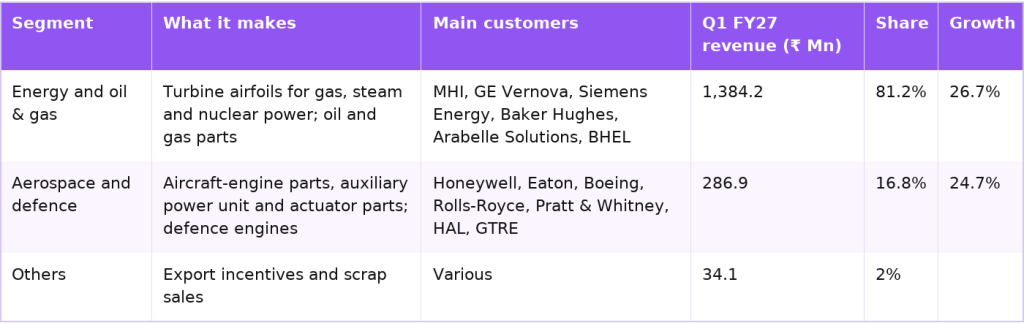
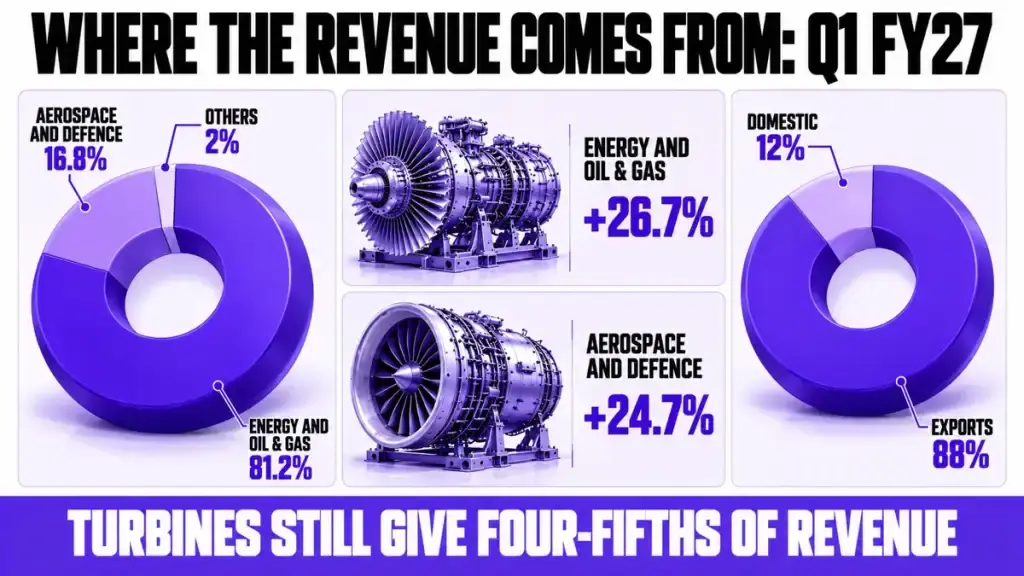
These two businesses are at different stages. Energy is the old core, and it gave ₹481 Cr, or 81.5%, of FY26 revenue, up about 34%. Aerospace and defence crossed ₹100 Cr for the first time in FY26, at ₹101 Cr, up about 25%. Domestic revenue was 12% of Q1 FY27, up from 8%, as Indian customers such as BHEL and GTRE grew.
That domestic share is small, but it is rising for a reason we can see. Indian buyers such as BHEL want to replace imported turbine blades, and India's defence labs want engines made at home. Both need suppliers that global makers have already approved. A small residual line, called others, adds export incentives and scrap sales, and came to ₹7.99 Cr in FY26. For now, though, almost all of Azad's revenue still comes from global makers, and each of its two segments is worth looking at on its own. Read this Segment-Wise Revenue Analysis Explained
Both businesses sell into large markets. Azad puts its addressable market in aerospace and defence at about ₹2,190 bn by 2029, up from about ₹1,190 bn in 2023. It puts the energy-turbine parts market at about ₹310 bn and the oil and gas parts market at about ₹930 bn by 2029.
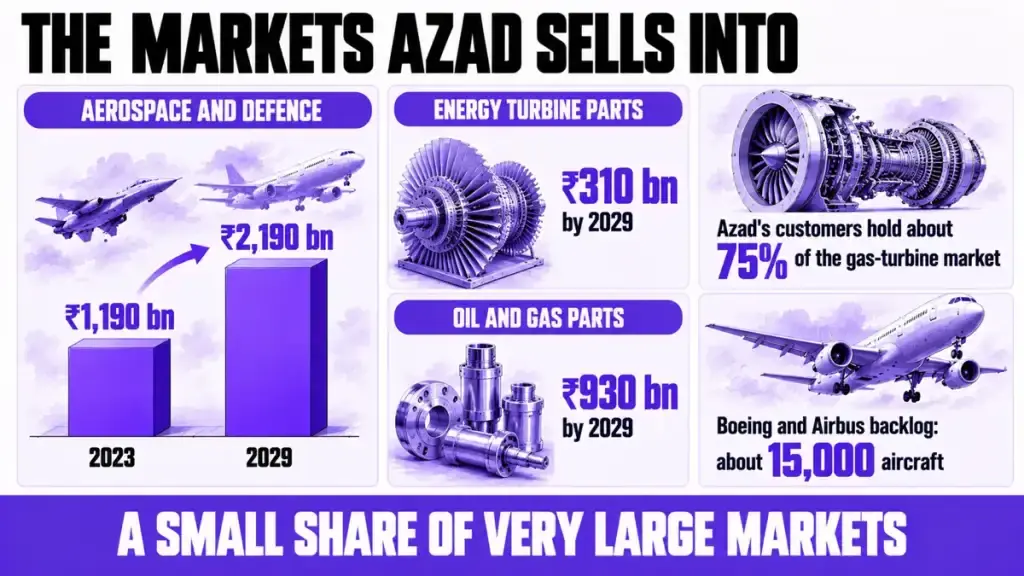
Those markets are far larger than Azad today, and that is the point we should keep in mind. FY26 standalone revenue of about ₹590.4 Cr is a small fraction of the markets the company itself has sized. What limits it is how many qualified parts it can make, not how many customers want them.
Gas Turbines for Power and Data Centres
Let's start with gas turbines, the heart of the energy business. Power companies want gas turbines because they can start quickly and back up solar and wind, and data centres want them for steady power. The turbine makers Azad supplies hold about 75% of the world's gas-turbine market, and each new turbine needs hundreds of airfoils.
Azad has made turbine airfoils since 2008, when its founder set up a machine shop for them, and MHI of Japan became one of its largest customers. In FY24, MHI named Azad its 2024 Partner of the Year from a network of over 1,000 suppliers. Azad now holds MHI airfoil contracts worth $83 million for five years, with a later phase taking its MHI contracts to about ₹1,387 Cr.
That single-source role is a step up. The parts are nozzle vane segments for the hot section, which is the part of the turbine just after the combustor, where temperatures are highest. Management says only a few suppliers in the world make these parts, and that the facility for them is about seven to eight months away from August 2026.
Beyond MHI, GE Vernova and Siemens Energy add more. GE Vernova signed a $112 million agreement for airfoils for its advanced gas turbines. Siemens Energy signed a $90 million, five-year agreement for combustion parts and cold blades, and its dedicated plant at Azad's new campus opened on 18 September 2025.
That Siemens plant follows a pattern that began years ago. In 2017, Azad opened an exclusive manufacturing bay for Mitsubishi Hitachi Power Systems, the MHI joint venture of the time, to qualify new products there. MHI's own dedicated plant at the new campus followed in March 2025. Each step gave the customer more space that was its own, and gave Azad more of the customer's parts.
Steam and Nuclear Turbines
Next, let's look at steam and nuclear turbines, which use larger blades and slower-moving designs. Azad makes last-stage blades, the longest blades at the low-pressure end of a steam turbine, and the fixed and moving airfoils around them.
Two makers of steam turbines for nuclear plants buy from Azad. Arabelle Solutions, part of France's EDF group, signed a supply agreement worth $40 million for complex rotating and stationary parts. GE Steam Power, part of GE Vernova, signed a long-term agreement worth about $53.5 million in FY26 for airfoils for nuclear, industrial and thermal power.
That GE work now has its own plant. Azad opened a dedicated facility for GE Vernova's steam power business on 29 April 2025, built to make these nuclear, industrial and thermal airfoils. Steam turbines last for decades and need replacement blades during their life, so this work also brings repeat orders long after a plant is built.
In India, BHEL buys from Azad too. BHEL first ordered advanced rotating airfoils for supercritical turbines, a project reviewed by the Central Electricity Authority, NTPC and BHEL. In October 2026, it named Azad a long-term source and awarded a two-year rate contract of about ₹52.68 Cr for gas-turbine stator vanes and rotor blades, running to 9 October 2028.
Oil and Gas Equipment
Now let's turn to oil and gas equipment, the smallest part of the energy business today. Azad makes slips, drill bits, hatch covers and frames for drilling and extraction equipment. Its customer is Baker Hughes, through its Italian arm Nuovo Pignone.
That business is about to grow. Baker Hughes extended its supply agreement with Azad to 2030, and Azad opened a 7,600 sq m plant for it in April 2026. The two companies also signed an MoU for a facility in Saudi Arabia, which management has put on hold while it finishes the Hyderabad plants.
So why should you care about such a small line? Because it is the same model that built the energy business. Azad qualified a few parts with one large customer, signed a long contract, and then built a plant just for that customer. If Baker Hughes follows the path that MHI took, oil and gas could become a much larger share of revenue over the next few years.
Aircraft Engines and Parts
Next, let's look at aerospace, which gave most of the aerospace and defence revenue of about ₹28.7 Cr in Q1 FY27. Global air traffic is expected to double between 2022 and 2029. Engine makers need more suppliers for that growth, and many of them are adding India.
Two companies, Boeing and Airbus, hold over 90% of the market for large passenger jets, and both depend on engine makers who are short of parts. That demand already reaches Azad. Its parts fly on the Airbus A320 and A350, the Boeing 737 MAX and 777X and the Gulfstream G550. It makes engine parts, auxiliary power unit parts and actuator and hydraulic parts. Honeywell Aerospace gave it a $16 million Phase 1 award, and Rolls-Royce signed a deal for civil engine parts for the life of the engine programme.
Beyond these, the next engine customers are close. Azad expected to deliver its first batch of Rolls-Royce qualification parts within the September quarter, with supply to follow. Pratt & Whitney Canada signed master terms for aircraft-engine parts, and a new contract for aero-engine precision parts was finalised in FY26. Safran Aircraft Engines signed an MoU with Azad, its first link with Safran, for rotating engine parts for defence platforms.
That speed comes from the energy years. Azad entered aerospace with about a decade of energy qualifications behind it, covering processes, metallurgy and audits. The company says that is why it moves through aerospace qualification cycles faster than a new entrant could. Each new engine maker adds years of repeat orders once its parts pass.
"Does the company have products or services with sufficient market potential to make possible a sizable increase in sales for at least several years?"
— Philip Fisher
For Azad, the answer lies in the engines and turbines its customers cannot build fast enough. Its share of what these makers spend on its kind of parts is still in low single digits.
India's First Indigenous Turbojet Engine
Finally, let's look at defence, the newest and smallest part of the business. On 22 July 2026, Azad delivered India's first indigenous expendable turbojet engine to GTRE and the Ministry of Defence. An expendable engine is a small jet engine built for a single flight, such as in a missile or a target drone. GTRE designed it, and Azad manufactured, assembled and integrated the whole engine.
That delivery moves Azad from parts to complete systems. Management says almost all the work was done in-house, apart from a few washers and small operations. The engine is now in testing and goes on to weapon trials. Azad has been told to prepare for large-scale production, and it is making a first lot of 20 engines.
Those production volumes are still open. Management said two-digit volumes would fit in today's plants, but the engine could need three or four digits, and it expects to know more within weeks. It also has a GTRE contract for an advanced turbo gas generator engine. Revenue from engines is not part of its growth guidance of over 25% a year.
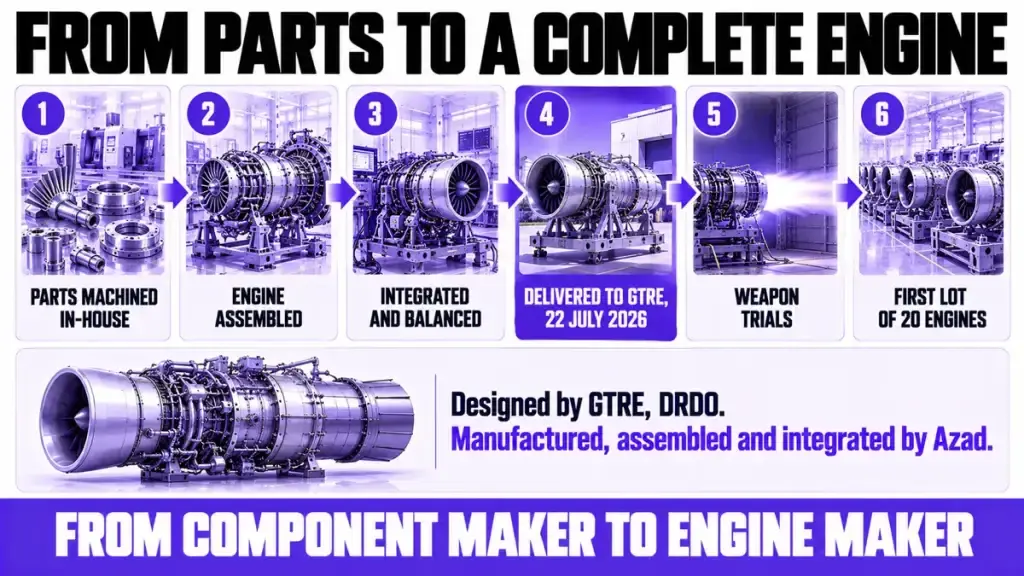
Why does a small turbojet matter so much? Because it shows that Azad can do more than machine a part to someone else's drawing. It can build, assemble and balance a complete engine and pass it to a defence customer. We think that skill matters for the larger engines India wants to build at home over the next decade, where Azad would like to be a partner.
"We have successfully evolved from being a precision component manufacturers into a fully integrated propulsion system player." - Rakesh Chopdar, Azad Engineering
Why Turbine Makers Rarely Change a Qualified Supplier
Now that we have seen each business, let's understand what keeps these customers with Azad. It starts with qualification. A turbine or engine maker tests every part a new supplier makes, often over 30-48 months, before it allows that part into its machines. Some parts must meet a zero-defects-per-million standard.
That testing is long, and you can see why from the company's own list. Before placing a single production order, a global maker checks process validation, metallurgical proof, dimensional accuracy, the first article and a serial production audit.
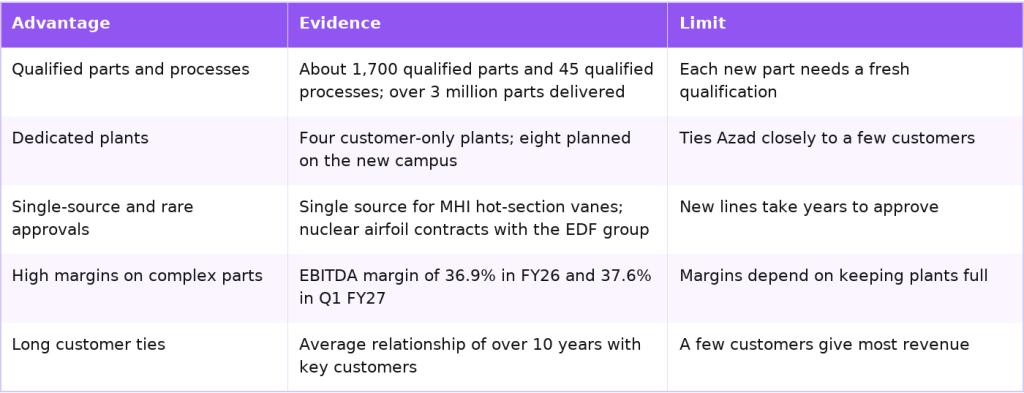
So once qualified, a supplier is very hard to replace. The customer would have to find another maker, wait years for it to qualify, and could face a failure in a machine worth crores. That is why Azad signs contracts of five to eight years, and why its key customers have stayed for over ten years on average. Read this Economic Moat Explained
That hold grows deeper with the dedicated plants. Each one is built around a single customer's parts, processes and audits. Management says that once a global maker builds a dedicated plant into its supply chain, moving that work away carries a huge switching cost.
"The key to investing is not assessing how much an industry is going to affect society, or how much it will grow, but rather determining the competitive advantage of any given company and, above all, the durability of that advantage."
— Warren Buffett
Azad's advantage is years of qualified parts, and each dedicated plant makes it harder for a customer to move that work elsewhere.
That skill also shows in the margin. The chairman traced the rise from an EBITDA margin of 18-19% in the early years to 37.6% in Q1 FY27 on the same product line, through shop-floor skill and steady improvement. Azad also writes off the cost of qualifying new parts as it spends it. Management says EBITDA would be 3-4 points higher if that cost were capitalised.
Its people are part of the advantage as well. Azad's founder set up its airfoil machine shop in 2008, and the company trains diploma holders in-house for 60-90 days. It had 2,168 permanent employees at the end of FY26, and it keeps a bench of trained staff ready for the new plants.
Its own processes add another layer. Azad does forging, vacuum heat treatment, shot peening and coatings in-house, and its subsidiary Azad VTC holds NADCAP approval for coatings. Keeping these steps inside the group means fewer outside vendors for a customer to audit, and less work sent out of the plant.
Its rivals are global, too. Azad competes for these parts mainly with suppliers from Europe, the United States, China and Japan. It wins against them by matching their quality while cutting machining time, which the company says gives it a cost edge over all four.
That edge leaves room to grow inside each customer. The company says its share of what these makers spend on the parts it produces is still in low single digits. It calls that a limit of capacity rather than capability, which is why it expects its share to rise as the new plants fill.
"We do not build speculative capacity. We have built dedicated customer-aligned infrastructure." - Vishnu Malpani, Azad Engineering
Its campus is the last layer. The new Centre of Excellence at Tunikibollaram covers about 94,899 sq m, against about 20,000 sq m at the older Jeedimetla plants. A second phase of 67,267 sq m is planned after that. All its plants, except those set aside for one customer, can make any customer's parts, including engine parts.
Financials: Growth and Margins Up, Cash Still Tied Up
Azad has more than tripled in size in four years, so let's look at five full years together. All figures are consolidated and restated.
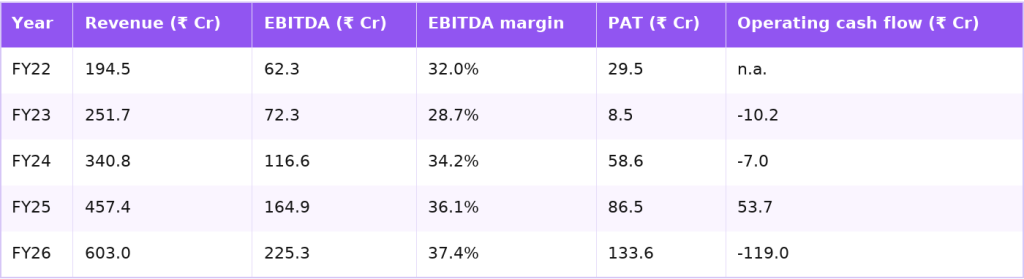
Revenue grew about 3.1 times in four years, from ₹194.5 Cr in FY22 to ₹603.0 Cr in FY26, or about 33% a year. The EBITDA margin rose from 32.0% to 37.4%, apart from a dip to 28.7% in FY23, and profit after tax grew about 4.5 times. FY23 profit was low mainly because of one-time finance costs of about ₹29.5 Cr, linked to convertible debentures and the early closure of bank loans.
Cash flow is the weak spot. From FY23 to FY26, operating cash flow added up to about minus ₹82 Cr, against about ₹287 Cr of profit. In FY26 alone, operations used about ₹119 Cr, as inventory and receivables grew ahead of the new plants.
That gap, together with the spending on the new campus, was paid for with fresh equity and borrowings. Borrowings rose to about ₹456.6 Cr in March 2026, against equity of about ₹1,529 Cr, and net debt was about ₹272 Cr after cash and treasury money. The plan to discount export bills, which should bring receivable days down to about 90 by Q4 FY27, is meant to close part of that gap.
"Our ultimate financial measure, and the one we most want to drive over the long-term, is free cash flow per share."
— Jeff Bezos
Azad already earns a margin near 37%. The next test is whether that margin turns into cash once the new plants are full and the build-out slows.
What the Next Two Years Look Like on Management's Numbers
So what could all of this add up to for you as a reader following Azad? Management guides revenue growth of over 25% a year for FY27 and beyond, and it calls that guidance conservative. It uses an EBITDA margin window of 32-35% for planning, while it has earned above 35% for the past two years.
On FY26 standalone revenue of about ₹590.4 Cr, growth of 25% would mean about ₹738 Cr in FY27. The step-up is due from the second half. About 80% of the start-up work on the new plants was done in Q1 FY27, the machines were running at full speed in Q2, and management expects the revenue to show from Q3.
Let's now put numbers on the plants, because they set the ceiling. Eight dedicated plants at about ₹150-180 Cr each would mean about ₹1,200 Cr of revenue from the new campus alone at full use. Civil construction for the remaining plants is due to finish within FY27, and Azad will give a capital spending plan for growth beyond FY29 in a later quarter.
Let's also look at working capital, because that is where most of the cash went. Inventory was built up for the new plants, and customers pay Azad slowly, with receivables at about 170-180 days. Management plans to discount its export bills with banks, which would bring receivable days down to about 90 by Q4 FY27. The cost of that discounting will show in finance costs, but operating cash flow should improve. Read this Cash Flow Statement Explained
As a reader, you should hold management to one more promise. It has said it will raise its growth guidance once the new plants are stable, and that its 25% figure is deliberately conservative. The second half of FY27 is when we will see whether that is true.
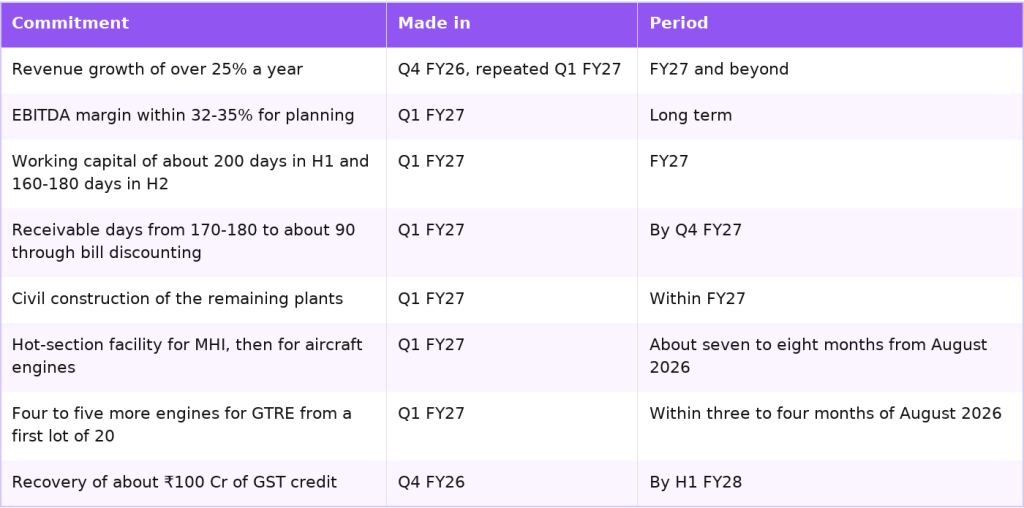
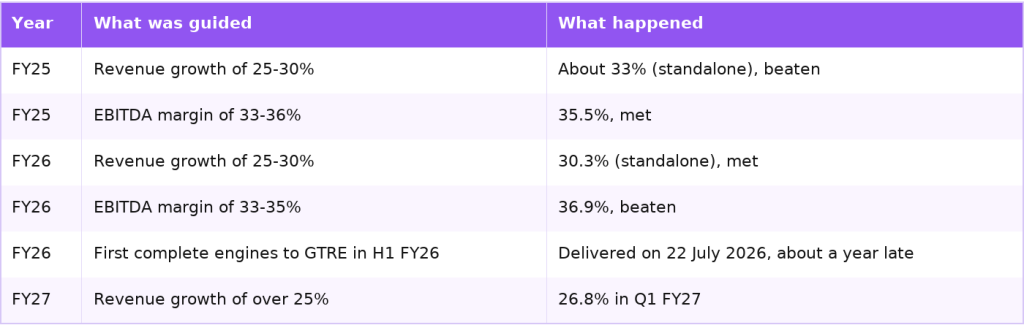
These commitments come with a record we can check. Azad met or beat its revenue and margin guidance in FY25 and FY26. Its working-capital targets have been harder to meet, and its defence engine and Rolls-Royce qualification each came about a year later than first expected.
Key Risks
No business grows in a straight line, so let's look at what could go wrong for Azad.
- Cash tied up in the build-out: standalone operating cash flow was negative by about ₹123.3 Cr in FY26, as inventory rose to about ₹326.6 Cr from about ₹188.5 Cr and receivables to about ₹309.2 Cr from about ₹221.6 Cr. Profit is not yet turning into cash.
- Rising debt: consolidated borrowings rose to about ₹456.6 Cr in March 2026 from about ₹243.6 Cr a year earlier. Depreciation and finance costs nearly doubled in Q1 FY27, and will stay high while the plants fill up.
- Ramp-up and qualification: revenue from the new plants depends on customers approving each part in each plant. If qualifications slip, the second-half step-up would come later than management expects.
- Delays on new programmes: the GTRE engine and the Rolls-Royce qualification each came about a year later than first guided. Engine volumes are still unknown.
- Few customers, one segment: energy and oil and gas gave 81.2% of Q1 FY27 revenue, and a few turbine makers give most of it. A slowdown in turbine orders would hit Azad directly.
- Currency and other income: 88% of Q1 FY27 revenue was exported. Other income fell to ₹4 Cr in Q1 FY27 from ₹17 Cr in Q4 FY26 as currency gains reversed.
- People and promoter holding: hiring 150-200 people a month is hard to sustain without quality slips. The promoter group held 55.84% at the end of FY26, after the promoter sold part of his shares during the year.
"All I want to know is where I'm going to die, so I'll never go there."
— Charlie Munger
For Azad, the places to avoid are clear from the list above: cash that does not come back, debt that keeps rising and plants that fill more slowly than planned.
Explore our Products
Research Framework

Emerging Titans
Combination of quantitative analysis, industry tailwinds, and management assessment - SPRINT investment philosophy

Tiny Titans
Heavy emphasis on scuttlebutt research, plant visits, and early on-ground signals
What to Track Next
If you follow Azad, these are the signals that will show whether the plan is on track.
- Revenue in Q3 and Q4 FY27 as the four dedicated plants reach full output
- Revenue growth for FY27 against the guided over 25%
- Rolls-Royce qualification parts, and the first orders from Pratt & Whitney and Safran
- Engine volumes from GTRE after weapon trials, and the first lot of 20
- Inventory and receivable days moving towards 160-180 days and about 90 days
- The capital spending plan for growth beyond FY29
Conclusion
Let's step back and put it all together. Azad spent close to two decades getting qualified with the world's turbine and engine makers, part by part. It now holds about ₹6,500 Cr of long contracts, earns a margin near 37%, and has delivered a complete jet engine for India's defence programme.
So the next two years will show whether the new plants can turn that order book into revenue. Four dedicated plants are running and four more are on the way, but they have tied up cash and raised debt along the way. If they fill up as planned from the second half of FY27, revenue could grow well above 25% a year. If qualifications and ramp-ups slip, the order book will stay large while the cash takes longer to come back. The next two quarters, with the first full output from the dedicated plants and the move to bill discounting, will show which way it goes.
FAQs
What does Azad Engineering do?
+Azad Engineering is a Hyderabad company that machines turbine airfoils, aircraft-engine parts and oil and gas parts for global makers such as Mitsubishi Heavy Industries, GE Vernova, Siemens Energy and Baker Hughes. About 93% of its FY26 revenue came from exports. It has also delivered India's first indigenous expendable turbojet engine to GTRE.
How big is Azad Engineering's order book?
+Azad's order book of long-term contracts was about ₹6,500 Cr at the end of FY26, about 11 times FY26 revenue. About $400 million is for energy turbines, about $200 million for aerospace and defence and about $100 million for oil and gas. Most contracts run for five to eight years.
What is a dedicated plant at Azad Engineering?
+A dedicated plant is a separate factory that Azad builds and runs for one customer only. Four are running, for MHI, GE Vernova, Siemens Energy and Baker Hughes, and Azad plans eight on its new campus. Each can earn about ₹150-180 Cr a year at full use.
How did Azad Engineering do in Q1 FY27?
+Standalone revenue rose 26.8% to ₹170.5 Cr, and EBITDA grew 32.1% to ₹64 Cr at a margin of 37.6%. Profit after tax rose 21.2% to ₹36.4 Cr, even as depreciation and finance costs rose with the new plants.
What is Azad Engineering's guidance?
+Management guides revenue growth of over 25% a year for FY27 and beyond, and calls that conservative. It uses an EBITDA margin window of 32-35% for planning and expects the new plants to show in revenue from Q3 FY27. Engine revenue is not part of that guidance.
What are the main risks for Azad Engineering?
+Standalone operating cash flow was negative by about ₹123.3 Cr in FY26, and consolidated borrowings rose to about ₹456.6 Cr. Other risks are slower qualification in the new plants, delays on new programmes, dependence on a few turbine makers, currency swings and the pace of hiring.

High growth stock specialist, Value Educator
Shashank Mahajan is an equity research professional with over 12 years of experience in identifying high-potential SME and micro-cap stocks at an early stage. He follows a rigorous scuttlebutt research–driven approach, combining on-ground insights with deep financial analysis. Shashank specializes in uncovering under-researched and under-owned companies with strong management quality and long-term growth potential. Through disciplined research and early identification, he focuses on spotting tomorrow’s market leaders before they enter the mainstream investor radar.
Atlanta Electricals: Capacity Nearly Quadrupled in a Year
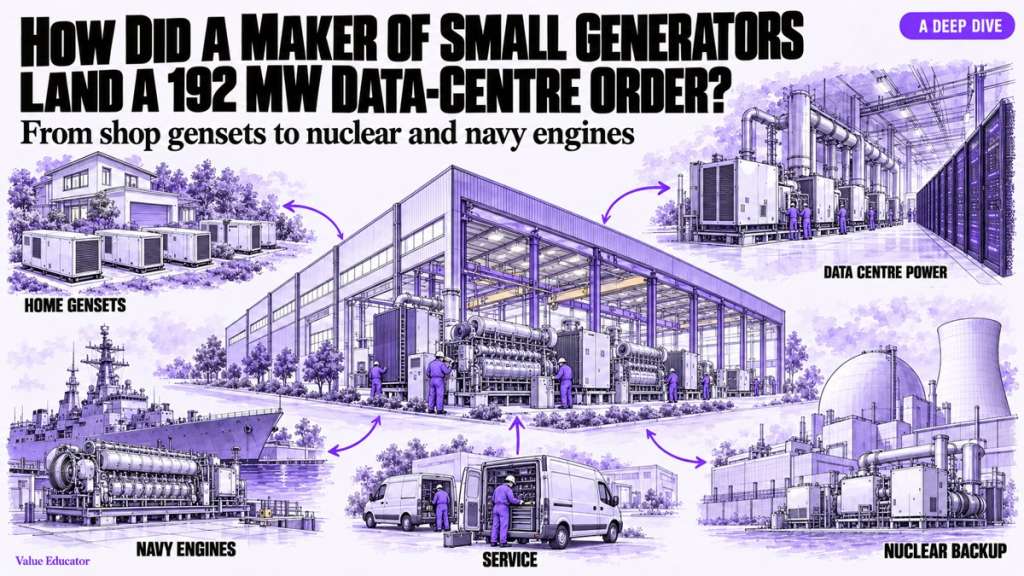
Kirloskar Oil Engines: Data Centres, Nuclear and the Navy
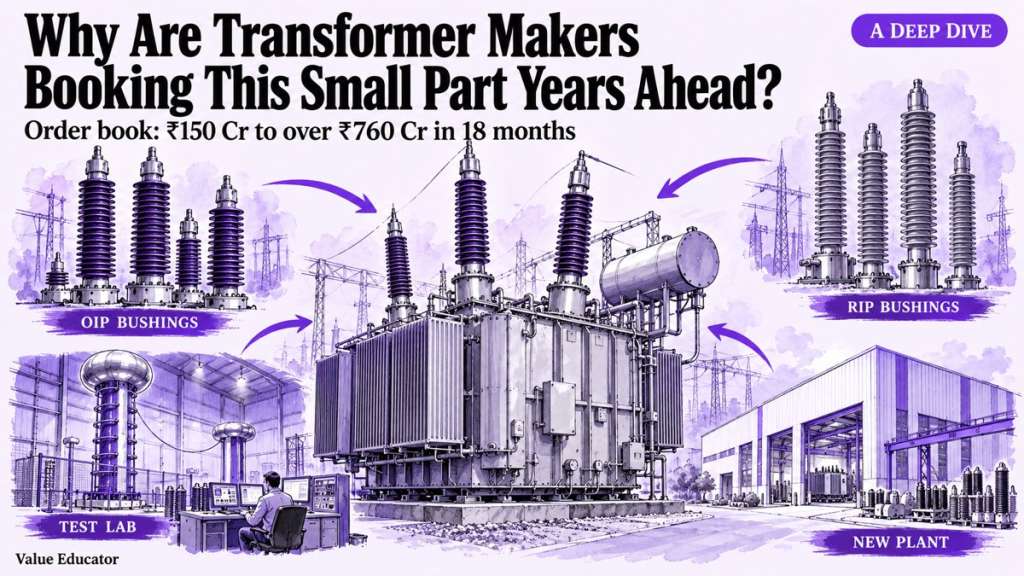
Yash Highvoltage: Bushing Maker With ₹760 Cr of Orders
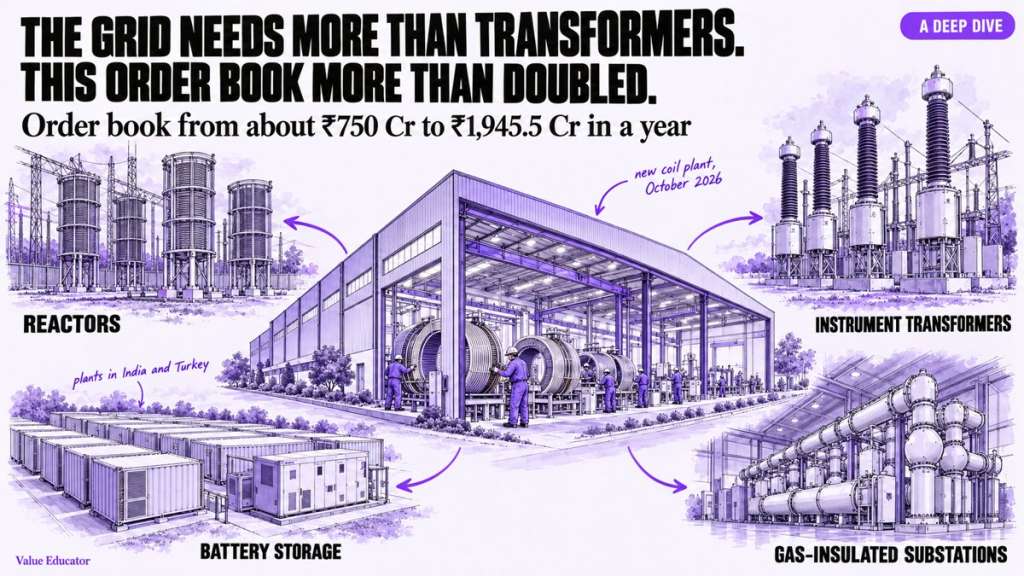
Quality Power: Reactor Maker With a ₹1,945.5 Cr Order Book
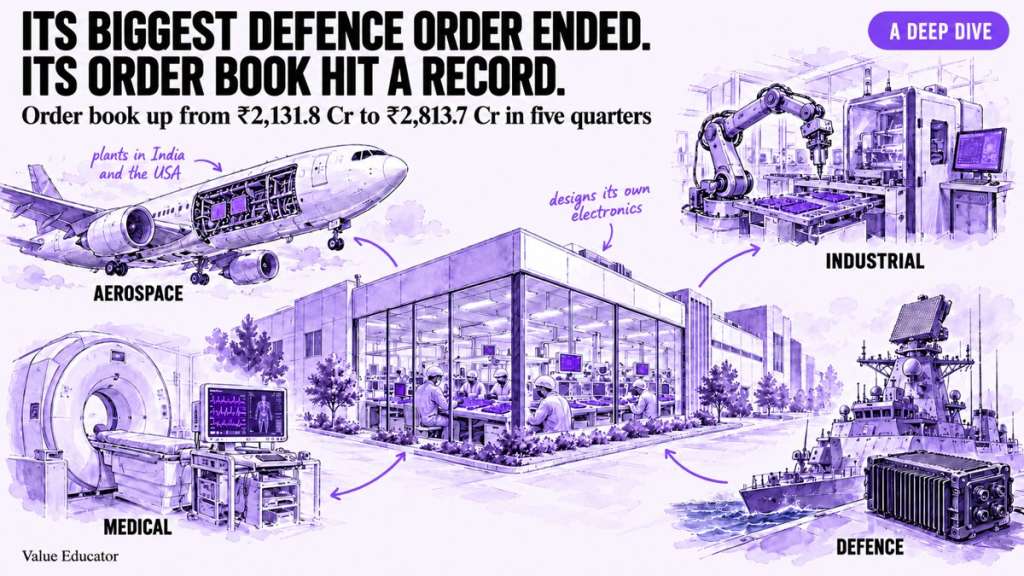
Cyient DLM: Aircraft Electronics and a Record Order Book

Zen Technologies: Revenue Fell After a Big Win
Explore our Products
Research Framework
Emerging Titans
Combination of quantitative analysis, industry tailwinds, and management assessment - SPRINT investment philosophy
Tiny Titans
Heavy emphasis on scuttlebutt research, plant visits, and early on-ground signals


 Orders
 Subscription
 Share with friends


Required Details
₹23999.00
(12 month subscription)
As per SEBI regulations, all users are mandated to complete the KYC that is validated for 1 year. Post payment, you will be redirected to the KYC screen


No comments yet. Be the first to comment!