
Black Box: Wiring US AI Data Centres, US$1,044 Mn Backlog
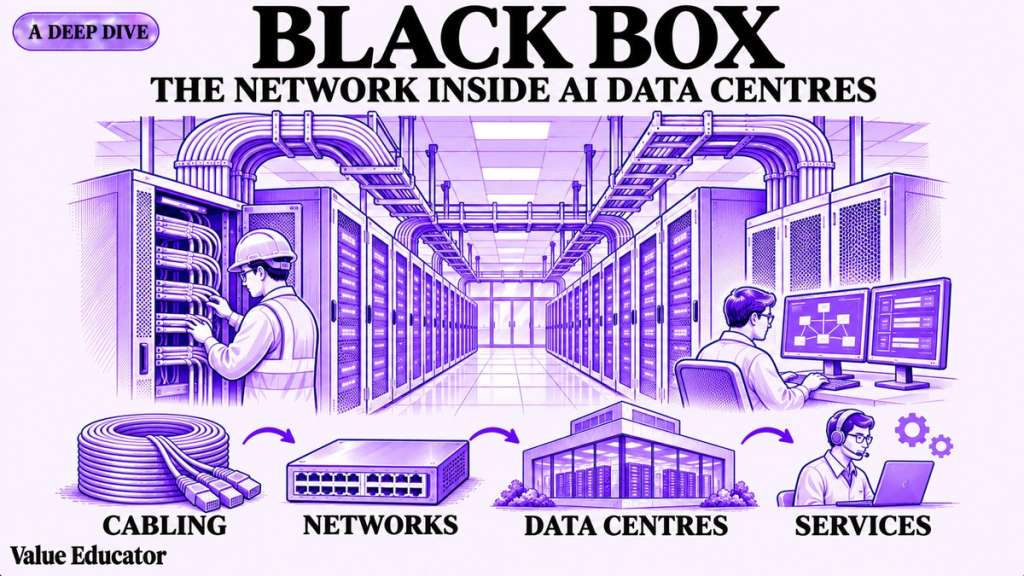
When a large cloud company builds a 100-megawatt AI data centre in the US, the fibre and cabling inside one building used to be a job of about US$8 million. In an AI building, management says, that job is now about US$60 million. The chips need far more connections to talk to each other, so the wiring has grown about 7.5 times.
That wiring is the business of an Indian-listed company. In its latest quarter, the July to September quarter of 2026, about 20% of its revenue came from data centres, against about 17% in FY26. Its order backlog crossed US$1,044 million, up 88% in a year. Management expects data centres to make up about 30% of revenue in FY27.
So what does this company actually do inside a data centre? It does not make servers or chips. It builds the network that connects them.
A data centre has a part called the white space. This is the hall where the server racks stand, as against the grey space that holds the power and cooling plant. Inside the white space, every rack must be connected to every other rack and to the outside world.
That connection work is called structured cabling. It means laying fibre-optic and copper cables in an organised way, through trays and patch panels, so thousands of machines can be linked, tested and changed later without tearing the hall apart. In US building contracts this work comes under a section known as Division 27, the communications section.
The buyers of this work are mostly hyperscalers. A hyperscaler is a very large cloud company, such as the ones that run search, social media or AI models, that builds its own data centres by the hundred. Management says the company works with four of the top six hyperscalers.
That company is Black Box Limited (NSE: BBOX). It was known as AGC Networks until it bought the US firm Black Box Corporation in January 2019. Today about 66% of its revenue comes from North America, it works in 35 countries and it has about 4,000 employees. Its promoter, Essar Telecom Limited, held 69.99% of the company in March 2026.
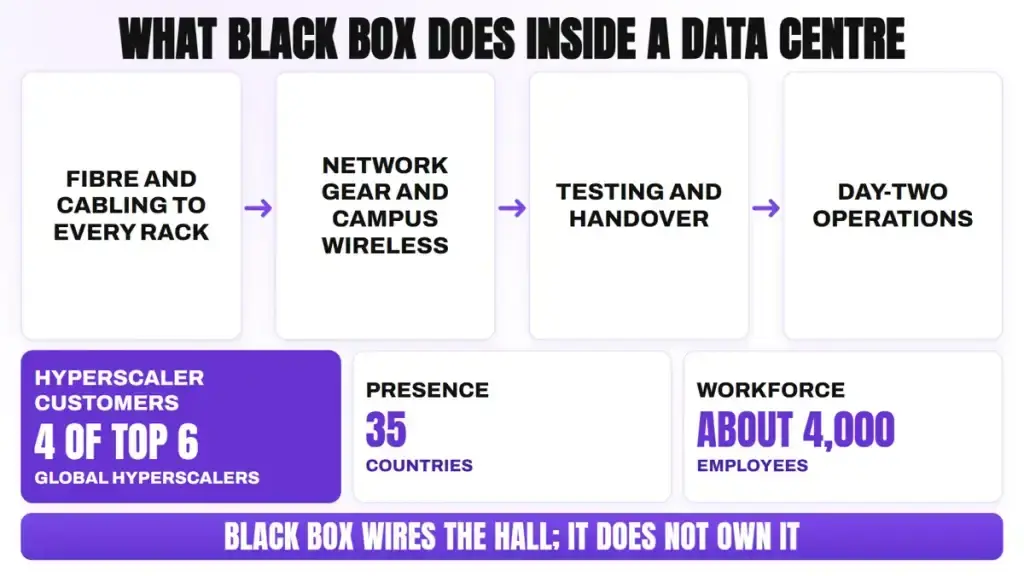
So Black Box has a clear spot in the data-centre chain. It does not own data centres, and it does not make the power or cooling equipment. It wires the hall, connects the racks and then runs and supports the network for the customer.
Black Box in five numbers
- Q2 FY27 revenue of ₹1,936 Cr, up 22%
- An order backlog of US$1,044 million, about ₹9,975 Cr, in September 2026
- Data centres at 20% of Q2 FY27 revenue
- An H1 FY27 EBITDA margin of 9.2%, with a 10% target for Q4 FY27
- A FY27 revenue guide of ₹7,800 Cr to ₹8,000 Cr
So a company whose revenue barely moved between FY23 and FY26 now has a backlog bigger than one and a half years of FY26 revenue. How did that show up in the latest quarter? Let's first understand the company, and then look at the latest quarter.
Black Box: Company Overview
Black Box Limited was incorporated in 1986 and has its registered office in Navi Mumbai. It was earlier called AGC Networks, and it took the Black Box name after buying the US company Black Box Corporation on 7 January 2019. Its promoter, Essar Telecom Limited, held 69.99% in March 2026; Sanjeev Verma is Whole-time Director and CEO, and Deepak Bansal is Executive Director and Global CFO. The company builds and runs digital infrastructure: data-centre cabling and networks, enterprise networks, workplace systems and cybersecurity, plus a technology products business. It has about 4,000 employees in 35 countries and more than 1,000 customers, including 120 Fortune 500 companies, and about 66% of its revenue comes from North America. Revenue from operations was ₹6,322 Cr in FY26, and its order backlog stood at US$1,044 million in September 2026. Read this Data Centre Stocks in India 2026: Suppliers and Operators
"Know what you own, and know why you own it."
— Peter Lynch
Black Box is easy to mistake for a hardware maker because of its name. It is mostly a services company that wires and runs networks, and its numbers make sense only once that is clear.
The Quarter Revenue Grew 22%
Let's look at Q2 FY27, the July to September quarter that Black Box reported on 13 November 2026. Revenue from operations was ₹1,936 Cr, up 22% from ₹1,585 Cr a year ago and 13% higher than the ₹1,719 Cr of Q1 FY27. The company calls it its highest quarterly revenue so far.

As we can see, profit grew faster than revenue. Read this EBITDA Explained: Uses and Limits EBITDA rose 23% to ₹175 Cr, and profit after tax rose 31% to ₹73 Cr. But the EBITDA margin stayed at 9.0%, the same as a year ago and lower than the 9.3% of Q1 FY27.

That flat margin has a reason. Black Box has started to hire ahead of its new hyperscaler projects, mostly in the US. The company says it hired about 300 people in the last two months and plans to add about 700 more in the next six to nine months. Those people cost money before the projects bring in revenue, so the margin waits for the second half.
That growth also came partly from an acquisition. On 1 May 2026 Black Box bought 2S Inovações Tecnológicas, a Brazilian network and cybersecurity integrator. 2S added ₹177 Cr of revenue in H1 FY27. Without it, H1 FY27 revenue growth would be about 17%, against the reported 23%.
Below the EBITDA line, two costs keep eating into profit. Finance cost was ₹50 Cr, against ₹39 Cr a year ago. Exceptional items took another ₹13 Cr, mostly severance pay and the early end of office leases. That is why a business with a 9.0% EBITDA margin keeps only 3.8% as profit after tax.
Those numbers look better over the half year. H1 FY27 revenue was ₹3,655 Cr, up 23%. EBITDA was ₹335 Cr, up 29%, and the margin rose 50 basis points to 9.2%. Profit after tax was ₹129 Cr, up 25%.
That acquisition also changed the balance sheet. Black Box paid a total consideration of ₹427.34 Cr for 2S, including deferred and earn-out payments, and booked provisional goodwill of ₹568.23 Cr. Total borrowings rose to about ₹1,211 Cr in September 2026, from about ₹827 Cr in March. Cash was ₹610 Cr, so net debt was about ₹601 Cr.
That borrowing went into the deal, but working capital moved too. Trade receivables were ₹908 Cr, against ₹1,153 Cr in March, while contract assets, work done but not yet billed, rose to ₹562 Cr from ₹280 Cr. Operating cash flow was ₹115 Cr in H1 FY27, against ₹97 Cr a year earlier. Read this Days Sales Outstanding (DSO) Explained
The Orders Behind FY27 and FY28
Now let's look at the orders, because they show how much of the coming revenue is already booked. Black Box reports two numbers. Order bookings are new orders won in a period. The order backlog is the value of signed orders not yet turned into revenue.
At the end of September 2026 the backlog was US$1,044 million, about ₹9,975 Cr. That is up from US$949 million in June 2026 and US$792 million in March. New orders in Q2 FY27 were US$298 million, and in H1 FY27 US$637 million.

That backlog was much smaller only two years ago. It was US$470 million in March 2024 and US$504 million in March 2025. The jump came from projects, mostly data centres. The project part of the backlog was US$524 million in September 2026, against US$121 million in March 2025.
Data centres drove most of those wins. In H1 FY27 Black Box added more than US$250 million of data-centre orders. In August 2026 it won a US$131 million order, about ₹1,240 Cr, from a new US-based Tier-1 hyperscaler, for work at one site over about three years. In Q2 it added a new US$55 million multi-site order from another US-based global hyperscaler.
What the backlog says: US$1,044 million is about 1.6 times FY26 revenue. But data-centre projects run for 24 to 36 months, so a large part of this backlog turns into revenue in FY28 and later, not in FY27.
Those long projects also change how fast the money comes in. Management says the average backlog now runs for about 18 months, up from 12 to 15 months in FY26. Enterprise projects run for 6 to 12 months, and maintenance and managed services contracts for 12 to 24 months.
How AGC Networks Became Black Box
Now that we have seen the quarter, let's go back and see how an Indian company came to own a US network business. AGC Networks, an Essar group company, bought the NASDAQ-listed Black Box Corporation on 7 January 2019 and later took its name. Black Box Corporation brought large US enterprise customers, a cabling and network workforce across the US, and a products business.
That deal also brought a long list of small, low-margin customers. For several years the company worked on cutting them. It moved from a fragmented base to about 300 key accounts, and cut its long tail of small accounts to fewer than 1,000. Its largest customer, Bank of America, has been with it for 27 years and has brought in more than US$1 billion of revenue over the last decade.

That table shows what the clean-up did.
"Turnarounds seldom turn."
— Warren Buffett
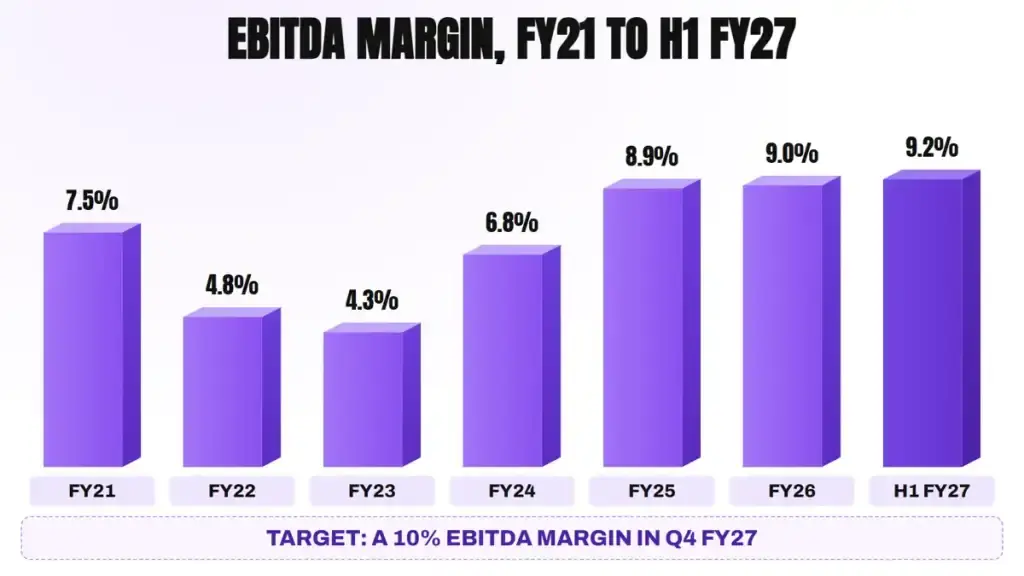
Black Box is a case where the margin did turn, from 4.3% to 9.0% in three years. Revenue has not turned yet, which is why the backlog matters so much now. Revenue stayed between ₹5,967 Cr and ₹6,322 Cr for four years. But the EBITDA margin more than doubled, from 4.3% in FY23 to 9.0% in FY26, and profit after tax rose from ₹24 Cr to ₹218 Cr.
That data-centre work is older than it looks. Black Box won its first data-centre site in Luleå, Sweden, in 2012, and its first North American site in New Albany, Ohio, in 2017. Its chief operating officer says one large US technology customer gave it two sites a little over a year before June 2026. By June 2026 it had seven dedicated sites from that customer, with three more allocated.
That growth also needed new money. In March 2026 Black Box completed a preferential issue that brought in ₹386.36 Cr, of which the promoters put in ₹200 Cr. Net worth rose to ₹1,287 Cr in March 2026, from ₹481 Cr two years earlier.
"These are not our competing bids that you can quote 5% less and win. That's not how hyperscalers operate." - Sanjeev Verma, Whole-time Director and CEO, August 2026
Two Segments and One Small Line
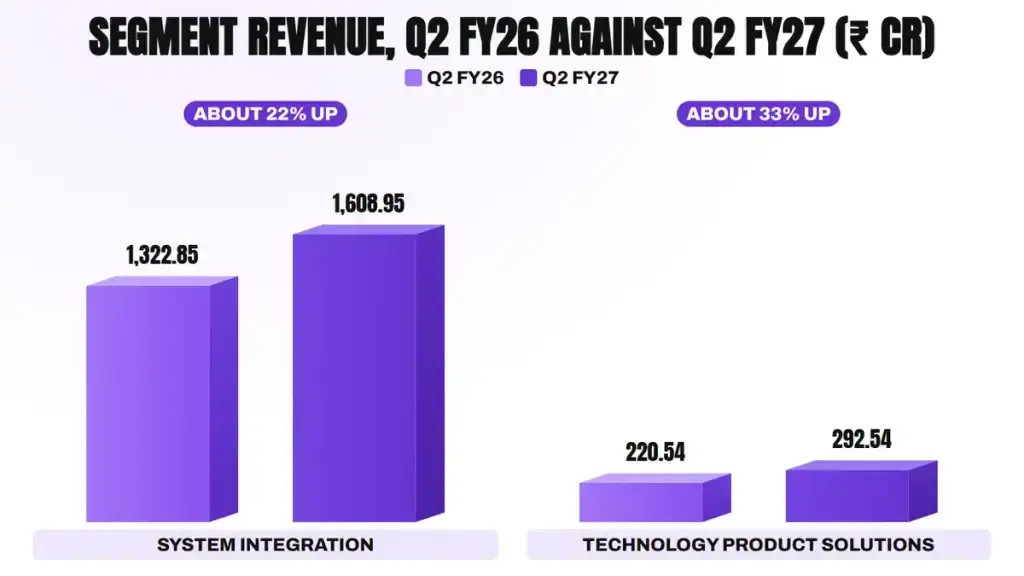
Now let's split the business into its parts, because each one earns in a different way. Black Box reports two main segments, system integration and technology product solutions, plus a small line called others.

These lines differ a lot in profit. System integration made a segment result of ₹434.13 Cr in FY26, while technology product solutions lost ₹15.84 Cr. In Q2 FY27 the product segment turned a small profit of ₹4.07 Cr, against a loss of ₹10.06 Cr a year ago.
Data Centres Inside System Integration
Let's start with data centres, the fastest-growing part of system integration. Black Box builds the data-centre network: fibre to the racks, structured cabling, the network gear and the wireless across the campus. After handover it can also run the site, which management calls day-two operations.
That work is a slice of the whole build. In February 2025 management said a US data centre costs about US$10 million per megawatt to build, and the networking and connectivity part is about 10% to 15% of it. So on a 200-megawatt build-out, the slice Black Box competes for is about US$200 million.
That slice is now growing faster than the building. AI halls pack far more GPUs into each rack, and each GPU needs many more fibre links. This is why the cabling for a 100-megawatt building went from about US$8 million to about US$60 million.
That shift shows in Black Box's revenue. Data centres were about 17% of FY26 revenue and 20% of Q2 FY27 revenue, which is about ₹387 Cr in the quarter. Management expects about 30% in FY27. Data centres were about 25% of the order backlog in June 2026, and management expects that share to rise towards 35% to 40%.
Enterprise Networks, Workplace and Cybersecurity
Next, let's look at the larger enterprise side of system integration. Here Black Box designs and runs office and campus networks, wireless and private LTE, audio-video and contact-centre systems, and security monitoring for banks, hospitals, retailers and airports.
These customers are some of the largest in the US. The company counts four of the top five US banks, 1,700+ hospitals and 5 of the top 10 US retailers among its customers. In FY26 it won a multi-year engagement of more than US$90 million with a major US international airport, one of the largest single contracts in its history.
That enterprise side grows more slowly. Management expects the non-hyperscale business to grow at about 10% a year for now. It argues that enterprise spending will pick up later, as AI use spreads from data centres to banks, hospitals and stores.
Technology Product Solutions
Next, let's look at the product business. Black Box sells KVM switches, which let one operator control many computers from one desk, along with AV switching, video-wall control and IoT sensors. These go into control rooms, airports, utilities and defence sites.
That business has a gross margin of about 40%, higher than services. But its revenue of ₹847.12 Cr in FY26 was too small to cover its costs, so it made a loss. Management expects about 20% growth in FY27, and the Q2 FY27 profit of ₹4.07 Cr is the first sign that scale is helping.
2S in Brazil
Finally, let's look at the newest part. 2S is a Brazilian network, cloud and cybersecurity integrator and a Cisco partner, with about 650 customers. Black Box expects it to add about ₹500 Cr of revenue a year and an EBITDA of about ₹50 Cr after integration. It is the first step in the company's plan to add revenue through acquisitions.
Where Black Box Sits in the Data-Centre Value Chain
Now let's place Black Box in the wider data-centre chain. A data centre needs land, grid power, the building shell, the power and cooling plant, then the servers and the network. Black Box works in the last part: the white space fit-out, the network that links the racks, and the support after handover.
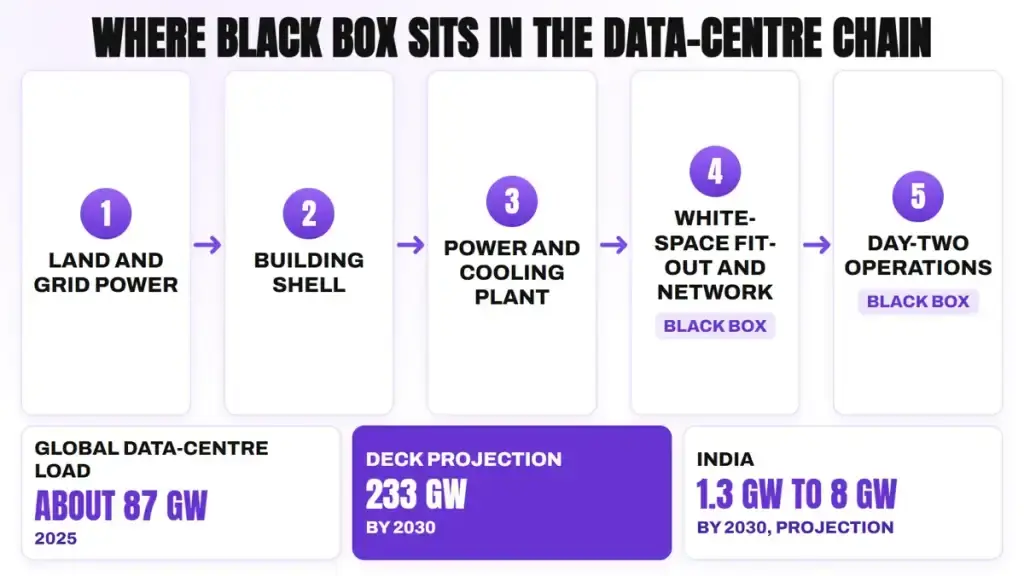
That chain is growing fast. The company's deck puts global data-centre IT load at about 87 GW in 2025 and projects 233 GW by 2030, with AI making up about half of the load by then. India is much smaller, at about 1.3 GW today, and the company projects about 8 GW by 2030.
That spending reaches Black Box through three kinds of buyers. Hyperscalers build their own campuses. Colocation operators build halls and lease them to hyperscalers and enterprises. General contractors run the build and hand out the cabling and network packages. Black Box counts two of the top US colocation players and four of the top six hyperscalers among its customers.
Those buyers have changed how they pick a supplier. Management says the old market was run by thousands of small local cabling contractors, many started by former telecom engineers. AI campuses need millions of connections on one site, which most small firms cannot handle. Management says only three or four firms are the size of Black Box, and none of them can take the work global.
Beyond the US, India is the next market. Black Box gets about 6% of its revenue from India, where it already serves banks, telecom operators, airports and government bodies. But management says India is a low-margin market, so for now the US remains its focus.
Why Black Box's Moat Is Hard to Copy
Now that we have seen the parts, let's understand the moat. Fibre and cabling are not secret technology. So the question is why a hyperscaler should give a multi-year campus to Black Box, and not to a local contractor that quotes less. Read this Economic Moat Explained
One part of the moat is scale. A hyperscaler building a gigawatt campus needs hundreds of trained technicians on site at the same time, across several states. Black Box has about 2,200 employees in North America and its teams cover 40+ US states. The company says it is the only India-origin digital infrastructure company now executing gigawatt-scale data-centre programmes.
Another layer is a record of finished work. Management says Black Box has executed several hundred megawatts, close to a gigawatt, of data-centre work. Hyperscalers invite suppliers who have already delivered, and management says it now gets invited more often than before.
That record runs through people and process too. Black Box runs a capability centre in Bengaluru with 630+ employees, which supports global delivery, and offshoring has reached 20% of the work. It also uses a program dashboard that tracks every site in a customer's campus programme.
Beyond scale, customer ties add a third layer. Its top 10 clients have stayed for more than 20 years on a weighted average. Once a bank or a hyperscaler trusts one firm with live sites, moving to another means retraining a new team on live sites.
"In business, I look for economic castles protected by unbreachable moats."
— Warren Buffett
Black Box's moat is not a patent. It is scale, a record of finished sites and long customer ties, and the margin will show how wide that moat really is.
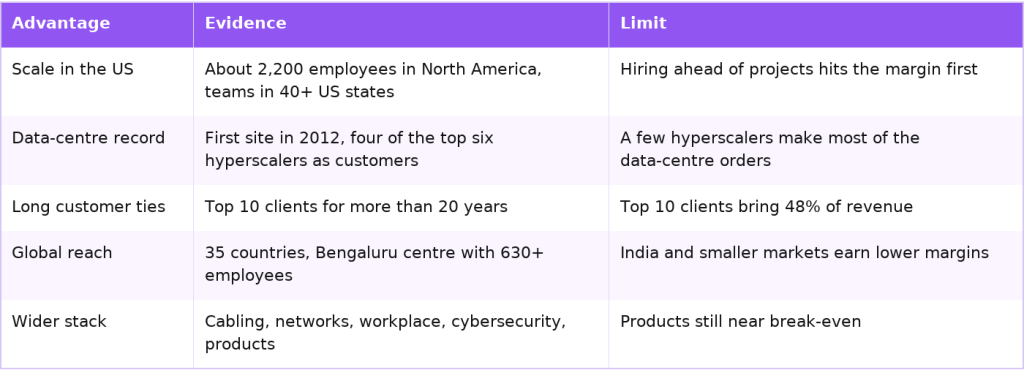
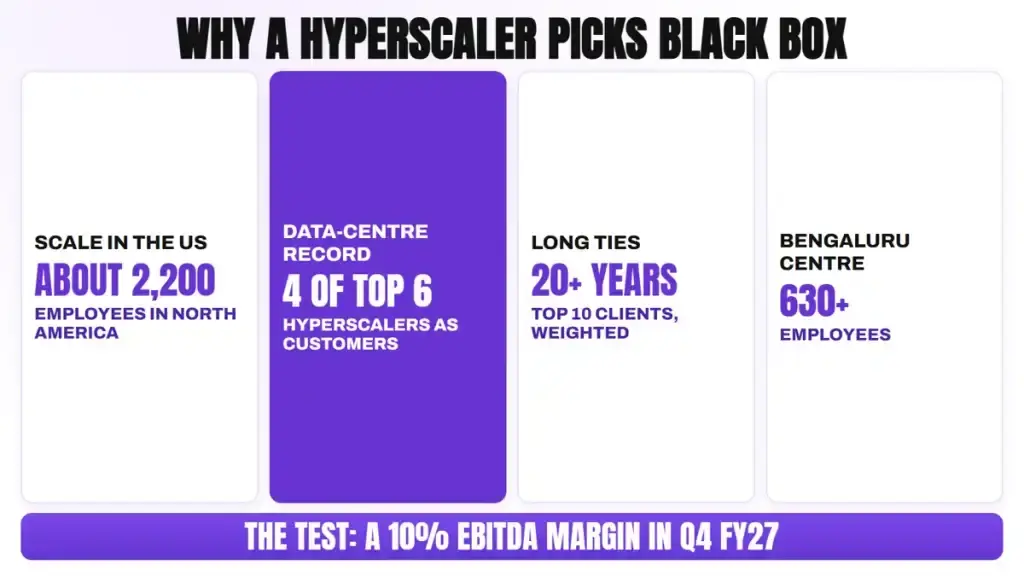
That table shows us why the margin is the real test of the moat. If buyers pay for certainty and not the lowest price, the EBITDA margin should rise as the data-centre share grows. So far it has moved from 4.3% in FY23 to 9.0% in FY26, and management targets 10% in Q4 FY27.
Financials: Five Years of Revenue, Margins and Cash Flow
One quarter can mislead in a project business, so let's look at the full years together. All figures are consolidated, as restated in the company's latest investor deck, and the first half of FY27 is shown for comparison.

Revenue barely moved for four years, between ₹5,967 Cr and ₹6,322 Cr from FY23 to FY26, while the company cut small accounts. But EBITDA more than doubled, from ₹269 Cr in FY23 to ₹570 Cr in FY26, and profit after tax rose from ₹24 Cr to ₹218 Cr.
Cash flow has lagged profit. From FY22 to FY26, operating cash flow added up to about ₹233 Cr, against ₹658 Cr of profit after tax, or about 35%. It was negative in FY25, at ₹88 Cr, and receivable days rose to about 67 in FY26 from about 35 in FY25 as large projects grew.
The balance sheet now carries more debt. Borrowings were about ₹1,211 Cr in September 2026, against about ₹827 Cr in March, after the 2S acquisition, and net debt was about ₹601 Cr. Net worth rose to ₹1,287 Cr in March 2026 after a ₹386.36 Cr preferential issue, so the next test is whether the bigger revenue turns into cash.
"Only when the tide goes out do you discover who's been swimming naked."
— Warren Buffett
Profit has grown fast at Black Box, but cash has not kept pace. A slower year for hyperscaler spending would show how much of that profit is tied up in receivables and unbilled work.
What FY27 Could Look Like on Management's Numbers
So where does the business go from here? In November 2026 management kept its FY27 guidance and said it was on track. That guidance is revenue of ₹7,800 Cr to ₹8,000 Cr, up 23% to 27%, and EBITDA of ₹725 Cr to ₹750 Cr at a margin of 9.3% to 9.4%. It also guides profit after tax of ₹300 Cr to ₹325 Cr, up 38% to 50%.
Now let's put those targets against the first half. H1 FY27 revenue was ₹3,655 Cr. Reaching ₹7,800 Cr to ₹8,000 Cr needs about ₹4,145 Cr to ₹4,345 Cr in H2. That is about 24% to 30% more than the ₹3,351 Cr of H2 FY26.

That profit line has an even steeper climb. H1 FY27 profit after tax was ₹129 Cr, so H2 needs about ₹171 Cr to ₹196 Cr. That is 33% to 52% more than H1, and it depends on the new hyperscaler sites ramping up and the margin reaching about 10% by Q4. Management also expects a tax rate of 10% to 15% in FY27 and FY28, rising to about 20% after that.
Beyond FY27, management has a FY30 plan. It aims to double organic revenue to about ₹12,000 Cr, a growth rate of about 17% a year from FY26, with an EBITDA margin of 10% or more. It plans to add about ₹6,000 Cr more through acquisitions, for a total of about ₹18,000 Cr, or US$2 billion. It also plans to grow from about 4,000 employees to about 7,000 by FY30.

Those commitments are easier to judge against the past. So let's check what management said before against what it delivered.
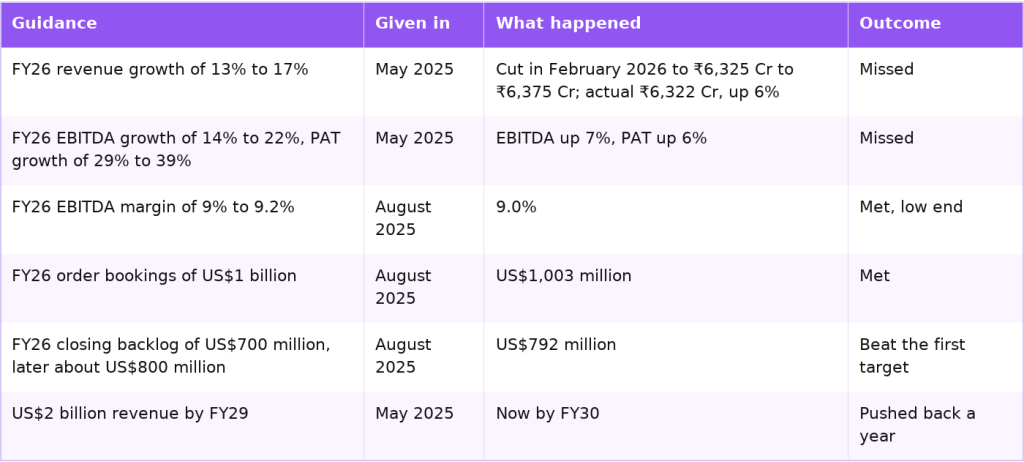
That record shows us a clear pattern. Order targets have been met, but revenue has lagged the orders. In FY26 a shortage of fibre and related parts across the data-centre industry delayed projects, and revenue moved to later quarters. So the H2 FY27 numbers will show whether the backlog now turns into revenue on time.
Key Risks
Now let's look at what could go wrong for Black Box, because FY26 has already shown some of these risks.
- Revenue slipping behind orders: in FY26 revenue grew 6% against a 13% to 17% guide, as fibre shortages and customer delays pushed projects into later quarters. The FY27 guide needs about 24% to 30% growth in H2.
- A steep profit climb: H2 FY27 profit after tax has to be 33% to 52% higher than H1. Hiring ahead of projects, finance cost and exceptional charges can all get in the way.
- Hyperscaler concentration: a few hyperscalers place most of the data-centre orders. If one slows its spending or delays a site, the backlog takes longer to turn into revenue.
- Thin net margin: profit after tax was 3.4% of revenue in FY26. Finance cost of ₹158 Cr and exceptional items of ₹63 Cr in FY26 take a large part of the EBITDA.
- Cash flow and working capital: operating cash flow added up to about ₹233 Cr from FY22 to FY26, against ₹658 Cr of profit after tax. Receivable days rose to about 67 in FY26, from about 35 in FY25.
- Debt after the acquisition: borrowings rose to about ₹1,211 Cr in September 2026, and goodwill to ₹963 Cr. CRISIL rates the bank facilities BBB+ with a positive outlook.
- Acquisition risk: the FY30 plan needs about ₹6,000 Cr of acquired revenue. Each deal brings integration work and more goodwill.
- Regulatory delays: in September 2026 import payments of ₹20.44 Cr, export proceeds of ₹7.44 Cr and other receipts of ₹11.14 Cr were delayed beyond the foreign exchange rules' time limits, and the company has applied to condone the delays. Disputed tax demands came to about ₹23.76 Cr in March 2026.
- Currency and the US: about 66% of revenue comes from North America, so the rupee and US spending cycles both move the reported numbers.
"It is not like that, that you receive the order and you start working tomorrow because these are not smaller orders, smaller contracts." - Deepak Bansal, Executive Director and Global CFO, August 2026
"By failing to prepare, you are preparing to fail."
— Benjamin Franklin
Black Box is hiring hundreds of people ahead of its hyperscaler sites. That preparation is what wins the work, but it also means costs arrive before revenue, which is where most of the risks below begin.
Explore our Products
Research Framework

Emerging Titans
Combination of quantitative analysis, industry tailwinds, and management assessment - SPRINT investment philosophy

Tiny Titans
Heavy emphasis on scuttlebutt research, plant visits, and early on-ground signals
What to Track Next
If you follow Black Box, these are the signals that will show where it goes next.
- H2 FY27 revenue against the ₹7,800 Cr to ₹8,000 Cr guide, and PAT against ₹300 Cr to ₹325 Cr
- The EBITDA margin against the 10% target for Q4 FY27
- The backlog after US$1,044 million, against the US$1.3 billion to US$1.4 billion target for March 2027
- The data-centre share of revenue after 20%, against about 30% for FY27
- New hyperscaler orders and the ramp-up at the US$131 million site
- Borrowings after about ₹1,211 Cr, and operating cash flow against EBITDA
- 2S revenue against about ₹500 Cr a year
Conclusion
Let's put it all together. Black Box spent four years with flat revenue while it cleaned up its customer base, and its EBITDA margin rose from 4.3% to 9.0%. Now the order backlog has more than doubled from US$470 million in March 2024 to US$1,044 million, and data centres have grown to 20% of revenue. The cautious thread is delivery: FY26 revenue lagged the orders, and the FY27 guide needs a much stronger second half. The next two quarters will show which thread is stronger.
Still, the next step is about delivery, not winning orders. What happens next depends on whether the hyperscaler sites ramp up on time, whether the margin reaches 10% as the new staff get busy, and whether the bigger revenue turns into cash rather than receivables.
FAQs
What does Black Box Limited do?
+Black Box builds and runs digital infrastructure: it lays fibre and structured cabling inside data centres, sets up enterprise networks, workplace systems and cybersecurity, and sells KVM and AV products. About 66% of its revenue comes from North America. FY26 revenue from operations was ₹6,322 Cr.
How did Black Box do in Q2 FY27?
+Revenue from operations rose 22% to ₹1,936 Cr. EBITDA rose 23% to ₹175 Cr at a 9.0% margin, and profit after tax rose 31% to ₹73 Cr. Data centres made up 20% of revenue in the quarter.
What is Black Box's order backlog?
+The order backlog was US$1,044 million, about ₹9,975 Cr, in September 2026, up 88% in a year. In H1 FY27 the company booked US$637 million of orders, including more than US$250 million of data-centre orders. Data-centre projects run for 24 to 36 months.
Where does Black Box fit in the data-centre value chain?
+Black Box works in the white space, the hall where the server racks stand. It lays the fibre and cabling to the racks, installs the network and runs the site after handover. It does not own data centres or make servers, power or cooling equipment.
What is Black Box's FY27 guidance?
+Management guides FY27 revenue of ₹7,800 Cr to ₹8,000 Cr, EBITDA of ₹725 Cr to ₹750 Cr and profit after tax of ₹300 Cr to ₹325 Cr. H1 FY27 revenue was ₹3,655 Cr, so about ₹4,145 Cr to ₹4,345 Cr is needed in the second half. It targets a 10% EBITDA margin in Q4 FY27.
What are the main risks for Black Box?
+In FY26 revenue grew only 6% against a 13% to 17% guide, as fibre shortages delayed projects. A few hyperscalers place most data-centre orders, profit after tax was only 3.4% of revenue in FY26, and borrowings rose to about ₹1,211 Cr after the 2S acquisition. Cash flow has also lagged profit.

High growth stock specialist, Value Educator
Shashank Mahajan is an equity research professional with over 12 years of experience in identifying high-potential SME and micro-cap stocks at an early stage. He follows a rigorous scuttlebutt research–driven approach, combining on-ground insights with deep financial analysis. Shashank specializes in uncovering under-researched and under-owned companies with strong management quality and long-term growth potential. Through disciplined research and early identification, he focuses on spotting tomorrow’s market leaders before they enter the mainstream investor radar.
More about Shashank Mahajan →
Azad Engineering vs MTAR vs Unimech: Aerospace Parts

Subros vs Lumax Auto vs Sona BLW: EV Auto Parts Compared
Jyoti CNC vs Macpower CNC: Machine Tool Makers Compared
Data Patterns vs Astra Microwave vs Apollo Micro

Himadri vs PCBL: Carbon Black and Battery Materials

Inox Wind vs Suzlon: Wind Turbine Makers Compared
Explore our Products
Research Framework
Emerging Titans
Combination of quantitative analysis, industry tailwinds, and management assessment - SPRINT investment philosophy
Tiny Titans
Heavy emphasis on scuttlebutt research, plant visits, and early on-ground signals



India's Aerospace Opportunity
Global Demand. Supply Bottlenecks. Opportunities Ahead.
Don't Miss This Exclusive Webinar!
Join Value Educator to decode the key trends shaping India's aerospace sector and learn how to identify tomorrow's potential leaders in the space.
- How the aircraft value chain works, layer by layer
- Indian companies supplying global aircraft makers
- A framework to judge any aerospace company

 Orders
 Subscription
 Share with friends


Required Details
₹23999.00
(12 month subscription)
As per SEBI regulations, all users are mandated to complete the KYC that is validated for 1 year. Post payment, you will be redirected to the KYC screen


No comments yet. Be the first to comment!