
Caplin Point: Latin American Generics and US Injectables
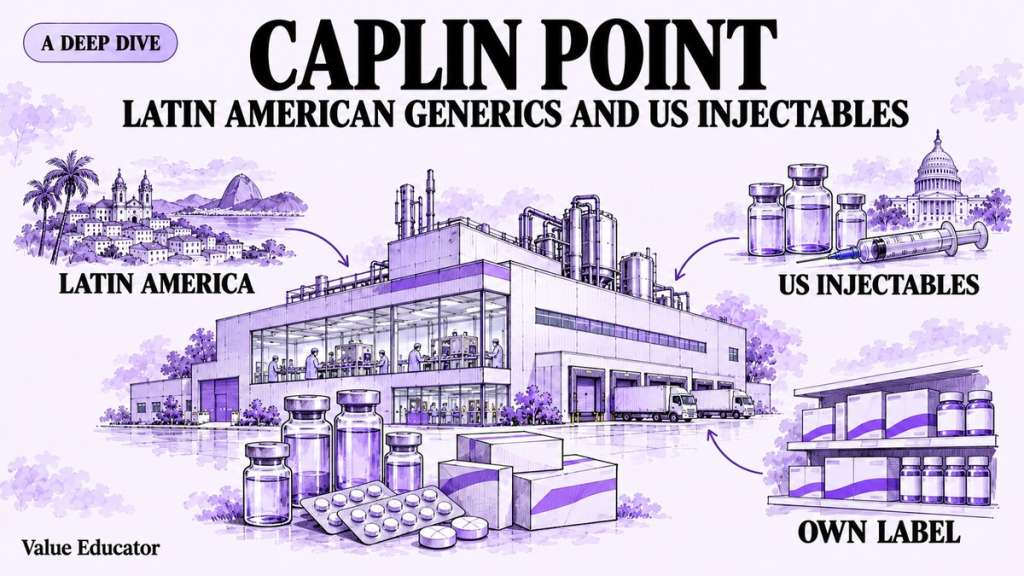
Walk into a small, family-run pharmacy in Guatemala, Honduras or Nicaragua, and look at the shelf behind the counter. During COVID, many people in Central America who lost their jobs put their savings into small pharmacies, wherever they could find a space. One Indian medicine maker made sure those small pharmacies never ran short of stock. When it later checked, its products held about 41% of the shelf space in these independent pharmacies.
So how does an Indian company win almost half the shelf in pharmacies thousands of kilometres away? It comes down to what it sells and where it keeps it. It sells generic medicines. A generic medicine is a copy of a medicine whose patent has expired, such as a painkiller, an antibiotic or a blood pressure tablet. Because many companies can make the same generic, they compete on price, on availability and on how fast they reach the shelf.
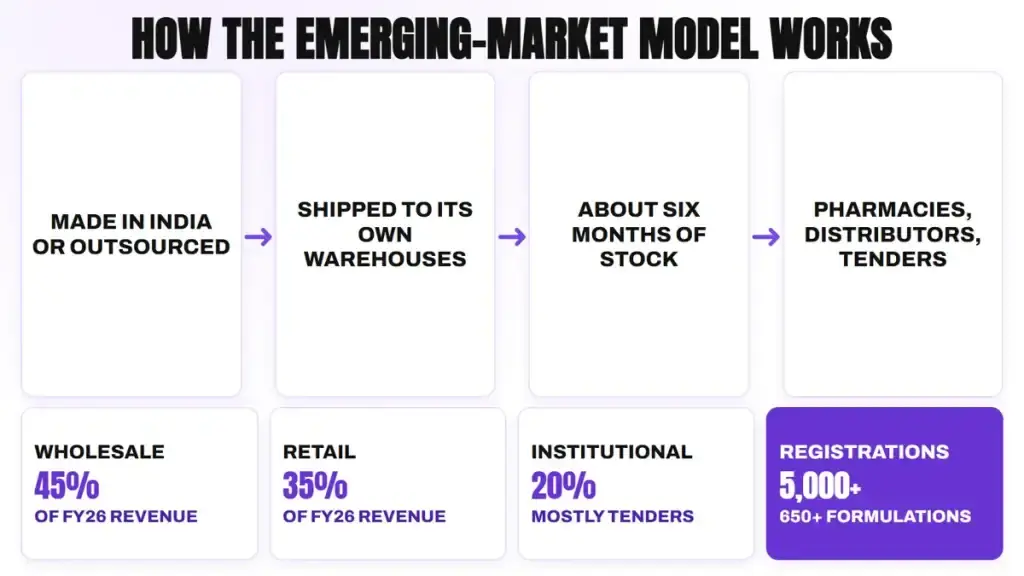
That company keeps its fast-moving products in its own warehouses inside those countries, close to the customer. Its chairman says these products always carry about six months of stock in the form of stock in the warehouse, stock in transit and work in progress. So when a pharmacy, a distributor or a government hospital places an order, the medicine is already in the country.
That company is Caplin Point Laboratories Ltd (NSE: CAPLIPOINT). Its founder, C.C. Paarthipan, began in 1987 with a partnership venture making ointments and creams, which became a private limited company in 1990. It listed in 1994, and from 2000 it moved into markets that larger Indian companies had left alone, in Latin America and French-speaking Africa. Today it sells 650+ formulations across 36 therapeutic segments, with 5,000+ product registrations.
Alongside that, Caplin runs a second, newer business. Its subsidiary makes sterile injectables in a plant near Chennai approved by the US drug regulator, the USFDA. A sterile injectable is a medicine given by injection or drip, so it must be made in a germ-free room. These are the medicines that hospitals in the US use every day, and they are harder to make than tablets.
Caplin Point Laboratories in five numbers
- Q2 FY27 revenue of ₹629.8 Cr, up 17.9%, with the US business up 21.3%
- FY26 revenue of ₹2,187.19 Cr and profit after tax of ₹649.73 Cr, up 20.08%
- Free cash reserves of ₹1,534 Cr in September 2026, and no bank loans
- 5,000+ product registrations across 23 countries where it sells
- US and other regulated markets at 21% of FY26 revenue, up from 2% in FY19
So a company built on cheap generics in small Latin American markets is now putting most of its new money into US injectables, oncology and its own raw materials. Let's first understand the company and how it got here, because its past choices explain most of today's business, and then look at the latest quarter.
Caplin Point Laboratories: Company Overview
Caplin Point Laboratories Ltd became a private limited company in 1990 and has its registered office in Tamil Nadu, with its corporate office in Chennai. It makes and sells generic medicines, mainly in Latin America and French-speaking Africa, through eight in-country subsidiaries in Latin America and its own warehouses there. Its subsidiary Caplin Steriles Limited makes sterile injectables and eye medicines for the US and other regulated markets at Gummidipoondi, and Caplin Steriles USA Inc sells them under the group's own label in the US. Its plants are at Puducherry, Gummidipoondi, Kakkalur and Visakhapatnam, with an oncology API plant coming up at Thervoy. It has 2,249 employees in India and 512 overseas. C.C. Paarthipan is the Chairman, Dr. Sridhar Ganesan the Managing Director, Ashok Partheeban and Vivek Partheeban the Vice Chairmen, and D. Muralidharan the Whole Time Director and CFO. Revenue from operations was ₹2,187.19 Cr in FY26, and free cash reserves stood at ₹1,534 Cr in September 2026. Read this How to Read a Balance Sheet
"The stock market is a device for transferring money from the impatient to the patient."
— Warren Buffett
Caplin spent two decades registering products one country at a time in markets most drug makers ignored. That patience is what built today's cash pile.
Why Caplin Chose Markets Others Skipped
Let's go back to how Caplin describes its own past, in three phases. From 1990 to 2005, it was a market-led generics maker that also made products under contract for others. From 2006 to 2020, it became a technology and research-led company. From 2021, it has been spreading across new geographies and product lines.
That middle phase is where the core of the business was built. Large Indian drug makers went after the US and Europe, where one approved product can bring in large sums. Caplin went the other way, to small countries in Central America, the Caribbean and French-speaking Africa. In these markets, a pharmacy owner cares less about a famous brand and more about whether the medicine is on the shelf, at a fair price, every week.
So Caplin built its business around availability.
"Know what you own, and know why you own it."
— Peter Lynch
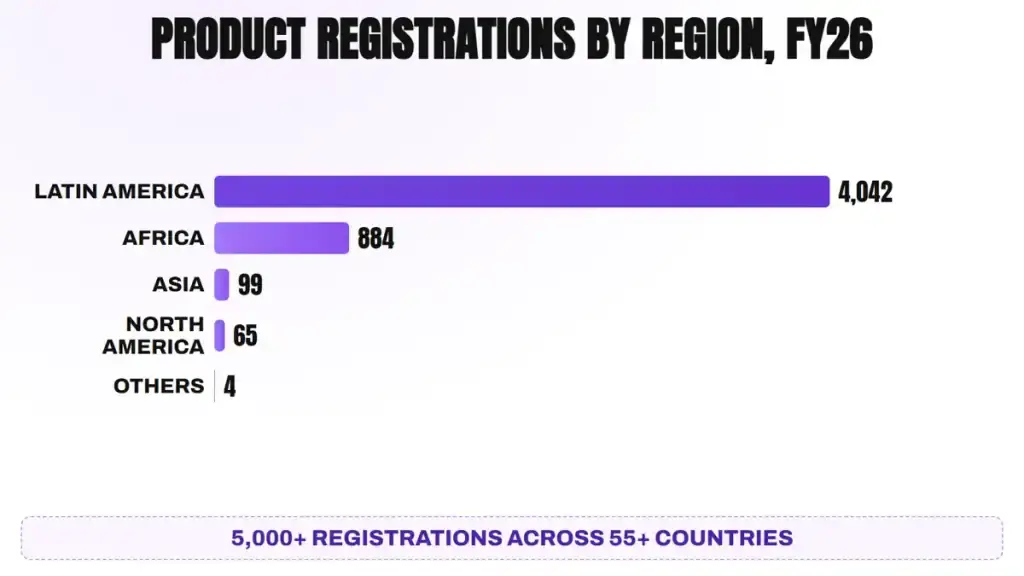
Caplin does not win on a famous molecule. It wins on registrations, stock in the right warehouse and a fair price, and that is what an owner of the business needs to understand. It registered product after product in each country, set up local companies and warehouses, and kept the fast movers in stock. Today it holds 4,042 registrations across 16 Latin American and Caribbean countries and 884 across 16 African countries. It reaches 30,000+ distribution touch points, such as pharmacies, clinics and distributors, in these emerging markets.
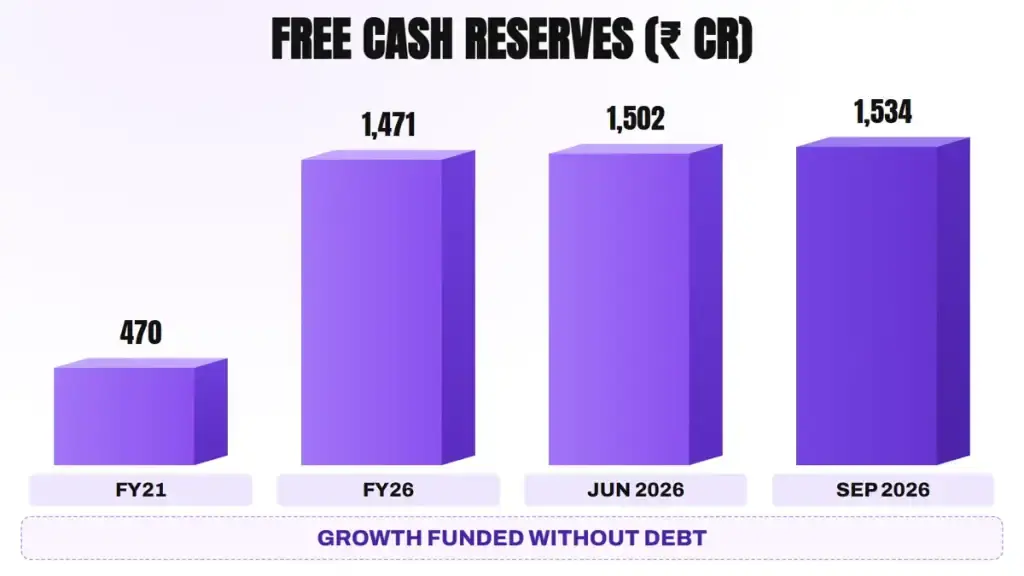
That model also turned out to be very profitable. Over FY21 to FY26, revenue grew from ₹1,061.29 Cr to ₹2,187.19 Cr, while profit after tax grew from ₹251.43 Cr to ₹649.73 Cr. Free cash reserves grew from ₹470 Cr to ₹1,471 Cr over the same five years, and none of that growth was funded with debt.
So by 2021, Caplin had more cash than its old business needed. Its third phase is about spending that cash on harder products and larger markets. Let's start with the latest quarter, which shows both businesses at work.
A Quarter of Steady Growth on Both Sides
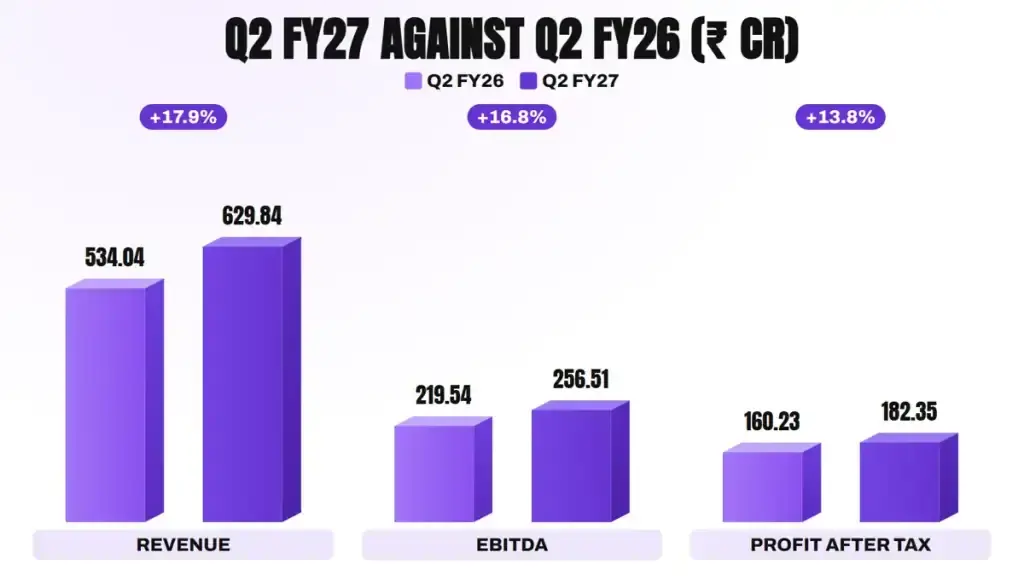
Let's look at Q2 FY27, the July to September quarter, which Caplin reported on 12 November 2026. It showed steady growth on both sides of the business. Revenue from operations was ₹629.84 Cr, up 17.9% from ₹534.04 Cr a year ago and up 3.2% from the June quarter. The table below shows the consolidated numbers. EBITDA here is the figure the company reports, which includes other income such as interest on its cash. Read this EBITDA Explained: Uses and Limits

As you can see, the margins barely moved, even as the company kept adding new plants, people and products. Gross margin, which is revenue minus the cost of the goods sold, came in at 62.1%, against 60.6% a year ago. EBITDA rose 16.8% to ₹256.51 Cr, and profit after tax rose 13.8% to ₹182.35 Cr.
That profit grew a little slower than revenue, and there are two clear reasons in the numbers. Depreciation rose 27.6% to ₹23.49 Cr, as new plants and lines came into use. Tax also rose 23.8% to ₹50.48 Cr. So the new capacity is already showing up as a cost, before it shows up fully in revenue.
Operating costs also grew faster than revenue in the quarter. Employee costs rose 19.9% to ₹57.59 Cr, R&D spending rose 10.7% to ₹23.74 Cr and other operating expenses rose 33.1% to ₹86.62 Cr. That is why a better gross margin did not lift the EBITDA margin. In August 2026, management said its expenses in Latin American markets were rising as it spent more on marketing there.
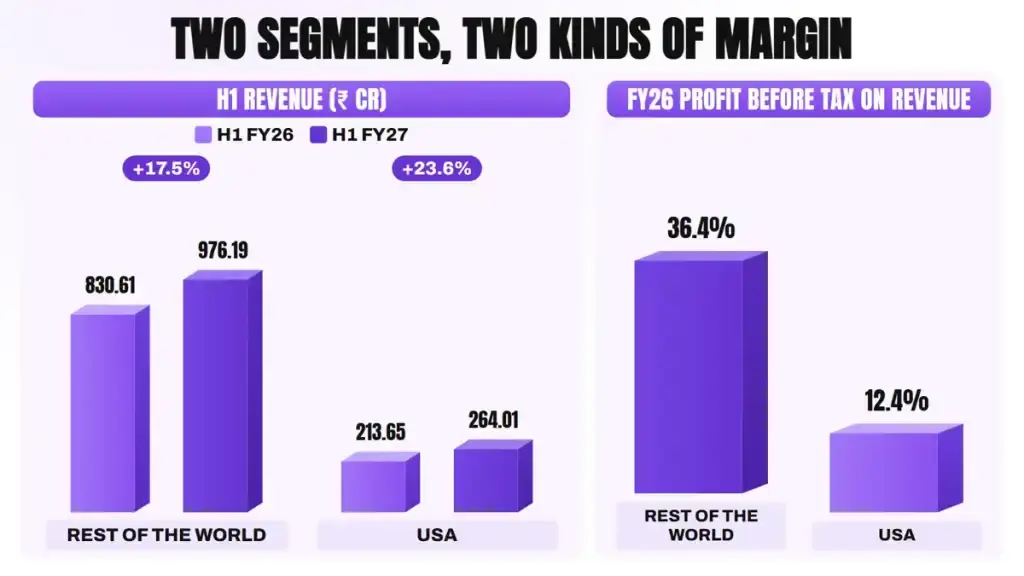
Now let's split the quarter by market. Caplin reports two segments, the US and the rest of the world, which is mostly Latin America with some Africa. The rest of the world brought in ₹500.12 Cr, up 17.1% from ₹427.08 Cr. The US brought in ₹129.72 Cr, up 21.3% from ₹106.96 Cr.
In Latin America, the quarter brought new tenders. A tender is a public auction in which a government health system buys medicines in bulk from the lowest qualified bidder. Caplin won tenders of $5.3 million in Central America, to be supplied over the next three quarters, and about 70% of that is oncology products. In Chile, it won new tenders of $5 million, to be supplied over 18 months. Six of its products were also accepted by the three largest pharmacy chains in Chile for annual supply.
Mexico, the largest market in the region, moved too. Caplin started commercial sales of oncology products there, received four new product approvals in the quarter and has 13 more under review. It plans to file 110+ more products in the next 18 months.
There is one number in the quarter that does not fit the pattern. The US segment earned a profit before tax of ₹16.32 Cr in Q2, against ₹33.27 Cr in the June quarter and ₹14.53 Cr a year ago. So US profit swings a lot from quarter to quarter, even while US revenue grows. For the half year, US profit before tax was ₹49.59 Cr, about double the ₹24.39 Cr of H1 FY26.
Where the Cash Went in the Half
Now let's look at the balance sheet, because for this company the cash matters as much as the profit. Free cash reserves, which the company defines as its cash and liquid investments, stood at ₹1,534 Cr in September 2026. Total liquid assets, which add receivables and inventory to that cash, stood at ₹2,967 Cr. Caplin had borrowings of only ₹0.78 Cr.
That cash came with a heavier inventory. Inventory rose from ₹428.86 Cr in March 2026 to ₹544.03 Cr in September. In the June quarter, management said it had chosen to stock up its warehouses to protect supplies against the conflicts that were disrupting shipping. That ₹544 Cr of stock was split three ways: 45% in warehouses near the customer, 18% in transit and 37% in India.
So cash from operations in H1 FY27 was ₹205.25 Cr, lower than ₹253.74 Cr a year ago. After ₹134.46 Cr spent on new plants and equipment, free cash flow for the half was about ₹70 Cr. Receivables stood at 129 days. Read this Days Sales Outstanding (DSO) Explained
What the cash says: Caplin earned ₹361.42 Cr of profit in H1 FY27 but turned only ₹205.25 Cr of it into operating cash, because inventory and receivables grew. The business still funds all its expansion from its own cash, but the gap between profit and cash is the number to watch while the stock build lasts.
Two Engines With Very Different Margins
Now let's split Caplin into its two engines and see how different their margins are. The emerging-market engine sells generics in Latin America and Africa. The US engine makes sterile injectables in India and sells them to US hospitals, first through partners and now also under its own name.

As you can see, the two engines earn very different returns today. In FY26, the rest of the world earned a profit before tax of about 36.4% on its revenue. The US earned about 12.4%. So Latin America is still where the profit comes from, while the US is where the growth and the new investment go. Read this Segment-Wise Revenue Analysis Explained
That US share has risen fast, though. US and other regulated markets made up 2% of revenue in FY19 and 21% in FY26. In FY26, US exports grew 27.89%, while exports to Latin America grew 9.53%. In the revenue split by geography, Latin America was 76%, the US 21% and Africa 3%.
Latin American Warehouses Next to the Customer
Let's start with the older engine, built around Latin American warehouses. Caplin sells in 23 countries, most of them small Latin American and French-speaking African markets that large drug makers do not focus on. It has eight subsidiaries inside Latin America, which hold 4,042 registered product licences there.
A registration is the licence a country's regulator gives before a medicine can be sold there. Each product needs its own registration in each country, with paperwork, tests and fees, and it can take years. So 5,000+ registrations across 650+ formulations is not something a new rival can copy in a year or two.
Then comes the sales channel. In FY26, wholesale made up 45% of revenue, retail 35% and institutional sales, mostly tenders, 20%. Generics made up 75% of revenue and branded generics 25%. A branded generic is a generic medicine sold under the maker's own brand name, which lets it charge a little more. In FY2012, branded generics were only 5% of revenue.
Then there is sourcing, because Caplin does not make everything it sells. In FY26, about 60% of what it sold was made in its own plants and 40% was outsourced. The chairman puts it simply: at least 40% to 50% of the Latin American business is outsourcing. So Caplin works partly as a manufacturer and partly as a distributor that knows which medicine each market needs.
Then there is Africa, the smallest part of the old engine. Caplin holds 884 registrations across 16 African countries, mostly French-speaking ones such as Senegal, Ivory Coast and Cameroon. Yet Africa made up only 3% of revenue in FY26. So Africa today is more of an option on the future than a source of growth, and Caplin spends most of its new effort in Latin America instead.
Now the new markets. Mexico and Chile are larger than the Central American countries, and each needs a different approach.
- Chile: Caplin recently set up its own distribution there. It now holds 135+ product licences and 24 running contracts that are expected to bring in $10 million in FY27.
- Mexico: It has 33 product approvals and a pipeline of 110+ products to file. It has bought land in Toluca for its first factory in Mexico, where local makers get a price advantage of 16% in government tenders, and expects construction to begin by the middle of 2027.
- Central America: It plans a liquid oral medicines plant in Guatemala. Once those liquids are registered, management expects its shelf share in independent pharmacies to rise from 41% to 57%.
Beyond new markets, Caplin is also adding more complex products to this old engine. It entered the central nervous system segment with brand marketing in three Latin American markets in FY26, and it launched branded pre-filled syringes in the region. Oncology products, which move mostly through tenders, are also a growing part of its tender wins.
US Injectables Under Its Own Label
Next, let's look at the newer engine, which now sells US injectables under its own label as well. Caplin Steriles Limited, or CSL, runs the USFDA-approved plant at Gummidipoondi near Chennai. Its products include liquid vials, freeze-dried vials, pre-mixed infusion bags, pre-filled syringes and ophthalmic solutions for the eye. Back in FY20, investment arms of the Fidelity group put ₹218 Cr into CSL to fund its growth.
Before CSL can sell a generic medicine in the US, it needs an ANDA, short for abbreviated new drug application. An ANDA is the USFDA's approval to sell a copy of a medicine whose patent has expired. CSL had 65 ANDAs filed and 59 approved by FY26, including ones it bought from other companies. It received 10 approvals in FY26 and bought another 15.
Those approvals now cover more formats than plain vials. Management lists pre-filled syringes, infusion bags, three-piece dropper bottles for eye medicines, cartridges and blow-fill-seal packs, a format where the plastic container is formed, filled and sealed in one step. CSL is also tripling the capacity of its infusion bag lines, a niche where it already has several approved products. Each new format means fewer competitors per product, which is how a generic maker protects its price in the US, where plain generics sell at very low prices. That depth of formats is also why the new plant matters, because each format needs its own line.
Even so, for years CSL sold most of its approved products through partners, who put their own label on them. Then in 2023 it incorporated Caplin Steriles USA Inc, or CSU, to sell under its own label directly to US wholesalers and hospital groups, and CSU began operations in 2025. In its first full year, FY26, CSU sold close to ₹100 Cr, or about $11 million, while the partner business kept its sales. CSL as a whole sold about ₹470 Cr in FY26.
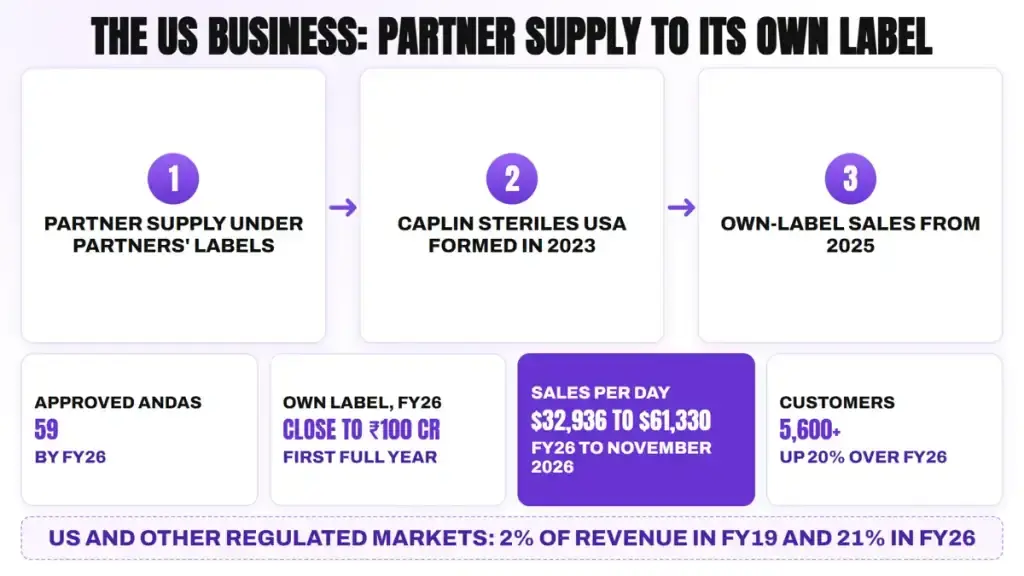
That own-label business is now growing faster than the rest. In Q1 FY27, CSU revenue rose from ₹14.4 Cr to ₹43.7 Cr. By November 2026, more than 5,600 customers were buying its products, and its average sales per day had risen from $32,936 in FY26 to $61,330. CSU's first-half sales were already above its sales for the whole of FY26. Today, about 60% of CSL's revenue is partner supply and about 40% is its own front end.
"We have spent several years building the capabilities to participate meaningfully in the US sterile injectable space and we are slowly starting to see the results of that now." - Vivek Partheeban, Vice Chairman, August 2026
Beyond the US, CSL has filed 120+ products in other regulated markets such as Canada, the EU, Australia, Brazil, South Africa and Saudi Arabia, and 75 of them are approved. It plans to file 60+ more in the next 18 months. Management expects meaningful revenue from these markets in FY27 and FY28.
Research That Feeds Both Engines
Now let's look at the research base that both engines draw on. Caplin spent ₹101 Cr on R&D in FY26, or 4.6% of revenue, across five dedicated R&D setups. That money goes into new generics for Latin America, injectables for the US and the APIs for its own plants.
Some of that money goes into newer areas. Caplin has filed its own GLP-1 products, the class of medicines used for diabetes and weight loss, in Central American markets, with sales planned after the patents there expire. It also completed its first biosimilar filing in Central America. Through partners in China, it gained access to 130+ approved dossiers that it can register in its markets.
Its own clinical research arm, Amaris Clinical, runs the bioequivalence studies that prove a generic works like the original. Management says such a study costs about $100,000 at an outside centre, and about half that at Amaris. Caplin is expanding Amaris to 120 beds by the end of FY27, mainly for its own products.
Why Caplin's Distribution Moat Is Hard to Copy
Now that we have seen both engines, let's understand the moat.
"In business, I look for economic castles protected by unbreachable moats."
— Warren Buffett
For a generics seller in small markets, the castle is the registration list and the warehouse network, both built over many years and one country at a time. In generics, the medicine itself is rarely special. Many companies can make the same paracetamol or antibiotic. So the advantage lies in everything around the medicine: the registrations, the warehouses, the relationships and the cash to keep stock in place.
Each of these takes years to build. A new rival entering Central America would first need registrations for hundreds of products, one by one, in each small country. Then it would need its own warehouses and trucks in each market, and six months of stock sitting in them. Few companies would do that for markets this small, and that is exactly why Caplin chose them. Read this Economic Moat Explained

That same moat has a limit, and it shows in the US. In US injectables, buyers pick suppliers by price and reliability, and a single plant inspection can stop shipments. CSL has had no unfavourable observations in any of its last three USFDA audits. But the US profit margin is still far below Latin America, so the US engine has not yet proved that it can earn like the old one.
Cost is the other side of the moat. Caplin makes most of its products in India and buys the rest from Indian and Chinese makers, so its cost per unit is low. That leaves room to sell at local prices in small markets and still keep a gross margin of about 60%, which few generic sellers in these countries can match. The new API plants are meant to widen that cost gap further.
Financials: Five Years of Revenue and Profit
One quarter can mislead in a business that ships tenders in lumps, so let's look at five full years together. These are the consolidated figures as filed in each year's annual report.
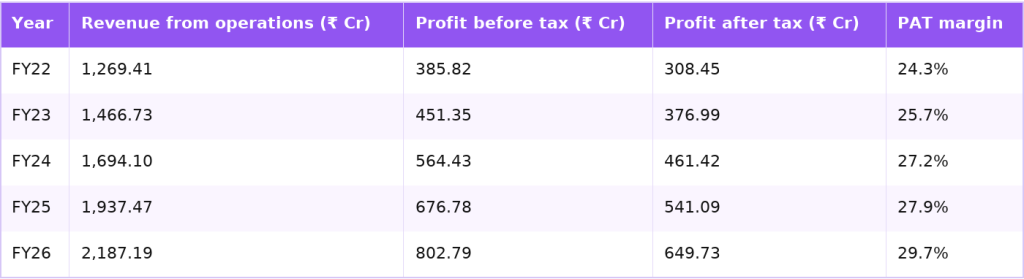
Revenue grew about 1.72 times in four years, from ₹1,269.41 Cr in FY22 to ₹2,187.19 Cr in FY26. Profit after tax grew faster, about 2.11 times, so the profit margin rose every single year, from 24.3% to 29.7%. Part of that came from a better product mix and part from other income on a growing cash pile.
The balance sheet grew with it. Net worth rose from ₹1,509.88 Cr in FY22 to ₹3,630.80 Cr in FY26, with almost no borrowings. The test for the next five years is whether the new plants and the US business can keep that margin while the share of lower-margin US revenue grows.
"In the short run, the market is a voting machine but in the long run, it is a weighing machine."
— Benjamin Graham
Caplin's five-year table shows profit and net worth compounding together. Over time, it is that steady weight of earnings and cash that counts.
What FY28 Could Look Like on Management's Numbers
So where does Caplin go from here? Management does not give yearly revenue guidance, but it has given margin ranges, a target for the US business and a large capital plan, so let's lay them out.
On margins, the CFO said in August 2026 that the gross margin would stay around 60%. The vice chairman said in February 2026 that a profit after tax margin of 26% to 29% is the range the company is comfortable with. For the US business, he said in mid-2026 that CSL could grow another 25% to 30% in FY27. The aim for CSU's own label was to touch or come close to ₹200 Cr in the same year. In November 2026, the company said it expects CSU to double its revenue and profit over FY26.
Beyond margins, the bigger change is the capital plan. Caplin has set aside a capex budget of about ₹1,000+ Cr for new plants, and about half of it is nearing completion. It plans to finish the rest over the next two years, from its own cash, and stay net cash positive throughout.
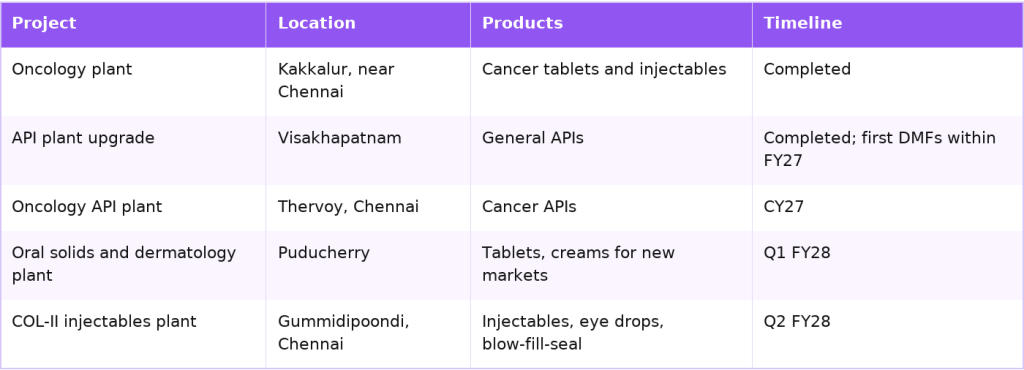
Two of these projects change what Caplin makes. The API plants make the active ingredient inside a medicine, called an API, short for active pharmaceutical ingredient. Caplin has finished R&D for 90+ APIs and wants to make in-house the APIs for 60% of its products. That should lower costs and reduce its dependence on outside suppliers.
Next comes injectable capacity, the other project that changes what Caplin makes. The chairman says CSL today has one USFDA plant with three old lines and two new ones. With the new plant, Caplin expects 17 injectable lines for the US and other regulated markets in the next two to three years. Each line can add new products, such as pre-filled syringes, where CSL has 12 more products in development for filing in FY28.

So let's put management's main commitments in one place.
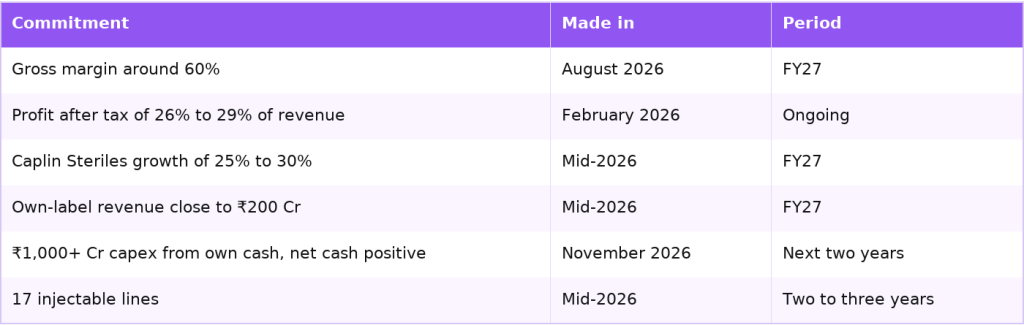
What would FY27 look like if these hold? Here is a simple exercise on our side, not a forecast from the company. If the second half grows at the first half's 18.8%, FY27 revenue from operations would be about ₹2,598 Cr. At the low end of the 26% to 29% profit range, that would mean a profit after tax of about ₹675 Cr, a little above the ₹649.73 Cr of FY26.
Those numbers are only a rough guide, but they show what matters: growth near 18% with margins held, while the new plants add costs before they add sales. Now let's compare what management said before with what it delivered.
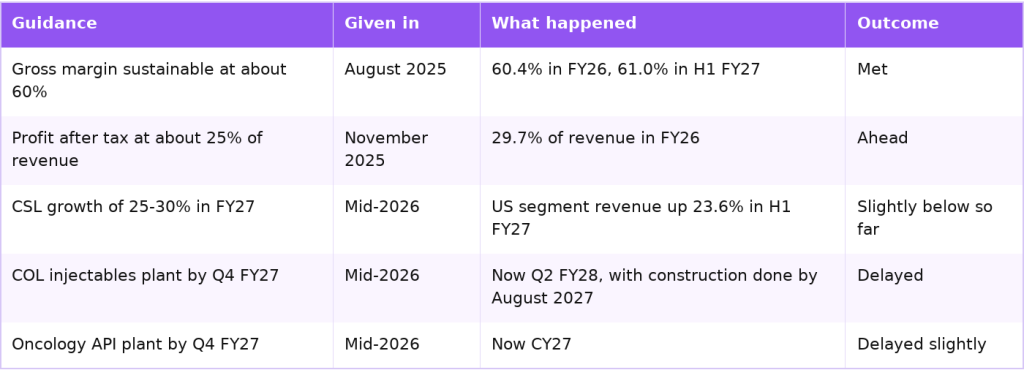
That record is mostly good on margins and mixed on plant timelines. Profit margins have stayed at or above what management promised. But the new plants, which are meant to drive the next phase, have each moved out by a few months.
How Caplin Uses Its Cash
That cash pile also raises a fair question: what does Caplin do with ₹1,534 Cr while the plants are being built? Most of it is held in bank deposits, bonds and debt funds. In August 2026, management said it had moved from keeping everything in fixed deposits to credit funds and debt funds, and that it would look at index funds over time, with capital protection first.
Then there are dividends. Caplin paid a total dividend of ₹8 per share for FY26, against ₹6 a year earlier, and paid out ₹60.81 Cr of dividends in H1 FY27. That is a small share of its profit, so most of what it earns stays in the business. Management has also said more than once that it keeps cash ready for an acquisition, such as a distribution company in Mexico or a batch of approved US products.
Key Risks
Now let's look at what could go wrong for Caplin Point Laboratories, because some of these risks are already visible.
- Small, volatile markets: most profit still comes from Latin American and African countries with weak currencies and unstable politics. A currency fall or a change in import rules in one large market would hurt.
- US profitability: the US segment earned about 12.4% before tax in FY26, against about 36.4% in the rest of the world, and its quarterly profit swung from ₹33.27 Cr to ₹16.32 Cr between Q1 and Q2 FY27.
- Working capital: inventory rose by ₹115.17 Cr in six months and receivables stood at 129 days, so operating cash flow fell to ₹205.25 Cr in H1 FY27 from ₹253.74 Cr.
- Supply chain: about 40% of products are outsourced, partly from China. Shipping disruptions, freight costs and raw material prices can raise costs or delay supply.
- Regulatory risk: the US business depends on the USFDA approval of one sterile plant. A bad inspection could stop shipments from it.
- Project delays: the COL-II plant moved from Q4 FY27 to Q2 FY28, and the oncology API plant to CY27. About ₹510 Cr of the capex was still to be spent in mid-2026.
- Acquisitions: Caplin is studying a distribution company in Mexico and 12+ oncology ANDAs. A large purchase could change the cash position quickly.
- Family control: the promoter group held 70.57% in March 2026, and promoter family members hold the chairman and both vice chairman roles.
"Our profits and cash flow will continue to be there because of our business model." - C.C. Paarthipan, Chairman, August 2026
"All I want to know is where I'm going to die, so I'll never go there."
— Charlie Munger
For Caplin, the places to watch are clear from the list above: thin US margins, a growing stock of inventory and plant timelines that have already moved. The tracking list below shows how to follow each one.
Explore our Products
Research Framework

Emerging Titans
Combination of quantitative analysis, industry tailwinds, and management assessment - SPRINT investment philosophy

Tiny Titans
Heavy emphasis on scuttlebutt research, plant visits, and early on-ground signals
What to Track Next
If you follow Caplin Point Laboratories, these are the signals that will show where it goes next.
- US segment revenue and profit before tax each quarter, against the 25-30% CSL growth aim
- CSU sales against the aim of doubling FY26 revenue and profit in FY27
- Mexico: approvals, oncology sales, the distribution deal and the Toluca plant
- The first DMF filings from Visakhapatnam within FY27
- Completion of the COL-II injectables plant by Q2 FY28 and of the Puducherry plant by Q1 FY28
- Inventory, receivable days and operating cash flow as the stock build unwinds
Members can read our full Research Desk report on Caplin Point Laboratories, with its detailed scorecard and section-by-section analysis.
Conclusion
Let's put it all together. Caplin Point Laboratories built a highly profitable business selling generics in small Latin American and African markets, with stock kept close to the customer and thousands of registrations that rivals would need years to copy. That engine still brings in about four-fifths of revenue and most of the profit. It has also paid for every new plant so far, without any debt. The next few quarters will show whether the US engine starts to earn like the Latin American one.
Now Caplin is spending about ₹1,000+ Cr of its own cash on a second phase: US injectables under its own label, oncology, its own APIs and larger markets such as Mexico. Revenue grew 17.9% in the latest quarter and the balance sheet holds ₹1,534 Cr of free cash reserves. What happens next depends on whether the US business can earn margins closer to Latin America's, and whether the new plants arrive on their new timelines.
FAQs
What does Caplin Point Laboratories do?
+Caplin Point makes and sells generic medicines, mainly in Latin America and French-speaking Africa, keeping stock in its own warehouses close to customers. Its subsidiary Caplin Steriles makes sterile injectables and eye medicines for the US and other regulated markets. FY26 revenue from operations was ₹2,187.19 Cr.
How did Caplin Point do in Q2 FY27?
+Revenue from operations rose 17.9% to ₹629.84 Cr, EBITDA rose 16.8% to ₹256.51 Cr at a 38.7% margin, and profit after tax rose 13.8% to ₹182.35 Cr. The rest of the world grew 17.1% and the US 21.3%.
How big is Caplin Point's US business?
+The US segment brought in ₹453.40 Cr in FY26, about 21% of revenue, against 2% in FY19. Its own label, Caplin Steriles USA, sold close to ₹100 Cr in its first full year, and its first-half FY27 sales were already above that.
Does Caplin Point have debt?
+Caplin Point had borrowings of only ₹0.78 Cr in September 2026 against free cash reserves of ₹1,534 Cr. It plans to fund its ₹1,000+ Cr capex from its own cash and stay net cash positive.
What are Caplin Point's expansion plans?
+Caplin has a capex budget of about ₹1,000+ Cr for an oncology plant, API plants at Visakhapatnam and Thervoy, an oral solids and dermatology plant at Puducherry and the COL-II injectables plant at Gummidipoondi due in Q2 FY28. It also plans a factory in Toluca, Mexico.
What are the main risks for Caplin Point?
+The US segment earned about 12.4% before tax in FY26 against about 36.4% in the rest of the world. Inventory rose by ₹115.17 Cr in six months, two plant timelines have moved, and most profit comes from small markets with volatile currencies.

High growth stock specialist, Value Educator
Shashank Mahajan is an equity research professional with over 12 years of experience in identifying high-potential SME and micro-cap stocks at an early stage. He follows a rigorous scuttlebutt research–driven approach, combining on-ground insights with deep financial analysis. Shashank specializes in uncovering under-researched and under-owned companies with strong management quality and long-term growth potential. Through disciplined research and early identification, he focuses on spotting tomorrow’s market leaders before they enter the mainstream investor radar.
Glenmark: The USD 700 Mn Cancer Deal and Its Brands
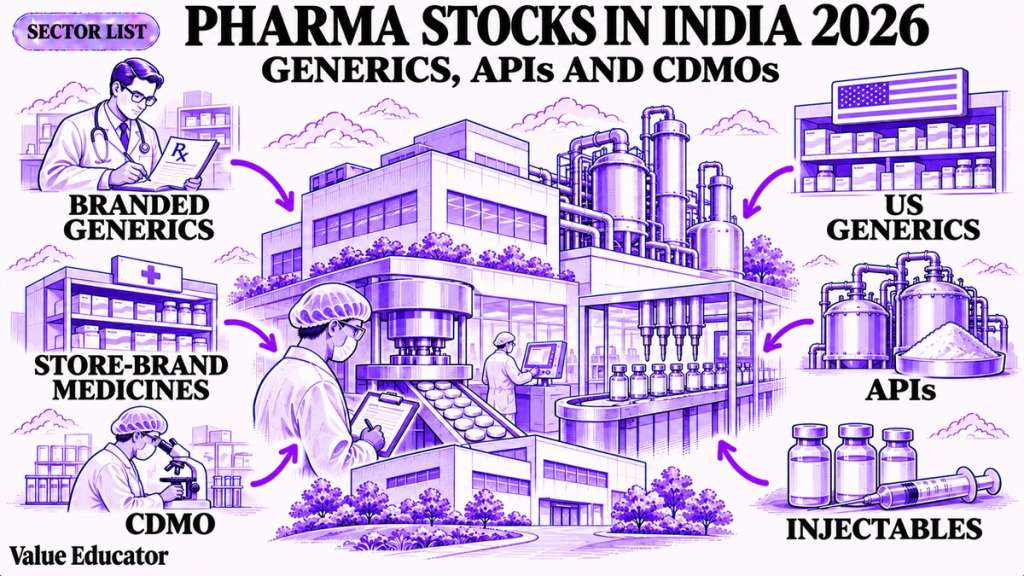
Pharma Stocks in India 2026: Generics, APIs and CDMOs
Granules India: From Paracetamol to a 65% Gross Margin
Natco Pharma: After Revlimid, 29 Patent Challenges
Shilpa Medicare: Cancer APIs, Films and Biosimilars
Alembic Pharma: US Plants Pay Back, Margin Hits 22.2%
Explore our Products
Research Framework
Emerging Titans
Combination of quantitative analysis, industry tailwinds, and management assessment - SPRINT investment philosophy
Tiny Titans
Heavy emphasis on scuttlebutt research, plant visits, and early on-ground signals



Modern Warfare to Multibaggers
Key Trends. Strategic Shifts. Opportunities Ahead.
Don't Miss This Exclusive Webinar!
Join Value Educator to decode the key trends shaping India's defence sector and learn how to identify tomorrow's potential leaders in the space.
- In-depth research on India's defence sector
- Live Q&A session
- Actionable takeaways for long-term investors

 Orders
 Subscription
 Share with friends


Required Details
₹23999.00
(12 month subscription)
As per SEBI regulations, all users are mandated to complete the KYC that is validated for 1 year. Post payment, you will be redirected to the KYC screen


No comments yet. Be the first to comment!