
Craftsman Automation: Engine Blocks to Aluminium Castings
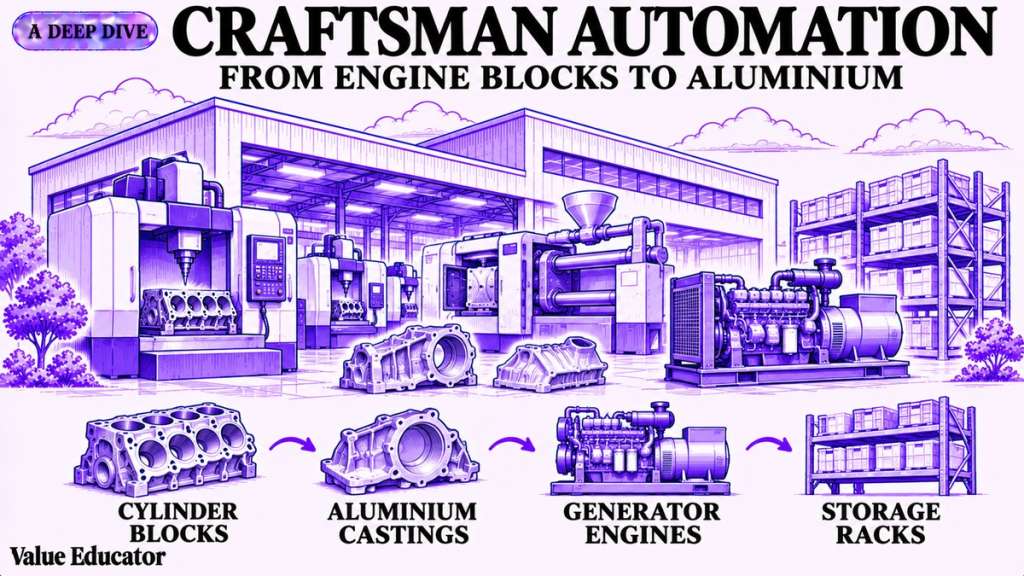
In FY22, an Indian parts maker sold 15,885 tonnes of aluminium castings. In FY26 it sold 94,904 tonnes, about six times as much. Over the same years, its revenue grew from ₹2,217 Cr to ₹8,069 Cr. In the July to September quarter of 2026 alone, it sold ₹2,945 Cr of parts.
Those parts sit inside engines and vehicles most of us use, though we never see them. The heaviest of them is the cylinder block, the large metal body of an engine that holds the cylinders where fuel burns. On top of it sits the cylinder head, which is the part that carries the valves and the passages for air and exhaust. Together with the gearbox and the parts that carry power to the wheels, these make up the powertrain, which means the parts that make and deliver a vehicle's power. Both have to be cast and then machined to a fraction of a millimetre, because a small error leaks oil or power.
Beyond these heavy parts, many lighter ones are made of aluminium by die-casting, which means molten aluminium is pushed or poured into a steel mould, called a die, where it cools into shape. The part can be an engine cover, a gearbox housing, a two-wheeler crankcase or an alloy wheel. In high pressure die-casting, the metal is forced in at high pressure, which suits thin, complex parts made in large numbers.
That parts maker is Craftsman Automation Ltd (NSE: CRAFTSMAN), based in Coimbatore, Tamil Nadu. It started in 1986 as a machine shop, and it now casts and machines engine parts, makes aluminium parts for two-wheelers and cars, and builds engineering products. Its storage solutions are the racks, shelving and automated storage systems that factories and warehouses use. It has 28 manufacturing facilities across 9 states in India, 2 more under construction and 1 plant in Germany.

So Craftsman sits at a clear point in the auto chain. It does not design vehicles or sell to drivers. It makes the heavy, precise metal parts that vehicle and engine makers bolt into their products, and it has moved more and more of its business towards aluminium.
Craftsman Automation in five numbers
- Q2 FY27 revenue of ₹2,945 Cr, up 47%
- Aluminium products at 61% of H1 FY27 revenue
- FY26 revenue of ₹8,069 Cr, with EBITDA of ₹1,300 Cr
- Orders for $100 million a year of data-centre generator engine parts, at full run rate by FY30
- A plan to grow revenue at 15% a year
So a Coimbatore machine shop that listed in March 2021 now earns more in one quarter than it did in all of FY22. How did that show up in the latest numbers? Let's first understand the company, and then look at the latest quarter.
Craftsman Automation: Company Overview
Craftsman Automation Ltd started in 1986 in Coimbatore, Tamil Nadu, where it is still based. Srinivasan Ravi, a mechanical engineer and first-generation entrepreneur, founded it and is its Chairman and Managing Director, and Ravi Gauthamram is a whole-time director. It machines engine parts, makes aluminium castings and alloy wheels, and builds storage systems and engineering products, through its own plants, its subsidiaries DR Axion and Sunbeam in India, and a foundry in Germany. It has 28 manufacturing facilities across 9 states in India, 2 more under construction and 1 plant in Germany, with a built-up area of over 3.9 million sq ft. It listed on the NSE and BSE in March 2021 and had 3,040 permanent employees on its own rolls in FY26. Revenue was ₹8,069 Cr in FY26, and borrowings stood at ₹3,618.6 Cr in September 2026, after a ₹2,000 Cr share placement earlier in the year. Read this RACL Geartech: Gears for KTM, BMW and Royal Enfield
"Know what you own, and know why you own it."
— Peter Lynch
Craftsman today is three businesses under one roof: engine parts, aluminium castings and storage systems. Each earns a different margin, so knowing which one drives the numbers is the first step to reading its results.
The Quarter Revenue Rose 47%
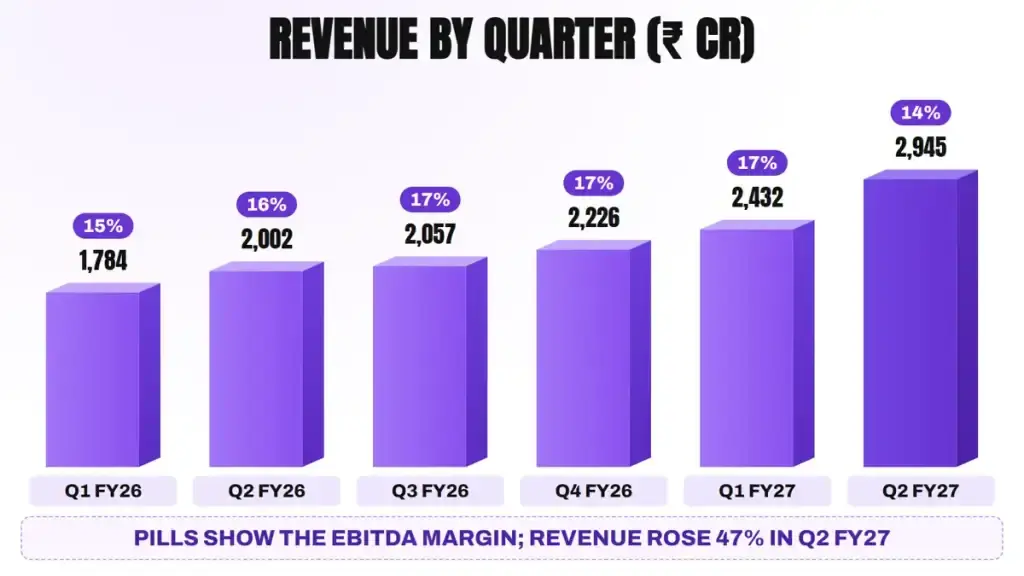
Let's look at Q2 FY27, the July to September quarter that the board approved on 28 October 2026. Revenue from operations was ₹2,945 Cr, up 47% from ₹2,002 Cr a year ago. It was also about 21% more than the ₹2,432 Cr of Q1 FY27.

As we can see, revenue grew much faster than profit in the quarter. EBITDA, which here includes other income, rose 32% to ₹412 Cr, but the margin was 14.0%, against 15.6% a year ago. Profit after tax still rose about 68.6% to ₹153.2 Cr, because finance cost and depreciation grew far more slowly than revenue. Read this Operating vs Net Profit Margin Explained
That margin gap came from one segment. Aluminium products brought in ₹1,819.5 Cr, up about 51%, but its EBIT was ₹136.4 Cr, against ₹141.4 Cr a year ago. So the aluminium EBIT margin was about 7.5%, against about 11.7% in Q2 FY26. EBIT is profit before interest and tax, after depreciation, so it shows what each segment earns on its plants.

Management gave two reasons for the aluminium margin. First, aluminium prices rose sharply, and there was fear of a shortage during the Middle East crisis, so the company bought extra metal to protect its customers' production lines. When prices then came down suddenly, that costlier metal went into its cost of goods. Second, several new aluminium plants are still ramping up, and their start-up costs eat into the margin until they fill up.
Beyond aluminium, the other two segments did better. Powertrain revenue rose about 39% to ₹746.3 Cr, and its EBIT rose to ₹134.7 Cr, a margin of about 18.0%. Industrial and engineering revenue rose about 46% to ₹379.5 Cr, and its EBIT jumped to ₹28.9 Cr from ₹3.8 Cr.
That same pattern shows in the first half, at a larger scale. H1 FY27 revenue was ₹5,377 Cr, up 42%. EBITDA was ₹820 Cr, up 41%, and profit after tax was ₹303.7 Cr, about 89% more than the ₹160.5 Cr of H1 FY26.
That growth also changed the balance sheet. In the April to June quarter the company raised ₹2,000 Cr through a qualified institutional placement, a share sale to large investors, and used it to repay borrowings and for general purposes. Net worth rose to ₹5,510.8 Cr in September 2026, from ₹3,264.1 Cr in March.
But debt still went up. Total borrowings were ₹3,618.6 Cr in September 2026, against ₹3,340.6 Cr in March. Management puts net debt at about ₹3,000 Cr, after cash of ₹495.5 Cr. The reason is the cash the business used in the half: operating cash flow was negative at about ₹514.6 Cr, and the company spent ₹1,107.0 Cr on new plants and machines.
Working capital tells us where that operating cash went. Read this Cash Flow Statement Explained Inventories rose to ₹2,511.4 Cr in September 2026 from ₹1,745.4 Cr in March, partly because of the safety stock of aluminium. Trade receivables rose to ₹1,532.2 Cr from ₹1,110.5 Cr as sales grew. Management says part of the safety stock will be used up in the coming quarter.
The Capacity Behind the Next Two Years
Now let's look at the capacity behind the next two years, because Craftsman does not report an order book. So the clues to its coming revenue are the plants it is adding and the orders management talks about.
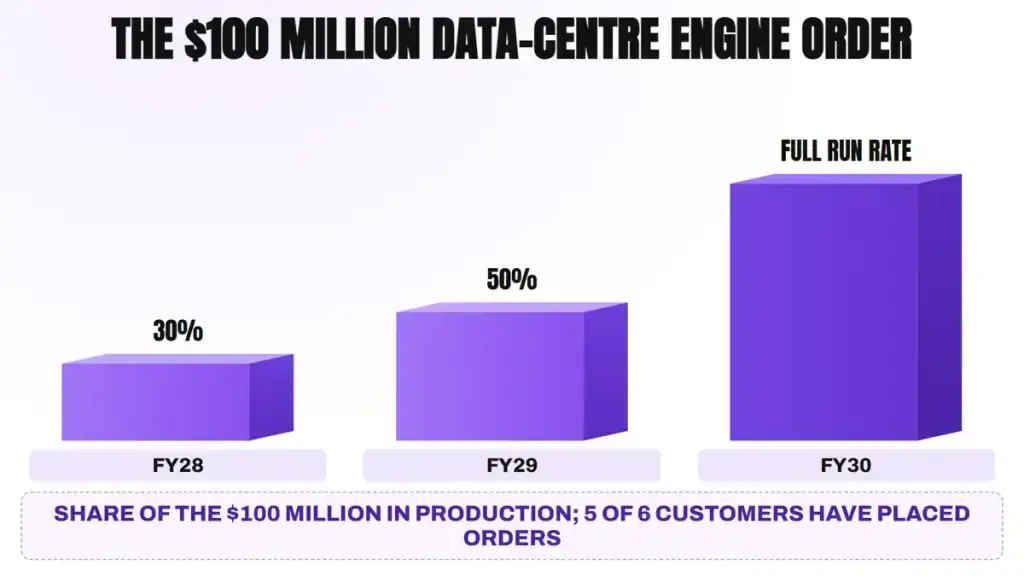
The biggest new order is for large stationary engines, the kind used in generators. Management says AI data centres need such generators for backup and main power, and that demand will keep growing over the next 5-7 years. Craftsman casts and machines parts for these engines. The first $100 million of yearly revenue is booked: five of six large customers have placed orders, and the orders from the first four already fill that target.
That business takes years to start. Management expects about 30% of the $100 million to be in production by FY28 and 50% by FY29, with the full run rate reached by the third or fourth quarter of FY30. It says enquiries for a second phase are strong, and that phase 2 will need much less capital, because the foundry and the basic machine shop are already built.
Beyond these engines, the other new capacity is in aluminium. DR Axion, its subsidiary in Tamil Nadu, has started trial production at its second plant, near Sriperumbudur. A new high pressure die-casting plant, unit 3 at Hosur, is planned for two-wheeler and car parts, because the current plants have run out of space. And the alloy wheel plants at Bhiwadi and Shoolagiri, with an installed capacity of 5.8 million wheels a year, were running at about 70% in recent months.
What the capacity says: Powertrain plants were running at about 70% and aluminium plants at more than 80% in July 2026. So aluminium is the segment that needs new plants first, and powertrain still has room to grow on its current machines.
How a Coimbatore Machine Shop Became an Aluminium Group
Now that we have seen the quarter, let's go back and see how a Coimbatore machine shop became an aluminium group. Srinivasan Ravi, a mechanical engineer and first-generation entrepreneur, started Craftsman in 1986 and is still its Chairman and Managing Director. Its first business was machining, and it added storage racks and aluminium foundries over the years.
That machining work gave it two skills that aluminium buyers now need. One is precision: Craftsman has more than 35 years of experience in machining cylinder blocks and heads. The other is building whole plants, including the special-purpose machines, tools and fixtures inside them. The company listed on the NSE and BSE in March 2021, and since then it has grown mainly through aluminium.
That shift came mainly through three acquisitions. On 1 February 2023, Craftsman bought 76% of DR Axion India for ₹375 Cr. DR Axion makes aluminium cylinder heads and other critical castings for car makers at Tiruvallur, near Chennai, and Craftsman bought the remaining 24% for ₹250 Cr in June 2024. In July 2024 it bought a German company, which then took over the assets of the Fronberg Guss foundry in October 2024. And on 9 October 2024 Sunbeam Lightweighting Solutions, an aluminium die-caster based in Haryana, became a wholly owned subsidiary.

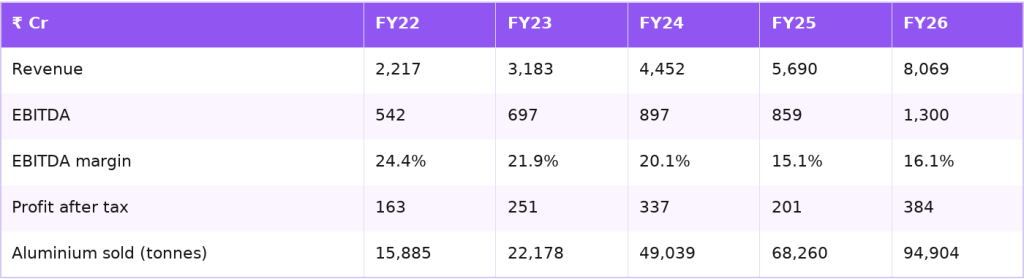
That change shows clearly in FY26. Revenue grew 42% to ₹8,069 Cr, EBITDA grew 51% to ₹1,300 Cr and profit after tax grew 91% to ₹384 Cr. In that year DR Axion had a turnover of ₹1,618.68 Cr and Sunbeam ₹1,396.96 Cr.
That growth had a cost in margin. The EBITDA margin went from 24.4% in FY22 to 16.1% in FY26. In FY26 powertrain earned an EBIT margin of about 16.6%, against about 10.3% in aluminium, where the metal is a large part of the selling price and the company earns no margin on the metal itself. Sunbeam also came with low-margin legacy products, and FY25 profit was ₹201 Cr, against ₹337 Cr in FY24, in the year of the acquisitions.
"Your margin is my opportunity."
— Jeff Bezos
Vehicle makers watch their suppliers' margins closely, and many still make aluminium parts in their own plants. For Craftsman, the question is whether it can earn a fair margin on the value it adds while customers push back on every price change.
"We are little more selective on the customers as well as the product looking at the lifecycle and profitability since we have now the base which is stronger." - Srinivasan Ravi, Chairman and Managing Director, October 2026
Three Segments and Who Buys From Each
Now let's split the business into its parts, because each one sells to a different buyer. Craftsman reports three segments: powertrain, aluminium products, and industrial and engineering. Read this Segment-Wise Revenue Analysis Explained

These segments sound different, but as you will see, they share the same plants and skills. Powertrain parts come from Craftsman's own cast-iron foundries and machine shops. Aluminium parts come from 16 plants across Craftsman, DR Axion and Sunbeam. Management calls the industrial segment the backbone of the other two, because it builds machines, tools and gears for them.
Powertrain, the Original Business
Let's start with powertrain, the oldest line. Craftsman machines cylinder blocks, cylinder heads, camshafts and transmission parts for commercial vehicles, tractors, utility vehicles and off-highway machines. It has 2 cast-iron foundries for larger parts, and its German subsidiary made 17% of H1 FY27 powertrain revenue.
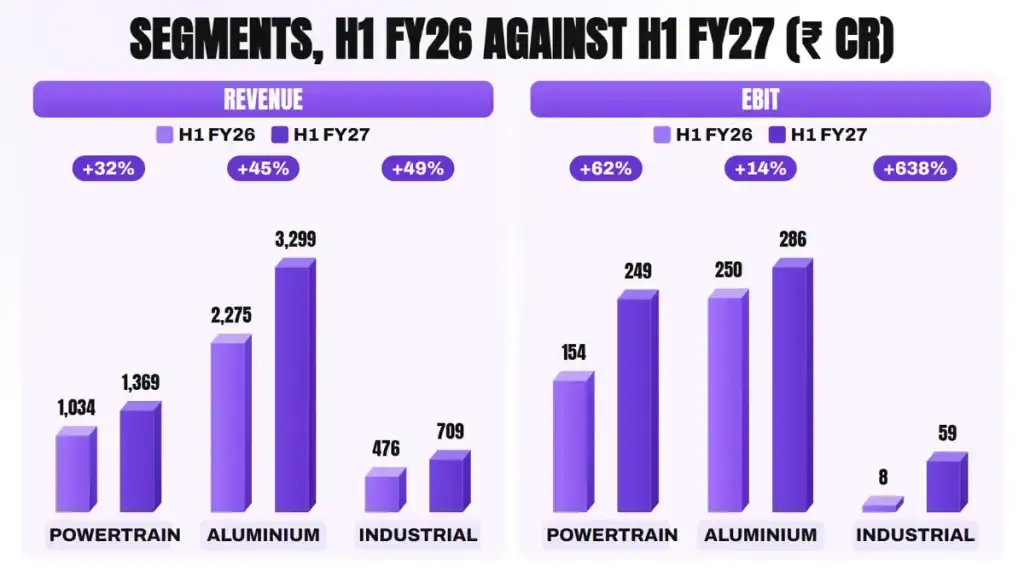
That line earns the best margin in the group. Powertrain revenue was ₹2,179 Cr in FY26, up 20%, with EBIT of ₹361 Cr. In H1 FY27, revenue rose 32% to ₹1,369 Cr and EBIT rose 62% to ₹249 Cr. Management says tractor demand will shrink for the next two quarters, but it expects the rest of powertrain to keep growing.
This segment also holds the data-centre engine order. Management says a generator for a data centre costs about $1 million to $1.5 million, and Craftsman's part in it may be worth $20,000 to $30,000, depending on the size of the engine. Craftsman worked with these customers for about four years before the orders came, because their product quality depends on its castings.
Aluminium Products, the Largest Line
Next, let's look at aluminium products, now 61% of revenue. Craftsman's own plants made 43% of the segment's H1 FY27 revenue, DR Axion 30% and Sunbeam 27%. By customer, 49% came from four-wheelers, 47% from two-wheelers and 4% from others.
That business grew fastest. Revenue was ₹4,789 Cr in FY26, up 58%, and ₹3,299 Cr in H1 FY27, up 45%. But H1 EBIT rose only 14% to ₹286 Cr, because of the aluminium price and the new plants. Management says that between Q1 and Q2 almost all of the growth was real volume, not higher metal prices.
That segment also holds a turnaround: Sunbeam. Management is exiting old products with negative EBITDA, some of them more than a decade old, and has sold one low-value line worth about ₹30 Cr a year. It says Sunbeam's revenue may be 10% to 20% lower, but it expects a mid-teens EBITDA margin there by the fourth quarter of FY27.
Industrial and Engineering, the Backbone
Finally, let's look at industrial and engineering, the smallest segment and what management calls the backbone of the other two. Storage solutions, such as racks, shelving, vertical lift modules and automated storage and retrieval systems, made 65% of its H1 FY27 revenue. The rest came from gears and gearboxes, material handling systems, special-purpose machines, tool rooms and contract manufacturing.
That segment's profit has turned up as factories invest. Revenue was ₹1,102 Cr in FY26, up 30%, and EBIT rose to ₹49 Cr from ₹19 Cr. In H1 FY27, EBIT was ₹59 Cr against ₹8 Cr a year earlier. Management says demand for lifting equipment and storage is rising quarter by quarter, and that the business needs little capital.
Where Craftsman Sits in the Auto Value Chain
Now let's place Craftsman in the wider chain. A vehicle maker designs the vehicle and assembles it. It buys systems such as engines and gearboxes from tier 1 suppliers, or makes them itself. Below them, tier 1 and tier 2 suppliers like Craftsman make the cast and machined parts that go into those systems.
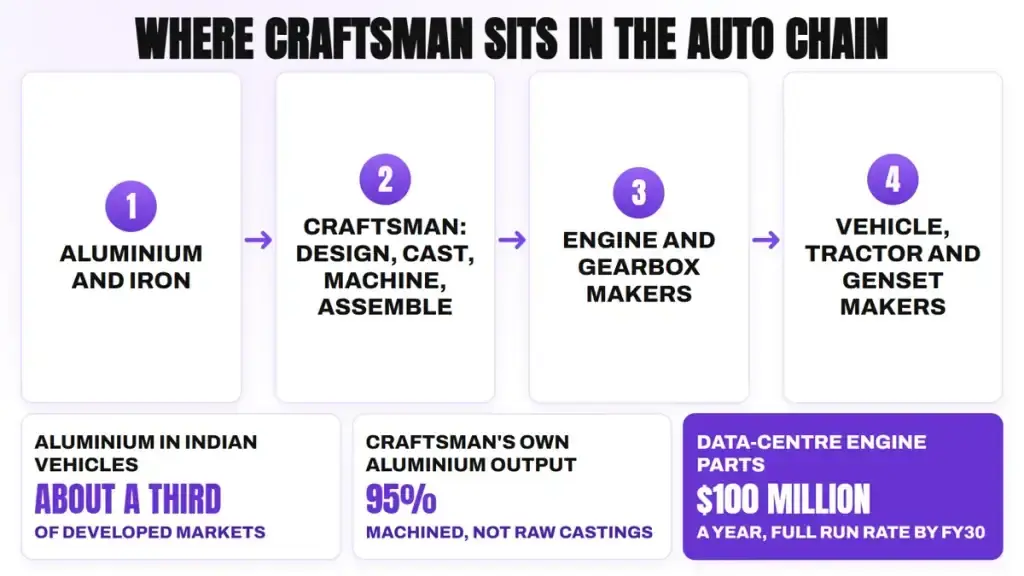
That chain is shifting in Craftsman's favour in three ways. First, many Indian car and two-wheeler makers still cast and machine aluminium parts in their own plants. Management says this is slowly changing, because suppliers can now match the quality at a reasonable price.
Second, India is becoming an export base for engines and gearboxes. Management says it has orders from multinational companies that will export such aggregates from India, and that petrol engines of 1.5 litres and below are a natural fit to make in India for the world. Tractors, two-wheelers and construction equipment already follow this pattern.
Third, vehicles are using more aluminium to cut weight. Management says Indian vehicles carry less than half, perhaps a third, of the aluminium content of vehicles in developed markets. Hybrid vehicles add transmission parts, and electric cars use more aluminium structural parts, which Craftsman can make with the same casting machines. Engine parts, though, disappear in a fully electric car, and its revenue from electric two-wheelers is negligible today, mostly alloy wheels.
Why Craftsman's Moat Is Hard to Copy
Now that we have seen the parts, let's understand the moat. An aluminium casting or an engine block is not a secret product. So the question is why a vehicle or engine maker should keep buying from Craftsman, and not from a rival or its own plant.
One part of the moat is that Craftsman does the whole job. It designs the tools and fixtures, builds many of its own special-purpose machines, casts the part, machines it, finishes it and assembles it. Management says 95% of Craftsman's own aluminium output is machined, not sold as raw castings. A customer gets a finished part from one supplier, and the supplier keeps more of the value.
Another layer is the time it takes to qualify. A new engine part has to pass the customer's tests before it goes into production, and for the large data-centre engines that took about four years. Management says the hardest step was getting these customers to accept Craftsman as a supplier, and that new orders from them should now come into production within about 2 years.
Beyond the plants, scale adds a third layer. Management says the large global aluminium makers have $3 billion to $8 billion of aluminium revenue, and that multinational customers want suppliers big enough to take $50 million or $100 million orders. Craftsman's plants have a built-up area of over 3.9 million sq ft, and it has kept adding capacity, often before the orders arrive.
"In business, I look for economic castles protected by unbreachable moats."
— Warren Buffett
Craftsman's castle is its ability to do the whole job, from the die to the finished part, and the years it takes a new supplier to win approval. Whether that moat holds shows up in the aluminium margin over the next few quarters.

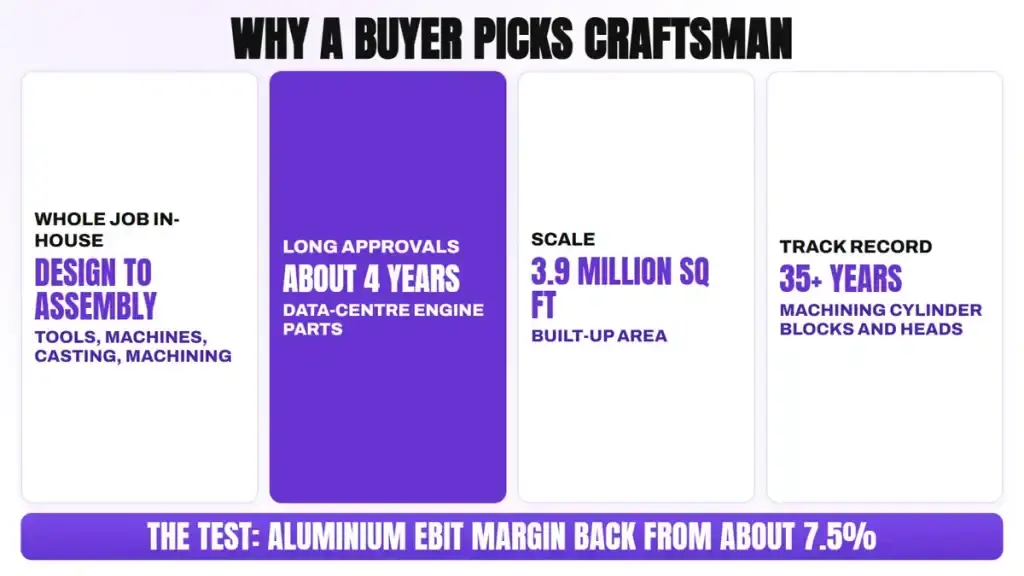
That table shows us why the margin is the real test of the moat. If buyers value the full job, Craftsman should be able to pass on metal costs and reset old prices. So far the record is mixed: powertrain EBIT was about 18.0% in Q2 FY27, while aluminium was about 7.5%.
Financials: Five Years of Revenue, Margins and Cash Flow
One quarter can mislead in a business that bought three companies in two years, so let's look at the full years together. Figures are consolidated, and EBITDA includes other income as the company reports it; the first half of FY27 is shown for comparison.
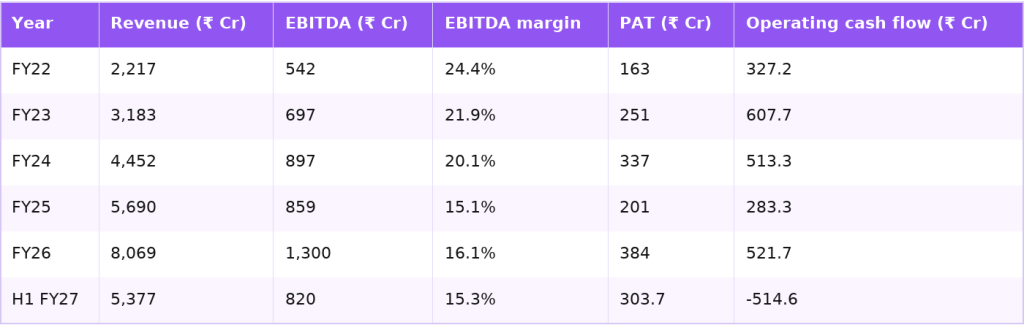
Revenue grew about 3.6 times in four years, from ₹2,217 Cr in FY22 to ₹8,069 Cr in FY26, while profit after tax grew about 2.4 times, from ₹163 Cr to ₹384 Cr. The EBITDA margin came down from 24.4% in FY22 to 16.1% in FY26 as aluminium castings, where the metal is a large part of the price, became most of the business.
Operating cash flow has run ahead of profit, because depreciation on a large plant base is a big non-cash cost. From FY22 to FY26 it added up to about ₹2,253.2 Cr, against ₹1,336 Cr of profit after tax, or about 1.7 times. But capex has been larger still: in FY26 the company spent ₹1,181.0 Cr on plants and machines, about 2.3 times its operating cash flow, and in H1 FY27 operating cash flow was negative at about ₹514.6 Cr as inventories and receivables grew.
That gap has been filled with debt and equity. Net debt rose to 2.4 times EBITDA in FY26 from 1.3 times in FY22. The ₹2,000 Cr share placement lifted net worth to ₹5,510.8 Cr in September 2026, about 1.7 times the March level, but borrowings still rose to ₹3,618.6 Cr. Management's target of 1.7 to 1.8 times net debt to EBITDA by March 2027 is the next test.
"Only when the tide goes out do you discover who's been swimming naked."
— Warren Buffett
In good years, a fast-growing parts maker can carry heavy capex and rising debt with ease. A slower year for vehicles or a long wait for price resets would show how much room Craftsman's cash flow really leaves.
What FY27 and FY28 Could Look Like on Management's Numbers
So where does the business go from here? In October 2026 management said it has committed to growing revenue at 15% a year, in real terms, not adjusted for inflation. In May 2026 it said FY27 growth would most probably be in the mid-teens, at the aluminium prices of that time.
So far, the first half has run well ahead of that. Revenue grew 42% in H1 FY27. Management says part of the growth comes from higher aluminium prices, and that on a standalone basis it grew 35% in real terms. If FY27 revenue grew only 15%, it would be about ₹9,279 Cr. The first half has already brought in ₹5,377 Cr, so the second half would need only about ₹3,902 Cr, against ₹4,283 Cr in H2 FY26.

Beyond growth, management also gives three markers for the next two years. Aluminium revenue should reach $1 billion in 2 to 3 years, from May 2026, at the aluminium prices of that time. EBITDA should reach about ₹1,850 Cr next year, the level at which the company says it can fund its capex from its own cash. And net debt should end FY27 at about 1.7 to 1.8 times EBITDA.
Capex is meant to slow down after a heavy first half. Management expects ₹500 Cr to ₹600 Cr of consolidated capex in Q3, and not much in Q4, because the greenfield plants for powertrain and aluminium are now in place. In July 2026 it agreed that about ₹1,500 Cr of capex for FY27 was a conservative figure.
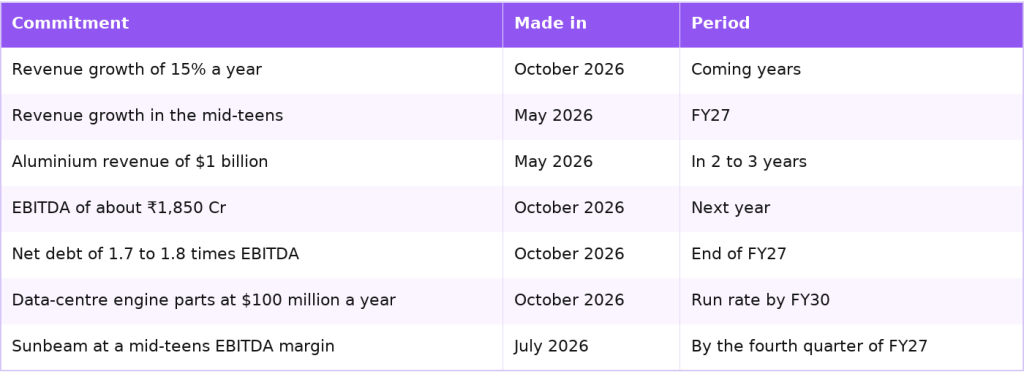
Those commitments are easier to judge against the past. So let's check what management said before against what it delivered.
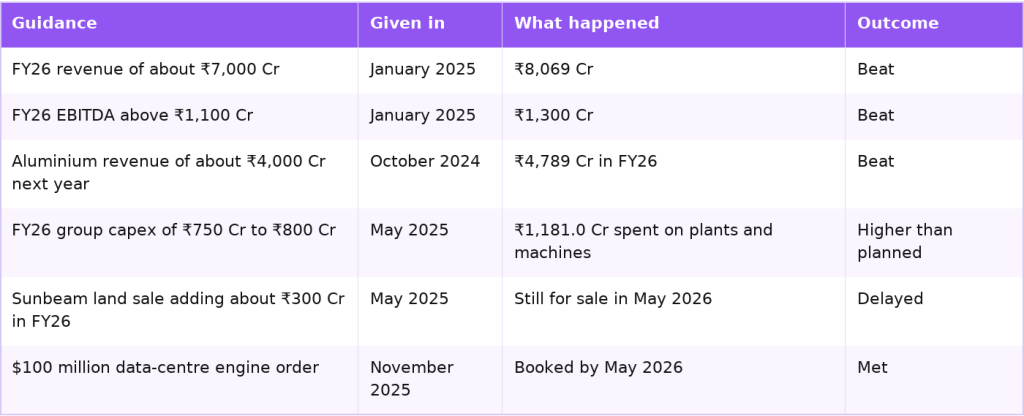
That record shows us a clear pattern. Revenue and EBITDA targets have been beaten, helped by the acquisitions and by aluminium prices. Capex has run above plan, and the Sunbeam land sale has not happened yet. That makes debt and cash flow the numbers to watch from here.
Key Risks
Now let's look at what could go wrong for Craftsman, because the latest quarter has already shown some of these risks.
- Aluminium prices: a sharp rise and fall in aluminium prices cut the aluminium EBIT margin to about 7.5% in Q2 FY27. Craftsman cannot earn a margin on the metal itself, and some customers take longer to accept price changes.
- Debt and cash flow: borrowings were ₹3,618.6 Cr in September 2026, and operating cash flow was negative at about ₹514.6 Cr in H1 FY27. Net debt was 2.4 times EBITDA at the end of FY26, against 1.3 times in FY22.
- Plants that are not yet full: new aluminium plants are still ramping up, and their start-up costs weigh on the margin. If orders come slower than planned, the heavy capex will earn less.
- Rising costs: management says labour, energy and consumable costs are rising fast, and that manpower cost inflation is hard to pass on to customers. It is asking for price resets of 6%-7% to 15%-20% on the value it adds, and the outcome is not settled.
- Sunbeam turnaround: Sunbeam's margin was still in single digits in May 2026. The exit from loss-making products has been delayed at customers' request, and its revenue may fall 10% to 20%.
- Electric vehicles: a fully electric car has no engine, so cylinder blocks and heads have no place in it. Craftsman's revenue from electric two-wheelers is negligible today, and its aluminium structural parts for electric cars still have to grow.
- Long wait for the data-centre order: most of the $100 million order comes into production in FY29 and FY30. A slowdown in data-centre building or a delay in customer approvals would push it out further.
- Tax disputes: in March 2026 the group had about ₹24.0 Cr of GST claims that it does not accept as debt, and about ₹4.9 Cr of income-tax claims. Capital commitments not yet provided for came to about ₹785.4 Cr.
- Cyclical end markets: trucks, tractors and two-wheelers move with the economy. Management expects tractor demand to shrink for the next two quarters.
"What is worrying us the inflationary manpower cost, which is very difficult to pass on to customer." - Srinivasan Ravi, Chairman and Managing Director, May 2026
"Risk means more things can happen than will happen."
— Howard Marks
Aluminium prices, labour costs, vehicle cycles and the pace of data-centre building can each move Craftsman's numbers. No one can say which will matter most next year, so the list below sets out what to watch.
Explore our Products
Research Framework

Emerging Titans
Combination of quantitative analysis, industry tailwinds, and management assessment - SPRINT investment philosophy

Tiny Titans
Heavy emphasis on scuttlebutt research, plant visits, and early on-ground signals
What to Track Next
If you follow Craftsman, these are the signals that will show where it goes next.
- The aluminium EBIT margin after about 7.5% in Q2 FY27, and the outcome of the price talks with customers
- Revenue growth in H2 FY27 against the 15% plan
- Borrowings after ₹3,618.6 Cr and net debt against 1.7 to 1.8 times EBITDA by March 2027
- Operating cash flow, and inventories after ₹2,511.4 Cr
- Sunbeam's margin by the fourth quarter of FY27, and the land sale
- First revenue from the data-centre engine parts, about 30% of the $100 million by FY28
For the other listed makers of cranes, gears, pumps, machine tools and process equipment, see Capital Goods Stocks in India 2026: The Capex Cycle.
Conclusion
Let's put it all together. Craftsman Automation has grown from ₹2,217 Cr of revenue in FY22 to ₹8,069 Cr in FY26, and it made ₹5,377 Cr in the first half of FY27 alone. Aluminium went from a side business to 61% of revenue, and a $100 million order for data-centre engine parts gives powertrain a new leg for FY29 and FY30. The cautious thread is the aluminium margin, which was about 7.5% in Q2 FY27, and the debt of ₹3,618.6 Cr that the heavy capex has left behind. The next two quarters will show whether the price resets come through and whether cash flow turns positive again.
Still, the next step is about margin and cash, not size. What happens next depends on whether customers accept the price resets, whether the new aluminium plants fill up, and whether the heavy capex of the last two years turns into cash that brings the debt down.
FAQs
What does Craftsman Automation do?
+Craftsman casts and machines engine parts such as cylinder blocks and cylinder heads, makes aluminium parts and alloy wheels for cars and two-wheelers, and builds storage racks and engineering products. FY26 revenue was ₹8,069 Cr, and aluminium products made up 61% of revenue in the first half of FY27.
How did Craftsman Automation do in Q2 FY27?
+Revenue rose 47% to ₹2,945 Cr and EBITDA rose 32% to ₹412 Cr, but the EBITDA margin was 14.0%, against 15.6% a year ago. Profit after tax rose about 68.6% to ₹153.2 Cr.
Why did Craftsman's aluminium margin come down?
+Management says it bought extra aluminium during a price spike and a feared shortage, and that costlier metal went into its costs when prices came down. New aluminium plants are also still ramping up. The aluminium EBIT margin was about 7.5% in Q2 FY27, against about 11.7% a year earlier.
What is Craftsman's data-centre engine order?
+Craftsman casts and machines parts for large stationary engines used in generators, including those that power AI data centres. Orders for the first $100 million a year of revenue are booked, with about 30% expected in production by FY28, 50% by FY29 and the full run rate in FY30.
What growth does Craftsman target?
+Management has committed to growing revenue at 15% a year in real terms and expected mid-teens growth in FY27. It aims for aluminium revenue of $1 billion in 2 to 3 years and EBITDA of about ₹1,850 Cr next year, and expects net debt of 1.7 to 1.8 times EBITDA by the end of FY27.
What are the main risks for Craftsman Automation?
+Aluminium prices and slow price resets can squeeze margins, and borrowings rose to ₹3,618.6 Cr in September 2026 after heavy capex. Rising labour costs, the Sunbeam turnaround, the shift to electric vehicles and cyclical truck and tractor demand are the other risks.

High growth stock specialist, Value Educator
Shashank Mahajan is an equity research professional with over 12 years of experience in identifying high-potential SME and micro-cap stocks at an early stage. He follows a rigorous scuttlebutt research–driven approach, combining on-ground insights with deep financial analysis. Shashank specializes in uncovering under-researched and under-owned companies with strong management quality and long-term growth potential. Through disciplined research and early identification, he focuses on spotting tomorrow’s market leaders before they enter the mainstream investor radar.
More about Shashank Mahajan →
PCBL Chemical: Carbon Black Margins and Battery Materials

KEC International: Record Orders, Weak Margin, High Debt

Sona BLW: EV Revenue Now Tops Half of Its Auto Sales

HPL Electric & Power: Smart Meters, Wires and Two Engines

Kaynes Technology: EMS, Chip Plants and ₹10,563.5 Cr Orders

Sterlite Technologies: Glass Rods to Hyperscaler Deals
Explore our Products
Research Framework
Emerging Titans
Combination of quantitative analysis, industry tailwinds, and management assessment - SPRINT investment philosophy
Tiny Titans
Heavy emphasis on scuttlebutt research, plant visits, and early on-ground signals



India's Aerospace Opportunity
Global Demand. Supply Bottlenecks. Opportunities Ahead.
Don't Miss This Exclusive Webinar!
Join Value Educator to decode the key trends shaping India's aerospace sector and learn how to identify tomorrow's potential leaders in the space.
- How the aircraft value chain works, layer by layer
- Indian companies supplying global aircraft makers
- A framework to judge any aerospace company

 Orders
 Subscription
 Share with friends


Required Details
₹23999.00
(12 month subscription)
As per SEBI regulations, all users are mandated to complete the KYC that is validated for 1 year. Post payment, you will be redirected to the KYC screen


No comments yet. Be the first to comment!