
RACL Geartech: Gears for KTM, BMW and Royal Enfield

Vehicle makers have long built the hardest parts of their engines in their own plants. That is now changing. MAN, the European truck maker, spent four years moving its gear production to an outside supplier and finished the move in 2025. In January 2026, Royal Enfield started buying transmission gears for its 350cc engine from the same supplier.
So what is being handed over? A transmission gear is a toothed wheel inside the gearbox that passes the engine's turning force to the wheels at different speeds. On a fast motorcycle these gears spin at very high speed for years. A run-out error of even 5 microns beyond the drawing can bring a customer's quality team to the supplier's door, asking which batch and which date. That is why vehicle makers kept gears in-house for so long.
That practice of keeping gears at home is fading for a simple reason. If you run a vehicle company, you earn your margin by designing, assembling and selling the vehicle. Every rupee you spend on a gear shop is a rupee not spent on that. As the company's COO puts it, assembly is the king of the supply chain. So the maker keeps the assembly line and buys the gears, but only from a supplier it trusts to make them the same way every day.
That shift shows best at the premium end, with KTM. KTM is an Austrian maker of premium street and off-road motorcycles that also races in MotoGP. It designs and builds its bikes in Austria and sells them through dealers around the world. Bajaj, which was already a shareholder, now runs it. By August 2026 its volumes were back near pre-COVID levels, and its plans for the 2027 model year are back to normal or slightly above.
And for the last 15 years, KTM's gears have come from Gajraula in Uttar Pradesh. They are made by RACL Geartech Ltd (BSE: 520073, NSE: RACLGEAR), a company founded in 1983. RACL makes transmission gears, shafts, gearbox sub-assemblies, chassis parts and industrial gears. It has two plants, at Gajraula and Noida, a subsidiary in Austria and 5 warehouses in Europe. So a part made in Uttar Pradesh can reach a line in Austria when the line needs it. For many export customers, RACL is a single source supplier, which means it is the only maker approved for a given part until that model ends.
That reach now goes into electric cars too. For BMW's new electric car platform, RACL makes parts for the reduction gearbox, which is the set of gears that brings an electric motor's very high speed down to the speed of the wheels.
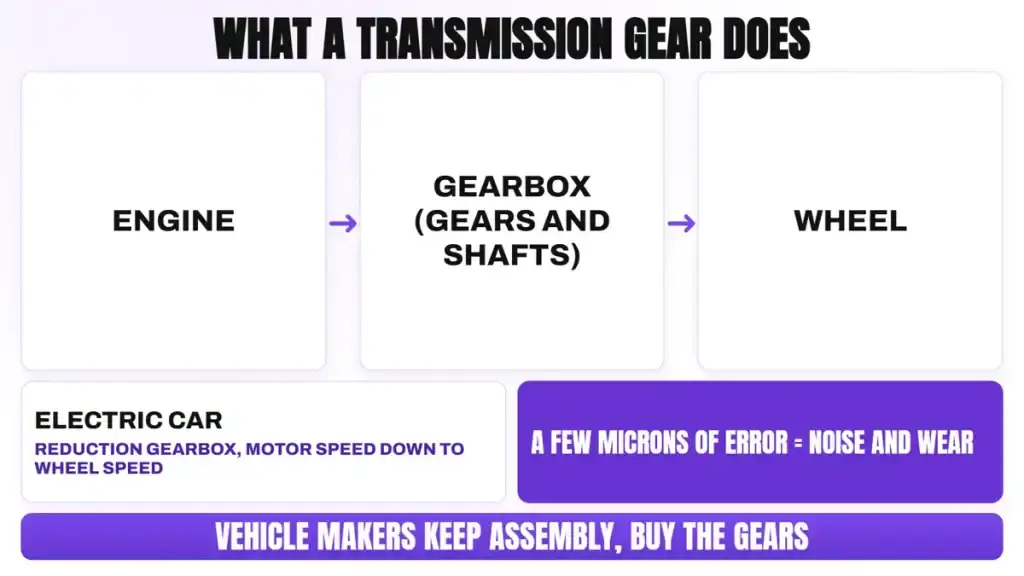
That set-up shows in the numbers. In FY26 total revenue crossed ₹500 Cr for the first time and three of every four rupees came from exports.
RACL Geartech in five numbers
- FY26 total revenue of ₹512.42 Cr, up 20.57%
- 75% of FY26 sales from exports, 69% from Europe
- FY26 EBITDA margin of 25.21%, against 22.34% a year earlier
- Debt to equity down to 0.63 from 1.30
- 29 active customers and more than 1,600 part numbers
So how does a gear shop from Uttar Pradesh end up inside BMW's electric cars and Royal Enfield's best-selling engine? Let's first understand the company, and then look at the latest quarter, where the change shows most clearly.
RACL Geartech: Company Overview
RACL Geartech Ltd was founded in 1983, with its registered office in New Delhi and its corporate office in Noida. It makes transmission gears, shafts, gearbox sub-assemblies, chassis parts, precision machined parts and industrial gears for two-wheelers, three-wheelers, cars, trucks, ATVs, tractors and industrial machines. Its two plants are at Gajraula and Noida in Uttar Pradesh, and it serves European customers through a wholly owned subsidiary in Austria and 5 warehouses in Europe. Gursharan Singh is the chairman and managing director and held 33.47% of the shares in March 2026, with the promoter group at 42.75%. More than 1,200 people work for the company, 771 of them permanent employees, and CARE rates it A-. FY26 consolidated total revenue was ₹512.42 Cr, and total debt stood at ₹221.82 Cr at the year end. Read this TD Power: 93% of New Orders Now Come From Abroad
"Behind every stock is a company. Find out what it's doing."
— Peter Lynch
RACL's name says gears, but what it really sells is the same part made the same way for years, to customers who cannot afford a recall. That is the business to understand before any number.
The Quarter Domestic Sales Caught Up
Let's begin with the June 2026 quarter, the latest one filed, because it is where domestic sales caught up. In Q1 FY27, RACL's consolidated total revenue was ₹132.60 Cr, up 21.99% from ₹108.7 Cr a year earlier. Revenue from operations alone grew faster, by 31.50%, from ₹100.65 Cr to ₹132.35 Cr.
That gap comes from other income. A year earlier other income was ₹8.05 Cr, while in Q1 FY27 it was close to nil. So, as you can see, the business itself grew by close to a third.
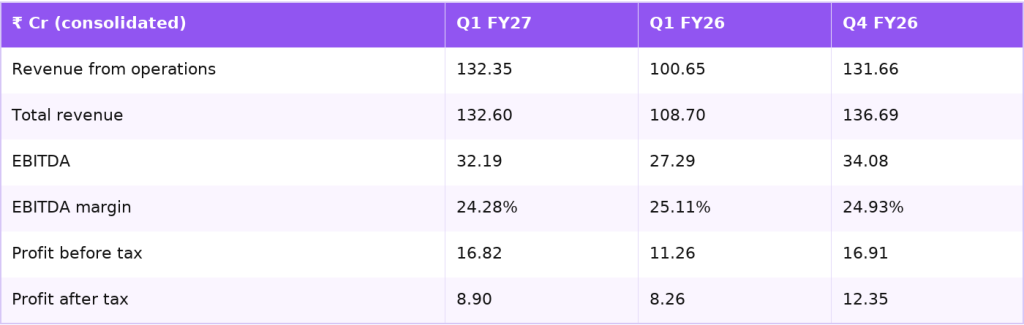
That revenue came mostly from exports, at ₹85.06 Cr, while domestic sales were ₹40.54 Cr. On net sales, the split was 66% exports and 34% domestic. In FY26 it had been 75% and 25%. So the domestic business, with Royal Enfield supply running since January, is catching up with exports.
That shift also shows in the regional split. Europe made up 59% of Q1 FY27 sales, India and the rest of Asia Pacific 36%, and North America 5%.
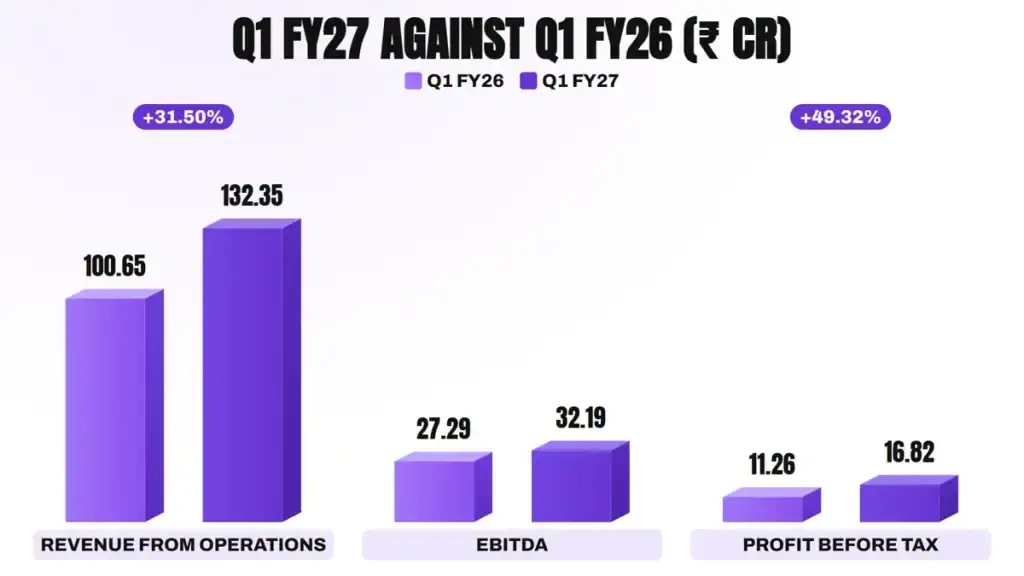
That growth carried through to profit before tax, which rose 49.32% to ₹16.82 Cr, and its margin rose to 12.68% from 10.36%. The reported EBITDA of ₹32.19 Cr includes other income. Read this EBITDA Explained: Uses and Limits Take that out, and EBITDA from operations rose from about ₹19.24 Cr to about ₹31.94 Cr, a rise of about 66%. Finance cost also fell, to about 4.81% of revenue, after the company repaid loans in FY26.
But profit after tax grew less, to ₹8.90 Cr from ₹8.26 Cr. Tax took ₹7.92 Cr in the quarter, close to half of profit before tax. Management says this came from a change in the surcharge rate, which raised deferred tax, and from timing differences on depreciation and gratuity. It expects a tax rate of 25.62% for the full year, so the high charge should not repeat every quarter.
That tax charge aside, the cost lines look steady. In the standalone business, raw material was close to 28% of revenue in Q1 FY27 and employee cost close to 12%. Depreciation was about 7.2%, and manufacturing expenses were about 33.5%. So a gear maker's biggest cost is running the machines and furnaces, not buying the steel.
That steel, too, comes from India. Management says almost all raw material is bought locally, and imported bearings, seals and other bought-out parts are at most about 5% of purchases. India is one of the world's largest steel producers, so you can see why management counts this as a cost edge over European suppliers.
How FY26 Became a Record Year
Now let's step back to FY26, the record year that just closed. It was the first year RACL crossed ₹500 Cr of total revenue. Consolidated total revenue was ₹512.42 Cr, up from ₹424.99 Cr.
Profit grew much faster than revenue. EBITDA rose 36.05% to ₹129.16 Cr, and profit before tax doubled from ₹32.8 Cr to ₹65.73 Cr. Profit after tax was ₹48.95 Cr, against ₹23.77 Cr in FY25.
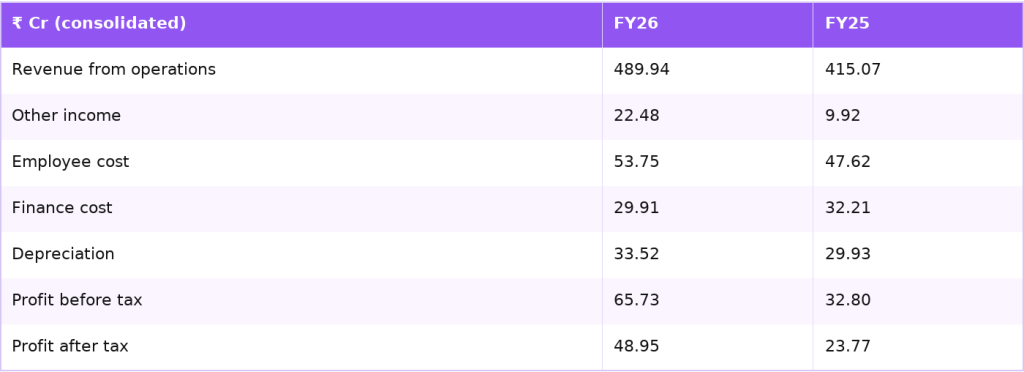
That jump came from operating leverage. Revenue from operations grew about 18%, while employee cost grew about 13% and finance cost actually fell. So the same machines and staff took on more work, which is what you want to see in a business with high fixed costs. Margins rose. Other income of ₹22.48 Cr also helped, and it made up about 34% of profit before tax.
That growth was strongest in the fourth quarter. Q4 FY26 total revenue was ₹136.69 Cr, up 48.20% from ₹92.23 Cr, and profit before tax grew 91.50% to ₹16.91 Cr.
That record also closed a goal set years ago. In 2019-20 management wrote a plan to take RACL to ₹500 Cr of revenue. FY25 was meant to be the year, but customer problems pushed it out by about a year. Over the four years from FY22, revenue from operations grew from about ₹271.22 Cr to ₹489.94 Cr, about 1.8 times.
The Balance Sheet After the Fund Raise
Now let's look at the balance sheet, because that profit came with less debt. In May 2025 the board allotted 10,06,480 shares on a preferential basis to three qualified institutional buyers and one individual investor. This brought in about ₹79.99 Cr, and ₹52.80 Cr of it went straight to repaying long-term loans.
As a result, total debt fell from ₹297.59 Cr to ₹221.82 Cr, down 25.46%. Debt to equity fell from 1.30 to 0.63, and interest cover rose from 3.01 to 4.26. Read this Debt to Equity Ratio Explained Cash generated from operations rose to ₹81.77 Cr from ₹62.91 Cr. Return on equity rose to 16.03% from 11.74%.
What the balance sheet says: the equity raise did more than cut interest. It gave RACL room to borrow again for a ₹77.45 Cr capex plan in FY27, which the company says will be funded with bank debt as it is spent.
Eight Vehicle Markets Sharing One Gear Shop
Now that we have seen the numbers, let's look at who buys these gears. RACL sells into eight vehicle markets from the same two plants. Read this Segment-Wise Revenue Analysis Explained The machines, the heat treatment and the testing are shared. What changes is the customer, the size of the gear and how many of each part the customer needs.
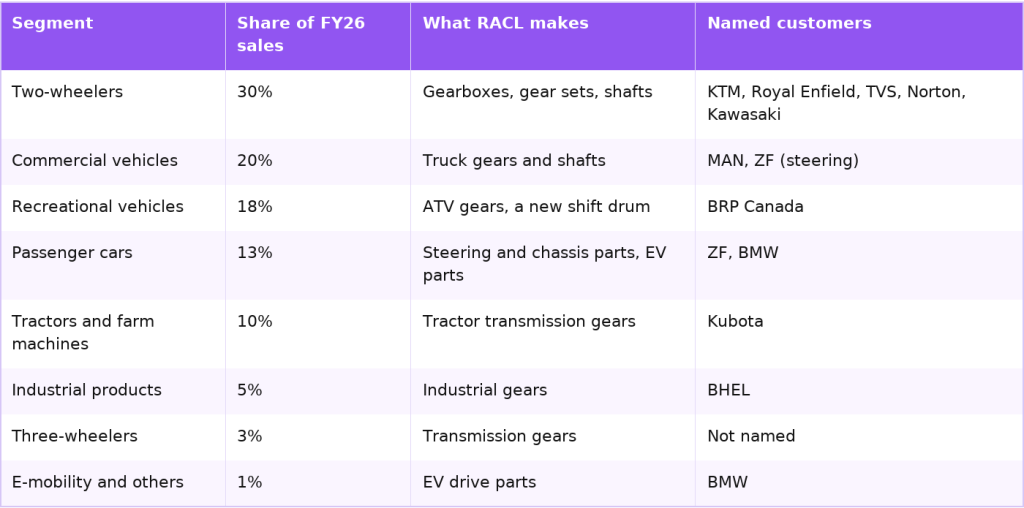
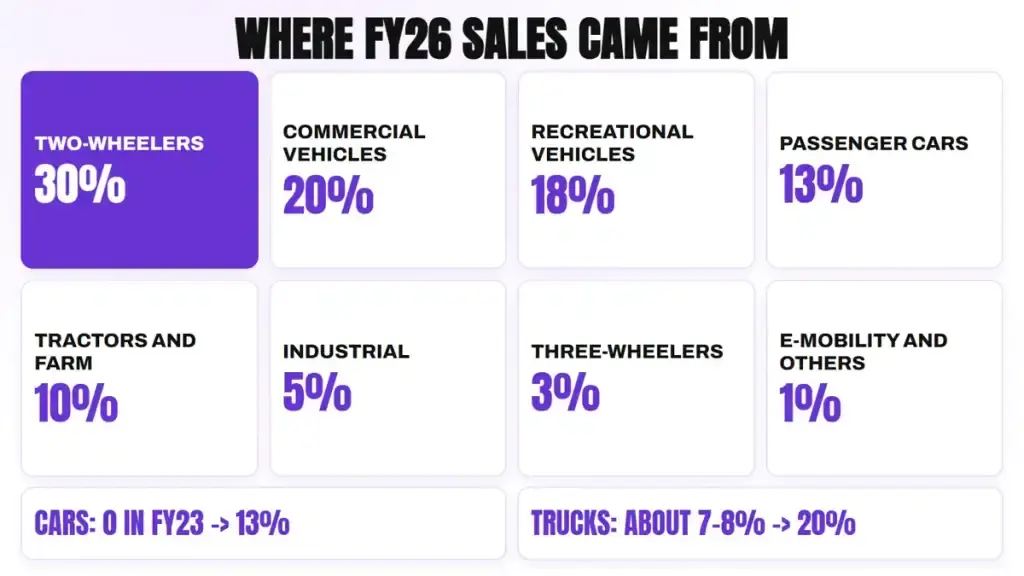
You can tell these markets apart by what each customer wants. A two-wheeler maker wants small, quiet gears in large numbers. A truck maker wants large gears that carry heavy loads over long distances. A car maker increasingly wants precise parts for steering and chassis, not just gears. And a tractor or industrial buyer wants gears that take high torque at low speed.
That mix has changed fast. In FY23 passenger cars were zero, commercial vehicles were about 7-8% and two-wheelers about 40-45%. By FY26 cars were 13%, trucks 20% and two-wheelers 30%. No market shrank in rupees. The newer ones simply grew faster, and management says they also carry more value per part.
Premium Motorcycles From KTM to Royal Enfield
Let's start with motorcycles, where RACL began. Two-wheelers and recreational vehicles together made up 48% of FY26 sales. RACL sells mainly at the premium end, where engines rev higher and the gearbox has to stay quiet.
As we saw, KTM has bought from RACL for about 15 years, through the company's Austrian subsidiary. That subsidiary, RACL Geartech GmbH, earned revenue of ₹8.19 Cr and a profit of ₹3.11 Cr in Q1 FY27. KTM has now launched a new Duke model, and its forecast for the coming months is strong. RACL is also the single source for the whole gear train of TVS's bigger motorcycles, including the Norton platform. Norton is an old motorcycle brand that TVS relaunched with a 1.2-litre bike, so volumes start small.
Next comes Royal Enfield, the newest name. Commercial supply started in January 2026, after RACL was nominated for about 10,000 sets a month for a 350cc engine. A set is all the gears one motorcycle needs. By August RACL had ramped up to close to 8,000 sets a month and is holding that level while its own suppliers add capacity. A second project, gears for a five-speed 350cc gearbox, was submitted for validation in June 2026.
Royal Enfield works with more than one gear supplier, unlike RACL's export customers. So RACL is adding capacity step by step and only for volumes the customer has committed.
"Show me the incentive and I will show you the outcome."
— Charlie Munger
A customer that splits its orders between suppliers gives none of them a reason to build ahead of demand. RACL builds for committed volumes there, and builds ahead only where it is the single source.
That leaves Kawasaki. Kawasaki India has bought small volumes for two to three years. In 2026 Kawasaki Japan awarded a much larger project of 15 parts for a general-purpose engine used in utility vehicles, motorcycles of up to 200cc and lawn mowers. Nine pilot lots were being submitted in June 2026, and mass production is expected early in 2027.
"Assembly is the king of the supply chain, so they would like to take that commanding position." - Prabh Mehar Singh, Chief Operating Officer, August 2026
ATVs bring the newest product line. BRP of Canada, one of the world's largest ATV makers, nominated RACL for a shift drum for its ATVs. A shift drum is the part that moves the forks inside a gearbox so the rider can change gear. It is RACL's first shifting part, not a gear, at about 1,50,000 parts a year, and mass production was planned for Q2 FY27.
Commercial Vehicles and the MAN Move
Next, let's look at commercial vehicles, which now make up a fifth of sales. The main truck customer is MAN, the German truck and bus maker. MAN used to make these gears in its own plant. From 2021 it followed a four-year plan to move them to RACL, shutting its own lines part by part. 2025 was the last year of that plan, and all the parts are now made in India.
That move explains most of the growth from 7-8% of sales to 20%. Demand helped too. Europe is spending more on roads, infrastructure and defence, and more freight moves by road when sea routes are disrupted. Management says the European truck business is running strongly and that domestic truck sales are also rising.
The next truck step is in North America. ZF, the global maker of transmissions and steering systems, nominated RACL for steering parts used in electric power steering for trucks. Electric power steering uses an electric motor instead of oil pressure to help turn the wheel. RACL will ship the parts to ZF's plant in Mexico, which will assemble the system for a US truck maker. This is RACL's first entry into American trucks, and supply is due to start in FY28.
Beyond Europe and the US, Brazil is the newest market. In October 2026 a customer there ordered engine timing gears for commercial vehicles and stationary engines. It is RACL's first order from Latin America.
Passenger Cars and Electric Vehicles
Now let's move to passenger cars, the market that did not exist for RACL four years ago. Cars made up 13% of FY26 sales. Here RACL makes more than gears. It supplies parts for electric power steering and roll control parts for the chassis of large BMW cars, and it is working on parts for rear-wheel steering.
Here ZF is the main car customer. RACL's parts go into a ZF system used first in a high-end car and now in BMW's X5 sport utility vehicle. The project is running at 50% to 60% of the capacity installed for it, and the customer's peak year has moved from 2028 to 2030. ZF has also moved its assembly to Eastern Europe, which lowers its own costs.
Next come electric cars, through BMW. As we saw at the start, an electric car has no multi-speed gearbox, only a reduction gearbox. Its gears must be very quiet, because there is no engine noise to cover any whine.
So far RACL has two BMW electric car projects, Titan and Venus, for the same car platform:
- Project Titan is the parking lock actuation assembly for BMW electric cars. It is built in a dedicated building at Gajraula called Udyam, which BMW's global team opened in February 2025. More than 2,500 sets went out in three pilot phases.
- Project Venus supplies drive train parts for an electric sports car. It was inaugurated on 4 April 2026, and more than 4,000 sets went out in four phases.
Both projects were set for mass production in October 2026. That date matters. In August, management said level one approval was done, pilot parts were already moving by sea, and BMW's team would visit on 24 October for the final sign-off. Both projects also run without paper, with each part traceable from the steel mill to the finished part.
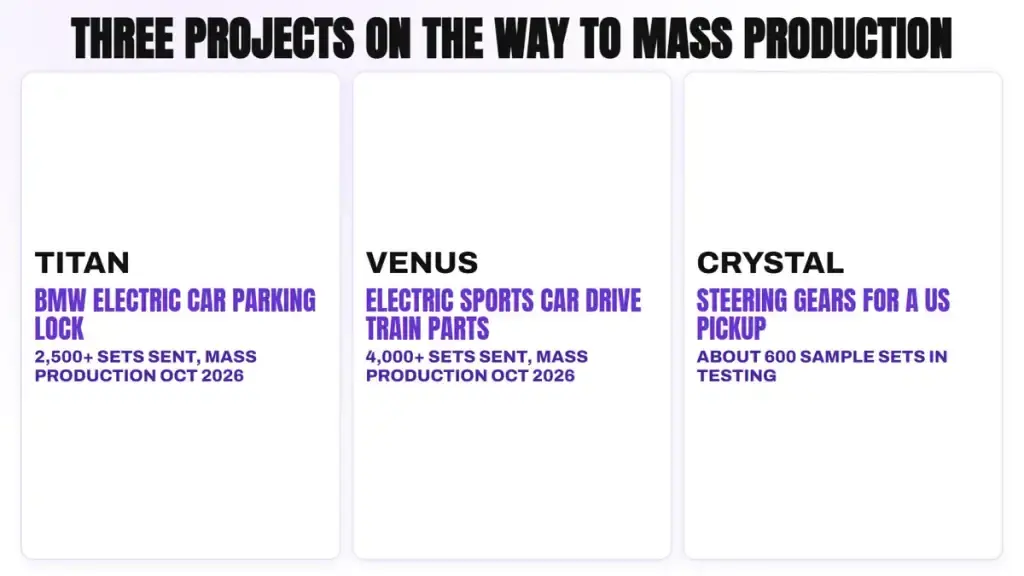
A third project, Crystal, follows. It covers ring gears, sun gears and planetary gear sets for electric power steering in an American carmaker's pickup truck, developed with ZF Rane. About 600 sample sets are being tested at the customer's end. Management calls Crystal the next big project and says it will need its own capex.
Electric cars are a large market to aim at, so let's size it. About 22 million electric cars were produced worldwide in 2025, and China made about 75% of them. RACL's position is narrow on purpose. It makes parts for premium electric cars, where precision and quiet running matter more than price.
Tractors and Industrial Gears
Now let's turn to tractors and industrial gears, the older markets that still make up 15% of sales. Kubota, the Japanese tractor and engine maker, has bought from RACL for about 20 years. It has signed an agreement with the Uttar Pradesh government for a new plant in the state where RACL is based, and has announced an investment of about ₹4,500 Cr in it.
Then there is the industrial line. It is newer. RACL is now an approved vendor of BHEL and has started mass production of gears for it. Management will not name the parts, but hints that some go into equipment that protects the country's seas. It also counts aerospace for civil aircraft, small actuators and robots as areas it is studying, without spending capital on them yet.
Why a Single Source Gear Supplier Is Hard to Copy
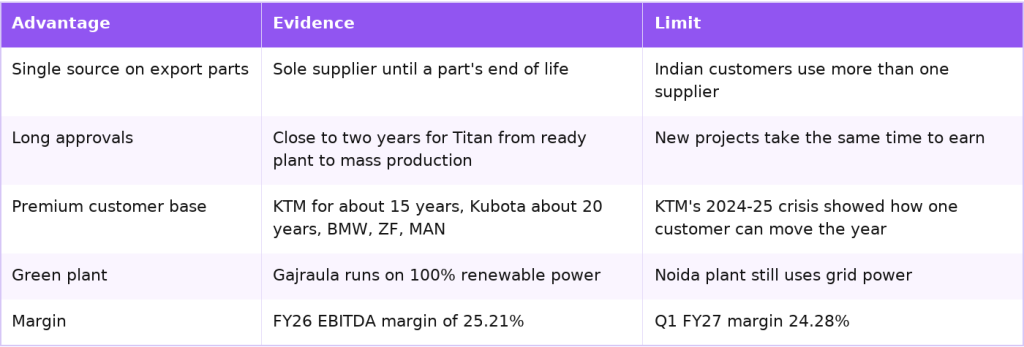
Now that we have seen all eight markets, let's understand the moat. RACL's export customers buy each part from just one supplier. As we saw at the start, that single source supplier stays the only maker until the part's model ends. So if RACL makes the first-speed gear for a truck, no one else makes that gear for that truck.
That rule comes from how recalls work. If a gear fails in the field, the vehicle maker must find which plant, which batch and which date the part came from. With two suppliers that search gets much harder. So the big global makers prefer one supplier per part.
"It takes 20 years to build a reputation and five minutes to ruin it."
— Warren Buffett
For a gear supplier, those five minutes are one bad batch in the field. That is why approvals take years, and why a supplier that clears them tends to keep the part.
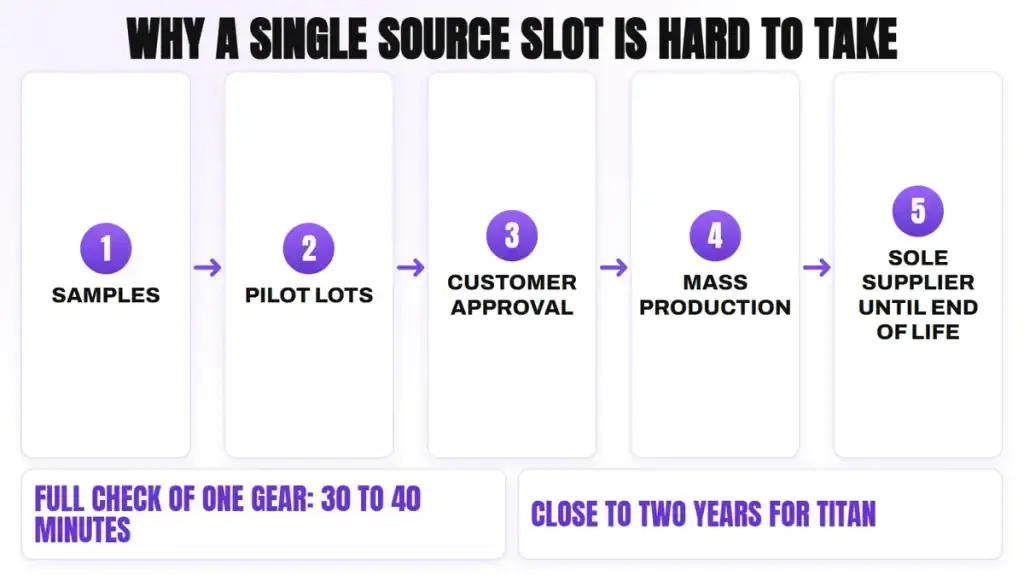
So winning that slot takes years. Anybody can make 100 good samples. The hard part is making 1,00,000 or 2,00,000 parts a month the same way when not every part can be checked. A full check of one gear takes 30 to 40 minutes. So the customer has to trust the supplier's process, its heat treatment and its records more than its final inspection.
Titan shows how long that trust takes to build. Pre-series production started in early 2025, BMW opened the building in February 2025, and mass production was set for October 2026. That is close to two years from a ready plant to full supply. If you were a rival, you would have to repeat all of it to take the part away.
That slot also tends to renew once it is won. This is the real lock-in. Read this Economic Moat Explained Management says that in the past five years no project has ended without a successor model of the same or higher value. In one case a project ends next year, and the new model carries more RACL content than the old one. And if a customer's model fails after RACL has invested, the customer usually makes up for it with cash, other business or a price increase.
Design is the next step up. RACL has tied up with ARRK Engineering, an R&D house in Munich, so that it can help design a part instead of only making it to the customer's drawing. It is working with two potential customers on this so far. RACL also holds a TISAX rating, an information security check used across the car industry.
There is also a newer layer. European buyers now look closely at a supplier's carbon emissions, and the EU's carbon border rules add to that pressure. Gajraula runs fully on renewable power, and the new heat treatment plant will run on electricity instead of LPG. Management sees this as an edge in Europe as buyers move parts out of China.
Financials: Five Years of Revenue, Margins and Cash
One quarter can mislead, so let's look at five full years together, all consolidated. The company's own EBITDA includes other income, so the table below takes other income out to show the margin from operations alone.
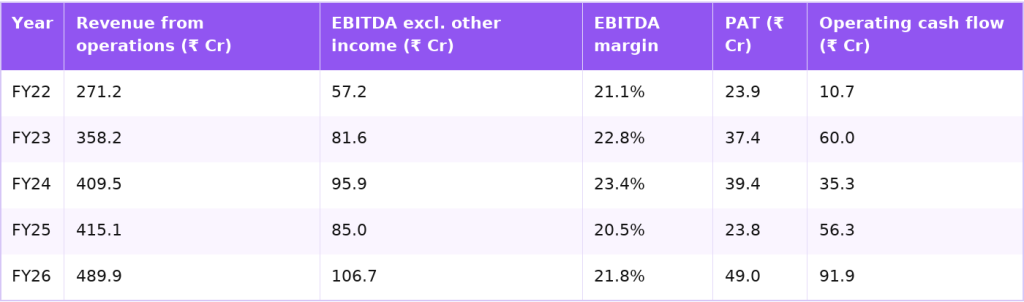
Revenue from operations grew about 1.8 times in four years, from about ₹271.2 Cr in FY22 to ₹489.94 Cr in FY26. The margin from operations stayed in a band of about 20-23%, and FY25 was the one flat year, when KTM's troubles held revenue near FY24's level and profit after tax fell to about ₹23.8 Cr.
Cash flow has been better than profit over the period. Operating cash flow added up to about ₹254.1 Cr over the five years, against about ₹173.5 Cr of profit after tax, because depreciation on a machine-heavy business is large. Most of that cash went back into plant: the company bought about ₹49.15 Cr of property, plant and equipment in FY26 alone.
Debt is the other side of that spending. Total debt fell from ₹297.59 Cr to ₹221.82 Cr in FY26 only because about ₹52.80 Cr of the new equity went to repay loans. With ₹77.45 Cr of capex planned for FY27 on bank debt, the debt line is the one to watch.
"Accounting is the language of business."
— Warren Buffett
RACL's reported EBITDA and the table above differ by other income, which was ₹22.48 Cr in FY26. Reading the statements line by line is how you see which part of profit came from making gears.
What FY27 Could Look Like on Management's Numbers
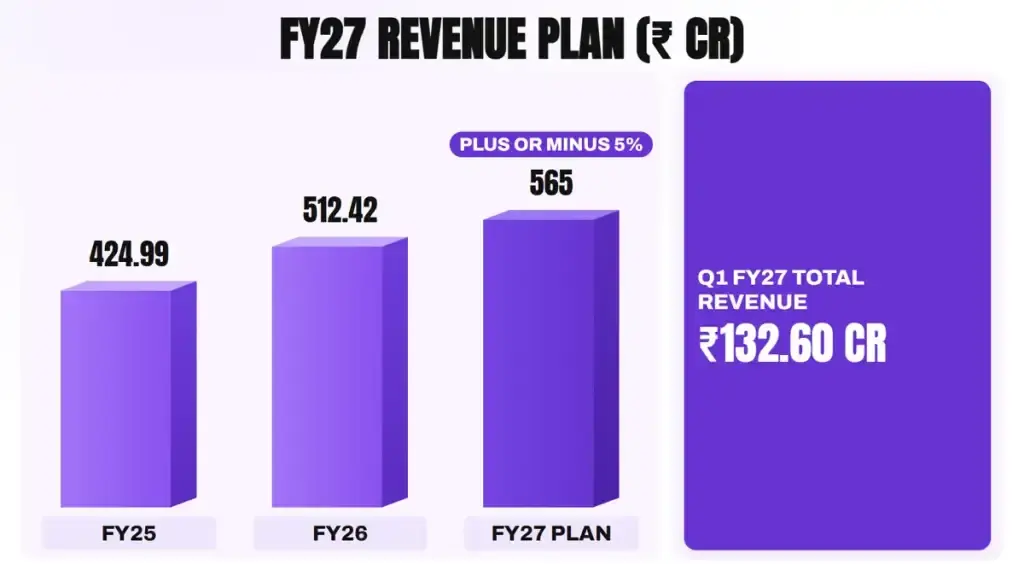
Now let's turn to the plan, because management has given unusually clear numbers for the year. In February 2026 the board set an FY27 revenue plan of ₹565 Cr, plus or minus 5%, about 17% above FY26. That plan was repeated in June 2026 and again in August.
Q1 FY27 total revenue of ₹132.60 Cr is about 23.5% of ₹565 Cr. If you add up the start dates, you will see that most of the new projects begin in the second half. BMW's two projects, Royal Enfield's second project and Kawasaki's 15 parts all have start dates from October 2026 onwards.
"We always have a very, very ambitious growth plan to grow, 15 to 20% per year." - Gursharan Singh, Chairman and Managing Director, August 2026
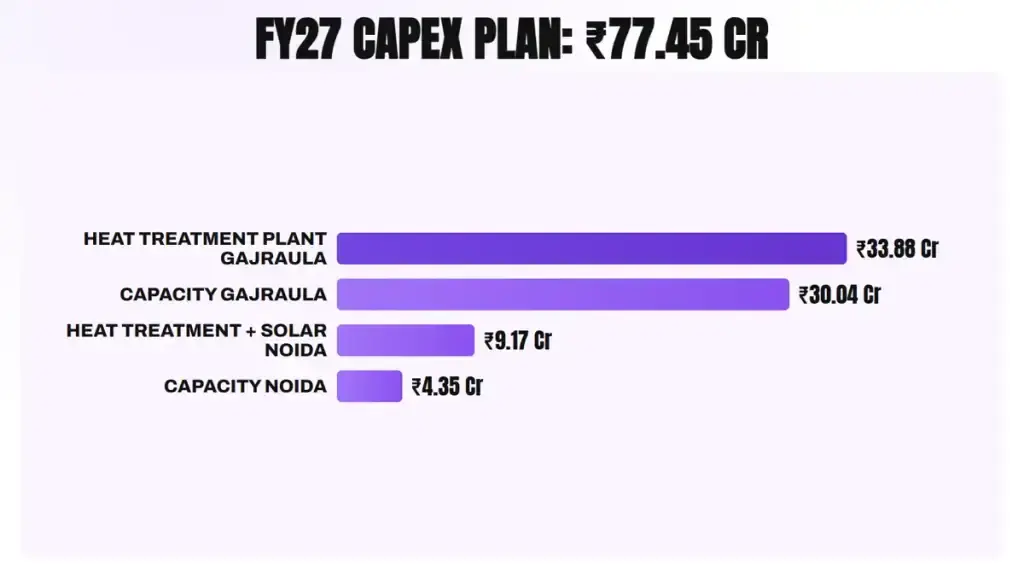
That plan is backed by capex, so let's look at how it splits. The board approved ₹77.45 Cr for FY27:
- ₹33.88 Cr to replace the old heat treatment plant at Gajraula
- ₹30.04 Cr for more capacity at Gajraula
- ₹4.35 Cr for more capacity at Noida
- ₹9.17 Cr for heat treatment and a rooftop solar plant at Noida
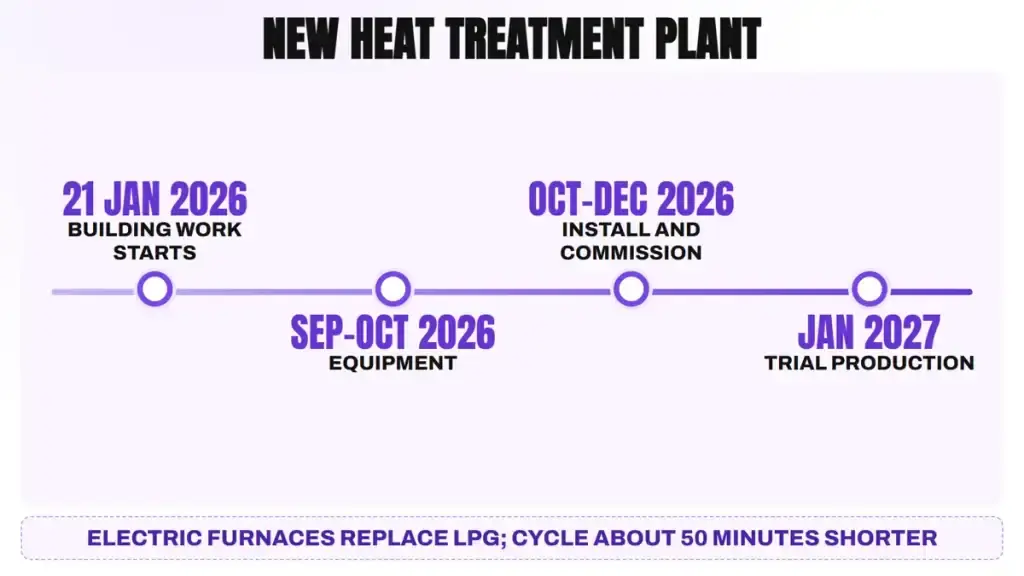
That first item, heat treatment, is the step where gears are heated and cooled under control so the surface becomes hard while the core stays tough. The current furnaces run on LPG and most are over 30 years old. The new plant runs on electric furnaces and cuts each cycle by about 50 minutes. Building work started on 21 January 2026, equipment was due between September and October, and trial production is planned for January 2027.
So about ₹40 Cr of the ₹77.45 Cr goes into heat treatment, and management treats that part as replacing old equipment rather than adding capacity. The rest, about ₹35 Cr, adds capacity that will come into use partly in FY27 and partly in FY28. As management puts it, what RACL invests this year is meant for next year's revenue.
The Noida plant is also growing, by about 27,760 square feet of new built-up area. And the Venus plant at Gajraula still has 50% of its space free for new projects.
Beyond FY27, management talks about doubling. In June it said it aims for ₹1,000 Cr of revenue in the next three to five years. The FY28 capex plan, including Crystal, is expected around January 2027.
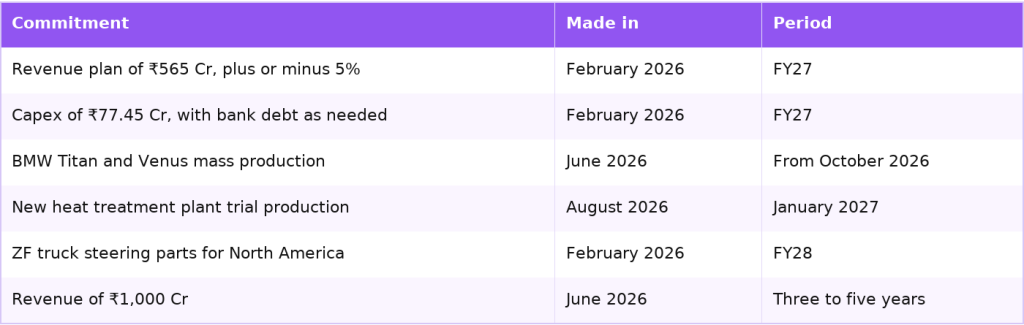
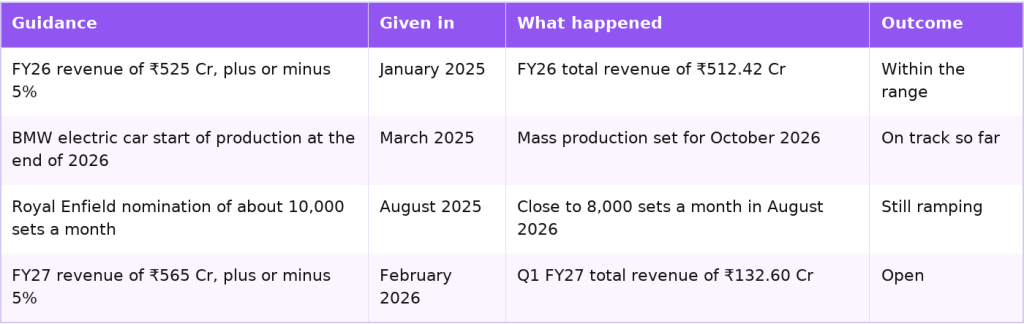
So how has management done against its own plans? On the recent targets, it has stayed close.
Key Risks
Now let's look at what could go wrong for RACL Geartech, because the last two years have already shown some of these risks.
- Customer setbacks: KTM went through insolvency in 2024-25, and its plant was shut for about six months. FY25 revenue from operations was ₹415.07 Cr, almost flat on about ₹409.52 Cr in FY24, and profit after tax fell to ₹23.77 Cr from about ₹39.40 Cr. No customer is more than 20% of sales, but one customer's trouble can still move a whole year.
- BMW timing: Titan and Venus depend on BMW's final approval and then on how well the new electric car sells. Management itself says the end buyer has to accept the car before volumes follow.
- Profit quality: other income of ₹22.48 Cr made up about 34% of FY26 profit before tax. In Q1 FY27 other income was close to nil, and tax took about 47% of profit before tax, so profit after tax rose only about 7.7%.
- Working capital: inventory was ₹147.42 Cr and trade receivables ₹145.99 Cr in March 2026. Each is close to 110 days of revenue, partly because RACL holds stock in its European warehouses for customers.
- Debt returns: the FY27 capex will be funded with bank debt, and gears are capital-heavy. Management has said the need to borrow will always be there.
- Promoter holding: promoters held 42.75% in March 2026. Part of the fall came from the new shares issued, and part from PICUP, the Uttar Pradesh state investment company counted in the promoter group, which cut its stake from 13.94% to 8.57%.
- Europe and costs: Europe was 59% of Q1 FY27 sales. Energy and input costs rose sharply from March 2026, and management was still asking customers for interim support in June.
- Domestic pricing: Royal Enfield and other Indian buyers use more than one supplier and are price sensitive, and management has said new high-volume business earns a different margin at the start.
- Thin disclosure: RACL gives no order book, no customer shares and no value per set. Investors have to rely on the plan and the project dates.
- Skilled staff: precision gears need trained machinists. In FY26 the turnover rate was 6.7% for permanent employees and 12.4% for permanent workers, which means about one in eight workers left during the year.
"Debt is, you know, never a dirty word, but you know, debt becomes always a nuisance when you raise debt without an industry level cost." - Gursharan Singh, Chairman and Managing Director, June 2026
"Risk comes from not knowing what you're doing."
— Warren Buffett
With RACL, the risks above are mostly visible: a few large customers, projects that depend on a customer's sign-off, and a capex plan funded by debt. Knowing them is the first step in tracking them.
Explore our Products
Research Framework

Emerging Titans
Combination of quantitative analysis, industry tailwinds, and management assessment - SPRINT investment philosophy

Tiny Titans
Heavy emphasis on scuttlebutt research, plant visits, and early on-ground signals
What to Track Next
If you follow RACL Geartech, these are the signals that will show where it goes next.
- Q2 FY27 results, which the board takes up on 13 November 2026, and H1 revenue against the ₹565 Cr plan
- BMW's final sign-off and the first months of Titan and Venus mass production
- Royal Enfield volumes moving from close to 8,000 sets a month toward 10,000 and the start of the second project
- Kawasaki's start of production and the BRP shift drum ramp
- The new heat treatment plant's trial run in January 2027 and the FY28 capex plan, including Crystal
- Debt after the capex, against debt to equity of 0.63 in March 2026
Conclusion
Let's put it all together. RACL Geartech has turned a premium motorcycle gear business into a supplier for trucks, cars, tractors and now electric cars. FY26 total revenue was ₹512.42 Cr at a 25.21% EBITDA margin, with three of every four rupees from exports. The cautious thread is concentration and debt: one customer's trouble flattened FY25, other income lifted FY26 profit, and the FY27 capex goes back onto bank borrowing. The next two quarters, starting with Q2 FY27 and the first months of BMW supply, will show which thread is stronger.
But the next year depends on projects that are only now starting. BMW's two electric car projects, Royal Enfield, Kawasaki and BRP all begin or ramp up in the second half of FY27. What happens next depends on whether those projects reach full volume on time, and whether the new heat treatment plant and capex lift capacity without stretching the balance sheet again.
FAQs
What does RACL Geartech make?
+RACL Geartech makes transmission gears, shafts, gearbox sub-assemblies, chassis parts and industrial gears from plants at Gajraula and Noida. Its customers include KTM, Royal Enfield, TVS, Kawasaki, MAN, ZF, BMW and Kubota. FY26 consolidated total revenue was ₹512.42 Cr, and 75% of sales came from exports.
How did RACL Geartech do in Q1 FY27?
+Consolidated total revenue was ₹132.60 Cr, up 21.99%, and revenue from operations grew 31.50% to ₹132.35 Cr. Profit before tax rose 49.32% to ₹16.82 Cr. Profit after tax was ₹8.90 Cr against ₹8.26 Cr, because tax took about 47% of profit before tax in the quarter.
What are RACL Geartech's BMW projects?
+Project Titan is the parking lock actuation assembly for BMW electric cars, made in the Udyam building at Gajraula, with more than 2,500 sets sent in pilot phases. Project Venus supplies drive train parts for an electric sports car, with more than 4,000 sets sent. Both were set for mass production in October 2026.
How much of RACL Geartech's revenue comes from exports?
+Exports were 75% of FY26 sales and Europe alone 69%. In Q1 FY27 the split moved to 66% exports and 34% domestic as Royal Enfield supply ramped up, with Europe at 59% of sales.
What is RACL Geartech's plan for FY27?
+The board set a revenue plan of ₹565 Cr, plus or minus 5%, about 17% above FY26. It approved capex of ₹77.45 Cr, including ₹33.88 Cr to replace the old heat treatment plant at Gajraula, with trial production in the new plant planned for January 2027.
What are the main risks for RACL Geartech?
+KTM's insolvency left FY25 revenue almost flat at ₹415.07 Cr, and other income made up about 34% of FY26 profit before tax. The BMW projects depend on the customer's final approval and car sales. Inventory and receivables are each close to 110 days of revenue, and the FY27 capex will be funded with bank debt.

High growth stock specialist, Value Educator
Shashank Mahajan is an equity research professional with over 12 years of experience in identifying high-potential SME and micro-cap stocks at an early stage. He follows a rigorous scuttlebutt research–driven approach, combining on-ground insights with deep financial analysis. Shashank specializes in uncovering under-researched and under-owned companies with strong management quality and long-term growth potential. Through disciplined research and early identification, he focuses on spotting tomorrow’s market leaders before they enter the mainstream investor radar.
Nuclear Power Stocks in India 2026: Suppliers and Orders
BESS Stocks in India 2026: Battery Storage Value Chain
Transformer Stocks in India 2026: Makers and Order Books

Transrail Lighting: A Line Builder With Its Own Tower Plants

Skipper Limited: A Tower Maker With ₹10,066 Cr of Orders
Sedemac Mechatronics: 1.45 Million Controllers a Quarter
Explore our Products
Research Framework
Emerging Titans
Combination of quantitative analysis, industry tailwinds, and management assessment - SPRINT investment philosophy
Tiny Titans
Heavy emphasis on scuttlebutt research, plant visits, and early on-ground signals



Modern Warfare to Multibaggers
Key Trends. Strategic Shifts. Opportunities Ahead.
Don't Miss This Exclusive Webinar!
Join Value Educator to decode the key trends shaping India's defence sector and learn how to identify tomorrow's potential leaders in the space.
- In-depth research on India's defence sector
- Live Q&A session
- Actionable takeaways for long-term investors

 Orders
 Subscription
 Share with friends


Required Details
₹23999.00
(12 month subscription)
As per SEBI regulations, all users are mandated to complete the KYC that is validated for 1 year. Post payment, you will be redirected to the KYC screen


No comments yet. Be the first to comment!