
HFCL: From BharatNet Contracts to Hyperscaler Cables
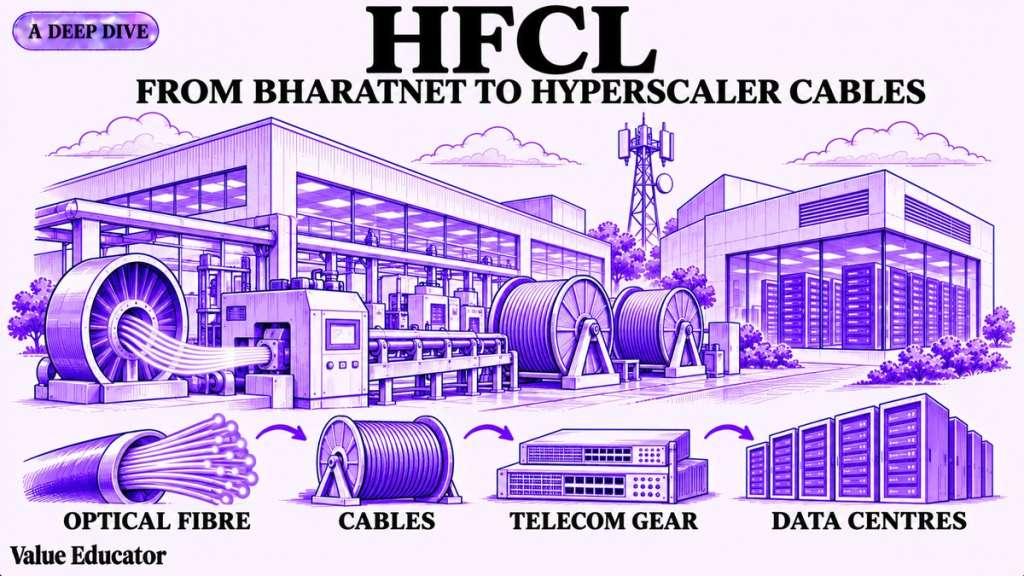
In the July to September quarter of 2025, an Indian telecom company earned ₹506.77 Cr from turnkey contracts, which means building whole fibre networks for government and railway programmes. It earned ₹490.10 Cr from the products it makes in its own plants. One year later, in the same quarter of 2026, turnkey contracts brought in only ₹136.07 Cr. Products brought in ₹2,321.98 Cr, almost five times as much as a year before.
That shift tells us what kind of products it makes. The largest is fibre. Optical fibre is the name for a glass thread thinner than a hair that carries data as pulses of light. A preform is the thick rod of very pure glass that fibre is drawn from, by heating it and pulling it into a thread many kilometres long. Many fibres are then packed into a cable with tubes, a strength member and a jacket.
Fibre makers measure their output in fibre kilometres, or fkm, which means one kilometre of one fibre. A cable that holds 288 fibres and runs for one kilometre counts as 288 fkm. That is why the newest cables matter so much. An AI data centre links thousands of GPU servers to each other, and it uses cables called high-fibre-count cables, which hold thousands of fibres in one jacket. The company says AI GPU racks need 36 times more fibre than ordinary computer racks.
That company is HFCL Limited (NSE: HFCL). It makes optical fibre and fibre cable in India, builds telecom equipment such as Wi-Fi access points, routers and radios, and makes defence products such as thermal weapon sights and radars. It also lays fibre networks under turnkey contracts. In the past year its cable business found a new set of buyers: the large cloud companies, called hyperscalers, that build AI data centres, mostly in North America for now.

So HFCL sits at one clear point in the data-centre chain. It does not build the halls, the power supply or the servers. It makes the fibre, the cables and the connectors that carry data between the servers and between the buildings.
HFCL in five numbers
- Q2 FY27 revenue of ₹2,541.79 Cr, up 143.62%
- An EBITDA margin of 25.89% in Q2 FY27, against 19.49% a year ago
- An order book of ₹28,911 Cr in September 2026, from ₹7,010 Cr in FY23
- Exports at about 63% of revenue, against 41.36% in FY26
- Planned capex of about ₹1,800 Cr for fibre, cable and preform capacity
So a company that earned ₹4,949.27 Cr in all of FY26 earned ₹4,456.77 Cr in the first half of FY27 alone. How did that show up in the latest numbers? Let's first understand the company, and then look at the latest quarter.
HFCL: Company Overview
HFCL Limited was incorporated in 1987 and has its registered office in Gurugram, Haryana. Mahendra Nahata, its founder, is the promoter and Managing Director, and the promoter group held 28.29% in September 2026. HFCL makes optical fibre, fibre cable and data-centre connectivity products, telecom equipment such as Wi-Fi access points, routers and radios, and defence products such as thermal weapon sights and radars, and it also builds and maintains networks under turnkey contracts. It runs six manufacturing facilities in India, with plants in Hyderabad, Goa, Chennai through its subsidiary HTL, and Hosur. The company had 1,820 permanent employees on its rolls in March 2026. Revenue from operations was ₹4,949.27 Cr in FY26, and net worth was ₹5,755.44 Cr in September 2026, against borrowings of about ₹1,840 Cr. Read this Data Centre Stocks in India 2026: Suppliers and Operators
"Know what you own, and know why you own it."
— Peter Lynch
HFCL's numbers changed because its buyers changed: from government network programmes in India to hyperscalers abroad. Knowing which of its four segments earns the money is the first step to reading its results.
The Quarter Profit Rose 448.1%
Let's look at Q2 FY27, the July to September quarter that HFCL reported on 19 October 2026, when its profit after tax rose 448.14%. Revenue from operations was ₹2,541.79 Cr, up 143.62% from ₹1,043.34 Cr a year ago. It was also 32.73% higher than the ₹1,914.98 Cr of Q1 FY27. Management called it the best quarter in the company's history.
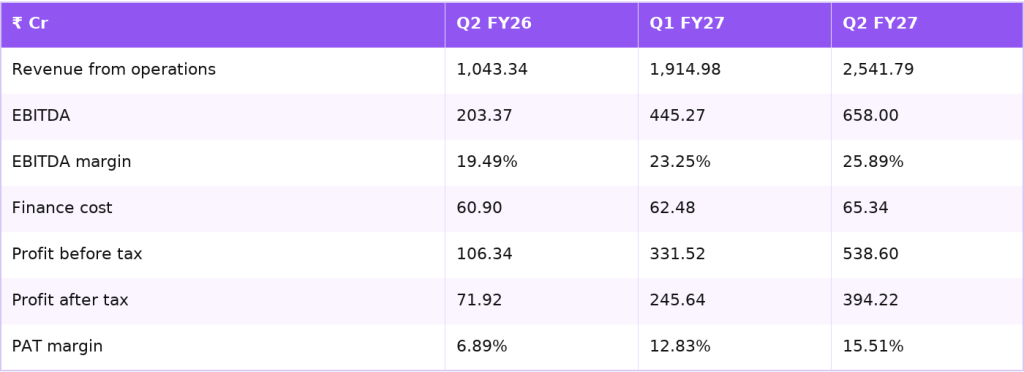
As we can see, profit grew much faster than revenue. EBITDA rose 223.55% to ₹658.00 Cr. Profit after tax rose 448.14% to ₹394.22 Cr, and the PAT margin went from 6.89% to 15.51%. HFCL counts other income inside EBITDA, so the EBITDA margin here is the company's own measure. Management also says the quarter had no one-time gain and no unusually high-margin order in it.

That chart also shows how fast the climb has been. Revenue was ₹871.02 Cr in Q1 FY26, at an EBITDA margin of 4.93%. It reached ₹1,210.79 Cr in Q3 FY26 and ₹1,824.12 Cr in Q4 FY26, as export orders grew. In two more quarters it rose to ₹2,541.79 Cr, and the margin reached 25.89%.
Behind that margin is the product line. The telecom products segment, which holds fibre, cable, connectivity products and telecom equipment, earned ₹2,321.98 Cr in the quarter. Its profit before interest and tax was ₹716.24 Cr, a segment margin of about 30.8%. A year earlier the same segment earned ₹490.10 Cr, with a segment profit of ₹122.54 Cr.
Exports drove much of that growth. Management says export revenue grew about 493% from a year ago, and the company's deck puts exports at about 63% of revenue. Private customers now make up about 92% of revenue, and products about 91%.
The price of fibre helped too. Management says fibre prices went up by about 20% in Q2 FY27, and that growth came from both higher volumes and better prices. A fibre for an AI data centre also sells for more than a telecom fibre. Management puts a telecom fibre at about USD 15 and a thin data-centre fibre at about USD 25.
That growth showed up in cash as well. Read this Cash Flow Statement Explained In the first half of FY27, operating cash flow was ₹455.27 Cr, against an outflow of ₹43.60 Cr in the first half of FY26. HFCL spent ₹436.27 Cr on plant and equipment in the same six months.

As we can see, the same pattern shows in the first half, at a larger scale. H1 FY27 revenue was ₹4,456.77 Cr, up 132.81% from ₹1,914.36 Cr. EBITDA for the half was ₹1,103.27 Cr at a margin of 24.75%, and profit after tax was ₹639.86 Cr, against ₹42.62 Cr in the first half of FY26.
Those profits also added to the balance sheet. Net worth rose to ₹5,755.44 Cr in September 2026, from ₹4,948.59 Cr in March. In July 2026, CARE Ratings upgraded HFCL's long-term bank rating to CARE A with a positive outlook, from CARE A- with a stable outlook.
The Orders Behind the Next Few Years
Now let's look at the orders, because they show how much of the coming revenue is already booked. At the end of September 2026 the order book was ₹28,911 Cr. It was ₹26,665 Cr in June 2026 and ₹21,206 Cr in March 2026. So even after shipping ₹2,541.79 Cr of goods and services in the quarter, the book grew by ₹2,246 Cr.
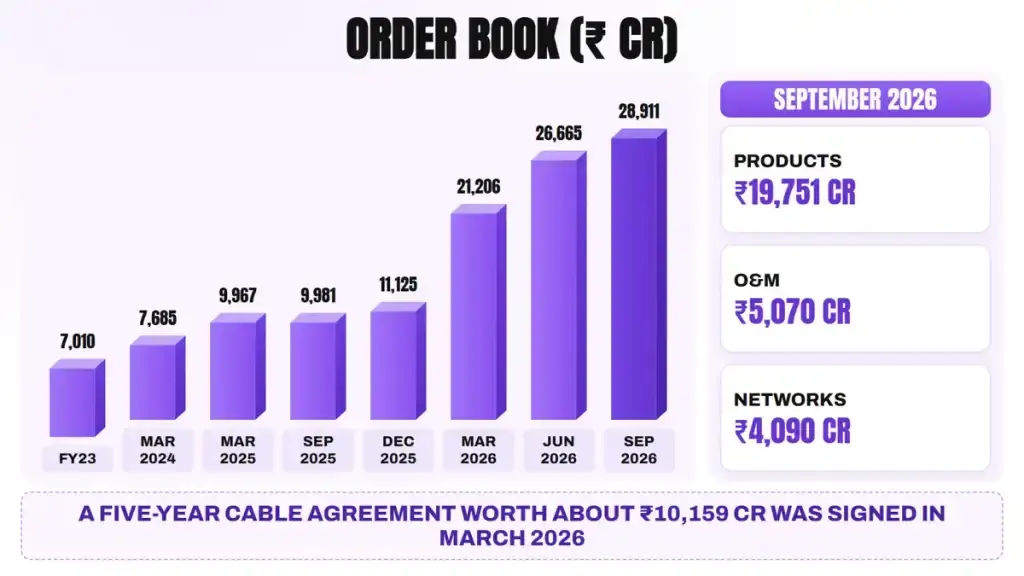
That book was very different only a year ago. It was ₹9,967 Cr in March 2025 and ₹9,981 Cr in September 2025, and ₹8,179 Cr of that September book came from government customers. The jump came in March 2026. HFCL signed a five-year supply agreement with a global multinational for high-fibre-count cables, worth about USD 1.10 billion, or about ₹10,159 Cr. The contract sets a minimum quantity for each calendar year from 2026 to 2028, and it extends to 2029 and 2030.
More such orders followed. In April 2026 HTL, a subsidiary, won about ₹1,366 Cr of cable orders from a Tier-1 customer in India. In July 2026 HFCL won a ₹495.80 Cr export order for fibre-based data-centre connectivity products, due by December 2026. In September 2026 it signed a second long-term agreement with a global multinational, worth about ₹2,329 Cr over 2027 to 2029.

What the order book says: ₹28,911 Cr is about 5.8 times the ₹4,949.27 Cr of revenue in FY26. Management says some orders run four to six months and some three to five years, so the book is spread over several years, not one.
Those terms matter for the reading. The O&M part, ₹5,070 Cr, is paid out over many years of network upkeep. The products part, ₹19,751 Cr, includes the multi-year cable agreements. Management also says it has more orders at an advanced stage, and that in Q2 alone it booked about ₹5,500 Cr of new orders against about ₹2,500 Cr of supply.
How a BharatNet Contractor Turned Into a Cable Exporter
Now that we have seen the quarter, let's go back and see how a BharatNet contractor turned into a cable exporter. HFCL was incorporated in 1987. Mahendra Nahata, its promoter and Managing Director, founded HFCL and has about four decades of experience in telecom. Its registered office is in Gurugram, and it runs plants in Hyderabad, Goa, Chennai through its subsidiary HTL, and Hosur, where it makes defence equipment.
For most of its life HFCL earned much of its money from India's telecom networks. It built fibre networks for BharatNet, the government programme to bring broadband to villages, and it supplied cable and equipment to Indian telecom companies. That work was large but it paid slowly, because government projects bill against milestones that need many approvals. Read this Days Sales Outstanding (DSO) Explained
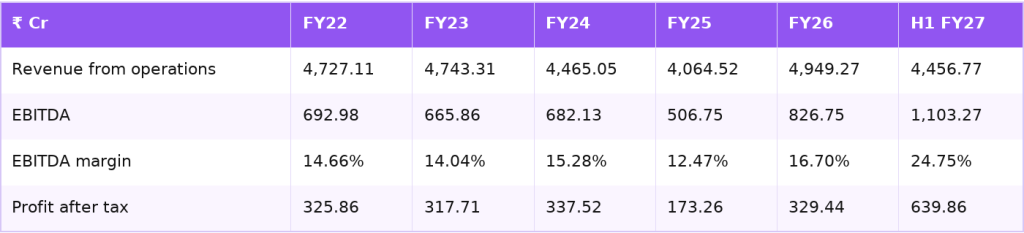
That table shows four flat years. Revenue stayed between about ₹4,065 Cr and ₹4,743 Cr from FY22 to FY25, and the EBITDA margin stayed between 12.47% and 15.28%. In FY24 and FY25, global fibre demand was soft and Indian telecom companies bought less cable.

Then the mix began to change. Exports were ₹497 Cr in FY25, about 12% of revenue. In FY26 they were ₹2,047 Cr, or 41.36%. The share of products went to about 62% of revenue in FY26, and private customers to about 84%. Management says it moved away from low-margin turnkey work on purpose, and now chooses its projects more carefully.
"Should you find yourself in a chronically leaking boat, energy devoted to changing vessels is likely to be more productive than energy devoted to patching leaks."
— Warren Buffett
HFCL did not try to fix the margin of its turnkey work. It moved its plants and its people towards cable for hyperscalers, and the margin followed the new mix. Its reason for going abroad was simple. Leaving out China, management says, India is only about 5% to 7% of the world telecom market, so growth had to come from exports.
That change shows clearly in the margin. The EBITDA margin rose from 12.47% in FY25 to 16.70% in FY26, and to 24.75% in the first half of FY27. Profit after tax for the first half, ₹639.86 Cr, was already almost twice the ₹329.44 Cr of all of FY26.
"I want to emphasise that we do not see this quarter as a peak, but as the sustained phase of strong growth." - Mahendra Nahata, Promoter and Managing Director, October 2026
Four Segments and One Cable Line Doing Most of the Work
Now let's split the business into its parts, because each one sells to a different buyer. HFCL reports four segments in its results. Its deck calls them four engines, from fibre and cable to telecom equipment, defence and EPC work.

These lines sound alike, but as you will see, each one wins orders in a different way. Cable for hyperscalers comes through long-term supply agreements. Turnkey work comes through government tenders. Defence comes through trials and approvals that can take years.

Fibre, Cable and Data-Centre Connectivity
Let's start with fibre and cable, now the largest line. HFCL can make about 28 million fkm of fibre and about 39 million fkm of cable a year. Its cable capacity is larger than its fibre capacity, and today it buys its preform from outside suppliers. Both kinds of plant are busy. Management says its fibre plants run at 100% of capacity and its data-centre cable lines run around the clock, while some telecom cable lines wait for orders.
That line has changed its buyers. Management says data centres now bring in about 65% to 75% of this revenue and telecom companies about 25% to 35%. The data-centre cables are also harder to make. HFCL has supplied ribbon cables with thousands of fibres to hyperscalers, has developed a 6,912-fibre cable, and is working on a 14,000-fibre cable.
Beyond the cable, HFCL is building a new line called connectivity solutions. These are the parts that go inside the data hall, such as multi-fibre MPO cables, patch panels and cable assemblies that plug the fibre into each rack. Management says this business started in FY27, with about ₹300 Cr of revenue in Q2. It expects about ₹800 Cr in FY27 and ₹2,000 Cr in FY28, and it is raising this capacity by five times.
Telecom Equipment
Next, let's look at telecom equipment, the products HFCL designs itself. These include Wi-Fi 5, 6 and 7 access points, unlicensed band radios, IP/MPLS routers, Ethernet switches and 5G fixed wireless access devices for homes. The company says it built India's first indigenously developed 5G fixed wireless device. Its deck says these 5G home devices have already won repeat orders from telecom companies.
That equipment comes from its own research work. HFCL has three research centres, in Bengaluru, Hyderabad and Gurugram, with 253 people working on telecom, defence and fibre products. These products sell mostly in India, to telecom companies and enterprises, and they sit inside the telecom products segment with the cable.
Defence and Aerospace
Now let's move to defence, the newest line. HFCL makes thermal weapon sights, including sights for the AK-203 rifle, electronic fuzes for artillery shells, surveillance radars and multi-mode hand grenades. In September 2026 it delivered the second batch of AK-203 thermal sights to the Indian armed forces. It has also built a foliage penetration radar, now in trials, and drone detection radars.
The next step is an acquisition. HFCL is putting its defence work into a subsidiary, HFCL Advance Systems, and buying an aerospace business that makes aerostructures. Management says the business being acquired has an unexecuted export order book of about ₹1,600 Cr, and it expects the deal to close in Q3 FY27. It is also building an ammunition complex on 1,000 acres in Andhra Pradesh, with a first phase of ₹230 Cr.
As you will see, that complex starts with one product. HFCL holds a transfer of technology from DRDO, the government's defence research body, for multi-mode hand grenades. Management says only three licensees, HFCL, one other private company and the government-owned Munition India, can bid for a large grenade tender. HFCL has bid in a tender for 800,000 such grenades, which would be made at the new site, and management expects the complex to earn revenue in about two years.
Turnkey Contracts and Services
Finally, let's look at turnkey work, the old core. Here HFCL builds and runs networks for BharatNet, BSNL, railways and the armed forces. Its deck says an HFCL consortium has won more than ₹8,100 Cr of BharatNet Phase III contracts. In June 2026 it also won a ₹2,666.09 Cr contract from Rail Vikas Nigam for a railway telecom network, to be built and then maintained for 10 years.
That segment has become much smaller. Its revenue was ₹506.77 Cr in Q2 FY26 and ₹136.07 Cr in Q2 FY27. Management says its board committee, with outside advisers, is weighing what to do with the EPC business, and a decision is expected within weeks.
Those contracts also bring long upkeep work. In May 2026 RailTel gave HFCL a ₹135.09 Cr order to maintain a secure railway network for five years, until January 2031. Management says a maintenance contract for an Army network, signed first through BSNL, is in its final stage of approval. It also says BharatNet bills held back by milestone checks in Q2 will be raised in Q3.
Where HFCL Sits in the Data-Centre Value Chain
Now let's place HFCL in the wider data-centre chain. A data centre needs land, power, cooling and racks before a single server goes in. Then come the servers, the GPUs and the network that joins them. HFCL's place is the passive part of that network: the fibre, the cable and the connectors that carry light between racks, halls and campuses.
That part has grown with AI. A training cluster links thousands of GPUs so they can work as one machine, and each link needs fibre. So hyperscalers buy cables with far more fibres than a telecom company ever did. Management says Indian telecom companies used cables of up to 288 fibres, while data-centre buyers now ask for cables of about 7,000 fibres.
That demand has also lifted prices. The company's deck says G.657A2 single-mode fibre prices are up more than 30% since early 2025. It says global fibre makers have limited capacity, because a preform plant takes 24 to 36 months to build. Management says only a handful of makers can supply cables of 7,000 fibres, and that in India only two of about 20 cable makers can make them.
Those buyers are mostly abroad for now. Management says about 70% of the export orders in the cable order book come from hyperscalers, while Indian orders come mostly from telecom companies. It puts India's data-centre capacity at about 1.6 gigawatts, with about 6 gigawatts expected by 2030, against about 130 gigawatts in the US.
Back home, telecom demand is returning. Management says Indian and overseas telecom companies bought little fibre for about two years because prices rose, and are now sending concrete enquiries for large orders. Telecom also needs fibre to carry data from the data centre to the user. So HFCL sells into both ends of the same data flow.
Now let us look at the size of the market those cables sell into. The company's deck, using an industry report, puts the global fibre cable market at about USD 21.5 billion in FY25 and projects USD 35.5 billion by FY32, a growth of 7.4% a year. It puts India's market at USD 1.4 billion, growing to USD 2.7 billion at 10.1% a year. The company also points to a newer buyer: military drones now use an estimated 50 to 100 million fkm of fibre a year, about 12% to 15% of world demand.
Why HFCL's Moat Is Hard to Copy
Now that we have seen the parts, let's understand the moat. Fibre itself can look like a commodity, since many companies around the world make it. So the question is why a hyperscaler should sign a five-year agreement with HFCL, and not simply buy from whoever is cheapest each quarter. Read this Economic Moat Explained
One part of the moat is the product. A 7,000-fibre cable has to fit thousands of thin fibres into a jacket small enough to pull through a duct, without losing signal. HFCL makes 180-micron fibre for these cables, which is thinner than the usual 250-micron fibre and has to be drawn more slowly and more carefully. Each new cable design then goes through the buyer's own testing and approval, which takes time to repeat with a new supplier.
"In business, I look for economic castles protected by unbreachable moats."
— Warren Buffett
For HFCL, the castle is a cable that few makers can produce at scale, and the moat is the testing and the multi-year agreements that keep a buyer from switching.
Another layer comes from making it all under one roof. HFCL draws its own fibre, makes the cable and now makes the connectivity products too. It is now adding its own preform, the most costly input. Management says making preform is at least 30% cheaper than buying it today, and that preform is about 45% of the total cost of a cable. On those numbers, it expects raw material cost to fall by about 10% to 12% once its own preform plant runs.
That integration also protects supply. Management says preform bought on the open market now costs about USD 300 per kg after a rise of about 600%, but HFCL buys under contracts fixed earlier. Its customer contracts also carry price reset clauses that are reviewed each year.
Beyond the plant, customer ties add a third layer. HFCL sells in more than 60 countries and has more than 80 large customers. Its deck says it supplies most of the world's largest telecom companies and hyperscalers. Two multi-year agreements with global companies, worth about ₹10,159 Cr and ₹2,329 Cr, show that such buyers want to lock in supply for years.
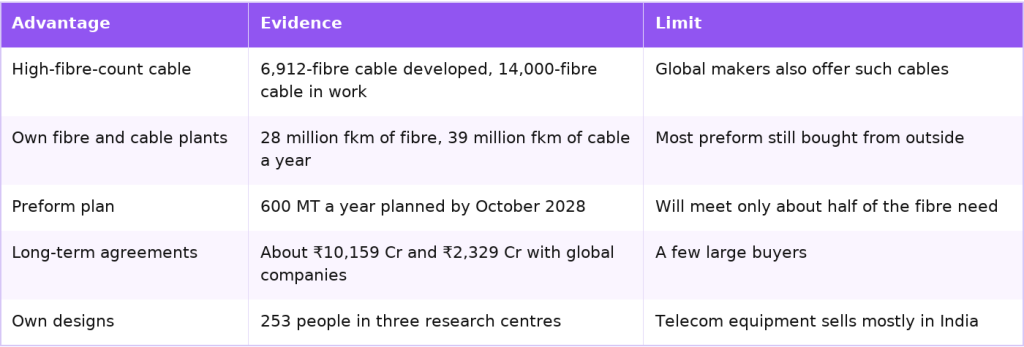
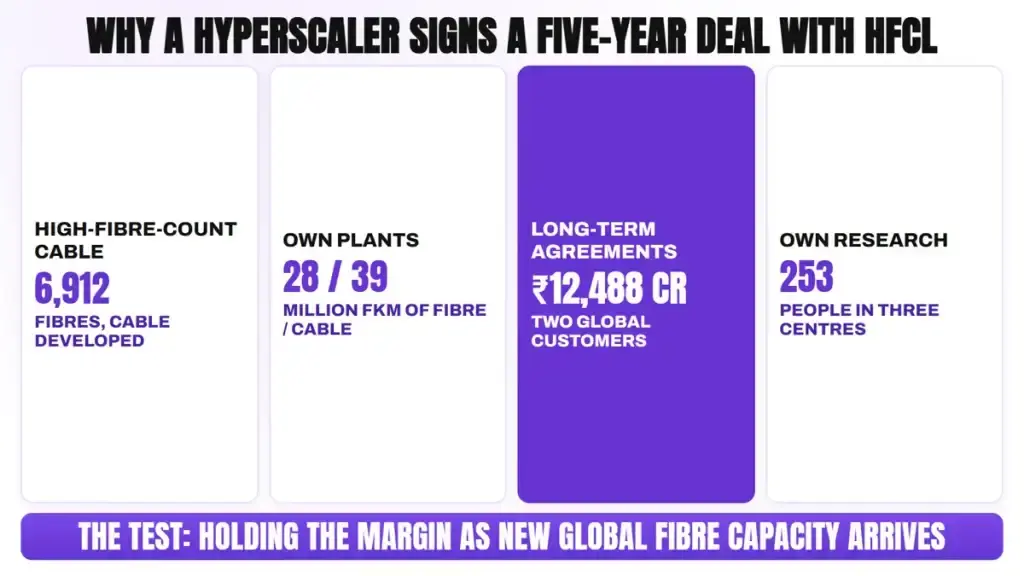
That table shows us why the margin is the real test of the moat. If buyers value the cable design and the steady supply, HFCL should hold a high margin even after new fibre capacity comes up around the world. So far it has: the margin went from 4.93% in Q1 FY26 to 25.89% in Q2 FY27.
Financials: Five Flat Years, Then a Change of Mix
One quarter can mislead in a business where a few large orders move the numbers, so let's look at the full years together. EBITDA here includes other income, as HFCL reports it, and the first half of FY27 is shown for comparison.
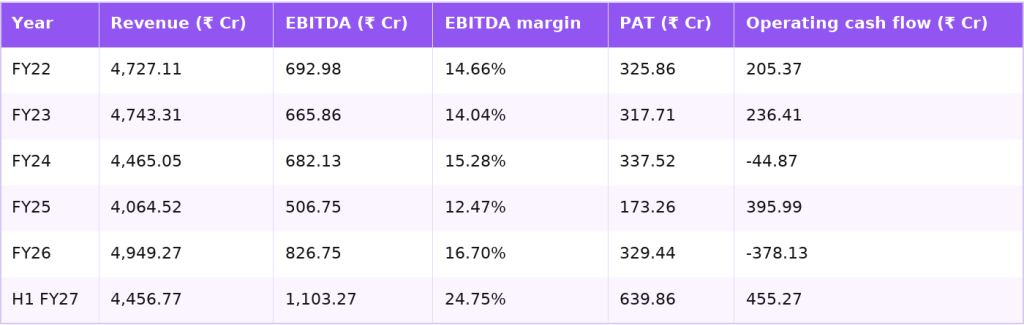
Revenue barely moved for four years, between about ₹4,065 Cr and ₹4,743 Cr from FY22 to FY25, and profit after tax stayed between ₹173.26 Cr and ₹337.52 Cr. The change came in FY26 and the first half of FY27, when cable exports grew and the EBITDA margin rose from 12.47% in FY25 to 24.75%.
Cash flow has lagged profit for most of these years. From FY22 to FY26, operating cash flow added up to about ₹414.8 Cr, against about ₹1,483.8 Cr of profit after tax, or about 28%. It was negative in FY24 and again in FY26, at ₹378.13 Cr, as receivables and inventory grew. Receivables came to about 224 days of revenue in FY24, about 207 days in FY25 and about 183 days in FY26.
The first half of FY27 looks different. Operating cash flow was ₹455.27 Cr, or about 71% of the profit after tax of ₹639.86 Cr. Borrowings were still about ₹1,840 Cr in September 2026, with net debt of about ₹1,245 Cr after cash, while about ₹1,800 Cr of capex lies ahead. How much of that capex the new cash flow can carry is the next test.
"The essence of investment management is the management of risks, not the management of returns."
— Benjamin Graham
HFCL's returns are rising fast. The risk to manage is the cash: whether receivables keep shrinking while the company spends about ₹1,800 Cr on new plants.
What FY27 and FY28 Could Look Like on Management's Numbers
So where does the business go from here? On 19 October 2026 management said it expects revenue growth of at least 80% in FY27. That would mean revenue of at least about ₹8,909 Cr, against ₹4,949.27 Cr in FY26. Management also said the ₹10,000 Cr revenue aim it had set for FY29 could come much earlier.

Now let's put that target against the first half. H1 FY27 revenue was ₹4,456.77 Cr. Reaching about ₹8,909 Cr needs about ₹4,452 Cr in H2, which is almost the same as H1. Management called this conservative, and said it expects Q3 FY27 revenue to be higher than Q2.
Beyond revenue, capacity sets the pace. HFCL plans to spend about ₹1,800 Cr to take fibre capacity to 43.10 million fkm a year and cable capacity to 62.00 million fkm by July 2028. Its preform plant is planned at 600 MT a year by October 2028, doubled from the 300 MT first planned. Management also says it will start a mid-term preform solution from early 2027, without giving details. The preform plan also needs a new input. Germanium, a chemical element used in making preform, will be needed in about two years, and management says it is already talking to suppliers. It adds that germanium is only a small part of the cost.
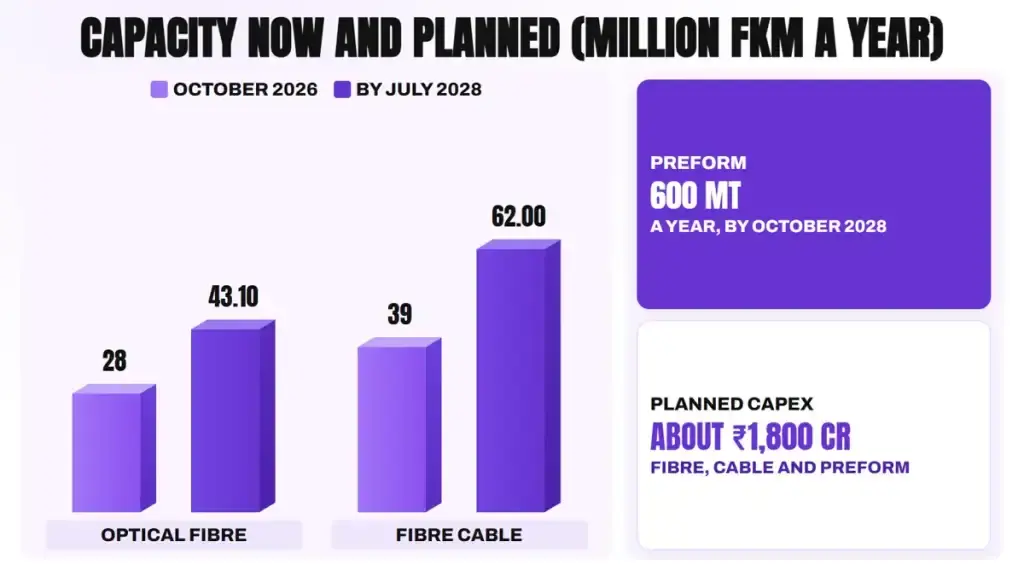
That spending builds on connectivity too. Management targets about ₹2,000 Cr of connectivity revenue in FY28, against about ₹800 Cr in FY27. In defence it targets ₹500 Cr to ₹600 Cr in FY27, at least ₹2,000 Cr in FY28, and an aim of ₹5,000 Cr in about three years.
Margins have their own guide. The October 2026 deck says the EBITDA margin should rise from about 16.7% in FY26 to more than 27% by FY29. Management says the margin will get better because of more capacity, its own preform and more connectivity products.
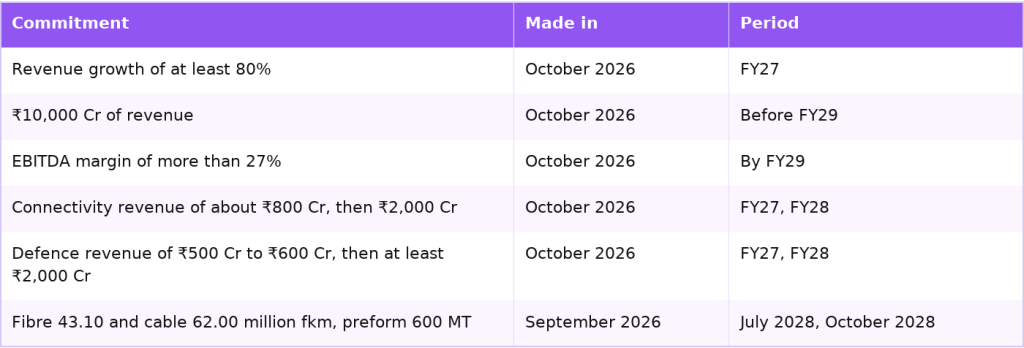
Those commitments are easier to judge against the past. So let's check what management said before against what it delivered.
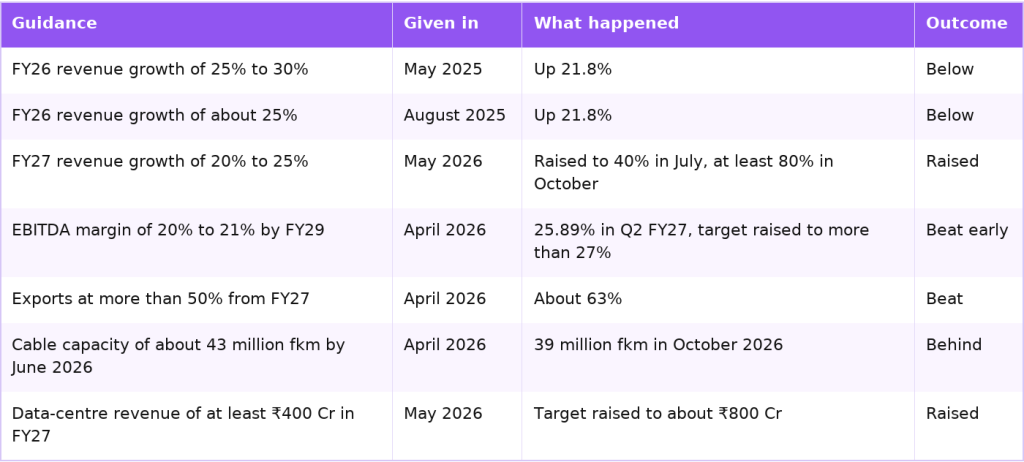
That record shows us a clear pattern. Revenue targets were below the mark in FY26 but have been raised twice in FY27, and the margin is already above the FY29 target set in April. The softer numbers are the timing of new capacity and the defence revenue, which was ₹78.68 Cr in the first half against the ₹500 Cr aim.
Key Risks
Now let's look at what could go wrong for HFCL, because some of these risks are already visible in the numbers.
- Fibre prices could fall: much of the margin comes from fibre prices that rose by about 20% in Q2 FY27 and more than 30% since early 2025. Global makers are adding capacity, and management itself says preform prices have to come down. A fall in cable prices would hit the margin.
- A few large buyers: about 70% of the cable export orders come from hyperscalers, and two long-term agreements are worth about ₹12,488 Cr together. A slowdown in AI data-centre spending by one or two buyers would show in HFCL's orders.
- Cash flow and receivables: operating cash flow was negative at ₹378.13 Cr in FY26, while profit after tax was ₹329.44 Cr. Receivables were about 183 days of revenue in FY26. The first half of FY27 was better, but turnkey bills still wait for long approval chains.
- Rising debt during capex: borrowings rose to about ₹1,840 Cr in September 2026 from about ₹1,713 Cr in March 2026, and about ₹1,800 Cr of capex is planned. Management says debt will come down from this year.
- Turnkey losses: the turnkey segment made a loss of ₹122.58 Cr in Q2 FY27. Management expects losses of not more than ₹75 Cr to ₹100 Cr over the next two quarters together, and a profit from Q1 FY28.
- Defence targets: defence revenue was ₹78.68 Cr in H1 FY27 against an aim of ₹500 Cr to ₹600 Cr for the year, and much depends on closing the aerospace acquisition.
- Preform and germanium supply: HFCL still buys most of its preform, and its own plant will cover only about half of its need. Germanium, a key input for preform, is subject to export curbs in some countries.
- Guarantees and disputes: bank guarantees given for the group came to ₹764.31 Cr in March 2026, and disputed tax and other claims not accepted as debt came to ₹74.36 Cr.
- Capacity on time: cable capacity was 39 million fkm in October 2026, below the about 43 million fkm planned for June 2026. Management also says preform machine deliveries slipped by two to three months, which it has built into the October 2028 date.
"So hypothetically, 5, 7 years later, fiber market, if at all stabilizes, then this sector of defense will show us growth." - Mahendra Nahata, Promoter and Managing Director, October 2026
"All I want to know is where I'm going to die, so I'll never go there."
— Charlie Munger
For HFCL, the places to watch are fibre prices, a few large buyers and cash flow. The list below sets out each of them.
Explore our Products
Research Framework

Emerging Titans
Combination of quantitative analysis, industry tailwinds, and management assessment - SPRINT investment philosophy

Tiny Titans
Heavy emphasis on scuttlebutt research, plant visits, and early on-ground signals
What to Track Next
If you follow HFCL, these are the signals that will show where it goes next.
- H2 FY27 revenue against the at least 80% growth aim, or about ₹8,909 Cr for the year
- The EBITDA margin after 25.89%, and fibre prices as new global capacity arrives
- The order book after ₹28,911 Cr, and new long-term cable agreements
- Operating cash flow, receivable days and debt after about ₹1,840 Cr
- Connectivity revenue against about ₹800 Cr in FY27, and defence against ₹500 Cr
- The decision on the EPC business and the close of the aerospace acquisition
Compare: see how it measures up against its peers in HFCL vs Sterlite Technologies: Optical Fibre Compared, a side-by-side look at order books, margins and balance sheets.
Conclusion
Let's put it all together. HFCL spent four years with revenue of about ₹4,065 Cr to ₹4,743 Cr, earned mostly from Indian telecom networks. In the first half of FY27 it earned ₹4,456.77 Cr, at an EBITDA margin of 24.75%, as cable for hyperscalers replaced turnkey work, and its order book reached ₹28,911 Cr. The cautious thread is the price of fibre, which could fall as new global capacity arrives, and the cash flow, which was negative in FY26. The next two quarters will show which thread is stronger.
Still, the next step depends on more than one strong half year. What happens next depends on whether fibre prices hold as new capacity arrives, whether the preform plant and the new cable lines start on time, and whether profit keeps turning into cash.
FAQs
What does HFCL do?
+HFCL makes optical fibre, fibre cable and data-centre connectivity products, telecom equipment such as Wi-Fi access points and routers, and defence products such as thermal weapon sights and radars. It also builds networks under turnkey contracts. FY26 revenue from operations was ₹4,949.27 Cr.
How did HFCL do in Q2 FY27?
+Revenue from operations rose 143.62% to ₹2,541.79 Cr. EBITDA was ₹658.00 Cr at a margin of 25.89%, and profit after tax rose 448.14% to ₹394.22 Cr. The telecom products segment, which holds fibre and cable, earned ₹2,321.98 Cr.
What is HFCL's order book?
+The order book was ₹28,911 Cr in September 2026, up from ₹21,206 Cr in March 2026 and ₹7,010 Cr in FY23. Products made up ₹19,751 Cr of it, and private customers ₹18,806 Cr. It includes a five-year cable agreement worth about ₹10,159 Cr with a global multinational.
Where does HFCL fit in the data-centre value chain?
+HFCL makes the passive part of the data-centre network: the fibre, the high-fibre-count cables and the connectivity products that link racks, halls and campuses. Most of these go to hyperscalers abroad. It does not build or run data centres itself.
What does HFCL expect for FY27?
+Management expects revenue growth of at least 80% in FY27, which would mean about ₹8,909 Cr against ₹4,949.27 Cr in FY26. It targets about ₹800 Cr from connectivity products and ₹500 Cr to ₹600 Cr from defence, and an EBITDA margin of more than 27% by FY29.
What are the main risks for HFCL?
+Much of the margin comes from fibre prices that rose sharply, and new global capacity could bring them down. A few hyperscalers make up a large part of the export orders. Operating cash flow was negative at ₹378.13 Cr in FY26, and borrowings were about ₹1,840 Cr in September 2026 with about ₹1,800 Cr of capex planned.

High growth stock specialist, Value Educator
Shashank Mahajan is an equity research professional with over 12 years of experience in identifying high-potential SME and micro-cap stocks at an early stage. He follows a rigorous scuttlebutt research–driven approach, combining on-ground insights with deep financial analysis. Shashank specializes in uncovering under-researched and under-owned companies with strong management quality and long-term growth potential. Through disciplined research and early identification, he focuses on spotting tomorrow’s market leaders before they enter the mainstream investor radar.
More about Shashank Mahajan →
PCBL Chemical: Carbon Black Margins and Battery Materials

KEC International: Record Orders, Weak Margin, High Debt

Sona BLW: EV Revenue Now Tops Half of Its Auto Sales

HPL Electric & Power: Smart Meters, Wires and Two Engines

Kaynes Technology: EMS, Chip Plants and ₹10,563.5 Cr Orders

Sterlite Technologies: Glass Rods to Hyperscaler Deals
Explore our Products
Research Framework
Emerging Titans
Combination of quantitative analysis, industry tailwinds, and management assessment - SPRINT investment philosophy
Tiny Titans
Heavy emphasis on scuttlebutt research, plant visits, and early on-ground signals



India's Aerospace Opportunity
Global Demand. Supply Bottlenecks. Opportunities Ahead.
Don't Miss This Exclusive Webinar!
Join Value Educator to decode the key trends shaping India's aerospace sector and learn how to identify tomorrow's potential leaders in the space.
- How the aircraft value chain works, layer by layer
- Indian companies supplying global aircraft makers
- A framework to judge any aerospace company

 Orders
 Subscription
 Share with friends


Required Details
₹23999.00
(12 month subscription)
As per SEBI regulations, all users are mandated to complete the KYC that is validated for 1 year. Post payment, you will be redirected to the KYC screen


No comments yet. Be the first to comment!