
Jyoti CNC: The 5-Axis Machines Behind India's Aircraft Parts

India is now making far more of its own aircraft parts. In September 2025 the government ordered 97 more Tejas Mk1A fighters from HAL for over ₹62,370 Cr, and about 105 Indian companies make detailed components for them. At Vadodara, Tata's C295 transport aircraft line plans to make 13,000 of its 14,000 detail parts in India. Each of those parts starts as a block of metal. A machine has to cut it into shape.
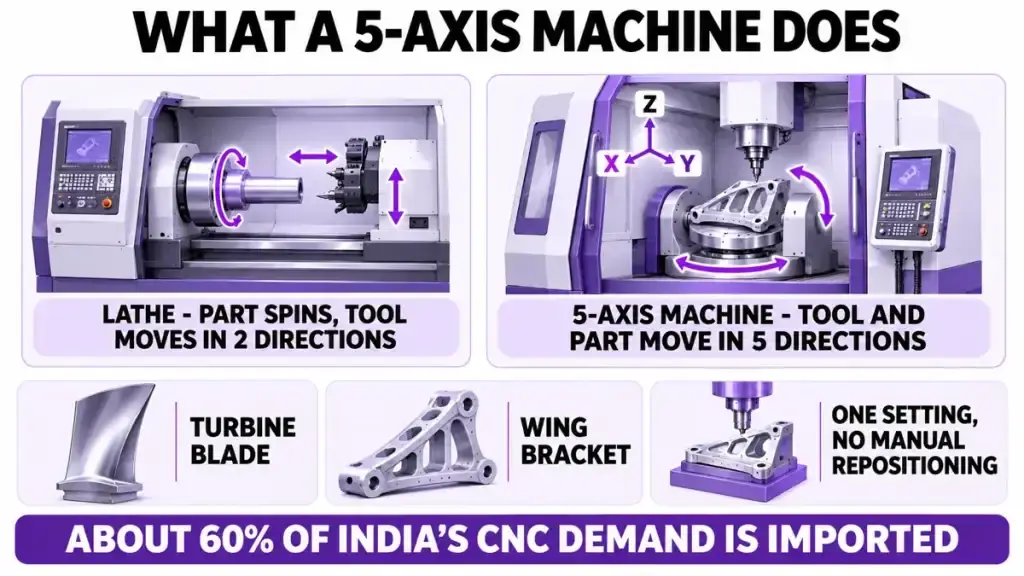
So who makes the machines that cut those parts? The answer starts with the CNC machine. A CNC machine, short for computer numerical control, is a metal-cutting machine run by a computer program, so it can repeat the same cut thousands of times to within microns. The simplest ones are lathes that turn a spinning bar into a shaft. The most advanced is a 5-axis machine, which is a machine where the tool and the part can move in five directions together. That lets a single machine cut a curved turbine blade or a wing bracket in one setting, without moving the part by hand.
Most of these machines in India still come from abroad. Around 60% of India's demand for CNC machines is met by imports, mainly from Japan, Europe and South Korea. The buyers are aircraft and missile makers such as HAL, Tata Advanced Systems, BrahMos and Bharat Dynamics, and their many suppliers, along with car makers and small engineering shops. A machine-tool maker sells them the machine once, then spares, service and the next machine as their plants grow. So when a customer's plant expands, the machine maker's order book grows with it.
That is where Jyoti CNC Automation Ltd (NSE: JYOTICNC) comes in. The Rajkot company makes more than 200 machine variants, from lathes priced up to ₹50 lakh to 5-axis and multitasking machines priced above ₹2 Cr. It also owns Huron Graffenstaden of Strasbourg, a French maker of 5-axis machines that it bought in 2007. Its customers include HAL, ISRO, BrahMos, Bharat Dynamics and ordnance factories in India, and Airbus, Safran, Dassault, GE and the European missile maker MBDA abroad. In FY26, aerospace and defence made up 39% of its revenue.
Jyoti CNC in five numbers
- An order book of ₹5,082 Cr in September 2026, about 2.4 times FY26 revenue
- Aerospace and defence at 36% of that order book, about ₹1,830 Cr
- A record 1,911 machines sold in Q2 FY27, against 1,315 a year earlier
- FY26 revenue of ₹2,093.1 Cr at an EBITDA margin of 25.2%
- More than ₹800 Cr of aerospace and defence work done in FY26, about 75% of it in India
So a Rajkot lathe maker now builds machines for missile and aircraft programmes on two continents. How did it get here, and what does the latest quarter say about the next one? Let's first understand the company, and then look at the latest quarter.
Jyoti CNC Automation: Company Overview
Jyoti CNC Automation Ltd began in 1989 as a partnership in Rajkot and was incorporated in 1991; its registered office and two plants are at Metoda, near Rajkot in Gujarat. Parakramsinh Jadeja, a partner since 1989, is the promoter, chairman and managing director. The company makes CNC metal-cutting machines, from entry-level lathes to 5-axis, multitasking and gantry machines, in more than 200 variants. Through its French subsidiary Huron Graffenstaden it also runs a third plant at Strasbourg, with sales and service arms in Germany, Canada and Turkey. Its total workforce is more than 4,500 people, and more than 1,40,000 of its machines are installed in over 62 countries. Consolidated revenue was ₹2,093.1 Cr in FY26, and borrowings stood at about ₹942.9 Cr in September 2026, with Crisil rating its long-term bank loans A+/Stable. Read this Best Defence Stocks in India for 2026
"We are stubborn on vision. We are flexible on details."
— Jeff Bezos
Jyoti's direction has stayed the same for two decades, from lathes to 5-axis machines and now to its own controllers. The details, such as where a machine is built or how Huron books revenue, have kept changing along the way.
The Quarter Rajkot Shipped a Record 1,911 Machines
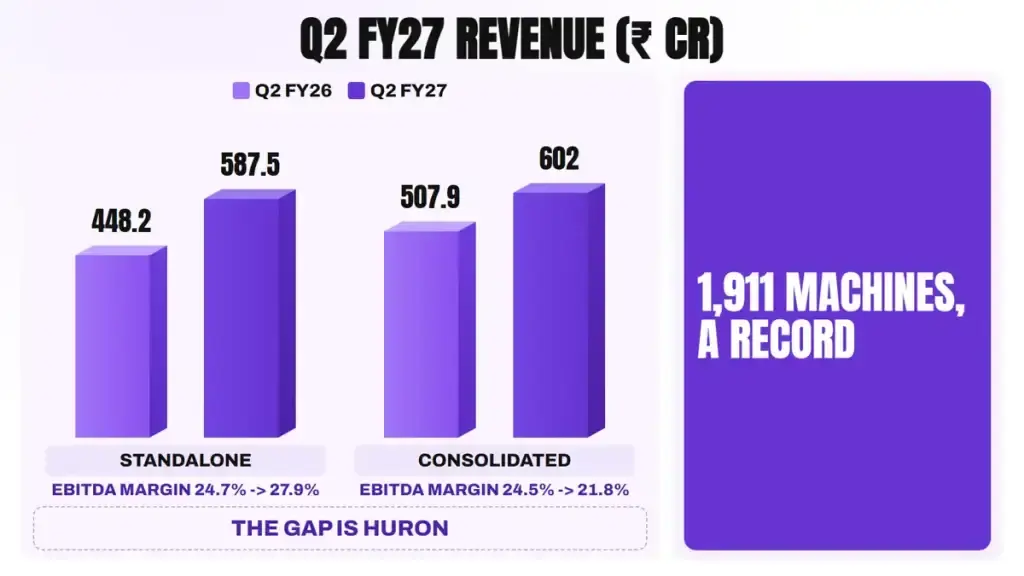
Let's look at Q2 FY27, the July to September quarter, which Jyoti reported on 3 November 2026. In that quarter its Rajkot plants shipped a record number of machines, and the Indian company, which Jyoti calls standalone, had its best quarter so far. Standalone revenue rose 31.1% to ₹587.5 Cr, and its EBITDA margin rose to 27.9% from 24.7%. Group revenue, which includes the French arm, rose 18.5% to ₹602 Cr.
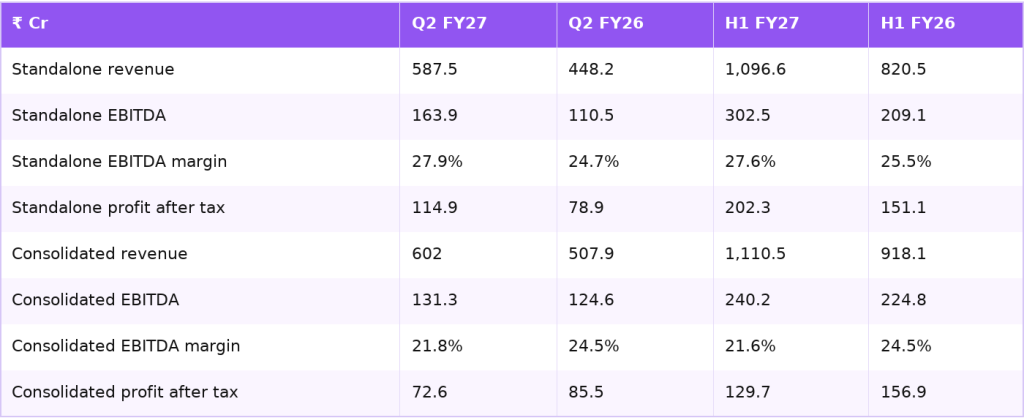
Why is the group number so close to the Indian number? It comes down to Huron, the French arm. Huron dispatched about ₹42 Cr of machines in the quarter. But part of that was made of machines and parts that Jyoti itself had sold to Huron, and those sales cancel out in the group accounts. So only about ₹15 Cr of Huron's revenue showed up in the consolidated figure. Huron's costs, though, were all booked. That hurts the margin.
That gap also explains the margins. The Indian company earned a 27.9% EBITDA margin, while the group earned 21.8%. Management agreed that if Huron's revenue for the quarter had been counted in full, the consolidated EBITDA margin would have been about 3-4% higher. That gap should close as Huron's revenue comes through in the second half.
"Behind every stock is a company. Find out what it's doing."
— Peter Lynch
Jyoti's group numbers and its Indian numbers tell two different stories this quarter. Knowing that Huron's sales to and from India cancel out is the first step to reading either one.
Now let's look at what drove the Indian number. The new capacity came on just in time. Jyoti put 10,000 more machines a year of capacity to use during the quarter, and sold 1,911 machines against 1,315 a year earlier. That is about 45% more machines. The old plant could make only about 1,500 a quarter, so you can see why the new capacity was needed.
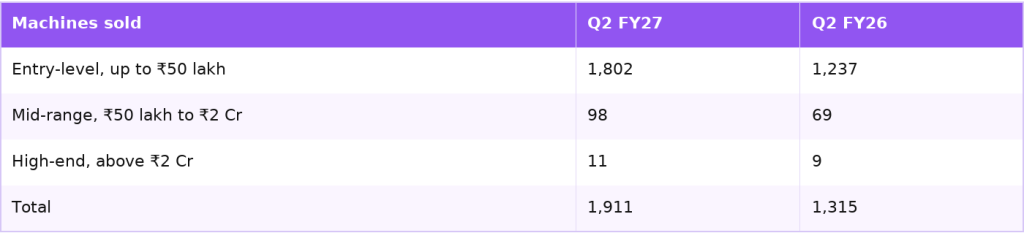
That mix tells us something important about how Jyoti earns. Volume comes from small machines. Most machines by count are entry-level lathes and machining centres for car-part makers and small shops. The high-end machines are few, only 11 in the quarter, but each is priced above ₹2 Cr and goes mostly to aerospace and defence customers. So the average price per machine is set by the mix, and more small machines mean a lower average.
Even with that mix, the gross margin went up. The standalone gross margin was 55.3%, against 51.7% a year ago. Jyoti makes its own castings, machined parts and sheet metal, so more volume through the same foundry and machine shop lowers the cost of each machine. In the six months to September the company also added about 950 people, whose costs are already in the numbers ahead of the extra output.
The Orders Behind the ₹5,082 Cr Book
Now let's look at the orders, because they decide how full the new plant will be. Jyoti booked orders of ₹809 Cr in Q2 FY27 and executed ₹575 Cr. So the order book rose from ₹4,848 Cr in June to ₹5,082 Cr in September 2026. At the FY26 revenue run-rate, that book covers about 2.4 years of work.
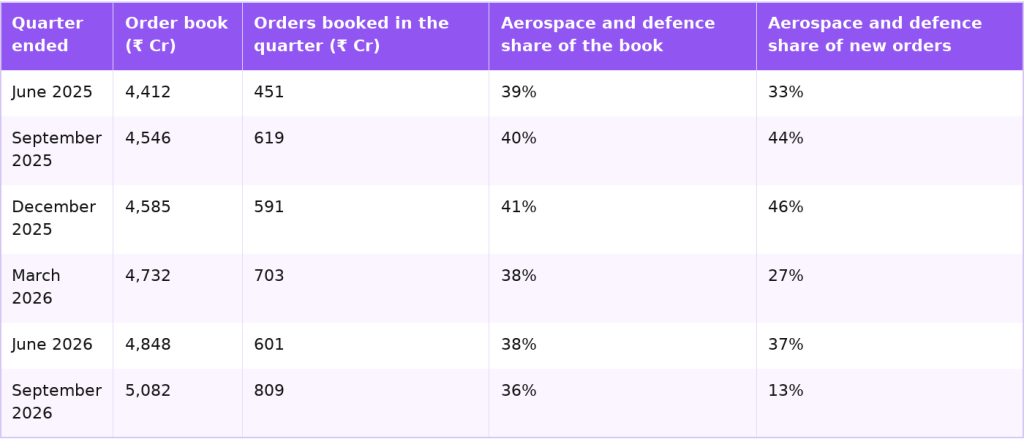
That table shows a change in who is ordering. For most of FY26, aerospace and defence brought in 33-46% of new orders. In Q2 FY27, car and car-part makers brought in 50% of new orders, and general engineering 27%. Management says many car makers are adding capacity, especially for electric vehicles. It also says many of its defence orders come through government tenders, and some of these did not open in the quarter as expected.
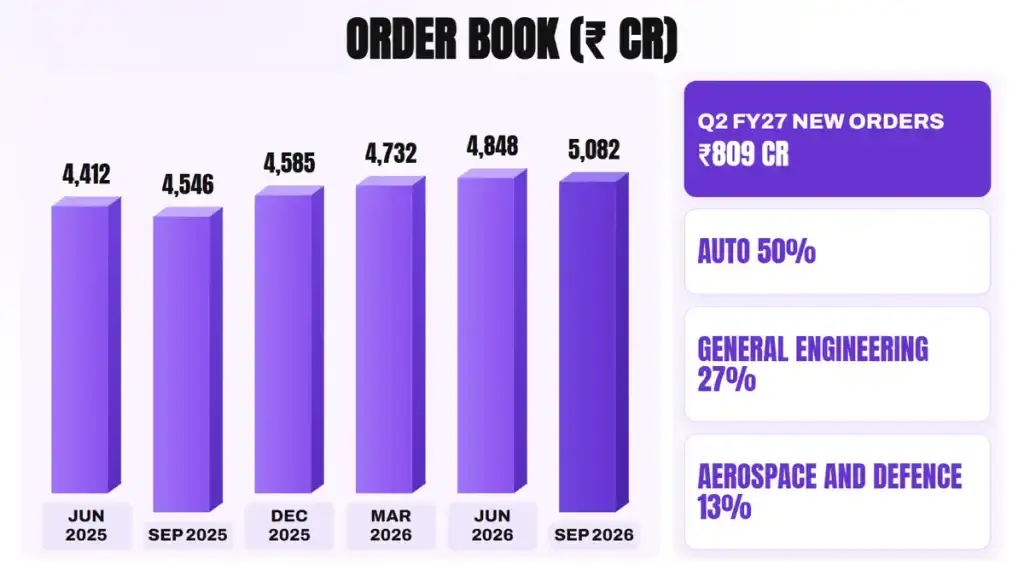
The order book also tells us how long customers wait. In FY26 Jyoti booked ₹2,364 Cr of orders and executed ₹1,978 Cr. Management has said customers are not ready to wait more than 18 months for delivery. The plant was the limit. So the book kept growing because the plant was full, not because orders were missing.
What the order book says: at ₹5,082 Cr, the book is about 2.4 times FY26 revenue. About ₹1,830 Cr of it is aerospace and defence work, where most machines are high-end and priced above ₹2 Cr each. That is the part of the book that decides the margin.
That order book now comes with better cash flow. Operating cash flow was ₹111.7 Cr in H1 FY27, against ₹13.2 Cr in H1 FY26, which is about 47% of EBITDA. Read this Cash Flow Statement Explained Inventory days came down to about 190 from 203 in March. Crisil assigned its A+/Stable rating to ₹1,415 Cr of Jyoti's long-term bank loans in October 2026.
How a Rajkot Lathe Maker Bought a French 5-Axis Pioneer
Now that we have seen the quarter, let's go back and see how Jyoti got here. The business began in Rajkot in 1989 as a partnership and became a company in 1991. Parakramsinh Jadeja, a partner since 1989, is the promoter, chairman and managing director.
That business took its big step in 2007, when Jyoti bought Huron Graffenstaden, a French machine-tool maker with about 150 years of history. Huron was a pioneer in 5-axis machining. Jyoti bought it through a French holding company, Jyoti SAS, along with Huron's sales arms in Germany and Canada. At the time, Jyoti's own revenue was about ₹50 Cr.
"When we took over this company, Jyoti's topline was INR50 crores. Today, we are at close to INR2,000 crores." - Parakramsinh Jadeja, Chairman and Managing Director, May 2026
What did Jyoti get from that deal? Management's answer is know-how. Jyoti says it learned precision manufacturing from Huron and built it in Rajkot. In 2016 it signed an agreement with a Government of India research institution to develop a 5-axis multitasking machine. In 2017 it launched the KX300 for the aerospace industry. Today Jyoti has more than 200 designers in India, against 15-20 at Huron, and the chairman says the aerospace and defence machines are now its own designs.
After the Huron deal, the listing came much later. Jyoti listed on the NSE and BSE in January 2024, and its borrowings went from about ₹835 Cr in March 2023 to about ₹303.8 Cr in March 2024. The results of the last five years are in the table below.
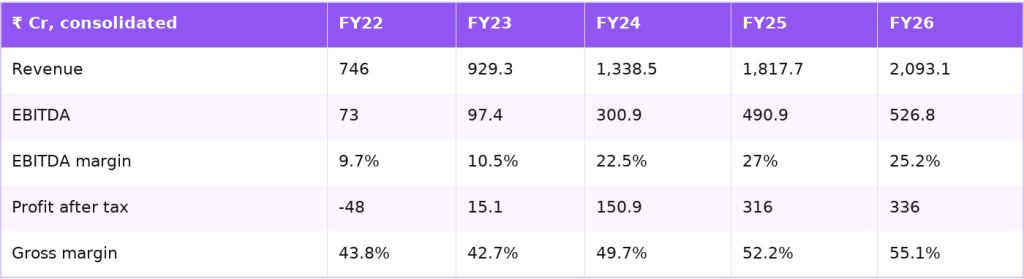
So revenue grew about 2.8 times in four years, and EBITDA grew about 7.2 times. The reason is in the gross margin row, which rose from 43.8% to 55.1%. Jyoti brought more of the machine in-house, from the casting to the paint, and it sold more high-end machines. Its foundry, machine shop and sheet-metal unit now make most of the parts that it once bought.
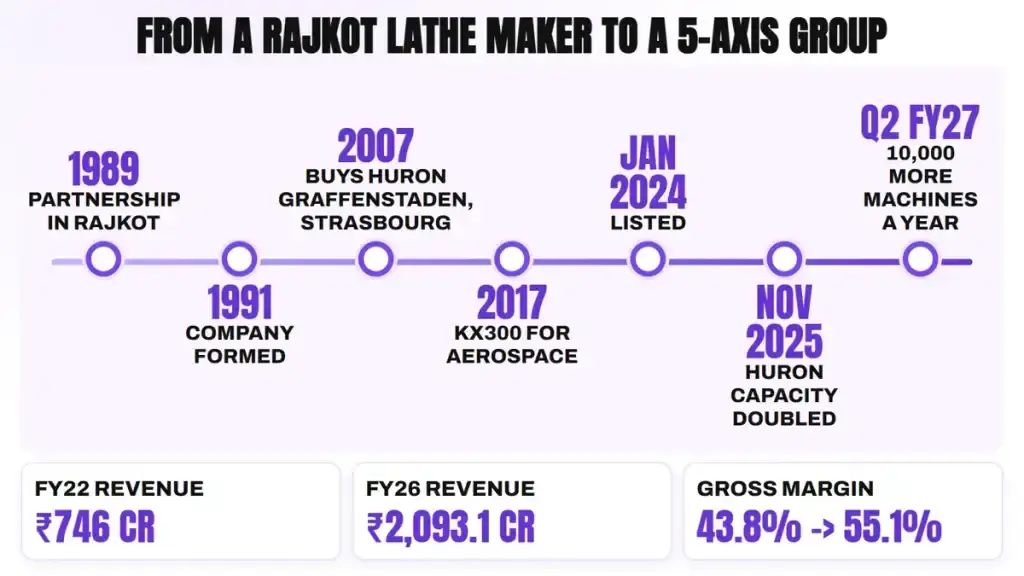
That growth also needed new capacity. Huron's plant at Strasbourg had not been expanded since the purchase, and in November 2025 Jyoti doubled its capacity. In Rajkot, the company added room for 10,000 more machines a year to its old capacity of 6,000. And in July 2025 it bought 20 acres at the Tumakuru Machine Tools Park in Karnataka for future growth.
Five Customer Groups, One Machine Range
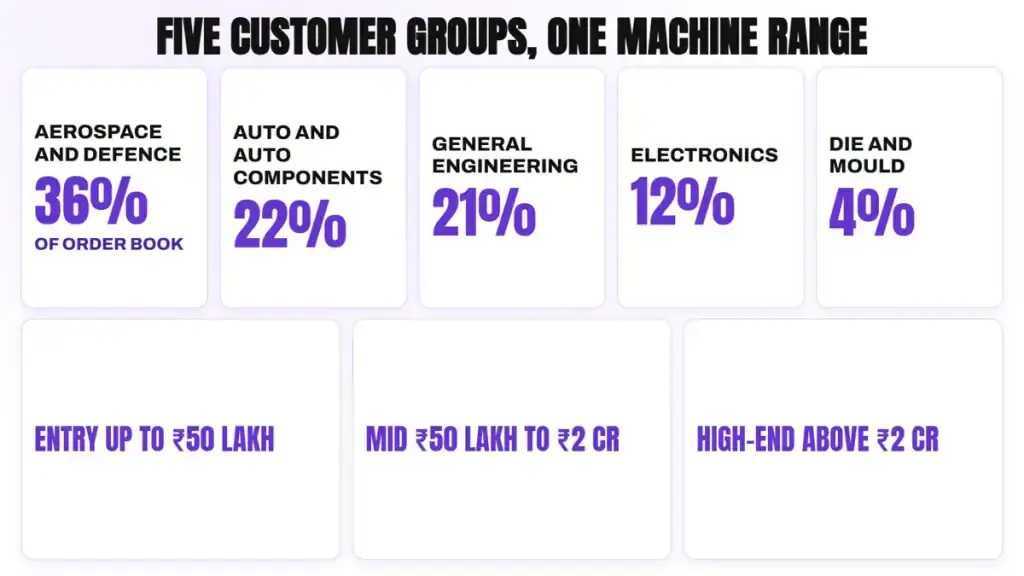
Now let's split the business by customer, because the same plant serves very different buyers. Jyoti reports one segment, CNC machines, so we have used the industry split it gives every quarter. Read this Segment-Wise Revenue Analysis Explained Each group buys a different kind of machine at a different price.
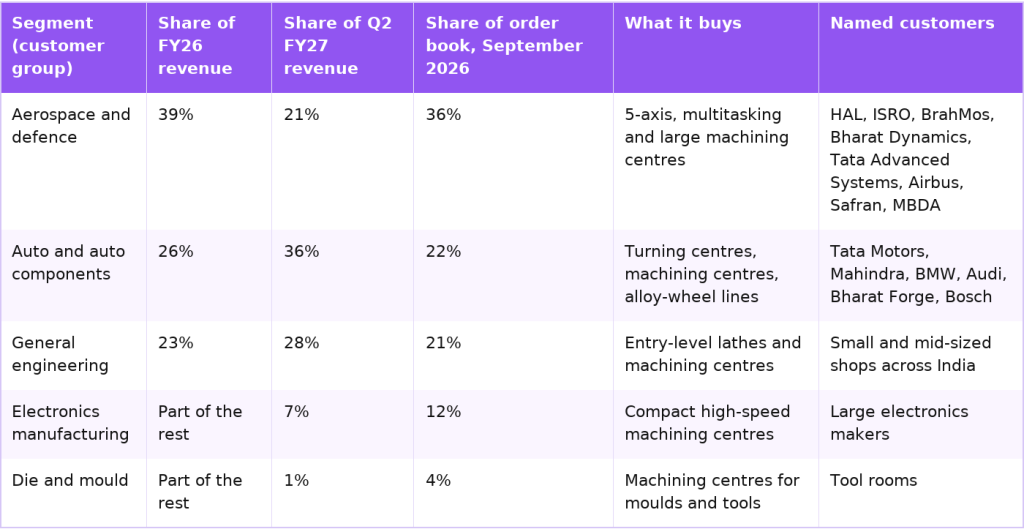
These groups sound alike, but as you will see, each one buys for a different reason. Aerospace and defence buyers need accuracy on hard metals like titanium and want machines that are qualified for their parts. Car-part makers need speed and repeat output on thousands of identical parts. Small engineering shops need a reliable lathe at a fair price, with service close by.
Aerospace and Defence
Let's start with aerospace and defence, the largest part of the order book. India's defence exports reached a record ₹38,424 Cr in FY26, and the government's target is ₹50,000 Cr of defence exports by 2029. Every rupee of that output needs parts, and the most complex parts need 5-axis machines.
That is the work Jyoti's high-end range was built for. A multitasking machine combines turning, milling and drilling in one setup, so a complex part never leaves the machine. Jyoti's new MTX 100 is a compact 5-axis turn-mill centre that also does gear cutting and grinding, and it is aimed at aerospace, defence, cars and oil and gas. Its GU 8 is a 5-axis gantry machine for very large parts. Most of these machines are made in Rajkot, and Huron makes the largest and most complex ones in Strasbourg.
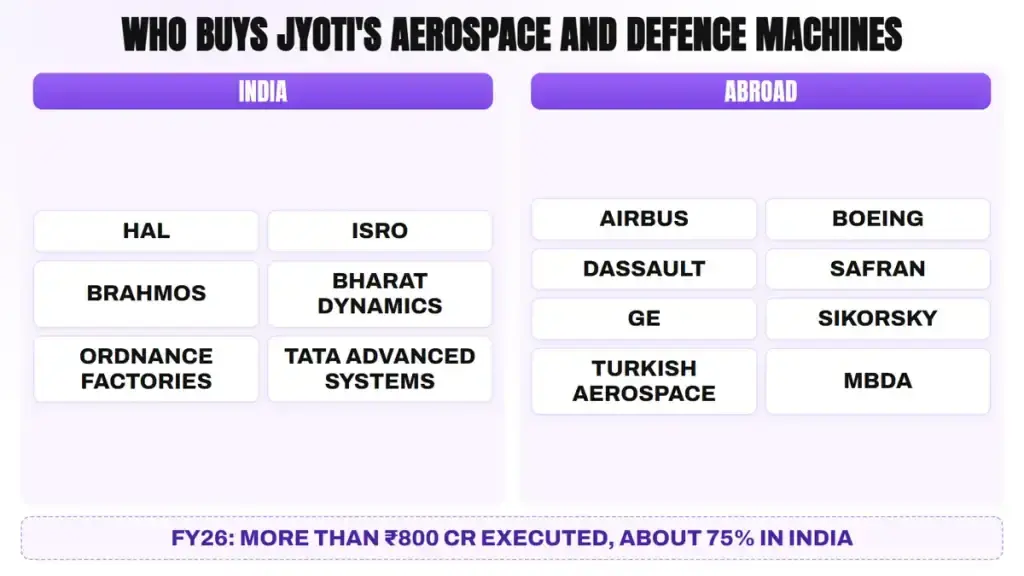
The scale of this work is now large. In FY26 Jyoti executed more than ₹800 Cr of aerospace and defence orders, about 39% of revenue, and about 75% of that work was done in India. In December 2025, aerospace and defence made up 41% of the order book, about ₹1,900 Cr. In September 2026 it was 36% of a larger book.
So who are these customers? Let's go through them. In India they include HAL, which builds the Tejas fighter, and ISRO, the space agency. They also include BrahMos, which makes the cruise missile of the same name, and Bharat Dynamics, the government's missile maker. The list adds the ordnance factories and Tata Advanced Systems, the Tata group's aerospace and defence arm, which works with Airbus, Boeing and Sikorsky. Abroad, management names Airbus, Boeing, Dassault, Safran, GE, Sikorsky, Turkish Aerospace and China's AVIC.
One customer shows how the work spreads. MBDA, the European missile maker, is a long-time Jyoti customer and is now building capacity in India with L&T. In August 2026 management said some MBDA orders had come in during the quarter, with more expected in the coming quarters. It also said many European aerospace companies coming to India have Jyoti on their preferred supplier list.
The suppliers to these programmes are buying too, as we can see in Rajkot itself. Jyoti has recently supplied machines to shops in Rajkot that make parts for Airbus and Dassault programmes. Each new supplier that wins a Tejas or C295 part is a possible machine buyer. Management expects more aerospace and defence orders this quarter and in the coming quarters, once the delayed government tenders open.
Huron, the French 5-Axis Arm
Next, let's look at Huron, the French arm behind much of the high-end range. Huron has a plant on 46,442 square metres of land at Strasbourg, with capacity of 240 machines a year. It gives Jyoti access to European and other international markets, through its own arms in Germany, Canada and Turkey. Management describes it as the group's technology hub for high-end machines.
Its revenue depends on a licence process. Many of its machines are dual-use, which means they can make both civilian and military parts. Under European Union rules, a dual-use machine needs an export licence before it leaves France, and the buyer must give an end-user certificate. Management says these approvals now take longer because of the war situation.
That process explains Huron's numbers. In FY26 Huron's revenue was about ₹248 Cr, of which ₹105 Cr was sold to Jyoti in India. In the last quarter of FY26, Jyoti reversed ₹67 Cr of Huron revenue for machines still waiting for licences. That revenue is deferred, not cancelled, and about ₹65 Cr of it was still pending in November 2026.
That work flows both ways between the two plants. Management says about 70% of the goods in a Huron machine now come from India, and Huron mainly assembles them. Jyoti sent ₹35 Cr of material to Huron in Q1 FY27 alone. So a Huron machine is in good part a Rajkot machine with a French badge and French final assembly.
The plan now is to ramp Huron back up. In November 2026 management said Huron should reach close to ₹300 Cr of revenue in FY27, about €28 million. It had done about €6.5 million by September. Licences for one or two machines came through in late October, and management agreed that Q3 FY27 dispatches could be ₹80-100 Cr, with more in Q4. In May 2026 Huron also had orders from Ukraine, about six machines worth close to ₹70 Cr, and management reported a good order from the French government.
Auto and Auto Components
Now let's move to auto and auto components, the car makers and their part suppliers, which gave Jyoti half of its new orders in Q2 FY27. India's electric vehicle market is projected to reach about $191 billion by 2034. The shift to electric vehicles is creating demand for parts with new shapes and for dedicated tooling. Each of those parts needs new machining lines.
Jyoti has built machines for exactly these parts. In 2022 it developed the VST 160, a machine with built-in automatic loading and unloading for electric vehicle parts. Its AWT 22 turns alloy wheels, and its HP 4000 and HP 6000 high-performance horizontal machining centres serve car, pump and farm-equipment makers. Its car customers include Tata Motors, Mahindra, BMW, Audi, Volkswagen and Daimler, and in India Bharat Forge and Bosch.
This group grew fast in the last year. Auto and auto components were 26% of FY26 revenue and 36% of Q2 FY27 revenue. Their share of the order book rose to 22% in September 2026 from 17% a year earlier.
General Engineering and the Small Shops
Now let's look at general engineering, the small and mid-sized engineering shops that are the oldest part of Jyoti's business. These are first, second and third-tier suppliers that make parts for car makers and general engineering firms. Jyoti now has more than 15,000 customers in India, up from 14,000 a year earlier. About one-third of them are loyal repeat buyers, management says.
These shops buy mainly entry-level machines, priced up to ₹50 lakh. That is why 1,802 of the 1,911 machines sold in Q2 FY27 were entry-level. In its home town of Rajkot alone, Jyoti expects to sell more than 2,000 machines this year. Management also sees demand growing in Punjab, the Kolhapur belt and eastern India.
Their segment, general engineering, made up 23% of FY26 revenue and 28% of Q2 FY27 revenue. It also brought in 31% of new orders in Q4 FY26 and 27% in Q2 FY27. Management says more of these shops now want machines with automation, because skilled operators are harder to find.
Electronics Manufacturing
Finally, let's look at electronics, the newest customer group. Electronics makers need compact, high-speed machining centres to cut small and precise metal parts. The potential CNC machine demand from India's electronics industry is projected at over 1,00,000 machines in the next five years.
Jyoti makes machines like the Tachyon Beta, a 5-axis machine with linear motors for electronics, aerospace and healthcare. Electronics made up 7% of Q2 FY27 revenue and 12% of the order book. In Q2 FY27, management said the execution of these orders improved as the new capacity came in. It expects a further step up over the next two quarters.
Why a 5-Axis Machine Maker Is Hard to Copy
Now that we have seen all five customer groups, let's understand Jyoti's moat. A machine tool is a long-life purchase. A defence parts maker that buys a 5-axis machine will run it for years, train its staff on it and qualify its parts on it. So before the price, a buyer asks whether the machine maker will still be there with spares, service and the next machine.
That trust takes years to build, and you cannot buy it. Read this Economic Moat Explained Jyoti has more than 1,40,000 machines installed in more than 62 countries, and 29 sales and service centres across 12 Indian states. A buyer can see Jyoti machines working in a neighbour's shop before it buys. For a small shop in Rajkot or Kolhapur, that nearby service is often the deciding factor.
Next comes the second layer, cost. Jyoti casts its own iron, machines its own parts, makes its own sheet metal and paints in-house. That is why its gross margin reached 55.1% in FY26. A rival that buys these parts from outside pays someone else's margin on each one. Jyoti is now building a lost-foam vacuum foundry that can pour single castings of up to 15 tonnes. Management says the few Indian foundries using this process make only small parts.
"The key to investing is not assessing how much an industry is going to affect society, or how much it will grow, but rather determining the competitive advantage of any given company and, above all, the durability of that advantage."
— Warren Buffett
For a machine-tool maker, durability comes from the installed base, the parts it makes in-house and the know-how behind its 5-axis machines. Each of these took Jyoti years to build.
Then comes the third layer, the 5-axis know-how from Huron. Jyoti estimates its own share of India's high-precision CNC metal-cutting machine market at about 10-12%, and it calls itself one of the leading Indian makers of simultaneous 5-axis machines. Its R&D centre has more than 250 people in Rajkot and Strasbourg. That team has built tools like PreciProtect, an AI system that stops a machine before a collision.
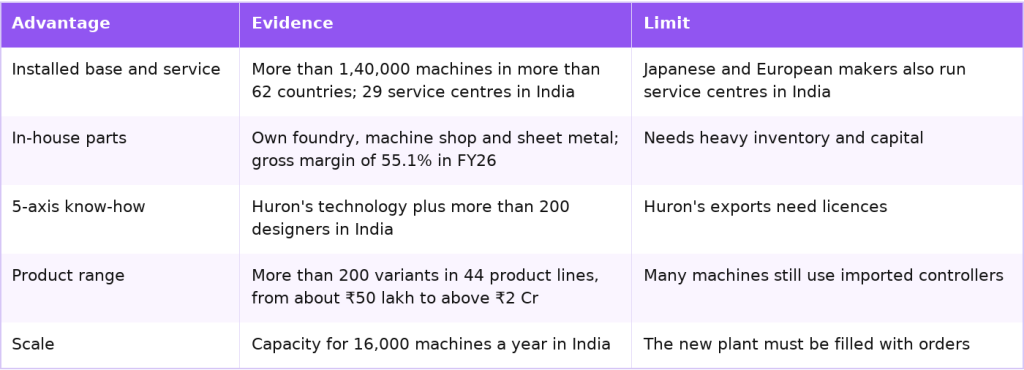
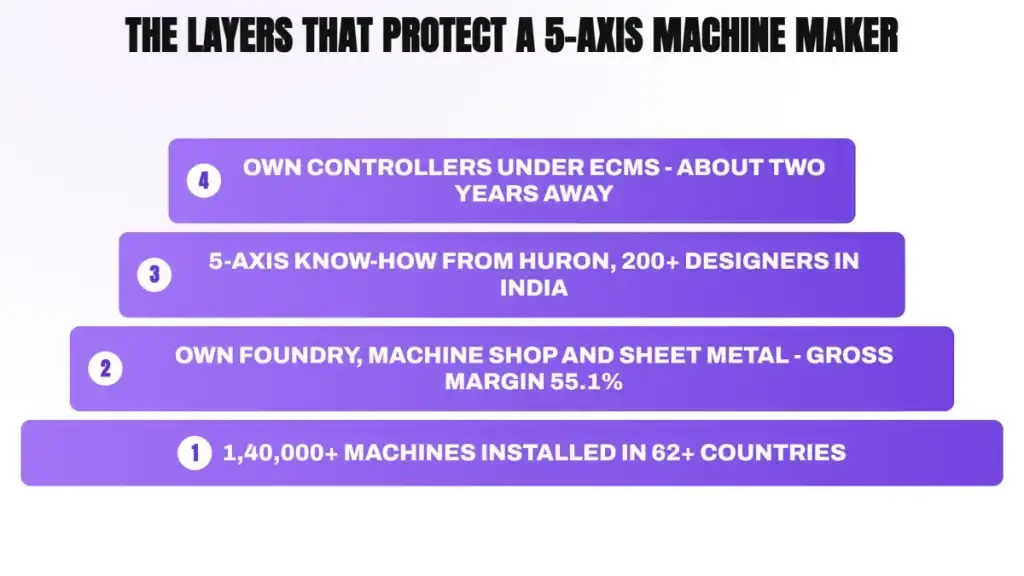
The last layer is still being built. Every Jyoti machine today runs on a controller, the computer that reads the program, bought from global suppliers. In August 2026 the government approved Jyoti's plan to make its own controllers, motors and drives under the Electronics Component Manufacturing Scheme. More than 110 engineers already work on the controller, with 40-50 more to join in about six months.
That shift matters for the moat because the controller is the brain of the machine. Once a customer learns a controller, switching to another machine maker means retraining staff. Management says it wants Jyoti to become a mechatronics company, one that makes both the mechanical machine and its electronics, in about two years. After that it plans to enter industrial automation, starting with robotics.
Financials: Five Years of Revenue, Margins and Cash
One quarter can mislead in a business where Huron's revenue moves with export licences, so let's look at five full years together. All figures are consolidated, as restated in the latest presentation.
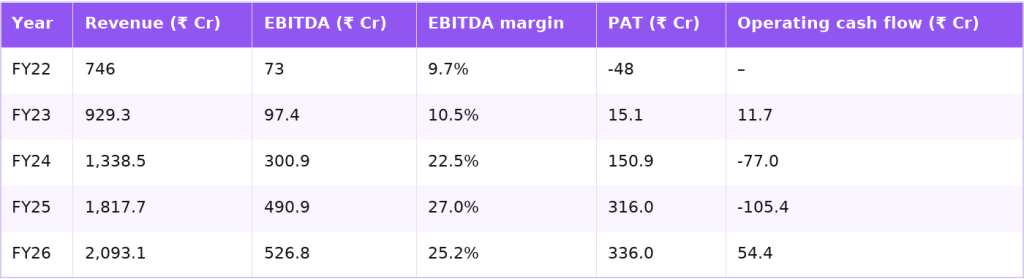
Revenue grew about 2.8 times from FY22 to FY26, and EBITDA grew about 7.2 times as the margin rose from 9.7% to 25.2%. The gross margin did most of that work, rising from 43.8% to 55.1% as Jyoti made more of each machine in-house and sold more high-end machines. FY22 was a loss year; FY26 profit after tax was ₹336 Cr.
Cash flow is the weak spot in the table. Operating cash flow was negative in FY24 and FY25 and only ₹54.4 Cr in FY26, against ₹336 Cr of profit. The reason is working capital: inventory stood at ₹1,166 Cr in March 2026 and ₹1,440.5 Cr in September 2026, because machines take months to build and many parts have long lead times.
The balance sheet has carried that gap with debt as well as equity. Borrowings went from about ₹303.8 Cr in March 2024, just after the listing, to about ₹849.7 Cr in March 2026 and about ₹942.9 Cr in September 2026, as the Rajkot expansion was built. Operating cash flow of ₹111.7 Cr in H1 FY27, about 47% of EBITDA, is the first sign of that turning.
"Beware of little expenses; a small leak will sink a great ship."
— Benjamin Franklin
For Jyoti the leak to watch is working capital. Inventory of more than ₹1,400 Cr ties up cash that the profit and loss account does not show.
What FY27 Could Look Like on Management's Numbers
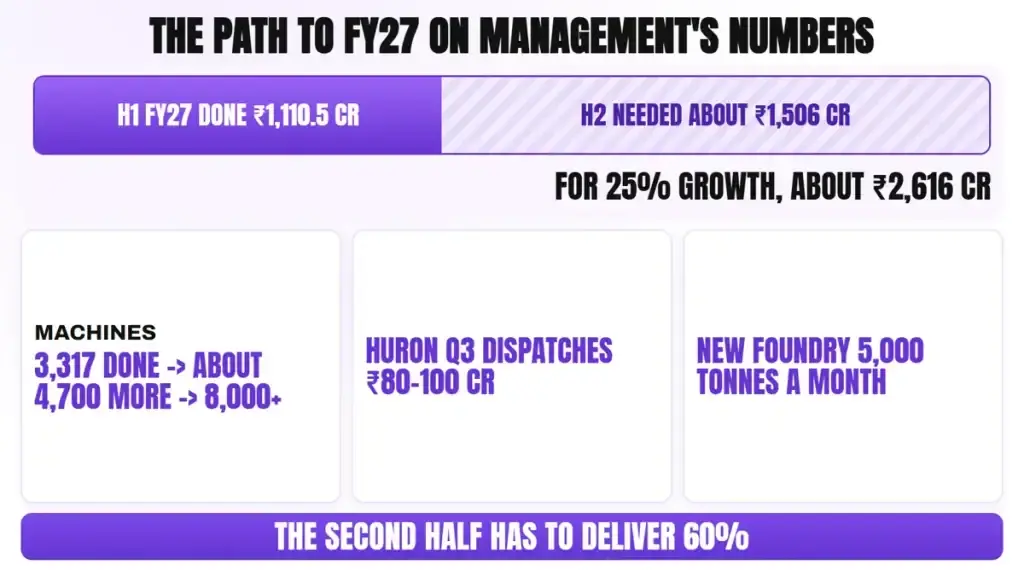
So where does Jyoti go from here? Let's lay out management's November 2026 numbers in order. The company and Huron together are guided to grow revenue by 25-30% in FY27. The EBITDA margin is guided to reach close to 25% by the end of the year. Management expects about 40% of the year's revenue in the first half and 60% in the second.
"In the next 2 years, we would like to be Jyoti, to be a mechatronics company. Today, we are a mechanical company." - Parakramsinh Jadeja, Chairman and Managing Director, November 2026
So let's put those numbers against what is already done. Growth of 25% on FY26 revenue of ₹2,093.1 Cr gives about ₹2,616 Cr for FY27. H1 FY27 revenue was ₹1,110.5 Cr, so the second half needs about ₹1,506 Cr, roughly 1.36 times the first half. On machines, Jyoti sold 3,317 in H1 FY27 and targets more than 8,000 for the year, so it needs about 4,700 in the second half.
Two things support that second half, capacity and Huron. Jyoti sold 1,911 machines in Q2 FY27 on a plant that could make about 1,500 a quarter before the expansion. The new foundry, which takes foundry capacity to 5,000 tonnes a month, is due this quarter. And Huron should add ₹80-100 Cr of dispatches in Q3, with more in Q4.
So most of the money for the new capacity is already spent. Jyoti has spent ₹183 Cr in FY27 so far on the expansion, against a total outlay of about ₹450-500 Cr. The controller project is the next step. Its total cost is about ₹1,250-1,300 Cr, of which ₹1,020.65 Cr of machinery qualifies for a central capital subsidy of up to 25%, about ₹255 Cr. Jyoti has applied for a matching subsidy from Gujarat. The first phase is about ₹400-450 Cr over a year, with about ₹200 Cr of subsidy.
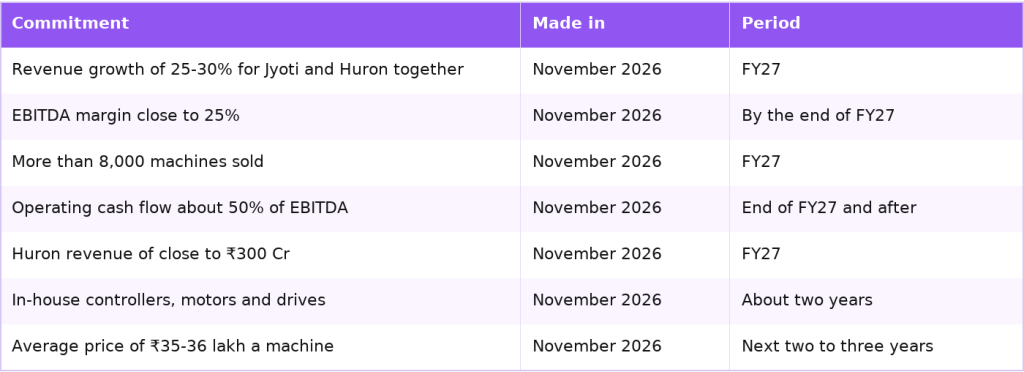
Those commitments are easier to judge against the past. So let's check what management has said before against what it delivered.
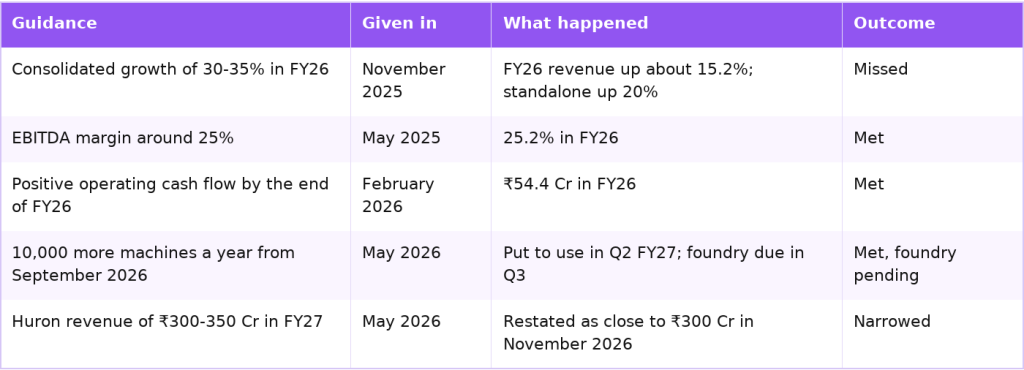
That record is mixed, as you can see. Margins and capacity came in as promised, and cash flow turned positive. But FY26 revenue grew about 15.2%, about half of the 30-35% management had expected in November 2025, because the Indian plant was full and Huron's revenue was reversed.
Key Risks
Now let's look at what could go wrong for Jyoti CNC, because several of these risks are already visible in the numbers.
- The French investigation: in April 2026, French authorities opened a judicial investigation into Huron and some of its employees over the export of dual-use machines, on suspicion of breaking European Union rules. Huron's director general was barred from his duties, and Huron bank accounts of about €4 million and two homes owned by Jyoti SAS were seized as interim measures. Huron denies the allegations. Management says there has been no communication from the authorities since April, and that the probe could take two, three or five years.
- The auditor's warning: Jyoti has ₹341.60 Cr invested in Jyoti SAS and ₹160.11 Cr of loans and advances to it. The auditor's report for FY26 points to Huron's accumulated losses, its eroded net worth and the investigation, and says these indicate a material uncertainty about the French subsidiary's ability to continue as a going concern. The company has not impaired the investment.
- Huron's revenue: ₹67 Cr of revenue was reversed in Q4 FY26, and about ₹65 Cr was still waiting for licences in November 2026. The FY27 target of close to ₹300 Cr needs most of its revenue in the second half, since only about €6.5 million was done by September.
- Consolidated profit: group profit after tax fell 15.1% in Q2 FY27 and 17.3% in H1 FY27, and the EBITDA margin was 21.6% for the half, against the 25% guided.
- Defence orders: aerospace and defence made up only 13% of new orders in Q2 FY27, against 44% a year earlier, because some government tenders did not open. Its share of revenue was 21% in the quarter, against 36% a year earlier.
- Debt and working capital: borrowings rose to about ₹942.9 Cr in September 2026 from ₹849.7 Cr in March, against cash and bank balances of about ₹118.1 Cr. Inventory rose to ₹1,440.5 Cr from ₹1,166 Cr in six months.
- Imported controllers: management says controller delivery times have more than doubled as machine-tool orders rise worldwide. Jyoti's own controllers are about two years away.
- Lower price per machine: management now gives a range of ₹32-35 lakh a machine as entry-level volumes grow, against ₹35.62 lakh for FY26.
- Competition: Japanese and European makers serve India from local service centres, and other Indian machine makers are adding capacity too.
- Pledged shares: a promoter group shareholder, Anilkumar Virani, has pledged shares for a business loan. In September 2026 his pledged shares were 7.72% of Jyoti's share capital.
- Staff: permanent worker turnover was 33.06% in FY26, against 12.8% in FY25, while the new plant needs many more trained people.
"Usually right now, the time has increased to give a end-user certificate because they are in a war situation." - Parakramsinh Jadeja, Chairman and Managing Director, November 2026
"Invert, always invert."
— Charlie Munger
Turning the question around helps here: instead of asking how Jyoti grows, ask what would stop it. The list above, led by the French investigation and the cash tied up in inventory, is the place to start.
Explore our Products
Research Framework

Emerging Titans
Combination of quantitative analysis, industry tailwinds, and management assessment - SPRINT investment philosophy

Tiny Titans
Heavy emphasis on scuttlebutt research, plant visits, and early on-ground signals
What to Track Next
If you follow Jyoti CNC, these are the signals that will show where it goes next.
- Huron's dispatches in Q3 FY27 against the ₹80-100 Cr expected, and the release of the pending ₹65 Cr
- Any update on the French investigation and the auditor's note on Jyoti SAS
- Aerospace and defence orders once the delayed government tenders open, against 13% of Q2 orders
- Machines sold in H2 FY27 against the 4,700 needed for 8,000 in the year
- The new foundry's start date and the consolidated EBITDA margin against 25%
- Operating cash flow against 50% of EBITDA, and borrowings after ₹942.9 Cr
Conclusion
Let's put it all together. Jyoti CNC has grown from a Rajkot lathe maker into a company that builds 5-axis machines for aircraft and missile programmes in India and Europe. FY26 revenue was ₹2,093.1 Cr at a 25.2% EBITDA margin, and its order book stood at ₹5,082 Cr in September 2026. The cautious thread is the French arm: an open investigation, an auditor's note on the subsidiary and revenue that waits on export licences. The next two quarters, with Huron's dispatches and the second-half machine count, will show which thread is stronger.
The Indian business is running at its best, with record dispatches and a standalone margin of 27.9%. The French arm is the open question. What happens next depends on whether Huron's licences come through, whether defence tenders turn into orders, and whether the new Rajkot plant fills up as planned.
FAQs
What does Jyoti CNC Automation make?
+Jyoti CNC makes CNC metal-cutting machines in more than 200 variants, from entry-level lathes priced up to ₹50 lakh to 5-axis and multitasking machines priced above ₹2 Cr. It makes them at Rajkot and, through its French subsidiary Huron Graffenstaden, at Strasbourg. FY26 revenue was ₹2,093.1 Cr.
How did Jyoti CNC do in Q2 FY27?
+Standalone revenue rose 31.1% to ₹587.5 Cr at an EBITDA margin of 27.9%, and the company sold a record 1,911 machines against 1,315 a year earlier. Consolidated revenue rose 18.5% to ₹602 Cr at an EBITDA margin of 21.8%, because most of Huron's revenue cancelled out or was not yet booked.
How big is Jyoti CNC's aerospace and defence business?
+Aerospace and defence made up 39% of FY26 revenue, and Jyoti executed more than ₹800 Cr of such orders in the year, about 75% of it in India. In September 2026 the segment was 36% of the ₹5,082 Cr order book. Customers include HAL, ISRO, BrahMos, Bharat Dynamics, Tata Advanced Systems, Airbus, Safran and MBDA.
What is Huron Graffenstaden and why does it matter?
+Huron is a French 5-axis machine maker that Jyoti bought in 2007, with a Strasbourg plant that can make 240 machines a year. Its revenue was about ₹248 Cr in FY26, and management expects close to ₹300 Cr in FY27. Its dual-use machines need export licences, and about ₹65 Cr of revenue was still waiting for them in November 2026.
What are Jyoti CNC's plans for FY27?
+Management guides 25-30% revenue growth for Jyoti and Huron together, more than 8,000 machines and an EBITDA margin close to 25% by the end of the year. It added capacity for 10,000 more machines a year at Rajkot in Q2 FY27 and has approval to invest ₹1,020.65 Cr in making its own controllers, motors and drives.
What are the main risks for Jyoti CNC?
+French authorities opened a judicial investigation into Huron's exports of dual-use machines in April 2026, and the auditor flagged a material uncertainty about the French subsidiary. Consolidated profit after tax fell 15.1% in Q2 FY27, borrowings reached about ₹942.9 Cr and inventory ₹1,440.5 Cr. Aerospace and defence made up only 13% of new orders in the quarter.

High growth stock specialist, Value Educator
Shashank Mahajan is an equity research professional with over 12 years of experience in identifying high-potential SME and micro-cap stocks at an early stage. He follows a rigorous scuttlebutt research–driven approach, combining on-ground insights with deep financial analysis. Shashank specializes in uncovering under-researched and under-owned companies with strong management quality and long-term growth potential. Through disciplined research and early identification, he focuses on spotting tomorrow’s market leaders before they enter the mainstream investor radar.

INOX India: The Rocket Order Behind a ₹2,268 Cr Book

APAR Industries: Google, Amazon and ₹12,025 Cr of Orders

Techno Electric: ₹11,000 Cr of Grid Orders and Data Centres

Sansera Engineering: Aircraft and Chip Parts Hit 14.9%

PTC Industries: The Titanium Melt Shop Behind Aerolloy

HBL Engineering: Defence Batteries, Fuzes and Kavach Orders
Explore our Products
Research Framework
Emerging Titans
Combination of quantitative analysis, industry tailwinds, and management assessment - SPRINT investment philosophy
Tiny Titans
Heavy emphasis on scuttlebutt research, plant visits, and early on-ground signals



Modern Warfare to Multibaggers
Key Trends. Strategic Shifts. Opportunities Ahead.
Don't Miss This Exclusive Webinar!
Join Value Educator to decode the key trends shaping India's defence sector and learn how to identify tomorrow's potential leaders in the space.
- In-depth research on India's defence sector
- Live Q&A session
- Actionable takeaways for long-term investors

 Orders
 Subscription
 Share with friends


Required Details
₹23999.00
(12 month subscription)
As per SEBI regulations, all users are mandated to complete the KYC that is validated for 1 year. Post payment, you will be redirected to the KYC screen


No comments yet. Be the first to comment!